Summary
Table of Content

Demand-Responsive Transit Systems Market
Get a free sample of this report
Form submitted successfully!
Error submitting form. Please try again.
Thank you!
Your inquiry has been received. Our team will reach out to you with the required details via email. To ensure that you don't miss their response, kindly remember to check your spam folder as well!
Request Sectional Data
Thank you!
Your inquiry has been received. Our team will reach out to you with the required details via email. To ensure that you don't miss their response, kindly remember to check your spam folder as well!
Form submitted successfully!
Error submitting form. Please try again.
Demand-Responsive Transit Systems Market Size
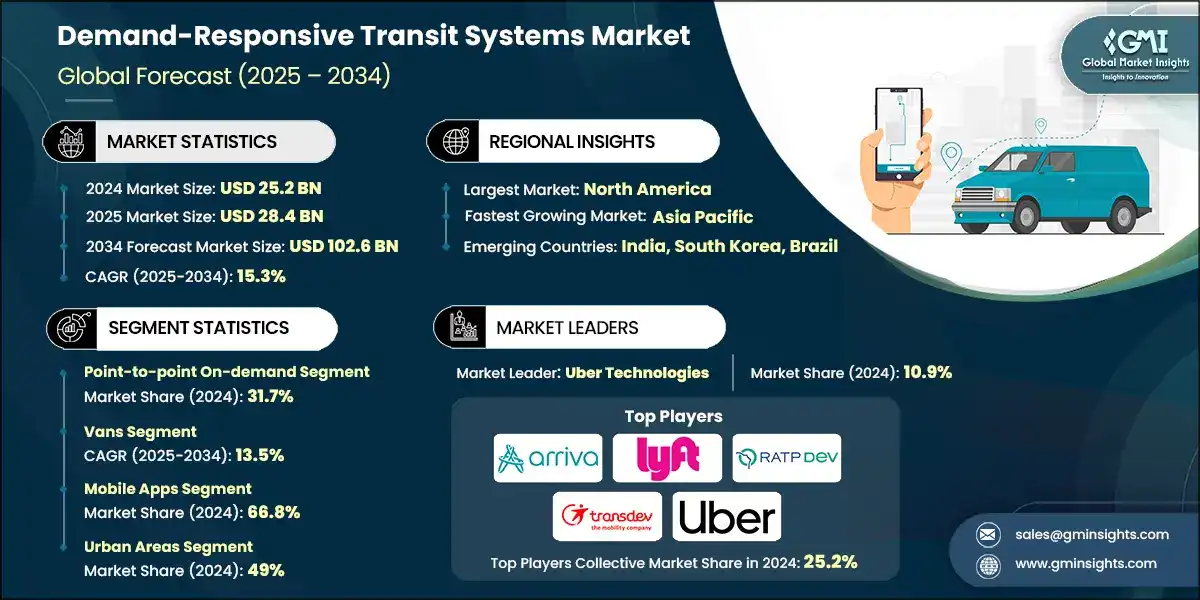
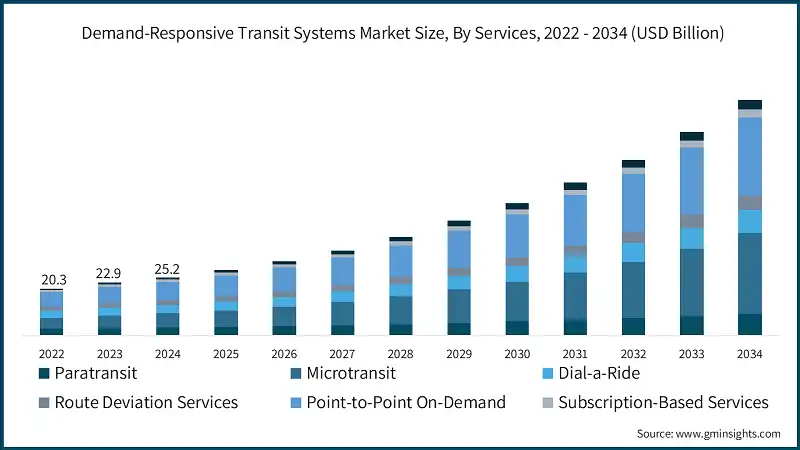
The global demand-responsive transit systems market size was estimated at USD 25.2 billion in 2024. The market is expected to grow from USD 28.4 billion in 2025 to USD 102.6 billion in 2034, at a CAGR of 15.3% according to latest report published by Global Market Insights Inc.
Demand-Responsive Transit Systems Market Key Takeaways
Market Size & Growth
- 2024 Market Size: USD 25.2 Billion
- 2025 Market Size: USD 28.4 Billion
- 2034 Forecast Market Size: USD 102.6 Billion
- CAGR (2025–2034): 15.3%
Regional Dominance
- Largest Market: North America
- Fastest Growing Region: Asia Pacific
Key Market Drivers
- Growing urbanization and micro-mobility demand.
- Advances in real-time routing, dynamic dispatch & mobile apps.
- Policy push towards reducing congestion & emissions.
- Rising demand for paratransit and first/last-mile solutions.
Challenges
- Variable regulatory frameworks across cities.
- Public transit incumbents’ resistance & funding limits.
Opportunity
- Integration with MaaS platforms and transit agencies.
- Electrification and micro-transit (EV shuttles, e-bikes/scooters).
Key Players
- Market Leader: Uber Technologies led with over 10.9% market share in 2024.
- Leading Players: Top 5 players in this market include Arriva, Lyft, RATP Dev, Transdev, Uber Technologies, which collectively held a market share of 25.2% in 2024.
Get Market Insights & Growth Opportunities
The demand-responsive transport service market continues to grow as jurisdictions implement services designed to be flexible enough to accommodate changes in demand and also serve areas that currently have a lack of service. The involvement of government agencies is growing. For example, in the United Kingdom, 20 million pounds have been allocated to support 17 Pilot Programs in Rural Areas and, in the United States, the FTA supported over 1200 demand-response transit projects in 2023.
The results of the operational evaluations indicate there are many efficiencies to be gained from this type of system. For instance, an analysis by the USDOT indicates that optimized routing has reduced the total number of vehicle miles travelled by approximately 31 percent in rural areas of Germany. In Canada, a 5-minute decrease in the average wait time of passengers was realized after the adoption of dynamic scheduling during a trial.
The integration of technology is essential to the growth of the market today. The use of real-time dispatch engines, mobile booking applications, and data-driven routing will enable system providers to better manage their pooled trips, achieve higher levels of ridership on their services, and reduce the amount of time spent travelling by limiting the number of unnecessary miles travelled. In addition, by utilizing these tools, system providers can achieve more reliability without the need to increase the size of their fleets.
The current direction of the demand-response transport market is being affected by changes to regulatory frameworks. As a result of this transition, agencies are in the process of changing their contract and performance standards to include flexible service models. Additionally, partnerships between transit agencies, contract fleets, and technology providers (such as ride-hailing or other) will allow demand-response transport to be implemented in locations where traditional fixed-route transit is not an option.
To get key market trends
Demand-Responsive Transit Systems Market Trends
Transport Demand Responsive (TDR), increasingly, is being electrified. Operators are removing internally combusted powered fleets and replacing them with low emission electric vehicle fleets. Recent European deployment reviews indicate that nearly 48% of new electric TDR fleet additions were electric. In Norway, municipalities have established that operating electric TDR vehicles produces an approximate twenty-five percent reduction in energy costs when compared to diesel vehicles.
Optimizing TDR systems, through the use of data, is another trend that continues to develop as more agencies create real-time routing and automated dispatching solutions. The US Department of Transportation completed an evaluation and found algorithmic routing resulted in a thirty-one percent decrease in vehicle miles travelled. In Canada, a province-wide trial analyzed the success of implementing dynamic scheduling and demonstrated that the average waiting time for passengers was reduced by five minutes compared to the previous manner of scheduling.
Integration between TDR systems and Public Transport Networks has also expanded as more authorities are using TDR to address first and last mile connectivity. Unified ticketing platforms and shared data standards have optimized coordination between Flexible Transport Services (FTS) and Fixed Route (FR) services. Agencies increasingly provide DRT systems with the designation of feeder services to address the removal of FRS coverage in low density areas while providing reliable ridership statistics.
Demand-Responsive Transit Systems Market Analysis
Learn more about the key segments shaping this market
Based on services, the demand-responsive transit systems market is divided into paratransit, microtransit, dial-a-ride, route deviation services, point-to-point on-demand, subscription-based services, and others. The point-to-point on-demand segment dominated the market in 2024, accounting for 31.7% share of total revenue.
- Point-to-point on-demand transportation is the biggest part of the demand-responsive transit market because riders increasingly prefer this type of service for its ability to provide them with more options, flexibility, and convenience when it comes to traveling directly from one place to another. They experience fewer waiting times than with other taxi services and they also get to take advantage of customized routes designed specifically for their needs. Transportation providers benefit as well because they have more efficient vehicle utilization (thereby lowering their operating costs) and are able to maintain a cost-effective service model.
- Microtransit services are also becoming popular as cities continue to implement shared shuttle services as a means of connecting people from the first mile to the last mile. By allowing dynamic routing and schedules (which utilize app-based bookings), these services improve efficiency by enabling multiple riders to share a ride. This in turn helps alleviate congestion on public transit and provides a scalable alternative for those who live along medium-demand routes.
- Paratransit service remains critical for ensuring individuals with disabilities, seniors and those who receive government assistance for low-income households are able to get around. Transportation agencies count on paratransit to meet federal regulations and achieve social inclusion goals and provide access to healthcare and employment opportunities, as well as other essential community resources in both urban and rural settings.
- Dial-a-ride and route deviation services provide complementary service for public transit. Through providing flexible routing/schedules, transportation providers are able to deliver improved coverage in low-density areas and reduce operational expenses associated with providing service via fixed route bus services serving areas with low ridership levels. As a result, transportation providers can better manage their resources and expand their reach while providing services that are efficient and cost-effective.

Learn more about the key segments shaping this market
Based on vehicle, the demand-responsive transit systems market is segmented into vans, cutaway buses, minibuses, sedans & cars, electric vehicles (EVs), and autonomous vehicles (AVs). The vans segment dominated the market in 2024 and is expected to grow at a CAGR of 13.5% from 2025 to 2034.
- Due to their flexibility, moderate-capacity, and cost-effectiveness, vans account for much of the demand-responsive transit systems' offerings. Because of the ability to drive on narrow roads, operators often choose vans based on both passenger demand and operational costs by optimizing the number of passengers on board.
- Regions experiencing a growing need for transportation services with mid-high volumes typically prefer to use cutaway buses. Their larger capacity allows for the pooling of passengers in an efficient manner while still allowing for fixed route deviations or scheduled trips to be viewed as public transit or corporate shuttle services.
- Minibuses are beginning to see an increase in popularity and implementation for digital-based communities and microtransit service models due to their ability to efficiently combine passenger capacity with optimal maneuverability, thus allowing operators to serve moderate density areas effectively. Fuel usage is also reduced while not compromising service frequency because of access to additional fleet resources.
- Sedans and cars have evolved into the predominant vehicle choice for paratransit services, connecting the critical first/last-mile segments. They promote highly personalized transportation with minimal empty miles due to the ease of pulling off in front of the consumer's door. Consequently, they provide value-added consumer services that are not easily attainable with larger vehicles in smaller, rural or specialty environments.
Based on technology, the demand-responsive transit systems market is classified into traditional booking systems, mobile apps, and others. The mobile apps segment dominated the market, accounting for share of 66.8% in 2024.
- Mobile application technologies are transforming the demand-responsive transit systems marketplace. More people are using smart devices to make transit, and it is more user-friendly when people can see when to book and where they book. Mobile applications use GPS/Geosystems technology to track vehicles, help the passengers track their location in real-time and calculate the fare immediately.
- While mobile applications continue to be the leader of demand-responsive transit systems, traditional booking methods have not been eliminated from parts of the world with limited digital adoption. Call centers and other manual methods allow a wider range of passengers to utilize these booking methods while providing a consistent rider base and ensuring coverage for the transit services in urban and rural areas where mobile solutions would not be feasible.
- The "other" category (that includes web-based applications, kiosks, and SMS) helps ensure equality for passengers who do not own mobile devices. In this way, these ancillary services increase the ability to use mobile applications for booking and can help ensure mobile applications provide additional value to passengers while helping to provide transit services to various populations (both urban and rural areas).
- The adoption of mobile applications allows operators to make decisions based on the data collected through the mobile application. Real-time analytics and predictive demand forecasting can help maximize the allocation of the fleet and reduce idle mileage as well as allow the operator to adjust the service frequency based on usage patterns to ensure maximum operational effectiveness and efficiency when managing transit systems.
Based on application, the demand-responsive transit systems market is segmented into urban areas, rural areas, corporate, public sector, and others. The urban areas segment dominated the market, accounting for share of 49% in 2024.
- The demand for demand-responsive transportation (DRT) in urban areas is growing as cities look to provide services not currently available through normal public transit options. This provides alternatives to the traditional transit system by improving the efficiency of the transit system, by making it more accessible to the user, in highly and densely populated regions, with varying demand for transit services.
- As such, demand-responsive transport (DRT) is also filling gaps in rural communities where traditional methods of public transportation are either insufficient, or do not exist. By allowing for flexible service scheduling, along with the use of small passenger-carrying vehicles, individuals in these rural areas have improved access to essential health care, education, and services, which has improved their quality of life by reducing the number of people who may live in isolation or have limited economic opportunities.
- Corporations are exploring options for DRT to complement traditional shuttle services dedicated to transporting employees to and from work, in addition to providing a means to move employees around their facilities, such as warehouses and factories. On-demand vehicles, and mobile apps that schedule DRT vehicle service appointments, increase the likelihood that employees will arrive at their place of work on time, decrease the number of employees who use their own vehicles, and reduce the cost of transportation for both the employer and employee.
- Another group of organizations that are currently using DRT is the public sector. Local and state governments are using DRT for multiple purposes, specifically to provide paratransit services, transport people to and from social services, and provide transportation options for their constituents' civic engagement. In doing so, government agencies have improved access for people with disabilities and seniors, in addition to maximizing the ability to provide such service options, within existing government budgets and/or regulatory requirements.

Looking for region specific data?
US dominates the North America demand-responsive transit systems market, accounting for 80.7% share and generating USD 7.3 billion revenue in 2024.
- US has been increasingly embraced, particularly within more rural and less densely populated areas of the country. There are currently approximately 32,423 DRT vehicles operating in the US as of 2023 which represents significant growth in financial investments being made into flexible transit options for consumers.
- The development of DRT within rural regions has proven to both be a cost-effective method of providing transportation and improve social equity. In studies where fixed-route bus service has been replaced with DRT services, it has been documented that the average operating cost per trip can be decreased by as much as 30%, while the amount of people riding can be increased by as much as 40%, thus providing an overall increase in operational efficiency.
- As public transit ridership within the US continues to increase, this rise promotes a greater demand for DRT services as well. In the time frame between 2022 and March 2023, there was a 17.3% increase in the overall number of transit rides taken throughout the US, which has allowed agencies to expand their use of flexible service delivery models and drive exploration of innovative service alternatives for low-income and/or underserved populations located in identified communities.
- Governmental Policy and Funding Opportunities have been established to increase and promote DRT adoption. Transit Agencies are now able to utilize the Federal and State Government resources to complete pilot testing of DRT service delivery models, most often for use by older adults and low-income individuals from under-resourced communities that are typically not provided with sufficient access to traditional bus or rail transit systems.
- Utilization of Technology for the Promotion of DRT within the US. The use of technology has vastly improved the scale of DRT development throughout the US by allowing transit agencies to take advantage of the implementation of real time dispatch systems, mobile booking applications and data-based routing systems which are capable of optimizing by limiting the amount of travel occurring (vehicle idle time), while at the same time improving both service frequency, reliability and therefore ridership within both low-density and variable/high-demand operational areas.
The demand-responsive transit systems market in Germany is expected to experience robust growth of CAGR 14% from 2025 to 2034, owing to expansion of rural and urban DRT services, technological advancements, and supportive policy frameworks for public transport modernization.
- Germany is experiencing an increase in the number of demand responsive transport (DRT) services in both rural and suburban areas as a result of traditional public transport's inability to meet customer needs.
- The lack of access to DRT services has created a situation where, for 55 million people living in suburban and rural Germany, fewer than half of their local stops have a frequency of more than twice an hour which creates a structural mobility deficit.
- DRT services are gaining momentum and acceptance. In fact, a customer satisfaction survey conducted among participants from rural cities in Germany showed that over 87.7% of the respondents indicated that they were "very satisfied" or "somewhat satisfied" with the door-to-door DRT services provided to them. The high number of respondents indicating this level of satisfaction supports expanding DRT services.
- The estimated potential for reductions in vehicle miles travelled associated with DRT services on simulated deployments in rural Germany, such as in the Bremerhaven region, will provide an estimated reduction of 31 percent. This reduction supports the environmental and cost-effective nature of DRT services, especially in low density rural areas.
- However, financial sustainability remains a challenge. The Association of German Transport Companies has stated that on-demand transport services are at risk of being discontinued because they do not have continuing financial support for 15-20 percent of organizations that have developed services. This presents a significant threat to the sustainability of pilot projects unless stable public funding is available to them.
- There is increasing technology adoption and integration into DRT services in Germany. Operators such as Ioki use app-based booking platforms and allow for real-time dispatching. These technologies will enable transport agencies to eliminate redundant routes.
The demand-responsive transit systems market in China is expected to experience strong growth from 2025 to 2034, fueled by rapid urbanization, rising adoption of app-based transit platforms, and government focus on sustainable and flexible mobility solutions.
- Demand responsive transport (DRT) continues to gain momentum across China, with municipalities and other regions testing a variety of shared bus and custom route shuttle programs. With potential market size estimates exceeding 100 billion yuan, indicating that there is a strong market demand for DRT bus services in China, there are many cities in China which have been running DRT services for quite some time now. For example, since 2021, Jinan, Shandong Province, has operated over 820 custom route buses every day, which serves approximately 5.5 million riders each year, and it is estimated that around 4,000 people a day in Jinan have made the switch from using their own vehicles to using the bus instead.
- Environmental factors are another driving force behind the growth of DRT. One example of how this had positive impact on the environment was demonstrated by a December 2021 trial program in Changsha, Hunan Province. In the first four months of the trial, approximately 24.7% of participants who used DRT to get to work made the switch from individually owned vehicles to using DRT. As a result, the amount of carbon emissions and traffic congestion in Changsha has been reduced.
- Behavioral research has shown that, among people over the age of 60 and among those with the highest income levels, there is a much greater willingness to use DRT services than there is in other age groups. The adoption of DRT services is positively correlated with an individual's income and education level.
- From a technology perspective, the Chinese DRT industry is reliant upon the increasing use of mobile applications to book services, artificial intelligence to support data-driven dispatch processes, and collaboration between transportation agencies and platform companies for collaborative planning of new routes and services, all of which help to improve routing and match service with demand in densely populated metropolitan areas.
The demand-responsive transit systems market in the UAE is anticipated to register consistent growth from 2025 to 2034, supported by government initiatives, smart city projects, and integration of technology-enabled transit solutions for urban and corporate mobility.
- In the UAE, it is emerging as a complementary solution to fixed route public transport, particularly in urban centers and newly developing districts. This is particularly relevant in Urban Centers and Newly Developing areas. Government agencies will be looking at flexible routing and on-demand shuttle systems to increase connectivity between residential and business districts.
- Government agencies support DRT development through initiatives designed to reduce congestion and improve mobility efficiency. The Municipalities are currently researching pilot programs that will include the use of smart booking platforms and real-time dispatch systems to facilitate optimal fleet utilization and provide a better level of convenience for residents and visitors alike.
- The technological integration that is a key aspect of the deployment of DRT services in the UAE is made possible by the use of mobile applications, GPS vehicle tracking systems and data-driven routing systems, allowing transportation operators to adapt their services to the specific demand patterns of passengers, peak travel hours and special events, which will ultimately lead to improvements in the reliability of service and overall operational efficiency.
- The demand for services, both in the Corporate Sector and the Public Sector, will shape the design of services. Corporations and Government Agencies work with transportation operators to offer Shuttle Services for their employees and customers to support and encourage sustainable mobility options and decreased dependence on private vehicles in high congestion zones.
The Brazil demand-responsive transit systems market is anticipated to grow at a robust CAGR of 13% CAGR from 2025 to 2034, driven by urbanization, increased public transport adoption, and expansion of on-demand mobility services.
- Brazil's Demand Responsive Transport (DRT) sector is beginning to rapidly develop, as cities and regions try to create flexible modes of transport for rural and urban areas that are currently poorly served. Traditionally, public transport has not adequately served many low-density neighborhoods consequently, an alternative is to provide an on-demand way of routing residents to important destinations.
- As such, pilot initiatives promote enhanced social inclusion and access that have begun to be implemented through the support of local governments. DRT services provide a reliable means of transporting individuals to health care providers, schools, and work, especially in outlying areas where public transportation services such as bus routes are infrequent or poorly used.
- The increasing use of new technologies in DRT will drive efficient operation of this sector by providing access to mobile booking systems, real-time tracking of vehicles, and the ability to analyze data to dispatch vehicles based on actual passenger demand. The ability for operators to rely on data to best utilize and optimize DRT fleets also provides for improved service reliability and flexibility.
- Cooperative arrangements between corporate and public sector stakeholders are helping to create viable DRT options. Employers have begun partnering with DRT transport operators to develop and provide shuttles to their workforce and also work with municipalities to offer DRT services. These partnerships promote sustainable travel and allow people to reduce their reliance on personal automobiles to reach their job sites and other destinations.
- Integrating DRT services into the network of existing transit systems is becoming a priority for many cities. DRT services will often serve as feeder services to both metro and bus systems, filling in the "first mile" and "last mile" gaps between fixed route public transport and individuals' homes, thereby helping to increase the accessibility of communities that historically have not been well served by fixed route public transport.
Demand-Responsive Transit Systems Market Share
- The top 7 companies in the demand-responsive transit systems industry are Uber Technologies, Lyft, Transdev, Arriva, RATP Dev, Keolis, Via Transportation, contributing around 29% of the market in 2024.
- Uber Technologies employs its global Ridesharing Network (RSN) in conjunction with its dynamic routing, which matches user demand in real-time for the provision of demand-responsive Transit Services. Also, through the UBER platform, Uber is providing scalable and economically viable Demand-Responsive Transit Solutions based on Data-Driven Routing and Extensive User Engagement.
- Lyft's core focus is providing an App-Based approach to customers, utilizing Dynamic Routing to create Shared Ride opportunities that allow for the optimum use of a fleet of vehicles while providing Urban Mobility Solutions that offer flexibility in meeting the First Mile/Last Mile connectivity requirements of customers.
- Transdev is a Global operator of Demand-Responsive Transit Services, which also provides the coordination and management of Multimodal (Bus/Train/Trolley) and Integrated Transit Solutions through their knowledge and experience with Public-Private Partnerships.
- Arriva, an I Squared Capital portfolio company, operates, they provide an Expertise in the Management of Infrastructure that leads to the Provision of Reliable and Cost-Effective Demand-Responsive Transit Services to all Urban and Suburban areas. Their Knowledge of Local Networks enables them to Optimize Routes.
- RATP Dev is an operator of Multimodal Transit with an Integrative, Multimodal Transit Platform that w/combines cost effective Bus, Shuttle and Demand-Responsive Transit Solutions to enable Increased Coverage, Improved Route Efficiency and Passenger Satisfaction in Urban and Suburban Areas.
- Keolis provides Managed Transit Services that use Innovative Technology to Optimize Scheduling and Operations and Improve the System's Integration of Demand-Responsive Transit services into Frontline Public Transit Networks, thus Improving the overall efficiency of both Forms of Transit.
- Via Transportation provides advanced technology Platforms that support the Demand-Responsive Transit Business Market through AI-Driven Routing and Real-Time Dispatching.
Demand-Responsive Transit Systems Market Companies
Major players operating in the demand-responsive transit systems industry are:
- Arriva
- Go-Ahead
- Keolis
- Lyft
- Moovit
- Padam Mobility
- RATP Dev
- Transdev
- Uber Technologies
- Via Transportation
- Urbanization, population proliferation, and mobility difficulties in less-densely populated regions are the primary driving factors behind the demand-responsive transit systems market's increased growth globally. Demand-responsive transit systems provide flexibility and always available transportation solutions with dynamic routing capabilities and real-time booking capabilities. Demand-responsive transit systems facilitate efficient first mile and last mile connections between the beginning and end of a passenger's journey, especially in areas where current public transport methods are limited or ineffective. Demand-Responsive Transit System adoption will further increase due to rising government support, urban mobility initiatives, and emphasis on decreasing congestion and emissions.
- Technological advances such as mobile application development, GPS technology, and data driven dispatch have increased demand-responsive transit operators' operational efficiency, fleet utilization, and customer satisfaction, while improving the number of passengers who are able to take advantage of demand-responsive transit systems in rural and underserved areas.
- Collaborative partnerships between providers from the public and private sectors drive implementation of employer transport solutions and shuttle services for their employees. Increasing numbers of demand-responsive transit operator's are merging demand-responsive transit with their existing public transport networks to achieve maximum multimodal connectivity and additional service coverage. Demand-Responsive Transit Systems have the potential to serve as scalable options for the challenges of urban and regional transportation, owing to the combination of policy support, advanced technology, and the emphasis on associated sustainable mobility.
Demand-Responsive Transit Systems Market Report Attributes
| Key Takeaway | Details |
|---|---|
| Market Size & Growth | |
| Base Year | 2024 |
| Market Size in 2024 | USD 25.2 Billion |
| Market Size in 2025 | USD 28.4 Billion |
| Forecast Period 2025 - 2034 CAGR | 15.3% |
| Market Size in 2034 | USD 102.6 Billion |
| Key Market Trends | |
| Drivers | Impact |
| Growing urbanization and micro-mobility demand | Increases need for flexible, on-demand shared services and first/last-mile solutions |
| Advances in real-time routing, dynamic dispatch & mobile apps | Improves service efficiency and user experience, raising adoption |
| Policy push towards reducing congestion & emissions | Favors DRT integration with public transport and funding for pilots |
| Rising demand for paratransit and first/last-mile solutions | Expands addressable market across demographic groups and geographies |
| Pitfalls & Challenges | Impact |
| Variable regulatory frameworks across cities | Slows rollout and complicates cross-market expansion |
| Public transit incumbents’ resistance & funding limits | Can restrict partnerships and long-term service subsidies |
| Opportunities: | Impact |
| Integration with MaaS platforms and transit agencies | Unlocks large captive demand and recurring revenue streams |
| Electrification and micro-transit (EV shuttles, e-bikes/scooters) | Lowers operating cost per km and appeals to sustainability goals |
| Market Leaders (2024) | |
| Market Leaders |
10.9% market share |
| Top Players |
Collective market share in 2024 is 25.2% |
| Competitive Edge |
|
| Regional Insights | |
| Largest Market | North America |
| Fastest growing market | Asia Pacific |
| Emerging countries | India, South Korea, Brazil |
| Future outlook |
|
What are the growth opportunities in this market?
Demand-Responsive Transit Systems Industry News
- In September 2025, Lyft and May Mobility launched a pilot robotaxi service in Atlanta using autonomous Toyota Sienna minivans with onboard safety operators. The pilot aims to evaluate autonomous operations, optimize passenger pick-up and drop-off efficiency, and expand future urban mobility offerings.
- In July 2025, Lyft announced plans to deploy self-driving Holon Urban shuttles developed by Benteler Mobility across its platform by late 2026. The shuttles are designed for urban environments, integrating autonomous navigation, real-time route adjustments, and passenger safety systems to enhance scalable transit solutions.
- In May 2025, Transdev began operating a Dial-a-Ride service in partnership with the San Benito County Local Transportation Authority. The service supplements fixed-route operations, providing flexible routing for residents, improving accessibility, and offering efficient transport for low-density and underserved areas.
- In May 2025, RATP Dev secured a contract to operate the Twisto mobility network in the Caen la mer region, covering on-demand transport, electric minibuses, and integrated ticketing. The initiative focuses on enhancing sustainability, efficiency, and service coverage for residents and visitors.
- In April 2025, Uber Technologies launched a 14-passenger shuttle service connecting Midtown and Downtown Atlanta with Hartsfield-Jackson Airport. The service offers affordable $10 introductory fares, real-time booking, and optimized routing to attract cost-conscious riders while improving first mile and last mile connectivity.
The demand-responsive transit systems market research report includes in-depth coverage of the industry with estimates & forecasts in terms of revenue ($ Mn/Bn) from 2021 to 2034, for the following segments:
Market, By Services
- Paratransit
- Microtransit
- Dial-a-Ride
- Route Deviation Services
- Point-to-Point On-Demand
- Subscription-Based Services
- Others
Market, By Vehicle
- Vans
- Cutaway Buses
- Minibuses
- Sedans & Cars
- Electric Vehicles (EVs)
- Autonomous Vehicles (AVs)
Market, By Technology
- Traditional booking system
- Mobile apps
- Others
Market, By Application
- Urban areas
- Rural areas
- Corporate
- Public sector
- Others
The above information is provided for the following regions and countries:
- North America
- US
- Canada
- Europe
- Germany
- UK
- France
- Italy
- Spain
- Russia
- Nordics
- Asia Pacific
- China
- India
- Japan
- Australia
- South Korea
- Singapore
- Thailand
- Malaysia
- Latin America
- Brazil
- Mexico
- Argentina
- MEA
- South Africa
- Saudi Arabia
- UAE
Frequently Asked Question(FAQ) :
What is the market size of the demand-responsive transit systems in 2024?
The market size was USD 25.2 billion in 2024, with a CAGR of 15.3% expected through 2034. The growth is driven by flexible service implementations, government support, and increasing demand in underserved areas.
What is the projected value of the demand-responsive transit systems market by 2034?
The market is poised to reach USD 102.6 billion by 2034, fueled by electrification, data-driven optimization, and integration with public transport networks.
What is the expected size of the demand-responsive transit systems industry in 2025?
The market size is projected to reach USD 28.4 billion in 2025.
How much revenue did the point-to-point on-demand segment generate in 2024?
The point-to-point on-demand segment generated approximately 31.7% of the total market revenue in 2024, lws by its flexibility, reduced wait times, and customized routes.
What was the valuation of the vans segment in 2024?
The vans segment dominated the market in 2024 and is expected to grow at a CAGR of 13.5% till 2034, owing to their flexibility, moderate capacity, and cost-effectiveness.
What is the growth outlook for the mobile apps segment?
The mobile apps segment, which accounted for 66.8% of the market share in 2024, with real-time tracking, fare calculation, and enhanced user convenience.
Which region leads the demand-responsive transit systems sector?
The United States leads the North American market, accounting for 80.7% of the regional revenue and generating USD 7.3 billion in 2024. The market is propelled by adoption in rural and less densely populated areas.
What are the upcoming trends in the demand-responsive transit systems market?
Trends include fleet electrification, real-time data-driven routing, integration with public transport for first and last-mile links, and adoption of unified ticketing platforms.
Who are the key players in the demand-responsive transit systems industry?
Key players include Arriva, Go-Ahead, Keolis, Lyft, Moovit, Padam Mobility, RATP Dev, Transdev, Uber Technologies, and Via Transportation.
Demand-Responsive Transit Systems Market Scope
Related Reports