Summary
Table of Content

Deep Depth Subsea Umbilicals, Risers and Flowlines (SURF) Market
Get a free sample of this report
Form submitted successfully!
Error submitting form. Please try again.
Thank you!
Your inquiry has been received. Our team will reach out to you with the required details via email. To ensure that you don't miss their response, kindly remember to check your spam folder as well!
Request Sectional Data
Thank you!
Your inquiry has been received. Our team will reach out to you with the required details via email. To ensure that you don't miss their response, kindly remember to check your spam folder as well!
Form submitted successfully!
Error submitting form. Please try again.
Deep Depth Subsea Umbilicals, Risers and Flowlines (SURF) Market Size
Accelerating investments toward exploration of deep oil & gas reserves
Deep Depth Subsea Umbilicals, Risers and Flowlines (SURF) Market Key Takeaways
Market Size & Growth
- 2025 Market Size: USD 1.7 Billion
- 2026 Market Size: USD 1.8 Billion
- 2035 Forecast Market Size: USD 3.8 Billion
- CAGR (2026–2035): 8.2%
Regional Dominance
- Largest Market: Middle East & Africa
- Fastest Growing Region: Europe
Key Market Drivers
- Accelerating investments toward exploration of deep oil & gas reserves.
- Rising energy demand.
- Growth in deepwater oilfield developments.
Challenges
- High drilling associated cost.
Opportunity
- Innovation in advanced materials and digital technologies.
- Expansion into emerging offshore regions.
- Adoption of digital twins & subsea automation technologies.
- Increased use of AUVs and ROVs for subsea operations.
Key Players
- Market Leader: TechnipFMC led with over 12.5% market share in 2025.
- Leading Players: Top 5 players in this market include Baker Hughes, TechnipFMC, Aker Solutions, John Wood Group, OneSubsea, which collectively held a market share of 36% in 2025.
Get Market Insights & Growth Opportunities
Flourishing investments and capital expenditure toward development of oil and gas fields in deep water depths along with growing inclination toward deployment of floating production facilities will contribute to industry growth. Operators targeting offshore basins where deepwater developments require highly reliable SURF infrastructure to transport hydrocarbons, power, and control signals across extreme subsea environments will shape business dynamics.
For instance, in February 2026, SLB awarded several contracts by Mubadala Energy for offshore drilling services pertaining to the Tangkulo deepwater gas development and related exploration activities in Indonesia's Andaman Sea. To facilitate safer, more effective, and streamlined project execution, the company will offer integrated drilling and well services throughout the entire well lifecycle, including drilling fluids, cementing, wireline, coiled tubing, testing, and completions.
Continuous offshore exploration across deep water, coupled with a diminishing number of active onshore oilfields, and a growing need for petrochemical products, will influence the industry landscape. Increased crude oil and gas transportation, along with subsea production linking to surface infrastructure systems, will boost the product deployment.
For instance, in December 2024, Shell’s Nigerian Company, SNEPCo approved the final investment decision for the development of Bonga North deep‑water offshore project in Nigeria. The project will link new production and water‑injection wells to the existing Bonga FPSO through additional subsea infrastructure. This investment is intended to sustain output from the Bonga hub and strengthen Shell’s long‑term upstream and integrated gas portfolio.
Accelerating investments for the development of subsea infrastructure and floating rig installations will further complement the industry outlook. For instance, in June 2024 one of the domestic independent energy companies issued a USD 50 million contract to Oceaneering International as part of its manufactured products segment. The company is going to manufacture a 27-kilometre electro-hydraulic steel tube for deepwater projects located in the Gulf of Mexico. The commencement of production is expected in September 2024, in the plant located in Panama City, Florida, with the final delivery in the early 2026.
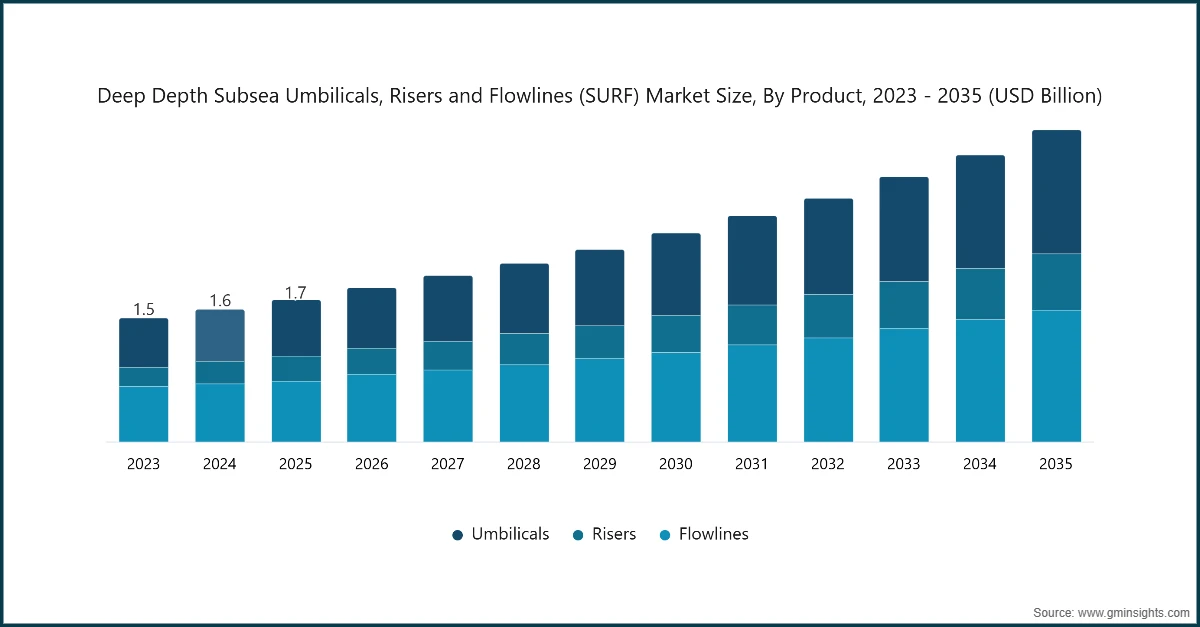
The deep depth subsea umbilicals, risers and flowlines market was estimated at USD 1.7 billion in 2025. The market is expected to grow from USD 1.8 billion in 2026 to USD 3.8 billion in 2035, at a CAGR of 8.2% according to a recent study by Global Market Insights Inc.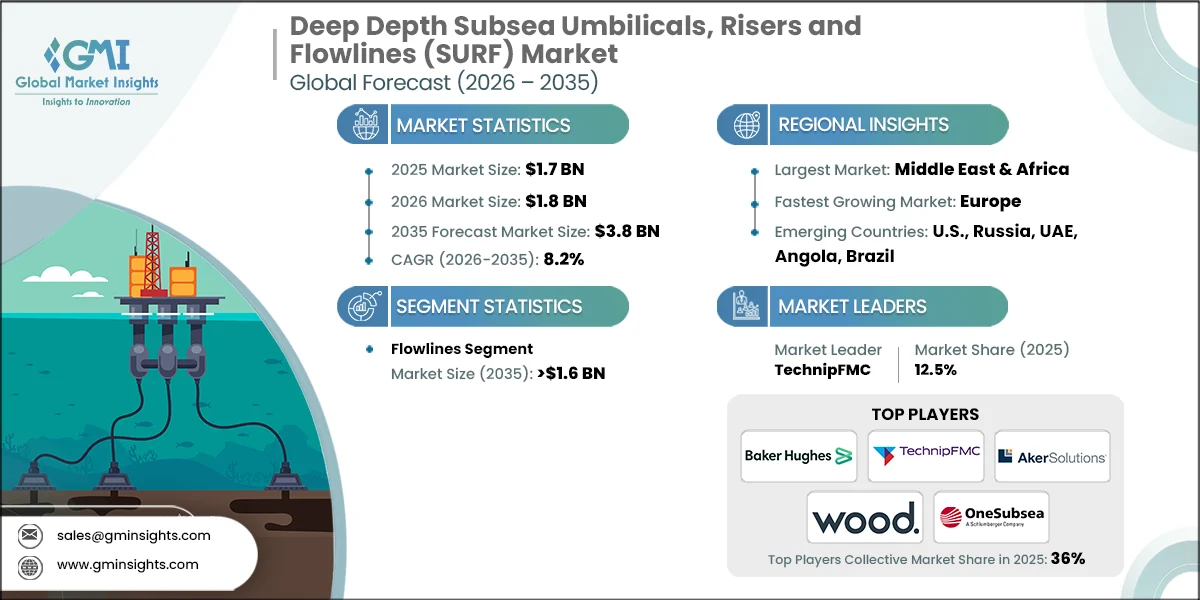
To get key market trends
Deep Depth Subsea Umbilicals, Risers and Flowlines (SURF) Market Trends
Deep depth subsea umbilicals, risers and flowlines industry is set to grow owing to the exploration of hydrocarbons in deep waters along with shifting focus on economical solutions, new and innovative technologies. Manufacturers have implemented advanced innovative methods and developing are more innovative production processes to reduce their costs and meet market requirements and increase safety.
For instance, in February 2024, CRP Subsea, a division of AIS, awarded a contract to supply DBM modules for deepwater oil field in Brazil's Santos Basin. The DBMs will support flexible production subsea riser, easing top tension on the FPSO vessel. Moreover, growing inclination on energy-efficient designs, eco-friendly anti-corrosion coatings and further integration of renewable energy sources in subsea operations will contribute to the industry growth.
Deep Depth Subsea Umbilicals, Risers and Flowlines (SURF) Market Analysis
Learn more about the key segments shaping this market
The flowlines segment is anticipated to grow over USD 1.6 billion by 2035. Continuous offshore oil and gas explorations, coupled with energy companies' deepwater field expansion, will boost the offshore business landscape. Shifting focus on cost-effective and durable solutions on account of the restricted access to oil reserves along with the transformation of the market towards oil and gas production from subsea regions is complementing the business landscape. Technological improvement in rigid and flexible technologies, to withstand rough seabed conditions and further offshore energy installation will positively influence the subsea flowlines business dynamics.
Learn more about the key segments shaping this market
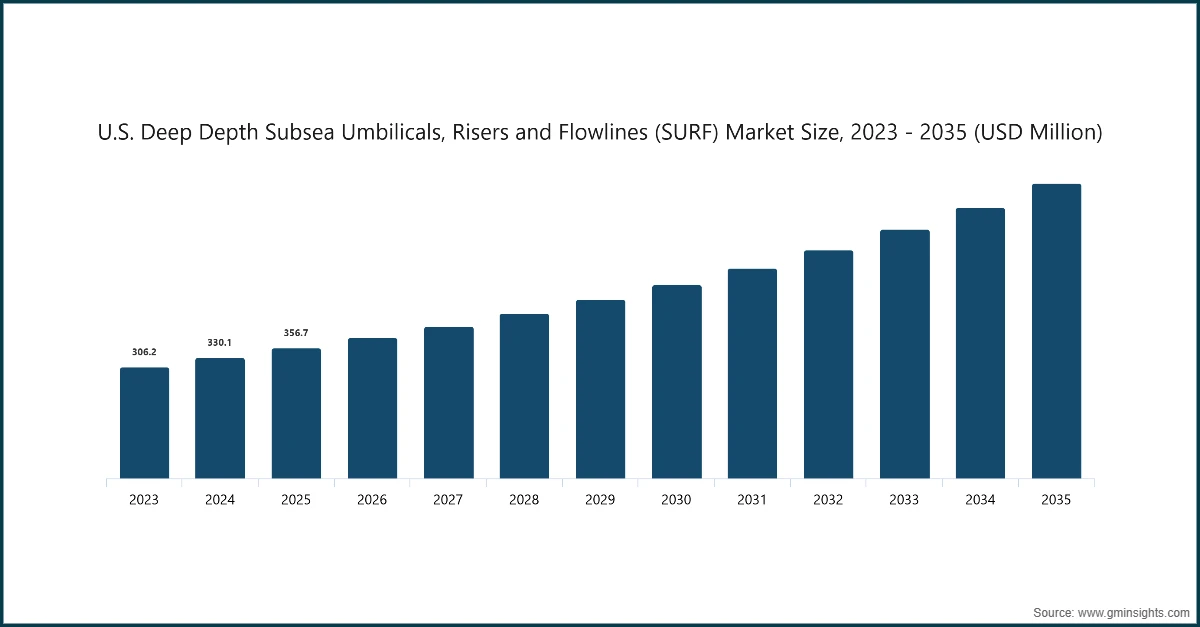
U.S. deep depth subsea umbilicals, risers and flowlines market is anticipated to grow over USD 810 million by 2035. Accelerating exploration of new reserves coupled with favorable regulations by the authorities toward development of subsea infrastructures across the sea bodies will further augment the industry landscape. Increasing investment in the discovery and production of new crude oil reserves, with an optimistic outlook for unconventional resource development will complement the business outlook.
For instance, in April 2025, bp announced a new oil discovery at its Far South prospect in the deepwater Gulf of America. The exploration well in Green Canyon Block 584, operated by bp with Chevron as partner, encountered high‑quality Miocene reservoirs in both the main bore and sidetrack. Moreover, rich offshore oil and gas reserves, together with active exploration and production efforts and existing oil and gas companies, will positively influence the industry landscape.
Deep Depth Subsea Umbilicals, Risers and Flowlines (SURF) Market Share
Companies operating in the deep depth subsea umbilicals, risers, and flowlines industry are focusing to strengthen their market presence by making strategic partnerships, collaborations and joint ventures for new projects. Players are aiming for R&D initiatives that are aimed at diversifying the range of customer needs and enhance their product portfolio.
The SURF industry is characterized by competitive environment, technological innovations, and players facing stringent regulatory environment. Companies including Baker Hughes, TechnipFMC, John Wood Group, Aker Solutions and OneSubsea specialize in positioning their most effective and dependable solutions, which can also be economically priced within market expectations.
Deep Depth Subsea Umbilicals, Risers and Flowlines (SURF) Market Companies
Major players operating in the deep depth subsea umbilicals, risers and flowlines industry are:
Aker Solutions
Aquaterra Energy
ArcelorMittal Energy Projects
Baker Hughes
Boskalis
Energy Equipment Tech
Fairtex Nigeria
Halliburton
Hohn Group
Icon Engineering
John Wood Group
NOV
Oceaneering International
OneSubsea
Prysmian Group
Saipem
Subsea7
Syensqo
TechnipFMC
Tenaris
Tresios
Deep Depth Subsea Umbilicals, Risers and Flowlines (SURF) Market Report Attributes
| Key Takeaway | Details |
|---|---|
| Market Size & Growth | |
| Base Year | 2025 |
| Market Size in 2025 | USD 1.7 Billion |
| Market Size in 2026 | USD 1.8 Billion |
| Forecast Period 2026-2035 CAGR | 8.2% |
| Market Size in 2035 | USD 3.8 Billion |
| Key Market Trends | |
| Drivers | Impact |
| Accelerating investments toward exploration of deep oil & gas reserves | Growing capital allocation to deepwater exploration boosts demand for high‑performance SURF systems, as operators require durable infrastructure to access challenging reservoirs and sustain long‑term offshore production. |
| Rising energy demand | Increasing global energy demand further driving offshore development, elevating requirement for subsea umbilicals, risers, and flowlines that reliably transport hydrocarbons from deepwater fields to processing facilities. |
| Growth in deepwater oilfield developments | Expansion of deep‑water projects strengthens market uptake of advanced SURF solutions, as operators prioritize robust systems capable of withstanding extreme pressures and harsh subsea conditions. |
| Pitfalls & Challenges | Impact |
| High drilling associated cost | High drilling costs restrain deep‑water project expansion, reducing operator willingness to commit capital to new fields and slowing demand for subsea umbilicals, risers, and flowlines essential for deep‑depth field development. |
| Opportunities: | Impact |
| Innovation in advanced materials and digital technologies | Adoption of thermoplastic composite pipes, digital twins, and automated subsea inspection tools boosts efficiency, reduces operational risk, and extends lifecycle performance, creating new technological opportunities. |
| Expansion into emerging offshore regions | Growing deepwater activity in regions like West Africa, Southeast Asia, and Brazil expands installation opportunities for robust SURF systems, increasing regional demand and diversifying project pipelines. |
| Adoption of digital twins & subsea automation technologies | Digital twin adoption enhances real time simulation, performance optimization, and lifecycle oversight of SURF infrastructure, enabling operators to reduce downtime and optimize deepwater production efficiency. |
| Increased use of AUVs and ROVs for subsea operations | Automation through AUVs and ROVs enhances precision in subsea installation and inspection, reducing operational risk and enabling more efficient large‑scale deepwater SURF deployment. |
| Market Leaders (2025) | |
| Market Leader |
Market Share of: 12.5% |
| Top Players |
Collective Market Share of: 36% |
| Competitive Edge |
|
| Regional Insights | |
| Largest Market | Middle East & Africa |
| Fastest growing market | Europe |
| Emerging countries | U.S., Russia, UAE, Angola, Brazil |
| Future outlook |
|
What are the growth opportunities in this market?
Deep Depth Subsea Umbilicals, Risers and Flowlines (SURF) Industry News
In February 2026, Chevron awarded Subsea7 a major subsea installation contract for a project in the Eastern Mediterranean, the company announced. Approximately 17 kilometers of flowlines and umbilicals will be moved and installed as part of the engineering work, which will begin immediately from Subsea7's Paris office. Offshore operations are expected to start in early 2028, enhancing the company's long-standing alliance with Chevron.
In April 2025, TechnipFMC formed a strategic partnership with Cairn Oil & Gas, a Vedanta Group company to accelerate the development of integrated subsea infrastructure for upcoming deepwater projects in India. With TechnipFMC's iEPCI model and integrated FEED approach, the partnership aims to boost project efficiency while leveraging state-of-the-art SPS and SURF capabilities. This partnership improves Cairn's deepwater expansion strategies by combining technical expertise with effective implementation.
In July 2024, Equinor has allocated Ocean Installer a remarkable EPCI contract for the Troll Phase 3 – Stage 2 project located in the Norwegian North Sea. The work encompasses extensive activities offshore such as, but not limited to, drilling, subsea installation, and pipeline building. Fabrication and installation of pipeline structures, spools, and MEG lines are among the various tasks Ocean Installer will undertake. The subsea production system, umbilicals, and trenching & pre-commissioning work, which the company will do, is a major advance in Norway's oil and gas industry.
The deep depth subsea umbilicals, risers and flowlines market research report includes in-depth coverage of the industry with estimates & forecast in terms of “‘000 Feet” and “USD Million” from 2022 to 2035 for the following segments:
Market, By Product
Umbilicals
Risers
SCR
Flexible
Others
Flowlines
The above information has been provided for the following regions and countries:
North America
U.S.
Canada
Mexico
Europe
UK
Norway
Netherlands
Russia
Asia Pacific
China
India
Indonesia
Malaysia
Thailand
Australia
Middle East & Africa
Angola
Nigeria
Egypt
Qatar
Saudi Arabia
UAE
Latin America
Brazil
Frequently Asked Question(FAQ) :
What is the market size of the deep depth subsea umbilicals, risers, and flowlines (SURF) in 2025?
The market size was estimated at USD 1.7 billion in 2025, with a CAGR of 8.2% expected through 2035. Increasing investments in deepwater oil and gas field developments and the adoption of floating production facilities are driving market growth.
What is the projected value of the deep depth subsea umbilicals, risers, and flowlines market by 2035?
The market is poised to reach USD 3.8 billion by 2035, driven by advancements in subsea technologies and the rising demand for reliable infrastructure in extreme subsea environments.
What is the expected size of the deep depth subsea umbilicals, risers, and flowlines (SURF) industry in 2026?
The market size is projected to reach USD 1.8 billion in 2026.
How much revenue is the flowlines segment expected to generate by 2035?
The flowlines segment is anticipated to generate over USD 1.6 billion by 2035, supported by continuous offshore oil and gas explorations and technological advancements in subsea flowline systems.
What is the valuation of the U.S. deep depth subsea umbilicals, risers, and flowlines (SURF) sector by 2035?
The U.S. market is set to exceed USD 810 million by 2035, led by new reserve explorations and favorable regulatory frameworks for subsea infrastructure development.
What are the upcoming trends in the deep depth subsea umbilicals, risers, and flowlines (SURF) market?
Trends include energy-efficient designs, eco-friendly anti-corrosion coatings, innovative production processes, and the use of renewable energy sources in subsea operations.
Who are the key players in the deep depth subsea umbilicals, risers, and flowlines industry?
Key players include Aker Solutions, Aquaterra Energy, ArcelorMittal Energy Projects, Baker Hughes, Boskalis, Energy Equipment Tech, Fairtex Nigeria, Halliburton, and Hohn Group.
Deep Depth Subsea Umbilicals, Risers and Flowlines (SURF) Market Scope
Related Reports