Summary
Table of Content

Decentralized Ventilation Systems Market
Get a free sample of this report
Form submitted successfully!
Error submitting form. Please try again.
Thank you!
Your inquiry has been received. Our team will reach out to you with the required details via email. To ensure that you don't miss their response, kindly remember to check your spam folder as well!
Request Sectional Data
Thank you!
Your inquiry has been received. Our team will reach out to you with the required details via email. To ensure that you don't miss their response, kindly remember to check your spam folder as well!
Form submitted successfully!
Error submitting form. Please try again.
Decentralized Ventilation Systems Market Size
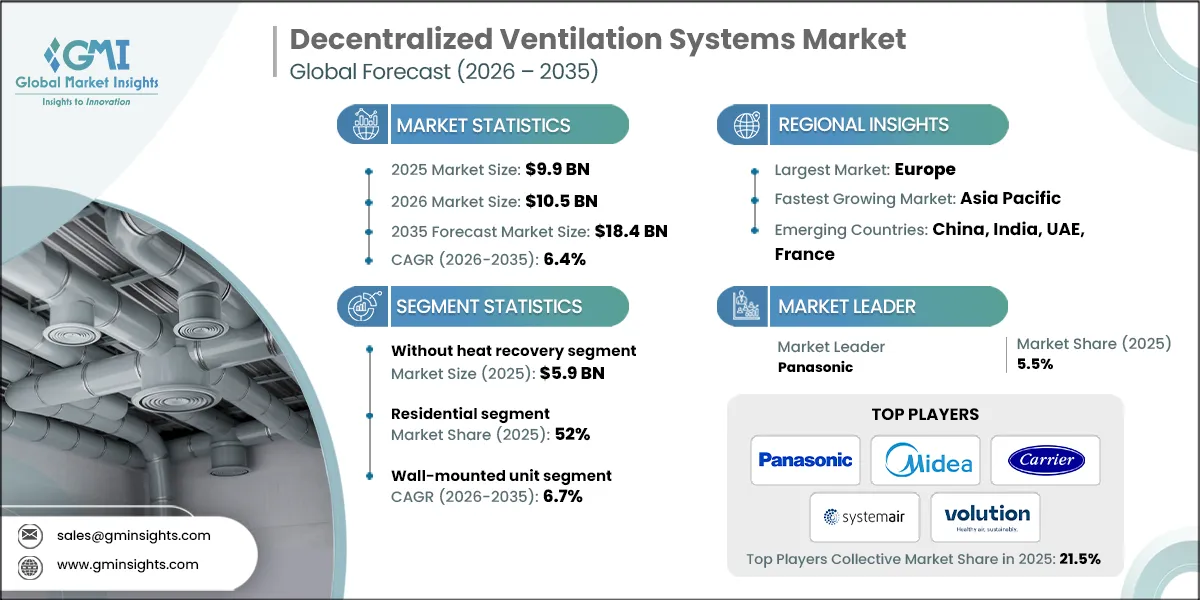
The global decentralized ventilation systems market was estimated at USD 9.9 billion in 2025. The market is expected to grow from USD 10.5 billion in 2026 to USD 18.4 billion in 2035, at a CAGR of 6.4% according to latest report published by Global Market Insights Inc.
Decentralized Ventilation Systems Market Key Takeaways
Market Size & Growth
- 2025 Market Size: USD 9.9 Billion
- 2026 Market Size: USD 10.5 Billion
- 2035 Forecast Market Size: USD 18.4 Billion
- CAGR (2026–2035): 6.4%
Regional Dominance
- Largest Market: Europe
- Fastest Growing Region: Asia Pacific
Key Market Drivers
- Increasing awareness of indoor air quality and its impact on health.
- Rising construction activities in residential and commercial sectors.
Challenges
- High initial installation costs and maintenance expenses.
- Technical complexities in integration with existing infrastructure.
Opportunity
- Technological advancements, such as smart and IoT-enabled systems.
- Expansion into emerging markets with increasing urbanization.
Key Players
- Market Leader: Panasonic led with over 5.5% market share in 2025.
- Leading Players: Top 5 players in this market include Panasonic, Midea, Carrier, Systemair, Volution Group, which collectively held a market share of 21.5% in 2025.
Get Market Insights & Growth Opportunities
The market for decentralized ventilation systems is growing as awareness about indoor air quality and its effect on health is increasing. Due to rising concerns about air pollution and its negative effects, residential and commercial sectors are adopting decentralized ventilation systems to maintain a healthy environment inside.
Stringent government regulations and specifications with regards to energy efficiency and ventilation in buildings are adding to the rising demand in the market. Governments around the globe are adopting strategies that support the construction of energy-efficient buildings and are consequently fueling the rising demand for the use of decentralized ventilation systems.
Another reason for an increase in the market is represented by urbanization and the growing demand from the construction industry. Modern infrastructure and energy-saving solutions are in high demand in cities that are constantly being developed. Decentralized ventilation systems are becoming the choice for new buildings because they can adapt to individual room needs.
Another major factor propelling market growth is the advances in technology in the ventilation market. Such advances include the development of smart ventilation systems with sensor and automation technology. Such technology helps in optimizing air flow in accordance with real-time conditions, thus improving energy efficiency and user comfort.
The growing trend of retrofitting buildings with energy-efficient systems is providing an impetus to the demand for the decentralized ventilation systems market. Decentralized systems are relatively easy to install in existing buildings compared to centralized systems, and hence, their demand is increasing because of the growing trend to upgrade buildings to current standards.
To get key market trends
Decentralized Ventilation Systems Market Trends
- Some of the most significant influences concerning the trend and specification related to ventilation involve slowing construction activity. These mostly involve increased interest and inflation rates, as well as continued labor struggles.
- The market for decentralized ventilation systems is experiencing remarkable growth due to certain critical trends and factors. One of the main drivers is the augmented importance of sustainability and energy efficiency in infrastructure.
- The world’s governments and regulatory agencies introduce strict energy efficiency guidelines and green building ratings, promoting the use of decentralized ventilation solutions with lower energy consumption and maintained indoor air quality.
- The rising recognition of indoor air pollution and its negative health implications is driving the need for sophisticated ventilation solutions, especially in residential and commercial buildings.
- Advancements in technology are also impacting the market. Smart ventilation systems with sensor technologies and internet-of-things-controlled ventilation systems are picking up pace. Smart ventilation systems help optimize the respiratory and usage of energy with the help of real-time information.
- Moreover, the rising trend of upgrading ventilating systems in existing buildings is opening opportunities within the market since existing infrastructure may lack proper ventilating systems.
- Moreover, with rising urbanization and the ever-growing construction sector, especially in emerging nations, the market further witnesses fuel additions for its growth. The growing extension in urban areas requires proficient ventilation systems for high-density residential and commercial buildings.
Decentralized Ventilation Systems Market Analysis
Learn more about the key segments shaping this market
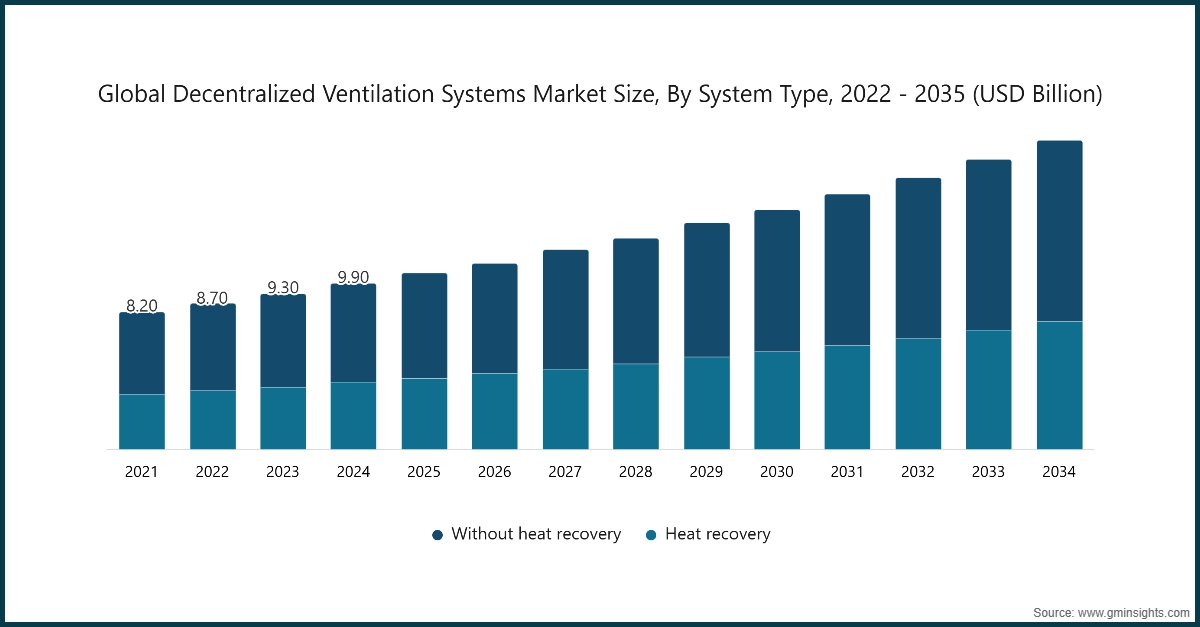
Based on the system type, the decentralized ventilation systems market is divided into heat recovery and without heat recovery. In 2025, without heat recovery dominated the market generating revenue of USD 5.9 billion and expected to grow at a CAGR of 6.2% during the forecast period.
- The segment without heat recovery is expected to increase steadily in the forecast period. This is mainly due to the economic nature of the product. The systems are commonly found in areas that have a medium range of temperatures. The development of smaller residential and commercial buildings in the developing nations is boosting the consumption of non-heat recovery ventilation systems.
- In 2025, heat recovery segment is expected to grow at a CAGR of 6.7% from 2026 to 2035. The heat recovery segment of the market expects substantial growth during the forecast period, given the rising traction for energy-efficient ventilation systems. The growing awareness about reducing energy and carbon emissions has created demand for heat recovery systems in residential, commercial, as well as industrial sectors.
- The heat recovery system maintains optimal air quality while preventing energy loss, making it the preferred choice for areas that enforce strict energy regulations.
Learn more about the key segments shaping this market
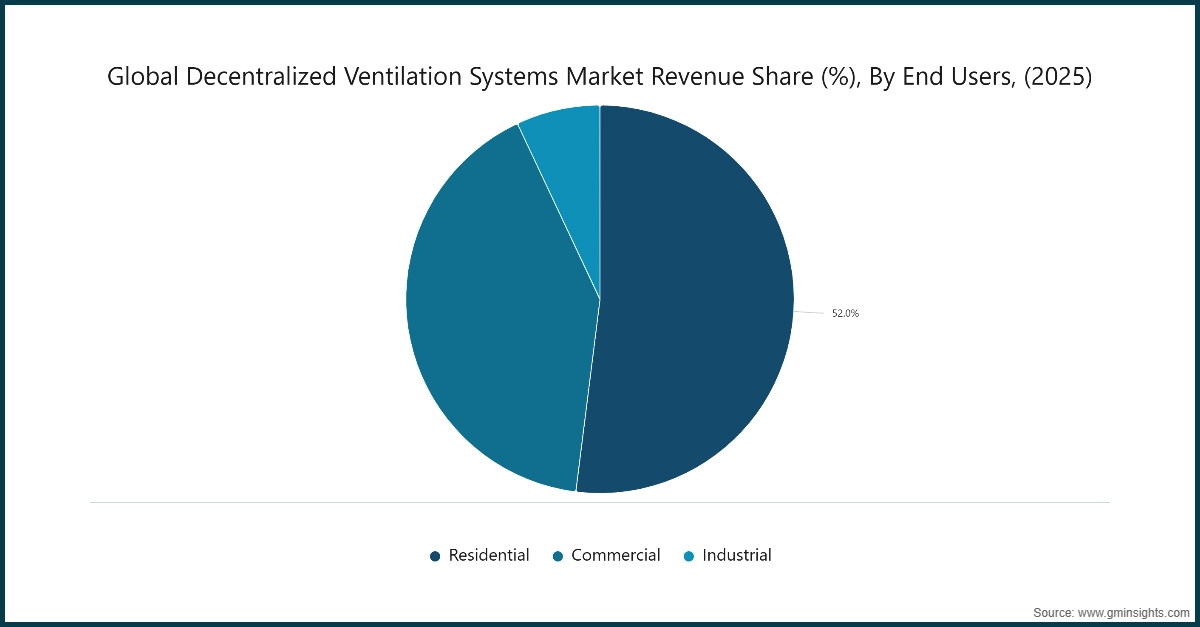
Based on end users, the decentralized ventilation systems market is segmented into residential, commercial and industrial. In 2025, residential segment dominates the market with 52% share and is expected to grow at a CAGR of 6.7% from 2026 to 2035.
- The residential market exhibits promising growth in the forecast period. Growing awareness regarding the importance of indoor air quality and the rising use of energy-efficient solutions boost demand for decentralized ventilation systems in residential applications.
- Furthermore, the increased rate of urbanization and the rise of multi-family residential projects are adding to the overall market growth. Moreover, the government's policies regarding sustainable building and conservation are encouraging homeowners to install improved ventilation systems.
- The commercial sector is expected to grow steadily during the forecast period due to an increased demand for efficient ventilation systems in office buildings, retail outlets, and healthcare facilities.
- The growing concerns regarding the health and efficiency of workers, along with the strict norms set by governments regarding indoor air quality, are boosting the demand for decentralized ventilation systems in commercial setups.
Based on installation types, the decentralized ventilation systems market is segmented into ceiling-mounted unit, wall-mounted unit, floor-mounted unit and others. In 2025, the wall-mounted unit segment dominates the market and is expected to grow at a CAGR of 6.7% from 2026 to 2035.
- The wall units’ segment is expected to grow steadily during the forecast period. These units are in high demand due to ease of installation and applicability to both retrofit and new construction applications. The growth in awareness about IAQ and the requirement for efficient ventilation in residential and small commercial environments is driving this segment.
- In 2025, the ceiling-mounted unit segment dominates the market and is expected to grow at a CAGR of 6.5% from 2026 to 2035. The ceiling-mounted units’ market is expected to see substantial growth during the forecast period.
- The reason for the increase can be attributed to the rising demand for energy-efficient ventilation systems and the adoption of smart home technology, as ceiling-mounted units are gaining momentum in residential as well as commercial areas due to their space-saving design and efficiency in air distribution.
Looking for region specific data?
North America Decentralized Ventilation Systems Market
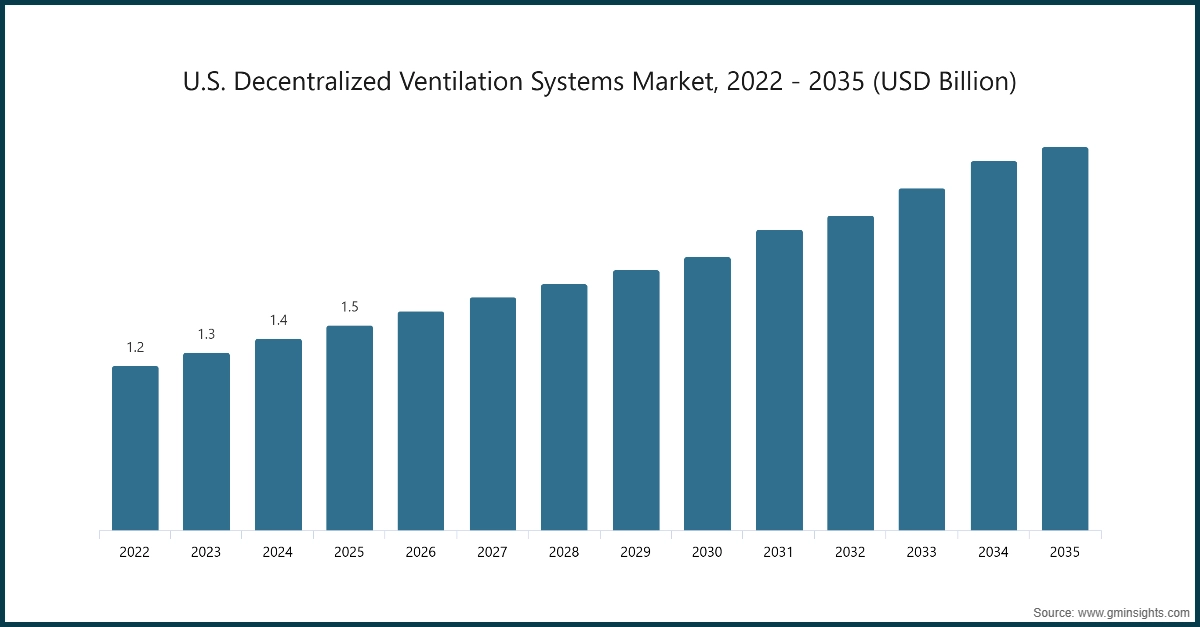
In terms of country, the United States led the decentralized ventilation systems industry with 80% of the revenue share with USD 1.5 billion in revenue in 2025.
- This market growth in the United States is fueled by growing awareness of air quality and strict government norms. The residential market is expected to have strong growth as there is a developing acceptance of energy-efficient solutions and the increasing trend of ‘Green Homes.’
- There is an increasing demand for decentralized ventilation systems in homes in an effort to enhance air movement and minimize energy consumption.
- The demand for decentralized ventilation systems is increasing in office buildings, retail businesses, and healthcare centers, where the maintenance of optimal air quality is of utmost importance. The increased focus on stricter building norms and the subsequent emphasis on energy-efficient HVAC systems is leading to the increased adoption of decentralized systems in commercial buildings.
Europe Decentralized Ventilation Systems Market
The Europe market was valued at USD 4.2 billion in 2025 and is projected to grow at a CAGR of 6.2% between 2026 and 2035.
- The market for decentralized ventilation systems in Europe is growing rapidly owing to rising awareness regarding air quality and energy conservation.
- Western Europe, comprising Germany, France, and the United Kingdom, leads the global market in terms of strict construction codes and the adoption of energy-saving technologies.
Asia Pacific Decentralized Ventilation Systems Market
The Asia Pacific market was valued at USD 3.2 billion in 2025 and is projected to grow at a CAGR of 6.9% between 2026 and 2035.
- The Asia Pacific market is experiencing a higher adoption rate of decentralized ventilation systems in the residential segment.
- With the rising awareness of the importance of indoor air quality and the resultant increase in the need for ventilation systems in residential areas due to rapid urbanization, the market is growing. China and India are leading the charge in the market.
Middle East and Africa Decentralized Ventilation Systems Market
The Middle East and Africa market was valued at USD 348.5 million in 2025 and is projected to grow at a CAGR of 5.7% between 2026 and 2035.
- The MEA market for decentralized ventilation systems is growing, thanks to the popularity of urbanization and growing consciousness about the importance of clean air inside buildings.
- Regions including the United Arab Emirates, Saudi Arabia, and South Africa are experiencing increased adoption rates driven by the rise in construction activities and the advent of strict government regulations pertaining to the use of energy-efficient technologies.
Decentralized Ventilation Systems Market Share
The top 5 companies in the decentralized ventilation systems industry are Midea, Panasonic, Carrier, Systemair, and Volution Group collectively hold a share of 21.6% in the market.
These companies continue to acquire and merge with others, expand facilities, and make various collaborations to increase their product offerings, access customer bases, and secure their market positions.
Midea is trying to widen its market base by using advanced technology to develop energy-efficient decentralized ventilation systems. The company concentrates on partnerships and acquisitions to enhance distribution networks and upgrade its products.
Panasonic has managed to increase its market share with its focus on innovations in smart ventilation solutions. The company has incorporated IoT-related functionalities in its products to provide customers with the best possible air quality and energy efficiency. In addition, it has carried out marketing and green initiatives in a bid to target environmentally concerned customers and establish itself in other markets across the world.
Carrier is expanding its market share by developing customizable decentralized ventilation systems. They emphasize their R&D activities by introducing the latest technology in their products, in line with tight energy regulation policies. They are expanding their market share by collaborating with other companies and having an effective service network.
Volution Group is increasing its share of the market by making acquisitions in new product lines that complement their existing offerings and are also innovators in energy-efficient ventilation solutions for niche marketing. Volution Group also spends on customer-centric approaches like providing training services to their customers.
Decentralized Ventilation Systems Market Companies
Major players operating in the decentralized ventilation systems industry are:
- Daikin
- Midea
- Panasonic
- Carrier
- Systemair
- Gree Electric
- Volution Group
- Mitsubishi Electric
- Johnson Controls
- LG Electronics
- Zehnder
- Lindab
- Broan-NuTone
- Haier
- RenewAire
To improve the product and market share key players are constantly investing in technological activities and are also entering into partnerships to provide improved and better solutions for the customers. These investments are benefiting both companies and customers as they help develop and offer solutions as per the changing technological trends and thus the customer requirements.
Daikin Industries is a global key player in manufacturing HVAC products, including the decentralized ventilation system. The company is known for its innovations, energy-saving products, and sustainable initiatives. The company’s global presence in multiple markets allows them to serve their customers in a diverse manner for residential, commercial, and industrial use.
Midea Group is a well-established company in the HVAC industry, with a broad lineup of decentralized ventilation systems. Midea is recognized for its superior research and development capabilities. The firm’s broad global reach and commitment to customer-driven innovations make it a fundamental rival in this industry.
Carrier Corporation is known for its heating, ventilation, and air conditioning systems, and it also focuses on providing solutions for decentralized ventilation. The organization focuses on sustainability and the latest technological advancements to make its solutions efficient and reliable. Carrier has an extensive presence and caters to different business segments, such as the residential, commercial, and industrial segments.
Mitsubishi Electric Corporation is one of the leading companies in the provision of HVAC systems, such as decentralized ventilation systems. Mitsubishi Electric is known for its innovative technology, energy-efficient products, and concern for a sustainable environment. Mitsubishi Electric's widespread presence across the globe and its extensive product offerings make the company a major contender in the market for decentralized ventilation systems.
Decentralized Ventilation Systems Market Report Attributes
| Key Takeaway | Details |
|---|---|
| Market Size & Growth | |
| Base Year | 2025 |
| Market Size in 2025 | USD 9.9 Billion |
| Market Size in 2026 | USD 10.5 Billion |
| Forecast Period 2026-2035 CAGR | 6.4% |
| Market Size in 2035 | USD 18.4 Billion |
| Key Market Trends | |
| Drivers | Impact |
| Increasing awareness of indoor air quality and its impact on health | This driver is significantly boosting the adoption of decentralized ventilation systems, as consumers prioritize healthier living and working environments |
| Rising construction activities in residential and commercial sectors | The growing construction industry is creating a higher demand for decentralized ventilation systems, contributing to market expansion |
| Pitfalls & Challenges | Impact |
| High initial installation costs and maintenance expenses | These costs act as a barrier for widespread adoption, particularly in cost-sensitive markets, slowing down market growth |
| Technical complexities in integration with existing infrastructure | Technical complex challenges can delay implementation and increase costs, impacting the overall market growth negatively |
| Opportunities: | Impact |
| Technological advancements, such as smart and IoT-enabled systems | These innovations are creating new avenues for market growth by enhancing system efficiency and user convenience |
| Expansion into emerging markets with increasing urbanization | Urbanization and infrastructure development in these regions present significant growth opportunities for market players |
| Market Leaders (2025) | |
| Market Leader |
5.5% market share |
| Top Players |
Collective market share in 2025 is 21.5% |
| Competitive Edge |
|
| Regional Insights | |
| Largest Market | Europe |
| Fastest growing market | Asia Pacific |
| Emerging countries | China, India, UAE, France |
| Future outlook |
|
What are the growth opportunities in this market?
Decentralized Ventilation Systems Industry News
- In September 2025, Panasonic announced the launch of its Intelli-Balance Elite and Elite Plus+ Series of energy recovery ventilators (ERV). Designed to deliver superior performance throughout the climate spectrum, from extreme cold to hot, humid conditions, these innovative models are engineered to address modern building standards and cater to a diverse range of consumer needs.
- In February 2025, Zehnder Group announced the expansion of its innovative Unity Range launching two new smarts, continuously running decentralized Mechanical Extract Ventilation (dMEV) fans onto the market: the Unity CV2.1HT and the Unity CV2.1APP. The new extract fans meet the evolving needs of households for enhanced air quality and energy efficiency, providing sustainable, user-friendly ventilation solutions
- In February 2024, Mitsubishi Electric introduced its latest innovation in mechanical ventilation, the RVXT3 Lossnay mechanical ventilation with heat recovery (MVHR) system. Designed to meet the growing demand for efficient, environment-friendly air quality solutions, the RVXT3 combines advanced ventilation technology with advanced energy-saving capabilities to offer commercial businesses superior indoor air quality while reducing their carbon footprint.
- In November 2025, LG Electronics announces the launch of home ventilation system LG Premium Ventilation PLUS. The new product detects indoor pollution with an AI air-quality sensor and maintains the indoor environment by supplying purified outdoor air through a filter.
The decentralized ventilation systems market research report includes in-depth coverage of the industry with estimates & forecasts in terms of revenue (USD Billion) and volume (Thousand Units) from 2022 to 2035, for the following segments:
Market, By System Type
- Heat recovery
- Without heat recovery
Market, By Type
- Horizontal units
- Vertical units
Market, By Installation Types
- Ceiling-mounted unit
- Wall-mounted unit
- Floor-mounted unit
- Others (window-integrated etc.)
Market, By Application
- New construction
- Retrofit
Market, By End Users
- Residential
- Commercial
- Offices
- Schools
- Healthcare facilities
- Others (retail stores etc.)
- Industrial
Market, By Distribution Channel
- Direct sales
- Indirect sales
The above information is provided for the following regions and countries:
- North America
- U.S.
- Canada
- Europe
- UK
- Germany
- France
- Italy
- Spain
- Netherlands
- Asia Pacific
- China
- India
- Japan
- South Korea
- Australia
- Latin America
- Brazil
- Mexico
- Argentina
- MEA
- South Africa
- Saudi Arabia
- UAE
Frequently Asked Question(FAQ) :
What is the market size of the decentralized ventilation systems in 2025?
The market size was USD 9.9 billion in 2025, with a CAGR of 6.4% expected through 2035 driven by increasing awareness of indoor air quality and stringent government regulations on energy efficiency.
What is the projected value of the decentralized ventilation systems market by 2035?
The decentralized ventilation systems market is expected to reach USD 18.4 billion by 2035, propelled by technological advancements, smart ventilation systems, and growing demand for energy-efficient solutions.
What is the current decentralized ventilation systems market size in 2026?
The market size is projected to reach USD 10.5 billion in 2026.
How much revenue did the without heat recovery segment generate in 2025?
Without heat recovery systems generated USD 5.9 billion in 2025 and are expected to grow at a CAGR of 6.2% during the forecast period.
What was the market share of the residential segment in 2025?
The residential segment dominated the market with 52% market share in 2025 and is expected to grow at a CAGR of 6.7% from 2026 to 2035.
What is the growth outlook for heat recovery systems from 2026 to 2035?
Heat recovery systems are projected to grow at a 6.7% CAGR till 2035, due to rising demand for energy-efficient ventilation and growing awareness about reducing carbon emissions.
Which region leads the decentralized ventilation systems market?
The United States dominated about 80% share with USD 1.5 billion revenue in 2025, fueled by rising air quality awareness and stringent government regulations.
What are the upcoming trends in the decentralized ventilation systems market?
Key trends include adoption of smart ventilation systems with IoT integration, sensor technologies for real-time optimization, growing retrofitting of existing buildings, and expansion into emerging markets with increasing urbanization.
Who are the key players in the decentralized ventilation systems market?
Key players include Daikin, Midea, Panasonic, Carrier, Systemair, Gree Electric, Volution Group, Mitsubishi Electric, Johnson Controls, LG Electronics, Zehnder, Lindab, Broan-NuTone, Haier, and RenewAire.
Decentralized Ventilation Systems Market Scope
Related Reports