Summary
Table of Content

Data Center Interconnect Market
Get a free sample of this report
Form submitted successfully!
Error submitting form. Please try again.
Thank you!
Your inquiry has been received. Our team will reach out to you with the required details via email. To ensure that you don't miss their response, kindly remember to check your spam folder as well!
Request Sectional Data
Thank you!
Your inquiry has been received. Our team will reach out to you with the required details via email. To ensure that you don't miss their response, kindly remember to check your spam folder as well!
Form submitted successfully!
Error submitting form. Please try again.
Data Center Interconnect Market Size
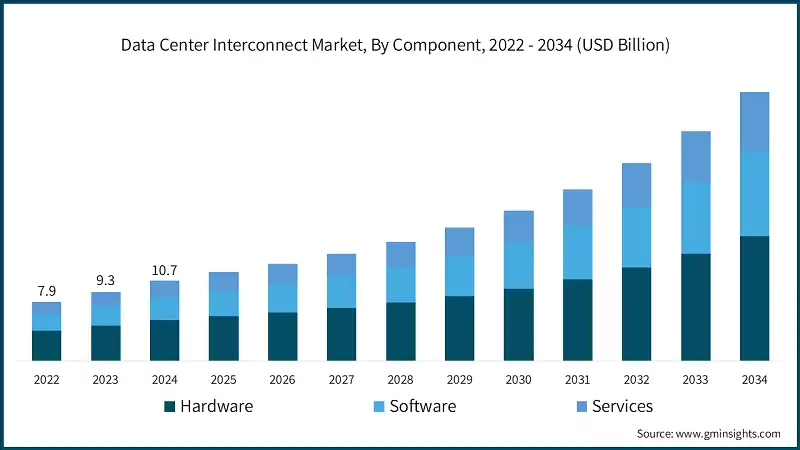
The global data center interconnect market was estimated at USD 10.7 billion in 2024. The market is expected to grow from USD 11.9 billion in 2025 to USD 35.9 billion in 2034, at a CAGR of 13.1%.

To get key market trends
- As data volumes begin to explode, hybrid clouds, and AI workloads have emerged, DCI must shift towards high-speed programmable optical networking backbones rather than low-cost commodity fiber connectivity. Dell Oro Group revealed that more than 60 percent of massive enterprises are moving to the 400G and 800G optical technology to support the real-time coordination of inter-data center traffic. These updates allow adapting the bandwidth, the optimization of the latencies, and encrypted transfer. Integration into the intent-based networking and automation tools have become the competitive requirement on the continuum basis.
- Regional DCI deployments are being driven through the collaboration of public and the private. As an example, in April 2024, the European Commission spent 260 million euros to increase the number of cross-border interconnects with fiber and submarine cables and make a pan-European secure data corridor. In the same way, Google and AWS and other hyperscaler are co-developing submarine cables and platforms along region fiber hubs to connect data centers on different continents in case of latency-sensitive applications such as generative AI and content delivery.
- The COVID-19 pandemic escalated expansion of data centers and inter-connect demand. Remote work, telemedicine, and streaming traffic have grown, possibly by 2 to 3 times, according to many operators, in East-West data traffic among regional data centers. It demonstrated high levels of redundant-path DCI networks, SDN-controlled network, and low-failure hardware were badly needed. Cross-data center flows all over the place and intentionally consciousness as well as fabrics at several firms are signs of autonomous adaptation to this uncertainty.
- Tiered services models also define the offerings of the market, particularly to the large enterprises and cloud-native vendors. Major vendors such as Ciena, Cisco, and Juniper provide various levels of DCI services, and these services include passive optical interconnects and active coherent optical offerings combined with AIOps, telemetry, and SLA. Such premium services can offer the features of programmable interface and real-time analytics, which enables the firms to match the capabilities of networks with mission critical workloads and compliance policies.
- The North America region dominates the world DCI market with hyperscale deployments, large cloud regions, highly connected internet exchange, and ecosystems. Providers in the US have access to high-tech optical network and cross-border fiber links. Having numerous Tier IV colocation facilities and investing in AI-oriented interconnects has allowed it to remain on the sidelines. Such an FCC program as the Rural Digital Opportunity Fund facilitates fiber construction into the regions.
- The Asia-Pacific market is the market with the fastest growth because of cloud-adoption, digitization and mega smart-city projects. New applications such as high-frequency trading, 5G edge applications, and sovereign cloud zones involve optical meshes in large-scale inter-data center applications that are being implemented in countries such as China, India, Singapore, and South Korea. The deployment of submarine cable (e.g., Bifrost, Echo) and local fiber mesh networks are extending DCI even further to Tier II and Tier III cities.
Data Center Interconnect Market Report Attributes
| Key Takeaway | Details |
|---|---|
| Market Size & Growth | |
| Base Year | 2024 |
| Market Size in 2024 | USD 10.7 Billion |
| Forecast Period 2025 - 2034 CAGR | 13.1% |
| Market Size in 2034 | USD 35.9 Billion |
| Key Market Trends | |
| Drivers | Impact |
| Rise in AI and machine learning workloads | Drives exponential bandwidth and low-latency interconnect demand across distributed compute environments. |
| Rapid cloud adoption and edge computing expansion | Fuels the need for scalable and high-capacity DCI to link core, cloud, and edge sites. |
| Surge in global data traffic and storage demands | Intensifies requirements for resilient, high-speed interconnects to handle increasing data volumes. |
| Increasing hyperscale data center deployments | Accelerates the adoption of advanced DCI solutions to support massive data exchange between facilities. |
| Pitfalls & Challenges | Impact |
| High initial capital expenditure for DCI infrastructure. | Limits adoption among small to mid-sized enterprises, delaying deployment of advanced DCI systems across developing markets. |
| Complex network management and integration issues. | Increases operational overhead and slows implementation, especially in hybrid environments with legacy systems and multi-vendor platforms. |
| Opportunities: | Impact |
| Development of AI-optimized DCI platforms | Enables ultra-fast data transfer, supporting real-time AI workloads and enhancing performance in next-gen, intelligent data centers. |
| Growth in 5G and edge data center deployments | Fuels demand for low-latency, high-bandwidth DCI solutions to interconnect distributed, high-speed edge computing infrastructures. |
| Expansion of digital infrastructure in emerging markets | Opens new revenue streams for DCI vendors by addressing connectivity gaps and enabling digital transformation initiatives. |
| Rising demand for energy-efficient and green DCI solutions | Encourages innovation in low-power optics and infrastructure, aligning sustainability goals and regulatory compliance across global data center operations. |
| Market Leaders (2024) | |
| Market Leaders |
8% market share |
| Top Players |
Collective Market Share in 2024 is 29% |
| Competitive Edge |
|
| Regional Insights | |
| Largest Market | North America |
| Fastest growing market | Asia Pacific |
| Emerging countries | India, Philippines, Indonesia, Brazil, Saudi Arabia, UAE |
| Future outlook |
|
What are the growth opportunities in this market?
Data Center Interconnect Market Trends
- With the increasing popularity of ultra-low latency and high-capacity data transfer powered by AI/ML and cloud-native app-driven environments, enterprises are quickly migrating towards 400G/800G coherent optical capabilities to 100G/200G applications. As per the report of Cignal AI 2024, the shipment of 400G coherent ports used in DCI increased by more than 70 percent YoY. Technology allows acceleration of data transfers across the East-West directions, which is essential to federated learning, multi cloud, and real-time analytics.
- For example, in November 2023, Cirion technologies, a provider of digital infrastructure in Latin America, commissioned Ciena to provide Waveserver-5 with 800 Gb/s to create interconnections between data centers in Bogota. The upgrade allows a flexible or programmable optical path and enhanced resiliency to local enterprises as well as government customers, high-bandwidth capacity, and lower cost-per-bit and footprint.
- DCI is even becoming more-so transitioning to software-based designs, merged with SDN controllers and AIOps platforms. Vendors such as Cisco, Ciena, and Nokia are integrating in real-time telemetry, intent-aware routing and AI-Based traffic prediction. These systems are capable of dynamically reconfiguring optical paths and bandwidth, with the result of automatically recovering, performance tuning and energy-efficient routing, which are essential elements of scaling multi-region cloud infrastructure.
- DCI is extended to reach edge computing with the mass spread of edge computing. Enterprises are connecting metro edge locales with core data centers through high-bandwidth interconnects to sustain latency-sensitive jobs, such as AR/VR, autonomous vehicles, and intelligent factories. DCI is increasingly the platform consistent to the distributed cloud model; vendors are implementing their controllable interconnects that extend across metro rings, regional aggregations, and sub-sea connections.
Data Center Interconnect Market Analysis
Learn more about the key segments shaping this market
Based on component, the market is divided into hardware, software, and services. The hardware segment dominated the data center interconnect market accounting for around 51% in 2024 and is expected to grow at a CAGR of over 12% through 2034.
- Data center interconnect (DCI) market is dominated by hardware segment as the physical infrastructure is necessary to carry out rapid and more stable data transfers between data centers. Optical transceivers, switches, routers and multiplexers are key elements in DCI, as more optical transceivers with 400G and 800G coherent optics are being deployed in supporting AI, cloud and IoT applications. These are costly and consume a large proportion of the data center budget.
- For example, in August 2023, Marvell introduced COLORZ 800, the first 800 Gbps ZR/ZR+ coherent pluggable optical modules. These modules are powered by the company 5 nm Orion coherent DSP and can do inter-data center applications up to 500km with full line rate or 1,200km at 400600 Gbps. Another area is capital costs, which are minimized by up to 75% and power per bit, which is cut by approximately 30 percent when compared to conventional DCI hardware.
- Moreover, hyperscale data centers and colocation facilities also periodically update their hardware to satisfy raised bandwidth and capacity requirements. The increasing popularity of distributing cloud structures and edge computing is also fueling the need for high-performance programmable interconnect hardware used to guarantee scalability with reliability.
- The software segment is expected to grow at a CAGR of over 14% due to the increasing demand for automation, comprehensive network monitoring and intelligent traffic control. It has advantages of such technologies as Software Defined Networking (SDN), Artificial Intelligence for IT Operations (AIOps) and intent-based networking that make it possible to provide dynamic bandwidth and real-time monitoring of the data centers. With the growth of multi-cloud and edge computing, enterprises have invested in different scalable and programmable DCI software to achieve better performance and reliability as well as simplify operation by using centralized control systems.
Learn more about the key segments shaping this market
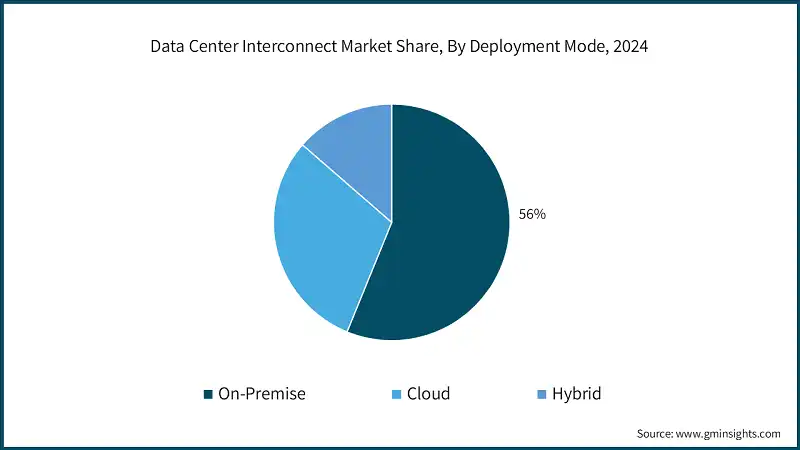
Based on deployment mode, the data center interconnect market is segmented into On-Premises, Cloud, and Hybrid. The on-premises segment dominates the market accounting for around 56% share in 2024, and the segment is expected to grow at a CAGR of over 12% from 2025-2034.
- On-premise DCI solutions can enable organizations and in particular hyperscalers and large enterprises to control their network infrastructure. It is important in safe, quick, and low-latency transmission of information regarding mission-critical data centers. It allows fancy customization too, thus is suitable to high-performance workloads like training of AI models, HPC, and financial trading systems.
- On-premise DCI is essential in several industries including government, healthcare, and BFSI where some strict local data residency laws must be adhered to and meet stringent data security regulation. On-premise systems assist in keeping sensitive information inside the domain of an organization, and they adhere to the GDPR, HIPAA, and regional data security regulations without the help of third-party cloud connections.
- For example, in November 2023, Nokia launched the Cloud DCI solution, which is specifically focused on the on-premises enterprise connectivity within the private and hybrid data centers. The 1830 Photonic Service Switch platform allows customers to create high-speed and secure optical networking connections inside their own buildings to support synchronous and asynchronous data replications and disaster recovery over metro and long-haul connections.
- Organizations having a large investment in tangible network infrastructure tend to want to use on-premise deployment to utilize pre-installed routers, switches, and fiber. Such a strategy includes long-term ROI and seamless integration with the existing IT systems and a private cloud.
- The hybrid segment is projected to grow at a CAGR of over 14% owing to the rising adoption of multi-cloud initiatives by enterprises. Different organizations desire the extendibility to handle their important workloads on-site and can use cloud scalability on treatable operations. Hybrid DCI supports effortless interconnectivity, data mobility, and enforcement and can thus be used to optimize the performance, compliance and costs of deployments of modern digital infrastructure.
Based on technology, the data center interconnect market is segmented into synchronous optical network (SONET), dense wavelength division multiplexing (DWDM), ethernet, optical transport network (OTN), and others. The dense wavelength division multiplexing (DWDM) segment is expected to dominate the market with around 58% share due to its ability to deliver ultra-high bandwidth and long-distance data transmission essential for hyperscale data center interconnects.
- Dense wavelength division multiplexing (DWDM) is the most decorated technology with maximum market share in the data center interconnect (DCI) market as it is the only technology with the capability to maximize the fiber capacity. DWDM is a method that allows sending a variety of information signals simultaneously using a single optical fiber by giving each signal a different wavelength. This enables data centers to scale bandwidth costs effectively, and this is crucial owing to the exponentially increasing inter-data-center traffic due to AI, cloud computing, and big data analytics.
- In addition, DWDM is preferred in long-haul and metro DCI deployments where low latency, high reliability and the highest throughput is required. Its high order modulation formats and its coherent transmission enable data rates up to 100G, 400G, 800G to be transmitted over long distances without signal degradation which reduces the need to regenerate signals and reduces the cost of operations.
- For instance, in June 2025, Nokia, partnering with CSC and SURF, achieved record 1.2 Tbps DWDM transmission over a single wavelength on a long-haul EU network, designed to serve the upcoming LUMI-AI supercomputer. This deployment underscores DWDM’s ability to deliver ultra-high capacity over extended distances, catering to AI-intensive computational workloads.
- DWDM infrastructure is becoming a significant investment of leading telecom and cloud operators that pursue the invisible connection across geographically fragmented facilities. Other companies, such as Ciena, Nokia, and Huawei are also working on DWDM systems that have integrated automation and SDN capabilities, which continue to add to the attractiveness of these systems in dynamic, scalable and forward-looking DCI networks.
- The optical transport network (OTN) segment is projected to experience high growth because it assures good error correction, efficiency in management of bandwidth, and multi-service transport bands over long distances. OTN can be used to interconnect data centers securely and reliably and provide high-speed, low-latency data transport that is critical to AI-driven applications and workloads, cloud applications and real-time data replication within distributed systems environments.
Based on end use, the data center interconnect market is divided into communications service providers (CSPS), internet content providers & carrier-neutral providers (ICPS/CNPS), government, and enterprise. The enterprises dominated the market.
- The enterprise segment holds the largest share in the data center interconnect (DCI) market due to the rising demand for private, secure, and scalable network architectures. Organizations with large enterprises in various industries, such as BFSI, healthcare, and retail are increasingly turning into multiple data centers to implement their business continuity, disaster recovery, and read-time analytics capabilities, supporting the need to have interconnection capabilities. Such organizations are focused on DCI solutions with high bandwidth and low latencies to ensure continuity at distributed facilities.
- Additionally, the increasing use of hybrid and multi-cloud approach by enterprises is one of the factors that have led to the growth of the demand of DCI to enable frictionless mobility of data between data centers on premises and cloud. Enterprises are requiring the software-defined interconnect and auto provisioning of the bandwidth to support dynamic workloads, increase network flexibility and network efficiency.
- For example, in May 2025, Adtran introduced its own solution AI Network Cloud (AINC) interconnect, which can improve the functions of data center interconnect (DCI). Incorporated into Dell AI Factory, the solution will offer up to 50x performance of a network, 20 percent greater efficiency of GPU performance, and 50 percent fewer transport costs as a key breakthrough in scalable, fiber-based optical connectivity to modern workloads of AI.
- In addition, the regulatory aspect of compliance, and data sovereignty has increased enterprise investment in interconnect dedicated infrastructure. Market leaders in the market include industries that deal with sensitive information, especially regarding finance and medical information where DCI solutions that have controlled data paths, encryption, and assured availability are preferred.
Looking for region specific data?
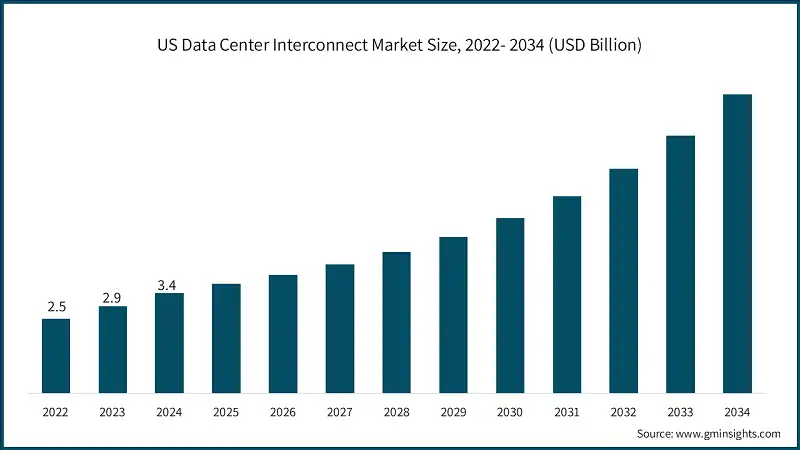
US dominated the data center interconnect market in North America with around 85% share and generated USD 3.4 billion in revenue in 2024.
- US which has a strong digital infrastructure and hyperscale cloud providers (Amazon Web Services, Google Cloud, Microsoft Azure), as well as a high level of concentration of enterprise and colocation data centers. DCI deployment is driven by strong customer demand to high-speed/low latency interconnection across metro and regional domains in financial, healthcare and e-commerce verticals. The U.S. is also the center where widespread 400G/800G optical network upgrades are happening and the use of open optical networking standards.
- In February 2025, Broadcom introduced high-speed and PCIe Gen6 retimers optimized to use AI data centers. Portfolio of PCIe Gen 6 including high-port switch and retimer and early-access Interop Development Platform (IDP), developed with Micron and Teledyne LeCroy.
- Interconnect needs are being accelerated by public-private partnerships and federal investments in digital resilience and cybersecurity and AI workloads. Programs such as the CHIPS and Science Act and rising AI data training centers are driving east-west traffic surges, necessitating scalable and secure DCI solutions. As a result, the U.S. leads both in market share and innovation adoption.
- Canada is expected to grow at a CAGR of over 13% through 2034 in the market, driven by increasing cloud adoption, growing AI workloads, federal digital infrastructure investments, and demand for high-bandwidth connectivity across provinces. Rising hyperscale deployments and enterprise data traffic are further accelerating growth.
The data center interconnect market in Germany is expected to experience significant and promising growth from 2025-2034.
- Europe accounts for around 21% of the market in 2024 and is expected to grow at a CAGR of over 10% owing to increasing cloud adoption, cross-border data traffic, and rising investments in digital infrastructure and low-latency connectivity.
- The German market is a key market in the European data center interconnect (DCI) in many ways because of its concept of high-density data infrastructure, robust enterprise IT penetration as well as high industry modernization. It includes key data centers such as Frankfurt that act as a nexus point of pan-European and global interconnectivity. The strong utilization of colocation plants and the existence of major telecom operators such as Deutsche Telekom and Vodafone serve the expansion of DCI application as well.
- In addition, the existence of advanced government backing of digital infrastructure and cybersecurity, as well as the growing interest in interconnection submitted by cloud providers and hyperscale data centers, provide great benefit to Germany. Regulatory systems that favor data localization and adhering to GDPR also promote enterprises to take on-premises and hybridized DCI, which has firm control over the regional market by Germany.
- For example, in March 2025, Germany’s national research and education network (DFN) selected Nokia to upgrade its optical backbone from 100G to 400G, with capacity to scale to 800G. The upgrade connects over 850 institutions across Germany, highlighting demand for ultra-high-speed DCI within mission-critical public infrastructure.
- The UK is already becoming the fastest-growing market for data center interconnect (DCI) in Europe due to escalating demand of cloud-native enterprise services, edge data traffic, and resilient multi-site connectivity. Large telecom and colocation providers such as BT, Colt and Equinix are developing interconnectivity infrastructure between major cities including London, Manchester and Slough, thus providing the opportunity to transmit over low-latency, high-capacity. DCI deployment is also being driven by the UK, which is pursuing digital sovereignty, adopting cloud technology in the government, and establishing infrastructure independence after Brexit.
The data center interconnect market in China is expected to experience significant and promising growth from 2025-2034.
- Asia Pacific accounts for over 34% of the global data center interconnect industry in 2024 and is the fastest-growing region with a CAGR of around 16% owing to rapid data center expansion, rising cloud adoption, increasing internet penetration, and government-led digitalization initiatives across countries like China, India, and Southeast Asia.
- In the Asia Pacific data center interconnect market, China is rapidly developing its digital infrastructure on a large scale and integrating “New Infrastructure” as a national strategy in its strategic planning. The rapid growth in data centers across the country, especially in major hubs such as Beijing, Shanghai, and Guangdong is contributing to the need to have DCI technologies that guarantee highly specified, low-latency data transfer between locations.
- The emergence of hyperscale data center deployments through cloud computing providers using Alibaba Cloud, Tencent Cloud, and Huawei Cloud, to name a few, has created a tremendous amount of demand on the high-tech interconnectivity needed to support cloud computing deployments. These companies are making investments in DWDM, OTN, and DCI based on Ethernet solutions to process the growing data traffic and enterprise loads.
- For example, in August 2024, NOKIA launched a high capacity and high bandwidth DWDM optical network in Southeast Asia designed to interconnect Telekom Malaysia infrastructure as the hyperscale edge and DCI footprint to offer high-capacity connectivity to Asia and beyond.
- In addition, the 5G installation, and the increasing use of AI and IOT use cases in China are increasing the pace at which the DCI systems that provide responsiveness, scalability, and security are demanded. Presence of government activities that promote edge computing, green data centers also support China in its growth path in the global DCI market.
- India is the fastest-growing economy in the region due to surging digital transformation, increasing cloud adoption, and government-led data localization mandates. Heavy investments in hyperscale players such as AWS, Google, and Microsoft as well as the exploding 5G networks and edge-computing are fueling the need to provide high-capacity data center interconnect solutions to enable scalable enterprise and low-latency connectivity.
The data center interconnect market in Brazil is expected to experience significant and promising growth from 2025-2034.
- Latin America holds around 5% of the global market and is growing steadily at a CAGR of around 13%. This growth is driven by the rapid expansion of digital services, international company interconnection, and increasing need of low-latency in between-data architectures. Telecom operators and governments are working on infusing powerful infrastructure in their national colocation and cloud link regions to assist in economic modernization and regional survivability of digital disturbances.
- Brazil dominates the Latin America DCI market, and its enterprises have a huge geography and varied data center clusters (e.g., Sao Paulo, Rio, Campinas), and robust enterprise demand driven by finance, e-commerce, and digital services. Telecommunication companies such as Claro and Vivo are also deploying high-capacity fiber and metro DWDM connections, and hyperscalers (AWS, GCP, Microsoft Azure) are building regional interconnect centers so that they can create secure high-speed connectivity between data centers.
- The data center interconnect market in Mexico is the fastest growing in the region, as its regulation landscape continues to shape up, enterprises ramp up cloud usage, and interconnection challenges between Mexico City, Guadalajara, and Monterrey necessitate resilient infrastructure. Enterprise cloud migration and content delivery is driving upgrades of optical backbone networks with DWDM and 100G+ coherent transport offered by national carriers like Telmex or Axtel.
The data center interconnect market in South Africa is expected to experience significant and promising growth from 2025-2034.
- The Middle East and Africa (MEA) combined represent about 4% share for the data center interconnect industry in 2024, and the region is experiencing steady growth that is attributed to expanding cloud adoption, rising mobile-first enterprise services, and increasing reliance on digital infrastructure to support remote work and smart city initiatives. While private and hyperscale deployments drive demand in urban centers, coverage gaps in rural and low-connectivity areas constrain full regionwide scaling.
- South Africa is also the most advanced DCI market in MEA due to its developed colocation and telecom infrastructure. Interconnected via high-speed DWDM and metro-fiber circles, major tier-1 data centers in both Johannesburg and Cape Town depend on reliable national power grid systems and enterprise demand that originates among BFSI and IT services.
- The fastest growing market in the region is the United Arab Emirates (UAE) due to the investments in smart cities in Dubai and Abu Dhabi. DWDM and coherent optical interconnects are being deployed in government data hubs and hyperscale entrants to support low-latency, uncompromised, secure connectivity of digital services, real-time analytics, and AI workloads across their many campuses.
Data Center Interconnect Market Share
- The top 7 companies in the Data center interconnect industry are Cisco, Juniper, Nokia, Huawei, Fujitsu, Arista Networks, and Extreme Networks which contributed around 34% of the market in 2024.
- Cisco specializes in high-capacity and automated DCI with NCS 1000 and 2000 series and Cisco ACI (Application Centric Infrastructure). It focuses on the automated network architecture via AI, hybrid cloud integration, and whole intent-based networking. The strategy implemented by Cisco is the incorporation of optical networking and programmable infrastructure to facilitate the benefit of scaling and multi-site connectivity using a better level of visibility, security as well as latency management in the data centers.
- Juniper uses its MX series routers and PTX transport platforms along with NorthStar Controller to deliver scalable and automated DCI. They are focused on AI powered routing, cloud-grade infrastructure and SDN to aid bandwidth efficiency, real-time orchestration, and traffic engineering. The approach adopted by Juniper focuses on the concepts of interoperability, zero-trust architecture, and environmentally conscientious connectivity by making use of lean optics and energy-efficient elements of networking.
- Nokia has DCI strategy based on its 1830 Photonic Service Switch (PSS) and WaveFabric. It concentrates on end-to-end automation, high-capacity coherent optics and open optical networking. Nokia has also allied SR Linux and the NetConf/YANG into its DCI portfolio in order to enable programmable operations and the inter-cloud scalability. Alliance with hyperscalers and cloud-native solutions continue the outline of its growth strategy.
- Huawei provides OptiXtrans DC908 which refers to DCI production, high-performance interconnects that are ultra-broadbanded and simple to deploy. The company strategy involves 200G/400G coherent optical transmission, intelligent O&M based on AIOps and green optical network. Huawei is focusing its optical and IP convergence to solve the big scale data replication, cloud movement, and disaster recovery mainly in the Asia and EMEA market.
- Fujitsu specializes with carrier-grade in DCI by using the 1FINITY branded T-series transponders and Virtuora branded network control software. They focus on open, disaggregated, and modular optical networking in addition to automation in service orchestration and network slicing. Fujitsu DCI roadmap enables 400ZR, ROADM flexibility and energy efficient transport optimized to edge data center and enterprise cloud deployment.
- Arista DCI strategy is based on leaf-spine deployments, VXLAN EVPN overlays, and real-time network state streaming and automaton with CloudVision. The company is aiming at cloud-scale customers with sub-1 microsecond 400G/800G switchers and emphasizes deterministic performance and open standards. Arista also focuses on visibility and telemetry in DCI sub spheres to ensure optimum network convergence and retention of remote workload.
- Extreme has been using its Fabric Connect, SLX routers, and ExtremeCloud IQ to provision dynamic and software defined DCI. The strategy is aligned to hyper-segmentation, automation, and cloud networking with the help of AI. Focusing on streamlined edge-to-core connectivity, Extreme is aiming at academic institutions, government and medical services with the goal of connecting multi-site infrastructure to low-touch DCI networking with secure connectivity.
Data Center Interconnect Market Companies
Major players operating in the data center interconnect industry are:
- Arista Networks
- Broadcom
- Cisco
- Extreme Networks
- Fujitsu
- Huawei
- IBM
- Infinera
- Juniper
- Nokia
- The market strategy in the data center interconnect market is also focused on the scalability and high-capacity optical networking that can deliver exponential data growth of data centers geographically scattered. The majority of the vendors are working to roll out 400G/800G coherent optics that allow the very high bandwidth, low-latency, and energy-efficient use. The solutions are commonly combined with programmable transport layers to add ease to large-scale and multi-cloud and hybrid deployments on enterprise and hyperscale networks.
- Automation and software defined as networking (SDN) as a differentiator is the other significant strategy to reduce operational costs and complexity. The providers are making investments in open and controller-based architectures that have built-in AI/ML capacity to ensure predictive analytics, fault handling, and intelligent routing of traffic. This transition helps in taking self-optimizing networks that have the capability to change dynamically according to real time workloads, disaster recovery requirements as well as variations in requirements of bandwidth.
- Moreover, the focus of DCI strategies is based on security, sustainability and interoperability. To protect data in transit, zero-trust models, encrypted optical transport, and compliance-driven architecture have become the widely distributed ones. At the same time, sustainability initiatives are opening the door to innovation in terms of energy-efficient hardware and environmentally responsible design. The importance of open standards and multivendor interoperability is vital particularly to clients having hybrid employments where direct interconnection of data centers and public cloud drawing is a fundamental principle to business continuity and execution of services.
Data Center Interconnect Industry News
- In November 2024, Nokia partnered with Dutch hosting provider Cloudbear to deploy a cutting-edge data center networking solution based on Kubernetes. The integration includes Nokia’s data center fabric switches and gateway routers, significantly enhancing Cloudbear’s hosting services across Europe. The initiative is aimed at improving network speed, reliability, and security while enabling tailored service delivery to European customers.
- In October 2024, Juniper Networks deployed its AI-Native Networking Platform, powered by Mist AI, for Seoul Semiconductor to enhance wired and wireless network access. The platform optimizes network performance using AIOps and microservices, improving employee productivity while reducing operational overhead through automated, measurable connectivity solutions.
- In March 2024, Infinera Corporation unveiled its ICE-D intra-data center optics solution, delivering high-speed connectivity of up to 1.6 Tb/s. Leveraging indium phosphide photonic integrated circuits, the technology achieves a 75% reduction in power consumption per bit, making it a highly energy-efficient choice. Designed to address the surging bandwidth demands from AI workloads, the solution supports scalable, cost-effective operations, anticipating a tenfold market growth in the DCI segment by 2027.
- In February 2024, Huawei Technologies Co., Ltd. launched the OptiXtrans DC908 Pro, its next-generation data center interconnect platform, at MWC Barcelona 2024. The system delivers 1.2 Tbit/s single-wavelength transmission over 240 km, backed by 99.999% reliability and AI-powered intelligent deployment capabilities. Engineered for the AI-driven digital era, this platform enables secure, ultra-reliable, and simplified inter-data center transmission, addressing the growing data exchange needs across enterprise and hyperscale environments.
The data center interconnect market research report includes in-depth coverage of the industry with estimates & forecasts in terms of revenue ($Bn) from 2021 to 2034, for the following segments:
Market, By Component
- Hardware
- Optical transceivers
- Switches & routers
- Cables & connectors
- Optical amplifiers
- Others
- Software
- Software-defined networking (SDN)
- Network management software
- Analytics & optimization software
- Others
- Services
- Professional
- Managed
Market, By Technology
- Synchronous optical network (SONET)
- Dense wavelength division multiplexing (DWDM)
- Ethernet
- Optical transport network (OTN)
- Others
Market, By Application
- Disaster recovery
- Content delivery
- Data replication
- Load balancing
- Cloud connectivity
Market, By Deployment Mode
- On-Premise
- Cloud
- Hybrid
Market, By Bandwidth
- Low bandwidth (Up to 1 Gbps)
- Medium bandwidth (1-10 Gbps)
- High bandwidth (10-100 Gbps)
- Ultra-high bandwidth (Above100 Gbps)
Market, By End Use
- Communications service providers (CSPs)
- Internet content providers & carrier-neutral providers (ICPs/CNPs)
- Government
- Enterprise
- BFSI
- Healthcare
- Media & entertainment
- Others
The above information is provided for the following regions and countries:
- North America
- US
- Canada
- Europe
- Germany
- UK
- France
- Italy
- Spain
- Netherlands
- Nordics
- Russia
- Asia Pacific
- China
- India
- Japan
- Australia
- South Korea
- Philippines
- Indonesia
- Singapore
- Latin America
- Brazil
- Mexico
- Argentina
- MEA
- South Africa
- Saudi Arabia
- UAE
Frequently Asked Question(FAQ) :
Who are the key players in the data center interconnect market?
Key players include Cisco, Juniper, Nokia, Huawei, Fujitsu, Arista Networks, Extreme Networks, Ciena, Infinera, and Broadcom.
What are the upcoming trends in the data center interconnect market?
Key trends include adoption of 400G/800G coherent optics, software-defined interconnects, AI-driven automation, and expansion of edge-to-core connectivity.
Which region leads the data center interconnect market?
North America held the largest share in 2024, led by the U.S. with USD 3.4 billion revenue, driven by hyperscale cloud providers and digital infrastructure investments.
What is the growth outlook for the hybrid deployment model from 2025 to 2034?
The hybrid deployment model is projected to grow at a CAGR of over 14% due to increased multi-cloud adoption and enterprise demand for flexible connectivity.
How much revenue did the hardware segment generate in 2024?
The hardware segment accounting for approximately 51% of the market share.
What is the market size of the data center interconnect in 2024?
The market size was USD 10.7 billion in 2024, with a CAGR of 13.1% expected through 2034 driven by rising AI workloads and cloud-edge integration demands.
What is the projected value of the data center interconnect market by 2034?
The data center interconnect market is expected to reach USD 35.9 billion by 2034, driven by hyperscale deployments, 5G expansion, and ultra-low latency requirements.
What was the valuation of on-premises deployment segment in 2024?
On-premises deployment held 56% market share in 2024.
Data Center Interconnect Market Scope
Related Reports