Summary
Table of Content

Data Center Immersion Cooling Market
Get a free sample of this report
Form submitted successfully!
Error submitting form. Please try again.
Thank you!
Your inquiry has been received. Our team will reach out to you with the required details via email. To ensure that you don't miss their response, kindly remember to check your spam folder as well!
Request Sectional Data
Thank you!
Your inquiry has been received. Our team will reach out to you with the required details via email. To ensure that you don't miss their response, kindly remember to check your spam folder as well!
Form submitted successfully!
Error submitting form. Please try again.
Data Center Immersion Cooling Market Size
The data center immersion cooling market is undergoing a rapid change due to the explosive growth of artificial intelligence workloads, the growing densities of power, and the growing demands of energy efficiency.
Data Center Immersion Cooling Market Key Takeaways
Market Size & Growth
- 2025 Market Size: USD 1.7 Billion
- 2026 Market Size: USD 2.1 Billion
- 2035 Forecast Market Size: USD 10.9 Billion
- CAGR (2026–2035): 19.8%
Regional Dominance
- Largest Market: North America
- Fastest Growing Region: Asia Pacific
Key Market Drivers
- Rise in rack power density and thermal challenges.
- Sustainability and reduction in PUE.
- Deployment in hyperscale and high-performance computing environments.
- Increasing interest from colocation and enterprise data centers.
Challenges
- High initial costs and design complexity.
- Material compatibility and maintenance issues.
Opportunity
- Expansion in AI/ML workloads and supercomputing sectors.
- Growing edge data center deployments in harsh environments.
- Fluid innovation and two-phase systems adoption.
Key Players
- Market Leader: Fujitsu led with over 6.36% market share in 2025.
- Leading Players: Top 5 players in this market include Bitfury, Fujitsu, Green Revolution Cooling, Submer, Vertiv, which collectively held a market share of 25.71% in 2025
Get Market Insights & Growth Opportunities
The U.S. Department of Energy estimates that data centers used more than 4.5% of the total electricity in the US in 2025, and will grow to 6.7% to 12% by 2028, and that cooling systems used 25-40% of total data center electricity. This threatening trend in the energy usage has intensified the use of more efficient cooling methods, including immersion cooling which has better thermal control and energy efficiency over conventional air-cooling methods.
According to the International Energy Agency, data center electricity consumption around the globe will be 260 TWh/s by 2026, accounting for 6% of overall electricity demand in the U.S., with 40% of data center power consumption attributed to cooling requirements. Immersion cooling (immersible servers) technology is a solution to this issue as it involves full immersion of servers in thermally conducting dielectric fluids that do not require a complex air conditioning system and allow much higher rack densities. The technology enables higher rack densities of over 100kW, which is needed in next-generation AI accelerators and high-performance computing applications.
Market expansion is also backed by attractive returns on investment metrics. According to BOYD Corporation, a 75% air-to-liquid cooling conversion has decreased the cost of power in the facilities by 27% and the total energy use of the data center by 15.5 percent, with the average Power Usage Effectiveness dropping to 1.55 in 2025. This efficiency, and the capability to utilize waste heat to provide district heating or industrial service, make immersion cooling one of the foundation technologies of sustainable data center operations to 2035.
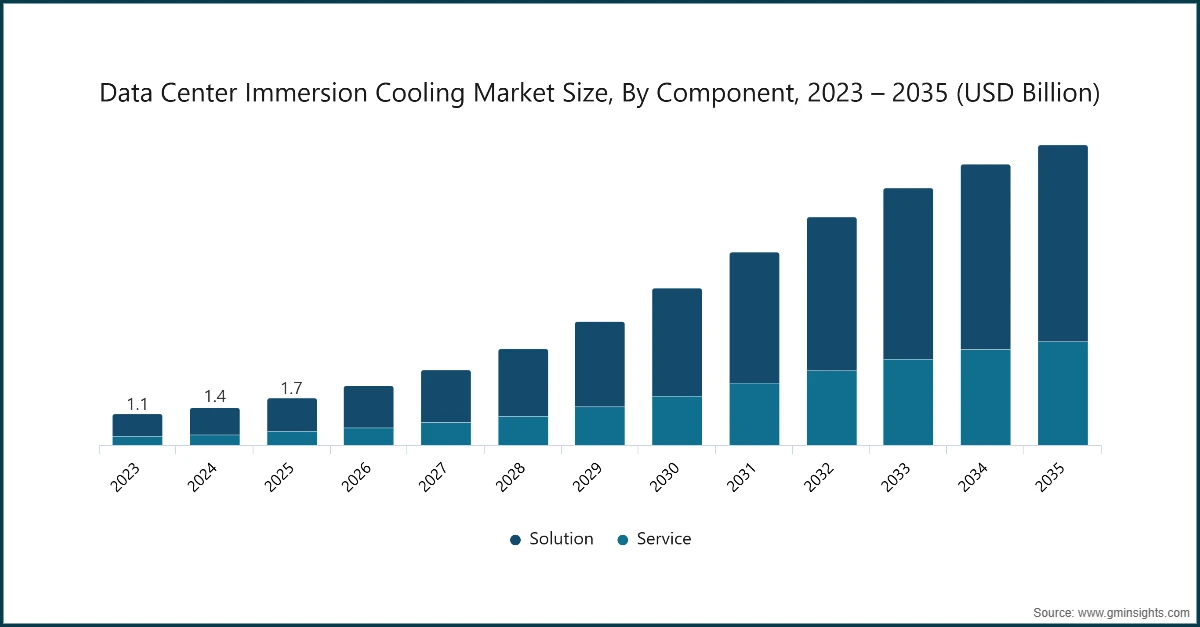
The global data center immersion cooling market was valued at USD 1.7 billion in 2025. The market is expected to grow from USD 2.1 billion in 2026 to USD 10.9 billion in 2035 at a CAGR of 19.8%, according to latest report published by Global Market Insights Inc.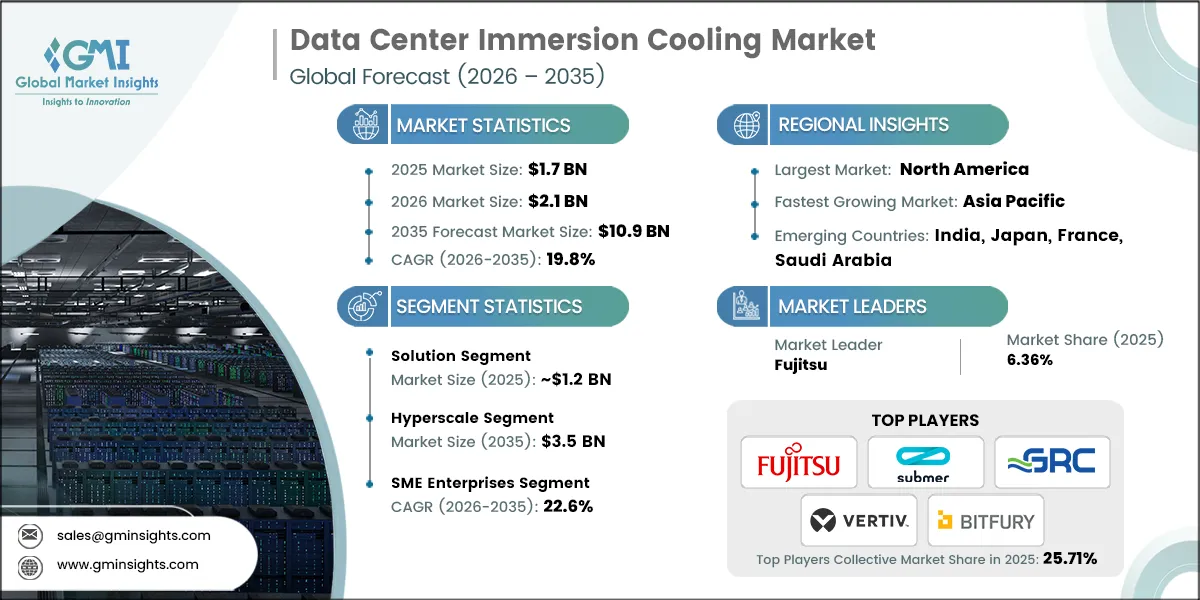
To get key market trends
Data Center Immersion Cooling Market Trends
The most important factor that has pushed towards the use of immersion cooling is the increase in workloads associated with artificial intelligence and machine learning. According to Data Center Frontier, average rack density has increased by almost two times (6.1 kW to 12 kW) with 60% of data centers currently adding density, and 40% of those deployments using liquid cooling. AI training clusters and inference servers impose the highest thermal loads ever, and each accelerator uses 700W to 1000W and demands cooling systems that can handle these localized sources of heat without limiting performance.
The growing energy prices and environmental sustainability pressure intensify the economic need of efficient cooling. Based on the U.S. Energy Information Administration, the commercial electricity sales in data center-intensive states such as Virginia and Texas rose by 14 billion kilowatthours and 13 billion kilowatthours, respectively, between 2019 and 2023, much of which was caused by the rise in data center operations. Immersion cooling is one way to solve this challenge, as it can cut cooling-related power usage by 40-60% as compared to air-cooled plants, which has a direct effect on the operational costs and carbon footprint indicators.
The urban data centres and colocation facilities have limited space, which enhances more rapid adoption. The 5-10x increased compute density per square foot through immersion cooling is also applicable to air-cooled deployments, which means that operators can make the most out of existing facilities without the need to make expensive expansions. This is a density benefit that is especially useful in markets that have limited real estate supply or have zoning policies that restrict new development.
Single-phase immersion cooling systems keep the fluid in liquid form during operation and they depend on circulation pumps and external heat exchangers to remove thermal energy. These are systems that are normally run using mineral oils, synthetic hydrocarbons or special synthetic fluids at temperatures of 40-60 C. The technology provides easier maintenance, reduced fluid expenses, and can be used with numerous server hardware with limited alterations.
Data Center Immersion Cooling Market Analysis
Learn more about the key segments shaping this market
Based on component, the market is divided into solution and service. The solution segment dominated the market with a 72% share and generating revenue of around USD 1.2 billion in 2025.
- The solution segment includes full immersion cooling systems such as tanks, coolant distribution systems, heat exchangers, monitoring equipment and integration hardware.
- Solution providers are also now providing turnkey deployments that can easily integrate with the existing data center infrastructure. For instance, in January 2026 Vertiv announced extended modular immersion in edge AI data centers, collaborating with hyperscalers such as Equinox to deploy in a short period. These modular solutions save months of time during installation and also minimize the interference to the current operations to a few weeks.
- The state-of-the-art solutions now have inbuilt thermal monitoring, automatic coolant control and links with building management systems to optimize overall efficiency. For instance, in January 2026, GRC introduced AI optimized single phase tanks, which were built with Intel latest Xeon 6 processors specifically to U.S. hyperscalers. These application-specific solutions reflect the move towards application-specific cooling infrastructure that is optimized to support specific workload profiles and processor architecture.
- The service segment includes installation, maintenance services, coolant services, performance optimization, and retrofit services of the existing facilities. With the maturity of the immersion cooling technology, service providers are evolving specialized skills in fluid chemistry, thermal dynamics, and system integration. This segment has the advantage of recurring revenues with maintenance deals, coolants change deal and performance checking subscriptions.
- Service offerings are expanding to provide thermal modelling and computational fluid dynamics to optimise tank placement, coolant flow patterns, and heat rejection plans. Facility operators who are not already familiar with the technology of immersion cooling are also provided with training programs by providers, helping them overcome a major adoption barrier. The technical difficulties of immersion cooling integration into the current infrastructure introduce a long-term need for professional advice and technical assistance.
Learn more about the key segments shaping this market
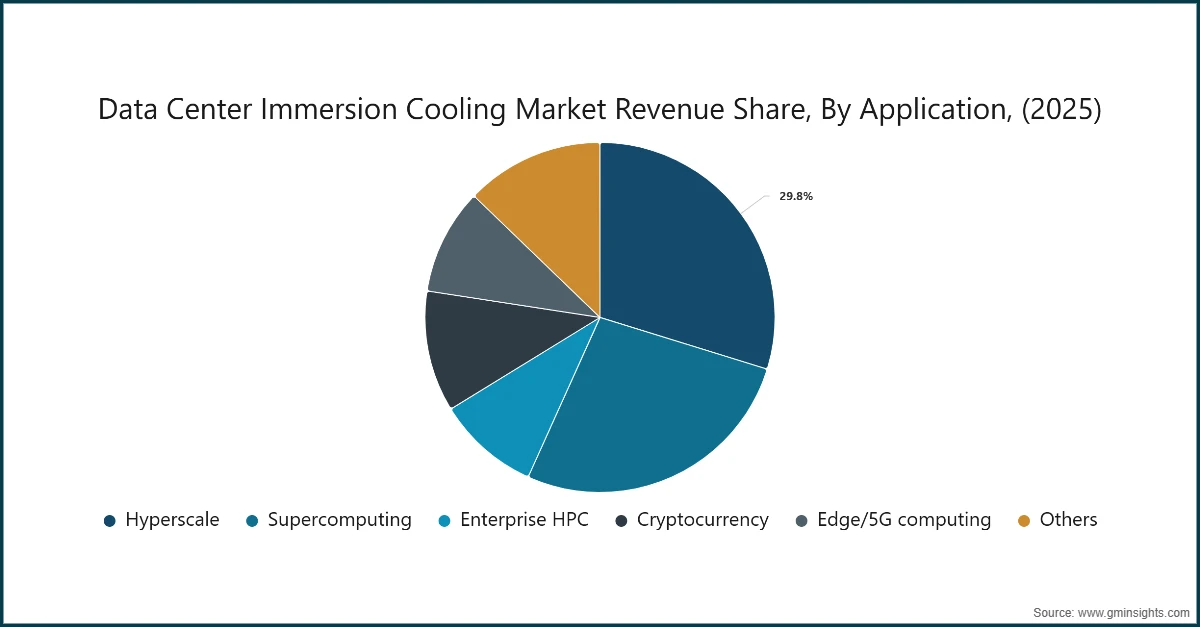
Based on application, the data center immersion cooling market is divided into hyperscale, supercomputing, enterprise HPC, cryptocurrency, edge/5G computing, and others. The hyperscale segment accounts for 29.8% share in 2025 and is expected to reach USD 3.5 billion by 2035.
- Hyperscale deployments are the most sizeable end-user, which is being propelled by giant AI training infrastructure investments by cloud providers and internet giants. These facilities operate at unprecedented scale with tens of thousands of servers packed into dedicated spaces. For instance, in January 2026, Submer and Inspur further collaborated on China-based hyperscale racks, aiming at 100kW+ densities with two-phase systems, as a result of the thermal extremes of frontier AI model training.
- Hyperscale operators give emphasis on total cost of ownership measures such as capital investment, operational effectiveness, and infrastructure durability. Immersion cooling solves all three aspects of reducing costs of cooling infrastructure, minimizing power usage, and increasing hardware longevity due to constant operating temperatures. Repurposing waste heat to provide heating to the facilities or nearby industrial uses also increases economic feasibility of hyperscale deployments to cold climates.
- Supercomputing facilities are also among the first users of immersion cooling technology, owing to their very high performance needs and highly advanced technical capabilities. Systems in research institutions and national laboratories have high density processors which create intense thermal loads that are difficult to cool using traditional methods. A higher processor frequency and sustained performance without thermal throttling is made possible through immersion cooling and is of direct benefit to scientific computation throughput.
- The high-performance computing is used in commercial areas such as financial services, pharmaceutical research, automotive design, and energy exploration. These applications demand substantial computing resources but operate under different constraints than hyperscale or academic supercomputing environments. Immersion cooling is being used in greater numbers to deploy enterprise HPC systems to achieve the highest computing density in a small data center footprint, especially in urban corporate data centers where real estate costs do not allow them to grow.
- Cryptocurrency mining is a niche yet important market segment that is associated with constant activity at full processor capacity. The mines are frequently set up in areas where electricity is cheap, and even where the thermal conditions are difficult. Immersion cooling has paramount benefits such as the minimization of electricity used in cooling, the capability of functioning in a higher ambient temperature, and defense against dust and humidity in factories.
Based on organization size, the data center immersion cooling market is divided into SME and large enterprises. The SME enterprises segment is expected to grow at the fastest CAGR of 22.6% between 2026 and 2035.
- Small and medium enterprises represent an emerging market segment as immersion cooling technology becomes more accessible through modular solutions and managed service offerings. SMEs typically lack dedicated facilities management expertise and capital for large-scale infrastructure investments, creating demand for turnkey systems with predictable operational costs. Immersion cooled infrastructure is becoming a high-end feature of colocation providers, allowing SMEs to use high-end cooling technology without capital investment.
- This segment particularly values simplified operations and minimal maintenance requirements. The simplicity of managing the coolant and the ability to use standard server hardware are the main factors that make single-phase immersion systems attractive to SMEs. With the cost-cutting impact of economies of scale and the maturity of technology, SME adoption will likely increase faster, especially in the organizations using AI workloads or in areas with high electricity prices or thermal management issues.
- Large companies hold most of the current market revenue because they have great computing infrastructure and elaborate procurement procedures. Such organizations run a variety of data centers with different workloads, including general-purpose computing and special AI training and high-performance computing applications. Major companies consider immersion cooling as part of an overall technology roadmap based on the overall cost of ownership, sustainability pledges and strategic computing potentials.
- Large enterprises are highly interested in immersion cooling due to corporate sustainability efforts. A lot of organizations have set the carbon neutrality goals that demand significant decreases in the energy usage of data centers. Immersion cooling directly deals with scope 2 emissions of electricity use and makes it possible to join in the initiatives of the circular economy by using waste heat as a resource. Corporate real estate strategies are also aided by technology by ensuring that computing density in the current facilities is maximized, avoiding or postponing the need to expand the facility at a high cost.
Based on cooling fluid, the data center immersion cooling market is segmented into mineral oil, synthetic fluid, and fluorocarbons-based fluid. The synthetic fluid segment dominated the market, generating revenue of USD 1.1 billion in 2025.
- Mineral oil is the cheapest form of cooling fluid that uses refined petroleum products which have great thermal properties and electrical insulation properties. Over decades of operation, technology has proven itself in terms of reliability in transformer cooling processes and offers a sense of stability and compatibility of the components. Mineral oil systems are generally half the price of synthetic alternatives, which makes it appealing to cost-conscious deployments and first immersion cooling pilot programs.
- Synthetic fluids include engineered polyalphaolefins and hydrocarbons as well as synthetic fluids that are meant to be used in immersion cooling. The fluids have better thermal stability, reduced viscosity that increases convective heat transfer and better biodegradability than mineral oils. Synthetic fluids are highly stable in the long run with minimal degradation, and this lowers the replacement rate and the cost of operation.
- In May 2025, Intel approved Shell immersion cooling fluids with 4th and 5th generation xeon processors, which are used to accelerate the adoption of server OEMs. This certification confirms the safety and performance of synthetic fluids using state-of-the-art processors eliminating any concerns about the compatibility of fluids with sensitive electronic parts.
- Further, in April 2025, Shell signed a Power Purchase Agreement with nLighten to supply nLighten with renewable energy to its Madrid data center, which supports immersion cooled edge operations and evidence integration with sustainable energy programs.
- Fluorocarbon-based fluids, particularly engineered fluorocarbons and hydrofluoroethers are the high-end market that allows two phase immersion cooling systems. These fluids have very low boiling points of 50-60°C, and the phase-change cooling of the fluids removes the need to pump the fluids and has a high heat transfer coefficient. The technology enables the largest power densities of over 200kW per rack, needed by frontier AI accelerators and next-generation high-performance computing systems.
Looking for region specific data?
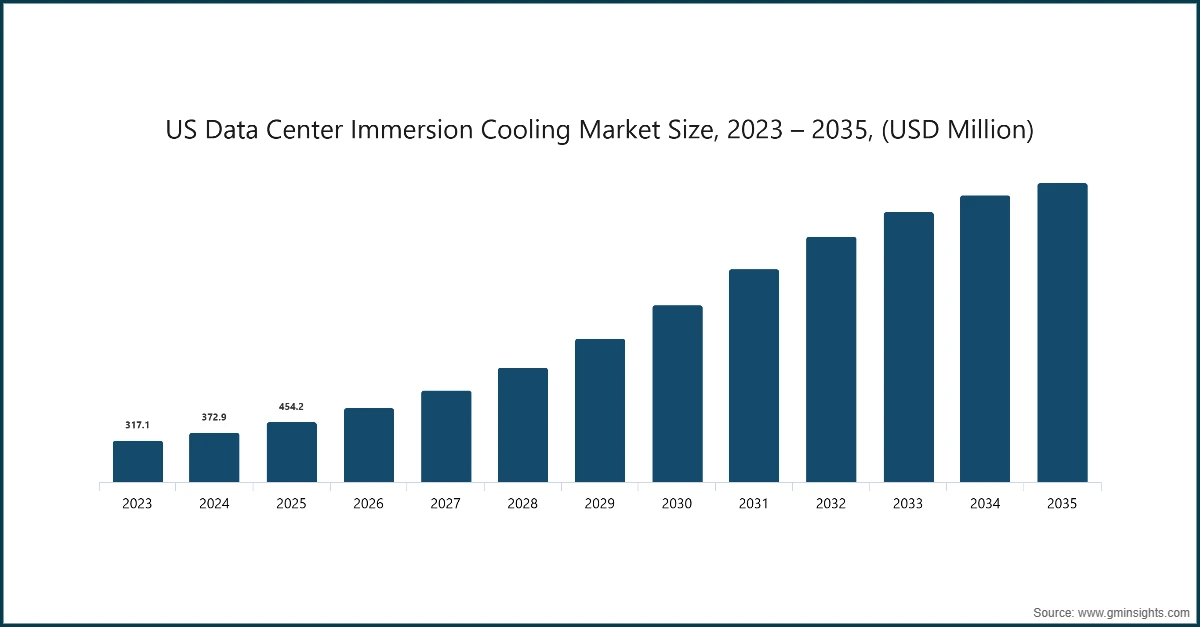
US dominated North America data center immersion cooling market, generating revenue of USD 454.2 million in 2025 with CAGR of 16.9% from 2026 to 2035.
- In US, the increase in demand for effective cooling systems is driven by the increase in demand from key clouds service providers and technological companies, who are based in the region to accommodate their increasing data center infrastructures. These organizations require emerging cooling technologies to sustain the competitiveness in terms of their costs of operation.
- The move towards sustainability and energy efficiency, as seen in the region, is resulting in improved usage of immersion cooling technologies. There has also been an increase in the usage of advanced cooling technologies by data center operators, aiming to ensure that they are meeting their obligations concerning environmental compliance while aiming to reduce costs of operation.
- Further, the market is supported by government initiatives to develop energy efficiency and sustainability within data centers. Market growth is being supported by government initiatives aimed at energy efficiency and sustainability in data centers. The immersion cooling technology is being adopted due to federal and state-level subsidies on energy-efficient technologies.
- Canada is expected to register significant growth during the forecast period due to the rising constructions of data centers and rising consciousness on energy efficient cooling options amongst Canadian business and providers of services.
UK dominated the Europe data center immersion cooling market accounting for USD 118.1 million in 2025 and is anticipated to show growth of 16.8% CAGR over the forecast period.
- In UK, energy efficiencies and carbon neutrality legislation mandated by the European Union is impacting the use of advanced cooling systems for data centers. The implementation of environmentally sustainable practices is generating high demand for immersion cooling solutions.
- Germany is one of the fastest-growing markets in Europe because of its structural strength as an industrial nation and its technical production capacity. In addition to this, the emphasis laid on the industry 4.0 plans have also spawned the need to deliver high-performance computing capabilities, which require effective cooling to be achieved.
- Data center construction, as well as data center modernization, is undergoing a significant transformation in United Kingdom, where the requirements of brexit-related data sovereignty and the growing need of local data processing services are the driving forces.
- France is investing a lot in data center infrastructure and sustainable technologies, and government initiatives prompt the use of energy efficient cooling solutions. Development of nuclear energy in this country offers a reliable source of power that can be utilized in the workings of data centers.
- As developed nations like Norway, Sweden, and Denmark are endowed with cold climates, the availability of renewable energy deposits, and favorable policies towards green technologies, they are emerging as promising sites of data centers development.
The data center immersion cooling market in China is expected to experience significant and promising growth with a CAGR of 20.8% from 2026 to 2035.
- China represents the largest market in the Asia Pacific region, attributed to the massive investments that have been put into data centers, as well as the development of artificial intelligence solutions. The ambitiousness of the country to transform itself into the global technology hub is generating huge demand for high quality cooling solutions.
- The upsurge of software applications, especially in services, cloud, and artificial intelligence services, has boosted the demand for high-density compute environments that require efficient cooling solutions.
- India is the fastest growing market in Asia Pacific. It is gaining fast digitalization and rising infrastructural investment in data centers in India, mainly due to the government of India encouraging the digital India trend and the higher need of cloud services. The data center operations require effective cooling in the country due to the hot climatic effects of the country.
- The construction and modernization of the data centers are also growing tremendously in Japan due to the digital transformation plans and growing needs to use cloud services. Ensuring energy efficiency and environmental sustainability is the driver the country is looking forward to achieving, which is also contributing to the mainstreaming of immersion cooling technologies.
- South Korea invests a lot in the development of infrastructure via 5G technology and artificial intelligence breakthrough, which creates a need for high-performance computing systems with great coolers.
Brazil dominates the Latin America data center immersion cooling market, showcasing strong growth potential, with a CAGR of 19.8% from 2026 to 2035.
- Brazil represents the largest market in Latin America as it is driven by digital transformation strategies and increasing demand for cloud services. Increasing technology industry in Brazil is raising demand for efficient cooling solutions in the data centers.
- Argentina is witnessing a fastest growth in data center construction, driven by hyperscale data center demand, data localization policies, and land availability & tax benefits through RIGI, with giant players such as OpenAI investing in a 500MW data center.
- There has also been an increase in investment in data center infrastructure in Colombia, considering the government initiatives towards undergoing a process of digital transformation and cloud consumption, which continues to increase.
- The emphasis on energy efficiency and the concept of sustainability in the region opens up the possibility of adoption of immersion cooling technology especially in the poor environmental conditions’ countries.
UAE leads the Middle East & Africa data center immersion cooling market, exhibiting remarkable growth of 18.4% during the forecast period of 2026 to 2035.
- The United Arab Emirates is leading the region in data center development, as the government focuses on the digital transformation and smart city development. The strategic position and the good infrastructure in the country is inviting foreign investments in data centers.
- Saudi Arabia is the fast-growing country in MEA. The Kingdom of Saudi Arabia is undertaking Vision 2030 to build data centers; this strategy has necessitated the need to install effective cooling systems in harsh environmental conditions. The extreme weather in the country makes sophisticated cooling systems very crucial.
- The biggest marketplace in Africa region is marked by South Africa because of the rising digital world and demand of cloud operation. Developing technology sector in the country is giving the opportunity of advanced cooling solutions.
Data Center Immersion Cooling Market Share
The top 7 companies in the data center immersion cooling industry are Green Revolution Cooling, Submer, Fujitsu, Asperitas, Vertiv, Bitfury Group Limited, and DCX Liquid Cooling Company, contributing 27.4% of the market in 2025.
- DCX Liquid Cooling Systems is a prominent provider of single-phase immersion (submerged) cooling systems for data centers. The company supplies complete solutions including immersion tanks, pumps, heat exchangers, and monitoring systems, optimized for high-density computing environments with superior energy efficiency compared to traditional air-cooling modules.
- Green Revolution Cooling (GRC) based in San Francisco is a company operating in immersion cooling market, providing high-performance data centers with single-phase immersion cooling systems. ElectroSafe fluids offered by the company are free of toxicity and are not inflammable and have superior thermal properties with which they efficiently facilitate heat transfer.
- Submer is a European company focusing on data centers and high-performance computing solutions using immersion cooling systems. The company has a complete cooling system which comprises immersion tanks, cooling distribution and monitoring units which are made to be efficient with regard to use of energy and reliability in operation.
- Fujitsu is a large technology platform that provides immersion cooling to the extensive data center offering. The cooling systems required by the company are meant to help them in the case of high compute densities and at the same time deliver efficient energy as well as low costs required during operation.
- Asperitas is a Dutch company, which has been developing immersion cooling technology to be used in data centres and high performative computing. The corporation develops creative refrigerating services to employ the best distinctive capacities in energy use, minimal use of the environment.
- Vertiv is a worldwide leader providing technological solutions for the critical infrastructure, such as the immersion cooling system of the data centers. The firm provides complete cooling solutions in a bid to assist in mission-critical applications with high-level reliability and efficiency.
- Bitfury is an organization that is involved in technology consisting of immersion cooling solutions that are specifically designed to cater to the cryptocurrency mining industry. The cooling systems of the company are high density mining optimized that offer better thermal and energy management systems.
Data Center Immersion Cooling Market Companies
Major players operating in the data center immersion cooling industry are:
- Asperitas
- Bitfury
- DCX Liquid Cooling Company
- Dell Technologies
- Fujitsu
- Green Revolution Cooling
- LiquidCool Solutions
- Midas Immersion Cooling
- Submer
- Vertiv
- The data center immersion cooling market is marked with great competition and high technological development. Companies are working on new kinds of coolers that may outdone the competition in terms of cooling, energy efficiency and environmentally friendly operations.
- Strategic partnerships, acquisitions, and product development initiatives are common strategies employed by market participants to strengthen their competitive positions.
- Market players are also putting in more investment on research and development activities where the firms target to come up with next generation cooling fluids, advanced monitoring systems, and integrated cooling solutions. The introduction of artificial intelligence and machine learning solutions in the management of cooling systems is generating a novel potential for differentiating positions at the market and competitive strength.
Data Center Immersion Cooling Market Report Attributes
| Key Takeaway | Details |
|---|---|
| Market Size & Growth | |
| Base Year | 2025 |
| Market Size in 2025 | USD 1.7 Billion |
| Market Size in 2026 | USD 2.1 Billion |
| Forecast Period 2026-2035 CAGR | 19.8% |
| Market Size in 2035 | USD 10.9 Billion |
| Key Market Trends | |
| Drivers | Impact |
| Rise in rack power density and thermal challenges | Increasing AI, HPC, and GPU-intensive workloads are pushing rack densities beyond traditional air-cooling limits, accelerating the shift toward immersion cooling for superior heat dissipation and performance stability |
| Sustainability and reduction in PUE | Immersion cooling significantly lowers Power Usage Effectiveness (PUE), reduces water consumption, and supports carbon-reduction goals, making it attractive for hyperscale and enterprise sustainability strategies |
| Deployment in hyperscale and high-performance computing environments | Hyperscalers and supercomputing facilities are adopting immersion cooling to manage 50kW–100kW+ rack densities efficiently while improving energy efficiency and infrastructure compactness |
| Increasing interest from colocation and enterprise data centers | Colocation providers and enterprise operators are exploring immersion systems to differentiate offerings, support AI tenants, and optimize space utilization in high-cost urban markets |
| Pitfalls & Challenges | Impact |
| High initial costs and design complexity | Upfront capital expenditure, retrofitting requirements, and integration with existing power and IT infrastructure create financial and technical entry barriers |
| Material compatibility and maintenance issues | Concerns around fluid compatibility, component warranties, leak prevention, and technician training slow broader enterprise-scale adoption |
| Opportunities: | Impact |
| Expansion in AI/ML workloads and supercomputing sectors | Rapid AI model scaling and GPU cluster expansion create strong long-term demand for high-density, energy-efficient cooling alternatives |
| Growing edge data center deployments in harsh environments | Immersion cooling offers reliability in high-temperature, dusty, or remote environments where traditional air systems are inefficient |
| Fluid innovation and two-phase systems adoption | Advancements in dielectric fluids and pump-less two-phase architectures improve thermal efficiency, reduce auxiliary power consumption, and enhance commercial viability |
| Market Leaders (2025) | |
| Market Leader |
6.36% market share |
| Top Players |
Collective market share in 2025 is 25.71% |
| Competitive Edge |
|
| Regional Insights | |
| Largest Market | North America |
| Fastest growing market | Asia Pacific |
| Emerging countries | India, Japan, France, Saudi Arabia |
| Future outlook |
|
What are the growth opportunities in this market?
Data Center Immersion Cooling Industry News
- In January 2026, Vertiv introduced expanded modular immersion cooling solutions tailored for edge AI data centers. The company partnered with hyperscalers such as Equinix to accelerate rapid deployment strategies. The modular architecture supports scalable, prefabricated integration for high-density racks. This initiative strengthens Vertiv’s footprint in next-generation AI infrastructure.
- In January 2026, Submer and Inspur deepened their collaboration to deploy two-phase immersion systems for hyperscale racks in China. The partnership focuses on supporting power densities exceeding 100 kW per rack. It strengthens localized manufacturing and hyperscale deployment capabilities. This development signals accelerating adoption of immersion cooling in Asia’s AI infrastructure expansion.
- In May 2025, Intel certified Shell’s immersion cooling fluids for use with its 4th and 5th Gen Xeon processors. The certification enhanced compatibility assurance for OEMs and hyperscale operators adopting liquid-based cooling systems. This development reduced technical barriers for enterprise-grade immersion deployments. It also accelerated commercial readiness across AI and high-performance computing environments.
- In September 2025, Shell signed a renewable energy management agreement with Google for its UK Waltham Cross data center. While focused on energy supply, the collaboration indirectly supports immersion-cooled infrastructure operating under sustainability mandates. The agreement highlights the convergence of advanced cooling technologies and renewable power sourcing. It reinforces integrated energy-plus-cooling strategies in hyperscale markets.
- In October 2025, Shell partnered with QingAn Energy Storage (QAES) to implement immersion cooling in the world’s first immersion-cooled battery energy storage system (BESS). This marked a diversification of immersion technology beyond conventional data centers. The initiative demonstrated enhanced thermal stability and system longevity benefits. It also showcased the adaptability of dielectric fluid cooling in energy storage applications.
- In November 2025, Eaton acquired Boyd Thermal to expand its advanced thermal management capabilities, including immersion cooling solutions for AI-focused data centers. The acquisition strengthened Eaton’s presence in high-density rack cooling technologies. It also enabled deeper integration across power management and thermal systems. The move positions Eaton to compete more aggressively in hyperscale and AI infrastructure projects.
- In May 2025, Submer and Microsoft expanded their immersion cooling pilot deployments across European data centers. The partnership focused on sustainable dielectric fluids and efficiency optimization for AI workloads. Results from pilot programs supported scaling decisions in select facilities. The collaboration underscores growing enterprise confidence in immersion cooling for production environments.
The data center immersion cooling market research report includes in-depth coverage of the industry with estimates & forecasts in terms of revenue ($Mn/Bn) from 2022 to 2035, for the following segments:
Market, By Component
- Solution
- Cooling fluids
- Cooling racks/modules
- Filters
- Pumps
- Heat exchangers
- Others
- Service
- Installation & maintenance
- Training & consulting
Market, By Cooling Technique
- Single phase cooling
- Two-phase cooling
Market, By Cooling Fluid
- Mineral oil
- Synthetic fluid
- Fluorocarbons-based fluid
Market, By Organization Size
- SME
- Large enterprises
Market, By Application
- Hyperscale
- Supercomputing
- Enterprise HPC
- Cryptocurrency
- Edge/5G computing
- Others
The above information is provided for the following regions and countries:
- North America
- US
- Canada
- Mexico
- Europe
- UK
- Germany
- France
- Italy
- Spain
- Poland
- Russia
- Asia Pacific
- China
- India
- Japan
- South Korea
- Australia
- Singapore
- Malaysia
- Indonesia
- Thailand
- Latin America
- Brazil
- Argentina
- Chile
- Colombia
- MEA
- UAE
- Saudi Arabia
- South Africa
Frequently Asked Question(FAQ) :
What is the market size of the data center immersion cooling in 2025?
The global data center immersion cooling market was valued at USD 1.7 billion in 2025, with a CAGR of 19.8% expected through 2035, driven by explosive growth in AI workloads, rising power densities, and increasing demand for energy-efficient cooling solutions.
What is the projected value of the data center immersion cooling market by 2035?
The data center immersion cooling market is expected to reach USD 10.9 billion by 2035, propelled by hyperscale data center expansion, advancements in dielectric fluid technology, and growing adoption of AI and high-performance computing infrastructure.
What is the current data center immersion cooling market size in 2026?
The market size is projected to reach USD 2.1 billion in 2026.
What was the market share and revenue of the solution segment in 2025?
The solution segment dominated the market with a 72% share, generating approximately USD 1.2 billion in 2025, driven by demand for turnkey immersion cooling systems including tanks, coolant distribution units, heat exchangers, and integrated monitoring hardware.
What was the revenue generated by the US data center immersion cooling market in 2025?
The US dominated the North America market, generating USD 454.2 million in 2025, supported by major cloud service providers, federal sustainability initiatives, and rapid adoption of energy-efficient cooling technologies.
What is the growth outlook for the SME segment from 2026 to 2035?
The SME segment is expected to grow at the fastest CAGR of 22.6% between 2026 and 2035, driven by increasing accessibility of modular immersion cooling solutions, managed service offerings, and growing AI workload adoption among smaller organizations.
Which region leads the data center immersion cooling market?
US dominated North America data center immersion cooling market, generating revenue of USD 454.2 million in 2025 with CAGR of 16.9% from 2026 to 2035.
What are the upcoming trends in the data center immersion cooling market?
Key trends include integration of AI-based thermal management algorithms for dynamic workload optimization, advancements in two-phase cooling architectures and dielectric fluid chemistry, modular prefabricated immersion-ready data center designs, and increasing use of waste heat recovery for district heating and industrial applications.
Who are the key players in the data center immersion cooling market?
Key players include Asperitas, Bitfury, DCX Liquid Cooling Company, Dell Technologies, Fujitsu, Green Revolution Cooling, LiquidCool Solutions, Midas Immersion Cooling, Submer, and Vertiv.
Data Center Immersion Cooling Market Scope
Related Reports