Summary
Table of Content

Data Center Heat Exchanger Market
Get a free sample of this report
Form submitted successfully!
Error submitting form. Please try again.
Thank you!
Your inquiry has been received. Our team will reach out to you with the required details via email. To ensure that you don't miss their response, kindly remember to check your spam folder as well!
Request Sectional Data
Thank you!
Your inquiry has been received. Our team will reach out to you with the required details via email. To ensure that you don't miss their response, kindly remember to check your spam folder as well!
Form submitted successfully!
Error submitting form. Please try again.
Data Center Heat Exchanger Market Size
Data center heat exchangers have become essential for modern digital infrastructures, offering sophisticated thermal management for high-density computing. With the rise of AI workloads, cloud computing, and edge deployments, hyperscale and colocation data centers increasingly rely on heat exchangers to ensure operational reliability, energy efficiency, and sustainability.
Data Center Heat Exchanger Market Key Takeaways
Market Size & Growth
- 2025 Market Size: USD 2.8 Billion
- 2026 Market Size: USD 3 Billion
- 2035 Forecast Market Size: USD 7.2 Billion
- CAGR (2026–2035): 10.1%
Regional Dominance
- Largest Market: North America
- Fastest Growing Region: Asia Pacific
Key Market Drivers
- Exponential growth in AI and high-performance computing workloads.
- Rising thermal density (50–100 kW racks) and GPU heat generation (1,200 W+ per chip).
- Sustainability mandates and net-zero carbon emission targets.
- Inadequacy of traditional air-cooling for modern workloads.
- Hyperscale data center expansion.
Challenges
- High initial capital investment requirements for liquid-cooling infrastructure.
- Water consumption concerns.
Opportunity
- Retrofit market for legacy data centers.
- Edge and micro data center cooling solutions.
- Waste heat recovery and reuse applications.
- Modular and prefabricated cooling units.
Key Players
- Market Leader: Vertiv led with over 16% market share in 2025.
- Leading Players: Top 5 players in this market include Alfa Laval, Rittal, Schneider Electric, STULZ, Vertiv, which collectively held a market share of 47% in 2025.
Get Market Insights & Growth Opportunities
The market includes air-to-air, liquid-to-liquid, and refrigerant-based heat exchanger systems integrated into rear-door cooling units, in-row cooling systems, and direct-to-chip liquid cooling. Modern solutions have shifted from traditional air-cooling to advanced liquid and hybrid systems, managing rack densities over 30–100 kW. With the growing adoption of AI accelerators and high-performance GPUs, operators are utilizing plate and microchannel heat exchangers to enhance heat rejection while reducing water and energy usage.
The rapid adoption of data center heat exchangers is driven by regulatory, economic, and technological factors. For instance, in January 2025, the European Commission reinforced energy efficiency directives under the Energy Efficiency Directive (EED), requiring large data centers to disclose energy performance metrics and implement heat reuse and recovery systems.
For instance, in March 2025, the US Department of Energy expanded efficiency guidelines for mission-critical facilities, encouraging the adoption of advanced liquid cooling and waste heat recovery technologies. These regulatory measures have accelerated investments in high-efficiency heat exchanger technologies capable of reducing PUE (Power Usage Effectiveness) and supporting carbon neutrality goals.
Hyperscale operators like Amazon Web Services, Microsoft, and Google are heavily investing in AI-optimized data centers, increasing the need for advanced thermal management systems. The growing deployment of AI clusters and high-density server racks has driven demand for liquid-to-liquid heat exchangers integrated with Coolant Distribution Units (CDUs) and immersion cooling systems.
North America dominates the market due to the presence of hyperscale cloud providers, early AI infrastructure adoption, and strict efficiency standards. Europe focuses on sustainable data center operations and district heat reuse, driven by regulatory pressures. Asia Pacific records the fastest growth, supported by digital transformation, large-scale data center construction, and government initiatives for energy-efficient infrastructure.
The global data center heat exchanger market size was estimated at USD 2.8 billion in 2025. The market is expected to grow from USD 3 billion in 2026 to USD 7.2 billion in 2035, at a CAGR of 10.1% according to latest report published by Global Market Insights Inc.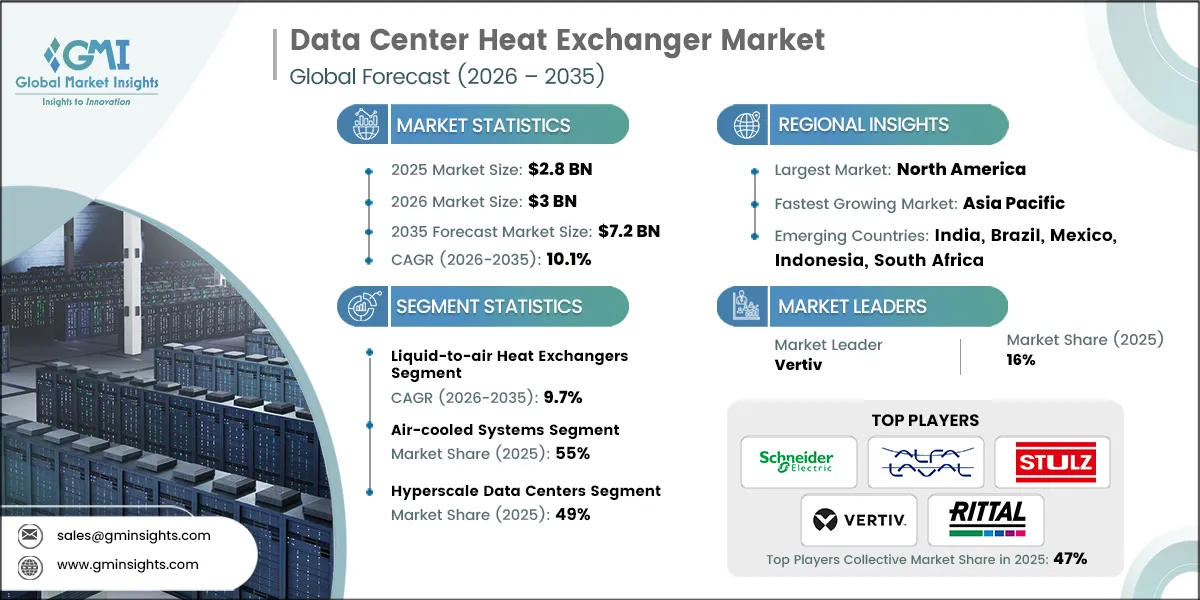
To get key market trends
Data Center Heat Exchanger Market Trends
The market is transforming due to AI-driven computing, sustainability mandates, and advancements in high-density digital infrastructure. Operators are transitioning from traditional air-cooling to advanced liquid and hybrid heat exchanger systems to support next-generation processors and GPUs.
For instance, in February 2025, Vertiv launched a liquid-cooling heat exchanger platform designed for AI clusters in hyperscale facilities with rack power densities above 100 kW. This innovation aims to accelerate liquid cooling adoption in the AI era.
Liquid cooling adoption is rising as rack power densities exceed 50–100 kW, far above the historical 5–15 kW range. AI servers with high-performance GPUs now generate over 1,000–1,200 W per chip, creating heat loads that traditional CRAH/CRAC systems cannot handle efficiently. This drives demand for liquid-to-liquid heat exchangers, Coolant Distribution Units (CDUs), rear-door heat exchangers, and direct-to-chip cooling loops.
Sustainability mandates are driving changes in procurement strategies. The European Commission's Energy Efficiency Directive requires large data centers to enhance transparency in energy use and heat reuse. Operators in Northern Europe are adopting high-efficiency plate heat exchangers to improve Power Usage Effectiveness (PUE) and support waste heat recovery for district heating networks.
Water stewardship is driving innovations in system design, with a focus on improving water usage effectiveness (WUE). Vendors are developing closed-loop liquid cooling and dry cooler-based heat exchanger systems to reduce evaporation losses while maintaining thermal performance, particularly in water-stressed regions of North America and the Asia Pacific.
Modular and prefabricated cooling units are gaining popularity as data center construction timelines shorten. Hyperscale operators are adopting factory-integrated heat exchanger skids to simplify installations and enable phased capacity expansions. Companies like Vertiv and Schneider Electric are expanding modular liquid cooling solutions to meet the growing demand from AI cluster deployments.
Advanced monitoring platforms simulate heat loads at rack and facility levels, enabling real-time prediction of thermal bottlenecks and optimization of coolant flow rates. By integrating sensor data with AI-driven analytics, facilities improve cooling efficiency, extend equipment lifespan, and reduce downtime.
The proliferation of edge and micro data centers is transforming the market. These sites require compact, low-maintenance heat exchanger systems for constrained environments, driving demand for high-efficiency liquid cooling modules in telecom, 5G, and industrial edge applications.
Data Center Heat Exchanger Market Analysis
Learn more about the key segments shaping this market
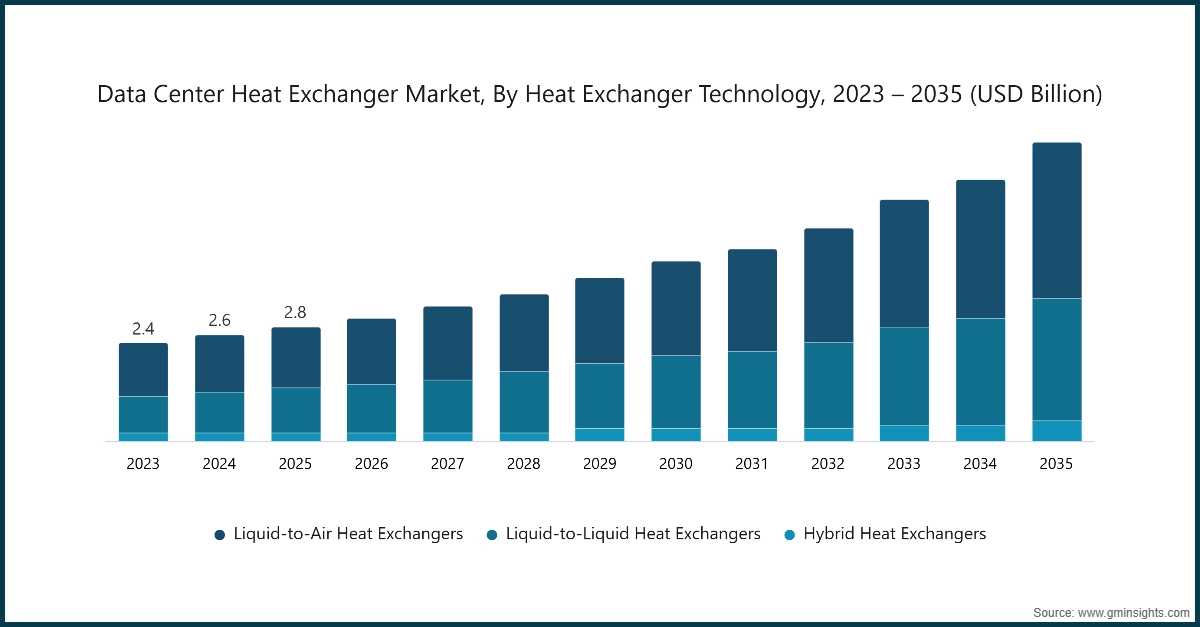
Based on heat exchanger technology, data center heat exchanger market is segmented into liquid-to-air heat exchangers, liquid-to-liquid heat exchangers and hybrid heat exchangers. The liquid-to-air heat exchangers segment dominates the market with 54% share in 2025, and the segment is expected to grow at a CAGR of 9.7% from 2026 to 2035.
- This segment represents the established technology baseline for data center cooling, encompassing rear door heat exchangers, Computer Room Air Handler (CRAH) units with chilled water coils, and air-to-water heat pumps that form the backbone of traditional data center thermal management infrastructure.
- These systems leverage the high thermal capacity of water to absorb heat through coils or heat exchanger surfaces, with air circulating across these surfaces to dissipate thermal energy before returning to the data center environment.
- Technology’s dominance stems from several factors including lower capital investment compared to full liquid cooling retrofits, compatibility with existing facility infrastructure designed around air distribution, and well-established operational expertise within data center management teams.
- The segment faces structural headwinds from migration toward liquid cooling for high-density AI workloads, as liquid-to-air systems encounter physical limitations at rack densities exceeding 30 kW where air circulation volumes and velocity requirements become impractical.
- For instance, in January 2025, Ireland lifted its de facto ban on Dublin grid connections for new data centers. However, it now mandates on-site generation or battery systems to meet full electricity demand, indirectly encouraging efficient liquid-to-air systems to reduce facility load.
- In 2025, Liquid-to-Liquid Heat Exchangers held a 40% market share with a 10.4% CAGR, driven by the growing adoption of direct-to-chip and immersion cooling technologies that eliminate air as a cooling medium.
- This segment includes coolant distribution units (CDUs), cold plates mounted on processors and GPUs, and heat exchangers in immersion cooling tanks and at the facility level, which transfer thermal loads to external heat rejection equipment or district heating networks.
- Liquid-to-liquid heat transfer significantly outperforms air cooling, managing 200-250 W/cm² compared to air cooling's 37-50 W/cm². It also improves energy efficiency by eliminating the need for power-intensive air circulation fans.
- In 2025, Hybrid Heat Exchangers accounted for 7% of the market share, growing at a 10.2% CAGR. They enable data centers to transition from air to liquid cooling without requiring a full infrastructure replacement.
- These systems integrate liquid-to-air and liquid-to-liquid heat exchange paths. They either use primary air cooling with direct-to-chip liquid cooling for high-density components or primary liquid cooling with supplemental air cooling for lower-power equipment.
- Operators can optimize capital allocation by using liquid cooling for AI racks over 50 kW and cost-effective air cooling for traditional server racks operating at 5-15 kW, avoiding over-investment in cooling capacity.
Learn more about the key segments shaping this market
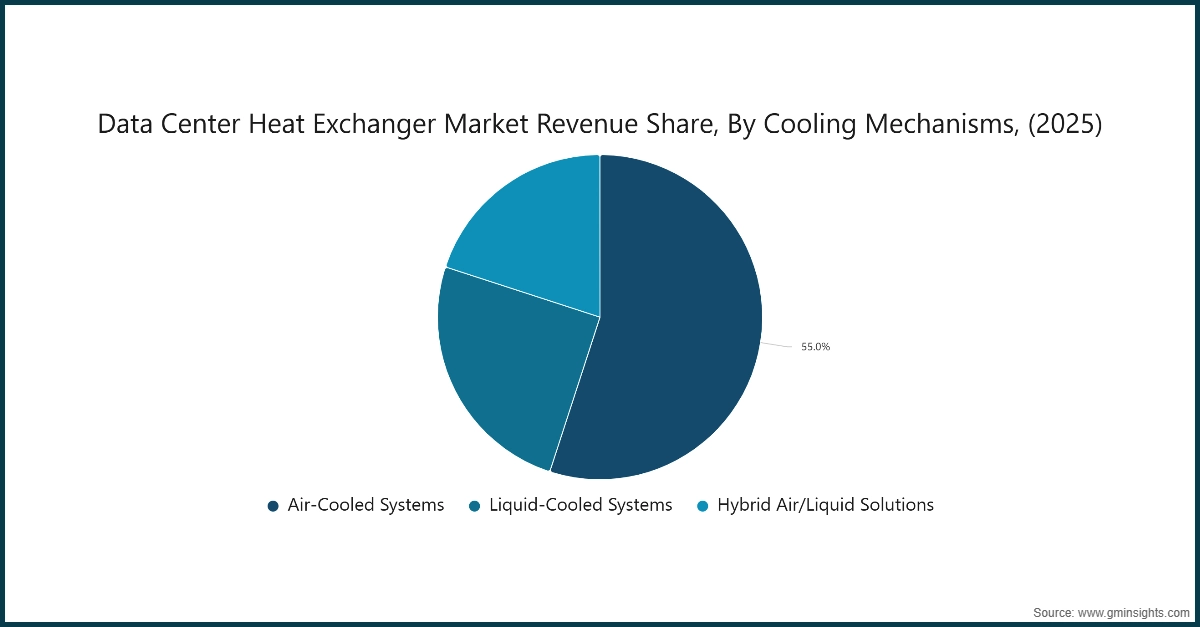
Based on cooling mechanisms, data center heat exchanger market is divided into air-cooled systems, liquid-cooled systems, and hybrid air/liquid solutions. The air-cooled systems segment dominates with 55% market share in 2025 and is growing at the rate of 9.8% CAGR.
- The air-cooled systems encompass traditional Computer Room Air Conditioning (CRAC) units using direct expansion refrigerant cycles, Computer Room Air Handlers (CRAHs) with chilled water loops, air-cooled chillers, and free cooling systems utilizing economizers to leverage ambient air temperature.
- Technology’s dominance stems from decades of standardization, well-understood operations, and numerous facilities designed around air distribution infrastructure, including raised floors, containment systems, and air handling equipment.
- Air-cooled systems remain optimal solution for traditional enterprise workloads operating at 5-15 kW per rack where capital cost advantage and operational simplicity outweigh the efficiency benefits of liquid cooling.
- For instance, in January 2025, Subzero Engineering launched an R&D data center in Ho Chi Minh City, Vietnam. The facility integrates energy-efficient systems and large-scale solar energy generation, showcasing innovation in air-cooled efficiency amid a gradual industry shift toward liquid cooling.
- In 2025, Liquid-Cooled Systems commanded a 25% market share, achieving the highest growth rate at 10.5% CAGR. This surge was propelled by the pressing need to cool AI workloads and regulatory pushes for energy-efficient solutions.
- This segment includes direct-to-chip cooling with cold plates on processors and GPUs, immersion cooling that submerges servers in dielectric fluid, and in-row cooling units with liquid heat exchangers placed between server racks.
- This technology offers 1,000 times greater heat removal efficiency than air cooling, supports rack densities over 100 kW, and reduces cooling-related energy consumption by 30-40% compared to traditional methods.
- In 2025, Hybrid Air/Liquid Solutions held a 20% market share with a 10.3% CAGR. This solution enables operators to optimize cooling strategies by aligning thermal management with workload requirements.
- These systems typically feature facility-level infrastructure supporting both air and liquid cooling distribution, with rack-level or row-level equipment selection based on power density and economic optimization.
- The architectural approach addresses real-world operational challenges, such as managing diverse workload profiles where traditional enterprise applications coexist with AI training clusters, implementing staged technology transitions for incremental liquid cooling expansion, and mitigating risks through redundant cooling pathways to prevent thermal emergencies.
Based on application, the data center heat exchanger market is segmented into server cooling, power electronics cooling (UPS, PDUs), HVAC systems integration, ventilation & air exchange and energy recovery / waste heat reuse. The server cooling segment dominates with 59% market share in 2025 with 10.3% CAGR during 2026 to 2035.
- server cooling application encompasses thermal management for compute infrastructure including traditional CPUs, GPUs for graphics and AI acceleration, and specialized processors including TPUs and ASICs for machine learning workloads.
- IT equipment forms the primary heat-generating load in data centers, with servers consuming 40-50% of total power. Modern AI accelerators currently generate over 1,000W per chip, with projections exceeding 2,000W in future generations.
- Global data center electricity consumption is projected to rise from 415 TWh in 2024 to 945 TWh by 2030, with AI-driven accelerated servers contributing nearly half of this growth.
- The International Energy Agency projects a 30% annual growth in server electricity consumption in the base case scenario, driving a proportional increase in thermal loads and the demand for advanced heat exchanger solutions.
- In 2025, power electronics cooling (UPS and PDUs) held a 14% market share, growing at a 9.9% CAGR. It supports thermal management for systems like UPS, PDUs, transformers, and switchgear, ensuring reliable electricity delivery to IT loads.
- Power electronics account for approximately 8% of data center electricity consumption due to transformation and conversion losses. The resulting heat requires dissipation to maintain equipment reliability and prevent premature component failure.
- UPS systems demand careful thermal management due to their reliance on temperature-sensitive batteries, power electronics whose thermal limits influence conversion efficiency, and control systems that need stable operating conditions.
- By 2025, HVAC Systems Integration is expected to hold a 13% market share, growing at a CAGR of 9.8%. It integrates data center cooling systems with building-level HVAC infrastructure, including heat recovery and humidity control systems for enhanced efficiency and IT equipment reliability.
- Data centers can utilize captured waste heat within broader facility contexts, reducing fossil fuel dependency for heating. This approach enhances sustainability while lowering operational costs.
- In 2025, Ventilation & Air Exchange held a 6% market share, growing at a 9.1% CAGR. It ensures fresh air introduction, exhaust air removal, and air quality maintenance in data centers, safeguarding personnel safety and equipment reliability.
- Modern data centers increasingly use economizer systems that cool outside air under suitable ambience, requiring air filtration, humidity control, and temperature conditioning before introduction.
Based on data centers, the data center heat exchanger market is divided between hyperscale data centers, enterprise data centers, colocation data centers, and edge/micro data centers. The hyperscale data centers dominate with 49% market share in 2025, and with a CAGR of 10.3% during forecast period.
- This segment encompasses facilities operated by cloud service providers, content delivery networks, and technology platforms requiring massive scale and high efficiency to support global service delivery.
- In 2023, hyperscale operators such as Amazon Web Services, Microsoft Azure, Google Cloud Platform, and Meta consumed over 110 TWh of electricity, more than three times their 2018 levels. This increase has driven significant investments in thermal management infrastructure.
- In 2024, North America's computing capacity under construction reached 6,350 MW, more than doubling from the previous year. Facilities with capacities of 100 MW to 1,000 MW were built to support AI training and inference workloads.
- Hyperscale operators are early adopters of liquid cooling. AWS has deployed low-water cooling systems in Frankfurt and Stockholm, while Google uses closed-loop water systems in its carbon-neutral Netherlands facility.
- Microsoft's AI-native hyperscale data center in Malaysia features immersion cooling, and Alphabet's Finland campus employs liquid cooling optimized for LLM training.
- In 2025, enterprise data centers accounted for 21% of the market, growing at a 9.8% CAGR. These private data centers are utilized by corporations, financial institutions, healthcare entities, government bodies, and others for internal IT services.
- Market dynamics show technology refresh cycles driving heat exchanger replacements as aging air-cooled infrastructure reaches end of lifecycle and undergoes modernization to more efficient systems.
- Cooling systems in less-efficient enterprise data centers consume over 30% of electricity. This creates a strong economic incentive for efficiency improvements to reduce operational costs.
Looking for region specific data?
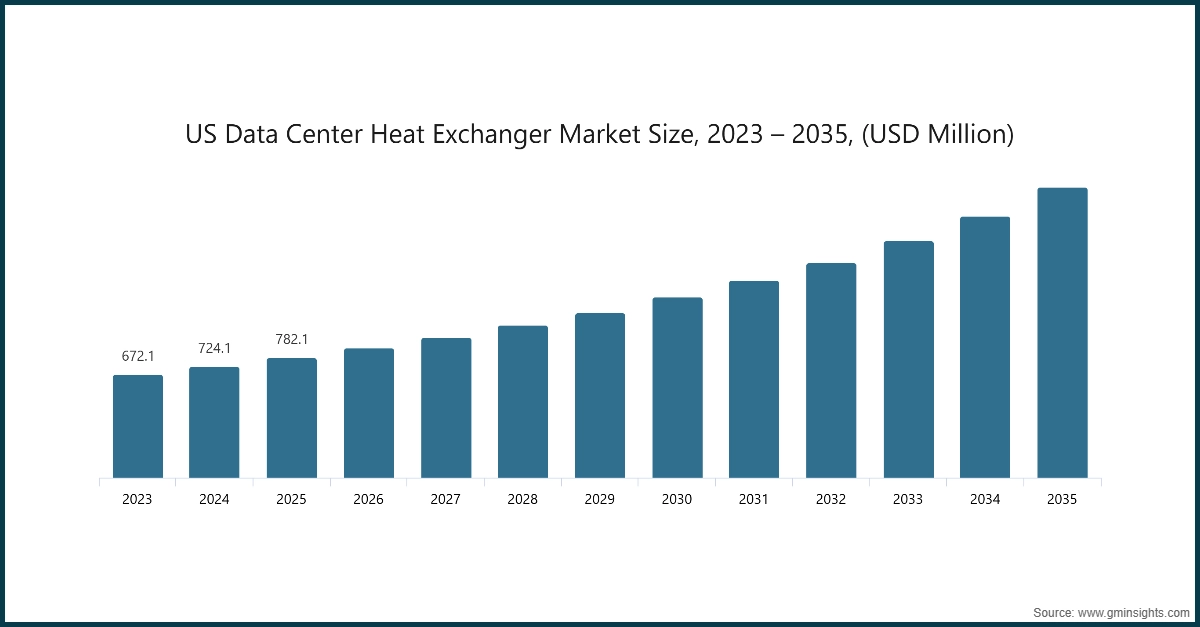
US dominated North America data center heat exchanger market generating revenue of USD 782.1 million in 2025 with CAGR of 9.4% during the forecasted timeframe from 2026 to 2035.
- The US market dominates globally, driven by the rapid expansion of hyperscale data centers, stringent energy-efficiency standards, and regulatory oversight from agencies such as the Department of Energy (DOE) and Environmental Protection Agency (EPA).
- In the US, surging demand for high-density computing and cloud services is prompting data center operators to turn to advanced cooling technologies. Leading the charge are liquid-to-air heat exchangers, celebrated for their efficiency and reliability.
- California, Texas, Virginia, and New York are at the forefront of data center development in the US By 2025, these states are set to house more than 1,500 operational data centers, playing a pivotal role in bolstering cloud, AI, and edge computing services.
- Texas and Virginia are becoming key hubs for innovative cooling solutions, supported by hyperscale facilities, renewable energy availability, and collaborations among OEMs, cooling technology providers, and engineering firms.
- New-generation data centers, emphasizing PUE (Power Usage Effectiveness) optimization and a reduced carbon footprint, have spurred demand for hybrid and liquid-to-liquid heat exchangers. This surge is largely attributed to the early adoption of sustainability-focused and energy-efficient strategies.
- For instance, in March 2025, Equinix rolled out state-of-the-art liquid-to-air cooling systems in several US facilities, underscoring the use of high-efficiency heat exchangers to bolster AI workloads and ensure thermal reliability.
- Operators are increasingly pursuing scalable and flexible heat exchanger solutions, driven by continuous advancements in cloud-native and modular data center designs. These solutions are essential for adapting to evolving computational loads and energy-efficiency demands.
North America dominated the data center heat exchanger market accounting for USD 967.3 million in 2025 and is anticipated to show growth of 9.6% CAGR over the forecast period.
- Hyperscale and enterprise data centers are densely packed in the region, bolstered by strict energy-efficiency regulations, a push for sustainability, and advanced cooling technologies. On top of that, the government is rolling out significant incentives to promote green IT infrastructure.
- In 2025, the United States is set to dominate the North American market with an impressive 81% share, equating to an estimated USD 782.1 million. Meanwhile, Canada, bolstered by its growing cloud and edge computing infrastructure, is projected to contribute a notable 19%, roughly translating to USD 185.2 million.
- The US market is projected to reach USD 1.9 billion by 2035, growing at a CAGR of 9.4%. This growth is driven by investments in hyperscale data centers, demand for energy-efficient cooling solutions, and regulatory efforts to lower PUE and carbon footprints.
- Canada’s data center heat exchanger market is expected to grow at a 10.2% CAGR, driven by government support for sustainable IT initiatives, renewable energy-powered data centers, and tax incentives. This growth surpasses the US in certain segments.
- In 2024–2025, the Canadian government allocated CAD 150 million (USD 110 million) from clean technology and sustainable infrastructure funds to support energy-efficient cooling solutions in hyperscale and enterprise data centers.
- For instance, in March 2025, Ontario-based data center operators introduced advanced liquid-to-liquid and hybrid heat exchangers in new facilities, improving thermal management and supporting sustainability goals.
- In North America, companies like Vertiv, Schneider Electric, and Stulz are driving market growth by developing modular, cloud-native, and energy-efficient cooling systems to support next-generation data center expansion.
The data center heat exchanger market in China is expected to experience significant and promising growth with a CAGR of 12.1% from 2026 to 2035.
- China is prioritizing the market to support its national strategy of advancing hyperscale computing, AI-driven cloud services, and energy-efficient IT infrastructure.
- The country plans to adopt energy-efficient, liquid-based cooling solutions in new data centers by 2025. It also aims to invest significantly in next generation hyperscale and edge computing facilities by 2030.
- For instance, in January 2025, the Ministry of Industry and Information Technology (MIIT) updated data center energy efficiency standards. The update mandates advanced heat exchanger systems in high-density computing environments.
- In China's competitive domestic market, leading technology providers like Huawei, Inspur, and Alibaba Cloud are adopting advanced heat exchangers, including liquid-to-air, liquid-to-liquid, and hybrid systems, to enhance cooling efficiency and reduce operational costs in hyperscale facilities.
- Chinese providers, including Tencent Cloud, Baidu Cloud, and 51Sim, are increasing market share through localized deployments and integrations. Meanwhile, international players focus on advanced thermal modeling and system optimization for high-density data centers.
- The Data Security Law and Personal Information Protection Law require data center cooling and thermal management systems to comply with energy-efficiency and local infrastructure localization regulations.
- China's market is growing faster than the global average, driven by government incentives, large-scale data center construction, and intense competition among domestic and international players.
Asia Pacific Data center heat exchanger market is anticipated to grow at a CAGR of 12.7% during the analysis timeframe.
- The Asia-Pacific market is experiencing rapid growth, driven by the expansion of hyperscale and cloud data centers, edge computing networks, and government initiatives promoting energy-efficient IT infrastructure.
- Rising infrastructure investments, smart-city projects, and digital transformation are driving data center operators to adopt advanced heat exchanger systems, including liquid-to-air, liquid-to-liquid, and hybrid solutions, for efficient thermal management.
- China, the leading data center and cloud computing hub in the region, is driving demand for advanced cooling solutions to support AI, big data, and hyperscale workloads. Key players like Huawei, Tencent Cloud, and Alibaba Cloud are heavily investing in energy-efficient heat exchangers.
- Japan boasts a mature data center industry, with key players such as NTT Communications, Fujitsu, and NEC implementing cutting-edge cooling solutions in their mission-critical facilities.
- For instance, in March 2025, the Japanese Ministry of Economy, Trade and Industry (METI) revised its guidelines, spotlighting the importance of liquid cooling systems for energy-efficient data center operations.
- South Korea is witnessing significant growth in high-density data center cooling adoption, driven by investments from Samsung SDS and LG CNS in edge computing and AI server clusters. In early 2025, the country expanded incentives for energy-efficient thermal management systems in large-scale facilities.
- India's emerging market is witnessing growth driven by hyperscale cloud operators like Tata Communications, Wipro, and Infosys, adopting advanced cooling technologies such as liquid-to-liquid and hybrid heat exchangers. Government initiatives, including the PLI scheme for IT infrastructure, further support sustainable advancements.
- Southeast Asian markets, including Thailand, Indonesia, and Vietnam, are adopting advanced heat exchanger systems. This growth is driven by global cloud service providers and Japanese OEM subsidiaries establishing regional data centers with modular and scalable cooling solutions to meet rising computational demands.
Germany dominates the Europe data center heat exchanger market, showcasing strong growth potential, with a CAGR of 8.7% from 2026 to 2035.
- Germany, with its dense network of hyperscale and enterprise data centers, robust industrial IT infrastructure, and commitment to energy efficiency and sustainability, spearheads the European market.
- Federal regulations, such as the Energy Industry Act (EnWG) and the European Union's Ecodesign directives, enforce strict energy-efficiency standards for data centers. This drives the adoption of advanced heat exchanger systems, including liquid-to-air, liquid-to-liquid, and hybrid types.
- Major operators and cloud providers, including Deutsche Telekom, SAP, and Hetzner, are investing in high-performance cooling solutions to handle heat loads from dense server racks and AI-driven workloads.
- Germany's strong industrial and IT ecosystem drives R&D in advanced cooling technologies, with companies like Vertiv, Schneider Electric, and Stulz offering energy-efficient, modular solutions for mission-critical facilities.
- The country's renewable energy strategy is driving the adoption of sustainable cooling systems, enabling operators to reduce costs and carbon emissions while ensuring reliability.
- The expansion of edge computing and AI infrastructure in industrial hubs such as Frankfurt, Munich, and Berlin is increasing the demand for heat exchanger systems. These systems are essential for providing flexible thermal management in smaller, distributed data centers.
- Germany's leadership in green IT and hyperscale infrastructure sets a European benchmark, influencing countries like France, the UK, and the Nordics to prioritize energy-efficient and high-density cooling solutions.
Europe data center heat exchanger market accounted for USD 840.2 million in 2025 and is anticipated to show growth of 8.3% CAGR over the forecast period.
- The European market is driven by stringent energy-efficiency regulations, a high concentration of hyperscale and enterprise data centers, and increasing demand for advanced cooling solutions to support AI, cloud, and edge computing workloads.
- The enforcement of EU Ecodesign and Energy Performance of Buildings Directive (EPBD) standards is driving the adoption of advanced liquid-to-air, liquid-to-liquid, and hybrid heat exchangers to meet PUE and sustainability goals.
- European standardization bodies, research consortia, and government programs are driving the adoption of energy-optimized data center frameworks. This requires operators to implement advanced thermal management solutions for dense server clusters and modular facilities.
- Germany, the UK, France, Italy, and the Nordics demonstrate varied heat exchanger adoption reflecting data center scale, industrial IT maturity, and regulatory pressure.
- Germany's market, supported by hyperscale facilities, industrial IT expertise, and providers like Vertiv, Schneider Electric, and Stulz, is driving the adoption of energy-efficient cooling solutions.
- The UK market is experiencing strong growth, driven by cloud infrastructure expansion, high-density enterprise data centers, and the adoption of advanced cooling techniques from high-performance computing and research facilities.
- Nordic countries (Sweden, Norway, Finland) are witnessing high adoption of energy-efficient heat exchangers due to government incentives supporting sustainable data centers, renewable energy integration, and advancements in AI and edge computing infrastructure.
- France, Italy, and Spain show moderate adoption due to smaller-scale facilities and emerging cloud infrastructure. However, EU cohesion funding and national sustainability programs are driving advancements in cooling deployment.
Brazil leads the Latin American ADAS simulation Market, exhibiting remarkable growth of 10.3% during the forecast period of 2026 to 2035.
- Brazil dominates the Latin American data center heat exchanger market, driven by the growth of hyperscale and enterprise data centers, cloud adoption, green IT initiatives, and investments in AI and edge computing.
- Regulatory requirements, such as the National Energy Efficiency Program (PNEE) and voluntary certification standards, are driving the adoption of advanced liquid-to-air, liquid-to-liquid, and hybrid heat exchangers to improve power usage effectiveness (PUE).
- For instance, in February 2025, Brazil's Ministry of Science, Technology, and Innovation (MCTI) introduced updated guidelines to enhance sustainable data center infrastructure, focusing on high-efficiency thermal management systems for new and upgraded facilities.
- Brazil's data center ecosystem, concentrated in São Paulo, Rio de Janeiro, and Campinas, is adopting modular and cloud-integrated heat exchangers to enable flexible and energy-efficient cooling in hyperscale facilities, edge nodes, and enterprise data centers.
- Countries like Mexico, Chile, and Colombia are witnessing growing adoption of advanced heat exchangers, fueled by the expansion of hyperscale data centers, cloud computing, and government incentives for energy-efficient IT infrastructure.
UAE to experience substantial growth in the Middle East and Africa Data center heat exchanger market in 2025.
- The UAE leads the Middle Eastern demand for data center heat exchangers, driven by the rapid growth of hyperscale and enterprise data centers, significant investments in cloud and edge computing, and strong government support for sustainable IT infrastructure.
- The country's demand for premium cloud services and advanced digital infrastructure is driving operators to invest in energy-efficient heat exchanger systems, including liquid-to-air, liquid-to-liquid, and hybrid cooling solutions.
- In the UAE, the logistics, financial, and technology sectors are increasingly turning to advanced data center cooling technologies. These technologies are essential for supporting mission-critical workloads, AI analytics, and high-density server environments.
- In March 2025, the Abu Dhabi Department of Energy introduced updated guidelines requiring energy-efficient cooling and thermal management standards for new hyperscale data centers.
- International technology providers, including Vertiv, Schneider Electric, and Stulz, are utilizing the UAE’s extreme climate to test high-efficiency cooling systems and modular heat exchanger designs.
- Saudi Arabia, Qatar, Bahrain, and other Gulf nations are emerging as significant markets for energy-efficient data center cooling, driven by hyperscale cloud deployments, smart city initiatives, and sustainable IT infrastructure incentives.
Data Center Heat Exchanger Market Share
The top 7 companies in the market are Vertiv, Schneider Electric, Rittal, STULZ, Alfa Laval, CoolIT Systems, and Airedale contributed around 57% of the market in 2025.
- Vertiv dominates the market with its extensive thermal management portfolio, including CRAC/CRAH units, rear door heat exchangers, in-row cooling, direct-to-chip liquid cooling, and immersion cooling solutions.
- Schneider Electric delivers integrated solutions globally, focusing on enterprises, colocation, and large-scale projects. These solutions include precision air conditioning, power distribution, and monitoring platforms.
- Rittal, a Germany-based company, has a strong presence in European markets and globally deploys precision cooling units and environmental control systems. Leveraging decades of expertise in industrial cooling, it focuses on reliability and performance in data center applications.
- STULZ specializes in precision air conditioning units, chillers, and humidity control systems, with a strong presence in Europe and North America. The company is enhancing its liquid cooling capabilities while maintaining leadership in traditional air cooling, offering solutions for diverse facility sizes and deployment needs.
- Alfa Laval is applying its industrial heat exchanger expertise to the data center market, offering brazed, gasketed, and welded designs optimized for HVAC and district energy systems. Its thermal engineering capabilities position it strongly for waste heat recovery projects, particularly those involving district heating networks, in line with European regulations.
- CoolIT Systems focusing on direct-to-chip liquid cooling solutions with cold plate technology, having supplied equipment used in Microsoft research demonstrating liquid cooling's superior thermal performance for AI workloads.
- Airedale, part of Modine Manufacturing's climate solutions portfolio, provides precision air conditioning and cooling solutions for mid- to large-scale projects in European markets. Modine, after raising its fiscal 2026 guidance twice, announced a strategic spinoff to focus on climate solutions, including data center cooling.
Data Center Heat Exchanger Market Companies
Major players operating in data center heat exchanger industry are:
- Airedale
- Alfa Laval
- CoolIT Systems
- Eaton
- Munters
- Nortek Air
- Rittal
- Schneider Electric
- STULZ
- Vertiv
- Airedale, Alfa Laval, CoolIT Systems, Eaton, Munters, Nortek Air, Rittal, Schneider Electric, STULZ, and Vertiv are the leading companies in the data center heat exchanger market, providing advanced cooling solutions and thermal management systems for hyperscale, enterprise, and edge data centers.
- These companies provide advanced data center heat exchanger solutions, including liquid-to-air, liquid-to-liquid, and hybrid cooling systems. Their energy-efficient, scalable designs help operators achieve low PUE, reduce costs, and maintain reliable thermal conditions for critical IT infrastructure.
- The market is growing rapidly due to increasing demand for hyperscale data centers, cloud services, edge computing, and energy-efficient IT infrastructure, alongside regulatory pressures for sustainability. Key players like Schneider Electric, STULZ, and Vertiv are driving innovation with AI-optimized cooling, digital twin simulations, and integrated facility management platforms, ensuring energy efficiency and operational reliability for large-scale data centers.
Data Center Heat Exchanger Market Report Attributes
| Key Takeaway | Details |
|---|---|
| Market Size & Growth | |
| Base Year | 2025 |
| Market Size in 2025 | USD 2.8 Billion |
| Market Size in 2026 | USD 3 Billion |
| Forecast Period 2026-2035 CAGR | 10.1% |
| Market Size in 2035 | USD 7.2 Billion |
| Key Market Trends | |
| Drivers | Impact |
| Exponential growth in AI and high-performance computing workloads | Increases demand for advanced liquid-based heat exchangers capable of handling continuous, high-intensity processing loads. |
| Rising thermal density (50–100 kW racks) and GPU heat generation (1,200 W+ per chip) | Accelerates deployment of high-efficiency liquid-to-liquid and rear-door heat exchanger systems to manage extreme heat loads. |
| Sustainability mandates and net-zero carbon emission targets | Encourages adoption of energy-efficient heat exchangers that reduce PUE and enable waste heat recovery. |
| Inadequacy of traditional air-cooling for modern workloads | Drives transition toward hybrid and liquid cooling heat exchanger solutions for improved thermal performance. |
| Hyperscale data center expansion | Expands large-scale procurement of modular and scalable heat exchanger systems across new facilities globally. |
| Pitfalls & Challenges | Impact |
| High initial capital investment requirements for liquid-cooling infrastructure | Elevated upfront costs for retrofitting facilities and deploying liquid-based heat exchangers may delay adoption, particularly among small and mid-sized data center operators. |
| Water consumption concerns | Increased scrutiny overwater usage can restrict deployment in water-stressed regions and push operators toward alternative or closed-loop cooling solutions. |
| Opportunities: | Impact |
| Retrofit market for legacy data centers | Modernization of existing air-cooled facilities creates demand for compact and high-efficiency heat exchanger upgrades without full infrastructure replacement. |
| Edge and micro data center cooling solutions | Growing deployment of distributed edge facilities drives need for space-efficient and low-maintenance heat exchanger systems. |
| Waste heat recovery and reuse applications | Integration of heat exchangers with district heating and industrial reuse systems enables new sustainability-driven revenue streams. |
| Modular and prefabricated cooling units | Adoption of plug-and-play cooling modules accelerates deployment timelines and supports scalable expansion of hyperscale and colocation facilities. |
| Market Leaders (2025) | |
| Market Leader |
16% Market Share |
| Top Players |
Collective Market Share is 47% |
| Competitive Edge |
|
| Regional Insights | |
| Largest Market | North America |
| Fastest growing market | Asia Pacific |
| Emerging countries | India, Brazil, Mexico, Indonesia, South Africa |
| Future outlook |
|
What are the growth opportunities in this market?
Data Center Heat Exchanger Industry News
- In November 2025, Vertiv partnered with IIT Bombay to strengthen its position in the region's expanding digital economies. The collaboration targets the Indian market, which is projected to witness a 193% capacity growth between 2025 and 2030.
- In November 2025, Vertiv partnered with Caterpillar to deliver modular power and cooling solutions, accelerating AI data center deployment and reducing grid strain in North America. This collaboration addresses power availability challenges hindering data center expansion in US markets.
- In November 2025, Huawei introduced prefabricated modular hyperscale data centers, tailored for swift deployment in the Middle East and Africa's remote and high-temperature locales. The product tackles regional challenges, such as soaring temperatures and a scarcity of local technical support.
- In October 2025, Vertiv partnered with NVIDIA to develop advanced 800 VDC power and cooling systems for the 2027 Rubin Ultra platforms. This collaboration positions both companies at the forefront of AI infrastructure advancements.
The data center heat exchanger market research report includes in-depth coverage of the industry with estimates & forecasts in terms of revenue (USD Bn) from 2022 to 2035, for the following segments:
Market, Heat Exchanger Technology
- Liquid-to-air heat exchangers
- Liquid-to-liquid heat exchangers
- Hybrid heat exchangers
Market, By Cooling Mechanisms
- Air-cooled systems
- Liquid-cooled systems
- Hybrid air/liquid solutions
Market, By Cooling Deployment Configuration
- Rear door heat exchangers (RDHx)
- In-row cooling units
- Direct-to-chip liquid cooling (Cold Plates)
- Immersion cooling systems
Market, By Application
- Server cooling
- Power electronics cooling (UPS, PDUs)
- HVAC systems integration
- Ventilation & air exchange
- Energy recovery / waste heat reuse
- Others
Market, By Data Centers
- Hyperscale data centers
- Enterprise data centers
- Colocation data centers
- Edge/micro data centers
The above information is provided for the following regions and countries:
- North America
- US
- Canada
- Europe
- Germany
- UK
- France
- Italy
- Spain
- Russia
- Netherlands
- Sweden
- Denmark
- Poland
- Asia Pacific
- China
- India
- Japan
- Australia
- South Korea
- Singapore
- Thailand
- Indonesia
- Vietnam
- Latin America
- Brazil
- Mexico
- Argentina
- Colombia
- MEA
- South Africa
- Saudi Arabia
- UAE
- Israel
Frequently Asked Question(FAQ) :
Which region dominated the North America data center heat exchanger market in 2025?
The U.S. led the North America market, generating USD 782.1 million in revenue in 2025, with a CAGR of 9.4% projected through 2035.
Who are the major players in the data center heat exchanger market?
Major players include Airedale, Alfa Laval, CoolIT Systems, Eaton, Munters, Nortek Air, Rittal, and Schneider Electric.
Which application segment led the data center heat exchanger industry in 2025?
The server cooling segment led the market with a 59% share in 2025 and is expected to grow at a CAGR of 10.3% from 2026 to 2035.
What was the market share of air-cooled systems in 2025?
Air-cooled systems dominated with a 55% market share in 2025, growing at a CAGR of 9.8% during the forecast period.
What was the market share of the liquid-to-air heat exchangers segment in 2025?
The liquid-to-air heat exchangers segment held a 54% market share in 2025 and is projected to grow at a CAGR of 9.7% from 2026 to 2035.
What is the projected value of the data center heat exchanger industry by 2035?
The market is expected to reach USD 7.2 billion by 2035, growing at a CAGR of 10.1%, fueled by the adoption of liquid and hybrid cooling systems for next-generation processors and GPUs.
What is the projected size of the data center heat exchanger market in 2026?
The market is expected to reach USD 3 billion in 2026.
What was the market size of the data center heat exchanger market in 2025?
The market size was estimated at USD 2.8 billion in 2025, driven by advancements in high-density digital infrastructure and sustainability mandates.
Data Center Heat Exchanger Market Scope
Related Reports