Summary
Table of Content

Cryogenic Equipment Market
Get a free sample of this report
Form submitted successfully!
Error submitting form. Please try again.
Thank you!
Your inquiry has been received. Our team will reach out to you with the required details via email. To ensure that you don't miss their response, kindly remember to check your spam folder as well!
Request Sectional Data
Thank you!
Your inquiry has been received. Our team will reach out to you with the required details via email. To ensure that you don't miss their response, kindly remember to check your spam folder as well!
Form submitted successfully!
Error submitting form. Please try again.
Cryogenic Equipment Market Size
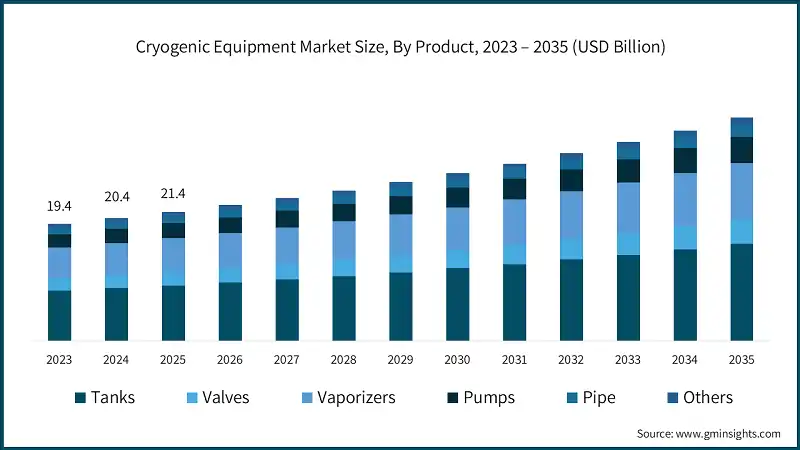
According to a recent study by Global Market Insights Inc., the cryogenic equipment market was estimated at USD 21.4 billion in 2025. The market is expected to grow from USD 22.5 billion in 2026 to USD 37 billion by 2035, at a CAGR of 5.7%.
Cryogenic Equipment Market Key Takeaways
Market Size & Growth
- 2025 Market Size: USD 21.4 Billion
- 2026 Market Size: USD 22.5 Billion
- 2035 Forecast Market Size: USD 37 Billion
- CAGR (2026–2035): 5.7%
Key Market Drivers
- Positive outlook towards healthcare, chemical, and food processing industries.
- Growing power sector.
- Growing demand for natural gas.
Challenges
- Safety concerns related to cryogenic liquid.
Opportunity
- Expansion of LNG Infrastructure.
- Rising Adoption in Space Exploration.
- Growth in Biotechnology and Healthcare Applications.
- Emergence of Hydrogen Economy.
Key Players
- Market Leader: Chart Industries led with over 16% market share in 2025.
- Leading Players: Top 5 players in this market include Chart Industries, Air Products, Linde PLC, Air Liquide, Flowserve, which collectively held a market share of 35% in 2025.
Get Market Insights & Growth Opportunities
- Increasing deployment of advanced liquefaction systems for natural gas storage coupled with rising integration of automated valve assemblies to optimize low-temperature operations is reshaping equipment configurations. Expanding use of cryogenic pumps for LNG bunkering applications in line with growing emphasis on emission reduction strategies across marine transport sectors is influencing design priorities.
- Cryogenic equipment refers to specialized devices and systems designed to produce, handle, store, and transport materials at extremely low temperatures. These temperatures are required to liquefy gases such as oxygen, nitrogen, hydrogen, helium, and natural gas.
- For instance, in October 2025, Tiger Logistics (India) announced the signing of a Memorandum of Understanding (MoU) with H2 Invest, a Russian enterprise specializing in hydrogen technologies. The collaboration aims to develop transportation and storage infrastructure for liquid hydrogen in India, supporting the country’s transition toward clean energy solutions.
- Surge in adoption of vacuum-insulated piping for industrial gas distribution together with enhanced focus on minimizing thermal losses during transfer processes is accelerating material innovations. Rising incorporation of modular cryogenic tanks for decentralized energy storage will foster business landscape.
- Increasing demand for flexible capacity solutions in remote industrial zones coupled with growing utilization of cryogenic vaporizers for high-flow applications in petrochemical complexes is redefining installation practices. Increasing preference for skid-mounted cryogenic systems for rapid deployment in temporary LNG facilities is expanding rental-based business models.
- Accelerated integration of IoT-enabled sensors for real-time monitoring of cryogenic pressure and temperature in line with rising adoption of predictive maintenance frameworks is transforming operational reliability. Expanding role of cryogenic compressors in hydrogen liquefaction projects is creating new engineering challenges for ultra-low temperature handling.
- For reference, in March 2025, CTCI announced that it has secured a USD 26.6 billion engineering, procurement, and construction contract in partnership with Japan’s IHI Plant Services Corporation (IPC). The joint venture will construct four above-ground, double-domed LNG cryogenic storage tanks, each with a capacity of 180,000 kiloliters, for CPC Corporation at the Kaohsiung Intercontinental LNG Terminal.
- Growing demand for composite materials in cryogenic tank fabrication in tandem with stringent weight optimization requirements for aerospace and space launch applications is driving material science advancements. Increasing deployment of cryogenic valves with smart actuation features for automated flow control is enhancing process safety standards.
- The cryogenic equipment market was valued at USD 18.5 billion in 2022 and grew at a CAGR of approximately 4.5% through 2025. Surge in LNG regasification terminals incorporating advanced cryogenic heat exchangers coupled with rising investments in cross-border gas trade infrastructure is influencing regional equipment demand.
- Expanding application of cryogenic refrigeration systems for superconducting magnet cooling in research facilities is boosting niche market segments. Rising adoption of cryogenic storage solutions for biopharmaceutical cold chain logistics together with increasing emphasis on vaccine preservation under ultra-low temperatures is diversifying end-use portfolios.
- For illustration, in April 2025, The SAG Group announced plans to expand its presence in India. Central to this strategy is a partnership with an Indian manufacturing firm in Maharashtra to establish a joint production facility. The facility will focus on producing cryogenic tanks for LNG and liquid hydrogen (LH2) trucks, as well as innovative lightweight components for India’s rapidly growing two-wheeler market.
- Growing integration of automated leak detection systems in cryogenic pipelines in tandem with heightened regulatory focus on operational safety compliance is shaping monitoring technological trends. Increasing preference for hybrid cryogenic systems combining mechanical refrigeration and liquid nitrogen cooling is influencing product innovation.
- Surge in cryogenic equipment retrofitting projects for aging LNG terminals coupled with rising need for capacity upgrades to meet peak seasonal demand is creating aftermarket opportunities. Expanding deployment of cryogenic heat exchangers in carbon capture and storage facilities is fostering new application domains.

To get key market trends
Cryogenic Equipment Market Trends
- Expanding investments in pharmaceutical manufacturing coupled with rising emphasis on sterile environments for drug formulation is set to enhance cryogenic equipment adoption. Increasing demand for precision cooling in biopharmaceutical storage together with stringent compliance for temperature-sensitive vaccines is reinforcing equipment deployment.
- Escalating utilization of cryogenic systems in chemical synthesis in tandem with growing preference for low-temperature reactions is shaping industry dynamics. Rising consumption of processed food in association with advanced freezing technologies is accelerating cryogenic freezer installations across production lines.
- For citation, in February 2023, InoxCVA signed a MoU with the Government of Gujarat to establish a USD 22.3 million cryogenic tank manufacturing facility at Savli, near Vadodara. The upcoming facility will focus on producing liquid medical oxygen storage tanks along with a range of cryogenic and non-cryogenic storage solutions, supporting healthcare and industrial applications across the country.
- Surging adoption of gas-fired turbines together with cryogenic storage systems for peak load management is enhancing operational flexibility. Growing investments in combined-cycle power plants in association with advanced cryogenic vaporizers is improving thermal efficiency benchmarks.
- Heightened demand for high-capacity cryogenic tanks in line with LNG bunkering for power utilities is reinforcing infrastructure modernization. Integration of cryogenic heat exchangers in tandem with waste heat recovery initiatives is complementing sustainability objectives.
- For instance, in May 2025, OEG announced a significant investment in its cryogenic ISO tanks in North America, now stationed at its Houston facility. This milestone marks the company’s formal entry into the region’s cryogenic tank market, enhancing its capability to support the growing demand for safe and efficient transportation of liquefied gases across the U.S. and international markets.
- Natural gas continues to play a pivotal role in global energy strategies, driving extensive LNG infrastructure development. LNG enables long-distance transport of natural gas, requiring liquefaction at -160°C and specialized cryogenic storage and transfer systems. Import terminals, floating storage units, and regasification facilities depend on high-integrity cryogenic tanks, pumps, and vaporizers to maintain product quality and safety.
- Industrial sectors such as steel, cement, and chemicals are increasingly switching to natural gas to reduce emissions, creating demand for onsite LNG storage and regasification systems. The maritime industry is adopting LNG as a cleaner fuel, spurring investments in bunkering infrastructure and cryogenic fueling systems for ships.
Cryogenic Equipment Market Analysis
Learn more about the key segments shaping this market
- Based on product, the industry is segmented into tanks, valves, vaporizers, pumps, pipe, and others. The tanks cryogenic equipment holds a share of 42.9% in 2025. Expanding LNG storage facilities coupled with rising emphasis on large-capacity containment is shaping tank design innovations. Increasing deployment of double-walled vacuum-insulated tanks together with stringent safety norms is reinforcing reliability standards.
- The valves cryogenic equipment market is set to exceed USD 4 billion by 2035. Growing preference for stainless steel and nickel alloys coupled with stringent performance standards is influencing material selection. Rising focus on zero-emission operations coupled with advanced cryogenic valve designs is aligning with sustainability objectives.
- For reference, in May 2024, Plug Power announced that it has secured contracts to deliver cryogenic equipment to a multinational industrial gas company and a statewide electric utility. The company also confirmed that it is in the final stages of negotiating an additional agreement with another leading industrial gas provider.
- The vaporizers segment will witness a CAGR of over 5% by 2035. Increasing integration of energy-efficient vaporizer designs together with heat recovery systems is reinforcing sustainability goals. Expanding industrial gas applications in association with high-capacity vaporizers is complementing continuous process requirements.
- The pumps segment was valued at USD 2.5 billion in 2025. Heightened focus on low-NPSH pump configurations in tandem with cavitation control measures is ensuring reliability in critical applications. Rising emphasis on cryogenic pumps in association with hydrogen liquefaction facilities is shaping emerging energy markets.
- For illustration, in October 2025, Burckhardt Compression delivered a turnkey compression solution for a major manufacturer of engineered cryogenic gas processing systems and small-scale LNG and industrial gas plants.
- The pipe segment will exceed USD 1.5 billion by 2035. Growing deployment of vacuum-jacketed cryogenic piping coupled with stringent thermal insulation standards is enhancing energy efficiency. Growing collaboration between pipe manufacturers and automation providers coupled with digital twin technology is optimizing design accuracy.
Learn more about the key segments shaping this market
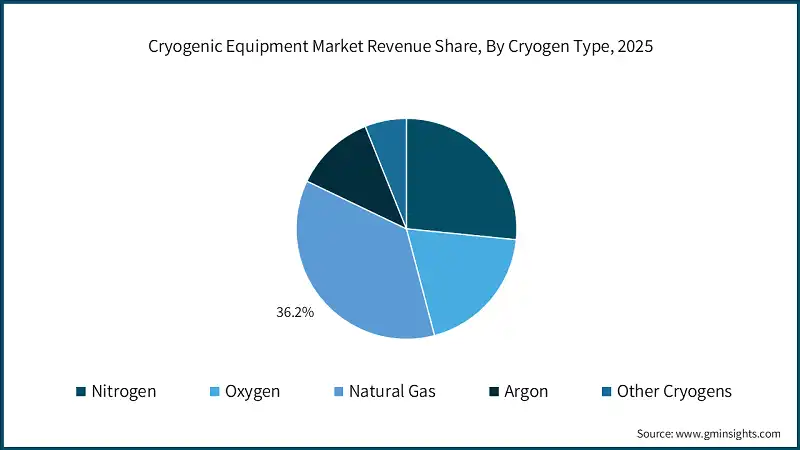
- Based on cryogen type, the cryogenic equipment market is divided into nitrogen, oxygen, natural gas, argon, and other cryogens. The natural gas segment holds a share of 36.2% in 2025 and is set to exceed USD 13 billion by 2035. Rising preference for natural gas-powered vehicles coupled with cryogenic fueling stations is reinforcing clean mobility initiatives.
- The oxygen segment will witness a CAGR of over 5.5% by 2035. Surging adoption of oxygen vaporizers together with high-capacity storage systems is complementing steel and metal fabrication processes. Increasing integration of oxygen cryogenic pumps in association with aerospace fueling systems is shaping niche applications.
- For citation, in November 2025, Venture Global announced that it has submitted a request to the U.S. Federal Energy Regulatory Commission seeking approval to more than double the capacity of its Plaquemines LNG export facility in Louisiana. The proposed expansion would add 30 million metric tons per annum (mtpa) of LNG capacity to the already approved 28 mtpa.
- The nitrogen cryogenic equipment market was estimated at USD 5.7 billion in 2025. Rising deployment of nitrogen-based cryogenic systems coupled with pharmaceutical cold storage requirements is shaping healthcare infrastructure. Growing integration of nitrogen vaporizers in tandem with industrial gas distribution networks is complementing continuous supply operations.
- The argon segment will exceed USD 4 billion by 2035. Surging demand for argon vaporizers together with high-purity gas handling systems is supporting advanced material processing. Increasing integration of argon cryogenic pumps in association with additive manufacturing processes is complementing industrial innovation.
- Based on application, the industry is divided into storage and distribution. The storage cryogenic equipment market holds a share of 65.1% in 2025 and is set to exceed USD 23.5 billion by 2035. Expanding installation of large-capacity cryogenic tanks coupled with rising LNG storage requirements is shaping infrastructure development.
- Increasing preference for vacuum-insulated storage systems together with advanced thermal protection technologies is reinforcing operational reliability. Growing integration of smart monitoring sensors coupled with predictive maintenance tools is improving asset lifecycle management.
- For reference, in November 2025, The Gulf Coast region is witnessing a surge in construction activity driven by major liquefied natural gas (LNG) infrastructure projects. Among the developments are two Texas megaprojects that commenced this year, each valued at over USD 1 billion. The first project involves a USD 2 billion, 400-mile LNG pipeline designed to expand export capacity while supporting the state’s growing energy needs for power generation and data centers.
- The distribution cryogenic equipment segment will witness a CAGR of over 5.5% by 2035. Growing collaboration between distribution system manufacturers and EPC contractors in tandem with automation initiatives is complementing project execution. Escalating LNG bunkering activities together with cryogenic fueling stations is shaping marine and transportation infrastructure.
- Rising preference for corrosion-resistant alloys coupled with advanced welding techniques is influencing material selection for piping systems. Expanding industrial gas distribution networks together with high-capacity cryogenic pumps is supporting continuous supply operations.

Looking for region specific data?
- The U.S. dominated the cryogenic equipment market in North America with around 85.7% share in 2025 and generated USD 4.2 billion in revenue. Rising adoption of cryogenic tanks in tandem with peak shaving facilities is complementing seasonal power demand management. Surging integration of IoT-enabled cryogenic pumps together with predictive maintenance tools is shaping smart plant operations.
- The North America cryogenic equipment market is projected to hit USD 8 billion by 2035. Surging adoption of cryogenic vaporizers together with hybrid energy systems is complementing renewable integration strategies. Expanding cold-chain logistics in tandem with nitrogen-based freezing systems is amplifying food and pharmaceutical supply chains.
- For instance, in October 2025, FortisBC received approval from the British Columbia Utilities Commission (BCUC) for a proposed USD 1.14 billion expansion of its liquefied natural gas (LNG) storage facility on Tilbury Island. The project aims to enhance energy security and strengthen the province’s natural gas supply chain.
- The Europe cryogenic equipment industry is set to grow at a rate of over 5% by 2035. Escalating installation of vacuum-insulated storage tanks together with recyclable materials is aligning with sustainability objectives. Expanding industrial gas consumption coupled with advanced cryogenic containment systems is shaping chemical and food processing sectors.
- The Middle East & Africa cryogenic equipment market holds a share of 11.5% in 2025. Surging integration of IoT-enabled cryogenic pumps together with predictive maintenance tools is shaping smart plant operations. Growing collaboration between regional EPC contractors and cryogenic equipment manufacturers in tandem with automation platforms is accelerating project execution.
- For citation, in January 2025, CB&I secured an engineering, procurement, and construction (EPC) contract from the TJN Ruwais joint venture for the Ruwais LNG project in Abu Dhabi, UAE. The contract, valued between USD 250 million and USD 500 million, covers the delivery of two full-containment concrete LNG storage tanks, each with a capacity of 180,000 cubic meters.
- The Asia Pacific cryogenic equipment market was valued at USD 7.5 billion in 2025. Growing LNG liquefaction coupled with advanced cryogenic pumps is reinforcing regional energy security initiatives. Surging adoption of cryogenic vaporizers together with hybrid energy storage solutions is complementing renewable integration programs.
- The Latin America cryogenic equipment market will exceed USD 2 billion by 2035. Growing integration of cryogenic piping systems in tandem with district cooling projects is influencing urban infrastructure development. Rising collaboration between regional EPC contractors and cryogenic solution providers in association with automation platforms is accelerating project timelines.
Cryogenic Equipment Market Share
- The top 5 players in cryogenic equipment industry are Chart Industries, Linde PLC, Flowserve Corporation, Air Products, and Air Liquide contribute around 35% of the market share in 2025. The market is highly competitive, driven by increasing demand for LNG, liquid hydrogen, and industrial gases.
- Linde is a global leader in industrial gases and cryogenic technologies, commanding a significant share of the cryogenic equipment market. Its portfolio spans storage tanks, vaporizers, valves, and advanced distribution systems for LNG, liquid hydrogen, and other industrial gases. Linde’s competitive advantage lies in its integrated approach combining equipment manufacturing with gas production and distribution services.
- Flowserve competes in the cryogenic equipment market primarily through its engineered flow control solutions, including cryogenic valves and pumps. The company serves critical industries such as oil and gas, LNG, and power generation, where cryogenic applications are essential for storage and transportation of ultra-cold fluids.
- Chart Industries represents a significant specialized player focusing exclusively on cryogenic equipment without integrated gas business. Chart's competitive advantages include broad product portfolio including tanks, heat exchangers, complete systems, technology leadership in small-scale and mobile applications, and strong position in emerging hydrogen equipment market. The company's strategy emphasizes innovation in hydrogen liquefaction and storage, expansion in biogas and renewable natural gas applications, and geographic diversification through acquisitions.
- Air Products maintains significant market presence competing primarily in large-scale industrial gas and LNG applications. The company's strengths include proprietary liquefaction technology for natural gas and industrial gases, project execution capabilities for mega-projects, and strategic focus on hydrogen economy opportunities. Air Products' strategy emphasizes technology licensing and equipment supply for LNG projects, hydrogen infrastructure including liquefaction and storage, and industrial gas facilities in emerging markets.
- Air Liquide is a key player in the cryogenic equipment market, leveraging its leadership in industrial gases and deep expertise in cryogenic technologies. The company offers a comprehensive range of equipment, including storage tanks, vaporizers, and distribution systems, integrated with its gas supply solutions. Air Liquide’s competitive advantage is rooted in its global scale and commitment to innovation, particularly in clean energy applications such as hydrogen production and LNG infrastructure.
Cryogenic Equipment Market Companies
- Emerson reported net sales of USD 18 billion for fiscal year 2025, up from USD 17.5 billion in 2024. The company’s Board of Directors approved a 5% increase in the quarterly cash dividend, raising it to USD 0.555 per share of common stock. Additionally, the Board authorized a share repurchase program for up to 50 million shares of Emerson’s common stock.
- Air Liquide posted revenues of USD 7.7 billion in the third quarter of 2025, representing a comparable increase of 1.9% versus the same period in 2024. Engineering & Technologies contributed USD 246.9 million in revenue during the quarter, up 1.7% on a comparable basis.
- Linde posted third-quarter 2025 sales of USD 25.2 billion, supported by strong operational performance. The company invested USD 112 million in research and development during the period, while operating profit reached USD 6.9 billion.
Major players operating in the cryogenic equipment industry are:
- Abhijit Enterprises
- Air Liquide
- Air Products and Chemicals
- AIR WATER
- Auguste Cryogenics
- BRUGG Pipes
- Chart Industries
- Cryogas Equipment
- Cryogenic OGS
- CRYOSPAIN
- Cryostar
- Cryoworld
- Demaco
- Emerson Electric
- Flowserve Corporation
- Hypro
- INOXCVA
- IWI Cryogenic Vaporization Systems (India) Pvt. Ltd.
- Kelvin International
- Linde
- Shell-n-Tube
- SLB
- Vacuum Barrier
Cryogenic Equipment Market Report Attributes
| Key Takeaway | Details |
|---|---|
| Market Size & Growth | |
| Base Year | 2025 |
| Market Size in 2025 | USD 21.4 Billion |
| Market Size in 2026 | USD 22.5 Billion |
| Forecast Period 2026-2035 CAGR | 5.7% |
| Market Size in 2035 | USD 37 Billion |
| Key Market Trends | |
| Drivers | Impact |
| Positive outlook towards healthcare, chemical, and food processing industries | Increasing investments and technological advancements in these sectors are driving demand for cryogenic equipment to support low-temperature storage and processing needs. |
| Growing power sector | Expansion of power generation capacity, especially in LNG-based plants, is boosting the adoption of cryogenic systems for fuel handling and storage. |
| Growing demand for natural gas | Rising global preference for cleaner energy sources is accelerating LNG infrastructure development, creating significant opportunities for cryogenic equipment. |
| Pitfalls & Challenges | Impact |
| Safety concerns related to cryogenic liquid | Handling extremely low-temperature liquids poses risks of burns, material embrittlement, and system failures, requiring strict safety protocols and specialized equipment. |
| Opportunities: | Impact |
| Expansion of LNG Infrastructure | Global investments in LNG terminals and transportation networks are creating strong demand for advanced cryogenic storage and handling systems. |
| Rising Adoption in Space Exploration | Increasing space missions and satellite launches require cryogenic technology for fuel storage and propulsion systems. |
| Growth in Biotechnology and Healthcare Applications | Advancements in medical research and biobanking are driving the need for cryogenic equipment for sample preservation and vaccine storage. |
| Emergence of Hydrogen Economy | The push toward clean energy and hydrogen as a fuel source is boosting demand for cryogenic systems for hydrogen liquefaction and storage. |
| Market Leaders (2025) | |
| Market Leaders |
16% market share |
| Top Players |
|
| Competitive Edge |
|
| Regional Insights | |
| Largest Market | North America |
| Fastest Growing Market | Asia Pacific |
| Emerging Country | U.S., UK, Poland, Norway, India, Indonesia |
| Future Outlook |
|
What are the growth opportunities in this market?
Cryogenic Equipment Industry News
- In October 2024, BRUGG Pipes developed customized solutions for advanced cryogenic infrastructure, addressing the increasing global demand for safe and efficient transportation of ultra-cold liquefied gases. The company offered vacuum-insulated, double-layered stainless-steel corrugated pipes engineered for next-generation energy carriers such as LNG and liquid hydrogen (LH2), ensuring secure and reliable transfer under extreme conditions.
- In July 2024, Flowserve Corporation acquired the intellectual property and ongoing R&D for cryogenic LNG submerged pump technology, systems, and packaging from the NexGen Cryogenic Solutions, an Arizona-based private company specializing in LNG pump and turbine engineering. This strategic acquisition brings NexGen Cryo’s advanced pump and CERT technology into Flowserve’s portfolio, strengthening its position in the liquefaction, shipping, and regasification segments.
- In April 2024, Cryospain delivered advanced cryogenic storage systems for a new modular air separation unit (ASU) in Mexico. The facility is designed to supply industrial gases through both pipeline and bulk distribution, strengthening regional supply reliability. The scope of work included engineering and delivering two low-pressure liquefied gas tanks: a 2,250 m³ tank for liquid oxygen (LOX) and a 3,700 m³ tank for liquid nitrogen (LIN). Built to maintain ultra-low temperatures, these tanks are integral to a cutting-edge ASU that supports scalable expansion through its modular design.
- In April 2023, Air Water announced the acquisition of M1 Engineering, a globally recognized provider of specialized cryogenic distribution equipment. This strategic move strengthens Air Water’s position in the industrial gas and cryogenic solutions market, expanding its product portfolio and enhancing its global footprint. The integration of M1 Engineering’s expertise in advanced cryogenic technologies is expected to accelerate innovation and deliver greater value to customers across diverse industries.
The cryogenic equipment market research report includes in-depth coverage of the industry with estimates & forecast in terms of revenue (USD Million) from 2022 to 2035, for the following segments:
Market, By Product
- Tanks
- Valves
- Vaporizers
- Pumps
- Pipe
- Others
Market, By Cryogen Type
- Nitrogen
- Oxygen
- Natural gas
- Argon
- Other cryogens
Market, By Application
- Storage
- Distribution
Market, By End Use
- O&G industry
- Power
- Food & beverage
- Chemical
- Rubber & plastics
- Metallurgy
- Healthcare
- Shipping
- Agriculture, forestry & fishing
- Other industries
The above information has been provided for the following regions & countries:
- North America
- U.S.
- Canada
- Mexico
- Europe
- UK
- Germany
- Italy
- Spain
- France
- Poland
- Norway
- Netherlands
- Asia Pacific
- China
- India
- Japan
- Indonesia
- Thailand
- Malaysia
- Philippines
- South Korea
- Australia
- Middle East & Africa
- UAE
- Saudi Arabia
- Kuwait
- Oman
- Turkey
- Qatar
- Egypt
- South Africa
- Latin America
- Brazil
- Argentina
- Peru
Frequently Asked Question(FAQ) :
What is the market size of the cryogenic equipment in 2025?
The market size was USD 21.4 billion in 2025, with a CAGR of 5.7% expected through 2035 driven by adoption of advanced LNG liquefaction systems, increasing integration of automated valve assemblies, and growing demand for natural gas infrastructure.
What is the projected value of the cryogenic equipment market by 2035?
The cryogenic equipment market is expected to reach USD 37 billion by 2035, propelled by expansion of LNG infrastructure, rising adoption in space exploration, growth in biotechnology and healthcare applications, and emergence of the hydrogen economy.
What is the current cryogenic equipment market size in 2026?
The market size is projected to reach USD 22.5 billion in 2026.
How much market share did the tanks segment hold in 2025?
The tanks segment held 42.9% market share in 2025, driven by expanding LNG storage facilities, rising emphasis on large-capacity containment, and increasing deployment of double-walled vacuum-insulated tanks with stringent safety norms.
What was the valuation of the pumps segment in 2025?
The pumps segment was valued at USD 2.5 billion in 2025, with heightened focus on low-NPSH pump configurations and rising emphasis on cryogenic pumps for hydrogen liquefaction facilities shaping emerging energy markets.
What is the growth outlook for the oxygen segment from 2026 to 2035?
The oxygen segment is projected to grow at over 5.5% CAGR through 2035, due to surging adoption of oxygen vaporizers, high-capacity storage systems complementing steel and metal fabrication processes, and integration with aerospace fueling systems.
Which region leads the cryogenic equipment market?
The U.S. region held approximately 85.7% share with generating USD 4.2 billion in 2025, driven by rising adoption of cryogenic tanks for peak shaving facilities, LNG infrastructure expansion, and integration of IoT-enabled systems.
What are the upcoming trends in the cryogenic equipment market?
Key trends include IoT-enabled monitoring, composite materials for aerospace, smart cryogenic valves, modular skid-mounted systems, rising use in hydrogen liquefaction, and increasing adoption of vacuum-insulated piping.
Who are the key players in the cryogenic equipment market?
Key players include Chart Industries, Air Products and Chemicals, Linde, Air Liquide, Flowserve Corporation, Abhijit Enterprises, AIR WATER, Auguste Cryogenics, BRUGG Pipes, Cryogas Equipment, Cryogenic OGS, CRYOSPAIN, Cryostar, Cryoworld, Demaco, Emerson Electric, Hypro, INOXCVA, IWI Cryogenic Vaporization Systems, Kelvin International, Shell-n-Tube, SLB, and Vacuum Barrier.
Cryogenic Equipment Market Scope
Related Reports