Summary
Table of Content

Crane Rental Market
Get a free sample of this report
Form submitted successfully!
Error submitting form. Please try again.
Thank you!
Your inquiry has been received. Our team will reach out to you with the required details via email. To ensure that you don't miss their response, kindly remember to check your spam folder as well!
Request Sectional Data
Thank you!
Your inquiry has been received. Our team will reach out to you with the required details via email. To ensure that you don't miss their response, kindly remember to check your spam folder as well!
Form submitted successfully!
Error submitting form. Please try again.
Crane Rental Market Size
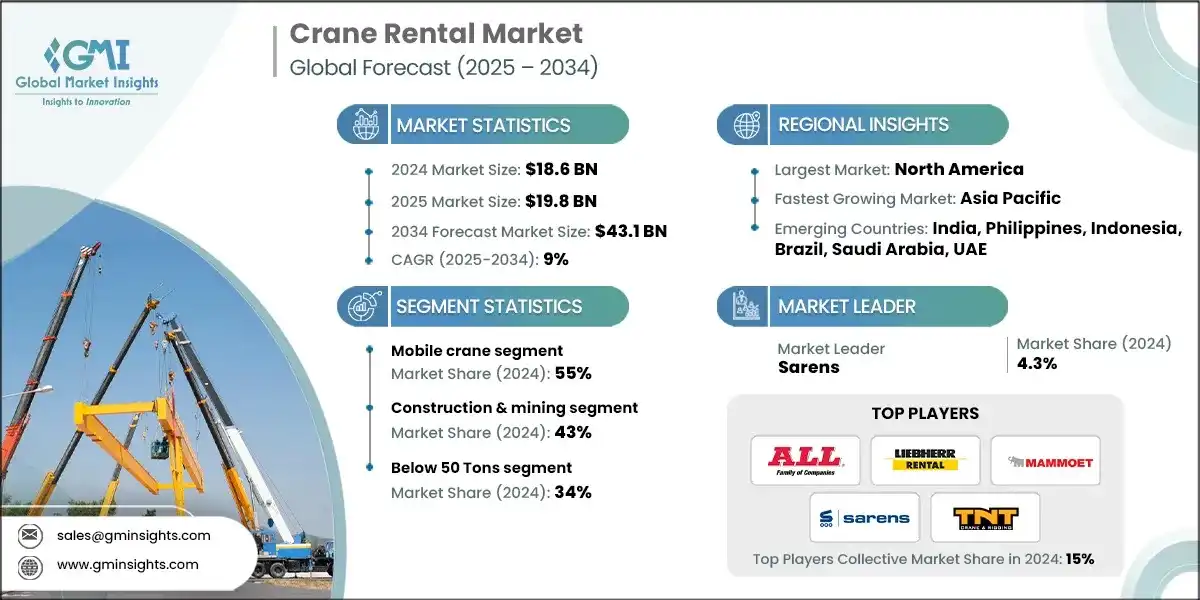
The crane rental market was estimated at USD 18.6 billion in 2024. The market is expected to grow from USD 19.8 billion in 2025 to USD 43.1 billion in 2034, at a CAGR of 9%, according to latest report published by Global Market Insights Inc.
Crane Rental Market Key Takeaways
Market Size & Growth
- 2024 Market Size: USD 18.6 Billion
- 2025 Market Size: USD 19.8 Billion
- 2034 Forecast Market Size: USD 43.1 Billion
- CAGR (2025–2034): 9%
Regional Dominance
- Largest Market: North America
- Fastest Growing Region: Asia Pacific
Key Market Drivers
- Rising infrastructure development projects.
- Surge in construction of industrial facilities.
- Increase in fleet modernization and adoption of hybrid/electric cranes.
- Rise in collaborations between OEMS and rental companies.
Challenges
- Lack of skilled and qualified operators.
- High maintenance and repair costs.
Opportunity
- Adoption of digital platforms for equipment leasing.
- Expansion in port and logistics infrastructure.
- Growth of public-private partnership (PPP) projects.
- Technological integration and automation.
Key Players
- Market Leader: Sarens led with over 4.3% market share in 2024.
- Leading Players: Top 5 players in this market include All Family/All Crane, Liebherr Rental, Mammoet, Sarens, TNT Crane & Rigging, which collectively held a market share of 15% in 2024.
Get Market Insights & Growth Opportunities
- The adoption of rental-based heavy lifting solutions is driving significant transformation in the global construction and infrastructure sectors. Renting cranes provides contractors and project developers with access to advanced lifting equipment without substantial upfront capital expenditure, enabling better capital allocation and operational agility. This trend is primarily fueled by the increasing complexity of urban megaprojects, renewable energy installations, and large-scale logistics operations, which require reliable, on-demand lifting solutions supported by professional operators and maintenance services.
- In August 2025, The Dubai-based crane sales/ leasing/ maintenance services provider announced that it has secured USD 50 million from a DIFC-based investment firm. The funding will support their online rental platform and physical inventory of all-terrain, crawler, rough-terrain and tower cranes in the Gulf region.
- The energy transition and infrastructure modernization initiatives are further accelerating the adoption of rental cranes. Renewable energy projects, including wind farms, solar installations, and power grid expansions, require heavy lifting of turbines, modules, and structural components. Crane rental companies are responding by investing in high-capacity crawler cranes and rough-terrain units designed for remote, off-grid environments, thereby reducing logistics costs and improving operational sustainability.
- Post-COVID-19, the construction and logistics industries have experienced accelerated digitalization and the adoption of equipment-sharing models. To address fluctuating demand and maintain project timelines, contractors are increasingly opting for flexible rental contracts that include service-level guarantees, online booking platforms, and telematic maintenance support. The deployment of rental management software and digital fleet platforms has enhanced transparency in pricing, utilization rates, and maintenance cycles, fostering a more data-driven rental ecosystem.
- The demand for heavy-lift solutions in smart cities, transportation, and industrial projects continues to grow as governments increase investments in infrastructure renewal and urban expansion. Advanced cranes available through rental channels now feature automated control systems, anti-collision sensors, and hybrid powertrains, improving on-site safety, fuel efficiency, and compliance with environmental regulations.
- North America represents a mature and robust market for crane rental services, driven by large-scale infrastructure, commercial, and industrial construction projects. The region benefits from well-established rental networks, a high concentration of large fleet operators, and strong adherence to safety and regulatory standards. Companies such as United Rentals, Maxim Crane Works, and Bigge Crane lead the market with extensive fleets and advanced digital fleet management systems. High demand from energy, utilities, and commercial real estate sectors, along with investment in renewable energy and logistics infrastructure, sustains steady rental activity and encourages the adoption of telematics and IoT-enabled crane operations.
- The Asia-Pacific region is emerging as the fastest-growing crane rental market, driven by large-scale construction projects, expanding industrial bases, and significant investments in transport, logistics, and renewable infrastructure. Key markets such as China, India, Japan, and South Korea are leading in equipment digitalization, infrastructure megaprojects, and partnerships between OEMs and rental service providers. Government-backed infrastructure programs and smart city initiatives are further promoting the adoption of advanced cranes through rental contracts, accelerating market growth.
To get key market trends
Crane Rental Market Trends
- Crane rental companies are adopting telematics and IoT solutions to monitor equipment performance, location, load capacity, and maintenance needs in real time. These technologies enhance fleet utilization, reduce downtime through predictive maintenance, and improve safety by detecting operational anomalies early, ultimately leading to cost efficiency and better asset management.
- For instance, in March 2024, United Rentals has introduced battery energy systems into its North American tower-crane rental fleet, developed in partnership with Termaco. The scalable system (up to 500 kW) allows cranes to operate using stored energy rather than continuous generator use, cutting fuel consumption by ~80% and generator runtime by ~91% in a trial project.
- With stricter emission regulations and growing sustainability commitments, rental providers are increasingly investing in electric and hybrid cranes. These cranes reduce fuel consumption, noise, and carbon emissions, making them ideal for urban and indoor projects. The trend supports clients’ ESG goals while cutting operating costs and improving environmental compliance.
- Global investments in renewable energy, transport, and smart city infrastructure are fueling the demand for crane rentals. Projects like wind farms, solar installations, and metro construction require high-capacity cranes for heavy lifting and assembly. Rental models offer flexibility and cost efficiency, enabling contractors to access advanced cranes without large capital investments.
Crane Rental Market Analysis
Learn more about the key segments shaping this market
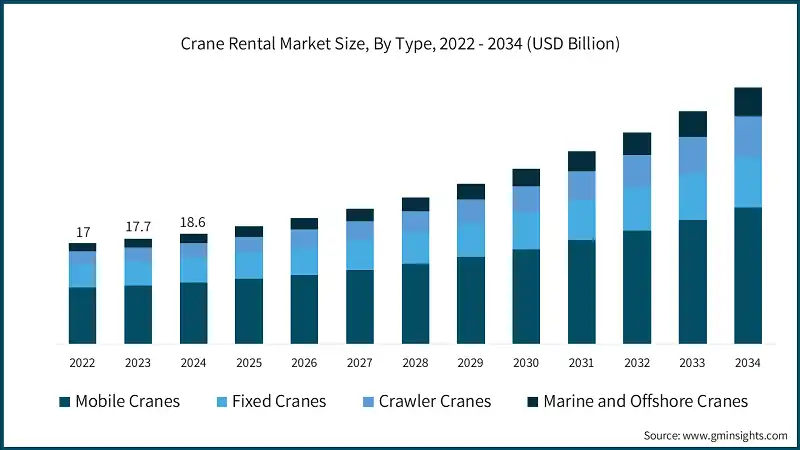
Based on type, the market is divided into mobile cranes, fixed cranes, crawler cranes, marine and offshore cranes. The mobile crane segment accounted for around 55% market share in 2024 and is expected to grow at a CAGR of more than 8.6% through 2034.
- The mobile cranes segment dominates the crane rental market due to its high versatility, mobility, and ability to handle a wide range of lifting operations across construction, industrial, and infrastructure projects. These cranes can be easily transported and set up on various job sites, reducing downtime and improving operational efficiency. Their flexible configurations, including all-terrain, rough-terrain, and truck-mounted variants, make them ideal for both urban and remote project environments.
- Moreover, growing demand for short-term and project-based crane rentals has further boosted the popularity of mobile cranes among contractors seeking cost-effective and time-efficient solutions. Advancements in lifting capacity, automation, and safety systems, along with continuous fleet modernization by rental companies, have strengthened the segment’s dominance in the crane rental market.
- In September 2025, Johnson Arabia boosted its heavy-lift capabilities by acquiring nearly 30 new cranes, including mobile tower, all-terrain and crawler models. The additions, sourced from industry leaders such as Liebherr and Terex, cover lifting capacities from 100 to 1,350 tons, aimed at major GCC infrastructure and energy projects.
- The marine and offshore cranes segment will experience a CAGR of more than 12% through 2034, owing to increasing offshore oil and gas exploration, port expansion projects, and growth in offshore wind energy installations. Rising global energy demand and investments in deep-water drilling operations are driving the need for high-capacity, corrosion-resistant cranes capable of operating in harsh marine environments.
Learn more about the key segments shaping this market
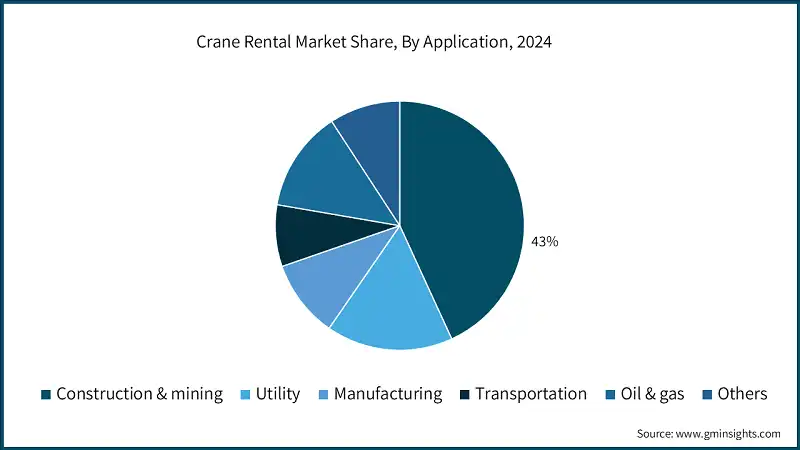
Based on application, the crane rental market is segmented into construction & mining, utility, manufacturing, transportation, oil & gas, and others. The construction & mining segment accounted for around 43% share in 2024 and is expected to grow at a CAGR of over 9.7% from 2025 to 2034.
- The construction & mining segment holds the largest market share in the crane rental market due to the continuous rise in global infrastructure projects, commercial developments, and mining expansions. Cranes are essential for lifting heavy materials, equipment, and components in high-rise construction, road, and bridge projects, making rental services a cost-effective and flexible option for contractors. The growing adoption of advanced lifting technologies and the need for efficiency in large-scale projects further strengthen this segment’s dominance.
- In the mining industry, cranes play a vital role in material handling, equipment installation, and maintenance activities in both surface and underground operations. The increasing demand for minerals, coupled with expansion in mining exploration and modernization projects, continues to drive crane rental utilization in this sector.
- For example, in August 2025, Mycrane Trading, a Dubai-based crane sales and rental company, secured a US $50 million investment to expand across the Middle East, Africa, CIS, and Asia, integrating its digital crane-rental platform with a physical fleet of all-terrain, crawler, rough-terrain, and tower cranes.
- The oil & gas segment will expand at a CAGR of more than 10.6% through 2034, due to the rising number of offshore exploration and production projects, increasing demand for heavy-lift equipment in refinery and pipeline construction, and the growing adoption of rental cranes for cost-efficient, short-term deployment in harsh and remote environments.
Based on lifting capacity, the crane rental market is segmented into below 50 tons, 50-150 tons, 150-300 tons, and above 300 Tons. Below 50 Tons segment dominated with around 34% share in 2024, due to high demand in residential, commercial, and small-scale infrastructure projects requiring flexible, easily transportable cranes for short-term and frequent lifting operations.
- The below 50 Tons segment dominates the crane rental market, driven by its extensive application in residential, commercial, and light industrial construction activities. These cranes are highly valued for their mobility, rapid deployment, and cost efficiency, making them an optimal choice for short-term and recurring operations such as material handling, building maintenance, and small-scale infrastructure projects.
- Renting these cranes enables contractors and builders to minimize capital expenditure and maintenance costs while ensuring operational agility. The increasing pace of urban development, road maintenance, and utility installation projects in emerging economies further accelerates the demand for compact and versatile cranes, reinforcing the below 50 Tons segment's market leadership.
- The Above 300 Tons segment will grow at a CAGR of over 10.4% through 2034, due to the increasing number of large-scale infrastructure, industrial, and energy projects requiring high capacity lifting solutions. Expanding investments in offshore wind farms, oil & gas facilities, and heavy civil engineering projects such as bridges, refineries, and power plants are driving demand for ultra-heavy cranes capable of handling complex, high-load operation.
Based on rental duration, the market is divided into short-term rental, long-term rental, and project-based rental. The short-term rental dominated the crane rental market.
- The short-term rental segment holds the highest market share due to its flexibility, cost efficiency, and convenience for contractors handling short-duration or project-specific lifting tasks. Many construction, maintenance, and industrial projects require cranes for limited periods such as equipment installation, material handling, or temporary site work making short-term rentals a more economical option compared to long-term leasing or ownership.
- Additionally, short-term rentals enable companies to access the latest crane models with advanced lifting technologies without incurring high capital or maintenance costs. The increasing number of small to medium-scale infrastructure and urban construction projects globally further supports this trend, as contractors prefer scalable rental options to meet fluctuating project demands and optimize operational budgets.
- The project-based rental segment is expected to witness the fastest growth due to the rising number of large-scale infrastructure, industrial, and energy projects that require cranes for extended, specialized operations. These projects such as metro construction, power plants, offshore wind farms, and refinery expansions demand customized heavy-lift solutions and long deployment durations, making project-based contracts more suitable than short-term rentals.
Looking for region specific data?
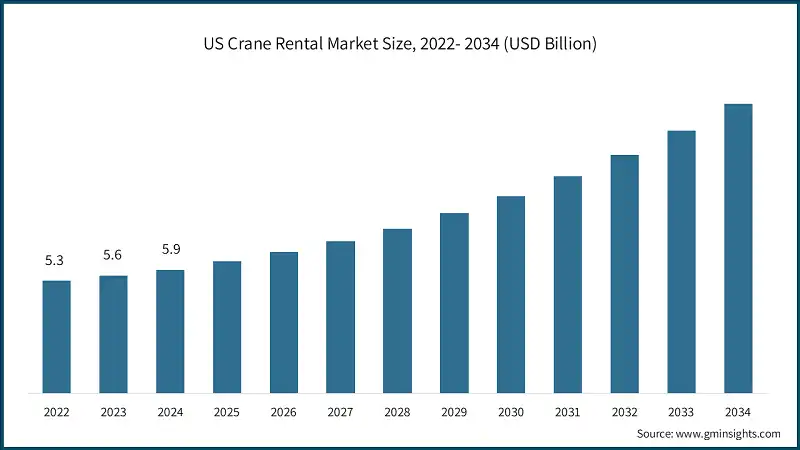
U.S. dominated the crane rental market in North America with around 85% share and generated USD 9.1 billion revenue in 2024.
- The U.S. crane rental industry is witnessing strong growth driven by rising infrastructure development, renewable energy projects, and industrial construction activity. Major federal investments, such as the Infrastructure Investment and Jobs Act (IIJA), are fueling demand for cranes in highway, bridge, and utility projects. Additionally, large-scale renewable initiatives including offshore wind farms and solar installations are increasing the need for heavy-lift and mobile cranes, particularly in coastal and industrial regions.
- Furthermore, the shift toward rental over ownership is accelerating as contractors seek cost-effective solutions and flexibility amid fluctuating project timelines. Rental companies are also upgrading fleets with telematics-enabled, hybrid, and electric cranes to meet emission norms and sustainability goals. The rise of digital rental platforms and predictive maintenance technologies further enhances operational efficiency and market competitiveness.
- For example, in January 2025, United Rentals announced its acquisition of H&E Equipment Services in a transaction valued at approximately $4.8 billion. This strategic move will expand United Rentals' U.S. operations by adding nearly 64,000 rental units to its fleet, positioning the company to capitalize on growth opportunities driven by increased infrastructure investments and the reshoring momentum within the construction sector.
- Canada crane rental market is projected to grow at a strong CAGR due to rising investments in infrastructure modernization, renewable energy projects, and mining expansion. The government’s focus on large-scale construction such as bridge rehabilitation, transportation corridors, and hydroelectric projects is boosting demand for heavy-lift and mobile cranes. Additionally, growing wind energy installations across provinces like Alberta and Saskatchewan are driving the adoption of high-capacity cranes for turbine erection.
The crane rental market in Germany is expected to experience significant and promising growth from 2025-2034.
- Europe accounted for over 29% of market share in 2024 and is the fastest-growing region with a CAGR of around 8.2% through 2034, owing to infrastructure renewal, renewable energy expansion, and strict emission regulations.
- Germany leads the market due to its strong industrial base, advanced construction sector, and growing investments in renewable energy and infrastructure modernization. The country’s large-scale projects such as wind farm installations, urban redevelopment, and transportation upgrades drive consistent demand for mobile and tower cranes. Germany’s engineering excellence and presence of major OEMs like Liebherr and Manitowoc further strengthen its rental ecosystem through easy access to high-performance equipment and after-sales services.
- Moreover, stringent environmental regulations are accelerating the adoption of hybrid and electric cranes, supporting sustainable construction practices. The increasing trend of renting rather than owning equipment among contractors, combined with digital fleet management and predictive maintenance technologies, continues to position Germany as the innovation and demand hub of Europe’s crane rental industry.
- For instance, in January 2024, Gerken GmbH announced its entry into dedicated crane rental, expanding from aerial lifts into all terrain models and large-crawler cranes, reflecting growth in specialized lifting demand in Germany.
- The UK is emerging as a major growing market for crane rental due to the surge in infrastructure development, urban regeneration, and renewable energy projects. Government initiatives like the National Infrastructure and Construction Pipeline (NICP) and major projects such as HS2, Hinkley Point C, and offshore wind farms are fueling demand for heavy lift and mobile cranes.
The crane rental market in China is expected to experience significant and promising growth from 2025-2034.
- Asia Pacific accounts for over 25% of the crane rental industry share in 2024 and is expected to grow at a CAGR of around 9.9% till 2034, owing to rapid urbanization, large-scale infrastructure projects, renewable energy expansion, and increasing demand for cost-efficient rental solutions.
- China leads the crane rental market due to its massive infrastructure investments, rapid urbanization, and strong manufacturing ecosystem. The government’s focus on transportation, energy, and industrial expansion including projects such as high-speed rail networks, smart cities, and renewable energy installations has significantly increased demand for cranes across construction and engineering sectors. China’s Belt and Road Initiative (BRI) has further accelerated heavy-lift requirements in both domestic and overseas projects.
- Additionally, the presence of major domestic manufacturers like XCMG, Zoomlion, and Sany enables cost-effective access to advanced lifting equipment, supporting a thriving rental ecosystem. The growing shift from ownership to rental among contractors, along with digital fleet management and smart crane technologies, continues to reinforce China’s leadership in the crane rental market.
- In September 2024, MyCrane marked a major milestone by listing over 10,000 cranes on its global online rental platform. The Dubai-headquartered company now supports a network of more than 1,100 equipment providers and aims to streamline crane sourcing for clients across construction, renewable energy, and industrial sectors.
- India is emerging as one of the fastest-growing markets in the Asia-Pacific crane rental industry due to rapid infrastructure expansion, smart city projects, renewable energy installations, and industrial growth. Government initiatives like Gati Shakti and National Infrastructure Pipeline (NIP) are fueling strong demand for cost-efficient and flexible crane rental solutions.
The crane rental market in Brazil is expected to experience significant and promising growth from 2025-2034.
- Latin America holds around 5% of the market share in 2024 and is growing steadily at a CAGR of around 8.8% through 2034. The developments are fueled by increasing investments in mining, oil & gas, renewable energy, and large-scale infrastructure projects across Brazil, Mexico, and Chile, alongside expanding construction and logistics sectors.
- Brazil dominates the Latin America crane rental market owing to its robust construction, energy, and industrial sectors. Major infrastructure projects, such as port expansions, renewable energy installations, and large-scale urban developments, are driving strong demand for mobile and tower cranes. The country’s investments in offshore oil exploration under Petrobras and renewable power projects, including wind and solar farms, are also fueling crane rental requirements across industrial and logistics hubs.
- Additionally, Brazil’s growing manufacturing base and modernization of transport infrastructure such as highways, bridges, and logistics corridors continue to boost crane usage. Several domestic rental firms are expanding their fleets, while international companies are entering the market through partnerships and acquisitions to meet the rising demand for advanced, safe, and cost-efficient lifting solutions.
- For example, in October 2025, Brazilian rental firm Cunzolo Máquinas e Equipamentos has taken delivery of a new 230-tonne Liebherr LTM 1230-5.1 all-terrain crane, which will be based in São José dos Campos. The unit features a 75 m main boom with bi-fold swingaway extension and can reach up to 113 m tip height.
- The Mexico crane rental market is rapidly expanding due to rising infrastructure investments, growth in industrial construction, and the booming energy and logistics sectors. Government-backed infrastructure projects, such as transportation corridor upgrades, refinery expansions, and renewable energy installations, are creating strong demand for mobile and tower cranes.
The crane rental market in UAE is expected to experience significant and promising growth from 2025-2034.
- MEA holds around 4% of the market share in 2024 and is growing steadily at a CAGR of around 6.7% through 2034, due to large-scale infrastructure and oil & gas projects across the Gulf region and Africa. Mega initiatives such as Saudi Arabia’s NEOM city, UAE’s port expansions, and ongoing mining developments in South Africa are fueling demand for heavy lifting and mobile crane rentals.
- The UAE dominates the MEA crane rental market owing to its large-scale infrastructure projects, rapid urbanization, and ongoing investments in construction, logistics, and energy sectors. The country’s ambitious megaprojects such as Dubai Expo legacy developments, Etihad Rail, and multiple high-rise and smart city projects in Abu Dhabi and Dubai have significantly increased the demand for heavy lifting solutions.
- Additionally, expansion in oil & gas, renewable energy (particularly solar), and port modernization projects further drives crane utilization. The presence of major international rental companies like Sarens, Al Faris Group, and Johnson Arabia enhances equipment availability and service standards. Strong regulatory frameworks, advanced project management practices, and continued government spending make the UAE a central hub for crane rental operations in the region.
- South Africa crane rental market is expected to grow at the fastest CAGR owing to increasing investments in mining, renewable energy, and infrastructure development projects. The government’s focus on improving transportation networks, upgrading ports, and expanding energy capacity through wind and solar projects is boosting crane rental demand.
Crane Rental Market Share
- The top 7 companies in the crane rental industry are Sarens, Mammoet, TNT Crane & Rigging, Liebherr Rental, All Family/All Crane, Maxim Crane Works, and Sanghvi Movers, contributed around 18% of the market in 2024.
- Sarens stands as the global market leader, operating from its Belgian headquarters with a comprehensive international presence spanning over 65 countries. The company's competitive strength lies in its integrated approach, combining crane rental with heavy transport, specialized rigging, and engineering services. Sarens' fleet includes some of the world's most advanced lifting equipment, including the SGC-250 ring crane with 5,000-ton capacity and ongoing development of the SGC-170 all-electric giant crane according to Sarens corporate communications.
- Mammoet operates as a global leader in heavy-lift and transport operations, maintaining its reputation for engineering excellence and project execution capabilities. The Dutch company's fleet includes ultra-heavy lift equipment capable of handling the world's most challenging lifting operations. Mammoet's competitive advantage stems from its engineering expertise, enabling the company to develop innovative solutions for complex projects that command premium pricing.
- TNT Crane & Rigging represents a significant North American operator with comprehensive capabilities across the United States and Canada. The company's success reflects its focus on customer service excellence, operational reliability, and strategic fleet investments. TNT's regional expertise and established customer relationships provide competitive advantages in serving local market requirements while maintaining cost-effective operations.
- Liebherr Rental leverages its position as a leading crane manufacturer to operate rental fleets in key markets worldwide. This dual role provides unique advantages including access to latest equipment technologies, comprehensive technical support, and integrated service capabilities. Liebherr's focus on innovation, including electric drive systems and advanced control technologies, positions the company to benefit from industry trends toward sustainability and operational efficiency.
- All Family/All Crane operates as a major North American rental company with extensive fleet capabilities and comprehensive geographic coverage. The company's recent acquisition of Lampson International in June 2023 demonstrates its commitment to growth through strategic consolidation. All Family's focus on operational excellence and customer service has established strong market positions across diverse industry segments.
- Maxim Crane Works maintains the largest crane fleet in North America according to ACT100 rankings, with over 732,000 tons of lifting capacity. The company's competitive strength lies in its comprehensive fleet, extensive branch network, and focus on operational efficiency. Maxim's strategic investments in high-capacity equipment and geographic expansion support its market leadership position.
- Sanghvi Movers represents a leading player in the Indian market with growing international presence. The company's success in the rapidly expanding Indian market demonstrates the opportunities available in emerging economies experiencing infrastructure development and industrialization. Sanghvi's focus on modern equipment and comprehensive service capabilities positions it to benefit from India's continued economic growth.
Crane Rental Market Companies
Major players operating in the crane rental industry are:
- Ainscough Crane
- All Family/All Crane
- Bigge Crane
- Liebherr Rental
- Mammoet
- Maxim Crane Works
- Sanghvi Movers
- Sarens
- TNT Crane & Rigging
- United Rentals
- Rental companies are increasingly adopting digital fleet management and automation platforms that enable dynamic pricing, remote scheduling, and utilization-based rental models. Cloud-based systems and BIM integration facilitate better project coordination, while AI-powered demand forecasting optimizes fleet allocation across regions. This transition toward tech-enabled rental ecosystems is improving ROI and operational scalability.
- Strategic partnerships and industry consolidation are reshaping competitive dynamics. Collaborations between OEMs, rental companies, and technology providers are driving innovation in hybrid and electric cranes, sustainability reporting, and smart construction platforms. These alliances promote compliance with emission regulations, ESG mandates, and safety standards, ensuring that the crane rental sector evolves toward a more efficient, sustainable, and digitally connected value chain.
Crane Rental Market Report Attributes
| Key Takeaway | Details |
|---|---|
| Market Size & Growth | |
| Base Year | 2024 |
| Market Size in 2024 | USD 18.6 Billion |
| Market Size in 2025 | USD 19.8 Billion |
| Forecast Period 2025 – 2034 CAGR | 9% |
| Market Size in 2034 | USD 43.1 Billion |
| Key Market Trends | |
| Drivers | Impact |
| Rising infrastructure development projects | The surge in global infrastructure projects including highways, metros, airports, and bridges is driving significant demand for cranes on a rental basis. Governments’ emphasis on urban expansion and modernization fuels large-scale construction activity, making crane rentals a preferred choice for flexibility, cost efficiency, and access to advanced equipment. |
| Surge in construction of industrial facilities | Rapid industrial expansion across manufacturing, logistics, and warehousing sectors is creating strong demand for crane rentals. Companies prefer renting cranes for plant setup, equipment installation, and structural assembly due to shorter project timelines and the ability to deploy specialized lifting machinery without heavy capital investment. |
| Increase in fleet modernization and adoption of hybrid/electric cranes | Crane rental companies are increasingly upgrading fleets with hybrid and electric cranes to meet sustainability goals and reduce fuel costs. These advanced cranes offer higher efficiency, lower emissions, and better digital monitoring, attracting clients seeking environmentally responsible and technologically advanced lifting solutions. |
| Rise in collaborations between OEMS and rental companies | Strategic partnerships between crane manufacturers and rental providers are strengthening market capabilities. OEM collaborations enable access to the latest crane models, maintenance expertise, and telematics integration, enhancing service reliability and operational performance, thereby driving rental fleet expansion and customer confidence in large-scale construction projects. |
| Pitfalls & Challenges | Impact |
| Lack of skilled and qualified operators | The shortage of skilled and certified crane operators is a major restraint in the crane rental market. Operating modern cranes requires technical expertise and safety training, which are often limited in emerging regions. This talent gap leads to project delays, safety risks, and higher operational costs for rental companies. |
| High maintenance and repair costs | Cranes require regular maintenance, inspections, and part replacements to ensure safe and efficient operations. The high cost of servicing, especially for heavy-duty and advanced cranes, poses financial challenges for rental firms. Frequent wear and tear, combined with the need for specialized technicians, further increases overall operational expenditure. |
| Opportunities: | Impact |
| Adoption of digital platforms for equipment leasing | The growing use of online platforms for crane rentals enables easier equipment access, real-time availability tracking, and improved fleet utilization, offering rental companies wider market reach and streamlined operations through digital transformation. |
| Expansion in port and logistics infrastructure | Increasing global trade and modernization of ports and logistics hubs are driving demand for heavy-lifting equipment. Crane rentals benefit from these large-scale infrastructure upgrades, particularly in container handling, cargo operations, and port construction projects. |
| Growth of public-private partnership (PPP) projects | The rise of PPP initiatives in infrastructure, energy, and transportation development creates long-term opportunities for crane rental providers to supply equipment for complex, multi-phase projects with guaranteed demand and sustained revenue potential. |
| Technological integration and automation | Advancements in automation, telematics, and remote operation technologies present new opportunities for crane rental companies. These innovations enhance equipment safety, precision, and efficiency while enabling predictive maintenance and data-driven fleet management, attracting clients seeking smarter lifting solutions. |
| Market Leaders (2024) | |
| Market Leaders |
4.3% market share |
| Top Players |
Collective market share in 2024 is 15% |
| Competitive Edge |
|
| Regional Insights | |
| Largest Market | North America |
| Fastest growing market | Asia Pacific |
| Emerging countries | India, Philippines, Indonesia, Brazil, Saudi Arabia, UAE |
| Future outlook |
|
What are the growth opportunities in this market?
Crane Rental Market News
- In March 2024, Bay Crane Companies completed the acquisition of United Crane & Rigging and Crane Rental Company's Mid-Atlantic assets from ML Holdings, significantly expanding its presence in the Baltimore and Capital Heights, Maryland markets. This strategic acquisition demonstrates the ongoing consolidation trend within the North American crane rental market and Bay Crane's commitment to geographic expansion through targeted acquisitions.
- In March 2024, JCB launched the T65D, a 65-foot diesel-powered telescopic handler specifically designed for the North American rental market. This product introduction reflects manufacturers' focus on rental-optimized equipment designs that offer improved operational efficiency, reduced maintenance requirements, and enhanced versatility for rental fleet operators.
- In February 2024, United Rentals acquired Western States Equipment's crane rental division, strengthening its specialized crane services and expanding its presence in western United States. This acquisition reflects United Rentals' strategy to enhance its specialized equipment capabilities while expanding geographic coverage.
- In January 2024, BigRentz announced a strategic partnership with Billd to provide contractors with construction-specific financing solutions, including same-day advances and flexible credit lines as BigRentz corporate communications. This partnership demonstrates the evolution of rental companies beyond equipment provision to comprehensive project support services.
The crane rental market research report includes in-depth coverage of the industry with estimates & forecasts in terms of revenue ($Bn) and shipment (Units) from 2021 to 2034, for the following segments:
Market, By Type
- Mobile Cranes
- All-Terrain Cranes
- Rough Terrain Cranes
- Truck-Mounted Cranes
- Pick and Carry Cranes
- Fixed Cranes
- Tower Cranes
- Overhead/Bridge Cranes
- Gantry Cranes
- Jib Cranes
- Crawler Cranes
- Marine and Offshore Cranes
Market, By Application
- Construction & mining
- Utility
- Manufacturing
- Transportation
- Oil & gas
- Others
Market, By Lifting Capacity
- Below 50 Tons
- 50-150 Tons
- 150-300 Tons
- Above 300 Tons
Market, By Rental Duration
- Short-Term Rental
- Long-Term Rental
- Project-Based Rental
The above information is provided for the following regions and countries:
- North America
- US
- Canada
- Europe
- Germany
- UK
- France
- Italy
- Spain
- Russia
- Asia Pacific
- China
- India
- Japan
- Australia
- South Korea
- Philippines
- Indonesia
- Latin America
- Brazil
- Mexico
- Argentina
- MEA
- South Africa
- Saudi Arabia
- UAE
Frequently Asked Question(FAQ) :
What is the market size of the crane rental in 2024?
The market size was USD 18.6 billion in 2024, with a CAGR of 9% expected through 2034 driven by rising adoption of rental-based heavy lifting solutions in construction and infrastructure.
What is the projected value of the crane rental market by 2034?
The crane rental market is expected to reach USD 43.1 billion by 2034, propelled by infrastructure development, renewable energy projects, and fleet modernization with hybrid/electric cranes.
What is the current crane rental market size in 2025?
The market size is projected to reach USD 19.8 billion in 2025.
What was the market share of the mobile crane segment in 2024?
Mobile cranes accounted for approximately 55% market share in 2024, dominating due to their versatility, mobility, and ability to handle diverse lifting operations across construction and infrastructure projects.
What was the valuation of construction & mining segment in 2024?
Construction & mining held 43% market share in 2024, due to the continuous rise in global infrastructure projects, commercial developments, and mining expansions.
What is the growth outlook for marine and offshore cranes from 2025 to 2034?
Marine and offshore cranes are projected to grow at a CAGR of more than 12% through 2034, driven by offshore oil and gas exploration, port expansion, and offshore wind energy installations.
Which region leads the crane rental market?
North America leads the market with the U.S. holding 85% regional share and generating USD 9.1 billion revenue in 2024. Strong infrastructure investments and renewable energy projects fuel the region's dominance.
What are the upcoming trends in the crane rental market?
Key trends include adoption of telematics and IoT solutions, investment in electric and hybrid cranes, digital fleet management platforms, and strategic partnerships between OEMs and rental companies for sustainability and automation.
Who are the key players in the crane rental market?
Key players include Sarens, Mammoet, TNT Crane & Rigging, Liebherr Rental, All Family/All Crane, Maxim Crane Works, Sanghvi Movers, Ainscough Crane, Bigge Crane, and United Rentals.
Crane Rental Market Scope
Related Reports