Summary
Table of Content

Crack Repair Chemicals Market
Get a free sample of this report
Form submitted successfully!
Error submitting form. Please try again.
Thank you!
Your inquiry has been received. Our team will reach out to you with the required details via email. To ensure that you don't miss their response, kindly remember to check your spam folder as well!
Request Sectional Data
Thank you!
Your inquiry has been received. Our team will reach out to you with the required details via email. To ensure that you don't miss their response, kindly remember to check your spam folder as well!
Form submitted successfully!
Error submitting form. Please try again.
Crack Repair Chemicals Market Size
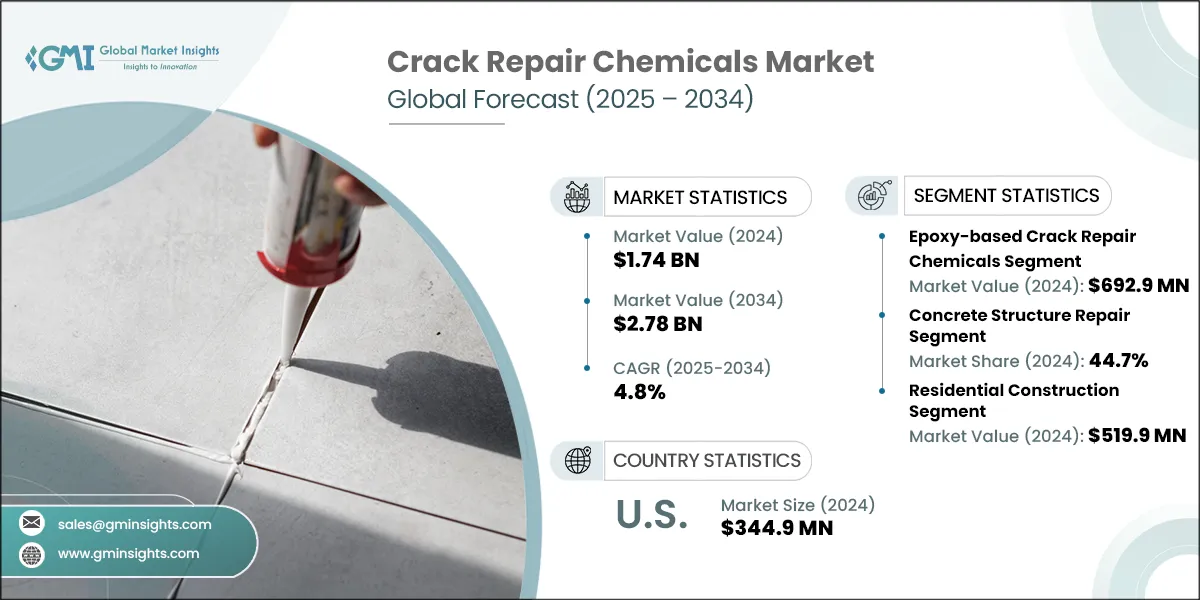
The global crack repair chemicals market was valued at USD 1.74 billion in 2024. The market is expected to grow from USD 1.82 billion in 2025 to USD 2.78 billion in 2034, at a CAGR of 4.8%.
To get key market trends
- Crack repair chemicals are used as essential constituents in making constructions and also in the repair of old buildings. These chemicals can broadly be classified into epoxy-based, polyurethane-based, acrylic-based, and cement-based products that are applied inside the crack to restore the strength of concrete, asphalt, and other building materials. Using residential, commercial, industrial, and infrastructure projects makes them essential for both building and renovation. The market has shown a steady rise due to the increase in demand for rapid and effective measures for maintenance of structures, especially developed countries' roads where buildings, bridges, and roads have fallen apart or deteriorated.
- Crack repairing chemicals are structures that can extend watertightness by effective barriers to water, avoid corrosion, and thereby localize the problem in the areas of the structure that require it the most. Therefore, these products have found their way into the public sector and private users. The upcoming materials developed act as fillers that could have better adhesion on the joints, provide higher elasticity, and withstand extreme working conditions. These are by far the best developments for areas that are subject to severe weather or earthquakes.
- Adverse security market conditions, environmental and regulatory conditions will shadow market growth. The demand for environmentally friendly water-based products is booming with the features that support the attainment of sustainability goals without compromising high performance. This has driven green product manufacturers to find new, cleaner methods of application, i.e., UV curing and nano-enhanced products.
- Europe is still a powerhouse within green buildings due to its commitment to energy-efficient repair and environmentally responsible construction. The market for crack repair chemicals has continued to grow as new technologies, regulatory compliance, and global influences grow in the market for resilient infrastructure.
Crack Repair Chemicals Market Report Attributes
| Key Takeaway | Details |
|---|---|
| Market Size & Growth | |
| Base Year | 2024 |
| Market Size in 2024 | USD 1.74 Billion |
| Forecast Period 2025 - 2034 CAGR | 4.8% |
| Market Size in 2034 | USD 2.78 Billion |
| Key Market Trends | |
| Drivers | Impact |
| Aging infrastructure in developed nations | Demands effective crack repair solutions to ensure their safety and enhance their lifetime. |
| Advancements in material science and technology | New materials in material science and technology show that they work better than traditional cement-based fillers. This has led to more use in residential, commercial, and industrial sectors. |
| Rapid urbanization and construction in emerging economies | Rapid urbanization and construction in emerging economies lead to more cracks and structural problems. This trend generates a strong demand for crack repair chemicals. |
| Pitfalls & Challenges | Impact |
| Volatility in raw material prices | Fluctuating prices caused by energy market instability and supply chain disruptions can significantly raise production costs and lower profit margins. |
| Supply chain disruptions | Pandemics or geopolitical tensions can disrupt the sourcing of raw materials, packaging, and distribution. |
| Opportunities: | Impact |
| Expansion into emerging markets | New development generates a demand for maintenance and crack repair solutions. |
| Eco-friendly and sustainable product development | Green construction materials are conspicuously sought after in the market owing to environmental regulations and the ever-increasing global warming consumer awareness. |
| Market Leaders (2024) | |
| Market Leaders |
12% Market Share |
| Top Players |
Collective Market Share in 2024 is 39.7% |
| Competitive Edge |
|
| Regional Insights | |
| Largest Market | Asia Pacific |
| Fastest growing market | Europe |
| Emerging country | India, Brazil, Mexico, Indonesia, Vietnam |
| Future outlook |
|
What are the growth opportunities in this market?
Crack Repair Chemicals Market Trends
- The market is undergoing dynamic changes in its technologies in the context of sustainability, fresh innovations, and digital integration. Manufacturers are taking the regulations into account while formulating low VOC, non-toxic, and bio-based crack repair chemicals and, for sure, making the developing more aware consumer segment aware of it.
- Development and marketing of high-performance specialized repair systems are quite demanding. These advanced products are durable, flexible, and most important, resistant to harsh environmental conditions; hence, they are being used in industries and infrastructural applications. Accordingly, relevant companies with such innovations are gaining a competitive edge as they service higher-value segments and thereby can charge a premium for these products.
- Crack repair solutions are being interfaced with latest smart construction technologies in the form of predictive maintenance platforms and sensor-based monitoring systems. The framework extends to early detection of cracks and automated repair scheduling for effective safety and throughput for contractors and facility managers on an industrial scale.
- Emerging markets give another promising area for growth. With increasing urbanization in Asia Pacific, Africa, and Latin America, there is a demand for cheap and effective crack repair solutions. Local production and distribution have a strong competitive advantage in these markets, derived from low cost and speedier application to market.
Crack Repair Chemicals Market Analysis

Learn more about the key segments shaping this market
The market by product type is segmented into epoxy-based crack repair chemicals, polyurethane-based solutions, acrylic-based repair materials, cement-based repair compounds, silane/siloxane-based products, others (hybrid systems, bio-based materials). Epoxy-based crack repair chemicals generated USD 692.9 million in 2024.
- Flexible and able to expand and contract with movement, polyurethane solutions came into increasing popularity. They can be described as in dynamic environment situations where temperature changes are experienced: bridges, tunnels, and buildings. The rapid curing feature provides the fast turnaround that is expected in urgent repairs, greatly benefiting project schedules.
- While they might not perform as well as others considered more specialized, acrylic repair materials represent the middle ground between cost and performance. Their ease of use and rapid-setting characteristics are especially appreciated in residential and commercial repair jobs where time constraints need to be considered.
- The cement-based repair products are still the workhorses in conventional construction mainly due to their low cost and compatibility with the concrete substrate. Cement-based systems are still seen as rough-and-ready implementations, whereas polymer-based systems are far more sophisticated; nevertheless, cement-based systems dominate noncritical repairs when cost considerations become pronounced.
- Silane/siloxane-derived materials are fast becoming the preferred choices for waterproofing and surface protection applications. Hybrid systems and bio-based products-the realm of maximum innovations-are characterized either by merging the good of multiple chemistries, or by utilizing sustainable constituents purposively engineered to reduce environmental footprints.
Learn more about the key segments shaping this market
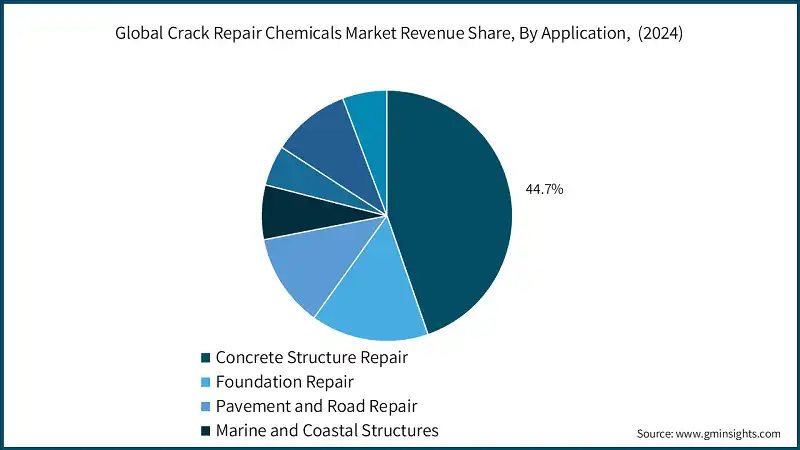
Based on application, the crack repair chemicals market is segmented into concrete structure repair, foundation repair, pavement and road repair, marine and coastal structures, foundry and metal casting, underground and tunnel applications, others (swimming pools, water treatment facilities). Concrete structure repair made up 44.7% of the market in 2024.
- Concrete repair continues to be the most significant section owing mainly to the high application of concrete in buildings, bridges, and industrial structures. Repair of the infrastructure is needed to maintain the architecture in terms of integrity when the infrastructure gets aged. This is also where crack repair chemicals used here should provide good adhesion, durability over time, and resistance against various environmental stressors.
- Another crucial fraction in foundation repairs considered even more vital is the locality where the soil movement or seismic impact is likely. These products must penetrate very deeply into the cracks and then stabilize the foundation to prevent future damage and the long-term safe keeping. Epoxy and polyurethane-based are the most common used products since they are strong and flexible.
- With the increased budget allocated to transport infrastructure, this segment was driven. Crack repair chemicals in this segment are able to sustain extreme loads and temperature variations, while withstanding persistent wear under very harsh conditions. The hallmark of this segment is the use of quick-setting and weather-resistant formulations, built to maintain minimum traffic disruption during maintenance operations.
- Since silane/siloxane-based products and hybrid systems have that property- that they penetrate deep and also give hydrophobicity, these would be an excellent solution for providing long-term protection against deterioration.
- The other types of applications are repair solutions which need to be waterproof and chemical resistant for swimming pools and water treatment plants. These are environments needing products that can withstand constant contact with water and maintenance cleaning agents to ensure optimal performance.
Based on end use, the crack repair chemicals market is segmented into residential construction, commercial construction, industrial construction, consumer goods industry, infrastructure and public works. Residential construction leads the market in 2024 with USD 519.9 million.
- Demand for replacement and crack repair come up with aging structures. Crack-repair chemicals come in handy for new constructions and renovations to secure structures from cracking or leaking by infiltration into them and thus prolonging home life. Indeed, they are affordable and easy to apply for, making them very appealing to homeowners and contractors who have very tight resources and timelines.
- Commercial construction, is driven predominantly by new office spaces, retail centers, and mixed-use developments. From this segment, the value proposition has been focused based on performance and aesthetics for the crack repair solutions to maintain both the aesthetic appeal and integrity of such high traffic buildings. Fast cure and high durability formulations are preferred to minimize downtimes and disruptions.
- Strategically, the consumer goods industry embraces crack repair chemicals in maintaining the manufacturing floor, storage areas, and packaging zones. They mainly require quick and reliable repairs as interruptions would cause production loss while ensuring the safety of its workers.
Based on technology, the market is segmented into conventional repair technologies, advanced repair technologies, emerging technologies. Conventional repair technologies lead the market in 2024.
- Cement-based traditional compounds, simple epoxy fillers that are inexpensive, and easy to use. Such materials are quite familiar and trustworthy with the same all-day requirement, so construction companies and general contractors will use them often for maintenance and quick repair needs.
- Advanced repair technologies are slowly being accepted in industrial and infrastructure applications. These include high-performance polyurethane systems, silane/siloxane-based waterproofing agents, hybrid formulations that will allow durability, chemical resistance, and mobility. More and more, these technologies are becoming incorporated in the workflows of architects and design professionals to satisfy the weighty structural-expressive demands, as real estate builders seek them for longer life and greater value of the buildings.
- New-age technologies are just coming into the market. Instance include bio-based crack repair materials, self-healing formulations, and smart formulations that change in response to the environment. Research institutions and universities have taken on a prominent participation role in the development of these technologies, while various government institutions are also sponsoring pilot projects and sustainable initiatives regarding such innovations. Not much has been done in adopting these technologies, but they are promising for the future scenarios in which, for some of these, their radically different approaches of urban development will change the way repairs will be done in the future.
Looking for region specific data?
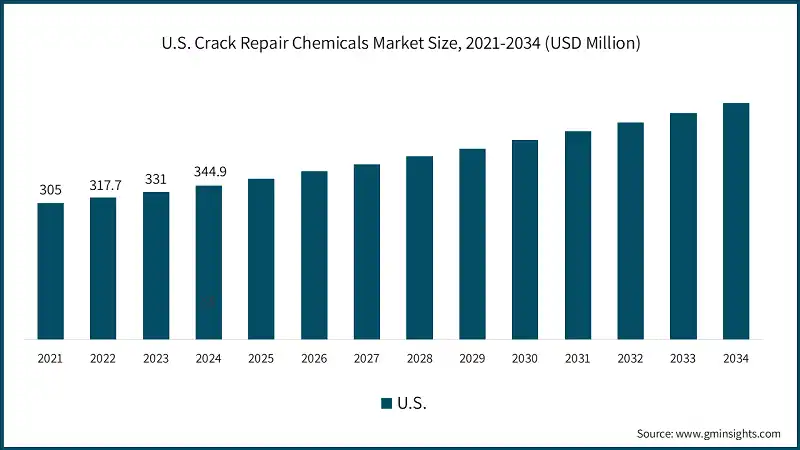
U.S. crack repair chemicals market was accounted for USD 344.9 million in 2024.
- The market in North America is significantly larger, the U.S. being the predominant one among the regions. The U.S., with its well-established construction sector and robust infrastructure investments, has created a focus on maintenance and rehabilitation of buildings hence demanding state-of-the-art crack repair solutions especially significant for large infrastructure projects like highways, bridges, and public edifices. Adding to the impetus given by the innovative demands for repair materials mainly epoxy- and polyurethane-based systems, this market is characterized also by the presence of big players in the game and active R&D operations within the region.
- Aside from these commercial aspects, the impetus from environmental awareness and concurrent regulatory pressures is shaping the U.S. market into adopting low-VOC and sustainable crack repair chemicals. Such developments fit within the bigger picture of reducing the overall environmental footprint of construction, as well as extending lifespan, into lifetime considerations.
- Crack repair systems have been adopted by contractors in Canada to address issues arising from remote access and environmentally sensitive areas. The synergism between durability, easy application, and eco-friendliness is inspiring collaborations between manufacturers and public sector organizations with a view to accelerating market growth.
The market in the Germany is expected to experience significant and promising growth from 2025 to 2034.
- Crack repair chemicals market in Europe is gaining strong momentum with leading nations like Germany and the UK taking the lead in innovations and high adoption rates. At the same time Germany, reputed as the engineering genius country with commitment to sustainability, is actively investing in advanced repair technologies. This is complemented by government-backed research initiatives and industrial partnerships that are working on the development of high-performance eco-friendly crack repair solutions. These efforts are thus in line with the country's broader goals of ensuring that infrastructures are standing the test of time as well as being friendly to the environment.
- UK is also emerging as a key player in smart construction initiatives as well with the use of digital tools such as Building Information Modelling (BIM) and systems for predictive maintenance essentially pushing the application of crack repair chemicals in much more clever and precise directions. Digital-first strategies will help contractors and developers decrease rehabilitation costs, improve accuracy, and extend the lifespan of critical structures.
The crack repair chemicals market in China is expected to experience significant and promising growth from 2025 to 2034.
- Asia-Pacific market is fast-growing; it has strong growth drivers originating from China and India. Because of the rapid urban renewal projects along with a strong government backing for supporting sustainable practices in construction, China tops the pace on massive infrastructure development projects. Long-term durability and reasonably low maintenance costs associated with the structures generated much demand for advanced crack-repair solutions, especially for public works on a large-scale level and high-rise developments. The strong presence of local players and growing acceptance of performance materials like epoxy and polyurethane compounds also buttress China's position in the market.
- India is not very far behind; although technology has not extensively penetrated the country, it has a great deal going for it. With government initiatives to promote affordable housing, smart cities, and modernization of infrastructure, cracks repair chemicals would find wide application in government as well as private undertaking works. Before this, Indian contractors used to depend on these solutions thereby enhancing life, decreasing maintenance cost, and resilience to safety specifications.
UAE market is expected to experience significant and promising growth from 2025 to 2034.
- Saudi Arabia and the United Arab Emirates have showcased booming activities in the crack repair chemicals market for Middle East & Africa, with alterations in the backdrop of construction created by smart city and sustainable urban development. Today, the country has proven itself as a resource in the region. The rapid expansion of infrastructure, along with the deployment of relatively new technology such as Building Information Modeling (BIM), digital twin systems, etc., makes it the epicenter of activities. The applications in which crack-repair solutions are utilized continue to tailor them to render repairs accurate, efficient, and, above all, fit into long-term sustainability goals.
- Saudi Arabia has a plan for its national agenda to diversify and transform its economy. As an additional thrust, it also aims for modernized infrastructure. Various government-backed initiatives encourage the award of large-scale development projects-public and private-to advance and environmentally friendly crack repair chemicals. The country highlights the three attributes of durability, cost-efficiency, and accountability to the environment, creating a significant demand for high-performance materials such as polyurethane and silane/siloxane systems.
Brazil is expected to experience significant and promising growth from 2025 to 2034.
- In Latin America crack repair chemicals is gaining momentum, with Brazil leading the market. The interest in affordable and sustainable housing projects has generated a need for reliable and cost-effective solutions for crack repair. There is also the boost to usage of premier level repair materials through government interventions that advance infrastructure and green building practices, with a focus on urban renewal and public housing.
- Argentina, on the other hand, is also in steady transformation away from pilot programs and experimental cooperation toward general adoption of crack repair technology. Construction in Argentina acknowledges the necessity of durable and efficient systems of repair on aging infrastructures towards safety increases in buildings.
Crack Repair Chemicals Market Share
- The markets are moderately consolidated with players like A Sika AG, MAPEI S.p.A., RPM International Inc., Master Builders Solutions (MBCC Group), and BASF SE holding 39.7% market share.
- Prominent players in the market continue to establish footholds through consistent funding toward research and development for the manufacture of high-performance recyclable formulations aligned to current industry standards and regulatory requirements.
- The great availability of multi-functional reparative agents which indeed seal cracks as well as providing other benefits such as waterproofing, UV resistance, and flexibility under structural loads is receiving considerable attention in research and manufacture. Such materials are now becoming part of the critical variables needed for large infrastructure and high-performance environments where longevity depends on reliable performance.
- With technologies receiving built-in real-world exposure and validation for broad applicability, these partnerships allow manufacturers to place their products directly into extensive urban development and renovation works. Prominent players in the market continue to establish footholds through consistent funding toward research and development for the manufacture of high-performance recyclable formulations aligned to current industry standards and regulatory requirements.
Crack Repair Chemicals Market Companies
Major players operating in the crack repair chemicals industry are:
- Sika AG
- MAPEI S.p.A
- RPM International Inc.
- Master Builders Solutions (MBCC Group)
- BASF SE
- Arkema S.A.
- Dow Inc.
- 3M Company
- Henkel AG & Co. KGaA
- Fosroc International Limited
Sika AG is engaged in developing crack repair chemicals, as part of the high-performance solutions offered by specialty construction chemicals for structural maintenance and rehabilitation. They are focused towards developing innovative formulations with durability, flexibility, and environmental friendliness built in, making them apt for simple as well as complex repair applications.
MAPEI S.p.A. has been a household name in the market due to its extensive knowledge in construction materials and kept abreast with all that is cool and new in the realm of innovation. The company is more into formulating high-performance crack repair solutions for various structural requirements-from residential buildings to intricate infrastructural projects.
RPM International Inc. has established itself as one of the players in the crack repair chemicals market with its extensive range of general and specialty coating brands. RPM International Inc. produces high-performance crack repair materials regarding durability, ease-of-application, and longer-lasting performance throughout the life of the structure.
Master Builders Solutions (MBCC Group) is a recognized leader in the market, an area it has advanced in material science and focused on performance-driven solutions. The company specializes in developing high-performance repair systems to solve the entire life cycle of structural problems-ranging from superficial cracks all the way to deep load-bearing damage in concrete and masonry.
Collectively, these companies illustrate a collaborative approach in innovating and refining crack repair solutions such that the widespread adoption of crack repair chemicals in construction can be made possible to address the issues related to material performance, compatibility, and scalability.
Crack Repair Chemicals Industry News
- February 2025 – Saint-Gobain acquired FOSROC, a leader in construction chemicals in Asia and emerging markets, completing further consolidation of Saint-Gobain's worldwide presence in the industry.
- March 2025 - Sika announced the successful recertification of Sarnafil AT®, a thermoplastic roofing membrane under Cradle to Cradle Certified™ (C2C), while Sarnafil® AT E, designed for higher fire requirements, has received its C2C certificate for the first time.
- July 2025 - Chryso, a global player in sustainable construction solutions and part of Saint-Gobain Construction Chemicals, announces the rebranding of its established synthetic fibers product lines. The formerly branded STRUX and SINTA will now be known as Adfil Strux Macro Synthetic Fibers and Adfil Sinta Micro Synthetic Fibers, respectively.
The crack repair chemicals market research report includes an in-depth coverage of the industry with estimates and forecast in terms of revenue in USD Million and volume in terms of Kilo tons from 2021–2034 for the following segments:
Market, By Product Type
- Epoxy-Based Crack Repair Chemicals
- Low-Viscosity Epoxy Resins
- High-Modulus Epoxy Systems
- Moisture-Tolerant Epoxy Solutions
- Rapid-Curing Epoxy Formulations
- Polyurethane-Based Solutions
- Hydrophobic Polyurethane Grouts
- Flexible Polyurethane Sealants
- Expanding Polyurethane Systems
- Acrylic-Based Repair Materials
- Water-Based Acrylic Systems
- Solvent-Based Acrylic Solutions
- Modified Acrylic Polymers
- Cement-Based Repair Compounds
- Polymer-Modified Cement Systems
- Rapid-Setting Cement Mortars
- Shrinkage-Compensating Cement
- Silane/Siloxane-Based Products
- Others (Hybrid Systems, Bio-Based Materials)
Market, By Application
- Concrete Structure Repair
- Building and Construction
- Bridge and Infrastructure
- Industrial Facilities
- Foundation Repair
- Residential Foundations
- Commercial Foundations
- Industrial Foundations
- Pavement and Road Repair
- Highway and Arterial Roads
- Airport Runways and Taxiways
- Parking Structures
- Marine and Coastal Structures
- Underground and Tunnel Applications
- Others (Swimming Pools, Water Treatment Facilities)
Market, By End User
- Residential Construction
- New Construction
- Renovation and Repair
- Maintenance Services
- Commercial Construction
- Office Buildings
- Retail and Shopping Centers
- Hospitality and Entertainment
- Industrial Construction
- Manufacturing Facilities
- Warehouses and Distribution Centers
- Power Generation Facilities
- Infrastructure and Public Works
- Transportation Infrastructure
- Water and Wastewater Treatment
- Government and Municipal Buildings
Market, By Technology
- Conventional Repair Technologies
- Injection-Based Systems
- Surface Application Methods
- Structural Strengthening Systems
- Advanced Repair Technologies
- Self-Healing Systems
- Nanotechnology-Enhanced Products
- Smart and Responsive Materials
- Emerging Technologies
- Bio-Based Healing Systems
- AI-Assisted Application Systems
- IoT-Enabled Monitoring Solutions
The above information is provided for the following regions and countries:
- North America
- U.S.
- Canada
- Europe
- Germany
- United Kingdom
- France
- Spain
- Italy
- Rest of Europe
- Asia Pacific
- China
- India
- Japan
- Australia
- South Korea
- Rest of Asia Pacific
- Latin America
- Brazil
- Mexico
- Argentina
- Rest of Latin America
- Middle East and Africa
- Saudi Arabia
- South Africa
- UAE
- Rest of Middle East & Africa
Frequently Asked Question(FAQ) :
Who are the key players in the crack repair chemicals market?
Key players include Sika AG, MAPEI S.p.A, RPM International Inc., Master Builders Solutions (MBCC Group), BASF SE, Arkema S.A., Dow Inc., and 3M Company.
What are the upcoming trends in the crack repair chemicals industry?
Key trends include the development of low VOC, non-toxic, and bio-based chemicals, increasing adoption of advanced repair systems resistant to harsh conditions, and growing demand for rapid-curing solutions for urgent repairs.
Which region leads the crack repair chemicals market?
North America leads the market, with the U.S. generating USD 344.9 million in 2024. The region's dominance is attributed to its well-established construction sector and significant infrastructure investments.
What was the market size of the crack repair chemicals in 2024?
The market size was USD 1.74 billion in 2024, with a CAGR of 4.8% projected through 2034, driven by increasing infrastructure repair needs and advancements in chemical formulations.
What is the projected value of the crack repair chemicals market by 2034?
The market is expected to reach USD 2.78 billion by 2034, fueled by demand for sustainable and high-performance repair solutions.
What was the market share of concrete structure repair in 2024?
Concrete structure repair accounted for 44.7% of the market in 2024, driven by the widespread use of concrete in buildings, bridges, and industrial structures.
How much revenue did the epoxy-based crack repair chemicals segment generate?
Epoxy-based crack repair chemicals generated USD 692.9 million in 2024, leading the market due to their superior strength and durability.
What is the projected size of the crack repair chemicals market in 2025?
The market is expected to grow to USD 1.82 billion in 2025.
Crack Repair Chemicals Market Scope
Related Reports