Summary
Table of Content

Cooling Meters Market
Get a free sample of this report
Form submitted successfully!
Error submitting form. Please try again.
Thank you!
Your inquiry has been received. Our team will reach out to you with the required details via email. To ensure that you don't miss their response, kindly remember to check your spam folder as well!
Request Sectional Data
Thank you!
Your inquiry has been received. Our team will reach out to you with the required details via email. To ensure that you don't miss their response, kindly remember to check your spam folder as well!
Form submitted successfully!
Error submitting form. Please try again.
Cooling Meters Market Size
- Paradigm shift toward sustainable cooling measures, supported by the rising environmental expectations and stricter regulations, to adopt smart metering solutions that provides exact measurement of chilled water usage and transparent billing. Growing focus on operational efficiency strengthening the industry expansion relevance across commercial complexes, industrial facilities and upgraded residential retrofits.
- Ongoing modernization of industries, commercial buildings and residential developments increases the adoption of district cooling networks with stringent government standards with the growing need for exact measurement of chilled water usage driving the advanced metering solutions, thus propelling the industry growth.
- Emerging manufacturers focus on reliable, low‑maintenance and digitally enabled meters that offer transparent billing, real‑time monitoring with upgraded building management systems. Shifting focus on reducing operational costs and improving environmental performance, cooling meters peruses as a key component in energy‑efficient infrastructure, supporting long‑term demand across both established and emerging markets.
- Wider expansion of district cooling networks with advanced meters to ensure reliable performance and fair cost allocation are equipped with digital communication, remote monitoring with data‑driven analytics as preferred choice for the industry. These technologies help build owners to optimize the system performance, reduce wastage and to maintain consistent cooling delivery.
- Rising demand prioritizing with advanced energy metering solutions to reduce energy production costs measuring accurate billing and efficient consumption management. Additionally, the upgradation of incredible meters with enhanced performance and strong resistance to extreme weather conditions, thus creating significant opportunities for cooling energy meter manufacturers, fueling industry growth.
- Key leading countries including U.S. and India are facing with energy crises which pushes for supportive renewable power growth stringent policies and norms regulated. Rapid industrialization and urbanization surge with the push for sustainable energy systems to intensify personalized and automated billing, further augmenting the rising importance of smart cooling meters in energy distribution networks, bolstering their industry adoption.
The cooling meters market was estimated at USD 1.4 billion in 2025. The market is expected to grow from USD 1.5 billion in 2026 to USD 2.5 billion in 2035, at a CAGR of 6.2%, according to Global Market Insights Inc.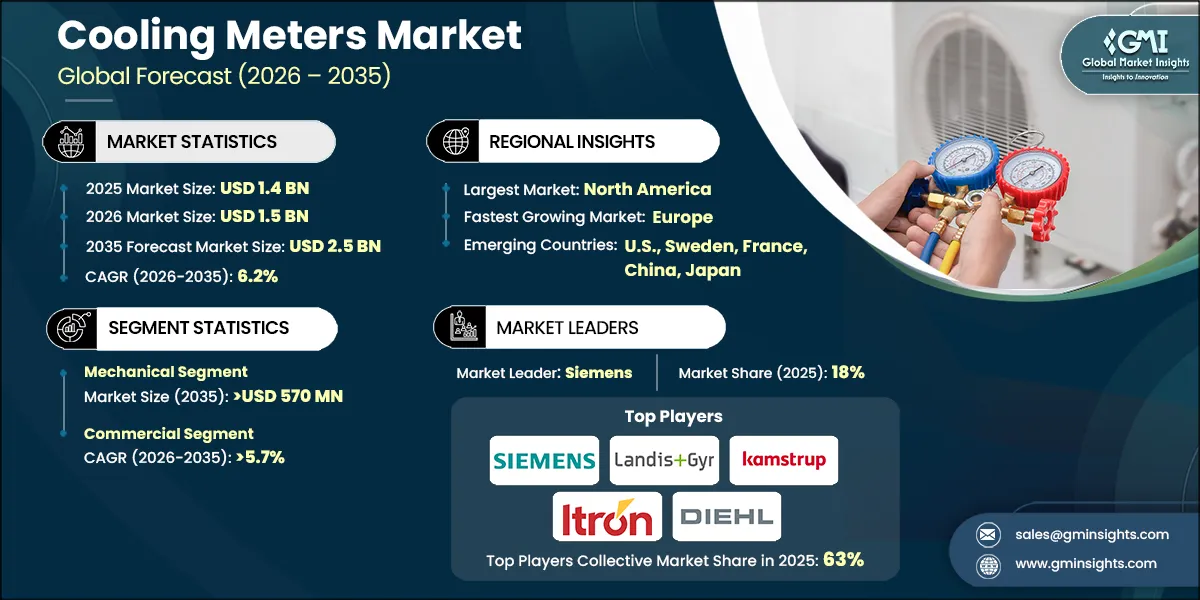
Cooling Meters Market Key Takeaways
Market Size & Growth
- 2025 Market Size: USD 1.4 Billion
- 2026 Market Size: USD 1.5 Billion
- 2035 Forecast Market Size: USD 2.5 Billion
- CAGR (2026–2035): 6.2%
Regional Dominance
- Largest Market: North America
- Fastest Growing Region: Europe
Key Market Drivers
- Growing inclination to adopt sustainable solutions.
- Favorable government efforts to adopt zero emission buildings.
- Surging requirement for cooling solutions across hot climate regions.
- Rising demand for advanced metering solutions.
Challenges
- Technical limitations during extreme weather conditions.
Opportunity
- Growth in Smart Buildings and Energy Efficiency Programs.
- Expansion of District Cooling Systems.
Key Players
- Market Leader: Siemens led with over 18% market share in 2025.
- Leading Players: Top 5 players in this market include Siemens, Kamstrup, Itron, Diehl Stiftung, Landis+Gyr, which collectively held a market share of 63% in 2025.
Get Market Insights & Growth Opportunities
To get key market trends
Cooling Meters Market Trends
- Cooling meters are structured for explosive environments and are delivered for various applications including convective cooling of high-speed tools and cooling switch cabinets, with the air conditioning for protective suits. Ongoing continuous upgradation for advanced cooling equipment, which informs real-time data monitoring to help cut energy bills, is set to foster the product sales over the recent years.
- Utilities and developers are prioritizing meters that support advanced communication protocols and centralized monitoring platforms, helping with streamline operations and improve service reliability. Shifting push toward smart district cooling, strengthening the demand for interoperable and scalable metering technologies.
- Rapid industrialization for digital and ultrasonic meters delivers higher accuracy, long‑term stability with retrofit building automation systems that enable real‑time monitoring, remote diagnostics and data‑driven optimization, thus adaptable for commercial and industrial applications, driving the business dynamics.
Cooling Meters Market Analysis
Learn more about the key segments shaping this market
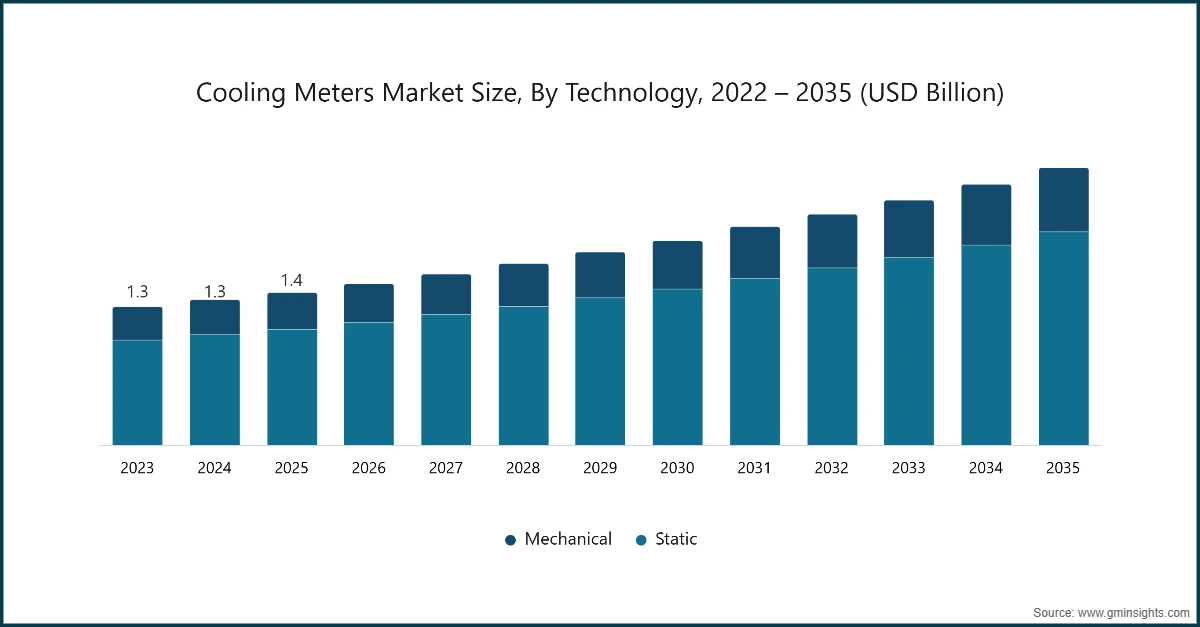
Based on technology, the cooling meters market is bifurcated into mechanical and static.
- Mechanical is anticipated to grow more than USD 570 Million by 2035 rising to the efficient design, cost-effectiveness and accurate measurement. These meters deliver simpler, mechanical technology that directly measures the flow of chilled water and temperature differential, suitable with cost-effective for environments where high-end smart technology is augmenting the product landscape. In addition, mechanical cooling meters are directly used in commercial and residential buildings aiming for green certifications with the LEED, thereby strengthening market growth.
Learn more about the key segments shaping this market
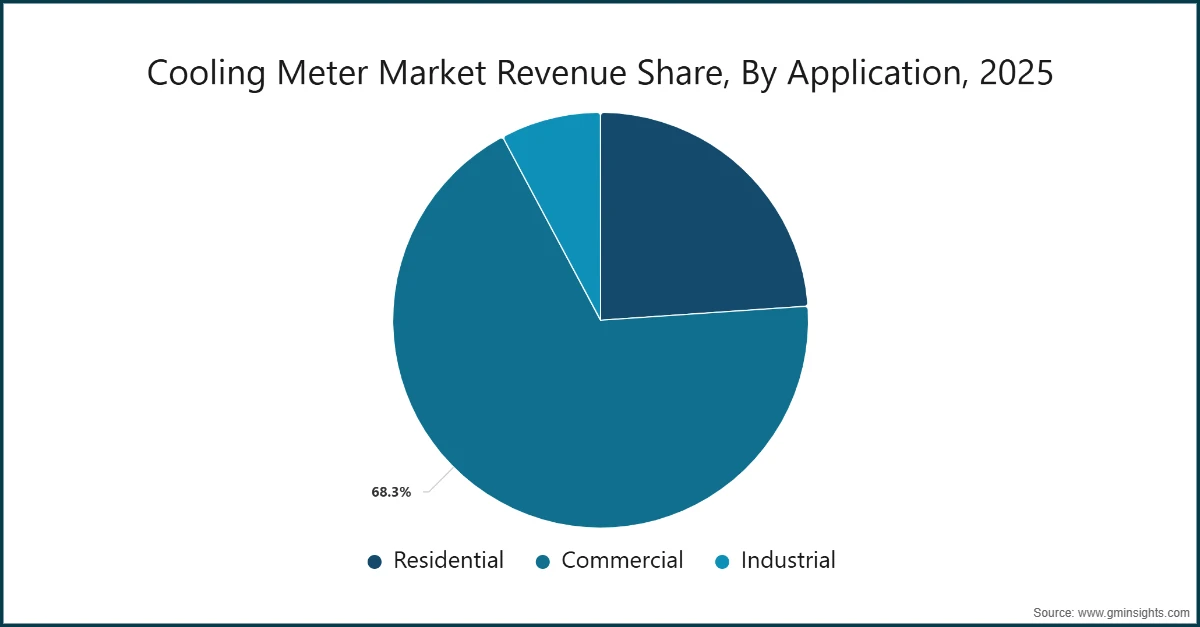
Based on application, the cooling meters market is bifurcated into residential, commercial and industrial.
- Commercial is anticipated to grow more than CAGR 5.7% by 2035 driven by the rising integration toward mitigating climate changes. Commercial buildings including office complexes, shopping malls, hotels are dependent on cooling meters to manage with their energy consumption. They commercial establishments delivers real-time data on energy consumption, helping building managers conduct regular energy audits enabling better control over cooling systems, ensuring they are operating efficiently, preventing overcooling and identifying opportunities for improvements, contributing to the industry landscape.
Looking for region specific data?
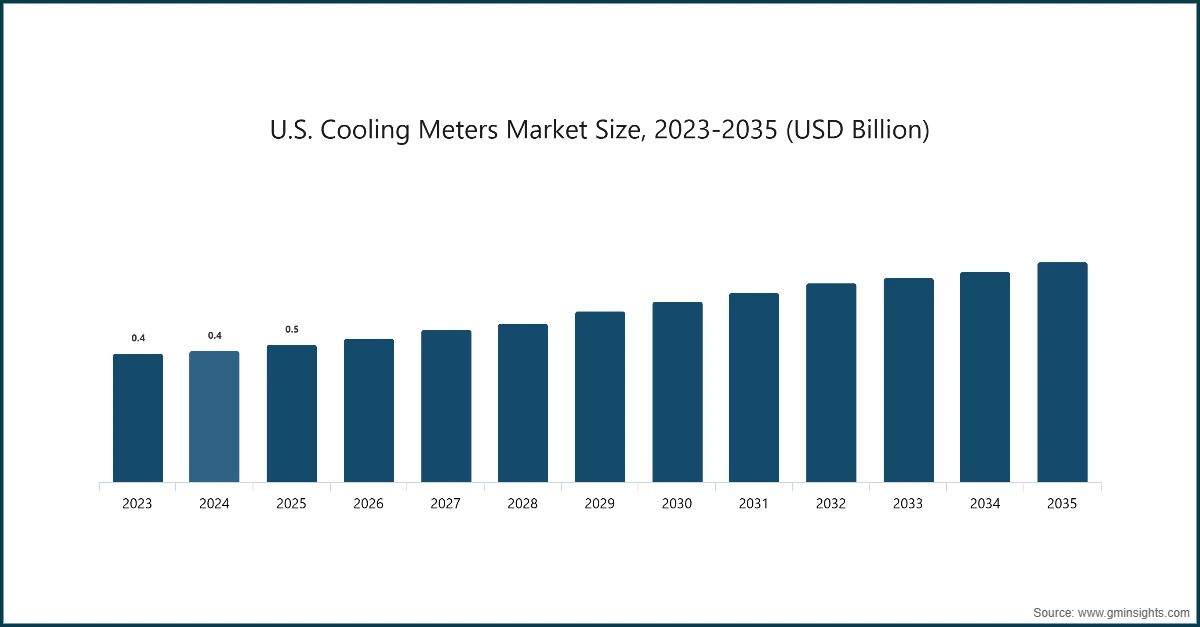
The U.S. cooling meters market is anticipated to grow more than USD 0.71 Billion by 2035 on account of the introduction of supportive mandates to expand sustainable building infrastructure.
- For instance, in October 2024, Advanced Cooling Technologies has secured USD 1.1 million funding with two subcontracts awarded by the U.S. DOE ARPA‑E under its COOLERCHIPS program. It aims at accelerating the development of high‑performance and energy‑efficient cooling solutions for data centers, designed to improve reliability, reduce power consumption and support rising compute densities.
Cooling Meters Market Share
- Key leading companies in the cooling meters industry focusing on modern innovation which is strengthening their competitive edge and meet the rising customer expectations. Flourishing investments in upgraded sensor technologies, digital monitoring platforms and smart connectivity features to deliver higher accuracy and real‑time system monitoring. Company market leaders are expanding their wide product portfolios with compact, energy‑efficient designs to address the rising demand.
Cooling Meters Market Companies
Eminent players operating in the cooling meters industry are:
- Apator S.A.
- Axioma Metering
- B Meters
- Danfoss
- Diehl Stiftung & Co. KG
- Honeywell International Inc.
- Integra Metering
- Itron Inc.
- ista Energy Solutions Limited
- Kamstrup
- Landis+Gyr
- QUNDIS
- RB Flowmeter
- Schneider Electric
- Secure Meters Ltd.
- Siemens
- Smartdhome Srl
- Sontex SA
- Xylem
- ZENNER International GmbH & Co. KG
Cooling Meters Market Report Attributes
| Key Takeaway | Details |
|---|---|
| Market Size & Growth | |
| Base Year | 2025 |
| Market Size in 2025 | USD 1.4 Billion |
| Market Size in 2026 | USD 1.5 Billion |
| Forecast Period 2026-2035 CAGR | 6.2% |
| Market Size in 2035 | USD 2.5 Billion |
| Key Market Trends | |
| Drivers | Impact |
| Growing inclination to adopt sustainable solutions | Increasing focus on sustainability and reducing energy consumption is set to drive the market outlook. Cooling meters help track energy use accurately, save on costs, and meet environmental goals. Growing awareness of efficient and smart devices across different sectors will augment the product growth. |
| Favorable government efforts to adopt zero emission buildings | Introduction of regulations, incentives, and programs to encourage the development of zero-emission and energy-efficient products will complement the business landscape. These policies support the use of cooling meters making it easier for establishments to comply with new standards and contribute to industry momentum. |
| Surging requirement for cooling solutions across hot climate regions | Hot climates and rising temperatures are increasing the demand for reliable cooling solutions in residential, commercial, and industrial buildings. Cooling meters play a crucial role by monitoring energy use, optimizing system performance, and helping to manage costs, which boosts adoption in these regions. |
| Rising demand for advanced metering solutions | Modern energy management trends favor smart, connected, and automated metering systems. Cooling meters have advanced features like data analytics, remote monitoring, and integration with building automation platforms that help improve efficiency, reduce operational costs, and enable predictive maintenance, leading to market growth. |
| Pitfalls & Challenges | Impact |
| Technical limitations during extreme weather conditions | Very high or very low temperatures, humidity, or storms may cause devices to give inaccurate readings or even temporarily fail. This technical limitation can disrupt energy monitoring, reduce the reliability of data, and increase maintenance needs, which may slow down adoption, especially in regions with harsh climates. |
| Opportunities: | Impact |
| Growth in Smart Buildings and Energy Efficiency Programs | Growing adoption of smart technologies to monitor consumption, control costs, and improve overall efficiency, will complement the market growth. Government programs and utility incentives to promote energy savings will create growth opportunities for manufacturers and solution providers. |
| Expansion of District Cooling Systems | Expansion of district cooling systems in urban areas, and in regions with hot climates will complement the market size. Cooling meters play a key role in monitoring energy use, ensuring accurate billing and fair cost distribution within these networks. Increasing investment in centralized cooling infrastructure, will surge the product demand. |
| Market Leaders (2025) | |
| Market Leader |
18% market share |
| Top Players |
Collective market share in 2025 is 63% |
| Competitive Edge |
|
| Regional Insights | |
| Largest Market | North America |
| Fastest growing market | Europe |
| Emerging countries | U.S., Sweden, France, China, Japan |
| Future outlook |
|
What are the growth opportunities in this market?
Cooling Meters Industry News
- In October 2025, Malema, introduced its new M‑3100 Series Clamp‑On Ultrasonic Flow Meter, of its flow‑measurement portfolio for the semiconductor industry. This device helps with high‑precision, non‑invasive transit‑time measurement for liquid‑filled closed conduits, designed for stringent reliability and cleanliness standards of advanced chip manufacturing.
- In February 2025, Dover introduced Malema M‑2300 Series High‑Purity Inline Straight Tube Ultrasonic Flow Meter, expanding its portfolio for semiconductor and industrial applications. It is designed to meet the stringent requirements of advanced chip‑manufacturing environments, and the M‑2300 Series offers precise flow measurement in a compact. This aims to help semiconductor manufacturers enhance process control, reliability and overall equipment performance.
- In September 2024, Kamstrup reduced the lead concentration in its cooling meters to enhance product sustainability. The company will limit lead concentration in all brass housings to a maximum of 0.1% by 2024 end for all sizes, except for the 19 x 165 mm brass housing, which will transition in 2025. This initiative reinforces Kamstrup's focus on delivering low-lead impact, sustainable products.
- In July 2024, Gentos has developed its new GF Series ultrasonic flowmeter, positioning it as a key solution for next‑generation liquid‑cooling systems amid rising computing power demands. It is structured to deliver the accurate monitoring and control of liquid‑cooling flow rates with advanced temperature‑regulation models that help reduce thermal congestion and maintain system stability.
The cooling meters market research report includes an in-depth coverage of the industry with estimates & forecast in terms of revenue and volume in “USD Million and ‘000 Units” from 2022 to 2035, for the following segments:
Market, By Product
Ultrasonic
- Vortex
- Others
Market, By Technology
Mechanical
- Static
Market, By Application
Residential
- Commercial
- College/University
- Office Building
- Government Building
- Others
- Industrial
The above information has been provided for the following regions and countries:
- North America
- U.S.
- Canada
- Europe
- Germany
- Poland
- Sweden
- Italy
- France
- Asia Pacific
- China
- Japan
- South Korea
- Singapore
- India
- Middle East
- Saudi Arabia
- UAE
- Qatar
- Oman
- Kuwait
- Rest of World
Frequently Asked Question(FAQ) :
What was the market size of the cooling meters in 2025?
The market was valued at USD 1.4 billion in 2025, with a CAGR of 6.2% expected through 2035. The growth is driven by the adoption of sustainable cooling measures, smart metering solutions, and a focus on operational efficiency.
What is the projected value of the cooling meters market by 2035?
The market is poised to reach USD 2.5 billion by 2035, fueled by advancements in smart district cooling, real-time monitoring technologies, and stricter environmental regulations.
What is the expected size of the cooling meters industry in 2026?
The market size is projected to reach USD 1.5 billion in 2026.
How much revenue is the mechanical cooling meters segment expected to generate by 2035?
The mechanical cooling meters segment is anticipated to surpass USD 570 million by 2035, led by their cost-effectiveness, efficient design, and suitability for green-certified buildings.
What is the growth outlook for the commercial segment from 2026 to 2035?
The commercial segment is expected to grow at a CAGR of over 5.7% till 2035, supported by the rising integration of cooling meters in office complexes, shopping malls, and hotels to optimize energy consumption and mitigate climate change impacts.
What is the projected size of the U.S. cooling meters sector by 2035?
The U.S. market is anticipated to exceed USD 0.71 billion by 2035, propelled by supportive mandates promoting sustainable building infrastructure.
What are the upcoming trends in the cooling meters market?
Key trends include advanced communication protocols, centralized monitoring, real-time data tracking, smart district cooling, and digital and ultrasonic meters for higher accuracy.
Who are the key players in the cooling meters industry?
Key players include Apator S.A., Axioma Metering, B Meters, Danfoss, Diehl Stiftung & Co. KG, Honeywell International Inc., Integra Metering, Itron Inc., ista Energy Solutions Limited, Kamstrup, Landis+Gyr, and QUNDIS.
Cooling Meters Market Scope
Related Reports