Summary
Table of Content

Cooking Coconut Milk Market
Get a free sample of this report
Form submitted successfully!
Error submitting form. Please try again.
Thank you!
Your inquiry has been received. Our team will reach out to you with the required details via email. To ensure that you don't miss their response, kindly remember to check your spam folder as well!
Request Sectional Data
Thank you!
Your inquiry has been received. Our team will reach out to you with the required details via email. To ensure that you don't miss their response, kindly remember to check your spam folder as well!
Form submitted successfully!
Error submitting form. Please try again.
Cooking Coconut Milk Market Size
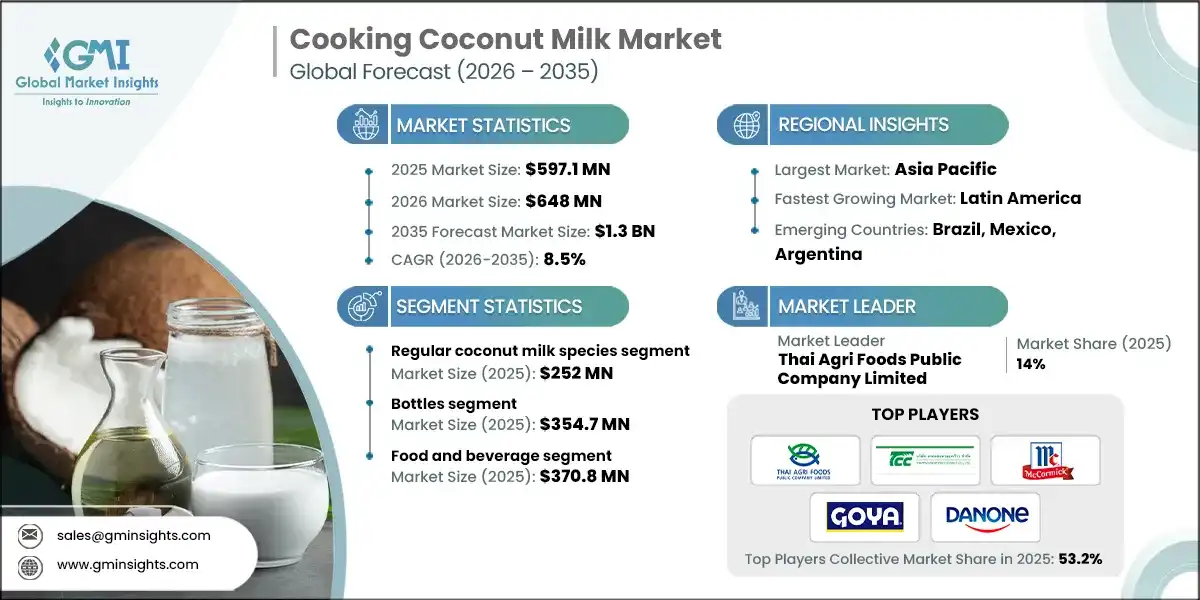
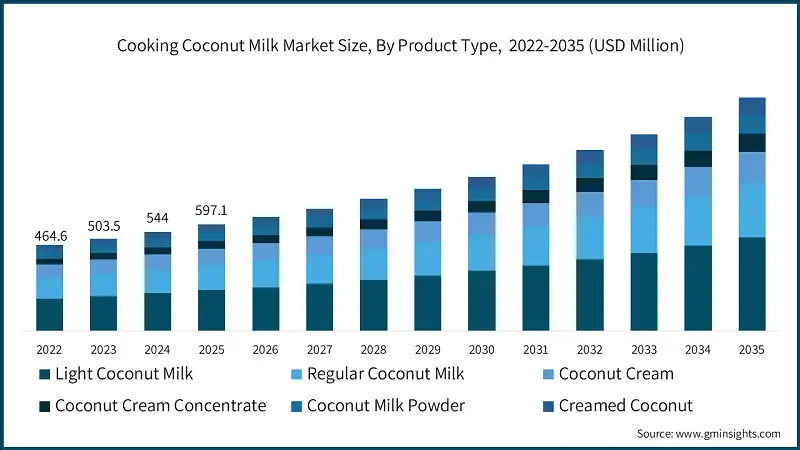
The global cooking coconut milk market size was estimated at USD 597.1 million in 2025. It is expected to grow from USD 648 million in 2026 to USD 1.3 billion by 2035, at a CAGR of 8.5%, according to latest report published by Global Market Insights Inc.
Cooking Coconut Milk Market Key Takeaways
Market Size & Growth
- 2025 Market Size: USD 597.1 Million
- 2026 Market Size: USD 648 Million
- 2035 Forecast Market Size: USD 1.3 Billion
- CAGR (2026–2035): 8.5%
Regional Dominance
- Largest Market: Asia Pacific
- Fastest Growing Region: Latin America
Key Market Drivers
- Rising Demand for Plant-Based Dairy Alternatives.
- Growing Lactose Intolerance & Dairy Allergies.
- Increasing Popularity of Asian & Tropical Cuisines.
Challenges
- High Saturated Fat Content Concerns.
- Climate Change Impact on Coconut Production.
Opportunity
- Rising Demand for Plant-Based, Clean-Label, and Health‑Focused Products.
- Expansion Through Packaging Innovation and Convenience Formats.
Key Players
- Market Leader: Thai Agri Foods Public Company Limited led with over 14% market share in 2025.
- Leading Players: Top 5 players in this market include Thai Agri Foods Public Company Limited, Theppadungporn Coconut Co., Ltd, McCormick & Company, Inc., Goya Foods, Inc., Danone S.A., which collectively held a market share of 53.2% in 2025.
Get Market Insights & Growth Opportunities
- The growing demand of plant based dairy products is a major growth driver that is favoring the growth of the coconut milk market. Traditional dairy is being replaced by plant-based alternatives because of health, ethical and environmental reasons by consumers. Naturally sourced and functionally versatile, coconut milk is increasingly accepted in the domestic cooking, foodservice and packaged food sectors, resulting in a consistent volume increase and increased retail penetration.
- Increased levels of lactose intolerance and dairy allergies are also increasing faster adoption in the market. Quite a large portion of the world community faces the problem of lactose digestion incompleteness, which makes it necessary to switch to dairy-free cooking products. Coconut milk presents an appropriate substitute with similar body and flavor advantages and thus would be used in preference in both traditional recipes and in contemporary food formulation, which increases its clientele segment in various regions.
- The growing popularity of Asian and tropical cuisine and food is driving the demand of coconut milk as a major culinary ingredient. The mainstream use of coconut milk in food preparation has increased due to the global exposure of the Thai, Indian and Southeast Asian and Caribbean food in restaurants, ready-to-eat meals and food delivery platform. This food differentiation contributes to a long-term increase in consumption and reinforces the demand of both retail and food service outlets.
To get key market trends
Cooking Coconut Milk Market Trends
- The cooking coconut milk industry is experiencing gradual growth with the changing consumer dietary shifts in favor of natural and plant-based food stuffs. The trend of growing the awareness of clean-label products and minimum processing is pushing people towards the consumption of coconut milk as a cooking staple in their home kitchens. Its application in savory and sweet preparations is the solid application its repeat consumption across households and foodservice operators.
- Increasing health awareness and intolerance to dairy products as a result of digestive intolerance or allergy are also increasing the pace of demand. Coconut milk is also becoming seen as an appropriate substitute product that offers the same functionality benefits, e.g. richness, mouthfeel and taste without animal-based product. This is changing to wider acceptability by mainstream and health-conscious consumer segments.
- Market momentum is also being driven by the increased exposure of the world to Asian, Southeast Asian and tropical food. Coconut milk is a staple of most traditional dishes and its introduction into international menus, ready to prepare meals, and restaurant service is expanding usage outside of the region. The trends of culinary experimentation and fusion cooking are here to sustain demand.
Cooking Coconut Milk Market Analysis
Learn more about the key segments shaping this market
Based on product type, the market is segmented into light coconut milk, regular coconut milk, coconut cream, coconut cream concentrate, coconut milk powder, and creamed coconut. Regular coconut milk species holds a significant share at a valuation of USD 252 million in 2025.
- By product type segmentation of cooking coconut milk market indicates that regular coconut milk takes the largest portion with the backing of the extensive uses in household cooking, foodservice, and industrial preparation of foods. The fact that it is a balanced fat content, full flavor, and can be used in both savory and sweet dishes makes it a favorite ingredient of the Asian, Western, and fusion cuisines. Frequent consumption of regular coconut milk as a base component in curries, soups, sauces, and ready-to-cook meals further increases the regular demand in the retail and commercial venues.
- The other product variations including light coconut milk, coconut cream, concentrates, powders and creamed coconut are complementary to the market in that they satisfy certain usage requirements, such as being nutritious, adding texture, convenience, and long shelf life. Nevertheless, they are mostly used in niche or application-specific demand, whereas normal coconut milk still enjoys the frequency of high consumption and widespread acceptance among consumers. Its variety of packaging, as well as its compatibility with clean-label and organic positioning, also contribute to its high market contribution in the overall product mix.
Based on packaging, the market is segmented into bottles, cans, pouches, and others. Bottles hold a significant share at a valuation of USD 354.7 million in 2025.
- Bottles constitute the largest proportion of the cooking coconut milk market because of their convenience, re-use and the preference of the consumers to have control on usage and storage. Bottled packaging promotes high consumption in the home environment because it is easy to carry around, spills less, and is portioned better hence highly applicable in retail as well as foodservice environments. The increased attention to the visibility of products, clarity of the labels, and high-class presentation further supports the usage of bottles in the organized retail networks.
- Other forms like cans, pouches and other packaging methods are still supportive in their functions through their application in certain use cases like bulk storage, cost efficient distribution and on the go consumption. Nevertheless, bottles are still popular because they can be adapted to the innovative approaches of sustainable packaging and integrated with contemporary store shelves and online delivery systems. The convenience and the perceived quality place the bottled coconut milk in a better position of choice among the greater market environments.
Learn more about the key segments shaping this market
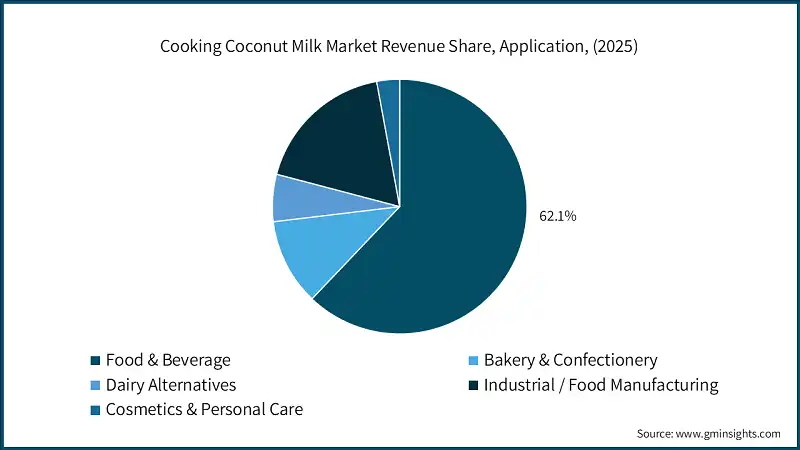
Based on application, the market is segmented into food & beverage, bakery & confectionery, dairy alternatives, industrial / food manufacturing, and cosmetics & personal care. Food & beverage, bakery & confectionery is estimated to grasp a value of USD 370.8 million in 2025 and is expected to grow at 8.2% of CAGR during the forecast period.
- The food and beverage segment takes up the largest portion of the cooking coconut milk market supported by its wide application in household cooking, restaurants, and quick-service restaurants. Coconut milk is a common and popular ingredient in curries, soups, and sauces, beverages, and ethnic cuisine and is a common ingredient in both modern and traditional food preparation. The increasing popularity of foreign dishes and vegetarian cuisine also contributes to the demand in this market segment in both retail and food service industries.
- Another line of application like bakery and confectionery, dairy substitutes, industrial food production and cosmetics and personal care is still secondary in both volume consumption. These groups are mostly dependent on coconut milk as a source of definite functional or formulation advantages, such as texture additives, richness of flavors and dairy alternatives. Nevertheless, the frequency of use and the wide culinary applicability of the food and beverage industry remain high enough to maintain its first-place position among total market demand.
Looking for region specific data?
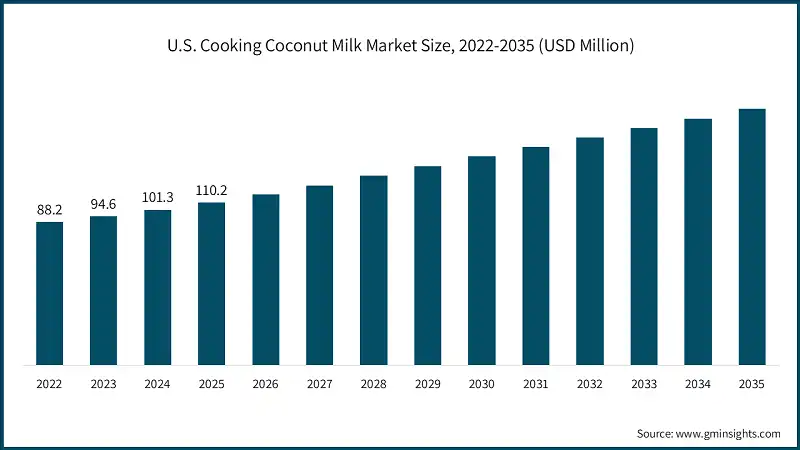
North America cooking coconut milk market accounted for USD 134.3 million in 2025 and is anticipated to show lucrative growth over the forecast period.
- The North American market of cooking coconut milk is seeing a continuous growth due to the increasing consumer demand of plant-based diets, lactose-free products, and health-conscious food options. The increased retail distribution in the United States by supermarkets, specialty health stores, and e-commerce platforms encourages the increased adoption of the product, and cafes and restaurants are beginning to incorporate coconut milk in food and beverages use, as tastes are changing.
- Canada is also a supplier of regional demand due to the specialty product and premium imports that meet the clean-label and organic tastes. The packaged coconut milk can be attributed to its convenience, combined with the increased knowledge about nutritional value, which supports the ongoing growth of the market. The process of urbanization and changing trends in the pattern of lifestyle consumption are also increasing the visibility of the market to the mainstream and niche markets in the global coconut milk market, consolidating the position of North America as a dynamic market in the region.
Europe accounted for USD 95.5 million in 2025 and is anticipated to show lucrative growth over the forecast period.
- The cooking coconut milk market in Europe is supported by a robust cultural change toward plant-based and sustainable food products, with the United Kingdom, Germany, and France being the first to the region to adopt it. The demand trends that have emerged as major drivers are consumer tastes towards clean-label components, organic credentials and environmental friendliness sourcing, to the extent that it is consumed by bakery, dessert and ready meals.
- The increasing availability of coconut milk in retail stores including supermarkets and dedicated health food shops and the rising culinary exploration of the foreign cuisines allow the product to be more densely penetrated among the different population segments. Moreover, the introduction of coconut milk in ethnic and fusion foods by the food processing industry helps to enhance its wider application in both the household and commercial kitchens, which further enhances the market momentum of the region.
Asia Pacific market accounted for USD 316.4 million in 2025 and is anticipated to show lucrative growth over the forecast period.
- The Asia-Pacific region has had a strong momentum in the cooking coconut milk market due to the high domestic consumption and high production of coconuts in countries such as Indonesia, the Philippines and India. Coconut milk is profoundly incorporated into the culinary traditions in southeast and south Asian countries creating stable demand in the home cooking as well as food service markets.
- The growth in market opportunities due to rapid urbanization, increase in dispensable incomes and growing retail infrastructure are increasing, especially in the emerging economies where the packaged and premium coconut milk variants are gaining grounds. The main producing nations usually encourage sustainable farming and enhanced processing capacities, increasing their exportability and regional distribution chains. Therefore, Asia-Pacific continues to have widespread use of coconut-related products, and due to their cultural inclination and increasing lifestyle changes to vegetarian substitutes, the growth is supported.
Latin America market accounted for 11% market share in 2025 and is anticipated to show steady growth over the forecast period.
- In Latin America, the expanding market of cooking coconut milk is supported by the growing number of consumers aware of the benefits of a vegetarian diet and the growing use of coconut products in food and beverage preparation. Brazil and Mexico are among the largest contributors to the demand in the region with the supermarkets and foodservice channel increasing the dairy-free products that are increasingly sought after by the health-conscious populations.
- The tropical climate of the region promotes domestic coconut production, meaning that the access to raw materials will be easier, whereas the introduction of foreign and mixed cuisines provides the introduction of coconut milk into a wider menu. Modernization of retail, such as improved product placement in organized retail and online stores, increased accessibility and visibility, which is a gradual and steady development of the market.
Middle East and Africa market accounted for 9.6% market share in 2025 and is anticipated to show steady growth over the forecast period.
- The cooking coconut milk market is gradually expanding in the Middle East & Africa region as urban consumers take on new diets that are health-conscious and vegetarian. Cities like Dubai (UAE), Riyadh (Saudi Arabia) and Johannesburg (South Africa) are moving towards the demand of exotic and international cuisine products like coconut milk specifically in the foodservice and hospitality segments. Coconut milk products can be found in premium and imported categories, which attract more middle-class population possessing increased disposable incomes and food consciousness. Even though the region is still relying on imports because it is not much in production, the growth of the retail networks and the change of the lifestyle towards dairy-free products are promising growth in the market. The use of coconut milk in restaurants, cafes, and home cooking strengthens its status as an emerging component in the local food system.
Cooking Coconut Milk Market Share
The cooking coconut milk industry is moderately concentrated with Thai Agri Foods Public Company Limited, McCormick and Company, Inc., Goya Foods, Inc., Theppadungporn Coconut Co., Ltd., and Danone S.A. among others controlling a large share of the global market that can be approximated to be about 53.2% in 2025.
To reinforce these leading positions, these organizations build their brands on strong brand equity, wide distribution network in the retail and foodservice channel, and wide geographic penetration in Asia-Pacific, North America and Europe. These two trends tend to create major demand groups in food applications, both traditional ethnic and contemporary plant-based and health markets, as dictated by household and industrial patterns of use.
In a bid to sustain and expand their market shares, these firms are stepping up product innovation (e.g., clean-label, organic, fortified, and flavored coconut milk products) and sustainable supply chain efforts, such as ethical sourcing and environmentally friendly packaging to attract health- and environment-conscious customers.
They are likewise accelerating distribution growth by e-commerce collaborations and worldwide retail partnerships and by investing in efficiency and quality enhancements of production in order to differentiate products as competition among substitute plant-based milks increases. There are also strategic marketing campaigns and entry into the market in the regions to assist with further penetration and the engagement of consumers in the new segments.
Cooking Coconut Milk Market Companies
Major players operating in cooking coconut milk industry are:
- KAIRA ORGANIC WORLD.
- The Coco Factory
- Pantainorasingh Manufacturer Co., Ltd.
- Thai Agri Foods Public Company Limited
- McCormick & Company, Inc.
- Danone S.A.
- Nestlé Lanka PLC
- Axelum Resources Corp
- Goya Foods, Inc.
- Theppadungporn Coconut Co., Ltd
- Vietworld Company Limited
- Renuka Foods
Thai Agri Foods is a manufacturer that has been in Thailand long producing coconut products such as culinary coconut milk and cream to retail and industrial uses that are served to the world markets with high production capabilities. The company is using a strong coconut supply base in Thailand as a source of high-quality products and distribution network which has a widespread in its international presence. It is known as one of the major distributors of the cooking coconut milk market globally.
Theppadungporn Coconut is a large Thai manufacturer and supplier of food products based on the use of coconuts and is most well-regarded through its Chaokoh brand of coconut milk, coconut cream, coconut water, and similar products. It has a history of more than 40 years in the business of providing genuine Thai coconut milk and other tropical food items to its global retail and foodservice platforms. The company also sells a variety of sauces and pastes through its Mae Ploy brand, also strengthening its food ingredient business.
McCormick and Company is a multinational company which produces flavors, spices and culinary products and it is located in the U.S. and is present in more than 150 countries. Its products mainly consist of seasonings and condiments, but it also has branded coconut milk products (under Thai Kitchen brand) which serve ethnic and culinary cooking segments. The scale, well-developed distribution network, and focus on the innovation of flavors can help McCormick compete in the larger coconut milk and cooking ingredients market.
Goya Foods is a large American food corporation that deals in Hispanic and Latin-American food items, such as coconut milk that is applied in both traditional and modern dishes. It has a wide line of grocery products that are distributed in the U.S., Caribbean and Latin America in which it is based at Jersey City, New Jersey. The addition of coconut milk will help Goya to be more competitive in the plant-based and cultural food segments.
Danone is a French multinational food-and-beverage corporation that has a strong world presence in dairy and plant-based alternatives. Danone sells coconut milk and blended plant-based drinks through brands like Silk and So Delicious Dairy Free to meet the demand of health conscious, vegan, and lactose-free consumers. Its wide range of R&D and marketing expertise can help it increase into the wider coconut milk and dairy substitute categories.
Cooking Coconut Milk Market Report Attributes
| Key Takeaway | Details |
|---|---|
| Market Size & Growth | |
| Base Year | 2025 |
| Market Size in 2025 | USD 597.1 Million |
| Market Size in 2026 | USD 648 Million |
| Forecast Period 2026 - 2035 CAGR | 8.5% |
| Market Size in 2035 | USD 1.3 Billion |
| Key Market Trends | |
| Drivers | Impact |
| Rising Demand for Plant-Based Dairy Alternatives | Accelerates market growth as consumers increasingly replace dairy with coconut milk for health, ethical, and diet-related reasons. |
| Growing Lactose Intolerance & Dairy Allergies | Expands the consumer base by positioning coconut milk as a necessary substitute for individuals who cannot consume traditional dairy. |
| Increasing Popularity of Asian & Tropical Cuisines | Boosts usage of coconut milk in global cooking as multicultural cuisines gain mainstream adoption. |
| Pitfalls & Challenges | Impact |
| High Saturated Fat Content Concerns | May limit adoption among health-conscious consumers concerned about cardiovascular risks despite overall plant-based interest. |
| Climate Change Impact on Coconut Production | Threatens supply stability and pricing due to weather-related disruptions in major coconu-producing regions. |
| Opportunities: | Impact |
| Rising Demand for Plant-Based, Clean-Label, and Health‑Focused Products | Enables premium pricing and product diversification through organic, fortified, and minimally processed coconut milk variants. |
| Expansion Through Packaging Innovation and Convenience Formats | Drives higher household and foodservice adoption via portable, sustainable, and long‑shelf‑life packaging solutions. |
| Market Leaders (2025) | |
| Market Leaders |
14% market share |
| Top Players |
|
| Competitive Edge |
|
| Regional Insights | |
| Largest Market | Asia Pacific |
| Fastest growing market | Latin America |
| Emerging countries | Brazil, Mexico, Argentina |
| Future outlook |
|
What are the growth opportunities in this market?
Cooking Coconut Milk Industry News
- In July 2025, Metro Pacific Agro Ventures, a subsidiary of Metro pacific Investments Corp., has bought coconut product maker Franklin Baker Group of Companies, a large Filipino coconut processing company that exports to more than 50 countries such as coconut cream and milk.
- In March 2025, Whole Moon, a plant drinks company, also launched a new coconut milk that is made of whole coconut meat, without added oils or creams. It is placed as a clean label, natural alternative that has a richer taste and texture and can now be found at retailers such as Sprouts throughout the U.S.
The cooking coconut milk market research report includes in-depth coverage of the industry with estimates & forecast in terms of revenue (USD Million) & volume (Kilo Tons) from 2022 to 2035, for the following segments:
Market, By Product Type
- Light coconut milk
- Regular coconut milk
- Coconut cream
- Coconut cream concentrate
- Coconut milk powder
- Creamed coconut
Market, By packaging
- Bottles
- Cans
- Pouches
- Others
Market, By Application
- Food & beverage
- Curries & gravies
- Soups & sauces
- Whipped cream applications
- Ready-to-drink beverages
- Bakery & confectionery
- Cakes & pastries
- Donuts & rolls
- Custards & fillings
- Dairy alternatives
- Non-dairy creamers
- Vegan cheese alternatives
- Yogurt alternatives
- Industrial / food manufacturing
- Confectionery centers
- Bakery fillings
- Food service ingredients
- Cosmetics & personal care
- Moisturizers & lotions
- Hair care products
The above information is provided for the following regions and countries:
- North America
- U.S.
- Canada
- Europe
- UK
- Germany
- France
- Italy
- Spain
- Rest of Europe
- Asia Pacific
- China
- India
- Japan
- South Korea
- Australia
- Rest of Asia Pacific
- Latin America
- Brazil
- Mexico
- Argentina
- Rest of Latin America
- MEA
- UAE
- Saudi Arabia
- South Africa
- Rest of Middle East and Africa
Frequently Asked Question(FAQ) :
What was the market size of the cooking coconut milk in 2025?
The market size was USD 597.1 million in 2025, with a CAGR of 8.5% expected through 2035. The growing demand for plant-based dairy alternatives, driven by health, ethical, and environmental considerations, is fueling market growth.
What is the projected value of the cooking coconut milk market by 2035?
The market is poised to reach USD 1.3 billion by 2035, supported by increasing adoption in domestic cooking, foodservice, and packaged food sectors.
What is the expected size of the cooking coconut milk industry in 2026?
The market size is projected to reach USD 648 million in 2026.
How much revenue did the regular coconut milk segment generate in 2025?
The regular coconut milk segment generated approximately USD 252 million in 2025, due to its balanced fat content, full flavor, and versatility in both savory and sweet dishes.
What was the valuation of the bottled coconut milk segment in 2025?
The bottled coconut milk segment accounted for USD 354.7 million in 2025, driven by its convenience, reusability, and consumer preference for controlled usage and storage.
What is the growth outlook for the food & beverage and bakery & confectionery segments during the forecast period?
The food & beverage and bakery & confectionery segments is set to expand at a CAGR of 8.2% till 2035, with a valuation of USD 370.8 million in 2025.
Which region leads the cooking coconut milk industry?
North America leads the market, accounting for USD 134.3 million in 2025. Growth is led by increasing consumer demand for plant-based diets, lactose-free products, and health-conscious food options.
What are the upcoming trends in the cooking coconut milk market?
Rising demand for clean-label, minimally processed foods, greater health awareness, growing interest in Asian and tropical cuisines, and more culinary experimentation and fusion cooking.
Who are the key players in the cooking coconut milk industry?
Key players include KAIRA ORGANIC WORLD, The Coco Factory, Pantainorasingh Manufacturer Co., Ltd., Thai Agri Foods Public Company Limited, McCormick & Company, Inc., Danone S.A., and Nestlé Lanka PLC.
Cooking Coconut Milk Market Scope
Related Reports