Summary
Table of Content

Controlled Environment Agriculture (CEA) Market
Get a free sample of this report
Form submitted successfully!
Error submitting form. Please try again.
Thank you!
Your inquiry has been received. Our team will reach out to you with the required details via email. To ensure that you don't miss their response, kindly remember to check your spam folder as well!
Request Sectional Data
Thank you!
Your inquiry has been received. Our team will reach out to you with the required details via email. To ensure that you don't miss their response, kindly remember to check your spam folder as well!
Form submitted successfully!
Error submitting form. Please try again.
Controlled Environment Agriculture (CEA) Market Size
The industry is entering a period where traditional agricultural practices that are reliant on natural conditions, like climate, soil, and time of year, will no longer exist. Growers can now create a controlled and sustainable environment which allows them to produce a consistent supply of crops.
Controlled Environment Agriculture (CEA) Market Key Takeaways
Market Size & Growth
- 2025 Market Size: USD 33.7 Billion
- 2026 Market Size: USD 36.7 Billion
- 2035 Forecast Market Size: USD 75.8 Billion
- CAGR (2026–2035): 8.4%
Regional Dominance
- Largest Market: Asia Pacific
- Fastest Growing Region: North America
Key Market Drivers
- Rising Demand for Clean and Traceable Produce.
- Declining Availability of Arable Land and Unpredictable Climate.
- Advancements in Indoor Farming Technologies.
Challenges
- High Initial Investment and Operating Costs.
- Need for Skilled Technical Expertise.
Opportunity
- Expansion of Urban and On‑Site Food Production.
- Integration of Renewable Energy and Smart Automation.
Key Players
- Market Leader: Grodan (Rockwool) led with over 2% market share in 2025.
- Leading Players: Top 5 players in this market include Grodan (Rockwool), Signify (Philips), Netafim (Orbia), Priva, Hoogendoorn, which collectively held a market share of 6% in 2025.
Get Market Insights & Growth Opportunities
The main drivers behind this transition are practical, such as the continuing decline in farmland, and consumer demand for clean, traceable food, as well as a desire to reduce resource wastage, chemical usage and provide fresh produce all year round. During this time of experimentation, the market is investigating how to strike the right balance between technology, operating costs and specific crop requirements through greenhouses, vertical farms and hybrid facilities.
As a result, large retailers and food companies have become more involved with CEA providers to find produce that delivers a consistent quality while being produced closer to the end consumer; therefore, encouraging CEA providers to enhance reliability and refine their business model. Simultaneously, newer CEA providers are entering the marketplace with unique and innovative technologies, including energy-efficient lighting and computer-controlled automation, that provide alternative labor pressure solutions. Although the industry still has challenges (e.g., high initial investments and lack of knowledgeable management staff), there is an ever-increasing consensus that both the CEA market and the CEA itself are maturing over the past.
The controlled environment agriculture market was estimated at USD 33.7 billion in 2025. The market is expected to grow from 36.7 billion in 2026 to USD 75.8 billion in 2035, at a CAGR of 8.4% according to latest report published by Global Market Insights Inc.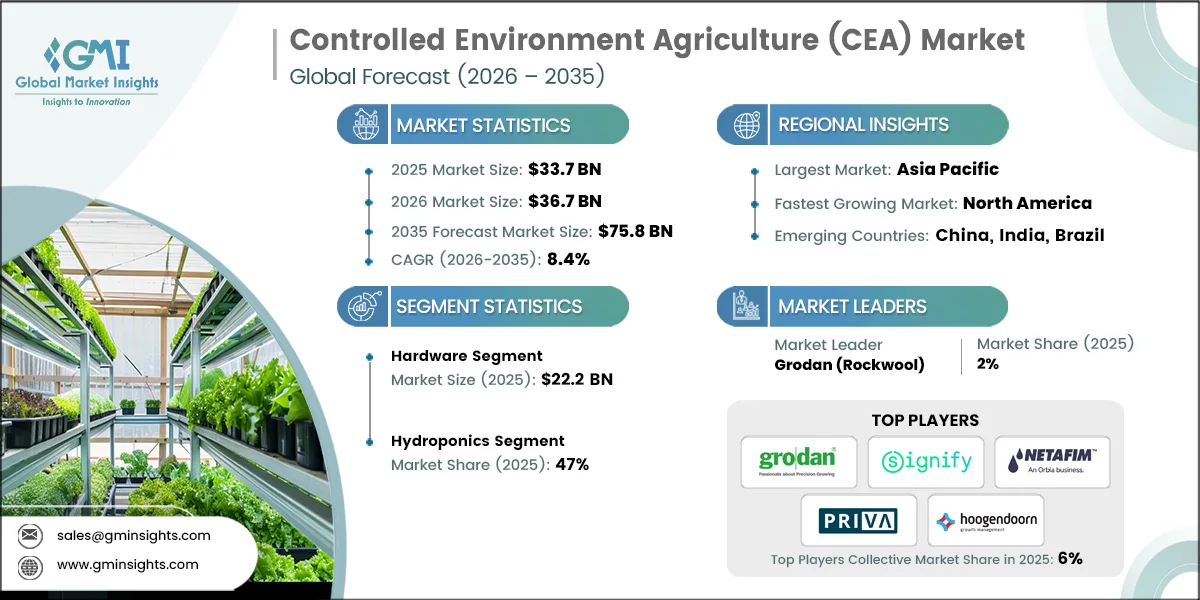
To get key market trends
Controlled Environment Agriculture (CEA) Market Trends
The controlled environment agriculture (CEA) industry is experiencing transformative growth, driven by an urgent need for sustainable food production, resilience against climate change, enhanced food security. Here are key business trends in the market:
- Vertical Agriculture's Growth: Vertically stacking plants is becoming more common as Companies who want to have the most amount of growing space in smaller footprints start to build vertical farms in city settings for local sourcing, ultimately making it easier than ever for consumers to have access to fresh produce and reduce the miles that produce typical travel. Vertical farming eliminates food deserts and improves food access for consumers.
- Increasingly, Controlled Environments Agriculture (CEA) facilities are using as much robotics, sensors and artificial intelligence to help with tasks like planting, harvesting, monitoring and controlling their environments. Utilization of automation/technology is reducing labour costs, improving efficiencies, and now allows producers to deliver nutrients more accurately and manage their environments to provide for the best in terms of consistency and yield.
- The variety of products that CEA producers are providing customers is also increasing. CEA producers are expanding their offerings to include, in addition to leafy greens, higher valued products such as strawberries, herbs, micro greens, etc. and even smaller types of fruits; this is broadening the sources of revenue for their businesses, helping them to meet consumer preferences, and enhancing the economic sustainability of CEA facilities by creating additional revenue from growing products for specialty, high value, or niche markets.
- Energy consumption represents a significant expense to the running of CEA facilities. The ongoing trend is that producers continue to work towards energy efficiency and renewable energy by using energy efficient LED’s priced and designed specifically for plant growth, installing improved heating and cooling systems, and incorporating renewable energy sources (i.e. solar and wind). This trend lowers operational costs, enhances sustainability, and decreases the overall carbon footprint of CEA.
Controlled Environment Agriculture (CEA) Market Analysis
Learn more about the key segments shaping this market
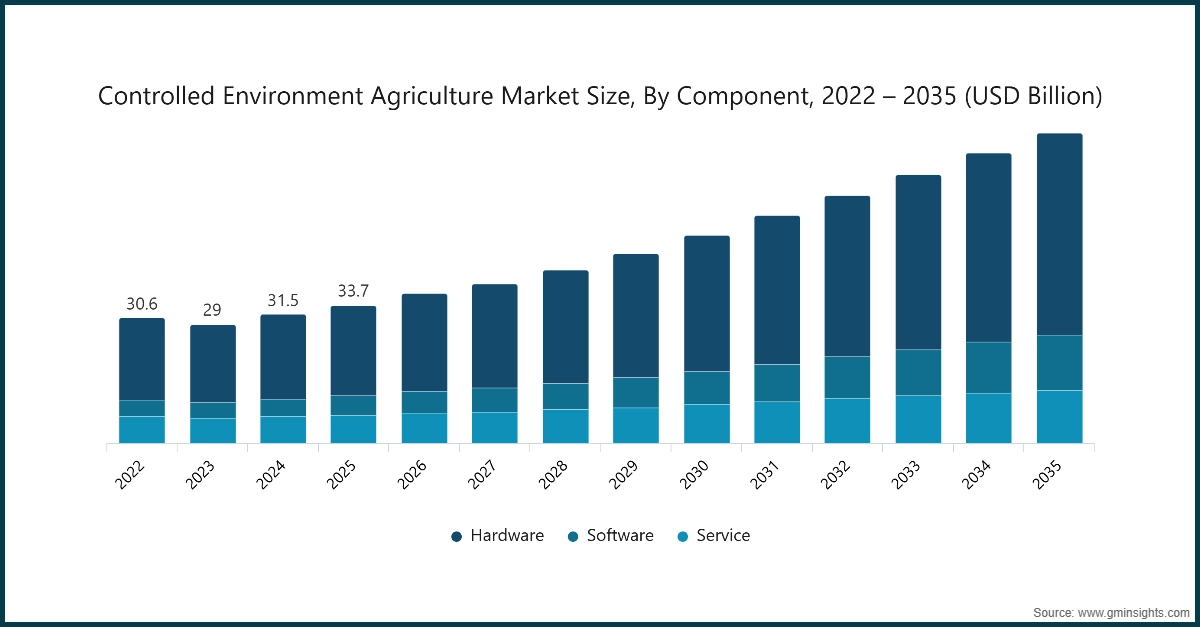
Based on components, the controlled environment agriculture market is divided into hardware, software and service. In 2025, hardware held the major market share, generating a revenue of USD 22.2 billion.
- The hardware segment is the foundation of every contemporary indoor agricultural system. Hardware components work together to create the stable conditions required for healthy crop growth by controlling light, temperature, humidity, airflow, and nutrient delivery in every indoor farming environment including traditional greenhouses, vertical farms, and plant-factories. The lack of hardware reliability makes it impossible for the grower to maintain the stable conditions necessary for the continuous production of edible crops; therefore, these systems are no longer viewed as optional but rather as necessary systems.
- Another factor that contributes to the dominance of hardware in the CEA market is that hardware has the largest share of investment at the initial construction phase of the facility. The costs for LED grow lights, HVAC systems, irrigation infrastructure, fertigation equipment, sensors, and racks account for most of the capital invested when constructing a new facility. The shift to automated and enclosed production systems has led to increased demand for new, durable, and advanced hardware systems. Furthermore, the lengthy replacement and ongoing maintenance patterns of these systems contribute to consistent long-term hardware investment.
- The direct relationship between hardware and crop production also leads to a predominance of hardware in the CEA market. Crop production is influenced by hardware components; for example: crops grow more quickly with better lighting; HVAC systems decrease the likelihood of disease; and reliable irrigation systems ensure proper delivery of nutrients. Because they impact yield, quality, and dependability, operators are motivated to upgrade their hardware as they expand. Essentially, the domination of the CEA hardware market can be explained as a result of the preceding factors.
Learn more about the key segments shaping this market
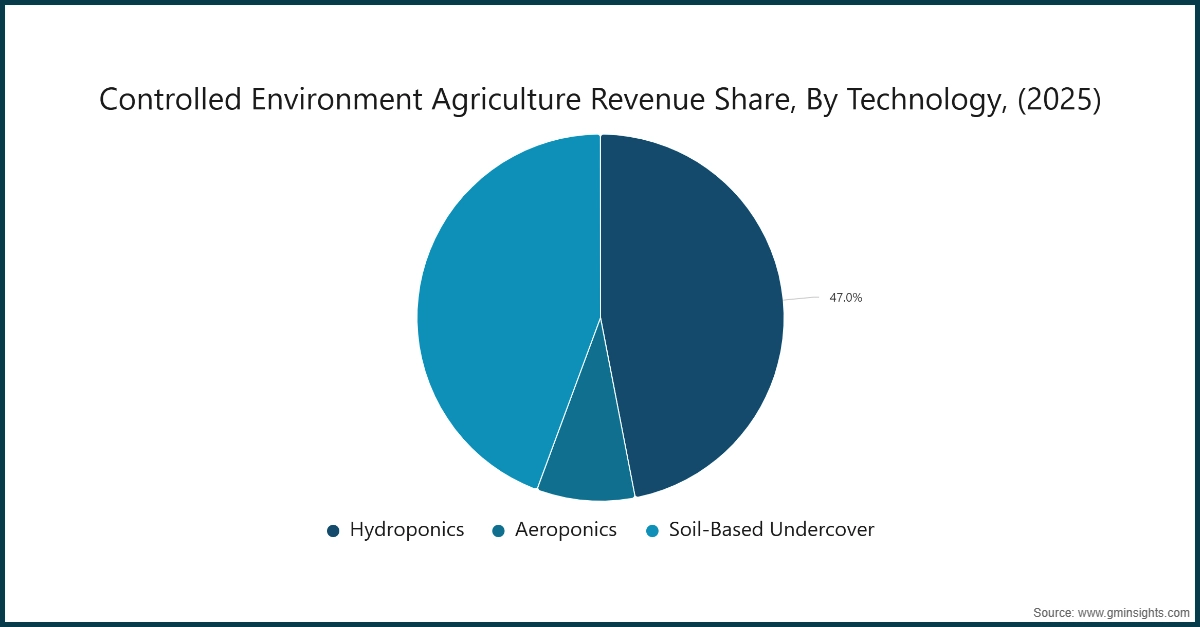
Based on technology, the controlled environment agriculture market is segmented into hydroponics, aeroponics, and soil-based undercover. Hydroponics segment held the largest share, accounting for 47% of the market in 2025.
- Hydroponics has asserted itself as the leading method for increasing food production by providing a simple, consistent, and highly efficient means of growing crops without dependence on soil or natural weather conditions. At its most basic, hydroponic systems supply plants with everything they require: water, nutrients, and oxygen. Furthermore, this provides a controlled growing environment which allows for maximum utilization and usage of inputs such as light and space.
- With precise input delivery, many of the common issues found in traditional agriculture (i.e. pest and soil disease pressures, weather variability, and imbalanced soil nutrient levels) are eliminated. Consequently, hydroponic growers can exhibit stable yield levels in terms of quantity and quality of a given crop.
- Hydroponics has also emerged as a leader due to its ability to significantly save upon space and other inputs/resources. Growing plants in a nutrient-rich solution allows for the ability to place them much closer together than in a traditional soil system, resulting in an increase in yield per square foot versus other agricultural systems. This makes hydroponic systems extremely beneficial to areas that experience land constraints and/or high land value as well as to farmers with limited land available for farming activities. Furthermore, the amount of water used in the growing processes is substantially less than in traditional farming, which serves to be very attractive to arid areas of the world experiencing water shortages while also appealing to growers interested in being environmentally responsible.
- Hydroponics are also more readily automated than other growing systems, allowing growers to monitor and make necessary adjustments to their growing environment more effectively. As a result, there are fewer labor requirements associated with producing crops in hydroponics, providing for more consistency in yield levels; thus contributing to the overall advantages of increased efficiency, consistency, reduction in space, and efficiency of resource usage are the reasons why hydroponics is becoming the leading method of increasing global food production.
Based on end use, the controlled environment agriculture market is segmented into commercial, residential and research & institutional. In 2025, commercial dominate the market with highest revenue share.
- The commercial segment dominates the market because it is the only segment operating at a scale where controlled production directly translates into business value. Commercial growers rely on predictable yields, yearround output, and consistent product quality factors that CEA can deliver far more reliably than traditional farming. This makes commercial operations the most natural adopters of advanced indoor systems, since the return on investment becomes clearer when crops are produced continuously and sold into established retail or food service channels.
- Another reason for dominance is the growing pressure on supply chains. Retailers, distributors, and restaurants increasingly want stable, local, pesticide‑light produce, and commercial CEA farms are positioned to meet this demand. Their ability to standardize growing conditions means fewer risks of crop failure, better shelf life, and more dependable supply contracts. This drives steady expansion, especially among large greenhouse networks and vertical farming facilities.
- Commercial operators also have the capital, technical staff, and long‑term planning horizon needed to deploy advanced systems such as automated lighting, precision irrigation, and climate‑control platforms. These investments create a performance gap that smaller segments residential or educational cannot match. Overall, the commercial segment leads because it aligns CEA’s strengths with clear economic, operational, and quality-driven benefits, making it the engine behind the market’s growth.
North America Controlled Environment Agriculture (CEA) Market
Looking for region specific data?
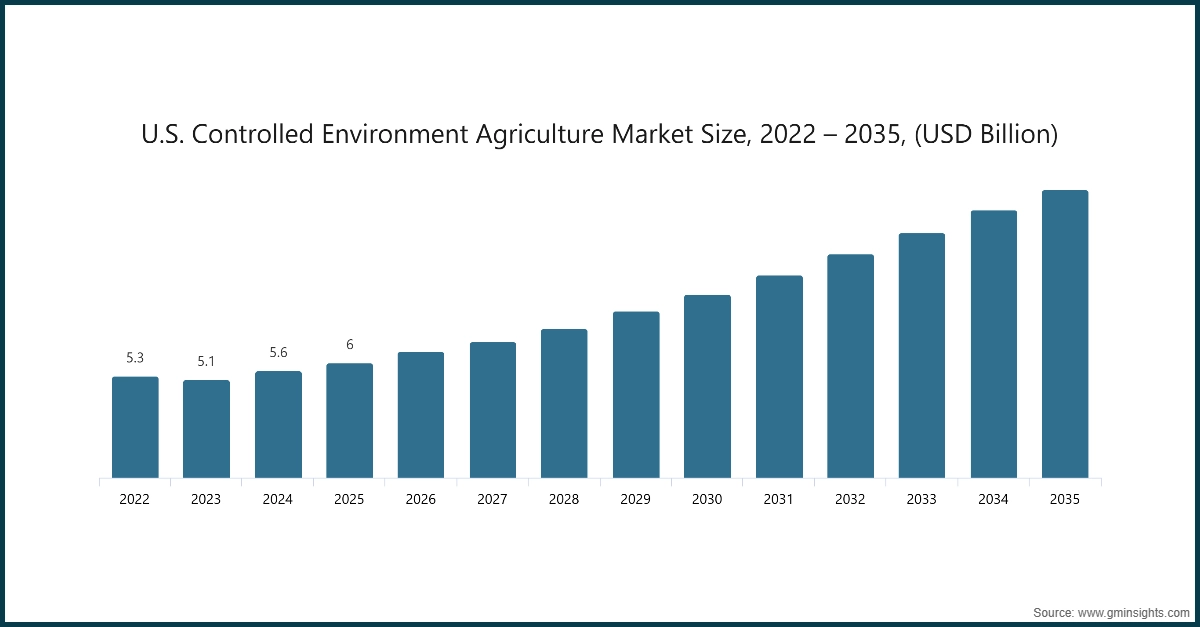
In 2025, the U.S. dominated the North America market, accounting for around 78% and generating around USD 6.0 billion revenue in the same year.
- In North America, there is greatly increased demand for reliable and locally grown produce from Controlled Environment Agriculture (CEA) due to increased concern over the uncertainty of sourcing crops from long supply chains.
- As retailers and food service operators increasingly want reliable and consistent crops with few or no pesticides, this demand has driven both greenhouse operators and vertical farming developers to increase their growing capacity in North America. In addition to having a good supply of locally grown produce, there is also a well-established system of technology providers, automation experts, and experienced growers to help new CEA projects grow quickly and effectively in North America.
- As a result of the continued focus on food safety and transparency, as well as the availability of food year-round, North America has a strong position in CEA. Farmers have been implementing more controlled systems with new technologies as the result of the disruption of climate events, labor shortages, and transportation costs. To create the best results, many growers have begun changing their business models and working to create efficiencies between energy use, crop selections and operational efficiencies. Therefore, North America’s overall market has a more mature, commercial and disciplined environment with an emphasis on enhancing scalability, ensuring reliability and forming close relationships with large grocery retailers.
Europe Controlled Environment Agriculture (CEA) Market
In Europe controlled environment agriculture (CEA) industry, Germany leads the market 12% share in 2025 and is expected to grow at 8.1% during the forecast period.
- The European CEA (controlled environment agriculture) market is driven by a long history of commitment to sustainability, efficient use of resources, and environmentally responsible production of food. Many countries in Europe have developed large greenhouse clusters; therefore, it is natural for more sophisticated indoor farming systems to be created as a natural progression from this history. Strong emphasis is placed on energy conservation, using renewable energy sources, and having intelligent environmental controls, which has resulted in producing incredibly efficient systems. Consumer trust in the production of clean, traceable food leads to heightened demand for crops produced in controlled environments.
- The area also has many regulatory environmental standards requiring the modernizing of agriculture. Consequently, growers are investing in smarter tools for climate control as well as using efficient lighting and automating processes that work to decrease resource use for water and chemicals. Vertical farms are becoming popular in urban locations where there may not be enough space for traditional farming systems or where sustainability goals are very high. The overall market in Europe will continue to grow steadily at an increasing rate due to innovation, regulatory pressures, environmental awareness and technological advancements.
Asia Pacific Controlled Environment Agriculture (CEA) Market
The Asia Pacific holds significant share in the market. China holds a market share of around 54% in 2025 and is anticipated to grow with a CAGR of around 8.4% from 2026 to 2035.
- The APAC region is experiencing rapid growth in CEA due to its dense urban populations and limited arable land. Many countries in the region face strong pressure to increase self-sufficiency in food production, especially in areas prone to climate extremes or heavy import dependence. This has created a favorable environment for vertical farms, indoor hydroponic facilities, and compact modular farms to serve growing cities. The region’s openness to new technologies, combined with strong government interest, supports widespread adoption of controlled growing systems.
- At the same time, consumer expectations in APAC are shifting toward cleaner, fresher produce that can be grown close to the point of consumption. CEA fits this demand well by offering stable output in a compact footprint, which is especially important in space‑constrained urban centers. Local startups and international players are increasingly collaborating on solutions tailored to the region’s varied climates, from tropical zones to colder northern areas. This blend of necessity, innovation, and policy support makes APAC one of the most dynamic regions for CEA expansion.
Controlled Environment Agriculture (CEA) Market Share
Grodan (Rockwool) is leading with 2% market share. Grodan (Rockwool), Signify (Philips), Netafim (Orbia), Priva and Hoogendoorn collectively hold around 6%, indicating moderately fragmented market concentration. These prominent players are proactively involved in strategic endeavors, such as mergers & acquisitions, facility expansions & collaborations, to expand their product portfolios, extend their reach to a broad customer base, and strengthen their market position.
- Grodan, a subsidiary of Rockwool Group, is a global leader in providing stone wool growing media solutions for horticulture. Their inert, sterile, and highly customizable substrates offer optimal root zone management, precise control over water and nutrients, and consistent growing conditions for CEA crops. This allows for superior yield, quality, and efficient resource use, making them indispensable for modern hydroponic and aeroponic systems.
- Signify, through its Philips Horticulture LED Solutions, is a leading provider of specialized LED lighting for CEA. Their tailored grow light recipes optimize photosynthesis, enhance plant growth, and improve crop quality and yield across various produce types. By offering energy-efficient and spectrum-specific lighting solutions, Signify enables growers to achieve higher productivity and reduced operational costs in indoor farming environments.
- Netafim, part of Orbia, is a pioneer and global leader in drip irrigation systems and precision agriculture. Their advanced irrigation solutions for CEA deliver water and nutrients directly to the plant roots, minimizing waste and maximizing uptake efficiency. This precise control of fertigation is critical for optimizing resource use, preventing disease, and ensuring consistent crop performance in controlled environments.
Controlled Environment Agriculture (CEA) Market Companies
Major players operating in the controlled environment agriculture (CEA) industry are:
- Heliospectra
- Netafim
- Freight Farms
- iFarm
- Koidra
- Urban Crop Solutions
- Agritecture
- Priva
- Signify
- Fluence
- Grodan
- OSRAM
- Hoogendoorn
- Argus Controls
- Ridder
Priva is a prominent developer of process control and building automation systems for horticulture and indoor cultivation. Their integrated solutions manage climate, irrigation, and energy usage with high precision, creating optimal and consistent growing conditions. By offering sophisticated software and hardware for environmental control, Priva enables CEA growers to maximize yield, quality, and operational efficiency while minimizing resource consumption.
Hoogendoorn provides innovative process automation and climate control systems for all types of CEA, from greenhouses to vertical farms. Their intelligent software solutions integrate climate, water, and energy management, allowing growers to optimize growth strategies based on plant physiology and external conditions. This comprehensive control helps achieve predictable harvests, superior crop quality, and efficient resource utilization in complex controlled environments.
Controlled Environment Agriculture (CEA) Market Report Attributes
| Key Takeaway | Details |
|---|---|
| Market Size & Growth | |
| Base Year | 2025 |
| Market Size in 2025 | USD 33.7 Billion |
| Market Size in 2026 | USD 36.7 Billion |
| Forecast Period 2026-2035 CAGR | 8.4% |
| Market Size in 2035 | USD 75.8 Billion |
| Key Market Trends | |
| Drivers | Impact |
| Rising Demand for Clean and Traceable Produce | Consumers and retailers increasingly prefer food grown with fewer chemicals and with clear transparency about how it is produced. CEA systems allow growers to meet these expectations consistently, which strengthens market adoption. |
| Declining Availability of Arable Land and Unpredictable Climate | Urban expansion and unstable weather patterns make traditional farming less reliable. CEA provides growers with protected environments where crops can thrive regardless of outdoor conditions, making it an appealing alternative. |
| Advancements in Indoor Farming Technologies | Improved lighting systems, climate‑control tools, and automation platforms have made indoor farming more efficient and easier to manage. These innovations help operators reduce labor, cut waste, and maintain consistent output, driving broader acceptance. |
| Pitfalls & Challenges | Impact |
| High Initial Investment and Operating Costs | Setting up controlled facilities, especially those using advanced equipment requires significant capital. Energy costs also remain a major burden for many operators |
| Need for Skilled Technical Expertise | CEA systems rely on precise management of lighting, nutrients, and climate. This creates a demand for trained professionals, which can be difficult to meet in newer or less developed markets. |
| Opportunities: | Impact |
| Expansion of Urban and On‑Site Food Production | Cities, retailers, and hospitality sectors are increasingly exploring on‑site or near‑site growing solutions. This opens doors for CEA companies to design compact, efficient urban farming models. |
| Integration of Renewable Energy and Smart Automation | Combining CEA with solar power, energy‑saving systems, and AI‑based monitoring can greatly reduce operating costs. This presents a strong opportunity for sustainable, high‑efficiency farming setups. |
| Market Leaders (2025) | |
| Market Leader |
2% market share |
| Top Players |
Consolidate share of 6% |
| Competitive Edge |
|
| Regional Insights | |
| Largest market | Asia Pacific |
| Fastest growing market | North America |
| Emerging countries | China, India, Brazil |
| Future Outlook |
|
What are the growth opportunities in this market?
Controlled Environment Agriculture (CEA) Industry News
- In March 2025, Source.ag launched three new AI product tiers Source Workspace (data aggregation), Harvest Forecast (yield prediction up to eight weeks ahead), and Cultivation Management (simulation/decision-support) serving 300+ commercial greenhouses across 1,800+ hectares in 19 countries. These products lower barriers to AI adoption, improve sales planning and reduce spot-market dependence through precise forecasting, optimize resource use and profitability through strategic modeling, and strengthen Source.ag's position as a leading AI platform provider for commercial greenhouse operations globally.
- In July 2024, San Francisco-based vertical farming startup Plenty agreed to form a $680 million joint venture with UAE-based Mawarid Group to develop and operate large-scale vertical farms across the Middle East. This partnership accelerates Plenty's international expansion into a high-growth, water-scarce region with strong demand for locally grown produce, leverages Mawarid's regional market access and capital, and positions Plenty to scale production capacity and revenue beyond North America.
- In March 2024, Source.ag introduced Source Irrigation Control, an AI-driven autonomous irrigation management solution for greenhouses that achieved 87% dry-down target accuracy versus 37% without the system during pilot trials. This innovation improves irrigation precision and scalability for greenhouse growers, reduces resource waste, enhances crop predictability, and positions Source.ag to capture the growing market for autonomous, data-driven greenhouse cultivation technology across 300+ commercial greenhouses globally.
- In March 2024, Skytree launched the Stratus Direct Air Capture (DAC) unit for large greenhouses and vertical farms, capturing up to 1,250 kg CO2 per day per unit with modular scaling and hybrid/all-electric configurations. This product enables CEA operators to generate independent, continuous CO2 supply onsite without fossil-fuel-based CO2, boost crop yields through CO2 enrichment, reduce carbon footprint, and avoid supply-chain price volatility for critical production inputs.
- In October 2023, Eden Green Technologies broke ground on a $40 million expansion of its Cleburne, Texas campus adding two greenhouses operational by early 2025, announcing plans to build 20 production facilities across the United States over five years. This expansion enables Eden Green to scale commercial indoor leafy greens production nationally, meet rising demand for locally grown produce, and establish a distributed network reducing food miles and improving supply-chain resilience.
The controlled environment agriculture (CEA) market research report includes in-depth coverage of the industry with estimates & forecasts in terms of revenue (USD Billion) and volume (Tons) from 2022 to 2035, for the following segments:
Market, by Component
- Hardware
- Lighting
- Climate control systems
- HVAC systems
- Humidity control
- Co2 management
- Sensors
- Irrigation systems
- Others
- Software
- Farm management software
- Data analytics
- Remote monitoring
- Others
- Service
- Installation
- Maintenance
- Consulting
Market, by Facility Type
- Greenhouses
- Vertical farms
- Others
Market, by Technology
- Hydroponics
- Aeroponics
- Soil-based undercover
Market, by Crop
- Vegetables
- Fruits
- Flowers and ornamentals
- Others
Market, by End Use
- Commercial
- Large-scale commercial (>50,000 sq ft)
- Small-scale commercial (<50,000 sq ft)
- Residential
- Research & institutional
The above information is provided for the following regions and countries:
- North America
- U.S.
- Canada
- Europe
- Germany
- UK
- France
- Italy
- Spain
- Russia
- Netherlands
- Asia Pacific
- China
- Japan
- India
- South Korea
- Australia
- Malaysia
- Latin America
- Brazil
- Mexico
- Argentina
- Middle East and Africa
- South Africa
- Saudi Arabia
- UAE
Frequently Asked Question(FAQ) :
What is the market size of the controlled environment agriculture (CEA) in 2025?
The market size was USD 33.7 billion in 2025, with a CAGR of 8.4% expected through 2035. The growth is driven by the need for sustainable food production, climate resilience, and enhanced food security.
What is the projected value of the controlled environment agriculture (CEA) market by 2035?
The market is poised to reach USD 75.8 billion by 2035, fueled by advancements in vertical farming, automation, and energy-efficient technologies.
What is the expected size of the controlled environment agriculture (CEA) industry in 2026?
The market size is projected to reach USD 36.7 billion in 2026.
How much revenue did the hardware segment generate in 2025?
The hardware segment generated approximately USD 22.2 billion in 2025, due to its critical role in maintaining stable conditions for crop production.
What was the market share of the hydroponics segment in 2025?
The hydroponics segment accounted for 47% of the market in 2025, driven by its efficiency and ability to grow crops without soil or natural weather conditions.
Which region leads the controlled environment agriculture (CEA) sector?
North America leads the market, with the U.S. accounting for 78% of the regional revenue and generating approximately USD 6 billion in 2025, driven by advancements in vertical farming and automation technologies.
What are the upcoming trends in the controlled environment agriculture market?
Trends include the rise of vertical farming, increased adoption of automation and AI, diversification of product offerings, energy-efficient practices, and the growing use of renewable energy sources.
Who are the key players in the controlled environment agriculture industry?
Key players include Heliospectra, Netafim, Freight Farms, iFarm, Koidra, Urban Crop Solutions, Agritecture, Priva, Signify, Fluence, and Grodan.
Who are the key players in the electric commercial vehicle traction motor industry?
Key players include ABB, Allison, BorgWarner, BYD, Dana, Magna, Nidec, Robert Bosch, Valeo, and ZF Friedrichshafen.
Controlled Environment Agriculture (CEA) Market Scope
Related Reports