Summary
Table of Content

Construction Equipment Market
Get a free sample of this report
Form submitted successfully!
Error submitting form. Please try again.
Thank you!
Your inquiry has been received. Our team will reach out to you with the required details via email. To ensure that you don't miss their response, kindly remember to check your spam folder as well!
Request Sectional Data
Thank you!
Your inquiry has been received. Our team will reach out to you with the required details via email. To ensure that you don't miss their response, kindly remember to check your spam folder as well!
Form submitted successfully!
Error submitting form. Please try again.
Construction Equipment Market Size
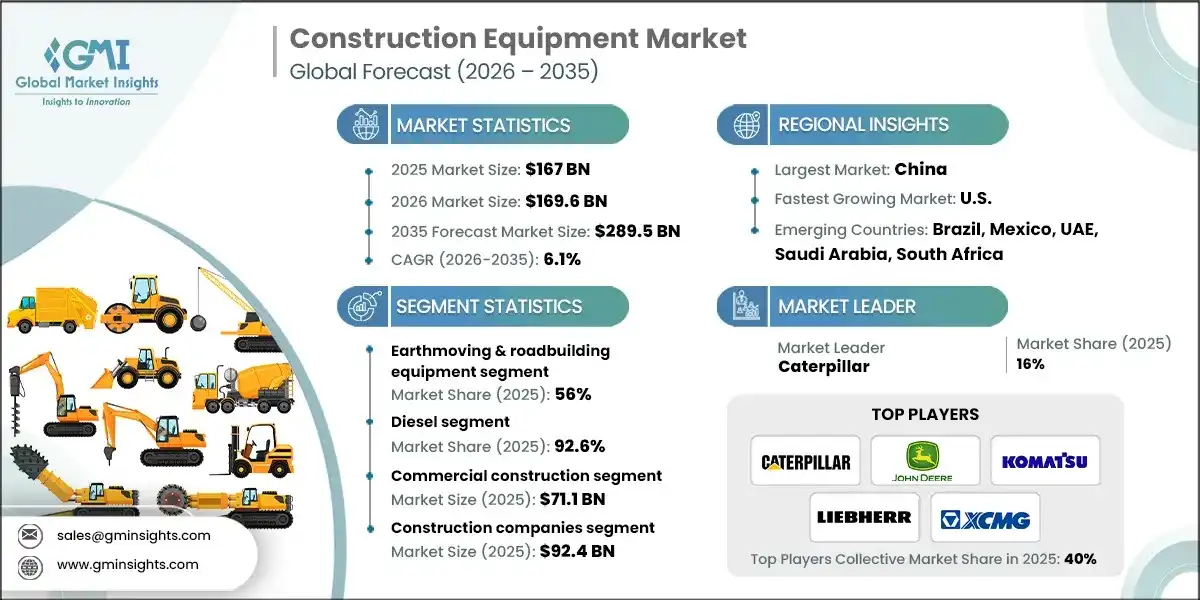
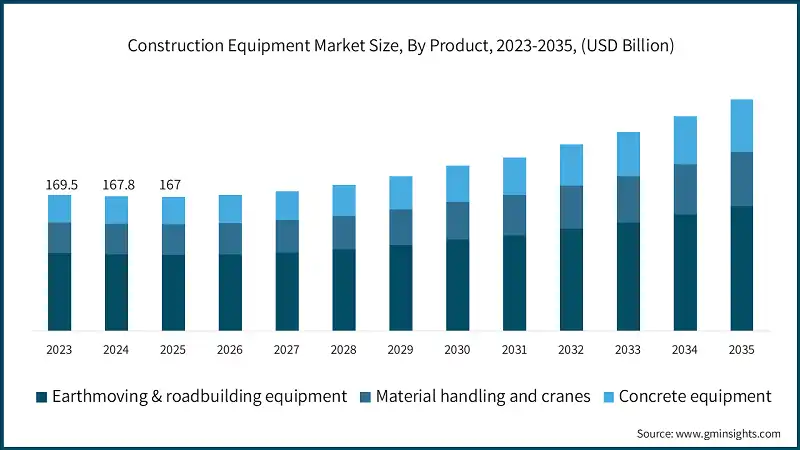
The global construction equipment market was valued at USD 167 billion in 2025. The market is expected to grow from USD 169.6 billion in 2026 to USD 289.5 billion in 2035 at a CAGR of 6.1%, according to latest report published by Global Market Insights Inc.
Construction Equipment Market Key Takeaways
Market Size & Growth
- 2025 Market Size: USD 167 Billion
- 2026 Market Size: USD 169.6 Billion
- 2035 Forecast Market Size: USD 289.5 Billion
- CAGR (2026–2035): 6.1%
Key Market Drivers
- Urbanization and infrastructure development.
- Rising government investments in smart cities & public works.
- Technological advancements.
- Shift toward electric and hybrid construction equipment.
- Rental and leasing boom.
Challenges
- High capital and maintenance costs.
- Volatility in raw material prices.
- Shortage of skilled operators.
- Regulatory and emission compliance requirements.
Opportunity
- Electrification and battery-powered machinery.
- Strategic partnerships between OEMs and rental firms.
- Integration of AI, automation & robotics.
- Growth in emerging APAC & African markets.
- Digital platforms for equipment rental & fleet management.
Key Players
- Market Leader: Caterpillar led with over 16% market share in 2025.
- Leading Players: Top 5 players in this market include Caterpillar, John Deere, Komatsu, Liebherr, XCMG, which collectively held a market share of 40% in 2025.
Get Market Insights & Growth Opportunities
The infrastructure and construction sector acts as a major growth driver for economic development of a country. High focus of regional government authorities on investing in large public infrastructure projects will positively influence the market demand.
The construction equipment market is witnessing an upward trend for smart construction. Advances in technology coupled with strategic partnerships between several companies are supporting the digital transformation of the industry in 2024.
For instance, In March 2024, Hitachi Construction Machinery (Europe) NV (HCME), a renowned construction equipment manufacturer, joined forces with ShareMat, a leading provider of professional software and Fleet Management Systems (FMS) for construction equipment, to establish a strategic collaboration in France.
In 2024, the Volvo Group estimated that about 56,050 construction equipment units were delivered worldwide. The main equipment deliveries took place in the Asia region, which contributed to over half of the market for the Volvo Group equipment. The market for the Volvo Group equipment within the North American region showed net deliveries of about 7,120 equipment units.
According to AEM (Association of Equipment Manufacturers), Government authorities worldwide are striving to replace existing aged infrastructure with strong modernized structures, which would propel growth within the construction equipment marketplace. For 2025, the growth in global construction demand is expected at 2.77%, followed by 3.7% and 3.92% in 2026 and 2027, respectively. In 2025, emerging markets are expected to grow faster than advanced economies at 3.55% and 1.61%, respectively. Of course, this is usually the case, but a widening disparity ties to the influence of interest rate increases.
The construction sector is witnessing increasing investments from several government organizations for the country’s overall economic development. For instance, the Russian government is focusing on the development of affordable housing for the low and middle-income groups. Similarly, through the ‘Make in India’ initiative, the Indian government is also focusing on developing the country’s infrastructure.
Products used in the construction industry mainly include earthmoving & road building equipment, material handling machines & cranes, and concrete equipment. Growing road development projects in Asia Pacific countries including China and India have created several growth opportunities for the industry growth.
Government initiatives related to the manufacturing & development of industrial machinery projects are further driving the product demand across the globe. Additionally, the rising popularity of the construction & mining equipment rental services is promoting the demand for such products.
The growing telecom, energy domain, and smart city initiatives for the realization of connected cities will boost the market growth.
The high cost of the machinery is expected to hamper the construction equipment market growth. Organizations undertaking small projects still prefer traditional human techniques over modern machinery owing to budgetary constraints. The high operating & maintenance cost of this equipment discouraging small-scale project owners to adopt technologically advanced equipment.
The escalating infrastructure development projects in Asia Pacific countries including India, China, and Japan will favor the market growth. The growing infrastructure activities in India have led several equipment manufacturers to expand their market presence in the country to increase their global footprint.
The Europe construction equipment market size is expected to grow rapidly with several countries including Italy and Spain gaining stability after the economic crisis. The strong manufacturing sector in Germany will further favor the manufacturing of technologically advanced machinery. German companies are looking to expand their industrial presence globally, thereby providing a boost to the industry growth.
To get key market trends
Construction Equipment Market Trends
Rising commercial constructions, such as IT parks, shopping malls, and other government buildings, are driving industry growth. Construction equipment possesses the ability to efficiently carry out heavy-duty works required in the construction sector, thereby boosting the market demand.
The shifting focus of construction companies and building contractors toward speeding up of construction operations without compromising safety & security will enhance business expansion.
Various governments, such as the UK, Brazil, Taiwan, New Zealand, and France, are focusing on improving their road and building infrastructures. These governments are heavily investing in various infrastructure projects to accelerate their economic growth. In September 2025, the latest data on construction activity was published by The Office for National Statistics (ONS). Output increased by 0.3% in June, after a fall of 0.5% in May, meaning output increased by 1.2% in Q2 compared with Q1. This increase followed a stable first quarter and followed a modest increase in output of 0.5% last year. The growth in output during Q2 was due to the increase in both new work and repair and maintenance activity - up 1.1% and 1.4%, respectively.
The construction equipment market is experiencing an upward trend owing to increasing focus toward smart cities and buildings. Several government authorities are establishing strategic partnerships with private firms to increase their transition toward smart cities, creating a positive market outlook
The initial high acquisition cost of modern construction machines is driving contractors and construction organizations to switch to construction equipment rental services. Market reasons such as high taxes, service, high depreciation costs, and the equipment insurance required by new machinery have all contributed to the increased demand for equipment rentals.
Additionally, the construction sector is dynamic and strongly influenced by market volatility. Renting construction equipment safeguards the organization against unforeseeable financial downturns. The availability of a wide range of technologically modern equipment for rent is also increasing market revenue.
The demand for used construction equipment has grown exponentially in recent years, which second-hand dealers and global online auction platforms are tapping into. The demand varies hugely from country to country. The growing construction sector in various countries has offered several opportunities for companies which are manufacturing construction equipment as well as companies selling used and refurbished equipment. Used construction equipment in real estate and construction activities has resulted in a substantial surge of demand for concrete equipment, excavators, backhoes and material handling equipment.
Construction Equipment Market Analysis
Learn more about the key segments shaping this market
Based on product, the market is divided into earthmoving & roadbuilding equipment, material handling and cranes, and concrete equipment. The earthmoving & roadbuilding equipment segment dominated around 56% market share in 2025 and is expected to grow at a CAGR of over 5.5% from 2026 to 2035.
- The earthmoving & road building equipment including backhoes, excavators, loaders, and compaction equipment will witness a rapid growth in the market. Major factors contributing to the market growth include rapid growth in road-building projects and development of public infrastructure by government authorities.
- Earthmoving and road-building equipment dominated the construction equipment market owing to a rapid growth in infrastructure development projects for enhanced road transport facilities and improved accessibility to remote areas. The large-scale expansion of road networks created a huge demand for fine-quality construction machinery, boosting industry growth.
- The modernization of roadways & railways in countries including Russia and India is driving the earthmoving and road-building equipment demand. Moreover, increasing mechanization in infrastructure activities is expected to drive the construction equipment market growth over the forecast timeline.
- The mechanization of infrastructure building activities to achieve fine quality is creating a demand for earthmoving & roadbuilding equipment. Excavators are expected to witness a high growth in the earthmoving and roadbuilding equipment segment. Increasing construction activities in the residential sector are providing growth opportunities for excavators in the market. In response to the growing market demand, industry players are launching new construction equipment integrated with advanced technologies such as IoT and AI.
- Growing inclination of end-users to obtain earthmoving machinery on rent or lease is an emerging trend in the construction equipment market. Increasing accessibility for rent based systems is encouraging users to use advanced earthmoving equipment. Rising automation need for efficient flow of goods will positively impact the equipment demand over the forecast timeline.
- Expansion of metal and mining sectors and increasing investments in agriculture, retail, hospitality, infrastructure & transportation sectors, and energy programs worldwide will drive the earthmoving construction equipment market growth. Rise in urbanization is a vital factor driving the growth of the earthmoving & road building equipment rental market. Urbanization is taking place at a faster pace and will contribute to the growth of the construction industry in developing countries across the globe.
Learn more about the key segments shaping this market
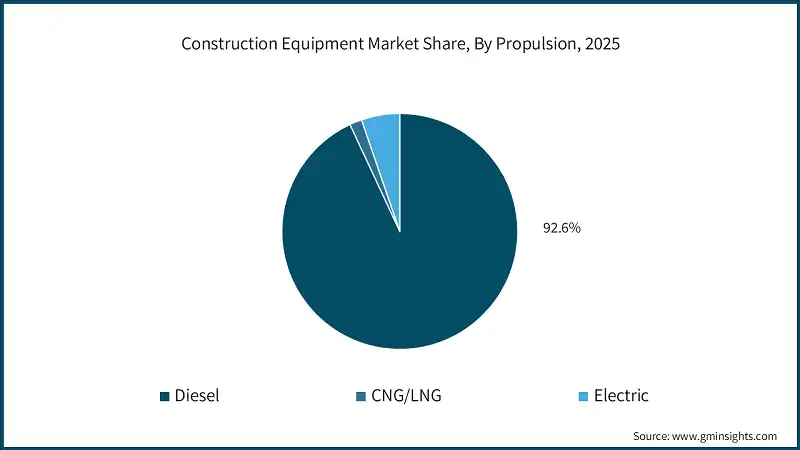
Based on propulsion, the market is segmented into diesel, CMG/LNG, and electric. The diesel segment dominates the market with 92.6% share in 2025 and is expected to grow at a CAGR of 5.6% from 2026 to 2035.
- Several construction equipment manufacturing companies are incorporating advanced technologies in their diesel fleet to enhance the performance of construction equipment. Moreover, several technology companies are focusing on innovating new solutions to enable enhanced construction equipment performance.
- Telematics systems combine GPS technology, on-board diagnostics, and monitoring sensors to track, log, and report data via cellular networks on the performance and operation of the diesel construction equipment. Additionally, rental companies are undertaking initiatives for enhancing their equipment by implementing remote monitoring systems for ease of controlling heavy machines remotely. Incorporating telematics technology in the equipment allows end-users and rental companies to track vehicles using a combination of cloud computing, GPRS networks, GPS receivers, and GPS satellites.
- Implementation of IoT technology in construction equipment will have a positive impact on the construction equipment market in the coming years. Renting provides a cost-efficient solution for companies or projects that require equipment for a short duration of time. With the latest technologies, such as remote services, safety services, enhanced operator’s cabin, and automatic controls, being integrated into equipment, consumers have new options for machinery that offers customized and specific applications.
- Shifting government focus on infrastructure development along with increasing consumer preference for luxurious and aesthetic constructions will provide an impetus to the industry growth. The rising necessity for houses along with investment regarding infrastructure development, such as smart city projects and increased construction expenditure, particularly in economically stabilizing countries, is expected to propel the market size.
Based on application, the construction equipment market is segmented into residential construction, commercial construction, industrial construction, mining & quarrying. The commercial construction dominated the market and was valued at USD 71.1 billion in 2025.
- With the rapidly rising commercial construction activities in North America and Europe, the demand for construction equipment is anticipated to rise over the forecast timeline. The rental industry in North America and Europe is significant, and companies operating in the territory are capitalizing on the structural changes in the market. The engineering machinery in the region, including cranes and other heavy equipment in the rental market accounts for over 70% of all the machinery.
- The rental market is showing a continuous upward trajectory and is expected to witness growth owing to increased consumer spending followed by growing commercial activities. In the heavy equipment industry, the rental model is a better alternative due to the frequently changing requirements.
- For instance, the type of equipment needed for a particular task on a job site may change from day to day and to address such requirements, renting out heavy equipment is much more feasible for a contractor. As a result, most heavy equipment manufacturers sell 75% of this equipment to the rental channel and heavy equipment makes up to over 40% of the overall inventory for all the major players in the North America market including United Rentals and RSC.
- Urbanization is creating a huge demand for construction of robust residential and commercial infrastructure. Countries such as Brazil, Mexico, Chile and Argentina are investing heavily in infrastructure development, supporting the construction equipment market growth.
Based on end use, the market is segmented into construction companies, mining operators, rental companies, government & municipalities, and industrial users. The construction companies is the largest segment in market and was valued at USD 92.4 billion in 2025.
- Continued construction of roads, bridges, airports, metro rail, housing projects are driving luxury demand towards construction equipment. The governments of the emerging economies are now focusing on infrastructure developments, which will open up long-term opportunities to construction companies. Organizations that incorporate a strategic use of machinery in projects can execute projects in less time, be more productive and have competitive advantage over other organizations in large infrastructure projects.
- The move by the world to curb carbon footprints is compelling construction firms to go green and embrace electric and hybrid machinery. This is being accelerated by sustainability objectives, green building, and more stringent emission regulations. By incorporating environmental-friendly equipment, companies not only save on operations but also enjoy favorable access to government-supported projects, which has them aligned with ESG investment priorities across the world.
- Construction companies are changing how they operate projects through telematics, IoT and automation. Intelligent equipment makes real-time tracking, predictive maintenance and optimization of fleets possible. This minimizes breakdown, optimizes work productivity and worker safety. Digital tools adopted by construction companies lead to increased profitability, improved project control, and enhancements in technology-driven construction infrastructure and urban development projects.
- The high cost of ownership tends to restrict purchase of equipment, but the emerging leasing and rental sector provides construction companies with easy access to equipment. This enables companies to expand without necessarily investing so much money. As rental systems and dealer relationships continue to grow worldwide, construction companies enjoy increased liquidity, fleet control, and the capacity to submit competitive bids on various projects.
- Asian, African and Latin American economies are undergoing rapid urbanization, which is driving massive residential and commercial real estate development. The construction companies are also being dependent on the use of modern equipment to cope up with high density development and rapid development timetables. Those companies that take advantage of the developed machines can lower labor intensity, enhance safety and provide projects at a quicker pace- achieving a better market share in the emerging urban economies.
Looking for region specific data?
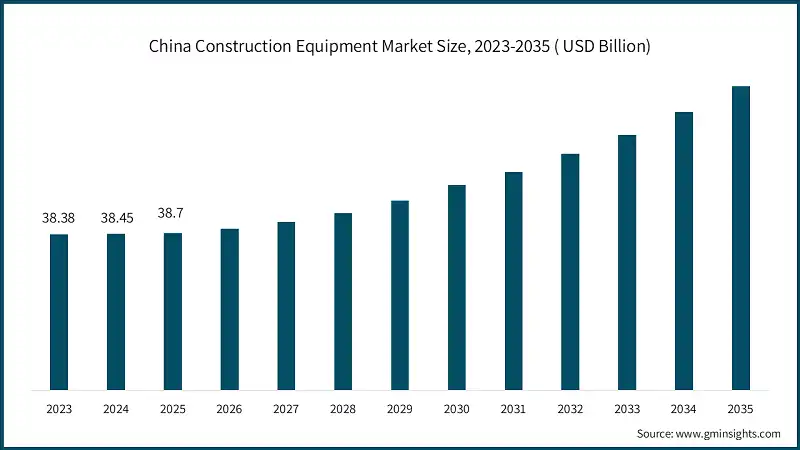
China dominated the construction equipment market in Asia Pacific with around 50% share in 2025 and generated USD 38.7 billion in revenue.
- The China market is expected to witness a high growth in the coming years owing to the rapidly increasing construction activities in the emerging economy. Growth in the industrialization domain is also a major factor contributing to the industry demand.
- With the Chinese labor costs rising in the recent years, renting machines has become a feasible option in the region. Chinese construction equipment rental companies are focusing on providing technologically advanced products to their large customers, such as building contractors and government infrastructure developers, to increase and retain their market share.
- The increasing coal production in China is accelerating the demand for various construction equipment and cranes in the regional mining sector. In the mining industry equipment such as industrial trucks and bulk material handling equipment are utilized for the continuous transportation of all forms of materials including excavated & crushed rocks, coal, and other fossil fuels in an efficient manner over long distances. The coal production industry also generates a huge demand for excavators and backhoes.
- Leading market players are emphasizing on forming strategic partnerships with other industry players to expand their geographic presence in China. The companies are focusing on leveraging the low cost and abundance of raw materials in the country.
Germany construction equipment market holds around 24% share in 2025 and generated USD 9.9 billion in revenue. The German economy is majorly driven by the country’s engineering and automobile industry.
- The robust manufacturing and transportation sectors in Germany require highly efficient material handling equipment and cranes. These developments have resulted in the demand for all-terrain and mobile cranes, further compelling manufacturers to introduce the application-specific machines. Several regional enterprises are signing strategic agreements for sales & distribution of the cranes.
- The Germany construction equipment market is witnessing a high demand for low or zero emission construction equipment. Stringent emission regulations, such as the EU V regulation for heavy machinery, is encouraging construction contractors and project managers to adopt technologically advanced low emission equipment. In response to this amplifying market trend, market players in the Germany construction equipment industry are launching new electric and alternative fuel products
- The aggressive move of Germany towards renewable energy and decarbonization is generating high demand in wind, solar, and hydrogen project construction equipment. The adoption of equipment is driven by infrastructure developments on energy storage, power grids and sustainable transport networks. Construction companies gain advantages related to the alignment with the policy of Energiewende, the use of advanced equipment in the process of large-scale development of green infrastructure.
- The investment in transport, housing, and digital infrastructure is increasing in Germany as the country invests in the smart city and urban renewal. Old infrastructure is being upgraded in cities with modern construction machinery in order to achieve efficiency and sustainability objectives. Businesses that embrace automation, telematics, and environmentally friendly equipment have an opportunity to take advantage of the increasing urge to repurpose urban cities and embrace high-tech infrastructure initiatives.
The construction equipment market in U.S. is projected to witness around 6.7% CAGR throughout 2026 to 2035.
- The U.S. has witnessed high growth opportunities in the real estate segment owing to the enormous investments by the government as well as private companies. Over the past years, the country has experienced a massive demand from commercial and residential segments. The growth of the construction industry in the U.S. is attributed to increased disposable incomes and the spending capacity to improvise the living standards and support the consumer lifestyle enhancement.
- Developments in robotics, electronics, and IoT in the country are further supporting the implementation of the latest technology-infused construction equipment systems. The U.S. construction equipment industry will witness a substantial growth owing to the growing investments by suppliers & manufacturers by installing automated equipment in the distribution centers and warehouses. The region has witnessed considerable growth owing to several companies delivering customized services and offering a variety of solutions by enhancing efficiency and reducing the costs. The presence of several major market players in the U.S. has led to a rise in the demand for improved solution and services to reduce the time required for completion of construction projects.
- The increasing construction spending in the region is further increasing the utilization of earthmoving & road building equipment, concrete equipment and cranes for timely project completion.
Brazil construction equipment is expected to reach over USD 5.9 billion in 2035 by growing at a CAGR of 3.7% between 2026 and 2035.
- The growing industrialization in Brazil is expected to proliferate the utilization of construction equipment, such as cranes and other material handling equipment, in the country. The growing manufacturing sector in the country demands enhanced automation solutions to ensure increased productivity for overall economic development.
- The industrial sector in the region is witnessing fast growth with increasing number of companies implementing robots and automated solutions for construction activities, thereby creating a high demand for technologically advanced construction equipment. However, shortage of skilled labor to operate the machines and high dependence on imports from European and Asian countries may hamper the market growth over the forecast period.
- The Brazilian construction industry has faced a slowdown and recession due to the COVID-19 pandemic and the resultant deteriorated business environment. The industry witnessed weaker infrastructure investments & reduced construction activities in 2020. However, the industry is now in its recovery phase and is expecting several construction projects along with FDIs.
- Due to the massive investment of Brazil in highways, rail and port modernization in agribusiness and export, demand in advanced construction equipment’s is emerging. The growth in the adoption of machinery to earthmoving and material handling is being driven by projects under the Growth Acceleration Program (PAC). Due to the growing logistics and transport infrastructure sector in Brazil, construction companies with access to modern equipment are finding the market efficient and competitive.
- The promotion of residential and commercial building is generating long-term construction demand due to government-supported residential and commercial housing programs like Minha Casa Minha Vida together with increasing urbanization. The urgency to deliver a project more quickly in large cities is pushing modern equipment usage. Building companies with efficient equipment will be able to save on labor and access Brazilian housing and social infrastructure sector opportunities.
Saudi Arabia construction equipment accounted for over USD 4.1 billion in 2025 and is anticipated to show lucrative growth over the forecast period.
- The escalating demand for construction equipment in Saudi Arabia is being fueled by the growth of the real estate and infrastructure sectors, expansion of public transport systems, and construction of commercial & recreational properties.
- Major places of Saudi Arabia including Riyadh, Madinah, Makkah, and Tabuk are witnessing increasing construction projects in the hotels & hospitality sector owing to rising tourism. The expansion of new railway lines and new development projects, such as in NEOM Tabuk and Al-Ula, are also contributing to the increasing demand for cranes and material handling equipment.
- Several initiatives are being taken by various companies operating in the Saudi construction market to adopt sustainable and low carbon footprint means of construction. This is encouraging building contractors to reduce emissions and pollution throughout the lifespan of the project. This growing trend has led to a robust demand for energy-efficient equipment in the market.
- The developments in Saudi’s residential construction industry will also contribute to market growth. According to International Trade Administration, the Saudi government has announced a national housing strategy to build over 1.5 million new homes in the region at a cost of approximately USD 80 billion, and around USD 3 billion to support the development of large infrastructure projects in Saudi Arabia. Such huge investments by the government in the country will contribute to the market growth.
Construction Equipment Market Share
- The top 7 companies in the construction equipment industry are Caterpillar, Komatsu, Hitachi Construction Machinery, Liebherr, Volvo, John Deere, and XCMG, contributing around 40% of the market in 2025.
- Caterpillar offers technologically advanced construction & mining machinery, diesel and natural gas engines, industrial gas turbines and diesel-electric locomotives. The company primarily focus on making investments in R&D activities to innovate new solutions to enhance product efficiency. It operates over eight R&D centers across the U.S., China, Japan. Caterpillar has developed Cat Connect solution that aids in maximizing production, improving safety, and reducing costs by allowing users to monitor and manage the equipment’s performance. The company operates a network of over 165 dealers and more than 28,000 suppliers in 191 countries across the globe. It generates over 58 percent of its total revenue from outside of the U.S.
- Komatsu specializes in the manufacture and sales of construction & mining equipment such as cranes, industrial machinery, and forest machines. The company offers forklift trucks, tunneling machines, and recycling equipment. It also offers industrial machines and machine tools to produce semiconductors, solar cells, and automobiles. Komatsu primarily focuses on building long standing partnerships with technology providers, dealers, distributors and other industry players. It has a global corporate responsibility partnership with Cummins to enhance communities across the world and strengthen the business relationship. The company has partnered with Shell Lubricants to launch Komatsu Genuine oil 15W-40, which is a reformulated lubricant and can be used in its heavy equipment.
- Liebherr manufactures, sells, and services a wide range of cranes, excavators, heavy-duty trucks, concrete mixing plants, and telescopic handlers. The company supplies rental machines for a range of requirements and offers the Liebherr Rental Services mobile application. It is known to remanufacture used components with the Liebherr Reman Program. Moreover, Liebherr is primarily focusing on expanding its business operations in Central and South America as well as Asia and Oceania regions. As of 2020, the company generates majority of its revenue from Europe and North America regions.
- Hitachi Construction Machinery provides support services and genuine spare parts through their extensive network, offering customers customized applications. Their equipment is integrated with smart technologies, including artificial intelligence and IoT, and an asset management system, which provides information on working conditions and locations, maximizing productivity and efficiency. They mainly provide better equipment performance and follow various equipment design and development requirements
- Volvo CE is working towards creating a sustainable business model by targeting to be completely fossil-free by the year 2040. In line with this, the company is embracing Industry 4.0 in their business operations like sourcing, manufacturing, and logistics. It has supported sustainable development in various initiatives like the Building Tomorrow Project, Mega Project Listing, and the Construction Climate Challenge. It is constantly working on innovation & research for creating new ideas, electric hybrid solutions, autonomous solutions, and concept models for the future.
Construction Equipment Market Companies
Major players operating in the construction equipment industry are:
- Caterpillar
- CNH Industrial
- Deere & Co.
- Doosan
- Hitachi Construction Machinery
- Komatsu
- Liebherr
- Sany
- Terex
- Volvo
- XCMG
- The construction equipment market is highly competitive owing to the presence of several established manufacturers including Terex, Komatsu, Sany, Volvo, Liebherr, and XCMG. Industry participants are primarily focusing on expanding their geographical presence to serve a wide customer base and introduce highly efficient construction machinery to gain a competitive edge over rivals.
- Continuous improvement and lean manufacturing technologies are deployed by the manufacturers to improve overall productivity. Development of innovative technologies related to power train and transmission systems is significantly contributing to production of fuel-efficient construction machinery. Manufacturers are also focusing on expanding their product portfolios to strengthen their foothold in the market. Industry players are engaged in developing effective supplier relations to ensure timely delivery of high-quality products to meet the growing demand of consumers. Moreover, promotional deals offered by manufacturers promote the adoption of construction equipment, further strengthening the market size.
Construction Equipment Market Report Attributes
| Key Takeaway | Details |
|---|---|
| Market Size & Growth | |
| Base Year | 2025 |
| Market Size in 2025 | USD 167 Billion |
| Market Size in 2026 | USD 169.6 Billion |
| Forecast Period 2026-2035 CAGR | 6.1% |
| Market Size in 2035 | USD 289.5 Billion |
| Key Market Trends | |
| Drivers | Impact |
| Urbanization and infrastructure development | Driving demand for earthmoving and material handling equipment |
| Rising government investments in smart cities & public works | Fuels sustained demand for construction machinery across roads, housing, and energy projects |
| Technological advancements | Enhances productivity, predictive maintenance, and operator efficiency |
| Shift toward electric and hybrid construction equipment | Supports sustainability goals and reduces fuel dependency |
| Rental and leasing boom | Expands access for SMEs and contractors, reducing upfront cost burden |
| Pitfalls & Challenges | Impact |
| High capital and maintenance costs | Restricts equipment ownership among small contractors |
| Volatility in raw material prices | Raises equipment cost and pressures margins |
| Shortage of skilled operators | Limits effective equipment utilization and project efficiency |
| Regulatory and emission compliance requirements | Increases R&D and operational costs for OEMs |
| Opportunities: | Impact |
| Electrification and battery-powered machinery | Expands green construction initiatives and compliance readiness |
| Strategic partnerships between OEMs and rental firms | Boosts market penetration and flexible usage models |
| Integration of AI, automation & robotics | Unlocks autonomous equipment opportunities and safety gains |
| Growth in emerging APAC & African markets | Provides large, untapped customer base for infrastructure development |
| Digital platforms for equipment rental & fleet management | Improves efficiency, transparency, and contractor adoption |
| Market Leaders (2025) | |
| Market Leaders |
16% market share |
| Top Players |
|
| Competitive Edge |
|
| Regional Insights | |
| Largest Market | China |
| Fastest Growing Market | US |
| Emerging Country | Brazil, Mexico, UAE, Saudi Arabia, South Africa |
| Future Outlook |
|
What are the growth opportunities in this market?
Construction Equipment Market News
- In January 2026, Caterpillar joined with Nvidia to change the construction equipment landscape, revealing an AI-embedded system for its machines at CES 2026. The company introduced the Cat AI Assistant, an artificial intelligence platform built on Nvidia’s Jetson Thor physical AI hardware, being tested on the Cat 306 CR Mini Excavator to support operators through questions, safety tips, and further resources while scheduling service tasks-in-cab to boost productivity and safety on job sites. The partnership also entails tests of digital twin simulations of building sites using Nvidia’s Omniverse technology, which upraises planning accuracy and material scheduling, besides marking a key step toward broader AI integration and autonomy in Caterpillar’s construction equipment portfolio.
- In August 2025, JCB is about to transform the construction equipment scenario in India, when it will introduce a new generation of machines. It will be equipped with prototypes that are hydrogen-powered, fully electric, low-fuel consumption hybrid equipment, and enhanced diesel-powered machines that are approved of the CEV Stage-V norms. These are new products that are expected to deliver better fuel economy, sophisticated engineering and intelligent control systems-they are supposed to be environmentally friendly, highly efficient, and designed to suit Indian conditions.
- In July 2025, New Holland Construction introduces W100D Compact Wheel Loader with an all-new operator-centric cab and cab features. Constructed with landscapers, agricultural operators, snow removers and others in mind, the W100D is a dependable powerhouse with a deliberate design to provide productivity and performance in a small class size where there has been scarce choice.
- In January 2025, Volvo introduces New Generation Excavators in Southeast Asia to enhance efficiency, productivity and safety of the customers. The New Generation 5 models include: EC210, EC220, EC230, EC300 and EC360 and they will be sold throughout the region starting January 2025.
- In July 2024, Hitachi Construction Machinery Americas releases a super long front excavator, no compromises, dedicated to the North American market. The ZX210LC-7H Super Long Front (SLF) offers 50 ft, 4 in (15.35 m) of reach at ground level and a 39-ft, 2-in (11.94-m) dig depth with fewer trade-offs in that it was specifically designed for this purpose. The hydraulic system is proprietary and has been designed to operate smoothly and safely. It has a next-level upgraded swing motor.
The construction equipment market research report includes in-depth coverage of the industry with estimates & forecasts in terms of revenue ($ Mn/Bn) and shipment (Units) from 2022 to 2035, for the following segments:
Market, By Product
- Earthmoving & roadbuilding equipment
- Backhoe
- Excavator
- Loader
- Compaction equipment
- Others
- Material handling and cranes
- Storage and handling equipment
- Engineered systems
- Industrial trucks
- Bulk material handling equipment
- Concrete equipment
- Concrete pumps
- Crusher
- Transit mixers
- Asphalt pavers
- Batching plants
Market, By Propulsion
- Diesel
- CNG/LNG
- Electric
Market, By Application
- Residential Construction
- Commercial Construction
- Industrial Construction
- Mining & Quarrying
Market, By End Use
- Construction Companies
- Mining Operators
- Rental Companies
- Government & Municipalities
- Industrial Users
The above information is provided for the following regions and countries:
- North America
- US
- Canada
- Europe
- UK
- Germany
- France
- Italy
- Spain
- Russia
- Denmark
- Finland
- Norway
- Sweden
- Asia Pacific
- China
- India
- Japan
- South Korea
- ANZ
- Singapore
- Thailand
- Indonesia
- Vietnam
- Latin America
- Brazil
- Mexico
- Argentina
- MEA
- South Africa
- Saudi Arabia
- UAE
Frequently Asked Question(FAQ) :
What is the market size of the construction equipment in 2025?
The market size was USD 167 billion in 2025, with a CAGR of 6.1% expected through 2035 driven by expanding infrastructure development, urbanization, and rising government investments in smart cities and public works.
What is the projected value of the construction equipment market by 2035?
The global market for construction equipment is expected to reach USD 289.5 billion by 2035, propelled by technological advancements, electrification trends, and growth in emerging Asia Pacific and African markets.
What is the current construction equipment market size in 2026?
The market size is projected to reach USD 169.6 billion in 2026.
How much market share did the earthmoving & roadbuilding equipment segment hold in 2025?
The earthmoving & roadbuilding equipment segment dominated with 56% market share in 2025 and is expected to grow at a CAGR of over 5.5% from 2026 to 2035, driven by rapid growth in infrastructure projects.
What was the market share of the diesel propulsion segment in 2025?
The diesel segment dominated with 92.6% market share in 2025 and is expected to grow at a CAGR of 5.6% from 2026 to 2035, supported by advanced telematics and IoT integration.
Which region leads the construction equipment market?
The U.S. market is projected to witness around 6.7% CAGR throughout 2026 to 2035, driven by real estate growth, increased construction spending, and implementation of robotics and IoT technologies.
What are the upcoming trends in the construction equipment market?
Key trends include electrification and battery-powered machinery, AI and automation integration, IoT-enabled fleet management, rental and leasing model expansion, and strategic partnerships between OEMs and rental firms.
Who are the key players in the construction equipment market?
Key players include Caterpillar, Komatsu, John Deere, Volvo, Liebherr, Hitachi, JCB, Sany, XCMG, CNH Industrial, Doosan, Terex, Case, New Holland, Hyundai, Zoomlion, Manitou, and Wacker Neuson.
Construction Equipment Market Scope
Related Reports