Summary
Table of Content

Connected Trucks Market
Get a free sample of this report
Form submitted successfully!
Error submitting form. Please try again.
Thank you!
Your inquiry has been received. Our team will reach out to you with the required details via email. To ensure that you don't miss their response, kindly remember to check your spam folder as well!
Request Sectional Data
Thank you!
Your inquiry has been received. Our team will reach out to you with the required details via email. To ensure that you don't miss their response, kindly remember to check your spam folder as well!
Form submitted successfully!
Error submitting form. Please try again.
Connected Trucks Market Size
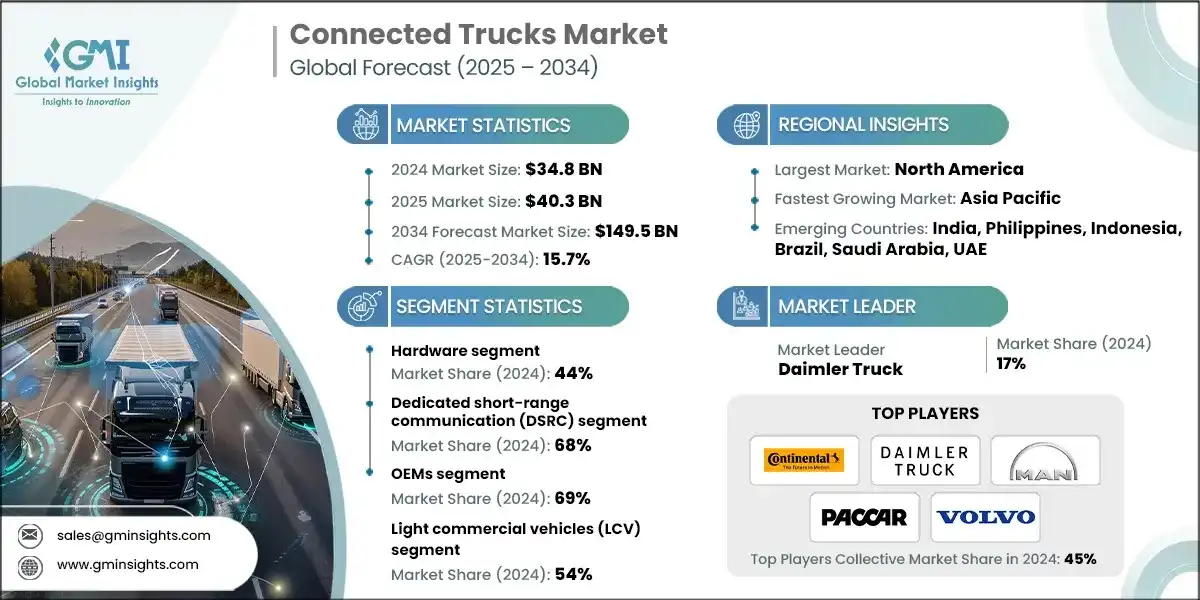
The global connected trucks market was estimated at USD 34.8 billion in 2024. The market is expected to grow from USD 40.3 billion in 2025 to USD 149.5 billion in 2034, at a CAGR of 15.7%, according to the latest report published by Global Market Insights Inc.
To get key market trends
The rising demand for connected trucks is transforming freight logistics and port-to-door supply chains worldwide. Telematics, fleet analytics, and in-cab connectivity help operators to model vehicle movements, forecast ETA variance, optimize load and route assignments, and decrease empty miles. Sophisticated simulation and digital- twin models can enable OEMs, fleet managers and infrastructure operators to virtually test their scheduling, capacity and curbside access scenarios under the assumption of operating cost reduction, enhanced safety, and greater on-time delivery efficiency.
For example, in June 2023, Volvo Eicher Commercial Vehicles (VECV), a joint venture in between the Volvo Group and Eicher Motors, announced that its Uptime Centre has dramatically improved operational reliability of its connected trucks and buses, resulting in a remarkable 98% improvement in uptime. This will lead to significant savings of 7-10% by fleet operators.
The shift towards electrification and low-carbon freight requires connected-truck platforms to coordinate energy consumption, charging schedules and range control across fleets. The integration of smart charging, charge-session and vehicle-to-grid/charging-station communications entails real-time telemetry and centrally controlled fleet management to ensure that the grid demand charges are not excessively charged. Dynamic load-balancing and route planning are also possible in mixed diesel-electric fleets, with connected systems, which maintain battery reserve on key legs.
The COVID-19 pandemic increased the pace of digitization in freight: remote diagnostics, contactless deliveries, and centralized operations centers became necessary when on-site interventions were limited. Fleets put more money into remote health monitoring, OTA updates and cloud-based telematics to keep their businesses going and minimize exposure to drivers. The outcome has increased strength in digital-twin route simulations, telematics stacks hardened with cyber-security, and cloud-orchestrated supply-chain continuity.
Rapid adoption of advanced driver assistance and autonomy-enabling systems (ADAS, platooning, lane-keep, automated braking) is increasing the value of high-integrity, low-latency connectivity in trucks. OEMs and fleets are investing in vehicle-level fusion (cameras + radar + lidar) plus cloud analytics to translate sensor data into safety workflows and regulatory compliance records. Interoperability standards and secure data-sharing frameworks are now priorities, since operational and insurance benefits depend on trustworthy data provenance.
North America is a strong market for connected-truck services because of large long-haul fleets, high telematics penetration and a mature aftermarket. Fleet-management, ELD compliance, and fuel-management services are widely used; large fleets purchase enterprise-grade telematics, analytics and custom integrations that command higher ARPUs (average revenue per unit). Several large telematics vendors, OEM fleet services and integrators lead deployments here, making it a center for innovation in platooning pilots and freight-telematics integrations.
Asia-Pacific is the fastest-growing region for connected trucks due to rapid e-commerce growth, large domestic freight volumes, and national investments in logistics modernization. China, India and Southeast Asian economies are scaling telematics in both OEM-supplied trucks and widespread aftermarket retrofit programs. Government logistics digitization initiatives and port modernization programs provide fertile ground for broad deployment of trailer telematics, cold-chain monitoring, and last-mile orchestration.
Connected Trucks Market Report Attributes
| Key Takeaway | Details |
|---|---|
| Market Size & Growth | |
| Base Year | 2024 |
| Market Size in 2024 | USD 34.8 Billion |
| Market Size in 2025 | USD 40.3 Billion |
| Forecast Period 2025 – 2034 CAGR | 15.7% |
| Market Size in 2034 | USD 149.5 Billion |
| Key Market Trends | |
| Drivers | Impact |
| Rising demand for fleet management efficiency | Fleet operators increasingly adopt connected technologies to optimize routes, monitor driver behavior, and track assets in real-time. This enhances fuel efficiency, reduces downtime, and lowers operational costs, driving widespread adoption of connected truck solutions across logistics and transport sectors. |
| Integration of 5G and IoT technologies | The deployment of 5G and IoT enables high-speed, low-latency communication between vehicles, infrastructure, and cloud systems. This integration supports real-time data exchange, enhances safety, and enables advanced applications like autonomous driving and vehicle-to-everything (V2X) connectivity. |
| Government regulations on safety and emissions | Regulatory mandates such as ELD, HOS compliance, and emission reduction targets push fleets to implement connected technologies. These systems help monitor compliance, enhance driver safety, and reduce environmental impact through optimized fuel consumption and predictive analytics. |
| Increasing adoption of cloud-based telematics platforms | Cloud telematics platforms enable centralized fleet monitoring, seamless over-the-air updates, and advanced data analytics. They help improve decision-making, streamline maintenance, and reduce operational |
| Pitfalls & Challenges | Impact |
| High initial implementation and maintenance costs | The installation of telematics devices, sensors, and advanced communication systems involves high upfront investment. Small and mid-sized fleet operators often face financial barriers due to hardware costs, software integration, and ongoing maintenance, limiting large-scale market adoption. |
| Concerns over data security and privacy | Connected trucks transmit massive data between vehicles and cloud systems, raising cybersecurity risks. Unauthorized access, data breaches, and privacy violations can disrupt operations and erode fleet owner trust, making security compliance and encryption critical challenges for market expansion. |
| Opportunities: | Impact |
| Expansion of autonomous and semi-autonomous trucks | Connected technologies form the foundation for autonomous truck operations by enabling real-time communication, sensor fusion, and decision-making. As automation advances, connectivity will play a crucial role in improving logistics efficiency, safety, and driver assistance systems globally. |
| Emergence of edge computing for real-time analytics | Edge computing allows data processing closer to the source, reducing latency and bandwidth usage. This enhances real-time decision-making for connected trucks, improving predictive maintenance, driver safety, and operational efficiency across fleets in various terrains and conditions. |
| Increasing electrification of commercial vehicles | The shift toward electric trucks increases the demand for connected solutions to monitor battery performance, energy usage, and charging optimization. Integrating telematics with electric drivetrains improves sustainability and supports efficient fleet management for zero-emission logistics. |
| Rising adoption in emerging markets | Emerging economies are rapidly adopting connected truck solutions due to expanding logistics infrastructure, smart city projects, and supportive government policies. Growing digitalization and investment in 5G networks further accelerate connected vehicle deployment in regions like Asia-Pacific, Latin America, and Africa. |
| Market Leaders (2024) | |
| Market Leaders |
17% market share |
| Top Players |
Collective Market Share in 2024 is 45% |
| Competitive Edge |
|
| Regional Insights | |
| Largest Market | North America |
| Fastest growing market | Asia Pacific |
| Emerging countries | India, Philippines, Indonesia, Brazil, Saudi Arabia, UAE |
| Future outlook |
|
What are the growth opportunities in this market?
Connected Trucks Market Trends
The connected truck industry is moving toward the trend of offering digital services as subscriptions of software and hardware components of telematics. Predictive maintenance, route improvement and uptime analytics are becoming a growing requirement of fleets. Telematics companies and OEMs are now offering software, artificial intelligence insights, and fleet management applications, which provide them with recurrent revenue streams and a better customer retention MRO.
For instance, in October 2025, Daimler Truck Financial Services (DTFS) and GEICO came up with a jointly developed program, called Connected Insurance, of commercial trucks in the U.S., where risk and premiums are determined based on real-time telematics data on Freightliner and Western Star trucks, and up to 10% of premiums are provided to owner-operators and small fleet owners.
With the rise of electric and hybrid trucking, connectivity is critical in controlling battery health, charging patterns, and range optimization. The linked platforms will also bridge trucks with charging infrastructure and multi-modal logistics systems to enhance energy efficiency and coordinate freight. This integration will guarantee the continuity of communication among supply chains and increase their sustainability and visibility in operations.
The automakers of trucks are also progressively integrating telematics and connectivity units on-site. This removes expensive installations in the aftermarket and offers real-time data to the fleets on the first day. Pre-delivery integration helps to accelerate the digital adoption, minimize downtime, and provide uniform connectivity among the models, and such advanced features of telematics are an inherent feature and not an option.
North America and Europe are developed regions, and thus, they are leading in terms of high adoption of telematics, whereas Asia-Pacific, Latin and Middle East are growing at a high rate because of changing of fleets and digitalization of logistics. The opportunities for emerging markets are high, and OEMs are straining to adapt to scalable low cost connected-truck solutions to meet various regional requirements.
Connected Trucks Market Analysis
Learn more about the key segments shaping this market
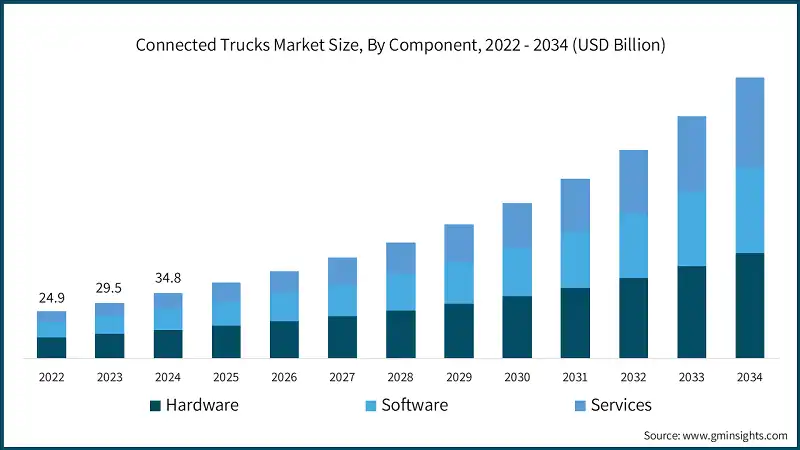
Based on component, the connected trucks market is divided into hardware, software, and services. The hardware segment dominated the market, accounting for around 44% share in 2024 and is expected to grow at a CAGR of over 13.9% through 2034.
- The hardware segment dominates the market because it forms the foundational layer enabling connectivity, data collection, and communication. Core components such as telematics control units (TCUs), on-board diagnostics (OBD) devices, GPS/GNSS systems, sensors, and communication modules (4G/5G, Wi-Fi, Bluetooth) are essential for real-time tracking, vehicle monitoring, and data transmission. These systems allow trucks to connect seamlessly with fleet management platforms and cloud ecosystems, providing the physical infrastructure for digital services.
- In March 2025, Geotab and Daimler Truck North America announced deeper OEM integration for Freightliner trucks with Cummins powertrains. The factory-installed telematics now plugs directly into Geotab’s MyGeotab platform, giving fleets seamless access to performance, sustainability and safety data.
- Additionally, the rising production of factory-fitted connected trucks by OEMs like Daimler, Volvo, and PACCAR are boosting hardware adoption. Growing investments in ADAS, V2X communication, and predictive maintenance systems further drive hardware demand. As fleets expand globally, connected hardware remains indispensable for ensuring operational efficiency, safety, and compliance.
- The services segment will experience a CAGR of more than 19% owing to the increasing adoption of cloud-based fleet management, predictive maintenance, and real-time data analytics. OEMs and telematics providers are expanding subscription-based and aftermarket service models, enabling continuous connectivity, software updates, and performance optimization throughout the truck’s lifecycle.
 Learn more about the key segments shaping this market
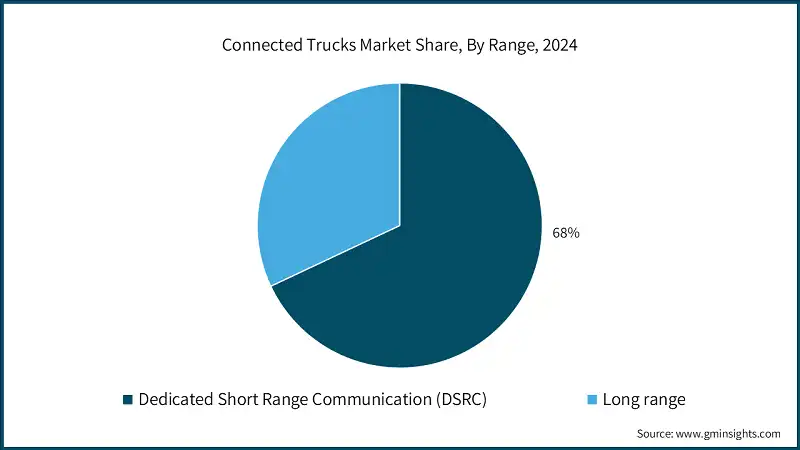
Based on range, the connected trucks market is segmented into dedicated short-range communication (DSRC), and long range. The dedicated short-range communication (DSRC) segment dominated the market accounting for around 68% share in 2024, and the segment is expected to grow at a CAGR of over 15.1% from 2025 to 2034.
- The dedicated short-range communication (DSRC) segment holds the largest market share in the market due to its proven reliability and low-latency performance for vehicle-to-vehicle (V2V) and vehicle-to-infrastructure (V2I) communications. DSRC enables instant data exchange, supporting applications like collision avoidance, lane-change assistance, and emergency braking alert critical for safety and regulatory compliance in commercial trucking operations.
- Furthermore, DSRC benefits from extensive government support and standardization, particularly in North America and Europe, where transportation authorities are deploying DSRC-based infrastructure for smart roadways and traffic management. Its ability to function without continuous internet connectivity also makes it ideal for long-haul routes, ensuring dependable communication even in remote or low-network regions.
- For example, in September 2024, Autotalks launched a globally deployed-ready V2X chipset supporting both DSRC (802.11p) and C-V2X (3GPP PC5), enabling one unified hardware solution for vehicle-to-everything communications across regions and standards.
- The long-range segment will expand at a CAGR of more than 16.8% due to the rising adoption of cellular V2X (C-V2X) and 5G networks that enable real-time vehicle-to-cloud and vehicle-to-vehicle communication. These technologies enhance safety, enable over-the-air updates, and support autonomous driving and large-scale fleet connectivity.
Based on sales channel, the connected trucks market is segmented into OEMs, and aftermarket. OEMs segment is expected to dominate the market with around 69% share in 2024 due to factory-fitted telematics, integrated connectivity platforms, and partnerships with tech providers ensuring standardized, reliable, and secure connected truck solutions.
- The connected trucks market is led by the segment of major truck manufacturers such as Daimler, Volvo and PACCAR are now offering connectivity systems and telematics facilities installed in new vehicles. These OEM based solutions will have a smooth compatibility, improved performance tracking and improved safety by including embedded sensors, GPS and improved communication modules.
- In addition, OEMs are partnering with providers of telematics like Geotab, Platform Science, and Trimble to provide real-time data analytics, over-the-air updates, and predictive maintenance. This solution enables fleet operators to have access to pre-existing ready-to-use digital ecosystems without installing any aftermarket solutions. This leads to increased efficiency in operations, less downtime and increased customer trust in the connectivity platforms that are supported by OEMs and place OEMs as the drivers of growth in the connected trucks market.
- For example, in August 2025, Samsara Networks Inc. deploys a pre-delivery program with Daimler Truck and Fontaine Modification: new trucks are sent out of the line with built-in telematics hardware and connectivity, and aftermarket installations no longer must wait.
- Aftermarket segment will grow at a CAGR of over 16.3% due to the increasing necessity for telematics solutions among current truck fleets. Third-party connectivity systems are becoming increasingly used by fleet operators as a tracking system, predictive maintenance, and regulatory compliance. Telematics platforms that are easy to upgrade and subscribe to and are cost-effective further promote the growth of aftermarket.
Based on vehicle, the connected trucks market is divided into light commercial vehicles (LCV), medium commercial vehicles (MCV), and heavy commercial vehicles (HCV). The light commercial vehicles (LCV) segment dominated the market with 54% share in 2024.
- The light commercial vehicles (LCV) segment holds the highest market share in the connected trucks market due to its widespread application in last-mile delivery, logistics, and e-commerce activities. Urban logistics has also increased the uptake of connected technologies in LCVs through the upsurge in demand of real-time fleet tracking, route optimization, and fuel management. Telematics and IoT are advancing through the development of complex telematics platforms and systems embedded into LCVs by OEMs such as Ford, Tata Motors, and Toyota to be more efficient and safer.
- The LCV segment is also advantageous in terms of the rapid technological adoption of the segment because of the low costs and the high rate of the operational turnover in comparison with heavy trucks. Connected solutions in the compliance management, driver monitoring, and cost-reduction categories become more and more popular among small and medium operators of fleets, which further strengthen the role of LCVs in the connected truck ecosystem.
- For instance, in September 2024, Continental Automotive announced a partnership with RAC to deliver its connected-vehicle telematics solutions for light commercial vehicles (LCVs) as part of fleet management services.
- Furthermore, the heavy commercial vehicles (HCV) segment is expected to witness the fastest growth due to increasing adoption of advanced telematics, ADAS, and vehicle-to-everything (V2X) communication systems for long-haul operations. Fleet operators and logistics companies are investing in connected HCVs to improve fuel efficiency, driver safety, and compliance management.
Looking for region specific data?
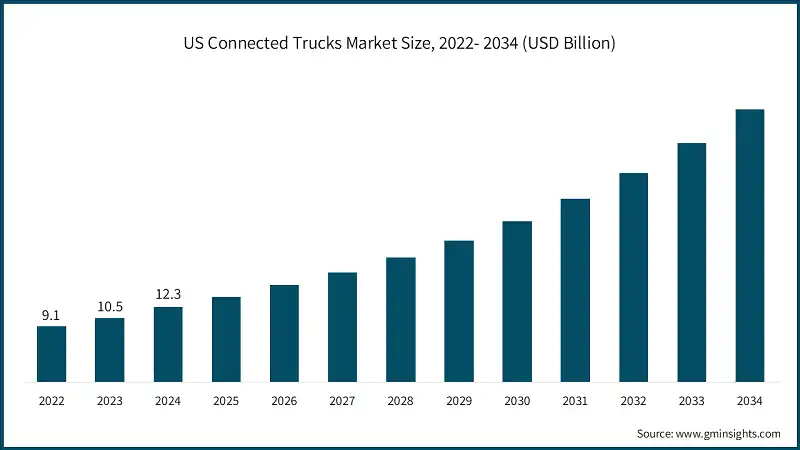
US dominated the connected trucks market in North America with around 85% share and generated USD 12.3 billion in revenue in 2024.
- The U.S. market is witnessing strong growth due to the early adoption of telematics, advanced connectivity infrastructure, and strong OEM presence. Leading manufacturers such as Daimler Truck North America, PACCAR, and Navistar have integrated factory-installed telematics systems like Detroit Connect and OnCommand Connection, driving market penetration.
- Additionally, federal safety mandates, increasing demand for fleet optimization, and the presence of major telematics providers like Geotab, Samsara, and Trimble are fueling rapid adoption. The growing focus on autonomous and electric commercial vehicles, supported by 5G network expansion and AI-based fleet management solutions, continues to make the U.S. a global hub for connected truck innovation.
- For example, in May 2025, Aurora Innovation, Inc. launched the U.S.’s first commercial driverless heavy-duty truck service on the I-45 corridor, demonstrating scale adoption of advanced connected truck systems.
- Canada is projected to grow at a strong CAGR for the market due to increasing investments in smart transportation infrastructure, 5G expansion, and adoption of fleet telematics across logistics and construction industries. Government initiatives supporting intelligent transportation systems (ITS) and carbon emission reduction are also accelerating deployment.
The connected trucks market in Germany is expected to experience significant and promising growth from 2025 to 2034.
- Europe accounts for over 30% of the market in 2024 and is the fastest-growing region with a CAGR of around 16% owing to stringent emission regulations, advanced 5G rollout, and OEM-led digitalization. Major players like Volvo, Scania, and MAN are driving adoption through integrated telematics and smart mobility initiatives.
- Germany is the leader in the connected trucks market due to its strong automotive manufacturing base, advanced digital infrastructure, and early adoption of telematics and ADAS technologies. Major OEMs such as Daimler Truck, MAN, and Scania have established Germany as a hub for innovation in connected and autonomous trucking. These companies are integrating real-time diagnostics, over-the-air (OTA) updates, and vehicle-to-everything (V2X) communication into their fleets to enhance safety and efficiency.
- Additionally, Germany’s supportive regulatory environment and large-scale investments in 5G and smart mobility programs are accelerating market expansion. Initiatives like the “Digital Test Bed Autobahn” and the European Green Deal are promoting the development of intelligent transportation systems, making Germany a model for connected truck deployment and sustainable logistics across Europe.
- For instance, in September 2024, Cummins Inc. announced a partnership with Bosch Global Software Solutions, ETAS GmbH and KPIT Technologies to launch the open source “Eclipse CANought” telematics software project for commercial vehicles a development involving German engineering firms and reflecting Germany’s importance in telematics innovation.
- The UK is becoming a major growing market for connected trucks due to increasing investments in smart mobility, 5G infrastructure, and connected fleet technologies. The government’s strong focus on reducing carbon emissions and enhancing road safety is driving adoption of telematics, ADAS, and connected vehicle systems.
The connected trucks market in China is expected to experience significant and promising growth of 17.6% from 2025-2034.
- Asia Pacific accounts for over 21% of the market in 2024 and is the fastest-growing region with a CAGR of around 18.3% owing to its rapid industrialization, expanding logistics networks, and strong government push for smart transportation. Countries like China, Japan, and India are heavily investing in 5G-enabled connectivity, IoT infrastructure, and intelligent fleet management systems.
- China is the leader in the connected trucks market due to its rapid advancements in 5G connectivity, large-scale manufacturing capabilities, and strong government support for intelligent transportation systems. The country’s “Made in China 2025” and “Smart Vehicle Innovation” policies have accelerated the integration of IoT, AI, and telematics in commercial vehicles.
- Leading OEMs such as BYD, FAW, and Dongfeng are actively deploying connected truck platforms that feature real-time diagnostics, predictive maintenance, and autonomous driving support. Partnerships between automakers and technology companies like Huawei and Baidu are further driving innovation in vehicle-to-everything (V2X) communication and cloud-based fleet management. These initiatives have positioned China as the most advanced and rapidly expanding market for connected truck technology in the Asia-Pacific region.
- In March 2025, BYD unveiled a new ultra-fast charging system capable of adding 400 km range in five minutes, signaling major investment into connected and electric commercial vehicle ecosystems in China.
- India is becoming one of the fastest-growing markets in the Asia Pacific market due to the rapid adoption of digital fleet management, strong government initiatives for logistics modernization, and expanding 4G/5G infrastructure. Programs like Digital India and Smart City Mission are driving demand for intelligent transport and vehicle telematics solutions.
The connected trucks market in Brazil is expected to experience significant and promising growth from 2025-2034.
- Latin America holds around 4% of the market and is growing steadily at a CAGR of around 15.4%. The developments are fueled by increasing adoption of fleet telematics, government efforts to modernize transportation infrastructure, and the rapid digitalization of logistics operations in countries like Brazil, Mexico, and Chile.
- Brazil dominates the Latin America connected trucks market owing to its large commercial vehicle fleet, advanced telecom infrastructure, and strong presence of global OEMs such as Volvo, Scania, Mercedes-Benz, and Iveco. The country’s logistics-heavy economy, driven by agriculture, mining, and industrial exports, has created strong demand for fleet monitoring, route optimization, and safety compliance solutions. Brazil’s regulatory framework also supports the adoption of telematics for transport management and emissions tracking.
- Moreover, growing investments in 4G/5G networks and IoT infrastructure are enhancing real-time data exchange between vehicles and cloud systems. Leading companies are partnering with local telematics providers to deploy predictive maintenance and connectivity platforms. This integration of smart fleet solutions and digital logistics platforms positions Brazil as the regional leader in connected truck innovation and adoption.
- For example, in February 2025, Toyota Motor Corporation and NTT DATA’s Transatel announced a collaboration in Brazil and Argentina to launch connected-vehicle services in Toyota vehicles, using e-SIMs and telematics for remote controls, Wi-Fi hotspot and over-the-air updates.
- The connected trucks market in Mexico is one of the fastest-growing in Latin America, driven by rapid logistics digitalization, strong cross-border trade with the U.S., and the expansion of e-commerce and industrial transport networks. Government programs promoting smart infrastructure and fleet efficiency are accelerating connected vehicle deployment across logistics and freight operations.
The connected trucks market in South Africa is expected to experience significant and promising growth from 2025-2034.
- Middle East and Africa (MEA) have a collective share of approximately 3% of the market in 2024, which is steadily growing due to rising investments in smart transportation infrastructure, logistics digitalization, and adoption of IoT-based fleet management solutions. Governments across the UAE, Saudi Arabia, and South Africa are emphasizing connected mobility as part of their national smart city and Vision 2030 programs.
- South Africa will take the lead in the African connected trucks market because of its advanced logistics infrastructure, strong commercial vehicle presence, and early adoption of telematics technologies. The country has a well-established trucking sector that supports mining, manufacturing, and cross-border trade, creating high demand for connected fleet management solutions. OEMs such as Volvo, MAN, and Isuzu have launched connected truck models with built-in telematics and diagnostics to improve operational efficiency and driver safety.
- Moreover, South Africa is home to leading telematics companies such as Mix Telematics and Cartrack, which are expanding connected fleet services across the continent. The increasing integration of IoT, cloud analytics, and AI-based safety systems in logistics is driving strong adoption of connected commercial vehicles in South Africa.
- The United Arab Emirates (UAE) is the most rapidly developing market within the MEA region, with its growth fueled by ambitious smart mobility initiatives, rapid digital transformation, and government-backed investments in intelligent transportation systems. Programs such as UAE Vision 2031 and Smart Dubai are accelerating the adoption of connected and autonomous vehicle technologies, including connected trucks.
Connected trucks Market Share
- The top 7 companies in the connected trucks industry are Daimler Truck, Volvo, PACCAR, Continental, Geotab, MAN Truck & Bus, and Trimble, contributed around 48% of the market in 2024.
- Daimler Truck focuses on its Detroit Connect and Fleetboard platforms, integrating telematics, predictive maintenance, and over-the-air (OTA) updates across its Freightliner, Western Star, and Mercedes-Benz trucks. Its strategy centers on AI-driven fleet optimization, uptime management, and cloud connectivity, with deep partnerships for autonomous and electric vehicle integration.
- Volvo leverages its Volvo Connect ecosystem, combining telematics, driver behavior analytics, uptime monitoring, and predictive diagnostics. It emphasizes real-time vehicle tracking, energy efficiency, and sustainability. Volvo’s connected services strategy is tightly linked with its electrification roadmap and autonomous truck testing under Vera and Volvo Autonomous Solutions.
- PACCAR integrates connected technologies through PACCAR Connect, SMARTLINQ, and TRUCKTECH+. The company’s strategy focuses on real-time diagnostics, cloud analytics, and connected uptime services for its Kenworth, Peterbilt, and DAF brands. It partners Platform Science and Cummins to embed OEM-native connectivity into new truck models.
- MAN’s Digital Services and RIO Platform enable connected fleet management, telematics integration, and driver performance analytics. The company focuses on interoperability with other TRATON brands, predictive maintenance, and scalable connectivity for electric trucks. MAN, also integrates cloud data for optimizing fleet costs and CO2 reduction.
- Continental’s strategy focuses on developing advanced telematics, connectivity modules, and ADAS for commercial vehicles. Through its AUMOVIO and Access & Telematics platforms, it provides V2X communication, predictive safety systems, and data-driven fleet management. Continental integrates cybersecurity and over-the-air (OTA) capabilities to enable intelligent, connected, and autonomous trucking operations.
- Geotab leads to cloud-based fleet telematics with its MyGeotab platform, supporting real-time data analytics, predictive maintenance, and driver behavior monitoring. Its strategy emphasizes open-platform integration, sustainability tracking, and OEM partnerships with brands like Daimler and Ford. Geotab focuses on AI-driven insights, EV compatibility, and smart data ecosystems for connected logistics.
- Trimble’s strategy centers around its Transportation Cloud and TMT Fleet Maintenance systems, delivering integrated telematics, routing optimization, and maintenance management. It leverages IoT and edge analytics for uptime improvement and cost reduction. Trimble also emphasizes interoperability across logistics systems, enabling data-driven decision-making and connected operations for large fleets globally.
Connected Trucks Market Companies
Major players operating in the connected trucks industry are:
- BYD Company
- Continental
- Daimler Truck
- Geotab
- MAN Truck & Bus
- PACCAR
- Scania
- Tata Motors
- Trimble
- Volvo
- The connected trucks market is leveraging advanced technologies, including IoT, 5G, and cloud computing, to enhance real-time fleet monitoring, predictive maintenance, and operational efficiency. Companies are streamlining data exchange between vehicles, drivers, and control centers to optimize logistics operations and maximize vehicle uptime.
- A key strategic focus is the development of software-driven ecosystems that generate recurring revenue through telematics subscriptions, analytics platforms, and over-the-air (OTA) updates. This shift from a product-based to a service-based model enables continuous improvements in vehicle performance, regulatory compliance, and driver safety by utilizing data insights and AI-driven solutions.
- Additionally, organizations are forming strategic partnerships with telecom providers, AI technology firms, and logistics platforms to expand their global presence and ensure interoperability. By prioritizing cybersecurity measures, adopting cloud-based fleet intelligence, and integrating sustainability initiatives, companies are strengthening their competitive positioning and driving adoption across both OEM and aftermarket channels.
Connected Trucks Industry News
- In October 2025, Daimler Truck, in collaboration with GEICO, introduced Connected Insurance, offering up to 10% premium discounts for Freightliner and Western Star fleets leveraging Detroit Connect telematics data to enhance risk assessment and operational safety.
- In September 2025, Volvo Trucks Celebrates 1 million Connected Trucks Milestone Volvo Trucks achieved a milestone of 1 million connected trucks globally, of which 218,000 are in North America, this marked a big milestone in the deployment of connected vehicles around the world. Success shows the magnitude of how OEMs implement connectivity systems and how connected technologies are becoming widely accepted by commercial fleet operators across the world.
- In January 2025, Geotab Enhances Mixed Fleet Management Capabilities Geotab announced expanded mixed fleet management with enhanced OEM integration, allowing vehicles with built-in OEM integration and old-fashioned vehicles to communicate data seamlessly through its MyGeotab platform. This move is a response to a vital market requirement with fleet operators becoming the industry owners of a broader array of vehicles produced by various manufacturers and in need of a single platform through which they can access a wide view of their fleets.
- In December 2024, the PACCAR electronics division PACCAR reorganized into PACCAR Electronics, a specialized division dedicated to vehicle electronics and connectivity solutions, and this shows that the company has perceived the importance of in-house development and less reliance on external suppliers. This is a strategic step that indicates that the role of electronics and connectivity in the competitiveness of commercial vehicles and the need to have further control over critical technology components is becoming more significant.
- In November 2024, Trimble Freight Visibility Relaunch Trimble reintroduced its freight visibility system with two-way TMS integration in North America, and this has improved the visibility of supply chains and the ability to coordinate transportation management systems users. The relaunch indicates that the integration of logistics technology and the increased significance of end-to-end visibility in the operations of freight transportation remain on the agenda.
- In October 2024, MAN Truck & Bus introduced AI-powered Fleet Assistant in Austria MAN Truck & Bus introduced AI-powered fleet assistant in October 2024 and intends to expand to Germany in October 2025 providing operational optimization recommendations, predictive maintenance recommendations, and real-time guidance based on the results of a detailed data analysis of vehicle and route. This trend involves the actual use of artificial intelligence in commercial fleet management packages.
The connected trucks market research report includes in-depth coverage of the industry with estimates & forecasts in terms of revenue ($Bn), Shipment (Units) from 2021 to 2034, for the following segments:
Market, By Component
- Hardware
- Telematics control units (TCUS)
- On-board diagnostics (OBD) devices
- Communication modules (cellular, wi-fi, bluetooth)
- Sensors & data collection devices
- GPS/GNSS positioning systems
- Others
- Software
- Fleet management software platforms
- Mobile applications & driver interfaces
- Analytics & business intelligence tools
- Integration & API management software
- Cybersecurity & data protection software
- Others
- Services
- Installation & integration services
- Data analytics & consulting services
- Maintenance & technical support
- Training & change management services
- Managed services & outsourcing
- Others
Market, By Connectivity
- Vehicle-to-Infrastructure (V2I) Communication
- Traffic signal integration
- Smart highway systems
- Toll collection & payment systems
- Weigh station communication
- Parking & loading zone management
- Vehicle-to-Cloud (V2C) Communication
- Fleet management platforms
- Remote diagnostics & monitoring
- Over-the-air updates & configuration
- Data analytics & business intelligence
- Regulatory compliance reporting
- Vehicle-to-Vehicle (V2V) Communication
- Platooning & convoy operations
- Collision avoidance systems
- Traffic flow optimization
- Emergency vehicle communication
- Cooperative adaptive cruise control
- Others
Market, By Range
- Dedicated Short Range Communication (DSRC)
- Long range
Market, By Vehicle
- Light Commercial Vehicles (LCV)
- Class 1–2 vehicles
- Pickup trucks & cargo vans
- Small delivery vehicles
- Service & utility vehicles
- Urban last-mile applications
- Medium Commercial Vehicles (MCV)
- Class 3–5 vehicles
- Box trucks & step vans
- Food service & beverage trucks
- Utility & municipal vehicles
- Regional distribution applications
- Refrigerated transport (reefer) units
- Heavy Commercial Vehicles (HCV)
- Class 6–8 vehicles
- Long-haul tractors & semi-trailers
- Heavy duty trucks & trailers
- Construction & vocational vehicles
- Specialized heavy equipment
Market, By Application
- Fleet Management
- Safety & Compliance
- Remote Diagnostics & Maintenance
- Infotainment & Connectivity
- Others
Market, By Sales Channel
- OEMs
- Aftermarket
The above information is provided for the following regions and countries:
- North America
- US
- Canada
- Europe
- Germany
- UK
- France
- Italy
- Spain
- Russia
- Asia Pacific
- China
- India
- Japan
- Australia
- South Korea
- Philippines
- Indonesia
- Latin America
- Brazil
- Mexico
- Argentina
- MEA
- South Africa
- Saudi Arabia
- UAE
Frequently Asked Question(FAQ) :
Which region leads the connected trucks sector?
North America leads the market, with the U.S. accounting for 85% of the regional revenue and generating USD 12.3 billion in 2024.
What are the upcoming trends in the connected trucks market?
Trends include subscription-based telematics, predictive maintenance, AI-driven fleet management, connectivity for electric and hybrid trucks, and pre-installed telematics units to boost digital adoption and efficiency.
Who are the key players in the connected trucks industry?
Key players include BYD Company, Continental, Daimler Truck, Geotab, MAN Truck & Bus, PACCAR, Scania, Tata Motors, Trimble, and Volvo.
What is the growth outlook for the OEMs segment in 2024?
The OEMs segment is expected to dominate the market with a 69% share in 2024, led by factory-fitted telematics, integrated connectivity platforms, and partnerships with technology providers.
How much revenue did the hardware segment generate in 2024?
The hardware segment generated approximately 44% of the market share in 2024 and is expected to witness over 13.9% CAGR through 2034.
What was the valuation of the DSRC segment in 2024?
The dedicated short-range communication (DSRC) segment accounted for 68% of the market share in 2024 and is set to expand at a CAGR of over 15.1% from 2025 to 2034.
What was the market size of the connected trucks in 2024?
The market size was USD 34.8 billion in 2024, with a CAGR of 15.7% expected through 2034. The increasing demand for connected trucks is driving growth by transforming freight logistics and supply chains globally.
What is the expected size of the connected trucks industry in 2025?
The market size is projected to reach USD 40.3 billion in 2025.
What is the projected value of the connected trucks market by 2034?
The market is poised to reach USD 149.5 billion by 2034, driven by advancements in telematics, fleet analytics, and integrated connectivity platforms.
Connected Trucks Market Scope
Related Reports