Summary
Table of Content

Connected Motorcycle Market
Get a free sample of this report
Form submitted successfully!
Error submitting form. Please try again.
Thank you!
Your inquiry has been received. Our team will reach out to you with the required details via email. To ensure that you don't miss their response, kindly remember to check your spam folder as well!
Request Sectional Data
Thank you!
Your inquiry has been received. Our team will reach out to you with the required details via email. To ensure that you don't miss their response, kindly remember to check your spam folder as well!
Form submitted successfully!
Error submitting form. Please try again.
Connected Motorcycle Market Size
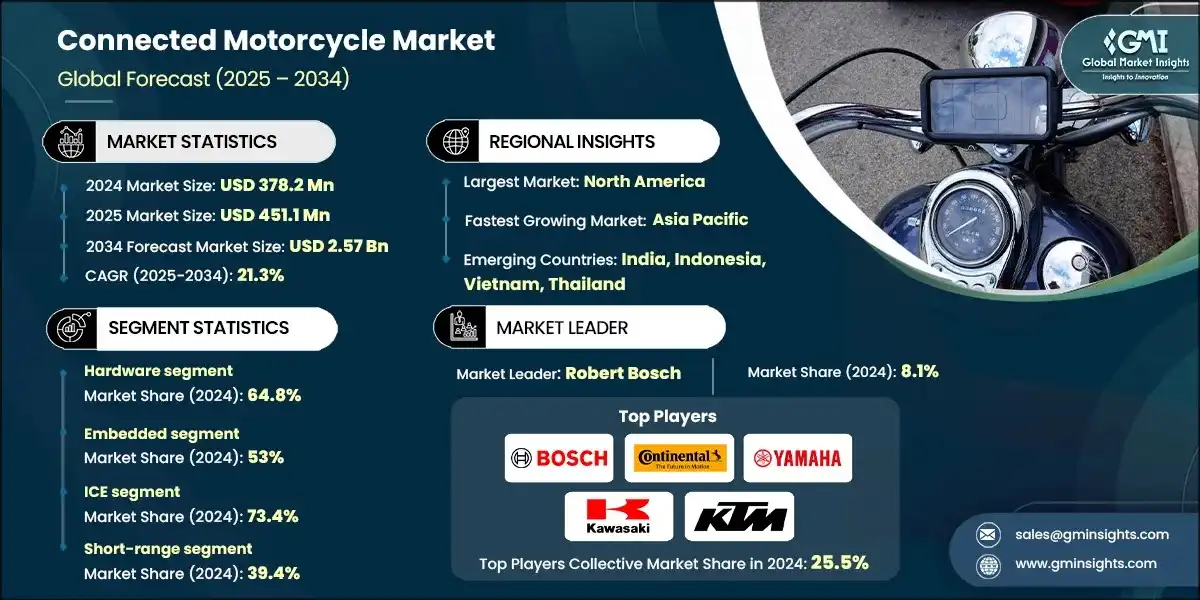
The global connected motorcycle market was valued at USD 378.2 million in 2024. The market is expected to grow from USD 451.1 million in 2025 to USD 2.57 billion in 2034, at a CAGR of 21.3%, according to latest report published by Global Market Insights Inc.
To get key market trends
- Connected motorcycles use sensors, GPS, and V2X communication to provide collision warnings, blind-spot monitoring, and real-time traffic updates. Improved rider safety lowers accidents, spurs rider adoption, and creates demand for embedded connectivity solutions across both consumer and fleet customers.
- With the increase in development of electric motorcycles and scooters, the demand for connectivity to monitor battery usage and performance, use over-the-air updates to improve motor vehicle systems, and provide connectivity-enabled logistics solutions keeps growing. Smart electric vehicles are highly reliant on telematics and mobile applications, which helps OEM and aftermarket providers to grow revenue from embedded systems, software, and services.
- Connected motorcycles and scooters are helping urban delivery services, ride-hailing services, and logistics fleets connect to route optimization, predictive maintenance, and real-time tracking. Subscription-sourced telematics services are creating recurring revenue, driving the acceptance to use tethered or embedded connectivity, and growing the commercial market for connected motorcycles.
- In June of 2025, BMW released the Connected Ride Navigator together with the F900GS, F900GS Adventure and F800GS. The Connected Ride Navigator integrates with the BMW app and My BMW Cloud and enables real-time, turn-by-turn navigation, route planning and media functions. The Connected Ride Navigator has a 5.5-inch screen and updates functionality via OTA over the air.
- The Asia-Pacific area is the leading market for connected motorcycles because of the rapid urbanization in the region, increasing traffic in cities and greater demand for efficient mobility to reduce congestion. The success of electric light two-wheelers (EL2W), increasing smartphone penetration and increasing connected technology adoption within the population will drive market growth and subsequent innovation.
Connected Motorcycle Market Report Attributes
| Key Takeaway | Details |
|---|---|
| Market Size & Growth | |
| Base Year | 2024 |
| Market Size in 2024 | USD 378.2 Million |
| Market Size in 2025 | USD 451.1 Million |
| Forecast Period 2025 - 2034 CAGR | 21.3% |
| Market Size in 2034 | USD 2.57 Billion |
| Key Market Trends | |
| Drivers | Impact |
| Rising Safety and Rider Assistance Adoption. | Advanced rider assistance systems (collision alerts, blind-spot detection, V2X) improve safety, reduce accidents, and increase consumer confidence. This drives demand for embedded connectivity, fostering investment in sensors, telematics, and app-based services. |
| Growth of Electric Motorcycles (EVs) | EVs rely heavily on connectivity for battery monitoring, ride analytics, and over-the-air updates. This accelerates adoption of embedded systems, boosts app engagement, and creates recurring revenue from software and telematics services. |
| Expansion of Fleet and Commercial Use | Delivery, logistics, and ride-hailing fleets adopt connected motorcycles for route optimization, predictive maintenance, and real-time tracking. This increases demand for subscription-based telematics and fleet management platforms, driving commercial market growth. |
| Government Regulations and Smart Mobility Initiatives | Policies supporting electric vehicles, safety standards, and smart city integration push OEM to offer connected solutions. This accelerates technology adoption, encourages infrastructure investment, and strengthens the ecosystem for connected motorcycle services. |
| Increasing Smartphone and IoT Integration | Widespread smartphone usage and IoT connectivity enable tethered and app-based motorcycle features, including navigation, ride analytics, and remote diagnostics. This enhances user experience, encourages digital engagement, and drives growth in software, services, and aftermarket connectivity solutions. |
| Pitfalls & Challenges | Impact |
| High Cost of Connected Systems | Premium embedded telematics, TFT displays, and advanced sensors increase motorcycle prices, limiting adoption in price-sensitive markets and slowing mass-market penetration, particularly in developing regions. |
| Data Security and Privacy Concerns | Connected motorcycles collect location, ride, and usage data, raising cybersecurity and privacy issues. Potential breaches can erode consumer trust, hinder adoption, and require OEM to invest in robust security systems. |
| Opportunities: | Impact |
| Electric Motorcycle Growth | Rising adoption of electric two-wheelers creates demand for embedded connectivity, battery monitoring, and OTA updates, opening revenue streams in software, telematics, and service subscriptions. |
| Fleet and Commercial Applications | Delivery, logistics, and ride-hailing fleets require real-time tracking, predictive maintenance, and route optimization, driving growth in subscription-based telematics and fleet management solutions. |
| Advanced Rider Assistance Systems (ARAS) Integration | Safety-enhancing technologies like collision alerts, V2X, and blind-spot detection increase demand for high-bandwidth connectivity and sensor integration, creating opportunities for premium products and safety-focused services. |
| Aftermarket and Retrofit Market | Growing interest in connected features for older motorcycles supports aftermarket GPS, GNSS trackers, and tethered solutions, enabling OEM and startups to tap into additional revenue beyond new vehicle sales |
| Market Leaders (2024) | |
| Market Leaders |
8.1% market share |
| Top Players |
Collective market share in 2024 is 25.5% |
| Competitive Edge |
|
| Regional Insights | |
| Largest Market | North America |
| Fastest Growing Market | Asia Pacific |
| Emerging Country | India, Indonesia, Vietnam, Thailand |
| Future Outlook |
|
What are the growth opportunities in this market?
Connected Motorcycle Market Trends
- The increase in electric two-wheelers, especially in the Asia-Pacific region and Europe, has created a surge in the adoption of embedded always connected solutions focused on battery management, Smart Ride analytics and over-the-air updates which create additional revenue for software, telematics and subscription-based service-based solutions while further improving urban mobility solutions.
- Motorcycle OEM have been introducing additional sensors, cameras and V2X connectivity for collision warnings, blind-spot detection, and traffic alerts improving safety while saving money and enhancing the adoption of value-added premium solutions that have always-connected capabilities with connected infrastructure/smart city use cases across all global OEM markets.
- The growing number of motorcycles with GPS technology incorporated in the motorcycle industry is making great advancements in safety and security. A rapid increase in the use of GPS trackers in motorcycles is becoming prevalent for anti-theft and recovery purposes. GPS trackers give you the ability to view the location in real-time, send tampering alerts, geofence capabilities, provide riders with peace of mind, and if recovery is needed, they substantially increase the chances of recovery.
- Many delivery, logistics and ride-hailing fleets are adopting always-connected motorcycles to enable real-time tracking of distant riders or delivery riders, predictive maintenance, route optimization, and recurring telematics revenue streams. These added telematics services result in large-scale adoption of both embedded and tethered connectivity to pay for overtime among all commercial segments of always-connected motorcycles.
Connected Motorcycle Market Analysis
Learn more about the key segments shaping this market
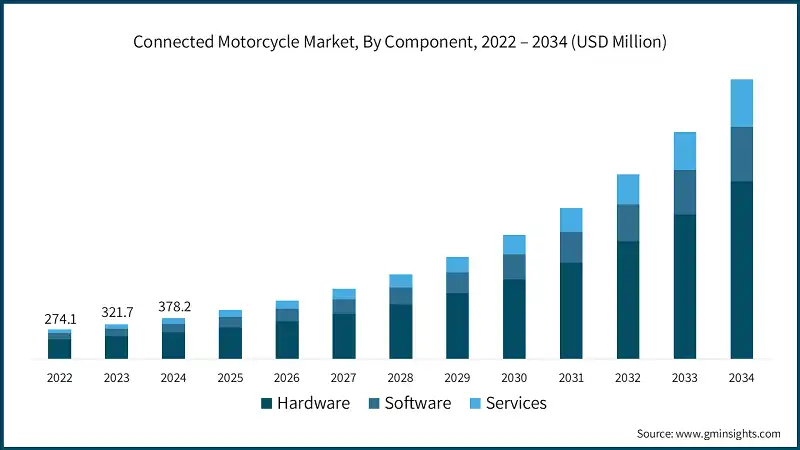
Based on component, the connected motorcycle market is divided into hardware, software and services. The hardware segment dominated the market accounting for around 64.8% in 2024 and is expected to grow at a CAGR of 20.7% through 2034.
- Motorcycles are becoming increasingly integrated with sensors, including GNSS/GPS, accelerometers, and components of Advanced Rider Assistance Systems (ARAS). They can provide a variety of safety features, predictive maintenance, and real-time diagnostics on the environment around the rider, resulting in a far more connected experience than simply the protection of the rider through operation.
- Manufacturers are concentrating on the development of small, low-power TCUs, displays, and communication modules that will allow connectivity without significant loads on batteries or vehicles, leading to a concern in the electric motorcycle and road mobility spaces.
- Motorcycle firmware, navigation, and safety systems can receive remote installation of software updates, which lowers service costs and warranties, increases the life of the vehicle, and enables features for a continuous improvement for both embedded and tethered systems.
- At EICMA 2024, Bosch also presented its next-generation TFT Connect display which are available in 7 inch and 10.25-inch high-resolution touchscreen displays (up to 1,500 nits’ brightness, 16 million colors). The displays are created for visibility in any weather, allow glove touch, voice control, and are designed to work with smartphone assistants.
- A new growing business model in the connected motorcycle space involves offering telematics, GPS tracking, and fleet management as a subscription-based service. For individual riders, this would also include premium navigation, cloud ride logs, and theft recovery. For commercial fleets, services would also include route optimization, predictive maintenance, and driver behavior monitoring.
Learn more about the key segments shaping this market
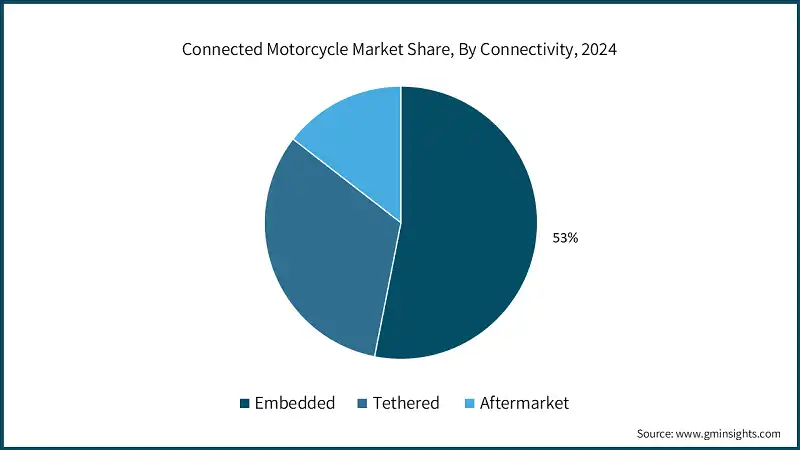
Based on connectivity, the connected motorcycle market is fragmented into embedded, tethered and aftermarket. The embedded segment dominates the market with 53% share in 2024, and the segment is expected to grow at a CAGR of 22.6% from 2025 to 2034.
- Motorcycle OEM is increasingly developing embedded telematics units that incorporate Advanced Rider Assistance Systems (ARAS such as collision alerts and blind-spot detection) and Vehicle-to-everything (V2X) systems in their new motorcycles. These ARAS and V2X technologies require always-on, high bandwidth connectivity and have positioned embedded hardware as an important means of enabling safety and compliance systems and improved rider experience.
- The ubiquitous tethered solution enabling smartphone-based rider abilities on electric motorcycles is the smartphone itself, which can fulfil bike-navigation, ride log, telematics, and performance analytics capabilities. While tethered connectivity is becoming the norm in other more price-sensitive and developing economies like India, Indonesia, and Vietnam, where affordable connectivity can be obtained through Bluetooth or Wi-Fi that balances cost and low-touch digital experience, riders still use tethered/connected innovations.
- For instance, Damon’s AI-enabled connected platform supports aftermarket adoption through plug-and-play telematics devices, mobile apps, and fleet dashboards. It allows retrofitting older motorcycles with predictive maintenance, GPS tracking, and rider safety services, extending connectivity beyond new OEM-built bikes.
- As such, commercial and delivery operators, and ride-hailing fleets have been able to retrofit their motorcycles with aftermarket telematics devices that provide intended built-in benefits for riders such as full GPS tracking, predictive maintenance, and driver behavior reporting for motorcycles that previously did not have these possibilities. Even though riders are using older motorcycles in their fleets, the telematics devices ensure that motorcycle riders have connected capabilities that also expand service revenues for telematics device companies.
Based on propulsion, the connected motorcycle market is bifurcated into ICE and electric. The ICE segment accounts for 73.4% share in 2024, as it is available in a wide range of price categories, from commuter to premium, allowing OEM to introduce connectivity at different affordability levels.
- ICE motorcycles, particularly in the mid-to-premium area, are seeing an increasing number of connected features, such as navigation, ride analytics, and ARAS integration. OEM is adding even more value based on analytics and connectivity, to be competitive with regulations tightening and the electric motorcycle slowly becoming the standard.
- Governments are implementing stricter emission norms and advanced safety systems, which is leading ICE motorcycle OEM to integrate connected telematics into the motorcycle's components so they can monitor maintenance, efficiency, and compliance. This trend allows ICE models to remain relevant whilst also developing the market in anticipation of electrification as a longer-term preference.
- Government subsidies and tax benefits and electric charging infrastructure investments are occurring in APAC, Europe, and North America to promote the use of electric two-wheelers, and this will enable the connected ecosystem to be more integrated. This will introduce data-driven services and offers advanced onboarding, cloud-based analytics, and advanced rider safety features after the initial development of the electric platform.
- At the CES 2025, Royal Enfield unveiled its Flying Flea electric motorcycle series, incorporating Qualcomm’s Snapdragon QWM2290 system-on-chip. This will enable features such as voice assistance, keys activated by smartphones, customizable mode of ride, along with real-time diagnostics and navigation through embedded connectivity and vehicle-to-cloud integration or vehicle to vehicle integration.
Based on network, the connected motorcycle market is segmented into cellular, short range and others. Short-range segment is fastest growing segment and held 39.4% share in 2024.The short-range enables real-time vehicle-to-vehicle and vehicle-to-infrastructure communication, supporting collision warnings, traffic alerts, and smart-city integration, which are increasingly demanded in congested urban areas.
- Motorcycle manufacturers are increasingly adding 4G and emerging 5G modules to allow real-time telemetry, navigation, remote diagnostics, and over-the-air updates. High-speed cell-based connectivity underpins advanced information and assistance features for riders, fleet management and cloud-IoT connected services, increasing the level of connectivity and the ease and enjoyment of riding for both solo riders and commercial fleets.
- For example, motorcycle manufacturers are using mobile connectivity and the cloud to sync rider ride data, ride media, ride notifications, etc. This allows manufacturers to provide riders with smart dashboards, AI predictive analytics, predictive maintenance models, reducing reliance on embedded or proprietary hardware and systems, especially for mid-range and high-end motorcycles.
- Short-range connectivity (satellite, wi-fi, Bluetooth, etc.) supports V2V and V2I connectivity with physical and cloud-based systems. Rider safety in urban areas can be improved through notifications for blind spots, hazardous situations, and actions coordinated with traffic signals - none of which may rely on long-range mobile networks.
- Utilized more on motorcycles for low-latency safety alerts, collision warnings and smart city integration, dedicated short-range communications (DSRC) and cellular-V2X (C-V2X) systems can complement cellular communications to offer reliable communications with other vehicles, roadside units, and infrastructure in very dynamic traffic situations.
- In May 2025, Suzuki Motorcycle India has introduced the 2025 Access 125 scooter, which has a new top-end TFT variant called Ride Connect. TFT refers to a 4.2-inch TFT high-quality digital display, and Ride Connect enables smartphone connectivity, navigation, ride statistics, and notifications. This upgrade makes it more useful to the user experience, enhances the modern feel of the scooter interface, and keeps up with India’s growing connected two-wheeler market.
Based on end use, the connected motorcycle market is bifurcated into private and commercial. The private segment dominates with a share of 71.4% in 2024 and is expected to grow at a CAGR of 21.9% till 2034; as most motorcycles worldwide are individually owned rather than fleet-operated, especially in Asia-Pacific and emerging markets, driving demand for personal connectivity features like navigation, ride analytics, and smartphone integration.
- Custom private riders are becoming more interested in smartphones, apps, and embedded connectivity. Riders seek navigation, ride analytics and media streaming and OEM's building customizable dashboards, ARAS features and OTA updates, and improving rider experience, safety and engagement are facilitating the premiumization of motorcycles in urban and suburban markets.
- Delivery, logistics, and ride-hailing businesses increasingly acquiring connected motorcycles to help monitor in real-time, optimize routes, and provide predictive maintenance. Subscription-based telematics platforms provide more cost efficiencies, improved uptime and reduced operational risks leading to credible growth opportunities in commercial mobility.
- Commercial operators are using connectivity to monitor driver behaviors, geofence, and closed regulatory standards. Connectivity helps improve the acceptance rate of accidents, improves service reliability, and increases fleet performance, and supports investment in short-range, cellular, and aftermarket connectivity technologies being used in all forms of mobility systems globally (developed and emerging).
- In April 2025, MTN unveiled a quick 2-hour motorbike delivery service in Johannesburg, allowing customers to receive packages with SIM cards and home internet connectivity in a speedy manner. The service utilizes connected motorcycles to provide quick and effective delivery and improve overall customer satisfaction.
Looking for region specific data?
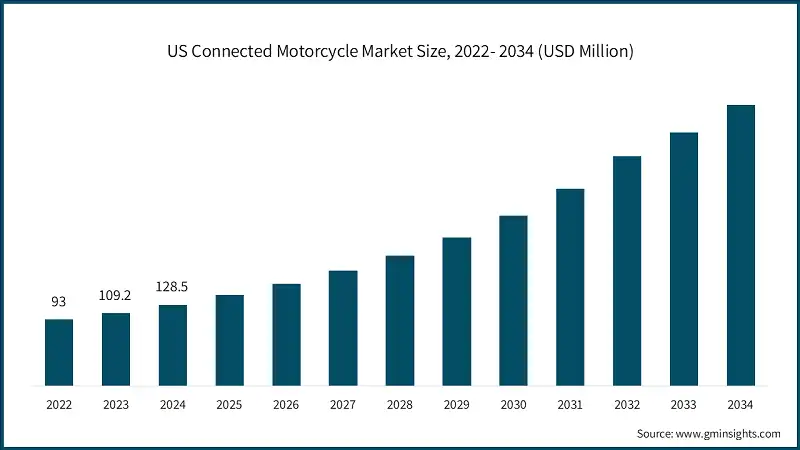
The US dominates the connected motorcycle market in North America with a market share of 87.4% in 2024 and is growing at a CAGR of 23.2% from 2025 to 2034. US is dominant since Harley-Davidson, BMW Motorrad, Robert Bosch, and Continental have strong operations in the US, facilitating R&D, distribution, and integration of connected solutions.
- Electric motorcycles are on the rise in the US, and with electric motorcycles like the Can-Am Pulse and Origin equipped with more advanced connectivity capabilities. The electric models are designed to work seamlessly with mobile apps and navigation systems and provide real-time diagnostics to satisfy environmentally conscious consumers looking for current connectivity for the ride.
- Consumers in the US are asking for motorcycles (ICE and electric) that come equipped with smart features like over-the-air updates, ride analytics, and integration with their mobile devices. This demand is pushing OEMs to innovate and deliver motorcycles with user experiences based on an advanced constellation of connectivity.
- Major OEM like BMW, Honda, and Harley-Davidson are installing sophisticated safety technologies into their motorcycles. Features like radar-based adaptive cruise control, blind-spot detection, and crash notifications are becoming standard on motorcycles, increasing rider safety and fueling the introduction of connected motorcycles in the US.
North America held connected motorcycle market share around 17.9% share in 2024 and generated USD 158.4 million in revenue. Riders and OEM in North America quickly embrace telematics, ARAS, GPS/GNSS, and OTA updates, driving widespread adoption of connected motorcycles.
- In North America, there has been an increasing trend to introduce ARAS (Advanced Rider Assistance Systems) such as collision avoidance, blind spot monitoring, and adaptive cruise control on connected motorcycles. These ARAS take advantage of high-bandwidth connectivity and GNSS/GPS to increase safety, reduce fatalities, and incentives by regulators and insurance companies to assist in safety features.
- Motorcycles are beginning to use over-the-air updates to enhance post-purchase performance, navigation, and safety features. In conjunction with telematics platforms, these services deliver real time diagnostics and predictive maintenance options together with individual ride analytics, all of which help OEM, and tech partners deliver a recurring revenue model with connected features.
- In North America there is an emphasis on safety features, navigation, and infotainment as riders make purchase decisions. Connected motorcycles that offer ARAS features, GPS/GNSS, smartphone integration, and real time diagnostics offer the safety and service buyers expect and enables the purchase of mid- and premium motorcycles with ported connectivity or embedded connectivity solutions.
- In Canada, BRP unveiled the 2025 Can-Am Pulse and Origin electric motorcycles, demonstrating Can-Am's return to the form factor. These models have 10.25-inch touchscreens, mobile connectivity and Rotax E-Power motors as standard features, offering rider connectivity, navigation and sustainable performance for the urban and adventure riding experience.
The connected motorcycle market in Europe is expected to experience significant and promising growth from 2025 to 2034 at a CAGR of 18.9%.
- Motorcycles are adopting AI and machine learning to deliver adaptive in-vehicle experiences and predictive maintenance notifications. By anticipating delegate needs and providing safety improvements through real-time information, these technologies improve the rider’s experience.
- Electric motorcycles in Europe are becoming more established, while models provide advanced connectivity features such as large touchscreen displays and mobile apps. For environmentally conscious riders who want good connectivity, these electric models offer all the best integration with smart devices.
- Regulations in Europe are increasingly requiring advanced safety features and encouraging sustainable transportation methods. This regulatory environment is more optimistic for manufacturers to include connectivity solutions; Adaptive Rider Assistance Systems (ARAS) are just one of the ways for manufacturers to meet safety standards and reduce their carbon footprint.
- In September 2025, Honda will offer a full-size electric motorcycle based on the EV FUN concept. This motorcycle will include CCS2 fast charging and highway capable performance, include advances in connectivity and position Honda to create more high-performance, connected electric motorcycles. The initial test rides offered by Honda in Europe indicate that motorcycles are highway oriented and there exist opportunities that Honda can enhance its competency in terms of electric transport.
The connected motorcycle market in Germany held a market share of 27.9% in 2024; and is expected to experience significant and promising growth from 2025 to 2034.
- In Germany, efforts to reduce carbon emissions and reduce fossil fuels has led to the implementation of policies encouraging the use of electric vehicles, including electric motorcycles. Electric motorcycles and electric motorcycles are also getting subsidies by the German government. These subsidies and policies are indirectly helping motorcycle manufacturers produce new connected smart and sustainable motorcycles with V2X types of technologies, ultimately helping to increase the uptake of smart and sustainable two-wheeled transportation throughout Germany.
- Motorcycle manufacturers are using artificial intelligence (AI) and machine learning (ML) in the motorcycles they manufacture to improve rider safety and personalize the rider experience. When these types of technologies are developed, the motorcycle can have capabilities such as predictive maintenance, adaptive cruise control, and hazard detection, which improve the overall comfort of riding and make riding a safer activity.
- Vehicle-to-Everything (V2X) communication is also becoming more popular in Germany for motorcycles, which lets motorcycles communicate with infrastructure and other vehicles. These types of infrastructures can help create better situational awareness with capabilities like collision avoidance and optimal routing, which can make riding safer and cities more mobile.
- BMW introduced the Motorrad Vision CE at IAA Mobility 2025 in Munich, a self-balancing electric scooter that is designed for urban mobility. It has a roll cage and seatbelt system that allows riders to not wear helmets. The scooter has a 75 mph top speed and a range of 80 miles. There are also multiple configurations that fit different lifestyles.
The connected motorcycle market in Asia Pacific is expected to experience strong growth from 2025 to 2034 and held a share of 41.9% in 2024.
- There is rapid growth of electric motorcycle use across the Asia-Pacific region, and this growth is expected to continue driven by environmental policies that encourage electric vehicles as well as incentives for the user to purchase. Many electric motorcycle manufacturers leave little to be desired when it comes to technology in connected vehicles. Many electric motorcycles are now equipped with advanced connectivity features such as GPS navigation, mobile app capability, and real-time diagnostic capabilities that make riding throughout the city much better and efficient.
- Moreover, motorcycle manufacturers in the Asia-Pacific region are using advanced AI and machine learning capabilities to create connected vehicles that improve safety and performance. We are clearly witnessing the rapid acceptance of predictive maintenance, adaptive cruise control, and real-time hazard detection which are becoming the standard in connected motorcycles that will ultimately result in improved rider safety and convenience.
- Further, continued rapid urbanization of countries like India, China, and Indonesia has increased demand for efficient, inexpensive transportation options. Therefore, motorcycles have provided an answer to, and a way to avoid congestion and limited parking, and therefore motorcycles are the preferred form for urban mobility.
- Governments across the Asia-Pacific region are introducing policies that support electric vehicles and connected technology. Examples of these policies would be subsidies for individuals who own and purchase electric motorcycles, and regulations that encourage manufactures to incorporate connectivity solutions into their respective vehicles.
- In December 2024, Yamaha launched the Y/AI, a motorcycle powered by artificial intelligence that took inspiration from the sci-fi anime series called "Tokyo Override." Built around the key elements of AI and connected vehicles, this motorcycle concept comes with spokeless, semi-transparent wheels that glow in the dark. It is minimalist and provides an exciting look at one potential future of connected and intelligent motorcycles.
The connected motorcycle market in China is expected to experience robust growth from 2025 to 2034 and held a share of 38.4% in 2024. China’s dense population and rapid urbanization drive high demand for efficient personal transportation, making motorcycles, especially connected and electric ones, highly attractive for commuting and delivery services.
- The electric motorcycle industry in China is on the rise due to government policies that encourage clean energy and sustainable transportation. The growth of this market is leading to higher uptake of electric motorcycles that also have advanced connectivity features, which enrich the riding experience.
- The Chinese motorcycle manufacturers of electric motors are incorporating artificial intelligence technology in their motorcycles to bring about safety and maximum performance. Enhanced features such as predictive maintenance, adaptive cruise control, and real-time hazard detection using LIDAR sensors are now standard features in connected motorcycles, thus enhancing convenience and safety.
- The government of China subsidizes the production of electric vehicles such as motorcycles and supports the production of electric motorcycles with sophisticated connectivity capabilities that are consistent with the national initiative to lower carbon emission and to support sustainable transportation.
- Honda has begun to enter the electric motorcycle market with a joint venture in China, Wuyang-Honda, which launched Honda’s first full-size electric motorcycle, named the E-VO, in July 2025. The motorcycle has been developed as a retro theme in the Chinese market, and it offers battery change technology and intelligent connectivity which incorporates smart application integration and updates through the Over the Air (OTA) technology.
The connected motorcycle market in Latin America is expected to experience significant and promising growth from 2025 to 2034 with a CAGR of 14.7%. China’s dense population and rapid urbanization drive high demand for efficient personal transportation, making motorcycles, especially connected and electric ones, highly attractive for commuting and delivery services.
- The uptake of electric motorcycles in Latin America is growing, fueled by environmental worries and state enticements. Electric motorcycles are generally equipped with connectivity features such as GPS sometimes working with a mobile app and provide real time diagnostics and updates to improve individual riding experiences and promoting sustainability.
- Latin American motorcycle producers are working with artificial intelligence with an aim to support improved safeness and safety performance from motorcycles. Functionalities such as predictive maintenance, adaptive cruise control and real time hazards are being developed into connected motorcycles now to ensure measured, safe, convenient riding experiences for motorcycle riders.
- The governments of some Latin American nations are introducing government incentives to drive adoption of electric vehicles, including motorcycles. Some incentives include government subsidies and tax offsets. This encourages manufacturers to produce electric motorcycles as high end connected motorcycles, while aiding these individual nations push to subdue their carbon indulge and advance sustainable mobility.
- Latin America urbanization and congestion levels have been taxing in decades gone, and for personal transportation, pick-up motorcycles are an appealing option. Connected motorcycles supply the rider with features; real time navigation, and fleet management, conveniences that would assist individuals living within congested cities when riding a motorcycle as an alternative to traditional combustion-based vehicles.
- In August 2025, Ituran, an international leader in connected vehicle services, announced collaborations with Yamaha and BMW Motorrad to expand its connected motorcycle services throughout Brazil. With this partnership we want to enhance rider safety and convenience by offering advanced telematics and real-time tracking features.
The connected motorcycle market in MEA is expected to experience significant and promising growth from 2025 to 2034. The region is expected to grow at a CAGR of 21.1% in the forecast period.
- Motorcycle manufacturers in the Middle East and Africa are also adding artificial intelligence capabilities to their motorcycles to improve overall safety for consumers and enhance performance. Features such as predictive maintenance, adaptive cruise control and real-time hazard detection are likely to become standard in connected motorcycles and will improve rider convenience and safety.
- The overall adoption of electric motorcycles across the Middle East and Africa is increasing through consumer needs for sustainability and the environmental issues associated with a reliance on fossil fuels. The existing electric motorcycles often come integrated with advanced connectivity features like GPS navigation, mobile app integration, and real-time diagnostics which give consumers an improved riding experience and attachment to sustainability.
- Government action is growing to support/promote electric vehicles including motorcycles in the Middle East and Africa. Promoting/encouraging manufacturers to implement advanced connectivity features on electric motorcycles supports and aligns government policies to decrease carbon emissions and encourage sustainability and environmentalism.
Connected Motorcycle Market Share
- The top 7 companies in the connected motorcycle industry are Robert Bosch, Continental, Yamaha, Kawasaki, KTM, Piaggio, Honda, contributing around 29.2% of the market in 2024.
- Robert Bosch is a worldwide leader in automotive electronics and IoT solutions and is a global provider of advanced sensors, telematics and connectivity systems for motorcycles. They stand out as a partner given their expertise in safety and navigation combined with intelligent mobility, as well as their ability to couple connectivity technologies. In this sense, Bosch is a global supplier to OEM and thus they account for a larger share of the connected vehicle market.
- Continental is a firm dealing with automotive electronics, components, tires, and vehicle networking systems. They enable the OEM to improve their motorcycle connectivity, safety and efficiency through their concentration on V2X communications, safety sensors and telematics. Continental has competitive technological capabilities and market demographics that position them as a significant shareholder in the connected motorcycle consumer market.
- Yamaha produces motorcycles that have integrated connectivity features such as mobile app integration, GPS navigation, and telematics. Yamaha has demonstrated these connectivity features in innovative products with strong global distribution, leading to significant penetration and adoption. Yamaha's R&D efforts aimed at developing increasingly connected technologies will help maintain their industry leadership position in the market.
- Kawasaki is increasingly leveraging advanced electronics and telematics systems to integrate smart connectivity-type features into their motorcycles including performance monitoring, navigation, and ride analytics features. Kawasaki ties connectivity features with performance features that allow for enhanced enhancements in higher-end premium motorcycles with smart technologies in the market.
Connected Motorcycle Market Companies
Major players operating in the connected motorcycle industry are:
- BMW Motorrad
- Continental
- Ducati
- Harley-Davidson
- Honda
- Kawasaki
- KTM
- Piaggio
- Robert Bosch
- Yamaha
- Robert Bosch is a worldwide market leader in the motorcycles automotive electronics and connectivity sector and provides a full portfolio of motorcycles. Bosch products have sophisticated sensors, telematics units and live diagnostics, predictive maintenance and vehicle-to-everyone (V2X) connection modules. Bosch Advanced Rider Assistance Systems (ARAS) increase the safety level by alerting the riders of the approaching crashes, offering adaptive braking, and stability control to make a smarter and safer motorcycle.
- Continental is another leading player in automotive electronics and vehicle networking systems for motorcycles but has a focus area on both safety and connectivity. Continental includes Telematics Control Units (TCUs) for motorcycles that allow for GPS tracking, telematics/remote diagnostics, and mobile applications for capturing data. Continental's V2X communication systems enable motorcycles to communicate with other vehicles and infrastructure, enhancing safety and reducing accidents, while also improving traffic management.
- Yamaha integrates advanced connectivity into their motorcycles to keep their riders engaged. Their Yamaha Connect platform allows seamless integration between the motorcycle and a smartphone, allowing riders to use GPS navigation, ride tracking, and media control. Yamaha motorcycles also embrace ride data logging and ride performance monitoring to provide riders with valuable diagnostic information about their ride.
- Kawasaki emphasizes smart and connected motorcycles that maximize performance, user experience, and rider safety. Their Rideology App connects your smartphone to your motorcycle to help guide you with navigation, communicate while riding in a group, and provide alerts. Kawasaki motorcycles come equipped with GPS tracking, telemetry, and ride analysis, allowing riders to see performance metrics in real time. Integrated communication systems help to keep group rides safer, as well as raising situational awareness.
Connected Motorcycle Industry News
- In March 2025, Continental started working on hardware and software for a complete platform for motorcycle connectivity. Continental's Connected Infotainment Box provides features such as turn-by-turn navigation, stolen vehicle tracking, and several more features, all without a mobile phone connection, allowing for enhanced safety and smart mobility while riding.
- In April 2025, Kawasaki introduced "Corleo", a robotic horse powered by hydrogen to be used for transport through all environments. It should be noted that although Corleo is not a motorcycle, the design capitalizes on Kawasaki's legacy in mobility as well as robotics, using AI for maintaining balance and for overcoming obstacles on the terrain, with a hydrogen engine that produces only water.
- In July 2025, KTM has resumed full production operations in Austria, representing an incredible achievement after the difficult start to the season. Riding the excitement of KTM’s 2026 off-road launch, the company emphasized maintaining quality and global availability.
- In December 2024, Yamaha debuted the Y/AI, a concept motorcycle that utilizes AI and is also inspired by Netflix’s “Tokyo Override.” This motorcycle displays an even more futuristic look with glow-in-the-dark wheels, as well as a more minimalist essence, demonstrating Yamaha's forward-thinking for AI-platform transportation in the future.
- Robert Bosch has announced a 10.25-inch TFT display in conjunction with its mySPIN Smartphone solution to offer connected services for motorcycle riders. The rider will be able to access their music, contacts, and navigation directly from the display of the motorcycle, a feature that promises to enhance safety and rider convenience.
The connected motorcycle market research report includes in-depth coverage of the industry with estimates & forecasts in terms of revenue ($ Mn/Bn, units) from 2021 to 2034, for the following segments:
Market, By Component
- Hardware
- TCU
- Display
- Sensors
- Others
- Software
- Services
- Professional service
- Managed services
Market, By Connectivity
- Embedded
- Tethered
- Aftermarket
Market, By Propulsion
- ICE
- Electric
- PHEV
- HEV
- FCEV
- BEV
Market, By Network
- Cellular
- Short range
- Others
Market, By End use
- Private
- Commercial
The above information is provided for the following regions and countries:
- North America
- US
- Canada
- Europe
- Germany
- UK
- France
- Italy
- Spain
- Nordics
- Netherlands
- Russia
- Asia Pacific
- Australia
- China
- India
- Indonesia
- Japan
- Singapore
- South Korea
- Thailand
- Vietnam
- Latin America
- Brazil
- Mexico
- Argentina
- MEA
- South Africa
- Saudi Arabia
- UAE
Frequently Asked Question(FAQ) :
Who are the key players in the connected motorcycle industry?
Major players include BMW Motorrad, Continental, Ducati, Harley-Davidson, Honda, Kawasaki, KTM, Piaggio, Robert Bosch, and Yamaha.
Which region leads the connected motorcycle sector?
The United States dominates the market in North America, holding an 87.4% share in 2024 and is likely to showcase around 23.2% CAGR through 2034.
What are the upcoming trends in the connected motorcycle market?
Key trends include electric two-wheelers with connectivity, V2X communication, GPS tracking, and telematics for fleet optimization and predictive maintenance.
What is the growth outlook for the ICE segment from 2025 to 2034?
The ICE segment, which accounted for 73.4% of the market in 2024, due to its availability across various price categories, enabling OEMs to introduce connectivity at different affordability levels.
What was the market share of the embedded segment in 2024?
The embedded segment held a 53% market share in 2024 and is set to expand at a CAGR of 22.6% till 2034.
How much revenue did the hardware segment generate in 2024?
The hardware segment accounted for approximately 64.8% of the market in 2024 and is expected to witness over 20.7% CAGR through 2034.
What is the projected value of the connected motorcycle market by 2034?
The market is poised to reach USD 2.57 billion by 2034, driven by advancements in V2X communication, GPS integration, and the growing adoption of smart city infrastructure.
What is the expected size of the connected motorcycle market in 2025?
The market size is projected to reach USD 451.1 million in 2025.
What was the market size of the connected motorcycle in 2024?
The market size was valued at USD 378.2 million in 2024, with a CAGR of 21.3% expected through 2034. Increasing adoption of connected technologies, enhanced rider safety, and demand for embedded connectivity solutions are driving market growth.
Connected Motorcycle Market Scope
Related Reports