Summary
Table of Content

Conductive Plastics for Automotive Electronics Market
Get a free sample of this report
Form submitted successfully!
Error submitting form. Please try again.
Thank you!
Your inquiry has been received. Our team will reach out to you with the required details via email. To ensure that you don't miss their response, kindly remember to check your spam folder as well!
Request Sectional Data
Thank you!
Your inquiry has been received. Our team will reach out to you with the required details via email. To ensure that you don't miss their response, kindly remember to check your spam folder as well!
Form submitted successfully!
Error submitting form. Please try again.
Conductive Plastics for Automotive Electronics Market Size
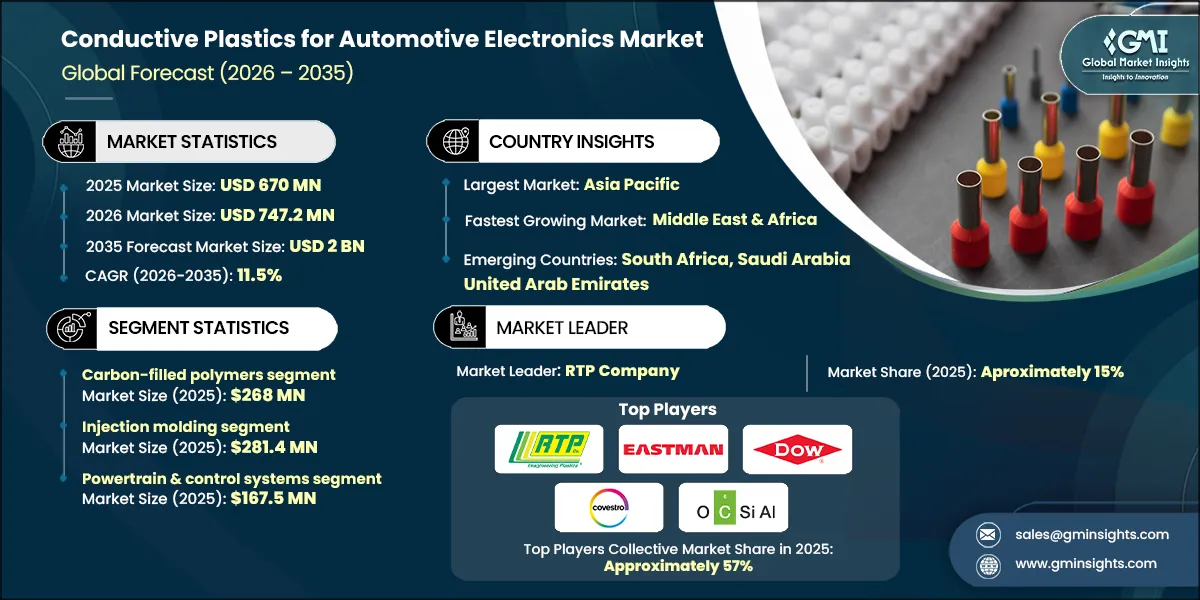
The global conductive plastics for automotive electronics market was estimated at USD 670 million in 2025. It is expected to grow from USD 747.2 million in 2026 to USD 2 billion by 2035, at a CAGR of 11.5%, according to latest report published by Global Market Insights Inc.
Conductive Plastics for Automotive Electronics Market Key Takeaways
Market Size & Growth
- 2025 Market Size: USD 670 Million
- 2026 Market Size: USD 747.2 Million
- 2035 Forecast Market Size: USD 2 Billion
- CAGR (2026–2035): 11.5%
Regional Dominance
- Largest Market: Asia Pacific
- Fastest Growing Region: Middle East & Africa
Key Market Drivers
- Rising Adoption of Lightweight Materials in Automotive Electronics.
- Increasing Demand for EMI/RFI Shielding Components.
- Technological Advancements in Conductive Additives.
Challenges
- Limited Thermal Conductivity.
- Complex and Costly Processing.
Opportunity
- Expansion of EV & Smart Electronics Applications.
- Advancements in High‑Performance Conductive Fillers.
Key Players
- Market Leader: RTP Company led with over market share aproximately 15% in 2025.
- Leading Players: Top 5 players in this market include RTP Company, Eastman Chemical Company, DOW, Covestro AG, OCSiAl, which collectively held a market share of 57% in 2025.
Get Market Insights & Growth Opportunities
- The Conductive Plastics for Automotive Electronics market is growing steadily with the rate of automotive manufacturers taking a rapid move to use lightweight materials to enable them in achieving vehicle efficiency, electrification, and design flexibility. Conductive plastics can be used to substitute traditional metal parts in electronic housings, connectors and structural parts and these plastics make the system have lower weight thus still performing the same functionality. This change is in line with the focus of OEM to maximize energy efficiency, enhanced thermal behavior, and easier integration of components into more complicated electronic architectures. With the vehicle platforms increasingly becoming more electrified and modular, the desire to keep the weight of their vehicles small and functional in a multifunctional manner, lightweight materials carry on aiding in the growth of the market.
- The increasing use of electronic components like ADAS, infotainment, power electronics and connectivity modules has further increased the pressure on the necessity of high quality EMI/RFI shielding systems in car models. Conductive plastics are now finding application in shielding delicate electronic parts against electromagnetic interference and to allow compact and integrated designs. Their capability to realize shielding effectiveness, design freedom and manufacturability makes them very useful in automotive electronics today. The use of conductive plastic-based shielding solutions is rapidly advancing across various subsystems of a vehicle as the signal integrity requirement grows with the increasing electronic content per vehicle and as shielding solutions.
- The development of conductive additives is contributing to the trend of using conductive plastics as it is increasing the electrical performance, processability, and applicability of conductive plastics. Carbon-based and hybrid conductive fillers can be innovated to enable manufacturers to attain desired conductivity with reduced material loadings that can be used in lightweighting and cost optimization. Their enhancements allow the creation of application specific compounds that meet the challenging automotive electronic applications. Additive technologies are increasingly broadening the performance capabilities of conductive plastics, as they grow older and become part of the specifications of the next-generation automotive electronic systems.
To get key market trends
Conductive Plastics for Automotive Electronics Market Trends
- Automobile electronics Conductive Plastics market is seeing a gradual growth in the number of customers due to the desire to make vehicle architecture more electronics-intensive. The automakers are also incorporating additional units of electronic control, sense, and connection, and it is demanding materials that have the capacity to be both electrical and lightweight as well as have the flexibility of design. Conductive plastics respond to these needs through providing the ability to integrate components and simplify part complexity and assembly process, which helps in scalable manufacturing.
- The trends in electrification of passenger and commercial vehicles are increasing expediency to utilize conductive plastics in battery systems, power electronics and charging interfaces. These materials allow effective thermal management and electrical operation and compact and modular design. They can be easily adopted in electrified platforms due to their suitability with high-volume automotive processing methods.
- Strict government control in regard to safety, electromagnetic compatibility, and functional reliability of vehicles is strengthening the requirements of conductive plastics in shielding and protective work. With increase in frequency of operation of electronic systems, conductive materials used by manufacturers are becoming more and more important as they guarantee stability of signals and reduce interference as much as possible. This leads to the choice of materials to engineered conductive polymers which are in line with strict automotive requirements.
Conductive Plastics for Automotive Electronics Market Analysis
Learn more about the key segments shaping this market
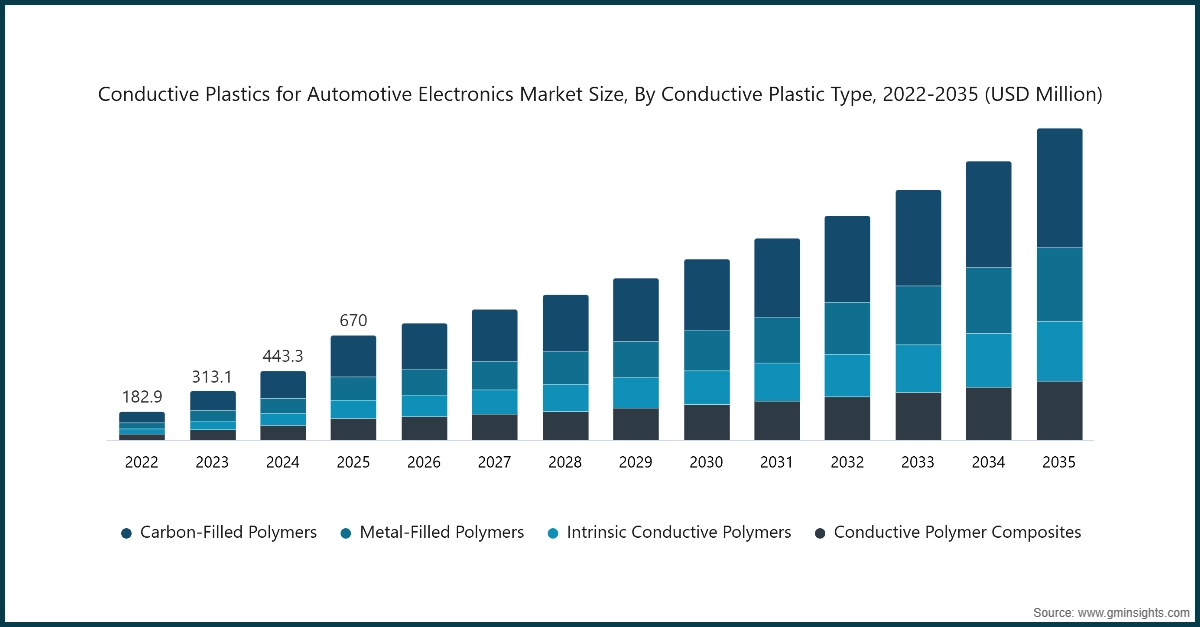
Based on conductive plastic type, the market is segmented into carbon-filled polymers, metal-filled polymers, intrinsic conductive polymers, and conductive polymer composites. carbon-filled polymers holds a significant share at a valuation of USD 268 million in 2025.
- The conductive plastic subdivisions are based on different performance, cost, and use compromises across the automotive electronics. Carbon based polymers have been applied because of their balanced conductivity, low weight and low cost, which are favorable in EMI shielding, ESD shielding, and sensor cases. Metal-filled polymers have increased electrical conductivity and thermal performance, which can be used in applications that need high signal integrity and heat dissipation, especially in high-load wire and power electronics. Intrinsic conductive polymers are used to fill niche needs in which flexibility, adjustable conductivity, and corrosion resistance are important, particularly in future electronic interfaces.
- Conductive polymer composites are on the rise because they can be easily used to combine the mechanical strengths of base polymers with better electrical conductivity with new-fangled fillers like carbon nanotubes or graphene. These materials allow optimum functionality with reduced filler loadings, lightweighting as well as enhanced processability of complex automotive electronic components. In all the segments, the choice of material is rapidly dependent on design flexibility, regulatory compliance, and the ability to meet high-volume production requirements and consequently, ongoing formulation innovation and tailoring.
Based on manufacturing process, the conductive plastics for automotive electronics market is segmented into between injection molding, extrusion, coating & surface treatment, additive manufacturing (3d printing), and compounding & masterbatch production. Injection molding hold a significant share at a valuation of USD 281.4 million in 2025.
- Manufacturing process underlines the diversity in the approaches to production that are used to address performance and scalability requirements in automotive electronics. The use of injection molding and extrusion is still very popular because of its applicability in terms of high-volume manufacturing of complex and continuous products and components with great dimensional accuracy and affordability. Masterbatch and compounding production is important to guarantee consistent dispersion of electrical-conductive fillers so that the electrical performance and stability of the processes can be consistent throughout downstream production.
- Surface treatment and coating are being utilized to increase conductivity, EMI shielding and surface functionality without affecting core material properties to facilitate lightweight and design flexible solutions. Additive manufacturing (3D printing) starts to become an additive technique to allow rapid prototyping and low volumes of production of customized conductive parts, especially when it comes to high-end electronic housing and integrated designs. These processes together promote material innovation, production flexibility and performance optimization in automotive electronic applications.
Learn more about the key segments shaping this market
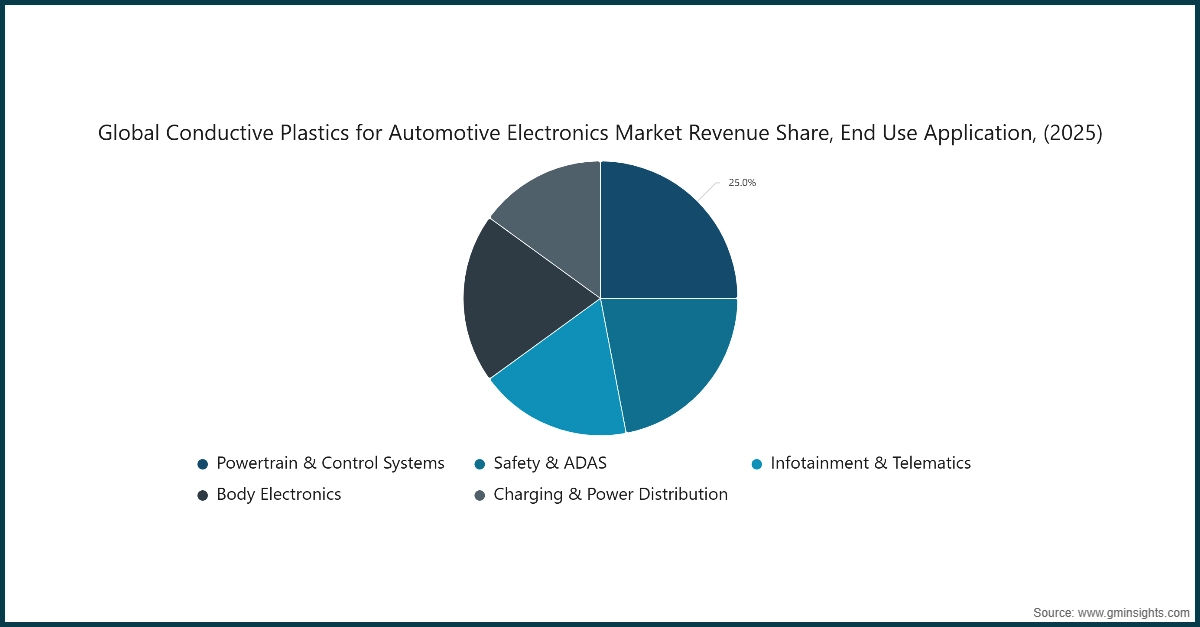
Based on end use application, the conductive plastics for automotive electronics market is segmented into powertrain & control systems, safety & ADAS, infotainment & telematics, body electronics, and charging & power distribution. powertrain & control systems is estimated to grasp a value of USD 167.5 million in 2025 and is expected to grow at 12.1% of CAGR during the forecast period.
- The analysis provided on the segmentation of the end-use application indicates the growing use of the conductive plastics in various systems in the automotive industry. Sensors, conductors, and control modules of the powertrain and control systems are made using conductive materials, which must perform reliably in terms of electrical performance over thermal and mechanical load conditions. Conductive plastics are also becoming widespread in the safety and ADAS systems housings and electronic enclosures to aid EMI shielding and signal stability which are imperative to the more advanced features of sensing and driver-assistance systems.
- The demand of infotainment and telematics system drives lightweight, design flexible conductive components with designs capable of providing connectivity, data transmission and electromagnetic compatibility. Conductive plastics are used in body electronics by being incorporated in lighting systems, switches, and comfort modules which helps in facilitating slim designs and enhancing durability. In the meantime, the charging and power distribution applications are on the rise as the electrification progresses, and conductive, and insulative plastics are the materials that aid thermal management, insulation-conductivity ratio, and space utilization of charging interfaces and power distribution modules.
Looking for region specific data?
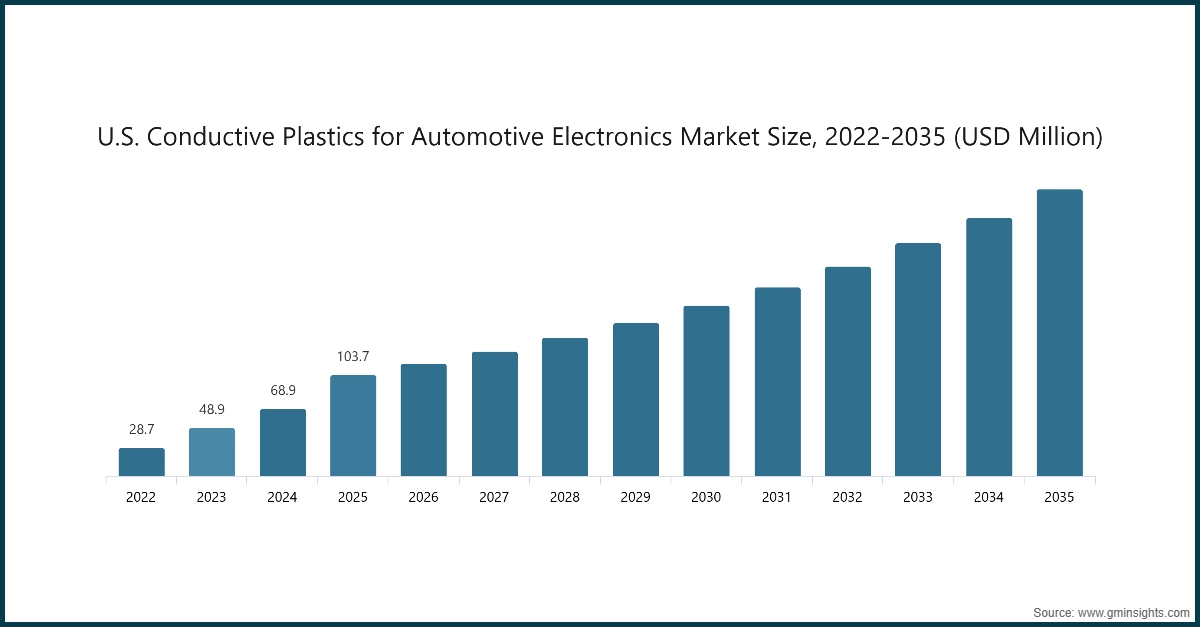
North America conductive plastics for automotive electronics market accounted for USD 120.9 million in 2025 and is anticipated to show lucrative growth over the forecast period.
- The conductive plastics market is witnessing a stable growth in the North America region, due to strong adoption in the automotive electronics markets, advanced manufacturing systems, and EV manufacturing industries. The greatest percentage of regional demand lies in the United States because the country has the most developed automotive supply chain and made significant investments in lightweight and high-performance materials that improve EMI shielding and electrical safety of the vehicle subsystems.
- Canada and Mexico also have a significant role to play on the basis of emerging electronics assembly and automotive parts manufacturing. The presence of regulatory support of sustainable materials and federal incentives on electrified mobility also leads to improved uptake in the region, and is supported by advances in the field of materials science and conduction plastics integration into automotive electronic modules and battery systems.
Europe conductive plastics for automotive electronics market accounted for USD 174.9 million in 2025 and is anticipated to show lucrative growth over the forecast period.
- The conductive plastics market is growing very fast in Europe with automotive manufacturers and electronics companies utilizing the highly developed polymer compounds in the production of their EMI shielding, sensor coverings, and connectors. The major share of the regional consumption is comprised of such countries as Germany, France, and the United Kingdom, which use their developed automotive and materials technology markets that focus on precision engineering and regulatory standards.
- The high-performance and recyclable materials are encouraged through the stringent environmental standards, the automation of industries, and renewable energy sources which support development by introducing conductive plastics in intelligent systems. The regional momentum is also gaining momentum with the emerging markets in Eastern Europe where materials technology is being embraced on a large scale.
Asia Pacific conductive plastics for automotive electronics market accounted for USD 308.2 million in 2025 and is anticipated to show lucrative growth over the forecast period.
- Asia Pacific continues to be a promising market of conductive plastics due to its large electronic manufacturing hubs and fast growing automotive industries. Some of the key contributors are China, Japan, India, and South Korea with China, the biggest due to its huge electronic assembly base, EV batteries, and integrated supply chains. The material adoption is further accelerated by the government efforts towards smart mobility and industrial modernization. The high export orientation and low cost competitiveness production environment in the region enhances its position as a major global consumer and supplier of conductive polymer solutions with a growing penetration into the automotive electronics, consumer device and industrial sectors.
Latin America conductive plastics for automotive electronics market accounted for 11.9% industry share in 2025 and is anticipated to show steady growth over the forecast period.
- In Latin America, the growth in demand of conductive plastics is constant due to the growing automotive manufacturing industries and emerging electronics industries in some countries such as Brazil and Mexico. The infrastructure development and the increase in industrialization support adoption because they increase the consumption of conductive compound in the harnessing of wires, connectors, and electronic assemblies. Following the fact that the share is still lower compared to that of the North America and the Asia Pacific, there is a clear indication of growth in the future as more investments are made in local production capacity and the wider use of advanced materials in auto parts as the regional supply chains mature.
Middle East and Africa conductive plastics for automotive electronics market accounted for 12.8% industry share in 2025 and is anticipated to show steady growth over the forecast period.
- The region of Middle East and Africa is slowly developing the conductive plastics market based on investment in industrial electrification, energy infrastructure and niche electronics production. Other countries like UAE and Saudi Arabia as well as South Africa are leading the way in adoption especially on conductive materials applicable in protective housings, antistatic components and industrial systems. The demand is still driven by urbanization and diversification of manufacturing outside oil and gas to automotive and infrastructure development, but the overall contribution of the region to the global figure is still relatively small.
Conductive Plastics for Automotive Electronics Market Share
The Conductive Plastics for Automotive Electronics market in 2025 is moderately consolidated and the five leading players will command an estimated 57 percent of the worldwide market share. Established material science and specialty compounders like Dow, Covestro AG, RTP Company, Eastman Chemical Company, and OCSiAl are able to have market leadership through their wide portfolio of products, strong OEM relations, and global manufacturing operations. Those companies enjoy scale effect, vertically integrated supply chain, and established ability to provide high-performance conductive solutions to EMI shielding, ESD protection, sensors, connectors, and EV electronics, which allows them to maintain a leading competitive position.
As a competitive strategy, major players are emphasizing on continuous investment in research and development in order to come up with better conductive formulations that are better in electrical performance, thermal performance and lightweight properties. Nanomaterials like carbon nanotubes and graphene are being increasingly used to enable companies to have high conductivity with low filler loadings to enhance processability and cost-effectiveness. Simultaneously, companies are advancing partnerships with automotive OEMs and Tier-1 vendors, regionalizing production capabilities, and concentrating on application-specific, customized compounds to fulfill the changing demands in electrification, autonomous systems, and regulation needs.
Conductive Plastics for Automotive Electronics Market Companies
Major players operating in conductive plastics for automotive electronics industry are:
- RTP Company
- Eastman Chemical Company
- SIMONA AG
- Nanocyl SA
- OCSiAl
- DOW
- Covestro AG
- Heraeus Materials Technology
- Agfa‑Gevaert NV
RTP Company is a privately owned worldwide custom compounder of engineered thermoplastics, conductive and antistatic compounds, in automotive electronics, sensors, EMI shielding, ESD protection, thermal management applications, etc. The product lines covered by the firm include PermaStat 2, ESD-C, and EMI products and they incorporate carbon based fillers, fibers, and nanotubes to achieve precision in the electrical performance. It facilitates custom development and fast development prototyping to address end-use performance specifications. RTP has also recently increased its conductive product range through acquisition of Clariant conductive business, increasing its global presence and product range.
Eastman Chemical Company is a major specialty material manufacturer in America that has a wide range of polymers, additives and advanced plastics. Its antistatic materials and conductive plastics are designed to combine both electrical and mechanical strengths, including automotive electronics, enclosures, and EMI shielding applications. To innovate its conductive solutions, Eastman uses polymer chemistry to tailor and manufactures products and develops scalable production and innovation partnerships. The operations of the company are global covering chemicals, fibers, and plastics manufacturing with high performance and sustainability.
Dow Inc. (Dow Chemical Company) is one of the leading materials science corporations in the United States that manufactures various types of chemicals, performance plastics, silicones, and conductive materials. Its conductive products are available in the form of thermally and electrically conductive polymers, silicones as well as additives that provide reliability and EMI/ thermal control in electronics and automotive systems. The resources of Dow are used to facilitate lightweighting, strength, and flexibility of processing more complex automotive electronic components. Innovation in conductive and specialty polymer solutions is maintained by the company due to its global size and research and development investments.
Covestro AG is a chemical and high-technology materials company of Germany who are spin-off of Bayer MaterialScience and deal with polyurethane and polycarbonate as raw materials. Although it is not entirely in the conductive plastics market, engineering polymers and high-performance materials of Covestro are utilized as base resins and additives in applications that need customized electrical and mechanical characteristics. Its products are used in the automotive, electronics, and industrial divisions, and it helps in the flexibility of designs and lightweighting of electrified vehicles. Covestro operates on a global supply network with a high presence in high-end material solutions.
OCSiAl Group is a Luxembourg nanotechnology firm and the largest manufacturer of single-walled carbon nanotubes (SWCNTs) in the world branded TUBALL™. These graphene nanotube additives are dramatic in terms of electrical conductivity at very low loadings, and are used in thermoplastics, elastomers, and composites in automotive electronics, EMI shielding, and lightweight conductive components. The industrial-level roll-out SWCNT production and nanotube concentrates by OCSiAl are facilitates performance changes (conductivity, strength, thermal stability) in the polymers in vehicles and electronic systems.
Conductive Plastics for Automotive Electronics Market Report Attributes
| Key Takeaway | Details |
|---|---|
| Market Size & Growth | |
| Base Year | 2025 |
| Market Size in 2025 | USD 670 Million |
| Market Size in 2026 | USD 747.2 Million |
| Forecast Period 2026-2035 CAGR | 11.5% |
| Market Size in 2035 | USD 2 Billion |
| Key Market Trends | |
| Drivers | Impact |
| Rising Adoption of Lightweight Materials in Automotive Electronics | Drives OEM demand for conductive plastics as they enable lighter, more energy-efficient electronic systems that support modern vehicle performance goals. |
| Increasing Demand for EMI/RFI Shielding Components | Boosts market uptake as conductive plastics replace metal shielding with cost-effective, lightweight solutions for increasingly complex automotive electronics. |
| Technological Advancements in Conductive Additives | Accelerates market penetration by enabling higher-performance materials that expand conductive plastics into more demanding automotive electronics applications |
| Pitfalls & Challenges | Impact |
| Limited Thermal Conductivity | Restricts growth by limiting the use of conductive plastics in high-heat automotive electronic environments, slowing substitution of metal components. |
| Complex and Costly Processing | Increases manufacturing overhead due to precise molding requirements, reducing cost competitiveness compared to traditional materials. |
| Opportunities: | Impact |
| Expansion of EV & Smart Electronics Applications | Creates strong revenue upside as rising EV and sensor adoption amplifies the need for lightweight, conductive materials across next‑gen automotive electronics. |
| Advancements in High‑Performance Conductive Fillers | Unlocks new premium application segments where improved conductivity and thermal stability allow conductive plastics to replace metals |
| Market Leaders (2025) | |
| Market Leader |
Market Share Aproximately 15% |
| Top Players |
Collective Market Share Approximately 57% |
| Competitive Edge |
|
| Regional Insights | |
| Largest Market | Asia Pacific |
| Fastest growing market | Middle East & Africa |
| Emerging countries | South Africa, Saudi Arabia, United Arab Emirates |
| Future outlook |
|
| Companies covered: | 9 |
| Tables, Charts & Figures: | 150 |
| Countries covered: | 18 |
| No of Pages: | 210 |
What are the growth opportunities in this market?
Conductive Plastics for Automotive Electronics Market News
- In February 2022, Celanese Corporation signed a definitive contract to purchase Mobility and Materials business unit of DuPont. This acquisition will enable Celanese to acquire a wide product base of engineered thermoplastics and elastomers and related production assets.
- In February 2022, DSM increased production of its high-performance engineering materials, Jiangsu Province, China. To satisfy the demand of the high-performance polymer materials like Stanyl, Akulon, Arnite, and other brands, the company expanded its compounding lines to supply the electronics and automotive sectors in China.
Conductive plastics for automotive electronics market research report includes in-depth coverage of the industry with estimates & forecast in terms of revenue (USD Million) & volume (Kilo Tons) from 2022 to 2035, for the following segments:
Market, By Conductive Plastics Type
- Carbon-filled polymers
- Carbon black
- Carbon nanotubes (CNT)
- Graphene/graphite
- Metal-filled polymers
- Silver-filled
- Nickel-filled
- Copper-filled
- Hybrid metal fillers
- Intrinsic conductive polymers
- Polyaniline (PANI)
- Polypyrrole (PPy)
- Poly(3,4-ethylenedioxythiophene) (PEDOT)
- Conductive polymer composites
- Thermoplastic composites
- Thermoset composites
Market, By Manufacturing Process
- Injection molding
- Extrusion (Profile, Film, Sheet, Cable)
- Coating & surface treatment
- Additive manufacturing (3D Printing)
- Compounding & masterbatch production
Market, By End Use Application
- Powertrain & control systems
- Engine control modules (ECM)
- Battery management systems (BMS) for EVs
- Safety & ADAS
- Airbag sensors
- Lidar/radar housings
- Camera mounts & shielding
- Infotainment & telematics
- Touch displays & bezels
- Antenna covers
- EMI/RFI Shields
- Body electronics
- Smart key housings
- Sensor housings (Proximity, Rain, Light)
- Connectivity modules
- Charging & power distribution
- Ev charging components
- Power distribution units
- Connector housings
The above information is provided for the following regions and countries:
- North America
- U.S.
- Canada
- Europe
- UK
- Germany
- France
- Italy
- Spain
- Rest of Europe
- Asia Pacific
- China
- India
- Japan
- South Korea
- Australia
- Rest of Asia Pacific
- Latin America
- Brazil
- Mexico
- Argentina
- Rest of Latin America
- MEA
- UAE
- Saudi Arabia
- South Africa
- Rest of Middle East and Africa
Frequently Asked Question(FAQ) :
What was the market size of the conductive plastics for automotive electronics market in 2025?
The market size was USD 670 million in 2025, with a CAGR of 11.5% projected through 2035, driven by the increasing adoption of electronics-intensive vehicle architectures and the demand for lightweight, electrically capable materials.
What is the projected value of the global conductive plastics for automotive electronics market by 2035?
The market is expected to reach USD 2 billion by 2035, fueled by trends in vehicle electrification and the growing need for materials that support thermal management, electrical operation, and modular designs.
What is the projected size of the conductive plastics for automotive electronics market in 2026?
The market is expected to grow to USD 747.2 million in 2026.
What was the market share of the carbon-filled polymers segment in 2025?
The carbon-filled polymers segment held a significant share, valued at USD 268 million in 2025.
What was the market share of the injection molding process in 2025?
The injection molding process accounted for a significant market share, with a valuation of USD 281.4 million in 2025.
Which end-use application dominated the market in 2025?
The powertrain & control systems segment led the market with a valuation of USD 167.5 million in 2025 and is projected to grow at a CAGR of 12.1% during the forecast period.
Which region leads the conductive plastics for automotive electronics market?
North America was the largest market in 2025, with an estimated value of USD 120.9 million. The region is anticipated to exhibit lucrative growth over the forecast period.
What are the upcoming trends in the conductive plastics for automotive electronics industry?
Key trends include the increasing use of conductive plastics in battery systems, power electronics, and charging interfaces, driven by their ability to support thermal management, electrical operations, and compatibility with high-volume automotive processing methods.
Who are the key players in the conductive plastics for automotive electronics market?
Major players include RTP Company, Eastman Chemical Company, SIMONA AG, Nanocyl SA, OCSiAl, DOW, Covestro AG, Heraeus Materials Technology, and Agfa-Gevaert NV.
Conductive Plastics for Automotive Electronics Market Scope
Related Reports