Summary
Table of Content

Complex Inorganic Color Pigments Market
Get a free sample of this report
Form submitted successfully!
Error submitting form. Please try again.
Thank you!
Your inquiry has been received. Our team will reach out to you with the required details via email. To ensure that you don't miss their response, kindly remember to check your spam folder as well!
Request Sectional Data
Thank you!
Your inquiry has been received. Our team will reach out to you with the required details via email. To ensure that you don't miss their response, kindly remember to check your spam folder as well!
Form submitted successfully!
Error submitting form. Please try again.
Complex Inorganic Color Pigments Market Size
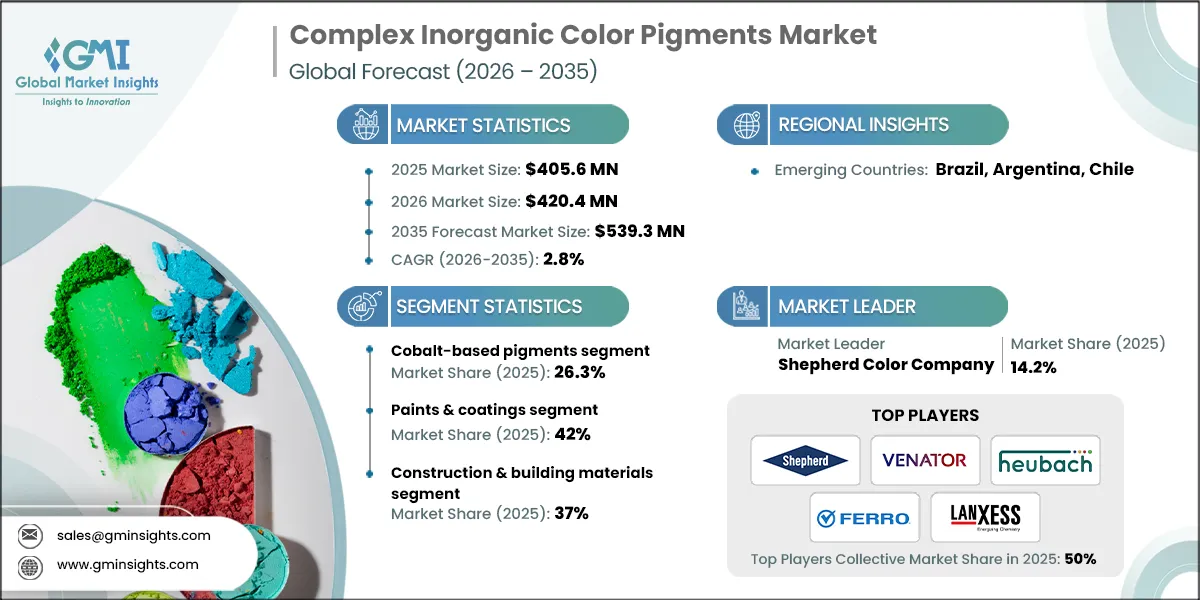
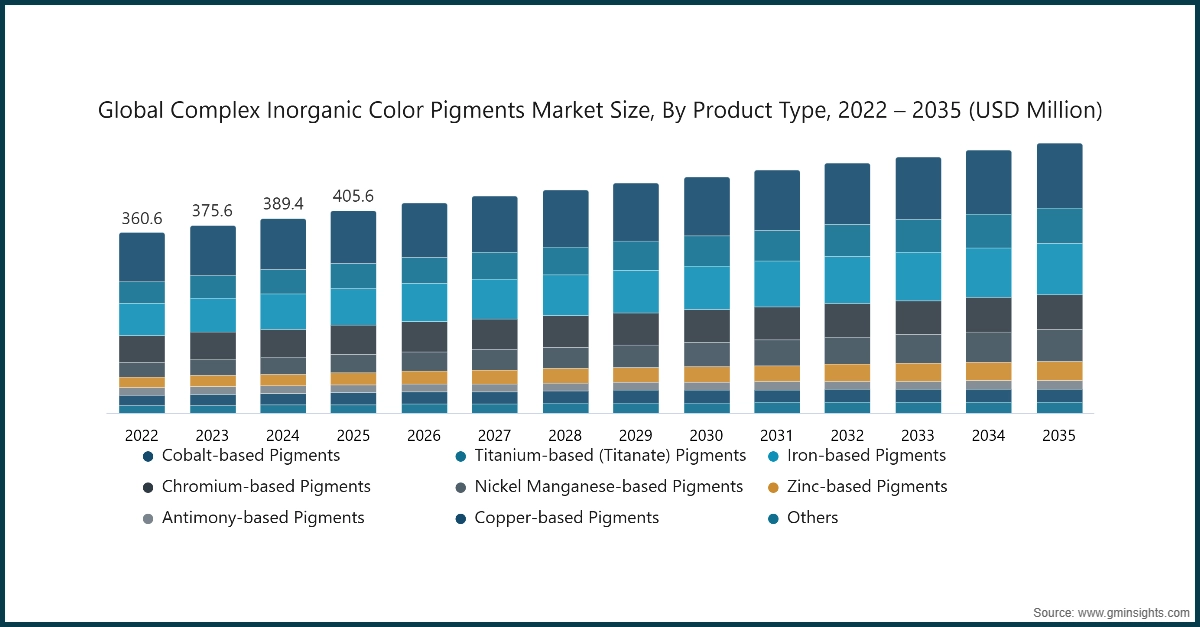
The global complex inorganic color pigments market was valued at USD 405.6 million in 2025. The market is expected to grow from USD 420.4 million in 2026 to USD 539.3 million in 2035, at a CAGR of 2.8% according to latest report published by Global Market Insights Inc.
Complex Inorganic Color Pigments Market Key Takeaways
Market Size & Growth
- 2025 Market Size: USD 405.6 Million
- 2026 Market Size: USD 420.4 Million
- 2035 Forecast Market Size: USD 539.3 Million
- CAGR (2026–2035): 2.8%
Key Market Drivers
- Rising Demand in High-Performance Coatings.
- Stringent Environmental and Safety Regulations.
- Increase in Infrared Reflective (Cool Roof) Applications.
Challenges
- High Raw Material Costs and Supply Constraints.
- Technical Limitations in Brightness and Color Range.
Opportunity
- Expansion in Electric Vehicles and Heat-Resistant Components.
- Technological Innovation in Hybrid and Nano-Pigment Formulations.
Key Players
- Market Leader: Shepherd Color Company led with over 14.2% market share in 2025.
- Leading Players: Top 5 players in this market include Shepherd Color Company, Venator Materials PLC, Heubach GmbH, Ferro Corporation, LANXESS AG, which collectively held a market share of 50% in 2025.
Get Market Insights & Growth Opportunities
- The market has been experiencing consistent growth due to increased consumer demand for high performance, durable and thermally stable pigments in a variety of industries, including automotive coatings, construction materials, plastics and ceramics. CICP's have been developed to provide superior weather resistance, chemical stability and non-migratory characteristics when compared to organic pigment alternatives for critical applications requiring longevity and compliance with stringent regulatory requirements.
- Growth of construction and infrastructure projects, particularly in emerging economies, is creating demand for CICP's use in concrete, roofing and ceramics. CICP's are considered a key component of architectural applications where aesthetics and environmental compliance are key, as well as UV resistance and thermal endurance. For example, as IR-reflective pigments, they are being increasingly adopted as part of cool roofs to enhance energy efficiency in buildings in hotter climates with an emphasis on sustainable development.
- Additionally, a major benefit of CICP's is the growing number of regulations regarding the safety, environmental compliance and sustainability of products being produced and sold throughout the European Union and North America. Because CICP's are made from non-toxic and lead-free materials, they are now a viable alternative to regulated heavy metals.
- The resurgence of global industrial activity and increased investment in automotive and powder coatings have had a significant impact on increasing consumption of CICPs (coated industrial chemicals). Because they exhibit excellent heat resistance and color stability, they are very common within automotive plastics as well as applications under the hood.
- The overall growth of the Electric Vehicle (EV) segment will be greater than 20% globally over the coming years, thereby increasing demand for the specialty coatings and thermally stable pigments used to manufacture battery housing and the motor sections of EVs.
- Manufacturers are developing advanced manufacturing technology for pigments, including nano-crystallization and hybrid pigment systems, which have provided a larger range of aesthetic and functional performance characteristics for CICPs (coated industrial chemicals).
- Many new user applications are now emerging for CICPs due to the above advancements in pigment technology, such as high-durability furniture, both indoors and outdoors, i.e., outdoor furniture; and coatings used in specialized defense industry applications. Manufacturers like Shepherd Color and TOMATEC lead this area with ongoing development of pigments that are reflective in the near-infrared (NIR) wavelength region, as well as the creation of advanced cobalt-aluminate blue and green pigment hues.
To get key market trends
Complex Inorganic Color Pigments Market Trends
- The trend of more people wanting to use infrared (IR) reflective pigments is very strong and growing. The reason for increased interest in IR reflective pigments is related to cool roof coatings as well as energy-efficient construction materials. Companies are using these pigments in Construction materials to make a cooler roof and to increase the energy efficiency of buildings. NIR (Near Infrared) reflective pigments provide energy efficient properties to buildings and other places by lowering their surface temperature.
- The strict policy requirements implemented by EU regulations within the REACH Regulation and the U.S. EPA Total Toxic Substances Control Act (TSCA) Reform has caused Manufacturers/Companies to start to develop away from using pigments that contain harmful materials like lead chromates. This is due to compliance with the CICP regulations. Some CICPs based on Cobalt, Nickel, and Titanium type chemistries also have a minimum risk to the environment associated with them, therefore they will help speed up the acceptance of CICPs throughout the coatings, ceramics, and plastic sector.
- Electric vehicles (EVs), smart infrastructure, and other industries require pigments with high heat resistance and a high degree of chemical inertness, in short, pigments for extreme use. CICP technologies outperform organic pigments in these areas. Shepherd Color and TOMATEC are creating custom pigment lines for battery housing, EV parts, and outdoor materials that require exceptional durability. Their product lines illustrate a shift towards customized formulations based on specific end use requirements.
- China, India, and Japan are leading the way in rapidly expanding their economies and building new infrastructure throughout the Asia-Pacific region, and thus they have quickly become large consumers of manufactured pigment products, as well as low-cost manufacturers of pigments, all within the same market. The availability of subsidies from local governments and support for loftier chemical production standards allows these manufacturers to supply the increasing demand for CICP products to the Asia-Pacific region and globally.
Complex Inorganic Color Pigments Market Analysis
Learn more about the key segments shaping this market
Based on product type, the market is segmented into cobalt-based pigments, titanium-based (titanate) pigments, iron-based pigments, chromium-based pigments, nickel manganese-based pigments, zinc-based pigments, antimony-based pigments, copper-based pigments, others. Cobalt-based pigments dominated the market with an approximate market share of 26.3% in 2025 and is expected to grow with a CAGR of 1.9% by 2035.
- Cobalt-based pigments occupy the largest share of the since they possess excellent thermal resistance properties, environmentally safe properties and color strength. These qualities have made cobalt the primary pigment in most high-performance architectural, automotive and industrial coatings. Cobalt-based pigments are used to provide brilliant blue and green hues that retain their vibrancy even when exposed to extreme levels of ultraviolet (UV) radiation, temperature fluctuation and chemicals.
- An important factor driving cobalt pigment use is the growing popularity of infrared (IR) reflective cobalt pigments for energy-efficient architectural coatings and cool roofs. In addition, pigment manufacturers such as DCL Corporation and Shepherd Color are developing improved formulations of cobalt-aluminate and cobalt chromite pigments that possess excellent IR reflectance characteristics and meet the environmental requirements of LEED-certified buildings. This trend has made them increasingly desirable over time.
- Cobalt-based pigments may be more costly than other pigment types, but because of durability, cobalt pigments represent a superior life-cycle cost benefit by prolonging time between repaints/replacements. Furthermore, due to the high-temperature tolerance of cobalt pigments, they are suited for use in electric vehicle (EV) parts, powder coatings, ceramic glaze and high-temperature plastic products, thus expanding their overall application base.
Based on application, the complex inorganic color pigments market is segmented into paints & coatings, plastics, concrete, glass & ceramics, inks & printing, others. Paints & coatings dominated the market with an approximate market share of 42% in 2025 and is expected to grow with a CAGR of 2% by 2035.
- A significant reason for this is that paint products typically rely on pigments to render paints with UV stability, thermal stability and Chemical Resistance. Therefore, CICP products are primarily utilized in the paint manufacturing process.
- Recently developed products, such as IR reflective pigments, promote wider use of CICP products within the market for "green" coatings targeted at creating energy efficient buildings and cool roofs. These newly developed pigments comply with government regulations and are helping to develop construction methods that support sustainable design initiatives.
- While the price of a CICP is greater than most organic based pigments, CICP Preservatives provide a longer service life and better performance characteristics vs. organic pigments; therefore, CICP products are an attractive option for use in paint products that are applied to create protective or decorative coatings in aggressive environments.
Learn more about the key segments shaping this market
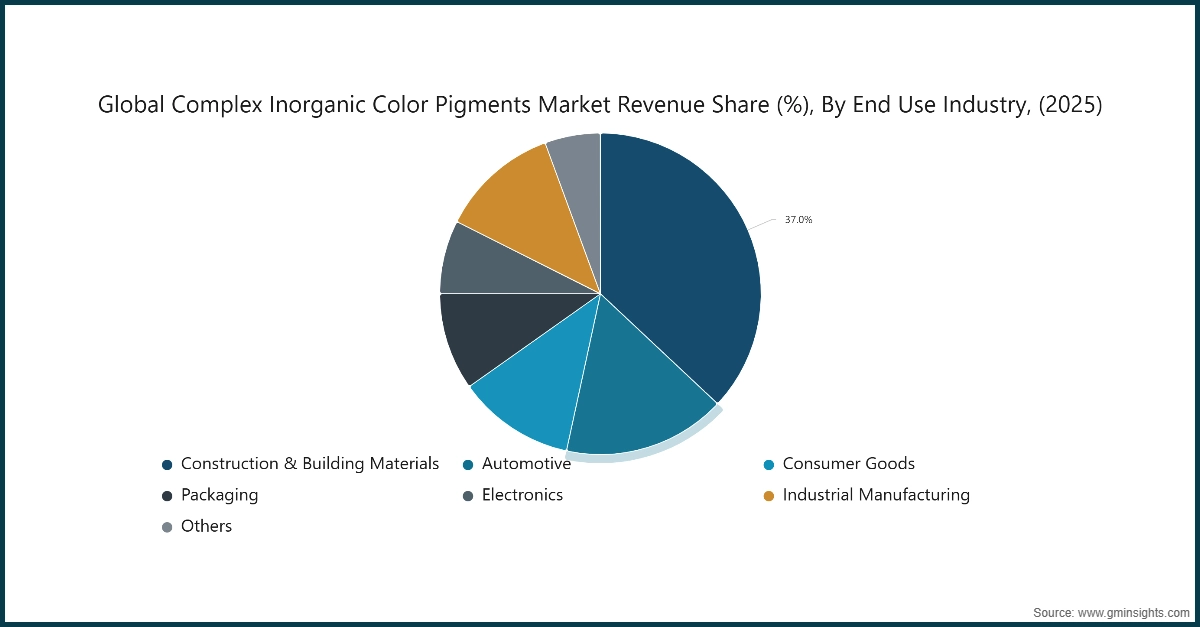
Based on end use industry, the complex inorganic color pigments market is segmented into construction & building materials, automotive, consumer goods, packaging, electronics, industrial manufacturing, and others. Construction & building materials held the largest market share of 37% in 2025 and is expected to grow at a CAGR of 1.9% during 2026-2035.
- CICP is the most widely utilized segment of the construction and building materials industry, as this pigment is primarily employed in exterior coatings and applications (roofing, rooftops, façades) to keep structures insulated from the sun’s rays. These products are particularly prized for their ability to maintain their original coloration over time, even when exposed to extreme climates and pollutants.
- In most cases, a pigment’s resistance to UV radiation, alkaline substances, and corrosive chemicals helps to preserve the color quality of the pigment. Therefore, the combination of aesthetic appeal and long-term durability makes CICP a popular choice among developers and builders. The continued expansion of urban development, particularly in developing countries, is expected to contribute to the long-term growth of CICP.
- Additional growth in this segment include the increased focus on sustainable practices and the construction of energy-efficient buildings. Expanded use of cool roofs (adoption of infrared-reflective pigments) for cool roofing and heat-reflective coatings to remove excess thermal energy from the building is becoming more common. Additionally, purchasing LEED certification and many other green certification programs help to create market opportunities for high-performance inorganic pigments.
Looking for region specific data?
The North America complex inorganic color pigments market is growing rapidly on the global level with a market share of 20.9% in 2025.
- North America is recognized as a well-established market for ceramic/inorganic composite coatings or CICPs because of the presence of existing advanced infrastructure, well-established regulatory frameworks and a strong emphasis on environmentally compliant products. It is also evident that much of the demand in North America for this type of product will stem from architectural (coatings), infrastructure (refurbishment) and industrial sectors.
- In addition, many government initiatives promoting sustainable building practices, such as ENERGY STAR and LEED rating systems, result in the increased use of infrared reflective or CICP coatings in major metropolitan areas.
- There has been an increase in eco-friendly construction and ceramic tile production in Canada, especially in provinces with environmental incentives for construction. Additionally, many of the manufacturers in North America are choosing to reshore pigment production to lessen their dependence on Asian manufacturers and assure they have access to vital raw materials produced domestically.
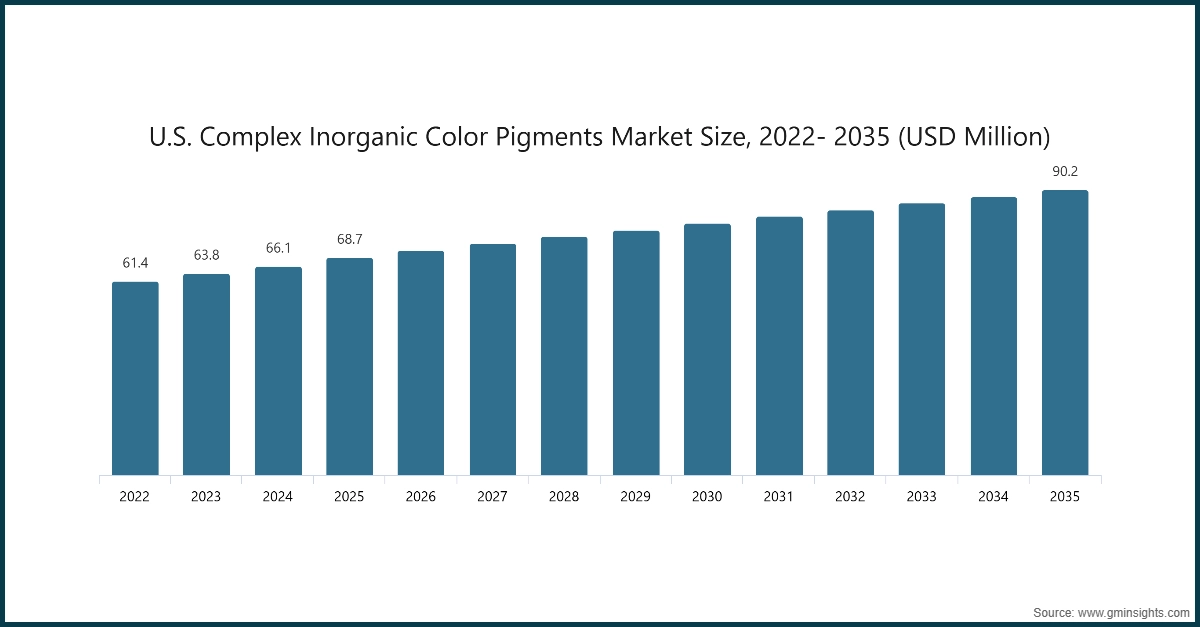
U.S. dominates the North America complex inorganic color pigments market, showcasing strong growth potential.
- The Infrastructure Investment and Jobs Act or IIJA has created substantial funding that is significantly increasing the demand for long-lasting, stable-color products for application to highways, bridges, and public buildings in the U.S. As a result, there has been a substantial increase in the use of CICPs for coloring concrete, protecting the surfaces of roads and roofing tiles.
Europe complex inorganic color pigments market held substantial position in the industry with revenue of USD 92 million in 2025 and is anticipated to show lucrative growth over the forecast period.
- The European market has the strongest regulatory influence on the use of CICPs within the construction, automotive, and packaging industries, leading to a rapid increase in their uptake across these market segments. As a result of the regulations within the REACH framework and the bans on the use of Chromium VI and Lead Chromate, many companies in Europe have been able to accelerate their transition to using more environmentally-compliant alternatives (CICPs). The growing implementation of reflective coatings by the major cities of Germany and the Netherlands (for urban cooling and energy efficiency) creates an additional impetus for the regional demand for pigments.
The Asia Pacific complex inorganic color pigments market is anticipated to grow at a CAGR of 2.9% during the analysis timeframe.
- The Asia Pacific region is projected to be the fastest growing geographic segment, largely due to the region's rapid urbanization and industrialization, along with the significant government investments in housing and transportation. China, India, and Japan are the largest consumers of pigments due to their large and expanding Ceramics, Plastic, and Construction industries. China has the largest pigment manufacturing capacity within the Asia Pacific region, while India's lower manufacturing costs, combined with increased policy support for manufacturing and export opportunities from "Make in India," are positioning the country to emerge as a key player within the pigment formulation and export markets.
Latin America complex inorganic color pigments accounted for 3.9% market share in 2025 and is anticipated to show highest growth over the forecast period.
- An aging infrastructure and a growing social housing demand will drive development in Latin America. Countries such as Brazil and Mexico are seen increase in the usage of pigments from traditional decorative concrete and coating application. However, the lack of manufacturing infrastructure and the economic instability will limit the scale of adoption within many Latin American countries. There is a growing interest in solar reflective paints and sustainable coatings, particularly for use in commercial building under climate adaptive urban planning In Brazil and Chile.
Middle East & Africa complex inorganic color pigments accounted for 5.8% market share in 2025 and is anticipated to show lucrative growth over the forecast period.
- A Desire For CICP application has increased in the Middle East and Africa, driven by climatic conditions and a need for durable heat-resistant building materials. The Governments of the UAE And Saudi Arabia are investing heavily in initiatives related smart city developments as well as green building initiatives such as NEOM. These initiatives are creating demand For IR reflective coatings and long-life pigments used in structural applications.
Complex Inorganic Color Pigments Market Share
The global CICP market has moderate concentration, with the major players (such as Shepherd Color Company, Venator Materials, Heubach GmbH, Ferro Corporation (Prince) and LANXESS AG), making up more than 50% of the overall market. These firms possess strong positions in the marketplace due to their vast product arrays, geographical distribution of products, and state-of-the art R&D capabilities for producing spans of long-lasting pigments with superior performance ratings.
The key driving forces within the CICP marketplace include technological advancements, compliance with regulations, price competitiveness, and ability to customize products. The leaders in this sector are leading the industry in developing IR-reflective pigments and high-temperature pigments for applications in energy-efficient buildings and electric vehicle production. Additionally, product innovation using hybrids and nano crystalline technologies are important factors that differentiate top-tier companies.
Recent years have shown a restructuring of the CICP market driven by many strategic moves. The acquisition of Clariant pigment platforms by Heubach and the merger with Ferro by Prince International has enabled the companies to improve their capabilities and expand their regional coverage. Other elements contributing to the competitive environment include alliances, alliances for sustainable practices, and upstream integration.
- Shepherd Color Company: Shepherd Color Co., globally recognized for its high-performance complex inorganic color pigments, has made a name for itself with its IR-reflective pigments used in energy-saving coatings and cool-roof systems. Concentrating exclusively on premium markets, Shepherd invests significantly in R&D to create customized pigment solutions for highly specialized fields.
- Venator Materials PLC: Venator produces a variety of inorganic pigments, including both titanium dioxide and specialty CICPs. The Duratint brand is one of its most widely used products within construction and coatings industries. Venator will continue to meet customers' servicing needs by providing cost-effective and reliability through supply-chain strengths, with global production facilities located in the U.S. as well as Europe, working within both commodity and specialty markets.
- Heubach GmbH: Heubach has recently expanded into the global CICP segment following its acquisition of Clariant Pigments. The company provides a large range of heat and weather-proofed pigments for use in plastic, coatings, and construction applications. The company has a strong emphasis on Eco compliance and innovation regarding color performance of its products.
- Ferro Corporation: As a business unit within the Prince International Corporation, Ferro is a leading manufacturer of both ceramic and industrial pigments. Ferro sells to many different industries including tile manufacturing, porcelain enamel, and coatings for paint and other products. Ferro combines its global networks to provide customers with local support for the custom formulation of Ferro products and offers its customers consistency of Ferro's product quality.
- LANXESS AG: LANXESS AG is an internationally recognized supplier of iron oxide and chromium oxide pigments sold under the Bayferrox name. LANXESS has one of the largest manufacturers of CICP world-widely located in Germany. With its focus on sustainability, process innovation, and supply reliability, LANXESS invests in environmentally friendly production methods and targets future growth within the colored architectural and industrial paint market.
Complex Inorganic Color Pigments Market Companies
Major players operating in the complex inorganic color pigments industry include:
- Asahi Kasei Kogyo Co., Ltd.
- BASF SE
- Cathay Industries
- Clariant AG
- DCL Corporation
- Ferro Corporation
- HANIL HOLDINGS Co., Ltd.
- Heubach GmbH
- LANSCO Colors
- LANXESS AG
- Mason Color Works, Inc.
- Shepherd Color Company
- Tata Pigments Limited
- TOMATEC Corporation
- Venator Materials PLC
Complex Inorganic Color Pigments Market Report Attributes
| Key Takeaway | Details |
|---|---|
| Market Size & Growth | |
| Base Year | 2025 |
| Market Size in 2025 | USD 405.6 Million |
| Market Size in 2026 | USD 420.4 Million |
| Forecast Period 2026-2035 CAGR | 2.8% |
| Market Size in 2035 | USD 539.3 Million |
| Key Market Trends | |
| Drivers | Impact |
| Rising Demand in High-Performance Coatings | Enhances market adoption due to superior heat, UV, and chemical resistance. |
| Stringent Environmental and Safety Regulations | Drives replacement of heavy-metal pigments with eco-friendly CICPs. |
| Increase in Infrared Reflective (Cool Roof) Applications | Boosts adoption in sustainable construction and energy-efficient infrastructure. |
| Pitfalls & Challenges | Impact |
| High Raw Material Costs and Supply Constraints | Affects pricing and margin stability due to reliance on rare metals like cobalt. |
| Technical Limitations in Brightness and Color Range | Limits competitiveness with organic pigments in decorative and aesthetic markets. |
| Opportunities: | Impact |
| Expansion in Electric Vehicles and Heat-Resistant Components | Opens new demand channels in EV coatings and battery housing applications. |
| Technological Innovation in Hybrid and Nano-Pigment Formulations | Differentiates product offerings by combining performance with broader color options. |
| Market Leaders (2025) | |
| Market Leader |
Approximate Market Share of 14.2% in 2025 |
| Top Players |
Collective Market Share of 50% in 2025 |
| Competitive Edge |
|
| Regional Insights | |
| Emerging countries | Brazil, Argentina, Chile |
What are the growth opportunities in this market?
Complex Inorganic Color Pigments Industry News
In November 2023, Shepherd Color Company unveil its latest product line in its Arctic line of IR-reflecting pigments. The pigments are primarily designed for the electric vehicle battery housings heat management coatings.
In October 2023, The Heubach Group announced they are adding to their cobalt-aluminate blue pigment line with a wider array of cobalt-aluminate blue pigments designed for better dispersion and greater recycling capabilities. The purpose of the cobalt-aluminate blue pigment line is to provide eco-friendly or sustainable building materials.
- In August 2023, The DCL Corporation announced the opening of a new Canadian Technical Service Center in Mississauga, Ontario to provide color matching services and performance testing of complex inorganic pigments on behalf of their customers.
- In June 2023, LANXESS AG complete a major energy efficiency upgrade at the Krefeld-Uerdingen CICP plant in Germany which resulted in improved production sustainability, and a reduction in emissions by 15%.
- In May 2023, the Venator Materials PLC showcased its newly developed; Duratint CICP-based series at the European Coatings Show to demonstrate superior architectural coatings that offer excellent weathering performance.
- In March 2023, Ferro Corporation (Prince International) launched a new series of NIR-reflective pigments for industrial powder coatings that offer exceptional thermal shielding in extreme temperature environments.
This complex inorganic color pigments market research report includes in-depth coverage of the industry, with estimates & forecasts in terms of revenue (USD Million) and volume (Kilo Tons) from 2026 to 2035, for the following segments:
Market, By Product Type
- Cobalt-based Pigments
- Titanium-based (Titanate) Pigments
- Iron-based Pigments
- Chromium-based Pigments
- Nickel Manganese-based Pigments
- Zinc-based Pigments
- Antimony-based Pigments
- Copper-based Pigments
- Others
Market, By Application
- Paints & Coatings
- Architectural Coatings
- Automotive Coatings
- Industrial Coatings
- Powder Coatings
- Coil Coatings
- Plastics
- Concrete
- Glass & Ceramics
- Inks & Printing
- Others
Market, By End Use Industry
- Construction & Building Materials
- Automotive
- Consumer Goods
- Packaging
- Electronics
- Industrial Manufacturing
- Others
The above information is provided for the following regions and countries:
- North America
- U.S.
- Canada
- Europe
- Germany
- UK
- France
- Spain
- Italy
- Rest of Europe
- Asia Pacific
- China
- India
- Japan
- Australia
- South Korea
- Rest of Asia Pacific
- Latin America
- Brazil
- Mexico
- Argentina
- Rest of Latin America
- Middle East and Africa
- Saudi Arabia
- South Africa
- UAE
- Rest of Middle East and Africa
Frequently Asked Question(FAQ) :
What was the market size of the complex inorganic color pigments market in 2025?
The market size was USD 405.6 million in 2025, with a CAGR of 2.8% projected through 2035, driven by the increasing adoption of IR reflective pigments and compliance with stringent environmental regulations.
What is the projected value of the complex inorganic color pigments market by 2035?
The market is expected to reach USD 539.3 million by 2035, fueled by the demand for energy-efficient construction materials and the shift towards environmentally friendly pigments.
What is the projected size of the complex inorganic color pigments market in 2026?
The market is expected to grow to USD 420.4 million in 2026.
What was the market share of cobalt-based pigments in 2025?
Cobalt-based pigments held the largest share, accounting for approximately 26.3% of the market in 2025, and are projected to grow at a CAGR of 1.9% through 2035.
Which end-use industry dominated the market in 2025?
The construction & building materials segment led the market with a 37% share in 2025, reflecting the growing use of pigments in energy-efficient building materials.
Which region leads the complex inorganic color pigments market?
North America was a key region in 2025, holding a market share of 20.9%. The region is experiencing rapid growth due to advancements in pigment technologies and strong industrial demand.
What are the upcoming trends in the complex inorganic color pigments industry?
Key trends include the rising adoption of IR reflective pigments for energy-efficient applications, the shift away from harmful pigments like lead chromates due to regulatory compliance, and the increasing use of environmentally friendly pigments based on cobalt, nickel, and titanium chemistries.
Who are the key players in the complex inorganic color pigments market?
Major players include Asahi Kasei Kogyo Co., Ltd., BASF SE, Cathay Industries, Clariant AG, DCL Corporation, Ferro Corporation, HANIL HOLDINGS Co., Ltd., Heubach GmbH, LANSCO Colors, and LANXESS AG.
Complex Inorganic Color Pigments Market Scope
Related Reports