Summary
Table of Content

Compact Construction Equipment Market
Get a free sample of this report
Form submitted successfully!
Error submitting form. Please try again.
Thank you!
Your inquiry has been received. Our team will reach out to you with the required details via email. To ensure that you don't miss their response, kindly remember to check your spam folder as well!
Request Sectional Data
Thank you!
Your inquiry has been received. Our team will reach out to you with the required details via email. To ensure that you don't miss their response, kindly remember to check your spam folder as well!
Form submitted successfully!
Error submitting form. Please try again.
Compact Construction Equipment Market Size
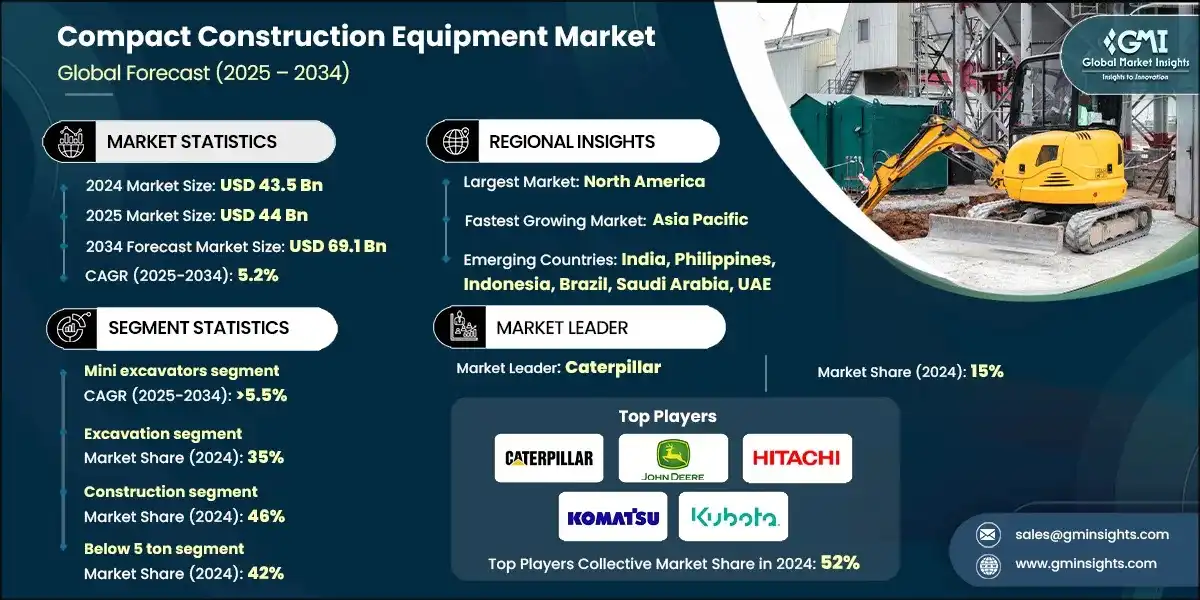
The global compact construction equipment market was estimated at USD 43.5 billion in 2024. The market is expected to grow from USD 44 billion in 2025 to USD 69.1 billion in 2034, at a CAGR of 5.2%, according to latest report published by Global Market Insights Inc.
Compact Construction Equipment Market Key Takeaways
Market Size & Growth
- 2024 Market Size: USD 43.5 Billion
- 2025 Market Size: USD 44 Billion
- 2034 Forecast Market Size: USD 69.1 Billion
- CAGR (2025–2034): 5.2%
Key Market Drivers
- Growing urbanization and infrastructure projects.
- Rise in rental fleet adoption..
- Surge in technological advancements such as telematics, automation, and AI..
- Surging electrification of compact construction equipment.
Challenges
- Increasingly stringent emission regulations.
- Intense competition from larger equipment.
Opportunity
- Growing electrification trend.
- Rise in adoption of smart and autonomous solutions.
- Surge in demand for aftermarket services and attachments.
- Expanding opportunities in emerging markets.
Key Players
- Market Leader: Caterpillar led with over 15% market share in 2024.
- Leading Players: Top 5 players in this market include Caterpillar, Deere & Company, Hitachi Construction Machinery, Komatsu, Kubota, which collectively held a market share of 52% in 2024.
Get Market Insights & Growth Opportunities
The increasing urban infrastructure development demand, smart cities, and residential housing projects have transformed the compact construction equipment market. Small machines also help a contractor to increase site productivity, decrease workforce reliance, and decrease overall operating expenses due to fuel-efficient engines and built-in telematics.
For example, in July 2025, Caterpillar launched its second-generation electric-powered compact excavators and skid steer loaders, with battery-swapping solutions and operator-assist technologies. Volvo CE and Kubota also introduced AI-based fleet management systems to monitor performance, fuel consumption, and uptime. OEMs are implementing autonomous functions and digital safety measures to improve compliance and safety of the operators.
The increasing pressure to decarbonize construction work and run on low emission/ electric machinery is leading operators to hybrid/ electric compact excavators, loaders and telehandlers. Real-time optimization of usages, reducing the volume of downtimes, and increasing the reliability of the machine lifecycle is becoming possible by Telematics, machine-learning-based predictive maintenance, and fleet virtualization.
COVID-19 pandemic initially slowed down the construction projects and postponed equipment deliveries. Nonetheless, recovery in the post-pandemic period has already increased the pace of investment in small machines to provide them with opportunities to deal with the lack of skilled labor and high safety standards. The use of remote diagnostics services, IoT machine monitoring, and subscription-based equipment leasing grew among rental businesses and contractors to be able to secure business continuity and financial flexibility.
The high demand of mini excavators, compact track loaders and backhoe loaders have been a consequence of the influx of infrastructural megaprojects, agricultural mechanization, and renewable energy plants. Automation-enabling skid steers, electrified telehandlers, and IoT-based fleet management systems are some of the main areas of growth where OEMs and contractors are putting money.
The construction equipment market in North America and Europe has high levels of consolidation, aided by investment in roadworks, residential housing, and electrified machines. The long-established industry players, including Caterpillar, Deere and Company, Volvo CE, and Komatsu operate on the frontline with software-definition, energy-efficient, and smart ready compact equipment. These areas will keep on being the world leaders in the use of autonomous and connected equipment technologies.
Asia-Pacific is the fastest growing region, and compact equipment is driven by rapid urbanization, affordable housing schemes and infrastructure corridors. China, Southeast Asian countries and India are moving towards hybrid/ electric compact machines, rental penetration and AI-enabled fleet management. Adoption is being accelerated by government initiatives such as India Smart City, China Belt and Road Initiative and ASEAN infrastructural initiatives.
To get key market trends
Compact Construction Equipment Market Trends
Automation, telematics, and AI integration are now typical features of modern compact construction equipment to track machine health, anticipate failures, and automate operational processes. These technologies decrease the fatigue of the operators, decrease fuel usage, increase safety and allow real time distribution of resources. AI controlled fleet management and IoT connectivity give ways to make the project implementation smooth, faster provisioning of tasks, and efficient use of energy, which helps to conduct high-performance and cost-effective operations.
For example, in March 2025, Komatsu collaborated with Honda to introduce hybrid-powered compact excavators that were fuel-efficient and had a lower carbon footprint. The partnership also concentrated on coming up with compact devices that are hydrogen-ready to have future-proof construction fleets.
Compact construction equipment is also moving towards electric and hybrid-powered trains, telematics-enabled control systems, and modular attachments to facilitate a wide range of applications with reduced emissions. Modular platforms are scalable, flexible in deployment, energy efficient because contractors can dynamically add or change attachments, support urban construction projects, combine autonomous guidance systems and have higher throughput with reduced downtime and more nimble equipment.
Digital twin technologies are enabling the virtual recreation of compact equipment fleets to provide real-time monitoring, predictive maintenance insights, and operational simulations. Cloud-enabled management platforms give central visibility, remote control, and improved cybersecurity for connected machines. This reduces operational expenses, eliminates unplanned downtime, enhances fleet reliability, and allows contractors to test project scenarios virtually before deployment, streamlining lifecycle management and enabling superior decision-making.
Compact Construction Equipment Market Analysis
Learn more about the key segments shaping this market
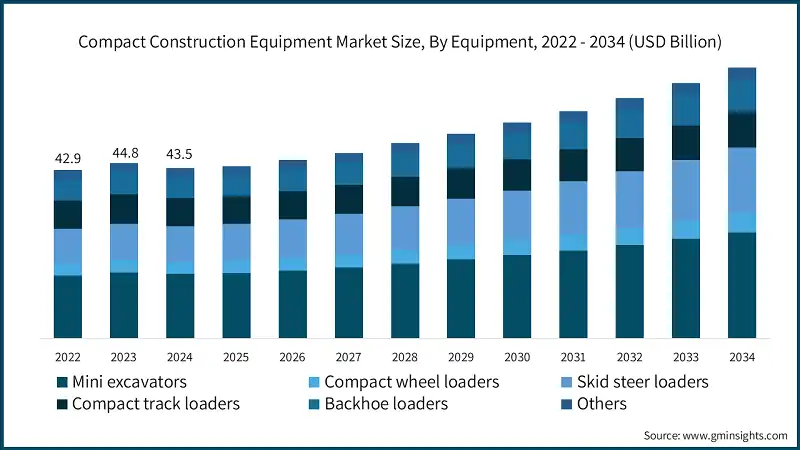
Based on equipment, the compact construction equipment market is divided into mini excavators, compact wheel loaders, skid steer loaders, compact track loaders, backhoe loaders, and others. The mini excavators segment dominated the market, accounting for around 38% in 2024 and is expected to grow at a CAGR of over 5.5% through 2034.
- The mini excavators dominate the compact construction equipment market because of their versatility, affordability, and flexibility in most applications. They are highly popular in urban construction, landscape construction, agriculture, utility construction, and road maintenance, where space is constrained, and maneuver is paramount. Their lower purchase and operating costs, relative to larger machines, make them appeal to small and mid-sized contractors and rental companies. Their dominance is further enhanced by the capability of managing various tasks using interchangeable attachments.
- The increased investments in smart cities, housing developments, and utility network development have caused an increase in the demand for mini excavators, particularly in highly populated areas. Moreover, the trend of electrification and hybrid models also follows the sustainability regulations well, which prompts its adoption in Europe, North America, and Asia-Pacific. Their small dimensions, fuel efficiency, and compatibility with telematics and automation are the guaranties of further market leadership.
- For example, in January 2025, Kubota introduced a new series of mini excavators with telematics to monitor their position in real-time, predictive maintenance, and remote diagnostics in Japan. The release promotes smart city infrastructural initiatives, and it demonstrates how automation is being made the norm in small-scale equipment.
- Skid steer loader is expected to grow at a CAGR of more than 6.6% due to their small size, flexibility, and ability to operate in confined spaces make them ideal for urban construction, landscaping, agriculture, and roadwork. These machines support various attachments like buckets, augers, and trenchers, helping contractors maximize efficiency with one machine. The market is growing due to the rising popularity of rental fleets and the demand for affordable, multi-functional equipment. Moreover, the introduction of electric and hybrid skid steer loaders aligns with sustainability goals, which are expected to drive their global adoption in the coming years.
Learn more about the key segments shaping this market
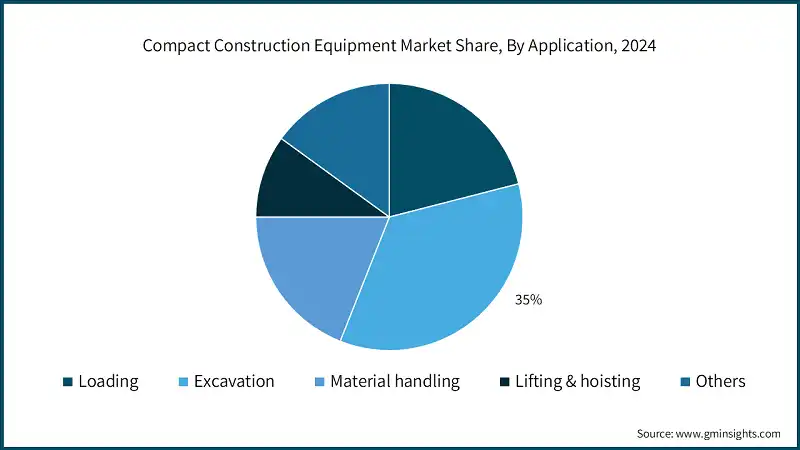
Based on application, the compact construction equipment market is segmented into loading, excavation, material handling, lifting & hoisting, and others. The excavation segment dominates the market accounting for around 35% share in 2024, and the segment is expected to grow at a CAGR of 4.8% between 2025 and 2034.
- The excavation segment comprises highest proportion of the compact construction equipment industry because it is very important in construction, infrastructural and utility projects. Excavators are needed to dig foundation, pipeline and cable trenching, and road and housing site preparation. Their accuracy, effectiveness and capacity to work in limited cities qualify them to be essential in the present building demands. Compact excavators offer a variety of attachments, enabling them to offer multi-purpose over single-purpose functions, which saves a lot of money spent on acquiring several machines per the contractors.
- Moreover, the increased investments made in smart cities, utility networks and housing projects across the globe have enhanced faster demand for excavation equipment. The introduction of electric and hybrid excavators also gives the segment added strength because of its introduction since global sustainability initiatives are aligned. Additionally, the automation and telematics integration will increase productivity, decrease downtime, and maintain safety, as the excavation is consolidated as the most popular application segment.
- In October 2024, CASE Construction Equipment introduced the CX15EV mini excavator in Latin America, aimed at residential excavation, small-scale mining, and agricultural trenching. The company mentioned increasing urbanization and modernization of infrastructure as some of the major drivers of growth.
- The compact construction equipment market from loading segment is expected to grow at a CAGR of around 6.9% because of the intensive application of the loading segment in material movement, road construction, mining and agricultural practices. Skid steers and wheel loaders (compact loaders) have great versatility, and their attachments can be changed using a variety of options, which makes them adaptable workers that can be used in many different tasks, including waste management, snow removal, and soil moving. Their performance on limited job sites, combined with the growing demand of rental fleets, contributes to the constant adoption.
Based on end user, the market is segmented into construction, agriculture, mining, utility works, and others. Construction segment is expected to dominate the market with around 46% share, driven by infrastructure expansion, urbanization, and rising demand for efficient equipment.
- The construction industry dominates the compact construction equipment market owing to the ever-increasing urbanization, infrastructural development, and residential housing construction projects in the world. Compact excavators, skid steer loaders, and mini wheel loaders come in handy in activities including foundation excavations, site preparation, material handling, and landscaping. Their ability to operate in small spaces, their maneuverability, and cost-effectiveness are the reasons they are applicable to contractors and rental companies acting both in urban and semi-urban locations. They are also highly dominant in construction applications due to their capability of doing multi duties using exchangeable attachment.
- Increased government spending on roads, bridges, smart cities and low-cost housing initiatives have increased the pace of compact construction machinery demand. Moreover, the transition to electrification, hybrid engines, and equipment with telematics meets the requirements of sustainability and enhances operational efficiency, safety, and productivity, to maintain the leading position of the construction segment in the market.
- For example, in June 2025, Caterpillar introduced its new 301.9 mini excavator in the U.S., an urban construction, foundation digging, and landscaping machine. The machine is more fuel efficient, compact and has telematics-enabled fleet management which makes it very suitable for construction contractors.
- The compact construction equipment market from mining segment is expected to experience the greatest CAGR of over 14.5% because of increased demand for compact construction equipment in small and medium scale mining operation especially in remote and constrained sites. Ore mining, site preparation and handling of materials in surface and underground mines are increasingly being performed by mini excavators, skid steer loaders and compact wheel loaders. They are easily maneuverable, durable and cost effective thus appropriate in operations where the large machines are not practical.
Based on operating capacity, the compact construction equipment market is divided into below 5 tons, 6 to 8 tons, above 8 tons. The below 5 ton dominated the market, accounting for around 42% share in 2024.
- The below 5-ton segment holds the highest market share in the compact construction equipment market due to its versatile, maneuverable and suitable to be used on restricted or urban construction sites. These small machines such as mini excavators, skid steer loaders and compact wheel loaders are common in residential construction, landscaping, utility work and small-scale infrastructure projects. Their small size enables them to work in tight areas where large machines cannot work effectively and minimize project delay and costs. They are also cheap in terms of purchase and maintenance hence their maximum appeal to small contractors and rental companies.
- Increasing investments in city housing, smart city development and infrastructure improvements are also driving demand towards sub-5-ton machines. The trend towards the use of electric and hybrid models, the integration of telematics and automation contributes to the increase in productivity, emission reduction, and durability, which confirm the leadership of the segment in the world market.
- For example, in July 2025, Hitachi Construction Machinery launched the ZX10U-5 mini excavator in Japan, aimed at tight urban construction sites and micro utility works. It is small-footprint and zero-tail swing in design which improves maneuverability.
- Moreover, the 6 to 8 Ton segment is expected to see the most rapid expansion as it offers optimal power, versatility, and compactness, which is in line with medium-scaffolded construction, urban infrastructure, and industrial applications. These machines, such as mini excavators, skid steer loaders, and compact wheel loaders, have greater lifting and digging abilities than the sub-5-ton machines but are still able to operate in limited spaces. Contractors and rental companies target this line with medium capacity projects that do not need the operational and transport difficulties of larger equipment.
Looking for region specific data?
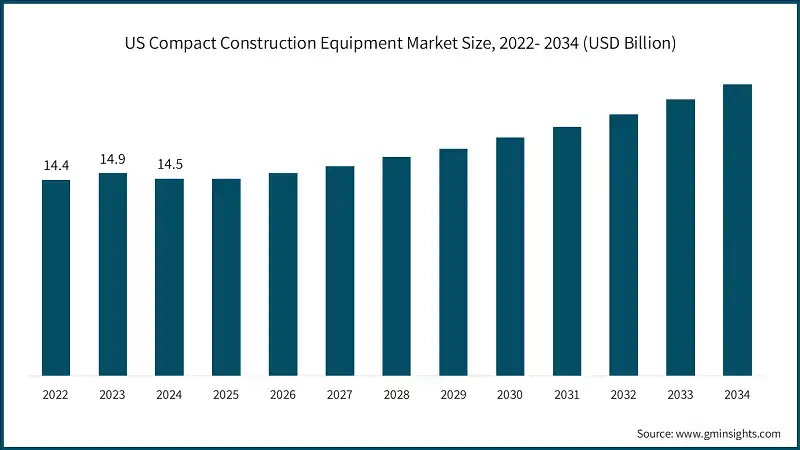
US dominated the compact construction equipment market in North America with around 85% share and generated USD 14.5 Billion in revenue in 2024.
- The U.S. compact construction equipment market is biggest in North America due to the widespread infrastructure renewal, urban housing and government investments in transportation and energy. The automation drive, to electrification, and AI-powered fleet management underline the foundation of scalable and energy-saving operations by contractors, rental agencies, and city governments. The growing labor shortages and tougher rules on emissions are also increasing the implementation of compact loaders, mini excavators and telehandlers equipped with smart-control technologies.
- In addition, the rise in investments in environmentally friendly construction activities, the use of electric equipment fleets, and the use of digital connections in jobsites are accelerating the expansion of the market. The collaboration with major OEMs such as Caterpillar, Deere and Company, Bobcat and Volvo CE allow U.S. contractors to use modular, low-emission, and telematics-built compact machines, which are applicable to various uses in the construction of housing, utilities, renewable energy.
- For example, in June 2025, Volvo Construction Equipment in the U.S. collaborated with Turner Construction to launch electric compact excavators and wheel loaders to support sustainable infrastructure projects. The partnership is in line with federal programs of green building and urban renewal.
- Canada is expected to emerge as the fastest-growing market in the North American region, supported by federal expenditures on infrastructure modernization, green building, and electrification targets. Compact excavators, mini loaders, and electric skid steers are also on demand in Toronto, Vancouver and Montreal to meet the demands of urban density and emissions.
The compact construction equipment market in Germany is expected to experience robust growth between 2025 and 2034.
- Europe accounts for around 19% of the compact construction equipment market in 2025 and is expected to grow at a CAGR of over 4.1%. The sector is growing with massive investments in infrastructure renewal, housing modernization and sustainable construction projects accompanied by strong government intervention. The transition to AI-enabled and electric platforms of compact equipment, digital job-site management is increasing the use of AI-enabled, electric, and modular compact equipment platforms within the region.
- Germany is the market leader, holding the largest share in Europe as it has a high level of digitalization of the equipment management and is more oriented to the sustainability as the main direction of its construction sector. Several programs like the nationwide green construction initiative in Germany and digital building strategy are making the country a center of high-tech compact machinery adoption. Government subsidies on electric mini excavators, smart telematics, and autonomous loaders are boosting fleet reliability, scalability, and environmental impact.
- Major OEMs, including Caterpillar, Wacker Neuson, and Volvo CE, have received multi-million-euro contracts with German contractors and rental companies to roll out low-emission, AI-enabled compact construction equipment. Research institutions and universities are working with manufacturers to speed up development in automation, predictive analytics and electrified fleets. Germany is an innovator of sustainable and digitally connected, high-performance, and digitally connected construction solutions in Europe by virtue of this ecosystem.
- For example, in August 2025, Wacker Neuson stated that it would expand its electric compact line in Germany, mini excavators and wheel loaders intended to serve urban work. The project is backed by carbon-neutral construction development objectives by the German government in the carbon-neutral construction project, yet it indicates that the country is highly interested in sustainability and digital innovations in the construction industry.
- The UK is the most rapidly expanding market in Europe driven by the regeneration of urban areas, housing needs and the swift adoption of green buildings. The adoption of compact loaders, electric excavators, and telematics-controlled fleet management is being accelerated through initiatives like the Net Zero Strategy of the UK, 5G-enabled smart construction sites, and incentive programs aimed at purchasing electrified machinery.
The compact construction equipment market in China is expected to experience strong growth between 2025 and 2034.
- Asia-Pacific accounts for over 34% of the compact construction equipment market in 2025 and is the fastest-growing region with a CAGR of around 6.4%. This growth is driven by rapid urbanization, massive development of infrastructures, affordable housing developments, and solid government support towards smart city developments and sustainable construction practices in China, India, and Southeast Asia.
- China dominates the Asia-Pacific market through huge investment in transport routes, renewable energy plants, and cities. The 14 th Five-Year plan of the government focuses on green buildings, electrification and digital technologies in construction that can improve productivity, minimize carbon emissions and achieve sustainability goals. This trend is driving the market towards electric mini excavators, compact loaders, and smart telematics-enabled equipment.
- The major Chinese firms like Sany, XCMG, and LiuGong are on the cutting edge of technology, providing electric compact excavators, AI-based fleet management systems, and hybrid telehandlers. The machines are used in urban residential development, industrial construction areas, and infrastructure megaprojects to create a scalable, energy-saving, and interconnected construction ecosystem.
- Additionally, AIs in the form of predictive maintenance, telematics and self-operating systems are moving towards the next level of development due to joint venture and cooperation with international OEMs. The long-term incentives by the state and the partnerships with the corporations establish China as the dominant player in the Asia-Pacific compact construction equipment market.
- India has emerged as the fastest-growing market in the region due to the rapid economic growth, urbanization, and significant government infrastructure projects. Programs such as Digital India, Smart Cities Mission and Make in India are hastening the use of electric loaders, small excavators and IoT-based job-site management systems.
- In July 2025, JCB India signed an agreement with Tata Motors to collaboratively develop electric compact excavators and loaders to serve urban projects in Mumbai, Hyderabad and Chennai. The partnership aims at developing the high-performance and sustainable machinery to help India in the flourishing infrastructure and residential demand. This indicates a fast-growing shift towards electrification and so-called digitization of construction equipment in India.
The compact construction equipment market in Brazil is expected to experience significant and promising growth from 2025 to 2034.
- Latin America holds about 6% of the compact construction equipment market in 2025, expanding at a CAGR of around 4%. This growth is supported by the modernization of infrastructure, urban housing, mining, and agricultural mechanization. Smart cities, renewable energy and transport infrastructure programs in government are increasing adoption rates, world OEMs are investing heavily in the region and Latin America is becoming a new construction equipment hub.
- Brazil dominates the Latin America compact construction equipment market due to the mass construction projects, industrial development, and housing demand. The adoption rate of compact excavators, skid steer loaders, and backhoe loaders is increasing owing to the growth of cities, renewable energy programs, and growth in the mechanization of farming and mining operations. Telematics and rental-based models are also being modernized in business to enhance efficiency and lower operating expenses.
- The infrastructure growth and affordable housing programs, as well as sustainable construction programs led by the government are fortifying the market, whereas foreign OEMs such as Caterpillar, Volvo CE, and Komatsu grow their presence in the country with hybrid and electric compact equipment that is suited to Brazilian conditions. Brazil is the center of the small equipment industry in Latin America as it is a local center of construction and mining.
- In September 2024, Volvo CE announced a USD 300 million investment in Brazil to increase its manufacturing of compact excavators and electric loaders to meet South American markets. The project will be expected to facilitate urban development, renewable energy facilities, and green infrastructure developments, which indicate the increasing significance of Brazil in the global plan of key OEMs.
- Mexico is the fastest-growing market in Latin America, due to urbanization, development of industrial corridors, and increasing housing demand. A rise in the manufacturing, logistics and e-commerce infrastructure is increasing the need to acquire compact loaders, mini excavators and telehandlers.
- The government efforts of Mexico to stimulate construction, foreign capital inflow, and develop smart city initiatives are driving the need of electrified and internet-connected compact equipment. Moreover, Global OEMs such as JCB, Bobcat, and Deere and Company are increasing their presence in the area by collaborating with local rental companies and can access more up-to-date fleets.
The compact construction equipment market in South Africa is expected to experience robust growth from 2025 to 2034.
- Middle East and Africa (MEA) hold around 2% of the compact construction equipment market in 2024, with steady growth driven by urbanization, infrastructure development, and housing demand. Governments are actively promoting smart city projects, renewable energy installations and the modernization of transport infrastructure and international OEMs are growing their presence on the regional level. The region is attracting foreign equipment manufacturers and rental companies, which has made MEA a novel center of compact construction equipment adoption.
- South Africa leads in the MEA market due to its highly established construction industry, robust mining, and the need to support compact loaders, mini excavators, and backhoe loaders in urban and industrial projects. The demand is being fueled by government-initiated housing expansion programs, road development projects, and renewable energy projects. Moreover, the shift towards rental penetration and fleet management through telematics is changing the usage of equipment nationwide.
- Local and international OEMs like Caterpillar, Bell Equipment, and Komatsu are consolidating their presence in South Africa by launching hybrid and electric compact equipment that are well-fit to urban construction and mining-support business processes. Co-operation with renting companies and contractors are also making it increasingly accessible and increasing the ownership expenses, uniting South Africa as the regional giant.
- For example, in August 2025, Bell Equipment collaborated with Caterpillar to introduce electric mini excavators and compact loaders in South Africa, which serve sustainable urban infrastructure and mining support projects. The initiative portrays the shift in South Africa towards green, efficient and connected equipment solutions.
- The UAE is the most rapidly developing market in the MEA, which is powered by megaprojects of smart cities, extensive infrastructures of tourism development, and urbanization. The national emphasis on sustainability and net-zero targets is helping to boost the need to use electric and hybrid compact construction equipment, particularly in the efforts of projects in Dubai, Abu Dhabi, and Sharjah.
Compact Construction Equipment Market Share
- The top 7 companies in the compact construction equipment industry are Caterpillar, Komatsu, Deere & Company, Kubota, Hitachi Construction Machinery, Volvo Construction Equipment, and JCB, contributed around 64% of the market in 2024.
- Caterpillar focuses on expanding its compact equipment line with advanced telematics, hybrid power solutions, and rental-friendly designs. The company emphasizes operator comfort, fuel efficiency, and connectivity while leveraging its global dealer network. Sustainability initiatives and digital fleet management tools strengthen Caterpillar’s competitiveness, particularly in urban construction and landscaping applications.
- Komatsu emphasizes electrification, automation, and smart construction solutions for compact equipment. Its strategy includes integrating IoT-based fleet monitoring, improving energy efficiency, and supporting sustainability goals. Komatsu also strengthens rental and leasing models, particularly in Europe and Asia, and collaborates on R&D to deliver compact machines that meet emission regulations and urban infrastructure demands.
- Deere focuses on technology-driven solutions, including precision construction, operator-assist systems, and telematics for compact equipment. The company enhances productivity through electric and hybrid models, prioritizes sustainability, and leverages its strong brand recognition in North America. Deere also expands aftersales support, financing, and rental services to capture demand in small contractors and municipal projects.
- Kubota leverages its strong presence in compact equipment by focusing on versatility, ease of operation, and eco-friendly engines. It emphasizes compact excavators, loaders, and utility vehicles tailored for agriculture, landscaping, and urban construction. Kubota invests in electrification and hybrid models while strengthening dealer networks and rental services, catering to small contractors and emerging markets.
- Hitachi emphasizes advanced hydraulic systems, electrification, and smart technologies for compact equipment. The company invests in telematics, predictive maintenance, and operator-friendly designs. Strategic partnerships in Europe and Asia enhance their compact range. Sustainability and compliance with emissions standards are key, while rental and leasing solutions expand accessibility for urban construction and infrastructure projects.
- Volvo leads with sustainability, focusing on electric compact machines and carbon-neutral solutions. Its strategy emphasizes operator safety, automation, and digital connectivity. Volvo actively scales its rental services and develops compact equipment for urban and indoor applications. By leveraging strong European presence and R&D investments, it aligns with global decarbonization and urban infrastructure needs.
- JCB prioritizes innovation in compact equipment with fuel-efficient engines, electric mini excavators, and versatile loaders. Its strategy emphasizes cost efficiency, robust design, and adaptability for contractors, agriculture, and rental markets. JCB leverages global distribution and aftersales support, while investing in sustainability and hydrogen-powered solutions to position itself as a leader in compact construction machinery.
Compact Construction Equipment Market Companies
Major players operating in the compact construction equipment industry are:
- Caterpillar
- Deere & Company
- Hitachi Construction Machinery
- JCB
- Komatsu
- Kubota
- SANY Heavy Industry
- Volvo Construction Equipment
- XCMG
- Yanmar
- Companies are focusing on creating versatile and multi-functional equipment using advanced technologies like telematics, AI, automation, and electric or hybrid powertrains. New developments in attachments and operator assistance systems help contractors work more efficiently, reduce downtime, and meet sustainability and emission standards.
- Businesses are expanding into emerging markets and urban construction areas. They use dealer networks, rental partnerships, and service centers to improve accessibility, reduce maintenance issues, and increase market reach. A strong distribution and support system builds customer trust and encourages long-term use of compact equipment.
- Firms are also prioritizing after-sales support, flexible financing, and rental options to make equipment more affordable and easier to use. They focus on promoting cost savings, efficiency, and safety while offering solutions tailored to urban, industrial, and small-scale construction projects to meet changing customer needs.
Compact Construction Equipment Market Report Attributes
| Key Takeaway | Details |
|---|---|
| Market Size & Growth | |
| Base Year | 2024 |
| Market Size in 2024 | USD 43.5 Billion |
| Market Size in 2025 | USD 44 Billion |
| Forecast Period 2025 - 2034 CAGR | 5.2% |
| Market Size in 2034 | USD 69.1 Billion |
| Key Market Trends | |
| Drivers | Impact |
| Growing urbanization and infrastructure projects | Rapid urban development and government-led infrastructure initiatives are driving demand for compact machinery. Smaller job sites and densely populated areas require versatile, space-efficient equipment, making compact construction equipment essential for excavation, loading, and material handling in cities and urban construction projects. |
| Rise in rental fleet adoption. | The growing preference for renting over purchasing construction machinery allows companies to reduce capital expenditure while accessing versatile equipment. Rental fleets boost demand for compact construction equipment, as these machines are cost-effective, multi-purpose, and ideal for short-term projects, helping contractors optimize resource utilization and operational efficiency. |
| Surge in technological advancements such as telematics, automation, and AI. | Innovations such as telematics, automation, and AI are enhancing productivity, safety, and machine monitoring. Advanced features enable operators to track performance, optimize fuel efficiency, and perform remote diagnostics, making compact construction equipment smarter and more attractive to contractors seeking efficiency and reduced downtime. |
| Surging electrification of compact construction equipment | Electric and hybrid compact machines reduce emissions, noise, and operational costs, aligning with sustainability goals. The shift to electrification is fueled by stricter environmental regulations and growing demand for eco-friendly solutions in urban construction, increasing adoption of battery-powered, hybrid, and low-emission compact construction equipment. |
| Pitfalls & Challenges | Impact |
| Increasingly stringent emission regulations | Tightening environmental and emission standards, such as EPA Tier 4 and EU Stage V, impose higher compliance costs on manufacturers. Developing low-emission or electric variants requires significant R&D investment, increasing equipment prices and limiting adoption, especially for small contractors in cost-sensitive markets. |
| Intense competition from larger equipment | Larger construction machines often offer higher power and productivity, making them preferable for certain projects. This creates competitive pressure on compact equipment manufacturers, as contractors may opt for bigger machines for efficiency, limiting market growth for compact construction equipment in projects where size is less of a constraint. |
| Opportunities: | Impact |
| Growing electrification trend | The shift toward battery-electric, hybrid, and hydrogen-powered compact equipment presents significant market opportunities. Environmentally conscious construction projects and stricter emission regulations drive demand for low-emission, energy-efficient machinery, enabling manufacturers to introduce innovative, sustainable products that appeal to urban contractors and eco-friendly infrastructure projects. |
| Rise in adoption of smart and autonomous solutions | Integration of AI, automation, and remote-control capabilities in compact construction equipment enhances efficiency, safety, and operational precision. Contractors adopting these technologies can reduce labor dependency and operational errors, opening opportunities for manufacturers to provide technologically advanced, high-value machinery in both construction and landscaping applications. |
| Surge in demand for aftermarket services and attachments | Growing interest in multi-purpose machinery fuels demand for diverse attachments, spare parts, and maintenance services. Manufacturers and service providers can capitalize on this trend by offering customizable solutions, prolonging equipment life, increasing operational flexibility, and creating recurring revenue streams through aftermarket support. |
| Expanding opportunities in emerging markets | Rapid industrialization, urbanization, and mechanization in regions like Asia-Pacific, Latin America, and Africa drive demand for compact construction equipment. Affordable, versatile machines are increasingly adopted for infrastructure, agriculture, and utility projects, presenting significant growth potential for manufacturers targeting these high-growth, cost-sensitive markets. |
| Market Leaders (2024) | |
| Market Leaders |
15% market share |
| Top Players |
Collective Market Share in 2024 is 52% |
| Competitive Edge |
|
| Regional Insights | |
| Largest Market | North America |
| Fastest Growing Market | Asia Pacific |
| Emerging Country | India, Philippines, Indonesia, Brazil, Saudi Arabia, UAE |
| Future Outlook |
|
What are the growth opportunities in this market?
Compact Construction Equipment Industry News
- In January 2025, CASE India introduced seven new products at the Bharat Construction Equipment Expo 2025. This launch emphasized the company's focus on innovation, sustainability, safety, and productivity. The lineup included two advanced vibratory compactors.
- In April 2024, Caterpillar Inc. introduced a new range of electric compact excavators. These machines feature zero-emission technology and advanced telematics, making them suitable for urban construction and indoor projects.
- In February 2024, Develon, previously known as Doosan Construction Equipment, introduced the latest DX17Z-7 zero tail swing and the DX19-7 conventional mini-excavators compliant with Stage V regulations. These new models offer notable enhancements in versatility, performance, operator comfort, and convenience of maintenance.
- In February 2024, Bobcat Company launched an autonomous compact track loader. This equipment uses AI-powered navigation and remote-control functions to improve efficiency in construction and landscaping work.
The compact construction equipment market research report includes in-depth coverage of the industry with estimates & forecasts in terms of revenue ($Bn) and shipment (Units) from 2021 to 2034, for the following segments:
Market, By Equipment
- Mini excavators
- Compact wheel loaders
- Skid steer loaders
- Compact track loaders
- Backhoe loaders
- Others
Market, By Application
- Loading
- Excavation
- Material handling
- Lifting & hoisting
- Others
Market, By End Use
- Construction
- Agriculture
- Mining
- Utility works
- Others
Market, By Operating Capacity
- Below 5 Ton
- 6 to 8 Ton
- Above 8 ton
Market, By Power Output
- Less than 100 HP
- 101-200 HP
- 201-400 HP
- More than 400 HP
The above information is provided for the following regions and countries:
- North America
- US
- Canada
- Europe
- Germany
- UK
- France
- Italy
- Spain
- Russia
- Nordics
- Asia Pacific
- China
- India
- Japan
- Australia
- South Korea
- Philippines
- Indonesia
- Latin America
- Brazil
- Mexico
- Argentina
- MEA
- South Africa
- Saudi Arabia
- UAE
Frequently Asked Question(FAQ) :
What was the market size of the compact construction equipment in 2024?
The market size was USD 43.5 billion in 2024 and is set to grow at a CAGR of 5.2% till 2034, driven by increasing urban infrastructure development, smart city initiatives, and residential housing projects.
What is the projected value of the compact construction equipment market by 2034?
The market is poised to reach USD 69.1 billion by 2034, fueled by advancements in automation, telematics, and AI integration.
What is the expected size of the compact construction equipment market in 2025?
The market size is projected to reach USD 44 billion in 2025.
What was the market share of the mini excavators segment in 2024?
The mini excavators segment accounted for approximately 38% of the market in 2024 and is expected to witness over 5.5% CAGR through 2034.
What was the share of the excavation segment in 2024?
The excavation segment held a 35% market share in 2024 and is set to expand at a CAGR of 4.8% between 2025 and 2034.
What was the market share of equipment under 5 tons in 2024?
Equipment under 5 tons dominated the market with a 42% share in 2024, owing to their versatility, maneuverability, and suitability for urban construction sites.
Which region dominated the compact construction equipment sector?
The U.S. led the North American market with an 85% share, generating USD 14.5 billion in revenue in 2024.
What are the upcoming trends in the compact construction equipment market?
Trends include electric and hybrid equipment, telematics, modular attachments, digital twins, cloud platforms, and AI-driven fleet management.
Who are the key players in the compact construction equipment industry?
Key players include Caterpillar, Deere & Company, Hitachi Construction Machinery, JCB, Komatsu, Kubota, SANY Heavy Industry, Volvo Construction Equipment, XCMG, and Yanmar.
Compact Construction Equipment Market Scope
Related Reports