Summary
Table of Content

Commercial Vehicle Seat Market
Get a free sample of this report
Form submitted successfully!
Error submitting form. Please try again.
Thank you!
Your inquiry has been received. Our team will reach out to you with the required details via email. To ensure that you don't miss their response, kindly remember to check your spam folder as well!
Request Sectional Data
Thank you!
Your inquiry has been received. Our team will reach out to you with the required details via email. To ensure that you don't miss their response, kindly remember to check your spam folder as well!
Form submitted successfully!
Error submitting form. Please try again.
Commercial Vehicle Seat Market Size
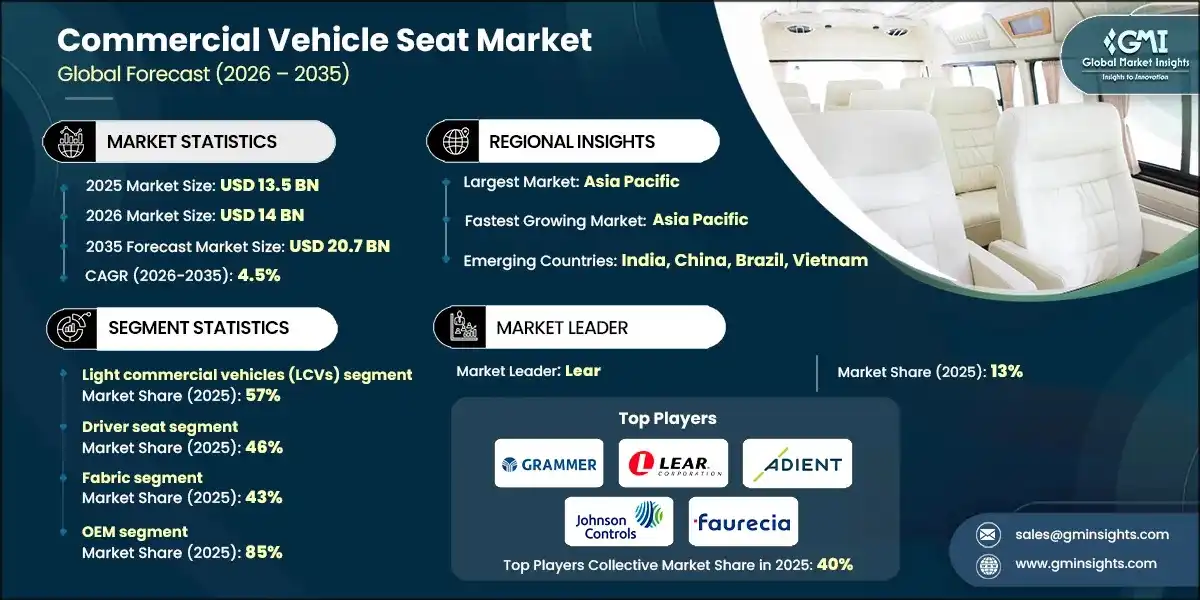
The global commercial vehicle seat market size was estimated at USD 13.5 billion in 2025. The market is expected to grow from USD 14 billion in 2026 to USD 20.7 billion in 2035, at a CAGR of 4.5% according to latest report published by Global Market Insights Inc.
Commercial Vehicle Seat Market Key Takeaways
Market Size & Growth
- 2025 Market Size: USD 13.5 Billion
- 2026 Market Size: USD 14 Billion
- 2035 Forecast Market Size: USD 20.7 Billion
- CAGR (2026–2035): 4.5%
Key Market Drivers
- Rising demand for lightweight and ergonomic seating.
- Stringent safety and emission regulations.
- Growth in e-commerce and logistics.
- Advancements in sustainable materials.
- Expansion of public transportation and fleet modernization.
Challenges
- High cost of advanced seating technologies.
- Supply chain disruptions.
Opportunity
- Growing demand for ergonomic and comfort-focused driver seats.
- Rising adoption of electric and autonomous commercial vehicles.
- Increasing use of modular and folding seating designs.
- Strong aftermarket replacement demand.
Key Players
- Market Leader: Lear led with over 13% market share in 2025.
- Leading Players: Top 5 players in this market include Lear, GRAMMER, Adient, Johnson Controls International, Faurecia, which collectively held a market share of 40% in 2025.
Get Market Insights & Growth Opportunities
The market is shifting towards ergonomic and comfort-focused designs due to rising awareness of driver health and efficiency. A study by the National Center for Biotechnology Information reveals that poorly designed seats cause back pain (90%), foot cramps (83%), and neck pain (77%), leading to productivity losses and higher healthcare costs for fleet operators.
Commercial vehicle seats are evolving from passive comfort elements to intelligent systems integrated with vehicle telematics and driver monitoring technologies. The shift toward powered/electric seats, heated and ventilated systems, memory functions, and massage capabilities reflects the premiumization of commercial vehicle interiors.
According to the Federal Transit Administration's National Transit Database, technology adoption in buses has significantly increased. Currently, 87% of buses have security cameras (up from 71% in 2014), 84% feature automated stop announcements (up from 63% in 2014), and 39% use automatic passenger counters (up from 15% in 2014). Additionally, seating systems now include sensors to monitor driver posture, detect fatigue, and adjust seat configurations for enhanced comfort.
The National Highway Traffic Safety Administration states that Level 4 and Level 5 autonomous systems will transform seating designs, enabling flexible interiors and modular seating. The premium segment is driving significant investments in advanced seating technologies.
The commercial vehicle seat market is witnessing strong growth due to stricter safety regulations globally. The National Highway Traffic Safety Administration enforces safety standards under FMVSS, covering seating systems, occupant crash protection, seat belt assemblies, anchorages, and flammability of interior materials.
The rapid growth of e-commerce and logistics services is driving increased demand for light commercial vehicles (LCVs) and delivery vans, fueling the market. The World Bank's report on COVID-19's impact on logistics highlights trucking services as essential infrastructure, exempt from lockdown restrictions during the pandemic.
To get key market trends
Commercial Vehicle Seat Market Trends
The market is undergoing significant changes due to regulatory updates, technological advancements, sustainability goals, and the rise of electrification and autonomous driving. These factors are redefining product development, competition, and value chain dynamics globally.
Commercial vehicle seating is being redesigned using biomechanical research, anthropometric data, and occupational health evidence to improve driver wellbeing and performance. This trend is most notable in long-haul trucking and transit buses, where drivers sit for 8 to 14 hours daily.
A study by the National Center for Biotechnology Information revealed significant anthropometric mismatches among Bangladeshi truck drivers using TATA, ASHOK LEYLAND, and ISUZU vehicles. Seat height mismatches ranged from 71% to 98%, while steering wheel clearance issues reached up to 100%. These mismatches contributed to health issues, with over 90% of drivers reporting back pain, 83% experiencing foot cramps, and 77% suffering neck pain.
Advancements in sensor technology and data analytics are transforming commercial vehicle seats. Once mere comfort elements, these seats are now integral to vehicle telematics and fleet management systems. This shift underscores the importance of monitoring driver behavior and physiological states, leading to enhanced safety and operational efficiency.
Smart seating systems feature pressure sensors to monitor posture and detect fatigue, temperature sensors to adjust climate zones based on body heat, and seat position sensors to restore seats to save memory settings for shared vehicles.
Regulatory mandates, corporate pledges, and a growing emphasis on environmental performance in procurement have shifted sustainability in commercial vehicle seating from a mere marketing message to a crucial operational necessity. This trend spans material choices, manufacturing methods, extending product lifespans, and recovering products at their end-of-life.
Commercial vehicle operators increasingly demand modular seating platforms with quick-release systems, folding/removable seats, and standardized rail interfaces. These features enable rapid interior reconfiguration to accommodate varying missions, passenger counts, and cargo needs, reducing reliance on single-purpose fleets.
Regulatory requirements and social equity considerations are transforming commercial vehicle seating specifications, particularly in public transportation. Laws like the Americans with Disabilities Act and similar global regulations mandate accommodations for passengers with disabilities, driving new design standards and market opportunities.
Commercial Vehicle Seat Market Analysis
Learn more about the key segments shaping this market
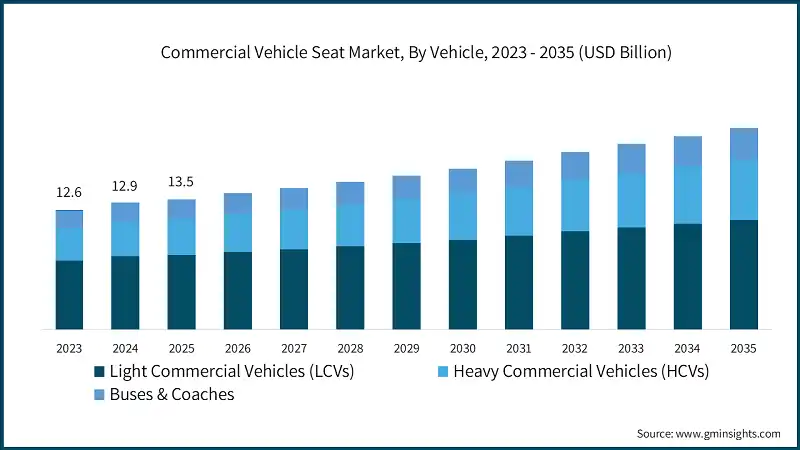
Based on vehicle, market is segmented into light commercial vehicles (LCVs), heavy commercial vehicles (HCVs), and buses & coaches. The light commercial vehicles (LCVs) segment dominates the market with 57% share in 2025, and the segment is expected to grow at a CAGR of 3.9% from 2026 to 2035 reflecting the segment's volume advantage and proliferation across last-mile delivery, service trades, and municipal fleets.
- The LCV segment includes vehicles with a gross vehicle weight of under 6,000 kg (13,228 lbs), such as panel vans, pickup trucks, and utility vehicles, used for applications like package delivery, trades, and municipal services.
- LCV seating prioritizes durability for frequent use, resistance to stains and wear, simplified adjustments to lower maintenance, and cost efficiency for price-sensitive buyers like small business operators and contractors.
- The World Bank attributes the surge in light commercial vehicle (LCV) demand to the rapid growth of e-commerce. During COVID-19, governments globally classified trucking and delivery services as essential, exempting them from lockdown restrictions.
- For instance, by March 2020, China's long-haul trucking volume recovered to 92% of 2019 levels, highlighting the sector's resilience. This growth has driven LCV fleet expansion, emphasizing comfortable driver seats and additional passenger seating for peak-season needs.
- Heavy commercial vehicles (HCVs), with GVWs above 15,000 kg (33,069 lbs), hold a 28% market share and are projected to grow at a 5.1% CAGR through 2034. Growth is driven by long-haul freight expansion, infrastructure construction, and premiumization trends addressing labor shortages.
- HCV seating specifications prioritize long-duration comfort for drivers spending 10-14 hours in their seats during long-haul operations.
- Features like vibration damping, powered adjustments, climate control, and ergonomic designs reduce road shock, address extreme temperatures, and minimize musculoskeletal disorder risks, with studies showing over 90% of truck drivers experiencing back pain.
- The Buses & Coaches segment, including transit buses, intercity coaches, school buses, shuttle buses, and specialized transport vehicles, is expected to hold a 15% market share in 2025.
- This is driven by higher seat counts (20-60 for transit buses, 50-80 for coaches) and premium specifications like ergonomic driver seats and durable, regulation-compliant passenger seats.
- Bus and coach seating specifications focus on mass transit needs, emphasizing durable materials, simplified maintenance, and ADA-compliant accessibility features. They adhere to FMVSS 222 safety standards while balancing fuel efficiency, capacity optimization, and passenger comfort for operational economics.
Learn more about the key segments shaping this market
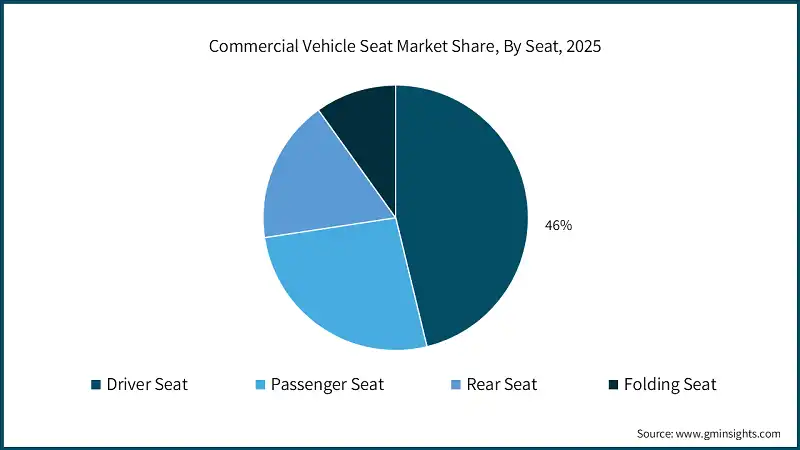
Based on seat, commercial vehicle seat market is divided into driver seat, passenger seat, rear seat, and folding seat. The driver seat segment dominates with 46% market share in 2025 and is growing at the fastest rate of 4.8% CAGR from 2026 to 2035 reflecting their premium specifications, advanced feature content, and critical importance to driver comfort, safety, and retention.
- Driver Seats hold the highest market value due to their ergonomic designs, advanced features like powered adjustments and climate control, and use of premium materials ensuring durability. Their role in enhancing operator health and productivity further justifies their higher price points.
- NCBI studies reveal that over 90% of truck drivers grapple with back pain, 83% endure foot cramps, and 77% face neck pain, all stemming from inadequately designed seating. This underscores the critical need for precise driver seat specifications.
- Fleet operators are adopting premium driver seats to retain talent in competitive labor markets. APTA data from 2023 highlights over 388,000 public transportation workers, with 4% job growth surpassing the 2% overall occupational growth. Seat upgrades in driver health programs reduce absenteeism, lower compensation claims, and improve satisfaction and retention.
- The driver seat segment is expected to grow at a CAGR of 4.8%, driven by premiumization, technological advancements, and the strategic emphasis on driver comfort.
- By 2025, forward-facing seats in commercial vehicles (pickup trucks, crew cabs, delivery vans) and passenger compartments (buses, coaches, shuttles) are expected to hold a 26.4% market share, valued at USD 3.5 billion.
- Specifications focus on durability for high usage, stain and vandalism resistance, and simplified designs to minimize maintenance. Cost optimization and accessibility features, such as priority seating zones, contrasting colors, and space for mobility aids, are also prioritized.
- Premium applications, such as intercity coaches and luxury shuttle services, are now equipping passenger seats with features that rival automotive standards. These enhancements include powered reclines, individual climate controls, integrated entertainment systems, and high-quality upholstery materials.
- Rear seats, predominantly used in extended cab pickups and crew-cab commercial vehicles, account for 18% of the market in 2024.
- These applications include occasional passenger transport, tool storage with folded seats, and multi-purpose configurations for passengers and cargo. Key features focus on foldable or removable designs, durability for intensive use, and simplified upholstery for cost efficiency and easy cleaning.
- Folding and removable rear seats enhance operational flexibility by creating flat load floors for transporting larger items. Some designs also include under seat storage or mounting points for toolboxes, maximizing space efficiency.
Based on material, the commercial vehicle seat market is segmented into fabric, vinyl, leather and synthetic materials. The fabric segment dominates with 43% market share in 2025 and is expected to expand at 4.6% CAGR during analysis timeframe.
- Fabric materials dominate commercial vehicle seating due to their cost-effectiveness, breathability for enhanced comfort in non-climate-controlled environments, and customization options.
- Their durability, supported by treatments like stain-resistant and flame-retardant coatings (FMVSS 302 compliant), further strengthens their suitability for commercial applications.
- Commercial vehicle fabric specifications focus on abrasion resistance, stain resistance, colorfastness, flame retardancy (FMVSS 302 compliance), and cleanability to ensure durability, safety, and reduced maintenance downtime.
- Manufacturers are increasingly selecting fabrics based on sustainability trends, opting for textiles made from recycled polyester sourced from PET bottles, blends of natural fibers like cotton and wool, and bio-based synthetic fibers to lessen reliance on petroleum.
- In 2025, vinyl, a PVC-based synthetic material known for its water resistance, easy cleaning, and durability, commands an 18% market share, translating to a valuation of USD 2.5 billion.
- Vinyl's waterproof and easy-to-clean properties make it ideal for vehicles exposed to weather, dirt, and chemicals, such as construction equipment, agricultural vehicles, and utility trucks. Its low-maintenance nature ensures quick sanitation, minimizing vehicle downtime.
- Commercial vinyl specifications focus on cold-crack resistance for flexibility in cold climates, UV stabilization to prevent sunlight-induced damage, flame retardancy per FMVSS 302, and grain patterns for aesthetics and slip resistance, along with puncture resistance to withstand sharp objects in work environments.
- Vinyl faces environmental challenges due to the chemical-intensive production of PVC and difficulties in recycling and disposal. Regulatory restrictions on phthalate plasticizers have further driven the development of phthalate-free alternatives.
- Leather holds a 27% market share, driven by its superior aesthetics, durability, breathability, and customization options. Its premium positioning reflects customer willingness to pay for enhanced vehicle specifications.
- Leather is widely used in premium commercial vehicles, including executive coaches, luxury tour buses, and high-spec heavy trucks, as well as in corporate and hospitality transportation. It enhances quality, comfort, brand positioning, and customer satisfaction, particularly in passenger-focused applications.
- Commercial vehicles prioritize select-grade hides with minimal blemishes, protective topcoats for durability, UV protection to prevent fading, fire-retardant treatments for safety, and perforations for better breathability in climate-controlled environments.
Based on sales channel, the commercial vehicle seat market is divided into OEM and aftermarket. OEM dominate with 85% market share in 2025, expanding at modest 4.3% CAGR during forecast period.
- The OEM channel supplies seats directly to commercial vehicle manufacturers, either integrated into assembly lines or through ship-to-line deliveries, reducing inventory costs.
- This channel's dominance highlights the integration of seating systems during vehicle design, aligning with chassis architecture, electrical systems, and customer-specific requirements for optimized applications.
- OEMs establish 3-7-year supply agreements aligned with vehicle platform lifecycles, requiring IATF 16949 certification, precise technical specifications, synchronized logistics, and collaborative engineering in vehicle development.
- OEM growth is driven by regulatory vehicle replacement cycles, the adoption of electric commercial vehicles (with DOE/EPA projecting 30% ZEV sales by 2030 and 100% by 2040), and autonomous vehicle programs enabling innovative seating configurations. Additionally, premiumization trends are prompting buyers to view advanced seating features as essential investments for driver retention.
- The Aftermarket segment serves replacement, upgrade, and retrofit applications through independent distributors, fleet maintenance providers, OEM parts networks, and direct-to-operator channels.
- This segment focuses on immediate operational needs, with price sensitivity among small fleet operators and shorter transaction cycles enabling rapid adoption of innovative products. It also features diverse product specifications to accommodate varied vehicle types, ages, and mission profiles.
- The evolution of distribution channels, driven by e-commerce platforms and digital parts catalogs, is fueling aftermarket growth. Online marketplaces enhance market transparency, intensify competition, and expand the reach of aftermarket seat suppliers beyond traditional geographic and inventory constraints.
Looking for region specific data?
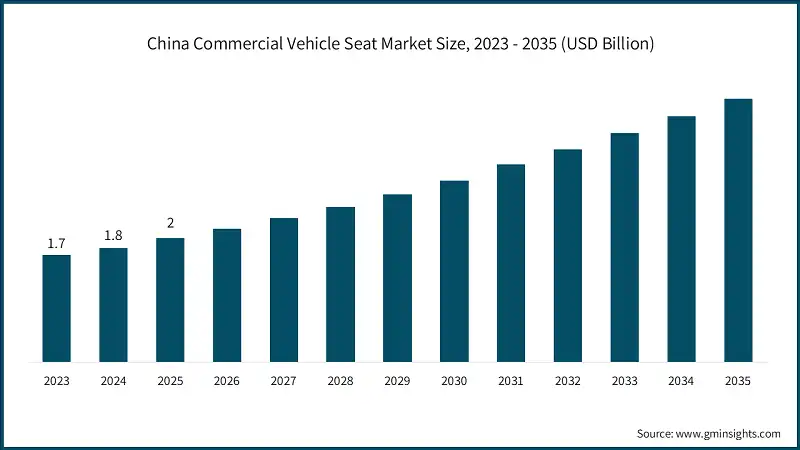
Asia Pacific region dominated the commercial vehicle seat market with a market share of 39% in 2025.
- The region's importance is driven by China's manufacturing scale, emerging economies' infrastructure growth, Japan and South Korea's automotive industries, and demographic trends like urbanization and middle-class expansion boosting commercial services demand.
- China holds a 38% regional share and is growing at a robust 7.9% CAGR, driven by its leading commercial vehicle production base and extensive logistics infrastructure supporting e-commerce and manufacturing.
- Greater China achieved 5.4% MHCV production growth in 2024, as per the PSR Truck Production Index, despite economic challenges like deflation concerns, property sector issues, and local government debt. This highlights the market's resilience.
- In 2025, the Asia Pacific region, including India, Japan, South Korea, ASEAN nations, and Australia/New Zealand, is expected to hold a 62% share. It is projected to grow at a remarkable CAGR of 10.9% through 2034, the fastest globally.
- India's fleet modernization, driven by BS VI implementation and upcoming BS VII standards in 2025, aligns with ASEAN's infrastructure investments supporting logistics growth. Additionally, Australia's mining and agricultural sectors continue to renew their vehicle fleets.
- According to PSR data, Japan and South Korea have achieved a 4.2% growth in MHCV production, bolstered by enhancements in their supply chains. In these mature markets, vehicles boast advanced specifications, encompassing premium seating systems, refined ergonomics, and integrated technologies.
- Japanese manufacturers like Isuzu, Hino, and Mitsubishi Fuso, along with Korean brands Hyundai and Kia, export commercial vehicles globally, boosting demand for Asia Pacific-made seating systems.
- Urbanization in the Asia Pacific is driving investments in public transportation and commercial vehicle fleets. Cities like Mumbai, Jakarta, and Bangkok are expanding transit systems, boosting seating demand.
The China leads the Asia Pacific commercial vehicle seat market.
- China holds a 38% share of the regional market and is growing at a 7.9% CAGR, driven by its leading commercial vehicle production base and extensive logistics infrastructure supporting e-commerce and manufacturing.
- Greater China achieved 5.4% MHCV production growth in 2024, as per the PSR Truck Production Index, despite economic challenges like deflation concerns, property sector issues, and local government debt. This highlights the market's resilience.
- A World Bank study on COVID-19's logistics impact highlighted China's rapid recovery, with long-haul trucking volumes rebounding from under 15% of 2019 levels in February 2020 to 92% by March 2020. This recovery, driven by market adaptability and supportive government policies, continues to fuel demand for commercial vehicles and seating.
- China's adoption of National VI emissions standards (equivalent to Euro VI) is driving fleet modernization and seating upgrades. This regulatory shift creates opportunities for seating suppliers to collaborate on new vehicle platforms.
- Rising demand for ergonomic, lightweight, and durable seats for drivers and passengers is driving market growth. This demand aligns with the expansion of e-commerce fleets, urban delivery vehicles, and intercity transportation networks.
- Leading seating suppliers and OEMs in China are driving growth by offering modular, premium, and sustainable seating solutions to domestic fleet operators and commercial vehicle manufacturers.
Europe commercial vehicle seat market accounted for USD 3.3 billion in 2025 and is anticipated to show growth of 4.9% CAGR over the forecast period.
- Europe is experiencing the second-fastest regional growth at a 4.9% CAGR, driven by sustainability mandates, public transit expansion, regulatory upgrades, and automotive engineering innovation.
- Germany, Europe's largest commercial vehicle manufacturing hub, is home to major truck OEMs like Daimler Truck AG, MAN Truck & Bus, and Scania. Its engineering excellence drives premium product development, early adoption of advanced features, and globally competitive seating system exports.
- Rest of Europe, including France, the UK, Italy, Spain, the Netherlands, Nordic countries, and others, is advancing public transit expansion and fleet modernization. These efforts align with sustainability mandates and EU regulatory harmonization to ensure uniform standards and market access.
- EU environmental regulations, particularly the EU VII emissions standards, drive European seating demand by enforcing stricter pollutant limits, including nitrous oxide (N2O), and requiring advanced technologies that necessitate vehicle and seating system redesigns.
- The European Green Deal's 2050 climate neutrality target is accelerating public and private sector efforts toward zero-emission vehicle adoption. Commercial vehicle operators face growing regulatory and societal pressure to transition their fleets.
- European commercial vehicle operators are at the forefront of global technology adoption, opting for advanced ergonomic seating, climate control, and massage functions in premium segments. They also integrating increasingly sophisticated monitoring systems with fleet telematics.
Germany dominates the Europe commercial vehicle seat market, showcasing strong growth potential, with a CAGR of around 5.1% from 2026 to 2035.
- Germany is a significant market for commercial vehicle seats in Europe, driven by its strong automotive manufacturing sector and focus on fleet modernization. Key OEMs like Daimler Truck, MAN, Volkswagen Truck & Bus, and Iveco are investing in advanced seating solutions to enhance driver comfort, safety, and ergonomics.
- The growing adoption of long-haul, urban delivery, and autonomous commercial vehicles is driving demand for ergonomic, lightweight, and durable seating. Government safety and emissions regulations further support the shift toward premium and modular seating solutions in the automotive industry.
- Germany's automotive supply chain, led by companies like GRAMMER, Lear Corporation, Faurecia, and Johnson Controls, is driving advancements in lightweight, modular, and smart seat technologies to enhance comfort, reduce fatigue, and improve efficiency.
- For instance, in 2024, GRAMMER partnered with Daimler Truck to develop ergonomic driver seats with air-suspension and vibration-damping systems, enhancing comfort and driver productivity in heavy-duty trucks.
- Germany's focus on digital mobility, fleet modernization, and regulatory compliance establishes it as a leader in premium, safety-compliant, and advanced commercial vehicle seating solutions in the European market.
The North America commercial vehicle seat market is anticipated to grow at a CAGR of 3.9% during the analysis timeframe.
- The region faces challenges from commercial vehicle production volatility, high interest rates affecting fleet investments, and mature market dynamics. However, growth opportunities arise from e-commerce expansion, government infrastructure spending, and the transition to electric commercial vehicles.
- Regulatory frameworks in North America, such as the NHTSA's FMVSS standards, significantly influence seating demand. These standards cover seating systems (FMVSS 207), occupant crash protection (FMVSS 208), seat belt assemblies (FMVSS 209), anchorages (FMVSS 210), and interior material flammability (FMVSS 302).
- The FMCSA regulates commercial vehicles through safety standards and enforcement regimes, ensuring compliance costs and supporting premium advanced seating systems that exceed regulatory requirements.
- In 2025, Canada is projected to hold a 17% regional share with a 4.6% CAGR, driven by USMCA trade integration, proximity to U.S. manufacturing hubs, and government-led infrastructure programs like public transit fleet modernization.
- The alignment of Canadian regulations with U.S. standards through the Canada Motor Vehicle Safety Standards (CMVSS) supports a unified North American market for seating suppliers. Additionally, colder climates in northern regions boost the demand for heated seating systems.
The commercial vehicle seat market in US is expected to experience significant and promising growth from 2026 to 2035.
- Hybrid, electric, and premium commercial vehicles are driving U.S. market growth. OEMs are increasingly adopting ergonomic, lightweight, and modular seating solutions to enhance driver comfort, safety, and efficiency.
- The United States holds 83% regional share, establishing itself as a key hub for commercial vehicle manufacturing.
- In 2024, the U.S. automotive sector supported over 580,000 jobs in the parts subsector, with foreign-owned affiliates employing 330,700 workers and investing over $7.9 billion in R&D in 2022.
- Collaboration among U.S. OEMs, Tier-1 suppliers, and seating manufacturers is driving innovations in ergonomic, modular, and lightweight seat designs, addressing the needs of both ICE and EV fleets.
- The U.S. leads in advanced, safety-compliant, and technologically advanced commercial vehicle seating solutions, driven by a strong manufacturing base, robust fleet operations, and alternative fuel adoption.
Brazil leads the Latin American commercial vehicle seat market, exhibiting remarkable growth of 4% during the forecast period of 2026 to 2035.
- Brazil dominates the Latin American market, driven by its expanding truck and bus manufacturing sector, growing logistics and e-commerce industries, and increasing demand for ergonomic seating in medium- and heavy-duty vehicles.
- Government policies and incentives are driving the adoption of advanced, durable, and safety-compliant seating systems in commercial vehicles, focusing on fleet modernization and emissions compliance.
- Brazilian OEMs and Tier-1 suppliers are innovating in seat design, utilizing lightweight materials, and adopting modular configurations to cater to the expanding demands of urban transport and logistics fleets.
- Brazil is set to lead the Latin American market, driven by robust industrial support, increasing fleet replacement needs, and advancements in ergonomic and premium seating solutions.
- For instance, in 2024, Marcopolo partnered with GRAMMER to develop ergonomic, vibration-damped seats for urban buses, emphasizing Brazil's focus on innovation and comfort in commercial vehicles.
South Africa to experience substantial growth in the Middle East and Africa commercial vehicle seat market in 2025.
- South Africa is becoming a key player in Africa's market, driven by rising demand for modern trucks and buses, fleet expansions, and increased adoption of ergonomic seating solutions.
- The commercial vehicle market is growing despite economic volatility and infrastructure gaps. NAAMSA reports steady growth in medium- and heavy-duty truck sales in 2024, driven by fleet replacement and expansion trends.
- South Africa is introducing policies to modernize its fleet by incentivizing National VI emissions compliance and advanced seating technologies. Government collaboration with industry stakeholders is improving production capacity and quality standards for commercial vehicle components.
- South Africa's fleet modernization programs, favorable regulations, and growing demand for ergonomic, durable seating are driving its position as a regional leader in commercial vehicle seat innovation.
Commercial Vehicle Seat Market Share
- The top 7 companies in the market are GRAMMER, Lear, Adient, Johnson Controls International, Faurecia, RECARO Automotive Seating and TS TECH contributed around 42% of the market in 2025.
- GRAMMER focuses on seating solutions for commercial vehicles and off-highway equipment, enabling expertise in applications like long-haul trucking, construction equipment, and rail vehicles, where seating needs differ from passenger vehicles.
- Lear, leveraging its position as one of the world's leading automotive technology suppliers with comprehensive seat system capabilities spanning complete seat design, engineering, testing, and manufacturing.
- Adient, the world's largest automotive seating supplier since its 2016 spin-off from Johnson Controls International plc, focuses on delivering complete seating solutions. These include mechanisms, structures, trim, and advanced electronics for powered adjustments and smart features.
- Johnson Controls International continues to operate in the commercial vehicle seating market, focusing on niche products, aftermarket services, and integrating seating with its HVAC technologies to enable climate-controlled systems for premium vehicles.
- Faurecia, a leader in integrated seating solutions, is expanding its portfolio to encompass cockpit electronics and interior systems. By seamlessly merging seats with displays, climate controls, and connectivity, the company is crafting unique value propositions. This is especially pertinent for commercial vehicle OEMs focused on advancing cabins, notably for electric and autonomous vehicles.
- RECARO Automotive Seating specializes in premium commercial vehicle segments, including luxury coaches, specialty trucks, and retrofit applications, leveraging its brand heritage and performance reputation to justify premium pricing.
- TS TECH focuses on Asian markets, primarily serving Japanese commercial vehicle manufacturers like Honda, Isuzu, and Hino. The company excels in precision manufacturing, just-in-time delivery, and product development tailored to Japanese OEM standards and customer preferences.
Commercial Vehicle Seat Market Companies
Major players operating in the market are:
- Adient
- Daimler
- Faurecia
- GRAMMER
- Hyundai Dymos
- Iveco
- Johnson Controls
- Lear
- RECARO Automotive Seating
- TS TECH
- The competitive landscape of the market is marked by the presence of several key players, including Lear, Adient, Grammer, and Freedman Seating. These companies compete on parameters such as technological advancements, durability, ergonomic design, and cost-effectiveness to cater to diverse commercial vehicle applications.
- With rising demand for enhanced driver comfort and safety, manufacturers focus on integrating innovative materials and smart seating solutions. Additionally, stringent regulatory standards for commercial vehicles drive the need for high-quality seating systems that ensure compliance with safety and sustainability guidelines.
- Technological advances play a crucial role in defining competition, with companies investing heavily in R&D to differentiate their products. Features such as adjustable lumbar support, vibration-dampening mechanisms, heated and ventilated seats, and lightweight materials are becoming industry standards.
- Geographical expansion and strategic partnerships are key strategies adopted by market players to strengthen their presence. Leading companies are expanding their manufacturing footprint in Asia-Pacific and Latin America, where the demand for commercial vehicles is increasing due to infrastructure growth. Mergers and acquisitions help companies consolidate their market position and gain access to new technologies and customer bases. The ability to scale production while maintaining quality and cost efficiency is a crucial factor influencing market leadership.
Commercial Vehicle Seat Market Report Attributes
| Key Takeaway | Details |
|---|---|
| Market Size & Growth | |
| Base Year | 2025 |
| Market Size in 2025 | USD 13.5 Billion |
| Market Size in 2026 | USD 14 Billion |
| Forecast Period 2026-2035 CAGR | 4.5% |
| Market Size in 2035 | USD 20.7 Billion |
| Key Market Trends | |
| Drivers | Impact |
| Rising demand for lightweight and ergonomic seating | Improves driver comfort and fuel efficiency while reducing fatigue in long-haul and commercial operations. |
| Stringent safety and emission regulations | Drives adoption of compliant, lightweight seat designs that support vehicle safety and emission targets. |
| Growth in e-commerce and logistics | Expanding delivery fleets increases demand for durable and cost-effective driver and passenger seats. |
| Advancements in sustainable materials | Encourages use of recyclable and eco-friendly seat materials to meet sustainability and OEM requirements. |
| Expansion of public transportation and fleet modernization | Increased procurement of buses and commercial fleets boosts demand for high-volume and durable seating solutions. |
| Pitfalls & Challenges | Impact |
| High cost of advanced seating technologies | Elevated seat prices limit adoption of premium, ergonomic, and smart seating solutions among cost-sensitive fleet operators. |
| Supply chain disruptions | Raw material shortages and logistics delays increase production costs and lead times, affecting OEM delivery schedules. |
| Opportunities: | Impact |
| Growing demand for ergonomic and comfort-focused driver seats | Increases adoption of premium seats that reduces driver fatigue and improves safety in long-haul and commercial operations. |
| Rising adoption of electric and autonomous commercial vehicles | Drives demand lightweight, smart, and modular seating aligned with new vehicle architectures. |
| Increasing use of modular and folding seating designs | Supports flexible vehicle layouts for multi-purpose and urban mobility applications. |
| Strong aftermarket replacement demand | Generates recurring revenue from seat upgrades and replacements across aging commercial fleets. |
| Market Leaders (2025) | |
| Market Leaders |
13% Market Share |
| Top Players |
|
| Competitive Edge |
|
| Regional Insights | |
| Largest Market | Asia Pacific |
| Fastest Growing Market | Asia Pacific |
| Emerging Country | India, China, Brazil, Vietnam |
| Future Outlook |
|
What are the growth opportunities in this market?
Commercial Vehicle Seat Industry News
- In September 2024, FORVIA announced that their truck seat range reduces CO2 emissions by up to 40% and incorporates sustainable materials.
- In March 2024, Toyota Boshoku Corporation announced that it is developing technologies for autonomous driving, including Relax & Safety Seats for enhanced passenger comfort and an Active Driver Engagement System to reduce fatigue.
- In September 2023, Adient unveiled its latest seating innovations at IAA 2023, focusing on sustainability, cost-effectiveness, and comfort. Their new Pure Essential seat is lightweight and environmentally conscious, designed for recyclability and minimal material use.
- In March 2023, Lear Corporation announced that the company was chosen by General Motors to supply front and rear seats for the 2024 Chevrolet Silverado EV. The second-row seat, designed by Lear, offers multiple configurations, including a fold-flat feature that expands storage with GM’s Multi-Flex Midgate. Lear would manufacture these seats at its new Detroit facility.
The commercial vehicle seat market research report includes in-depth coverage of the industry with estimates & forecasts in terms of revenue ($Bn) & shipment (Units) from 2022 to 2035, for the following segments:
Market, By Seat
- Driver seat
- Passenger seat
- Rear seat
- Folding seat
Market, By Material
- Fabric
- Vinyl
- Leather
- Synthetic materials
Market, By Vehicle
- Light commercial vehicles (LCV)
- Heavy commercial vehicles (HCV)
- Buses & coaches
Market, By Technology
- Standard/conventional seats
- Powered/electric seats
- Heated & ventilated seats
- Memory seats
- Massage seats
Market, By Sales Channel
- OEM
- Aftermarket
The above information is provided for the following regions and countries:
- North America
- US
- Canada
- Europe
- Germany
- UK
- France
- Italy
- Spain
- Russia
- Nordics
- Benelux
- Asia Pacific
- China
- India
- Japan
- Australia
- South Korea
- Singapore
- Thailand
- Indonesia
- Vietnam
- Latin America
- Brazil
- Mexico
- Argentina
- Colombia
- MEA
- South Africa
- Saudi Arabia
- UAE
Frequently Asked Question(FAQ) :
What is the market size of the commercial vehicle seat market in 2025?
The global market size for commercial vehicle seat was valued at USD 13.5 billion in 2025, driven by rising demand for ergonomic seating, fleet modernization, and growth in logistics and public transportation.
What is the projected value of the commercial vehicle seat market by 2035?
The market is expected to reach USD 20.7 billion by 2035, growing at a CAGR of 4.5% from 2026 to 2035 due to premiumization, safety regulations, and adoption of smart seating technologies.
What will be the market value of the market in 2026?
The market is projected to reach USD 14 billion in 2026, reflecting steady demand from OEMs and expanding commercial vehicle fleets.
Which vehicle segment leads the market?
Light commercial vehicles (LCVs) dominate the market with a 57% share in 2025, supported by rapid growth in e-commerce, last-mile delivery, and municipal fleets.
Which region leads the commercial vehicle seat market?
Asia Pacific leads the global market with a 39% share in 2025, driven by large-scale commercial vehicle production in China, infrastructure development, and rapid logistics expansion.
Who are the key players in the commercial vehicle seat market?
Major players include GRAMMER, Lear, Adient, Johnson Controls International, Faurecia, RECARO Automotive Seating, and TS TECH.
Commercial Vehicle Seat Market Scope
Related Reports