Summary
Table of Content

Commercial Cooling Meters Market
Get a free sample of this report
Form submitted successfully!
Error submitting form. Please try again.
Thank you!
Your inquiry has been received. Our team will reach out to you with the required details via email. To ensure that you don't miss their response, kindly remember to check your spam folder as well!
Request Sectional Data
Thank you!
Your inquiry has been received. Our team will reach out to you with the required details via email. To ensure that you don't miss their response, kindly remember to check your spam folder as well!
Form submitted successfully!
Error submitting form. Please try again.
Commercial Cooling Meters Market Size
- Growing expansion of commercial real estate including office complexes, retail centers, hospitality projects and institutional buildings to drive the rising need of cooling measurement solutions. Modern facility owners are adopting cooling meters to improve operational efficiency and to gain accurate insights into consumption patterns, detect inefficiencies and to enhance system performance, optimizing cooling distribution driving the momentum.
- Cooling meters are the measuring devices which are used to measure the energy consumed for cooling purposes in heating, ventilation and air conditioning (HVAC) systems. These meters quantify the accurate units of energy transferred via cooling systems, especially in chilled water and other cooling mediums.
- Rising consumer usage around commercial property owners prefer advanced metering solutions that offer long‑term precision, durable construction and the ease of integration into existing cooling systems. The need for accurate billing in multi‑occupancy buildings and district cooling networks which continues to widen the market base, marking an essential component of commercial energy‑management frameworks, fosters industry expansion.
- For instance, in May 2023, the U.S. DOE flourished an investment of USD 40 million to support 15 projects focused on advancing high‑performance, energy‑efficient cooling technologies for data centers. These projects are run by national laboratories, universities aim to significantly reduce the energy required to cool data centers represent a meaningful share of national electricity consumption.
- Ongoing retrofit market for advanced cooling meters for older commercial buildings are upgraded to meet energy efficiency goals is set to drive the business momentum. Existing commercial firms are upgrading traditional meters to smart cooling meters to experience better control over energy usage and comply with stringent new regulations, strengthening the industry landscape.
- Paradigm shift toward renewable energy audits inefficiencies in commercial cooling systems, targeted improvements owing to equipment upgrades or system setting adjustments and delivers more prevalent. Sustainable energy performance yield significant cost savings, positively impacting the industry statistics. In addition, the incorporation of cooling meters into smart building systems is set to bolster the industry dynamics.
The commercial cooling meters market was estimated at USD 900 million in 2025. The market is expected to grow from USD 1 billion in 2026 to USD 1.6 billion in 2035, at a CAGR of 5.4% according to a recent study by Global Market Insights Inc.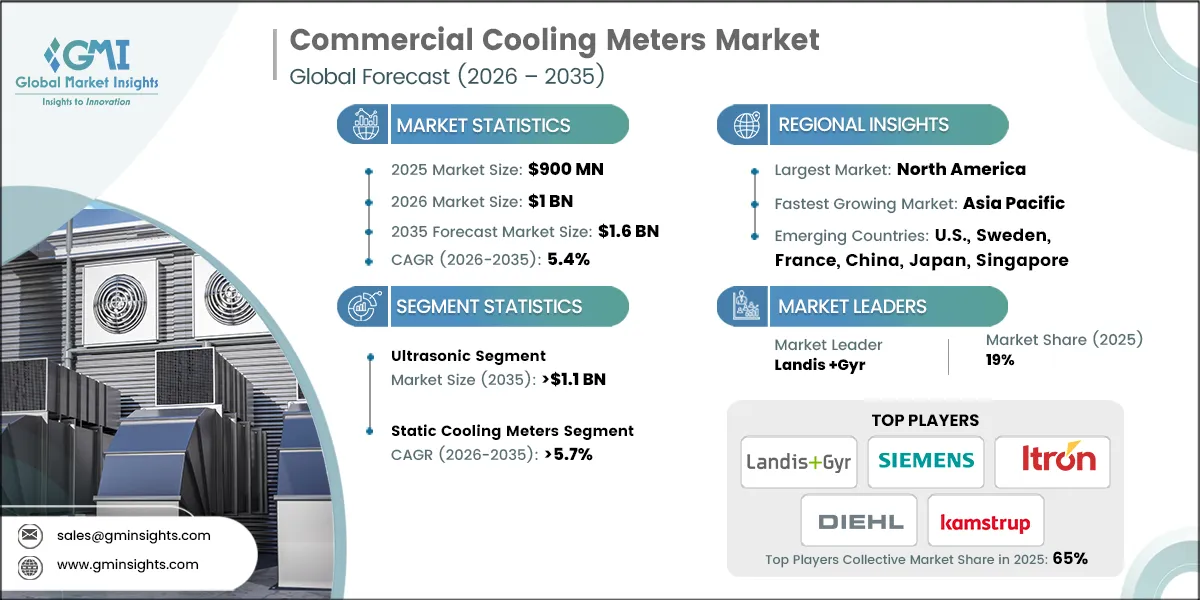
Commercial Cooling Meters Market Key Takeaways
Market Size & Growth
- 2025 Market Size: USD 900 Million
- 2026 Market Size: USD 1 Billion
- 2035 Forecast Market Size: USD 1.6 Billion
- CAGR (2026–2035): 5.4%
Regional Dominance
- Largest Market: North America
- Fastest Growing Region: Asia Pacific
Key Market Drivers
- Growing demand for energy efficiency.
- Integration with smart building technologies.
- Regulatory compliance and incentives.
Challenges
- Technical limitations during extreme weather conditions.
Opportunity
- Growth in Smart Buildings and Energy Efficiency Programs.
- Expansion of District Cooling Systems.
Key Players
- Market Leader: Landis +Gyr led with over 19% market share in 2025.
- Leading Players: Top 5 players in this market include Siemens, Landis+Gyr, Kamstrup, Itron, Diehl Stiftung, which collectively held a market share of 65% in 2025.
Get Market Insights & Growth Opportunities
To get key market trends
Commercial Cooling Meters Market Trends
- Building owners and facility managers increasingly prioritize energy accountability and operational transparency towards upgraded modern technologies support more accurate monitoring and help businesses benefit from their cooling strategies. Modern commercial establishments helping organizations align with green‑building standards while maintaining reliable operation. Multi‑tenant buildings, district cooling networks and large commercial campuses are adopting advanced metering solutions to ensure fair allocation of cooling costs for billing accuracy which improves stability under variable load conditions, and stronger safeguards against measurement drift.
- For instance, in May 2025, ABB introduced its next generation of electromagnetic flowmeters, delivering a new level of accuracy, connectivity and operational flexibility for both commercial and utility sectors, focusing on two advanced models ProcessMaster and AquaMaster with high‑performance measurement capabilities with modular architectures and built‑in IoT connectivity, enabling easier upgrades, improved inventory management across connected flow assets.
- Growing demand to adopt solutions that promote efficient energy use and reduce environmental impact, these meters are designed for long lifecycle performance, minimal maintenance requirements, and compatibility with green‑building initiatives are gaining significant traction, aligns with the broader push toward sustainable commercial development.
- Retrofit expansion of data‑intensive facilities including tech parks, corporate campuses, retail hubs and hospitality complexes is contributing to the business environments that requires robust cooling measurement to manage increasing thermal loads and keeping operational costs under control. In addition, growing consumer demand toward meters is capable of long‑term durability and reliable performance in higher utilization settings.
Commercial Cooling Meters Market Analysis
Learn more about the key segments shaping this market
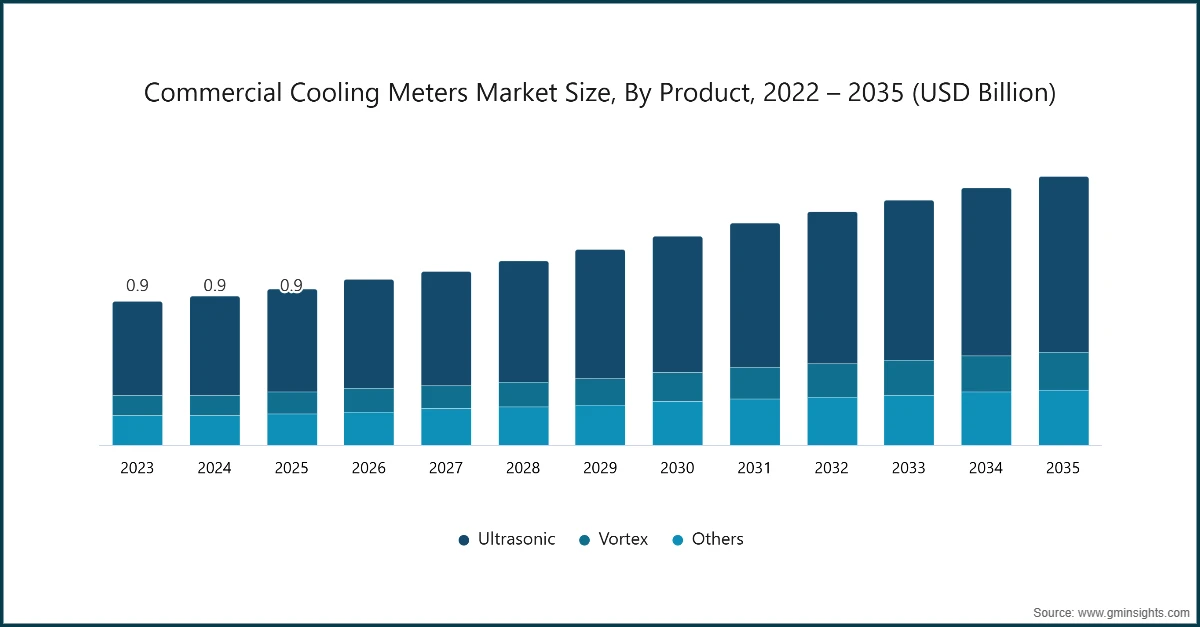
Based on product, the market is segmented into ultrasonic, vortex and others.
- Ultrasonic is set to grow more than USD 1.1 billion by 2035. These meters are gaining traction in the business sector with rising emphasis on precision, reliability, and advanced monitoring capabilities. Their ability to deliver consistently accurate measurements makes them an asset for modern buildings that require detailed visibility into cooling usage. Leveraging dependable performance without disrupting system flow, ultrasonic cooling meters are emerging as trusted, long‑term solutions for efficient and uninterrupted cooling management.
Learn more about the key segments shaping this market
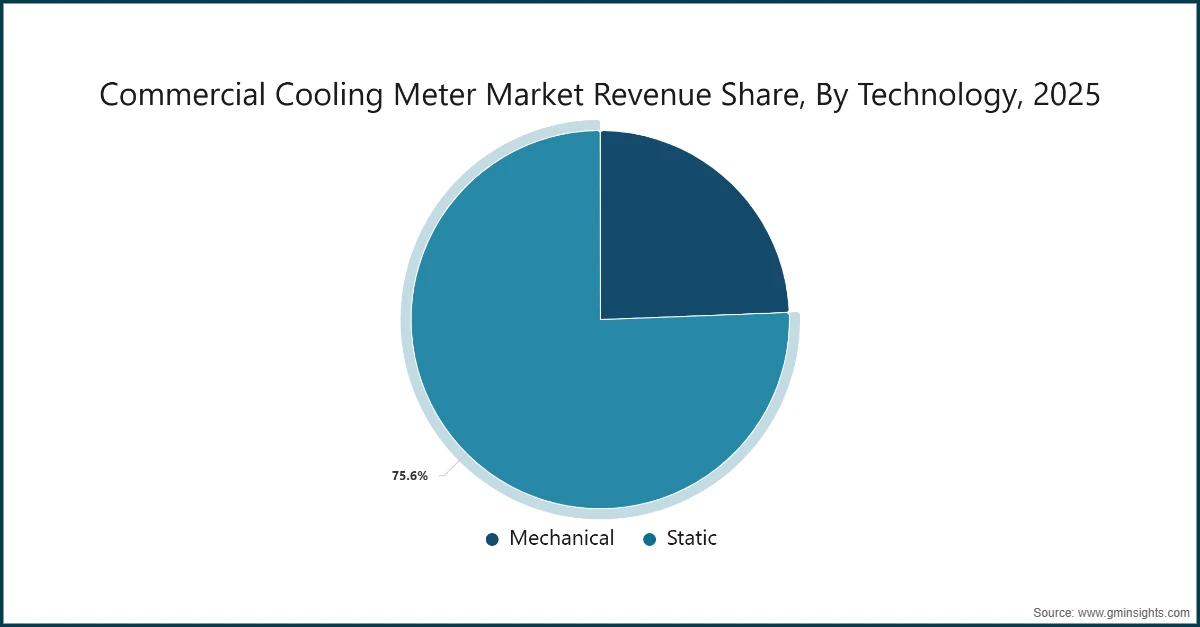
Based on technology, the commercial cooling meters market is segmented into static and mechanical.
- Static cooling meters are anticipated to grow at a CAGR of more than 5.7% by 2035, driven by the accurate measurements of flow and energy usage which makes these systems valuable. These meters integrate supports real‑time monitoring and automated control strategies with digital cooling networks that allows facility managers to capture more granular data, ensuring better alignment as wider acceptance across modern commercial developments.
Looking for region specific data?
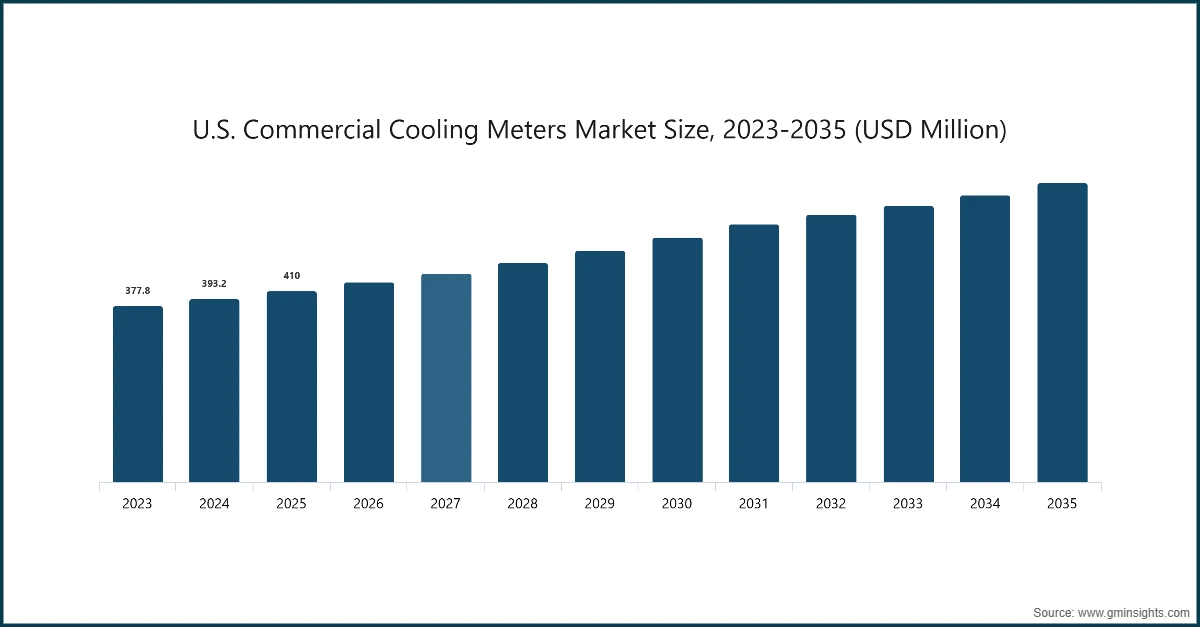
The U.S. commercial cooling meters market is set to grow more than USD 641.2 million by 2035.
- Rising incorporation of smart building systems enabling automated control, continuous performance monitoring and data‑driven energy optimization, which is surged to accelerate market expansion. Favorable energy‑efficiency regulations and the stricter enforcement of building codes requiring accurate metering solutions owing to commercial cooling meters, further lifting industry momentum. Moreover, rising emphasis with the meters and IoT‑enabled infrastructure reinforcing the overall competitiveness and growth potential, fostering the business growth.
Commercial Cooling Meters Market Share
- Key major players in the market increasing focuses on strategies to enhance product performance, operational intelligence includes developing advanced metering technologies that deliver higher measurement accuracy, improved durability and seamless integration with modern building management systems. Flourishing investments in digital capabilities owing to remote monitoring, data analytics and smart connectivity to help customers optimize cooling efficiency and reduce operational costs.
Commercial Cooling Meters Market Companies
Eminent players operating in the commercial cooling meters industry are:
- Apator Group
- Axioma Metering
- Badger Meter
- BMETERS
- Danfoss
- Diehl Stiftung & Co. KG
- Honeywell International
- Integra Metering
- Itron
- ista Energy Solutions
- Kamstrup
- Landis+Gyr
- Qundis
- Schneider Electric
- Secure Meters
- Sensus
- Siemens
- Sontex
- Techem
- Zenner International
Commercial Cooling Meters Market Report Attributes
| Key Takeaway | Details |
|---|---|
| Market Size & Growth | |
| Base Year | 2025 |
| Market Size in 2025 | USD 900 Million |
| Market Size in 2026 | USD 1 Billion |
| Forecast Period 2026-2035 CAGR | 5.4% |
| Market Size in 2035 | USD 1.6 Billion |
| Key Market Trends | |
| Drivers | Impact |
| Growing demand for energy efficiency | Constant efforts to reduce energy consumption, lower carbon emissions, and improve overall building efficiency, by governments, businesses, and property owners will contribute to market growth. Cooling meters support in measuring and tracking the actual amount of energy used for chilled water systems and air conditioning, making it easier to monitor performance and identify waste, driving the business momentum. |
| Integration with smart building technologies | Introduction of building codes along with energy performance standards, and incentive programs by federal, state, and local authorities to encourage lower carbon footprints will lead to market growth. Shifting focus on reducing energy use and adopting clean energy sources along with increasing requirement for accurate measurement and monitoring of energy consumption will augment the demand for high rated products. |
| Regulatory compliance and incentives | Cooling meters enable landlords to bill tenants based on actual usage rather than fixed allocations, ensuring compliance with energy laws. They provide the data foundation necessary to maintain certification and pass audits. |
| Pitfalls & Challenges | Impact |
| Technical limitations during extreme weather conditions | Very high or very low temperatures, humidity, or storms may cause devices to give inaccurate readings or even temporarily fail. This technical limitation can disrupt energy monitoring, reduce the reliability of data, and increase maintenance needs, which may slow down adoption, especially in regions with harsh climates. |
| Opportunities: | Impact |
| Growth in Smart Buildings and Energy Efficiency Programs | Growing adoption of smart technologies to monitor consumption, control costs, and improve overall efficiency, will complement the market growth. Government programs and utility incentives to promote energy savings will create growth opportunities for manufacturers and solution providers. |
| Expansion of District Cooling Systems | Expansion of district cooling systems in urban areas, and in regions with hot climates will complement the market size. Cooling meters play a key role in monitoring energy use, ensuring accurate billing and fair cost distribution within these networks. Increasing investment in centralized cooling infrastructure, will surge the product demand. |
| Market Leaders (2025) | |
| Market Leader |
19% market share |
| Top Players |
Collective market share in 2025 is 65% |
| Competitive Edge |
|
| Regional Insights | |
| Largest Market | North America |
| Fastest growing market | Asia Pacific |
| Emerging countries | U.S., Sweden, France, China, Japan, Singapore |
| Future outlook |
|
What are the growth opportunities in this market?
Commercial Cooling Meters Industry News
- In December 2025, Malema launched its new M‑2300 Series High‑Purity Inline Straight Tube Ultrasonic Flow Meter for precision flow measurement in semiconductor environments. It is designed to meet the stringent demands of advanced chip‑manufacturing processes and the M‑2300 Series delivers accurate, reliable flow monitoring, integrates an ultrasonic sensor and electronics into a single streamlined unit.
- In March 2025, SONOTEC expanded its SONOFLOW sensor family, presenting the SONOFLOW CO.55 SD V3.0 with an advanced, non‑contact clamp‑on flow meter that stands out for its integrated touch display and stainless‑steel housing. This device features at INTERPHEX and designed sensor enhances liquid‑handling efficiency in bioprocess environments.
- In February 2024, Diehl Metering introduced the latest generation of its ALTAIR volumetric water meter series, unveiling the ALTAIR V5 with a strong focus on durability and sustainability. This new model features a compact, eco‑designed construction that reduces material use and lowers its environmental footprint and enhances long‑term performance. It is developed with smart‑metering readiness, supports modern water management needs and through modular clip‑on radio options.
- In September 2024, Kamstrup reduced lead concentration for cooling meters to up to 0.1% implementing all brass housings transitioning to a maximum lead concentration of 0.1% within the 19 x 165 mm brass housing. This initiative supports sustainable development by offering clients products with minimal lead impact.
This commercial cooling meters market research report includes an in-depth coverage of the industry with estimates & forecast in terms of volume and revenue in “USD Million & ‘000 Units” from 2022 to 2035, for the following segments:
Market, By Product
- Ultrasonic
- Vortex
- Others
Market, By Technology
Mechanical
Static
Market, By Application
College/University
Office Building
- Government Building
- Others
The above information has been provided for the following regions and countries:
- North America
- U.S.
- Canada
- Europe
- Germany
- Poland
- Sweden
- Italy
- France
- Finland
- Austria
- Norway
- Asia Pacific
- China
- Japan
- South Korea
- Singapore
- India
- Middle East
- Saudi Arabia
- UAE
- Qatar
- Oman
- Kuwait
- Rest of World
Frequently Asked Question(FAQ) :
What is the market size of the commercial cooling meters in 2025?
The market size was USD 900 million in 2025, with a CAGR of 5.4% expected through 2035, driven by growing commercial real estate expansion and rising demand for energy efficiency solutions.
What is the projected value of the commercial cooling meters industry by 2035?
The commercial cooling meters market is expected to reach USD 1.6 billion by 2035, propelled by smart building integration, district cooling expansion, and stricter energy reporting requirements.
What is the current commercial cooling meters industry size in 2026?
The market size is projected to reach USD 1 billion in 2026.
How much is the ultrasonic segment expected to generate by 2035?
The ultrasonic segment is set to grow to more than USD 1.1 billion by 2035, driven by rising emphasis on precision, reliability, and advanced monitoring capabilities in modern commercial buildings.
What is the growth outlook for the static technology segment from 2026 to 2035?
Static cooling meters are anticipated to grow at a CAGR of more than 5.7% by 2035, driven by accurate flow and energy measurement capabilities and seamless integration with digital cooling networks.
Which region leads the commercial cooling meters market?
The U.S. commercial cooling meters market is set to grow to more than USD 641.2 million by 2035, supported by smart building adoption, favorable energy-efficiency regulations, and stricter enforcement of building codes.
What are the upcoming trends in the commercial cooling meters market?
Key trends include integration with smart building systems, adoption of IoT-enabled remote monitoring platforms, retrofit upgrades in older commercial buildings, and growing demand for sustainable and long-lifecycle metering solutions.
Who are the key players in the commercial cooling meters market?
Key players include Apator Group, Axioma Metering, Badger Meter, BMETERS, Danfoss, Diehl Stiftung & Co. KG, Honeywell International, Integra Metering, Itron, ista Energy Solutions, Kamstrup, Landis+Gyr, Qundis, Schneider Electric, Secure Meters, Sensus, Siemens, Sontex, Techem, and Zenner International.
Commercial Cooling Meters Market Scope
Related Reports