Summary
Table of Content

Commercial Boiler Market
Get a free sample of this report
Form submitted successfully!
Error submitting form. Please try again.
Thank you!
Your inquiry has been received. Our team will reach out to you with the required details via email. To ensure that you don't miss their response, kindly remember to check your spam folder as well!
Request Sectional Data
Thank you!
Your inquiry has been received. Our team will reach out to you with the required details via email. To ensure that you don't miss their response, kindly remember to check your spam folder as well!
Form submitted successfully!
Error submitting form. Please try again.
Commercial Boiler Market Size
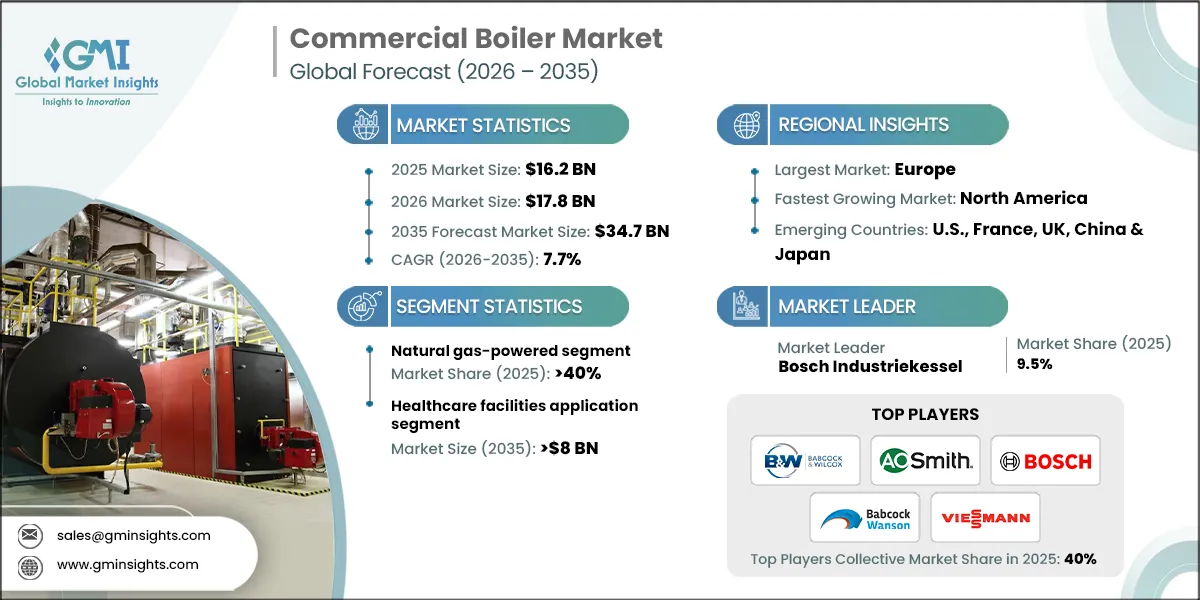
According to a recent study by Global Market Insights Inc., the commercial boiler market was estimated at USD 16.2 billion in 2025. The market is expected to grow from USD 17.8 billion in 2026 to USD 34.7 billion by 2035, at a CAGR of 7.7%.
To get key market trends
- The growing focus on reducing carbon emissions along with the push for electrification & the adoption of hybrid heating solutions will elevate the business landscape. Expanding district heating networks combined with the rising preference for modular and packaged boiler systems in commercial settings will stimulate the industry dynamics.
- Commercial boiler technology reflects a sophisticated integration of engineering excellence and operational reliability, developed to provide consistent, high-capacity heating solutions for diverse commercial environments. These systems focus on delivering optimal thermal performance through advanced heat transfer mechanisms, intelligent control systems, and precision in combustion processes.
- Growing adoption of low-emission and eco-friendly boiler systems in conjunction with stringent environmental regulations will accelerate business growth. Continuous innovation in modular and simpler design coupled with delivering energy efficiency in heating solutions will drive the business potential.
- For instance, at COP28, nearly 200 nations signed a landmark agreement to accelerate global energy efficiency improvements by 2030. This initiative is expected to drive decarbonization, foster economic growth, diversify energy sources, and spur innovation in operational efficiency.
- The commercial boiler market was valued at USD 12.7 billion in 2022 and grew at a CAGR of over 4.5% through 2025. The growing emphasis on smart city development coupled with seamless urban integration and accelerating urbanization will drive the business momentum.
- Ongoing advancements in boiler technology, including advanced digital controls, IoT-enabled connectivity, and predictive maintenance capabilities will enhance the product adoption. In addition, the growing development of district heating networks in line with the increasing adoption of packaged boiler systems within commercial spaces will positively influence the business scenario.
- Increased public spending in the healthcare sector along with significant investments from both private and government entities will strengthen the business landscape. The rising application of these systems for space heating, water heating, and sterilizing autoclave equipment will further accelerate industry potential.
- For instance, in July 2025, AstraZeneca announced a USD 50 billion U.S. investment through 2030 to expand its manufacturing and R&D capabilities. The initiative includes building a pharmaceutical facility in Virginia with its largest single investment to date alongside the expansion of research and cell therapy production across key sites in California, Maryland, Massachusetts, Texas, and Indiana.
Commercial Boiler Market Report Attributes
| Key Takeaway | Details |
|---|---|
| Market Size & Growth | |
| Base Year | 2025 |
| Market Size in 2025 | USD 16.2 Billion |
| Market Size in 2026 | USD 17.8 Billion |
| Forecast Period 2026 - 2035 CAGR | 7.7% |
| Market Size in 2035 | USD 34.7 Billion |
| Key Market Trends | |
| Drivers | Impact |
| Increasing demand for space heating in commercial buildings | The growing need for reliable and efficient heating solutions in facilities is driving the adoption of advanced boilers that ensure consistent thermal comfort across large areas. |
| Surging replacement of existing heating units with energy-efficient boilers | Businesses are increasingly upgrading outdated systems with modern, high-efficiency boilers to reduce operational costs, improve performance, and comply with evolving sustainability goals. |
| Stringent government regulations pertaining to carbon emissions | Tighter environmental standards and emission control policies are accelerating the shift toward low-emission and eco-friendly boiler technologies, reinforcing their role in sustainable building practices. |
| Pitfalls & Challenges | Impact |
| High initial investment | The substantial upfront cost associated with installing advanced boilers often poses a challenge for businesses, particularly small and medium enterprises. This financial barrier can delay adoption despite long-term benefits in efficiency and sustainability. |
| Opportunities: | Impact |
| Smart building integration | The growing adoption of building automation systems creates opportunities for IoT-enabled commercial boilers with remote monitoring, predictive maintenance, and integration into centralized energy management platforms. |
| Energy-efficient heating solutions | Rising demand for sustainability and compliance with green building standards is driving innovation in high-efficiency commercial boilers. Advanced condensing technology, low-emission burners, and optimized heat exchangers are key areas of development to minimize fuel consumption and carbon footprint. |
| Flexible and modular systems | Commercial spaces require modular boiler systems that can scale with demand. Compact, easy-to-install designs allow businesses to optimize space utilization while ensuring reliable heating performance. |
| Enhanced safety and compliance | Stringent safety regulations and customer expectations are creating opportunities for heating technologies equipped with advanced safety features, including automated shutdown systems, real-time fault detection, and compliance with ASME and local standards. |
| Market Leaders (2025) | |
| Market Leaders |
9.5% market share |
| Top Players |
|
| Competitive Edge |
|
| Regional Insights | |
| Largest Market | Europe |
| Fastest Growing Market | North America |
| Emerging Country | U.S., France, UK, China & Japan |
| Future outlook |
|
What are the growth opportunities in this market?
Commercial Boiler Market Trends
- The widespread use of these systems in commercial facilities including schools, government institutions, universities, and airports will elevate the demand of this product. Additionally, rising government expenditure on healthcare coupled with substantial investments from both public and private sectors will positively sway the industry scenario.
- Urbanization and rapid infrastructure development are playing a pivotal role in shaping the demand for space heating across commercial sectors. The construction of smart cities, high-rise office towers, and mixed-use commercial complexes has created a pressing need for centralized heating systems that can deliver uniform warmth across multiple zones.
- Regions experiencing prolonged winters and unpredictable cold spells require dependable heating solutions to ensure uninterrupted operations in offices, retail outlets, and institutional facilities. In such scenarios, commercial boilers stand out for their ability to provide consistent heat output even during peak demand periods.
- For illustration, in July 2025, Bosch Group completed its largest-ever acquisition of Johnson Controls’s residential and light commercial HVAC unit (USD 8 billion). The deal added commercial boiler and HVAC plants in Norman (OK) and Wichita (KS), nearly doubling Bosch Home Comfort’s U.S. presence.
- The momentum behind replacing legacy heating equipment with energy-efficient commercial boilers is accelerating, driven by a convergence of performance, sustainability, and compliance priorities. Many installed systems operate at low seasonal efficiencies, exhibit pronounced part-load penalties, and suffer from aging components that degrade heat transfer, burner stability, and control precision.
- Building automation advances and digitalization strengthen the case for replacement by enabling granular control, continuous commissioning, and data-driven optimization. Legacy units often rely on outdated controls that cannot coordinate multizone hydronic networks, variable flow strategies, or dynamic setback schedules.
- Economic and operational factors also favor replacement, despite concerns regarding upfront capital. Total cost of ownership analyses frequently reveals that fuel savings, lower maintenance burden, and avoided downtime can offset initial expenditure within reasonable payback windows, which in turn will proliferate commercial boiler market outlook.
- For citation, in April 2024, The DOE released the Large Commercial Building Boiler Electrification Guide, providing strategies and best practices for converting existing heating systems into facilities to electric alternatives. The guide assists facility managers, engineers, and designers in planning efficient electrification projects, improving energy performance.
- The paradigm shift from traditional fossil fuels toward low-carbon energy sources combined with the rapid adoption of clean heating technologies will escalate the business opportunities. Modernization initiatives in commercial infrastructure and the rising preference for energy-efficient heating systems will further accelerate commercial boiler market growth.
- The growing implementation of multi-boiler systems, driven by stringent carbon emission mandates and an increased focus on operational reliability is reshaping business dynamics. These solutions deliver compelling advantages, including reduced installation expenses, shorter deployment timelines, and superior operational efficiency, which will strengthen the industry trajectory.
Commercial Boiler Market Analysis
Learn more about the key segments shaping this market
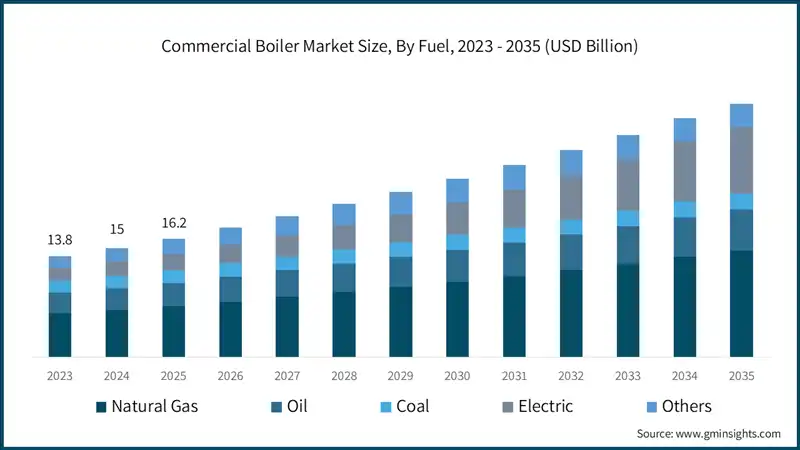
- Based on fuel, the industry is segmented into natural gas, oil, coal, electric, and others. The natural gas-powered commercial boiler market holds a share of over 40% in 2025 and is set to grow at a CAGR of 7% from 2026 to 2035.
- The portfolio rationalization by facility owners increasingly favors gas-fired condensing units that deliver high seasonal efficiencies and lower operational emissions compared to many legacy systems. Moreover, technology innovation within natural gas boilers concentrates on advanced burner modulation and oxygen trim that lift efficiency even under variable load profiles.
- The oil fired commercial boiler industry is set to exceed USD 5 billion by 2035. These units remain a practical choice for facilities that require on-site fuel storage and independence from pipeline networks. The extensive availability of oil reserves across multiple regions coupled with rising investments in infrastructure development will boost the business scenario.
- For illustration, in 2024, Canada introduced regulations mandating a 35% reduction in emissions from the oil & gas sector. This policy aims to incentivize producers to reinvest profits into climate-positive initiatives, reinforcing the country’s commitment to sustainability. Given that oil and gas remain the largest contributors to national emissions, achieving these reductions is critical to meeting Canada’s long-term climate objectives.
- Coal boilers are utilized in facilities located near coal resources, particularly in regions where coal continues to serve as a primary energy source. Technological advancements in these systems are primarily aimed at reducing emissions and improving operational efficiency.
- The electric commercial boiler market was estimated at USD 2.3 billion in 2025. These units are gaining traction due to simplicity, compactness, and compatibility with electrification strategies aligned to net-zero targets. Moreover, electric boilers align with time-of-use tariffs and peak-shaving programs, allowing facilities to modulate thermal production in response to grid signals and pricing.
- For instance, in July 2025, U.S. Department of Energy issued a guidance document aimed at accelerating the electrification of space heating in large commercial buildings. The guidance focuses on retrofitting existing fossil-fuel-based boiler systems with electric alternatives, outlining technical pathways, performance considerations, and best practices to reduce emissions, improve energy efficiency, and support long-term decarbonization goals.
Learn more about the key segments shaping this market
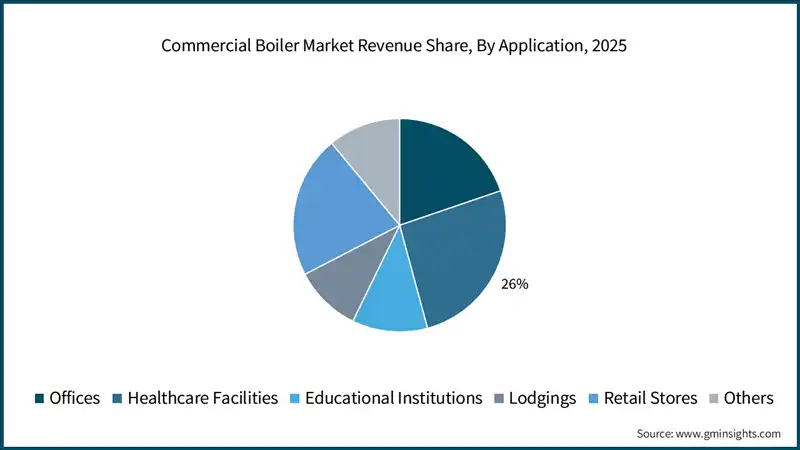
- Based on application, the commercial boiler market is bifurcated into offices, healthcare facilities, educational institutions, lodgings, retail stores and others. The healthcare facilities application holds a share of 26% in 2025 and is set to surpass USD 8 billion by 2035. The rapid expansion of healthcare infrastructure combined with the establishment of new hospitals and diagnostic centers will elevate industry growth.
- Office spaces are adopting advanced boiler systems to ensure consistent thermal comfort across large, multi-zone environments. Modern workplaces prioritize energy efficiency and occupant well-being, making high-performance heating solutions essential for productivity and compliance with green building standards.
- The educational institution segment will witness a CAGR of over 7.5% by 2035. Increasing foreign capital inflows in line with strategic partnerships among regional governments to upgrade school infrastructure in developing economies will stimulate business outlook.
- For instance, South Korea’s Ministry of Education strengthened its digital learning roadmap by allocating USD 69.3 million through 2026 for comprehensive classroom infrastructure upgrades. In parallel, an additional USD 43.2 million has been earmarked for AI-driven education programs, enabling the deployment of AI-based textbook monitoring systems across 6,000 schools and the training of 1,200 digital tutors to enhance technology-enabled learning outcomes.
- The rapid expansion of the tourism industry along with the growing number of hotels and resorts, is set to drive increased adoption of boiler systems. Furthermore, stringent regulatory frameworks and rising consumer spending levels will continue to support and strengthen the overall business landscape.
- The retail stores commercial boiler market was valued at USD 3.5 billion in 2025, fueled by significant private investments in the development of new outlets. Additionally, changing weather patterns and the heightened focus on maintaining optimal indoor comfort will bolster the industry potential.
- For citation, in July 2025, Cleaver-Brooks announced a strategic collaboration with a leading software provider to develop advanced predictive maintenance solutions for its commercial boiler portfolio. The initiative leverages data analytics and digital monitoring to anticipate equipment issues, optimize maintenance schedules, enhance operational uptime, and expand its’ digital service capabilities.
Looking for region specific data?
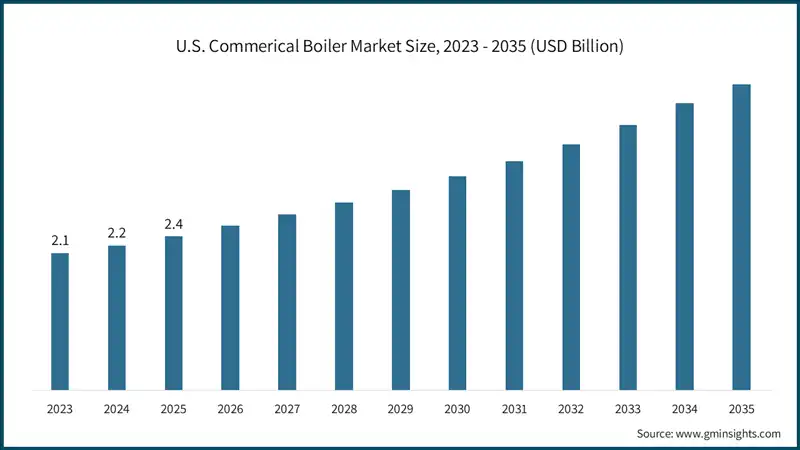
- The U.S. dominated the commercial boiler market in North America with over 80% share in 2025 and generated above USD 2.4 billion in revenue. Rising investments in commercial infrastructure coupled with growing demand for advanced space and water heating solutions will foster the country’s growth.
- For instance, in FY 2025, the U.S. Department of Housing and Urban Development (HUD) allocated USD 35.2 billion, representing over 11% of its total USD 296.2 billion budget, toward strategic priorities such as community revitalization, affordable housing, and urban development.
- North America commercial boiler market is projected to hit USD 5 billion by 2035. Severe weather patterns in tandem with rising investments in construction projects will enhance the business potential. Furthermore, increasing demand for space heating, extended cold seasons, and the modernization of commercial infrastructure continue to strengthen the industry outlook.
- The Europe commercial boiler market is set to grow at a rate of over 8% by 2035, driven by stringent emission standards aligned with national sustainability objectives. Increasing demand for compact and space-saving boiler units in association with urban infrastructure development will boost product penetration.
- Asia Pacific commercial boiler market reached USD 4.4 billion in 2025. Ongoing expansion of commercial establishments including hospitals, hotels, and educational institutions coupled with increasing heating requirements will amplify the industry scenario.
- For citation, in 2025, the Australian government reaffirmed its commitment to universal healthcare by allocating USD 8.5 billion to strengthen Medicare. This strategic investment is aimed at improving access to primary care, ensuring timely medical services for citizens, and advancing value-based healthcare models to enhance patient outcomes and operational efficiency across the system.
- The Middle East & Africa commercial boiler market is projected to expand significantly, driven by rapid urbanization and the growing prevalence of premium and smart homes that demand personalized heating solutions, reinforcing the region’s market landscape.
- Emphasis on lifecycle cost optimization together with digitalization of heating systems will transform procurement strategies in regional markets. Moreover, development of low-noise and high-performance boiler units in association with improving comfort standards in premium commercial spaces will positively influence the business scenario.
- The growing focus on sustainability is driving the integration of renewable energy solutions across Latin America. Continued urban development, rapid industrialization, and government-backed incentives for cleaner heating technologies will further propel the industry expansion.
- For illustration, in 2024, Brazil launched its National Energy Transition Policy, aiming to secure USD 400 billion in green investments over the next decade. This initiative focuses on accelerating clean energy adoption, reinforcing Brazil’s leadership in renewables, and driving sustainable industrial growth through wind, solar, biofuels, and hydrogen development.
Commercial Boiler Market Share
- The top 5 players in commercial boiler industry include Babcock & Wilcox, A.O. Smith, Bosch Industriekessel, Babcock Wanson and VIESSMANN contribute around 40% of the market share in 2025.
- The industry participants are focusing on innovations such as modular designs and hybrid systems that integrate renewable energy sources to meet evolving sustainability standards. Strategic partnerships with construction firms, facility management providers, and digital platforms are enhancing market penetration.
- Babcock & Wilcox offers advanced commercial boiler solutions engineered for high efficiency and operational reliability. Its portfolio emphasizes cutting-edge combustion technology, modular designs, and integration with smart control systems to optimize performance across diverse commercial applications.
- A.O. Smith delivers premium commercial boilers designed to combine energy efficiency with intelligent functionality. The product range incorporates advanced temperature control systems, IoT-enabled monitoring, and eco-conscious engineering to meet stringent regulatory standards.
- Bosch Industriekessel provides high-performance commercial boiler systems featuring state-of-the-art condensing technology and smart automation capabilities. Its offerings prioritize energy savings, low emissions, and seamless integration with building management systems.
- Babcock Wanson specializes in industrial and commercial boiler systems that deliver exceptional thermal efficiency and operational flexibility. The company’s portfolio includes advanced combustion systems, modular configurations, and intelligent control platforms that enable precise load management.
- VIESSMANN offers innovative commercial boiler solutions that combine high efficiency condensing technology with smart digital interfaces. Its products are engineered for superior energy performance, reduced emissions, and compatibility with renewable energy systems.
Commercial Boiler Market Companies
- A. O. Smith reported strong performance in the first nine months of 2025, achieving net sales of USD 2.9 billion and a gross profit of USD 1.1 billion. The company’s growth reflects its focus on high-efficiency water heating solutions, supported by strategic investments in innovation and sustainability-driven product development.
- Miura America recorded revenue of USD 789 million in the first six months of 2025, supported by an operating profit of USD 88.7 million. The company’s strong performance reflects its focus on high-efficiency modular boiler systems, advanced automation, and sustainability-driven heating solutions, reinforcing its leadership in the commercial boiler segment.
- Babcock & Wilcox reported revenue of USD 299.9 million in the first six months of 2025, supported by research & development investments totaling USD 1.3 million. It continues to strengthen its position in the market through innovation in low-emission technologies and advanced system designs aimed at improving efficiency and sustainability.
Major players operating in the commercial boiler market are:
- A.O. Smith
- AERCO
- Ariston Holding
- Atlantic Boilers
- Babcock & Wilcox
- Babcock Wanson
- Bosch Industriekessel
- Bradford White Corporation
- BURNHAM COMMERCIAL BOILERS
- Clayton Industries
- Cleaver-Brooks
- Columbia Boiler Company
- FERROLI
- Fonderie Sime
- FONDITAL
- Fulton
- Hurst Boiler & Welding
- Miura America
- PARKER BOILER
- PB HEAT
- Precision Boilers
- Vaillant Group
- Superior Boiler
- VIESSMANN
- Weil-McLain
- WOLF
Commercial Boiler Industry News
- In December 2025, Babcock & Wilcox Canada was awarded the second phase of a USD 20 million boiler refurbishment at the Irving Pulp & Paper Mill. The scope includes installing superheaters, upgraded air systems, an economizer, and related components, with project execution scheduled for Spring 2026.
- In November 2025, A. O. Smith announced a USD 470 million acquisition of Leonard Valve Company, a key provider of commercial mixing valves and boiler control technologies. This acquisition expands A. O. Smith’s mechanical room product portfolio and strengthens its connected hydronic and water management offerings. The deal is expected to close in Q1 2026.
- In January 2025, Bosch introduced the Buderus Gen 2 SSB Boiler, featuring a series of advanced upgrades over its predecessor. Designed with output capacities ranging from 798 to 8,192 MBH, the Gen 2 model delivers enhanced performance, reliability, and operational flexibility. These improvements position it as a robust solution for a broad spectrum of commercial applications, aligning with evolving efficiency and sustainability requirements.
- In October 2024, AERCO’s CFR condensing boiler earned the AHR Innovation Award in the Heating category for its groundbreaking Category I vent design. This stainless-steel condensing boiler offers cost-effective retrofitting by eliminating the need for expensive venting systems. Delivering energy savings of up to 87.6%, the CFR model ensures full compliance with local regulations while supporting decarbonization initiatives.
The commercial boiler market research report includes in-depth coverage of the industry with estimates & forecast in terms of revenue (USD Million), capacity (MMBTU/hr) & volume (Units) from 2022 to 2035, for the following segments:
Market, By Fuel
- Natural gas
- Oil
- Coal
- Electric
- Others
Market, By Capacity
- ≤ 0.3 - 2.5 MMBtu/hr
- > 2.5 - 10 MMBtu/hr
- > 10 - 50 MMBtu/hr
- > 50 - 100 MMBtu/hr
- > 100 - 250 MMBtu/hr
Market, By Technology
- Condensing
- Non-condensing
Market, By Product
- Hot water
- Steam
Market, By Application
- Offices
- Healthcare facilities
- Educational institutions
- Lodgings
- Retail stores
- Others
The above information has been provided for the following regions and countries:
- North America
- U.S.
- Canada
- Mexico
- Europe
- France
- UK
- Poland
- Italy
- Spain
- Austria
- Germany
- Sweden
- Russia
- Asia Pacific
- China
- India
- Philippines
- Japan
- South Korea
- Australia
- Indonesia
- Middle East & Africa
- Saudi Arabia
- Iran
- UAE
- Nigeria
- South Africa
- Latin America
- Argentina
- Chile
- Brazil
Frequently Asked Question(FAQ) :
What is the fastest-growing application segment in the market?
The educational institutions segment is expected to grow at a CAGR of over 7.5% through 2035, driven by infrastructure upgrades and public-sector investments.
Who are the key players in the commercial boiler market?
Leading companies include Babcock & Wilcox, A.O. Smith, Bosch Industriekessel, Babcock Wanson, and VIESSMANN.
Which application segment leads the commercial boiler market?
Healthcare facilities led the market with a 26% share in 2025, supported by rising hospital construction, sterilization needs, and demand for reliable heating systems.
Which region holds the largest share of the commercial boiler market?
The U.S. held 80% share with USD 2.4 billion in 2025, driven by rising commercial infrastructure investment and heating demand.
How is the electric commercial boiler segment performing?
The electric commercial boiler market was valued at USD 2.3 billion in 2025, gaining traction due to electrification strategies, compact design, and compatibility with net-zero emission goals.
Which fuel segment dominates the commercial boiler market?
The natural gas segment dominated the market with over 40% share in 2025, owing to high efficiency, lower emissions, and widespread fuel availability.
What is the estimated commercial boiler market size in 2026?
The market size is projected to reach USD 17.8 billion in 2026, reflecting steady growth in commercial infrastructure and heating modernization.
What is the market size of the commercial boiler in 2025?
The market size was USD 16.2 billion in 2025, with a CAGR of 7.7% expected through 2035, driven by rising demand for space heating in commercial buildings and increasing adoption of energy-efficient heating systems.
What is the projected value of the commercial boiler market by 2035?
The market is expected to reach USD 34.7 billion by 2035, supported by decarbonization initiatives and smart heating technologies.
Commercial Boiler Market Scope
Related Reports