Summary
Table of Content

Citrus Pectin Market
Get a free sample of this report
Form submitted successfully!
Error submitting form. Please try again.
Thank you!
Your inquiry has been received. Our team will reach out to you with the required details via email. To ensure that you don't miss their response, kindly remember to check your spam folder as well!
Request Sectional Data
Thank you!
Your inquiry has been received. Our team will reach out to you with the required details via email. To ensure that you don't miss their response, kindly remember to check your spam folder as well!
Form submitted successfully!
Error submitting form. Please try again.
Citrus Pectin Market Size
- Citrus pectin is a naturally occurring polysaccharide found in the cell walls of citrus fruits such as oranges, lemons, limes, and grapefruits. The main source of pectin extraction comes from citrus peels which serve as waste materials during juice production.
- Pectin exists as a chemical compound which consists of multiple galacturonic acid units that develop into a complex carbohydrate structure which can absorb water and create gels when exposed to appropriate conditions. The plant-based origin of citrus pectin together with its functional characteristics leads to its extensive application in food products and pharmaceutical medicines and nutraceutical supplements.
- Citrus pectin is commonly categorized based on its degree of esterification into high methoxyl (HM) and low methoxyl (LM) pectin. High methoxyl pectin requires both sugar content and acidic conditions to create gel formations while low methoxyl pectin requires calcium ions for gel formation at minimal sugar levels.
- The classification system establishes product functionalities which different formulations use for making jams, jellies, confectionery and products with reduced sugar content. The hydrocolloid functions as a gelling agent which also produces thickening effects and stabilizing results for food systems.
- Citrus pectin functions as an essential food processing component which controls its gelation process through its rheological characteristics.
The global citrus pectin market was valued at USD 1.4 billion in 2025. The market is expected to grow from USD 1.5 billion in 2026 to USD 2.4 billion in 2035, at a CAGR of 5.4% according to the latest report published by Global Market Insights Inc.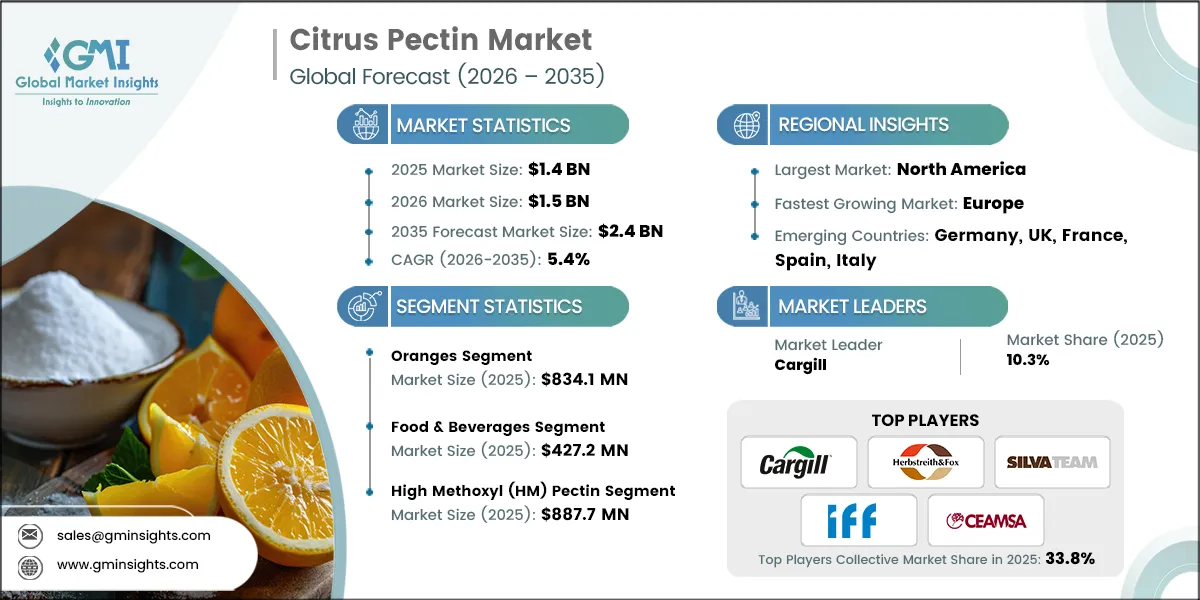
Citrus Pectin Market Key Takeaways
Market Size & Growth
- 2025 Market Size: USD 1.4 Billion
- 2026 Market Size: USD 1.5 Billion
- 2035 Forecast Market Size: USD 2.4 Billion
- CAGR (2026–2035): 5.4%
Regional Dominance
- Largest Market: North America
- Fastest Growing Region: Europe
Key Market Drivers
- Rising demand for clean-label ingredients.
- Expansion of functional foods and supplements.
- Increased processed and convenience food consumption.
Challenges
- Raw material supply fluctuations.
- High extraction and processing costs.
Opportunity
- Low-sugar and sugar-free product development.
- Pharmaceutical and nutraceutical applications.
- Sustainable and biodegradable packaging.
Key Players
- Market Leader: Cargill led with over 10.3% market share in 2025.
- Leading Players: Top 5 players in this market include Cargill, Herbstreith & Fox, Silvateam, CEAMSA (Compañía Española de Algas Marinas), IFF, which collectively held a market share of 33.8% in 2025.
Get Market Insights & Growth Opportunities
To get key market trends
Citrus Pectin Market Trends
- The citrus pectin industry is expanding because demand for natural clean-label products increases in both food and pharmaceutical markets. The various uses of citrus pectin for low-sugar and low-fat food products together with its potential health benefits have made it a widely used ingredient. The citrus pectin industry will experience continuous growth because consumers increasingly choose healthier natural ingredient alternatives for their products.
- The citrus pectin industry is gaining traction as a versatile ingredient across various industries, including food and beverage, animal feed, and biofuels. Food producers are now using Citrus Pectin in health-based products because it contains high dietary fiber and low calories while its properties improve texture and stability. Clean-label and plant-based products are popular among consumers who seek natural and sustainable ingredients for their products.
- The demand for fiber increases because people learn about its benefits for digestive health and protection against chronic diseases. Citrus Pectin is used by animal feed industry as an economical nutritional material which helps livestock gain better health and productivity.
- In biofuel and bioplastics production, citrus Pectin serves as a fundamental element which supports to renewable and environmentally friendly methods thus results in market growth. Bioethanol production uses the carbohydrate-rich material of Citrus Pectin to produce energy-efficient fermentation.
Citrus Pectin Market Analysis
Learn more about the key segments shaping this market
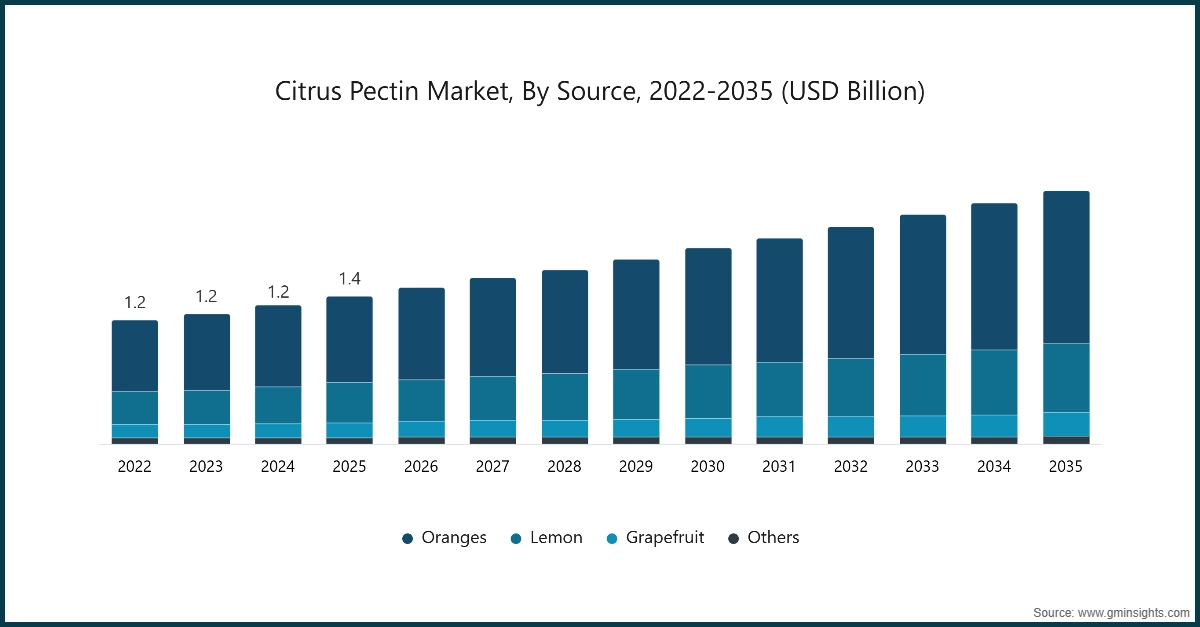
The citrus pectin market by source is segmented into oranges, lemon, grapefruit, others. Oranges hold the largest market value of USD 834.1 million in 2025.
- The flexibility of citrus pectin produced from oranges is an important demand driver in the food and beverage sector. Citrus pectin, a natural thickening and gelling ingredient is widely valued due to its ability to improve the texture and consistency in diverse range of products such as jellies, jams, fruit juices, and dairy products. Its clean-label, non-GMO status also corresponds with rising consumer desire for healthful and natural ingredients, enhancing its demand in the food sector.
- Manufacturers who want to diversify their raw material sources now consider pectin from grapefruit and other fruits which include limes and tangerines as essential. This helps to reduce supply risks due to seasonal or weather changes. The improved extraction methods now enable pectin recovery from these fruits at higher efficiency, which creates new market possibilities for nutraceuticals and sustainable packaging solutions.
The citrus pectin market by grade is segmented into high methoxyl (HM) pectin and low methoxyl (LM) pectin. High methoxyl (HM) pectin hold the largest market value of USD 887.7 million in 2025.
- The food industry requires High Methoxyl (HM) Pectin grade because its gelling properties enable production of jellies and jams and fruit preserves. The production of correct product texture and consistency depends on HM pectin ability to form strong gels under conditions of high sugar content and low pH levels.
- The market for Low Methoxyl (LM) pectin is expanding rapidly because more people want to buy sugar-reduced foods and diabetic-friendly products. The product gains demand because it provides a gelling method through calcium instead of sugar which health-focused products need.
Learn more about the key segments shaping this market
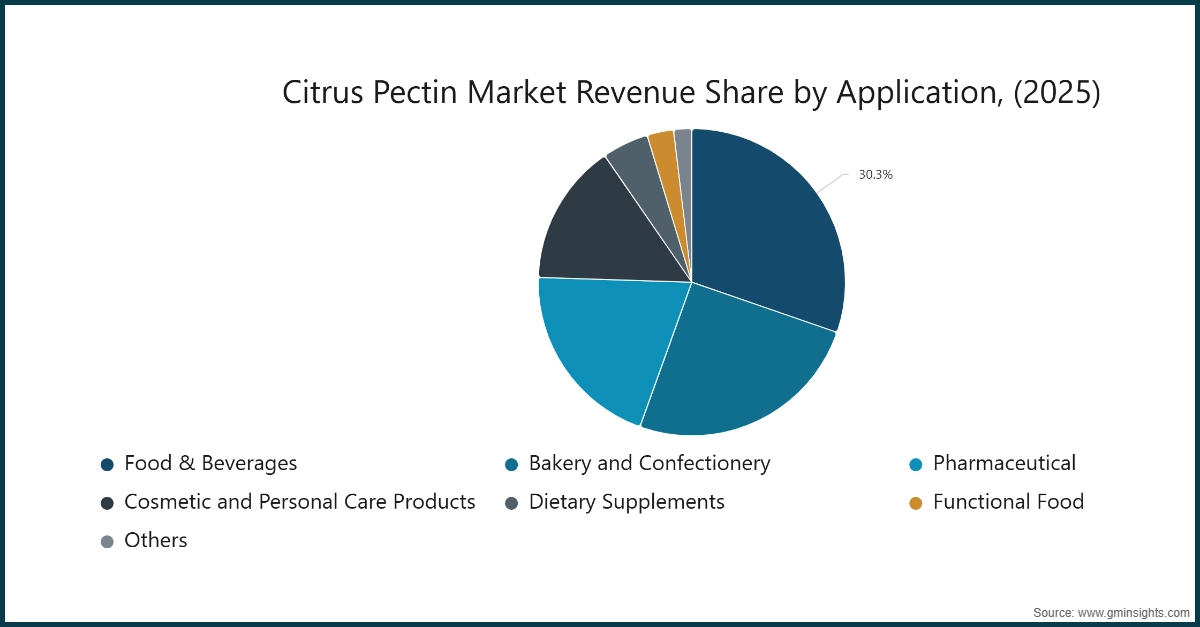
The citrus pectin market by application is segmented into food & beverages, bakery and confectionery, pharmaceutical, cosmetic and personal care products, dietary supplements, functional food and others. Food & Beverages holds the largest market value of USD 427.2 million in 2025.
- Citrus pectin is used as a natural gelling and stabilizing agent in products like jams, juices, and dairy beverages. The bakery and confectionery industries use citrus pectin to improve product texture and to extend product shelf life, which helps them meet consumer demand for clean-label and healthy snack options. The pharmaceutical industry now uses citrus pectin in two main applications, which include its function as a controlled-release component and its use as a dietary fiber supplement.
- The cosmetic and personal care industry now uses citrus pectin because people want plant-based ingredients which provide natural moisture benefits. The dietary supplements and functional food sectors are growing rapidly as consumers increasingly demand products that promote digestive health and immunity, where modified citrus pectin is widely used. The ingredient demonstrates its versatility through emerging applications in both biodegradable packaging and animal nutrition.
The citrus pectin market by distribution channel is segmented into direct sales, distributors and wholesalers, online retail, convenience stores, specialty stores and others. Distributors and wholesalers holds the largest market value of USD 578.9 million in 2025.
- Bulk buyers, including food manufacturers, pharmaceutical companies, and dietary supplement producers allows suppliers to offer customized products and secure long-term contracts thus direct sales remain a key channel. The citrus pectin industry depends on distributors and wholesalers who play vital roles in establishing product availability across different markets by reaching both domestic and international customers. Smaller manufacturers and specialty customers and health-conscious consumers now have easier access to pectin products through the growing online retail market.
- Convenience stores and specialty stores are increasingly catering demand to home cooks, artisanal producers and DIY jam or jelly makers, reflecting a rising interest in clean-label and health-oriented foods. The functional foods and nutraceuticals and personal care industries now have new platforms available through B2B marketplaces and institutional procurement and industrial sourcing platforms to fulfill their increasing operational needs. The market now employs multiple distribution methods to provide bulk products while allowing smaller buyers to access products from niche markets.
Looking for region specific data?
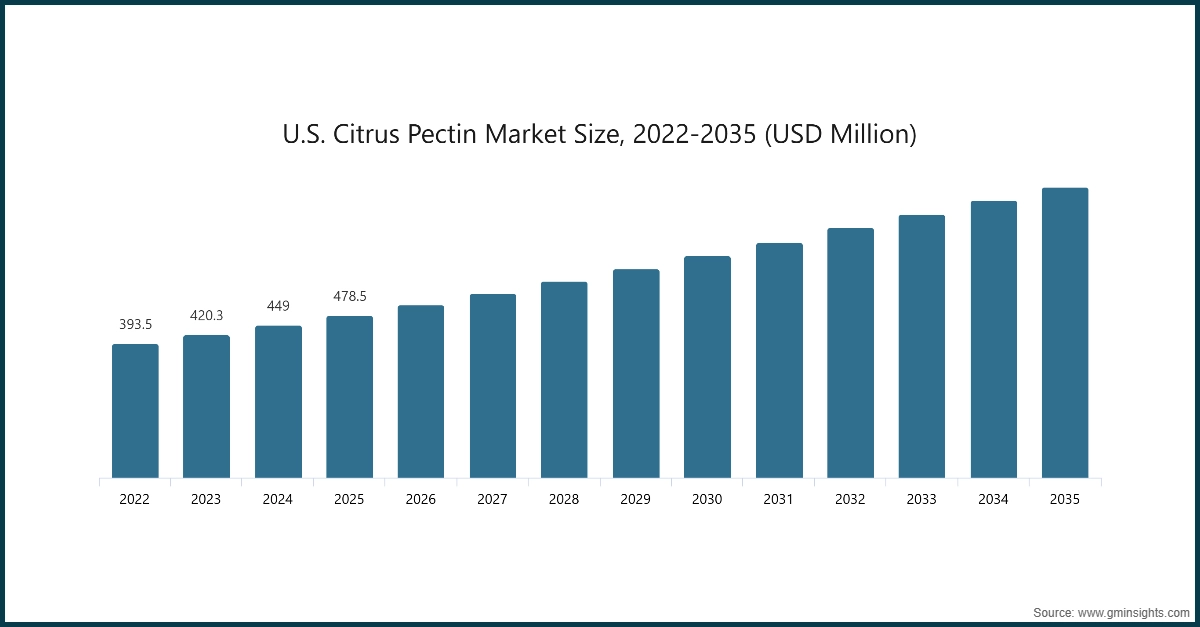
The market in the North America is expected to experience significant and promising growth from USD 562.9 million in 2025 to USD 1,009.2 million in 2035. The U.S. citrus pectin market accounted for USD 478.5 million in 2025.
- The demand for citrus pectin in North America is increasing because people want functional foods and low-sugar products and dietary supplements. In the United States, manufacturers use citrus pectin in their confectionery products and beverages and dairy products to create clean-label products that meet health needs of consumers.
The market in the Europe is expected to experience significant and promising growth from USD 356.4 million in 2025 to USD 598.1 million in 2035.
- European citrus pectin consumption is growing because bakery and dairy and nutraceutical businesses are expanding their use of natural ingredients. Germany uses citrus pectin to create jams and dairy beverages and low-sugar products which comply with food safety standards and clean-label trends while developing environmentally friendly packaging solutions and new pectin applications for functional foods.
The citrus pectin market in Asia Pacific is expected to experience increasing growth from USD 328.2 million in 2025 to USD 540.3 million in 2035.
- The demand for citrus pectin in Asia-Pacific is rising because more people understand the advantages of digestive health and functional foods. The Chinese market uses citrus pectin in its beverage and confectionery and dietary supplement products which get their citrus fruit supply from domestic production to meet local needs and regional export requirements.
Middle East & Africa market is expected to experience significant and promising growth from USD 45.8 million in 2025 to USD 55.7 million in 2035.
- The demand for citrus pectin in Middle Eastern and African markets is increasing because consumers prefer products with clean labels and health benefits. South African manufacturers are using pectin more frequently in their confectionery products and jams and dairy beverages, which creates both local production and international exporting possibilities.
Latin America is expected to experience significant and increasing growth from USD 115.2 million to USD 185.7 million in 2035.
- The citrus pectin market in Latin America is growing because of the increasing citrus cultivation and food processing activities. In Brazil, orange peel by-products are processed into pectin for jams, juices, and low-sugar products, which helps the local market and regional exporting needs.
Citrus Pectin Market Share
- Citrus Pectin industries are moderately consolidated with players like Cargill, Herbstreith & Fox, Silvateam, CEAMSA (Compañía Española de Algas Marinas), IFF holding 33.8% market share and Cargill being the market leader holding the market share of 10.3% in 2025.
- The production of high-purity citrus pectin exists because companies need to produce this material with stable quality to meet the exact requirements of food and beverage and pharmaceutical companies. Their product range includes different pectin types which support various uses from making low-sugar jams to developing nutraceuticals.
- The research and development investments enable companies to develop new extraction processes while improving product performance and developing new product combinations. The company uses these capabilities to create products which satisfy market demands for clean-label items and plant-based products and health-oriented solutions.
- Customized solutions help manufacturers to establish stronger business relationships by fullfing demand. The company offers clients customized product formulations combined with adaptable packaging solutions and expert application support to help them reach their specific product requirements for texture and stability and functional advantages.
- Branding activities and sustainability programs both help organizations remain competitive in their markets. The company establishes market leadership through its eco-friendly extraction technologies and biodegradable packaging materials and complete product labeling transparency which attracts environmentally aware customers.
Citrus Pectin Market Companies
Major players operating in the citrus Pectin industry are:
- Cargill
- Ingredion
- Herbstreith & Fox KG Pektin-Fabriken
- Tate & Lyle
- Compañía Española de Algas Marinas (CEAMSA)
- Quadra Chemicals
- Silvateam
- CEAMSA
- Fiberstar
- Krishna Pectins Pvt Ltd
- Labh Ingredients
- IFF
Cargill operates as a global corporation which works in agriculture and food manufacturing and commodity trading. The company provides complete supply chain services as it delivers ingredients and risk management services and innovative solutions to food manufacturers and farmers and consumers with its commitment to sustainability.
Herbstreith & Fox operates as a family-owned business which functions as a German company that creates natural pectin and fruit preparations. The company delivers premium gelling agents and stabilizers and texturizers to the food and beverage sector which contains fruit components and promotes natural ingredient use and innovative product development.
Silvateam operates as an Italian business which manufactures natural hydrocolloids and tannins for various applications in the food and feed and industrial markets. The company maintains sustainable sourcing practices while delivering pectin, gelatin and tannin products which helps to improve texture, stability and nutritional content across different uses.
CEAMSA is a Spanish company that produces seaweed-based ingredients and sells them in various markets. CEAMSA uses sustainable methods to harvest and process marine algae which allows them to create natural hydrocolloids like alginates and carrageenans and agar for use in food products and pharmaceuticals and cosmetics and industrial applications. CEAMSA operates as an advanced company which develops marine biotechnology solutions through its sustainable practices of acquiring environmental resources.
IFF develops both flavoring and scent products, active ingredients products. The company provides innovative sensory experiences and functional ingredients to the food, beverage, personal care, and household product industries. IFF provides a product range which contains both natural and synthetic flavors plus fragrances and specialty ingredients and solutions that control taste and aroma while preserving products through sustainable methods and technological innovation.
Citrus Pectin Market Report Attributes
| Key Takeaway | Details |
|---|---|
| Market Size & Growth | |
| Base Year | 2025 |
| Market Size in 2025 | USD 1.4 Billion |
| Market Size in 2026 | USD 1.5 Billion |
| Forecast Period 2026-2035 CAGR | 5.4% |
| Market Size in 2035 | USD 2.4 Billion |
| Key Market Trends | |
| Drivers | Impact |
| Rising demand for clean-label ingredients | Consumers increasingly prefer natural, plant-based additives, boosting citrus pectin use in food, beverages, and nutraceuticals as a safe, recognizable, and functional ingredient. |
| Expansion of functional foods and supplements | Citrus pectin’s dietary fiber and digestive health benefits drive its inclusion in fortified, low-sugar, and health-focused formulations, meeting the growing functional food market demand. |
| Increased processed and convenience food consumption | Citrus pectin’s gelling, stabilizing, and texture-enhancing properties make it essential for jams, dairy beverages, confectionery, and ready-to-eat products, supporting large-scale food production. |
| Pitfalls & Challenges | Impact |
| Raw material supply fluctuations | Seasonal variations, climate changes, and citrus crop inconsistencies can disrupt pectin availability and increase costs for manufacturers globally. |
| High extraction and processing costs | Purification, standardization, and specialized production processes make citrus pectin expensive compared to other hydrocolloids like guar gum or starch derivatives. |
| Opportunities: | Impact |
| Low-sugar and sugar-free product development | Low methoxyl citrus pectin enables gel formation using calcium ions, supporting health-conscious and diabetic-friendly formulations in jams, desserts, and beverages. |
| Pharmaceutical and nutraceutical applications | Modified citrus pectin offers potential in drug delivery, immune support, and therapeutic supplements due to its enhanced solubility, bioavailability, and functional versatility. |
| Sustainable and biodegradable packaging | Citrus pectin-based edible films and coatings provide eco-friendly alternatives to synthetic polymers, supporting environmental sustainability and reducing plastic dependence in food packaging. |
| Market Leaders (2025) | |
| Market Leader |
Market share 10.3% |
| Top Players |
Collective market share of 33.8 % in 2025 |
| Competitive Edge |
|
| Regional Insights | |
| Largest Market | North America |
| Fastest growing market | Europe |
| Emerging countries | Germany, UK, France, Spain, Italy |
| Future outlook |
|
What are the growth opportunities in this market?
Citrus Pectin Industry News
- In November 2024, Tate & Lyle completed its acquisition of CP Kelco, CP Kelco U.S., CP Kelco China. The merger created a global specialty food and beverage solutions company which combined Tate & Lyle's sweetening and mouthfeel and fortification skills with CP Kelco's range of pectin and specialty gums and natural-based elements.
- In January 2024, IFF launched Grindsted Pectin FB 420 for baking applications. It is ideal for baking applications, has unique sensory qualities for bake-stable fruit fillings, and is label-friendly and process-efficient.
The citrus pectin market research report includes an in-depth coverage of the industry with estimates and forecast in terms of revenue in USD Million and volume in terms of kilo tons from 2022–2035 for the following segments:
Market, By Source
- Oranges
- Lemon
- Grapefruit
- Others
Market, By Grade
- High methoxyl (HM) pectin
- Low methoxyl (LM) pectin
Market, By Application
- Food & beverages
- Bakery and confectionery
- Pharmaceutical
- Cosmetic and personal care products
- Dietary supplements
- Functional food
- Others
Market, By Distribution Channel
- Supermarkets / grocery stores
- Convenience stores
- Online marketplaces
- Direct sales / brand website
- Wholesale distributors
- Others
The above information is provided for the following regions and countries:
- North America
- U.S.
- Canada
- Europe
- Germany
- UK
- France
- Spain
- Italy
- Rest of Europe
- Asia Pacific
- China
- India
- Japan
- Australia
- South Korea
- Rest of Asia Pacific
- Latin America
- Brazil
- Mexico
- Argentina
- Rest of Latin America
- Middle East and Africa
- Saudi Arabia
- South Africa
- UAE
- Rest of Middle East & Africa
Frequently Asked Question(FAQ) :
What was the market size of the citrus pectin in 2025?
The market was valued at USD 1.4 billion in 2025, with a CAGR of 5.4% expected through 2035. The market growth is driven by increasing demand for clean-label products, health benefits, and its versatile applications across industries.
What is the projected value of the citrus pectin market by 2035?
The market is poised to reach USD 2.4 billion by 2035, fueled by rising consumer preference for natural ingredients, its use in biofuels, and growing applications in food, pharmaceuticals, and animal feed.
What is the expected size of the citrus pectin industry in 2026?
The market size is projected to reach USD 1.5 billion in 2026.
How much revenue did the oranges segment generate in 2025?
The oranges segment generated approximately USD 834.1 million in 2025, led by its flexibility and demand in the food and beverage sector for natural thickening and gelling agents.
What was the valuation of the High Methoxyl (HM) pectin segment in 2025?
The High Methoxyl (HM) pectin segment accounted for USD 887.7 million in 2025, owing to its strong gelling properties, which are essential for producing jellies, jams, and fruit preserves.
Which region leads the citrus pectin sector?
North America leads the market, with its valuation expected to grow from USD 562.9 million in 2025 to USD 1 billion by 2035.
What are the upcoming trends in the citrus pectin market?
Rising demand for clean-label and plant-based products, along with increased use of citrus pectin in biofuels, bioplastics, pharmaceuticals, and animal feed, is driving market growth.
Who are the key players in the citrus pectin industry?
Key players include Cargill, Ingredion, Herbstreith & Fox KG Pektin-Fabriken, Tate & Lyle, Quadra Chemicals, Silvateam, CEAMSA, Fiberstar, Krishna Pectins Pvt Ltd, Labh Ingredients, and IFF.
Citrus Pectin Market Scope
Related Reports