Summary
Table of Content

China Self-monitoring Blood Glucose Devices Market
Get a free sample of this report
Form submitted successfully!
Error submitting form. Please try again.
Thank you!
Your inquiry has been received. Our team will reach out to you with the required details via email. To ensure that you don't miss their response, kindly remember to check your spam folder as well!
Request Sectional Data
Thank you!
Your inquiry has been received. Our team will reach out to you with the required details via email. To ensure that you don't miss their response, kindly remember to check your spam folder as well!
Form submitted successfully!
Error submitting form. Please try again.
China Self-monitoring Blood Glucose Devices Market Size
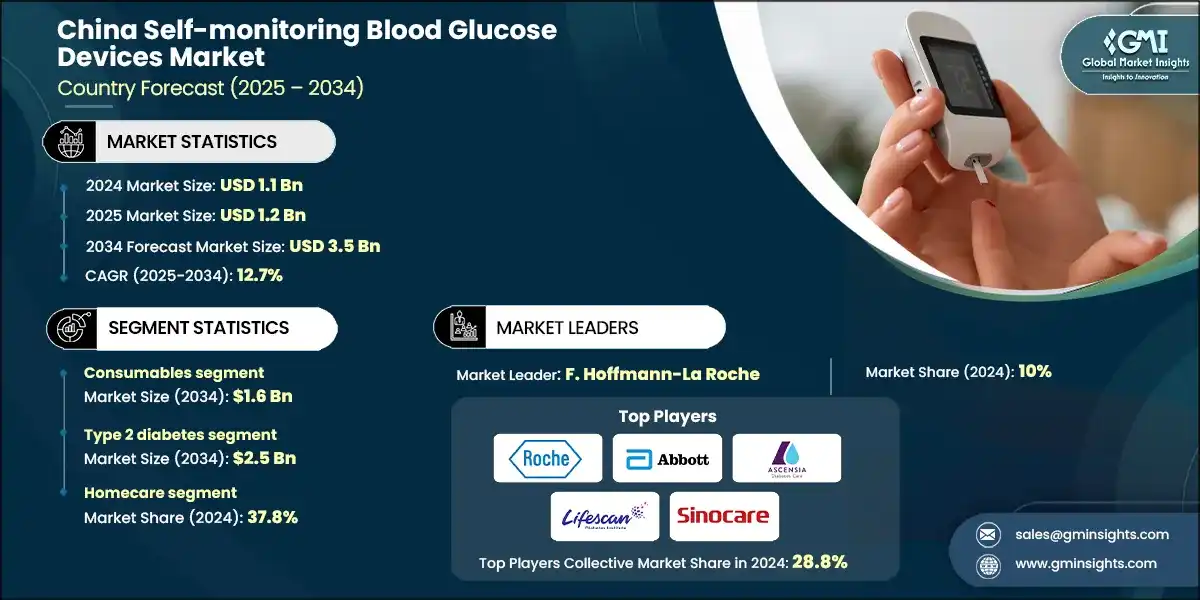
The China self-monitoring blood glucose devices market size was valued at USD 1.1 billion in 2024. The market is projected to grow from USD 1.2 billion in 2025 to USD 3.5 billion in 2034, expanding at a CAGR of 12.7%, according to the latest report published by Global Market Insights Inc.
To get key market trends
This steady growth is stimulated by various factors such as the rising incidence of diabetes in China, rising demand for home-based health solutions, increasing technological advancement in devices, rising government initiatives, and increasing awareness among people.
These devices enable patients to manage their diabetes effectively by providing real-time data on blood sugar levels. This data helps individuals make informed decisions regarding diet, physical activity, and medication. Major companies in the industry include F. Hoffmann-La Roche, Abbott Laboratories, Ascensia Diabetes Care Holdings, LifeScan, and Sinocare. The market consists of components such as blood glucose meters, test strips, and lancet devices, all designed to efficiently monitor blood glucose levels.
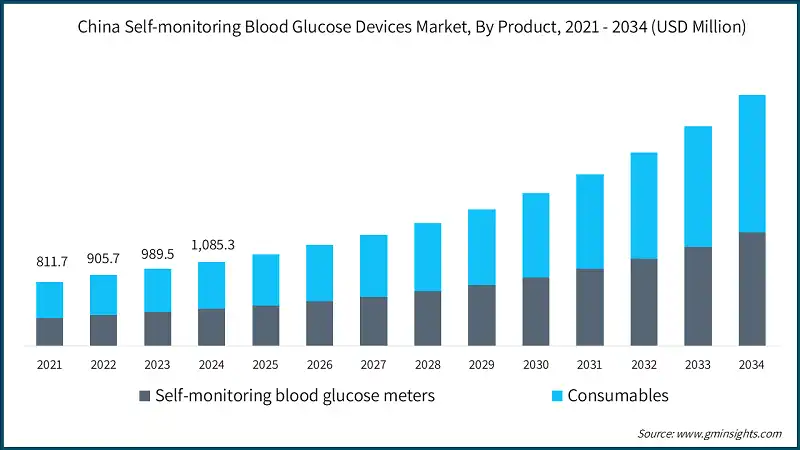
The market increased from USD 811.7 million in 2021 to USD 989.5 million in 2023. This growth can be attributed to the rising incidence of diabetes in China, along with government initiatives and increasing public awareness.
The Chinese government is actively working to improve public health awareness, particularly regarding chronic diseases such as diabetes, through initiatives such as Healthy China 2030. These programs aim to enhance health literacy, empower individuals to manage diabetes, and encourage the use of health technologies such as SMBG devices. These efforts are driving the adoption of SMBG devices as part of effective diabetes management strategies.
The increasing prevalence of diabetes in China is a significant factor driving the growth of the self-monitoring blood glucose (SMBG) devices market. For example, a 2023 report by the National Institute of Health (NIH) revealed that approximately 233 million people in China were living with diabetes. The age-standardized prevalence rate rose from 7.53% in 2005 to 13.7% in 2023, representing nearly a 50% increase. This surge has led to a growing demand for effective diabetes management tools, particularly SMBG devices.
Additionally, the rising preference for home-based healthcare solutions is further propelling the market. China’s aging population, which is more susceptible to chronic conditions such as diabetes, requires consistent monitoring and long-term care. For many elderly individuals, frequent hospital visits are challenging due to mobility limitations and the strain on the healthcare system. Thus, SMBG devices have emerged as a convenient and reliable option for at-home blood glucose monitoring. This shift is being reinforced by both consumer demand and government initiatives aimed at promoting preventive healthcare, making it a key driver of growth in China’s SMBG market.
Self-monitoring blood glucose devices have been in use for decades. These devices operate by pricking a finger with a sharp lancet, applying the blood sample to a strip, and inserting the strip into the glucometer, which is estimated to reach USD 46.8 billion by 2032, to measure an individual's blood glucose level.
China Self-monitoring Blood Glucose Devices Market Report Attributes
| Key Takeaway | Details |
|---|---|
| Market Size & Growth | |
| Base Year | 2024 |
| Market Size in 2024 | USD 1.1 Billion |
| Market Size in 2025 | USD 1.2 Billion |
| Forecast Period 2025 - 2034 CAGR | 12.7% |
| Market Size in 2034 | USD 3.5 Billion |
| Key Market Trends | |
| Drivers | Impact |
| Increasing incidence of diabetes in China | Drives demand for SMBG devices, expanding the patient base and promoting early diagnosis and regular monitoring. |
| Rising demand for home-based health solutions | Increases demand for portable, user-friendly SMBG devices that enable remote monitoring and personalized care. |
| Technological advancements in self-monitoring blood glucose devices | Enhances device accuracy, convenience, and user engagement, contributing to market growth. |
| Growth in government initiatives to increase awareness among people | Encourages early diagnosis and proactive diabetes management, expanding the consumer base for SMBG solutions. |
| Pitfalls & Challenges | Impact |
| High cost of advanced devices and accessories | Limits accessibility and adoption among low-income populations, slowing market penetration. |
| Stringent regulatory requirements | Delays product approvals and increases compliance costs for manufacturers. |
| Opportunities: | Impact |
| Growth in digital health integration through apps and cloud platforms | Improves real-time data sharing, predictive analytics, and personalized diabetes management, creating new value propositions for SMBG providers. |
| Market Leaders (2024) | |
| Market Leaders |
10% market share |
| Top Players |
collective market share 28.8% |
| Competitive Edge |
|
| Future outlook |
|
What are the growth opportunities in this market?
China Self-monitoring Blood Glucose Devices Market Trends
- Technological advancements are playing a pivotal role in driving the growth of the self-monitoring blood glucose (SMBG) industry in China. Modern SMBG devices increasingly feature Bluetooth and USB connectivity, enabling seamless integration with mobile applications for real-time glucose tracking and lifestyle management. This digital integration supports more personalized and proactive diabetes care.
- For instance, Sinocare’s Safe AQ Smart allows users to sync glucose readings with mobile apps, facilitating easy data sharing and trend analysis. Similarly, iHealth’s Smart Glucometer connects to cloud platforms, enabling healthcare professionals to remotely monitor patient data, an approach that aligns with China’s expanding telemedicine infrastructure.
- Moreover, advancements in device accuracy, powered by AI-driven algorithms and multi-factor calibration techniques, are significantly reducing measurement errors and enhancing diagnostic reliability. Innovations such as minimal blood sample requirements and no-wipe test strip designs are improving user comfort and convenience.
- Additionally, SMBG devices in China are becoming increasingly portable and ergonomically designed, addressing the diverse needs of both younger, tech-savvy users and elderly patients. These user-centric innovations are enhancing comfort, ease of use, and accessibility, making regular glucose monitoring more convenient for all age groups.
China Self-monitoring Blood Glucose Devices Market Analysis
Learn more about the key segments shaping this market
The China self-monitoring blood glucose devices market was valued at USD 811.7 million in 2021. The market size reached USD 989.5 million in 2023, up from USD 905.7 million in 2022.
Based on product, the market is segmented into self-monitoring blood glucose meters and consumables. The consumables segment is further bifurcated into testing strips and lancets. The consumables segment was valued at USD 608.2 million in 2024 and is projected to reach USD 1.9 billion by 2034, growing at a CAGR of 12.5%. In comparison, the self-monitoring blood glucose meters segment, valued at USD 477 million in 2024, is expected to grow to USD 1.6 billion by 2034.
- Consumables represent a substantial segment of China’s self-monitoring blood glucose (SMBG) market, with lancets playing a crucial role due to their necessity in daily blood sample collection. As the diabetic population continues to grow and home-based monitoring becomes more widespread, the demand for safe, efficient, and user-friendly consumables is steadily increasing.
- Manufacturers are introducing advanced features such as ultra-thin needles, automatic lancing mechanisms, and sterile, single-use formats to enhance safety and comfort. For example, Sinocare’s lancet systems incorporate ergonomic designs and precision engineering to reduce pain and improve ease of use, particularly for elderly and pediatric patients.
- Similarly, products such as Roche’s Accu-Chek Softclix demonstrate advanced design features, such as silicone-coated needles and motion-control technology, which can enhance user experience and compliance, especially among elderly and pediatric patients.
- Thus, the consumables segment, especially lancets, continues to be a key driver of growth in China’s SMBG market.
Based on application, the China self-monitoring blood glucose devices market is segmented into type 1 diabetes, type 2 diabetes, and gestational diabetes. Type 2 diabetes emerged as a dominant segment in the market, accounting for 69.5% of revenue share in 2024, and is expected to reach USD 2.5 billion in 2034.
- The growing prevalence of type 2 diabetes in China is a key factor accelerating the growth of the self-monitoring blood glucose (SMBG) devices market.
- For instance, according to the National Institute of Health (NIH), by 2021, the incidence of type 2 diabetes in China had reached 341.5 cases per 100,000 people, a 1.6% increase compared to 1990. This sharp rise in cases is driving an urgent need for effective diabetes self-management tools.
- SMBG devices are particularly well-suited for managing type 2 diabetes, as they empower patients to monitor their blood glucose levels regularly, make informed decisions regarding diet and medication, and take timely action to prevent complications. Their affordability, portability, and compatibility with digital health platforms make them an ideal solution for both urban and rural populations.
- Furthermore, these devices support China’s broader healthcare goals by promoting patient autonomy and preventive care, aligning with national initiatives such as Healthy China 2030, which emphasizes chronic disease management and digital health integration.
Learn more about the key segments shaping this market
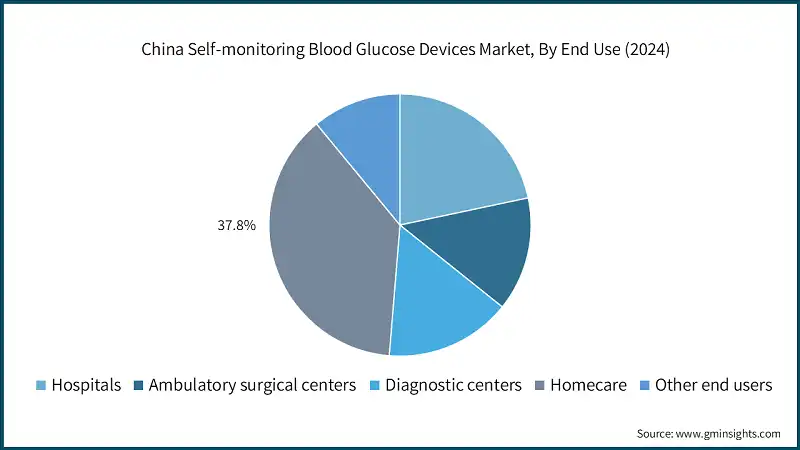
Based on end use, the China self-monitoring blood glucose devices market is segmented into hospitals, ambulatory surgical centers, diagnostic centers, homecare, and other end users. Homecare segment accounted for a dominant share of about 37.8% in 2024 owing to increasing growth in self-blood glucose monitoring practices in the country. Hospitals accounted for the revenue share of 21.4% in 2024.
- Hospitals continue to serve as the primary hub for diabetes diagnosis and management across China. With over 36,570 hospitals, including more than 3,275 tertiary-level institutions, the country’s healthcare system remains highly centralized. Patients with chronic conditions such as type 2 diabetes rely heavily on hospitals for routine monitoring, education, and prescription management.
- Further, hospitals are increasingly integrating self-monitoring blood glucose (SMBG) devices into both outpatient and inpatient care. These devices are widely used to monitor glucose levels before meals, assist in insulin dose adjustments, and support emergency departments in managing acute glycemic events.
- Moreover, ongoing technological advancements, including non-invasive monitoring, Bluetooth connectivity, and smart data tracking, are making SMBG devices more efficient, user-friendly, and widely adopted across hospitals.
China Self-monitoring Blood Glucose Devices Market Share
- The China self-monitoring blood glucose devices industry is competitive, with the top five companies, F. Hoffmann-La Roche, Abbott Laboratories, Ascensia Diabetes Care Holdings, LifeScan, and Sinocare, holding approximately 28.8% of the market share. Their dominance is attributed to extensive product portfolios, robust distribution networks, regulatory compliance, and continuous innovation.
- Leading players are embedding Bluetooth, USB, and cloud-based data sharing into their devices, enabling real-time monitoring and remote consultations. Companies such as Roche and Abbott are also forming strategic partnerships with hospitals and tech firms to expand their reach. The ability to adapt quickly to regulatory shifts, integrate with national health platforms, and offer value-added services is critical to sustaining leadership in this dynamic market.
- F. Hoffmann-La Roche continues to lead the Chinese SMBG market by offering a comprehensive ecosystem under its Accu-Chek and mySugr brands. The company’s strategy revolves around Integrated Personalized Diabetes Management (iPDM), which combines glucose monitoring, insulin delivery, and digital coaching. Roche’s focus on broadening access and partnering with local healthcare providers ensures its solutions are embedded in both urban hospitals and rural clinics.
- Furthermore, competition within the market has increased due to government initiatives in diabetes management and the growing consumer appetite for health-focused solutions. This complex environment illustrates the continuous innovation and strategic flexibility required by market players to maintain and develop their market positions.
China Self-monitoring Blood Glucose Devices Market Companies
Few of the prominent players operating in the China self-monitoring blood glucose devices industry include:
- Abbott Laboratories
- AgaMatrix
- Arkray
- Ascensia Diabetes Care Holdings
- B. Braun Melsungen
- Bionime Corporation
- DarioHealth
- F. Hoffmann-La Roche
- Hangzhou Jingce Medical Technology
- LifeScan
- Menarini Diagnostics
- Nova Biomedical
- Sanofi
- Sinocare
- Ypsomed Holding
- Ascensia Diabetes Care Holdings
Ascensia Diabetes Care Holdings is a prominent player in China’s self-monitoring blood glucose (SMBG) market. The company offers innovative and highly accurate glucose monitoring devices designed for simplicity and ease of use, supporting effective diabetes management across diverse patient groups.
Sinocare is known for developing advanced, patient-friendly blood glucose monitoring systems that enhance user confidence and promote better control over diabetes.
F. Hoffmann-La Roche holds a leading position in China’s SMBG market through its Accu-Chek product line, which includes devices such as Accu-Chek Instant and Accu-Chek Guide Me. These meters feature user-friendly displays, Bluetooth connectivity, and seamless integration with Roche’s mySugr app, enabling comprehensive digital diabetes management.
China Self-monitoring Blood Glucose Monitoring Devices Industry News:
- In April 2024, Hangzhou Jingce Medical Technology received NMPA approval for its innovative combined glucometer, which integrates both invasive and non-invasive monitoring technologies. This breakthrough enhances patient comfort and accessibility, aligning with China’s push for smart, user-friendly diabetes management solutions and its broader digital health transformation goals.
The China self-monitoring blood glucose devices market research report includes an in-depth coverage of the industry with estimates and forecast in terms of revenue in USD Million from 2021 - 2034 for the following segments:
Market, By Product
- Self-monitoring blood glucose meters
- Consumables
- Testing strips
- Lancets
Market, By Application
- Type 1 diabetes
- Type 2 diabetes
- Gestational diabetes
Market, By End Use
- Hospitals
- Ambulatory surgical centers
- Diagnostic centers
- Homecare
- Other end use
Frequently Asked Question(FAQ) :
Who are the key players in the China self-monitoring blood glucose devices market?
Key players include Abbott Laboratories, AgaMatrix, Arkray, B. Braun Melsungen, Bionime Corporation, DarioHealth, F. Hoffmann-La Roche, LifeScan, Menarini Diagnostics, Nova Biomedical, Sanofi, and Sinocare.
What was the market share of the homecare segment in 2024?
The homecare segment held a dominant share of 37.8% in 2024, led by the increasing adoption of self-monitoring blood glucose practices in China.
What are the key trends in the China self-monitoring blood glucose devices sector?
Key trends include device connectivity, AI-driven accuracy, portable designs, minimal samples, and telemedicine integration.
What was the revenue share of the Type 2 diabetes segment in 2024?
The Type 2 diabetes segment accounted for 69.5% of the market revenue in 2024, with an expected valuation of USD 2.5 billion by 2034.
How much revenue did the consumables segment generate in 2024?
The consumables segment generated approximately USD 608.2 million in 2024, with a projected CAGR of 12.5% through 2034.
What is the expected size of the China self-monitoring blood glucose devices market in 2025?
The market size is projected to reach USD 1.2 billion in 2025.
What is the projected value of the China self-monitoring blood glucose devices market by 2034?
The market is poised to reach USD 3.5 billion by 2034, driven by innovations in device accuracy, connectivity features, and increasing adoption of telemedicine.
What is the market size of the China self-monitoring blood glucose devices in 2024?
The market size was valued at USD 1.1 billion in 2024, with a CAGR of 12.7% expected through 2034. Factors such as rising diabetes prevalence, demand for home-based health solutions, and technological advancements are driving market growth.
China Self-monitoring Blood Glucose Devices Market Scope
Related Reports