Summary
Table of Content

China Recycled Plastic Construction Materials Market
Get a free sample of this report
Form submitted successfully!
Error submitting form. Please try again.
Thank you!
Your inquiry has been received. Our team will reach out to you with the required details via email. To ensure that you don't miss their response, kindly remember to check your spam folder as well!
Request Sectional Data
Thank you!
Your inquiry has been received. Our team will reach out to you with the required details via email. To ensure that you don't miss their response, kindly remember to check your spam folder as well!
Form submitted successfully!
Error submitting form. Please try again.
China Recycled Plastic Construction Materials Market Size
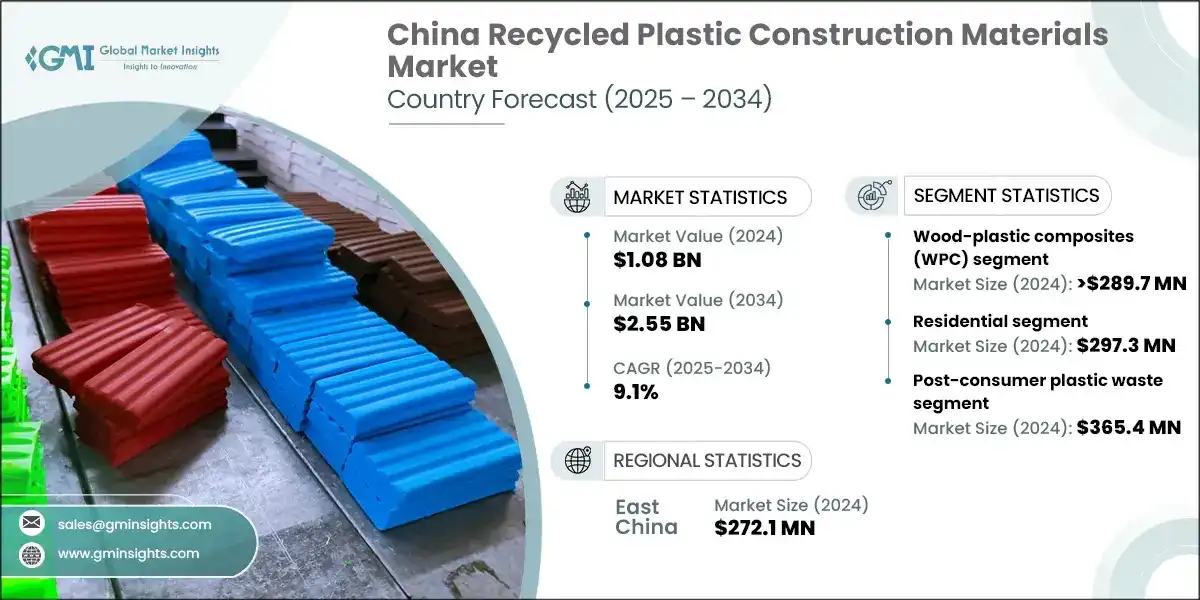
According to a recent study by Global Market Insights Inc., the China recycled plastic construction materials market size was estimated at USD 1.08 billion in 2024. The market is expected to grow from USD 1.17 billion in 2025 to USD 2.55 billion in 2034, at a CAGR of 9.1%.
China Recycled Plastic Construction Materials Market Key Takeaways
Market Size & Growth
- 2024 Market Size: USD 1.08 Billion
- 2034 Forecast Market Size: USD 2.55 Billion
- CAGR (2025–2034): 9.1%
Key Market Drivers
- National Circular Economy Strategy.
- Construction Waste Management Mandates.
- Urbanization and Infrastructure Development.
Challenges
- Infrastructure Development Requirements.
- Regional Development Disparities.
Opportunity
- Belt and Road Initiative Integration.
- Green Building Certification Growth.
Key Players
- Market Leader: China National Building Material Group Corporation led with over 18.7% market share in 2024.
- Leading Players: Top 5 players in this market include China National Building Material Group Corporation, China State Construction Engineering Corporation, China Resources Group, Sinopec, Shanghai Construction Group, which collectively held a market share of 62.4% in 2024.
Get Market Insights & Growth Opportunities
- The market of construction with recycled plastic in China is stimulated by the combination of strong policy systems, sustainable assets, and growth of the urban development with the interest of greener construction materials. The existence of national policies towards pursuing the implementation of circular economies, a stronger emphasis on construction waste regulations, and the high rate of urbanization and big investment in infrastructures are fostering positive conditions in increasing the size of the market.
- At the national level, the circular-economy strategy of China has become a prominent force that popularizes recycled plastic in the construction industry. The 14th Five-Year Plan and State Council guidelines focus on resource efficiency, closed-loop industrial systems and the green-transition pathways.
- Policies under such framework are promising to offer great incentives to companies to incorporate post-consumer materials and C&D plastics into value chains. Early adoption of recycled plastic building materials such as WPC decking, panels and composites into buildings has been encouraged by subsidy schemes, technology patronage and pilot circular-economy cities.
- Higher requirements for construction waste management are also transforming the market environment. The framework of classification, sorting and recycling construction and demolition waste streams has been widened by the Ministry of Housing and Urban-Rural Development. These activities guarantee continuity of supply of feedstock to the recycled plastics used in bricks and aggregates and in cladding materials. Pilot programs such as zero-waste cities and sponge city programs also ensure downstream demand because recycled materials are required in built-up construction projects.
- Temporary or long-term scale demand of low-cost and low-carbon inputs of building remains due to rapid urbanization and increased investments by the populace in fixed assets. In the end of 2024, the urbanization rate in China was 67% and it grew by 0.84% points annually, leaving the building process with yet another demand that involves the recycled-plastic materials being asked to be used.
To get key market trends
China Recycled Plastic Construction Materials Market Trends
- China recycled plastic building materials market has been experiencing an increasing pattern of computerization in the recycling activities. Artificial intelligence (AI), the internet of things (IoT), and blockchain are being used in traceability and tracking of material flows in a construction site and demo sites. Such digitization does not only increase efficiency but also make sure that it corresponds to the strategy of the government, which is the circular economy. An example is Shanghai, which has recently established a waste-tracking scheme to ensure the establishment of more than 85 percent of construction waste reuse, which supports the idea of transparency and accountability in recycling activities.
- The trend of green building certifications that have been steadily increasing recycled plastic materials use is another large trend to consider; certifications including LEED, BREEAM and Three-Star Rating system in China have all worked to drive the uptake of recycled plastic materials. Builders are consuming these products to acquire sustainability points as well as satisfy required requirements in urban construction. The green building construction in China (as well as recycled plastic composites, used in cladding, insulation and piping) has increased rapidly with more than 10,000 certified projects in China in 2023, with the tier-1 cities of China such as Shanghai and Shenzhen driving most growth.
- PPP (Public-Private Partnership) is also gaining space in the market to create recycling infrastructure, especially the regional hubs that can process and supply recycle plastics to construction. Such partnerships enhance supplement and decrease fluctuation of raw material costs. The most recent cooperation of CNBM with local governments to develop recycling parks is the clearest example, as the relationship between waste management and the construction industry solidifies.
China Recycled Plastic Construction Materials Market Analysis

Learn more about the key segments shaping this market
Based on products type, the market is segmented into Recycled Plastic Aggregates and Additives, Wood-Plastic Composites (WPC), Recycled Plastic Building Blocks and Bricks, Insulation and Thermal Materials, Piping and Infrastructure Components, and Roofing and Cladding Materials. Wood-plastic composites (WPC) segment was worth over USD 289.7 million in 2024.
- The China recycled plastic construction materials market is dominated by Wood Plastic Composites (WPC) which comprise the majority market share (around 26.8%) in the year 2024. The advantage of the segment is the broad scope of application in the industry as this segment covers overall demand in the decking, façade batten, landscaping, and outdoor furniture sectors, especially in the province of Zhejiang, Jiangsu, and Shanghai, where considerable urban refurbishment and urban infrastructure construction programs are underway.
- Municipal authorities and real estate developers have been increasingly turning to WPC in preference over timber because of durability, maintenance free and that it can pass the stringent requirements of green buildings set up in China making WPC a reasonably priced alternative to timber in large scale publicity projects.
- Piping and other infrastructure components and disc materials and insulation materials are other segments that are experiencing healthy growth. Investments in drainage and cable conduit piping are propelled by sponge city projects throughout China, and insulation is catching on due to more stringent building energy-efficiency requirements in Tier-1 and Tier-2 cities.
- In the meantime, products that use recycled plastic in the roofing, cladding, aggregates and bricks are becoming niche but growing rapidly, especially in rural housing and modular construction. Nevertheless, in relation to them, WPC is still beating the others because of the maturity of its supply chain, high availability of PCR feedstock materials and its quicker adoption by the contractors making it the flagship of the market of recycled plastic construction materials in China.
Based on applications, the market is segmented into residential construction, commercial and office construction, industrial construction, infrastructure and public works, and smart city and green building projects. The residential segment was valued at USD 297.3 million in 2024.
- The residential construction phase occupies an almost 27.5% revenue share in 2024 and is likely to retain its dominance till 2034. High population in urban areas, increased demand of houses among the middle-income groups, and affordable housing schemes developed by government bodies have strengthened the trend of using sustainable and economical materials at high rate.
- There is a rise of recycled plastic-made wood plastic composites, roofing sheets, and insulation boards in high-density residential complex in such metropolitan cities as Shanghai, Beijing and Guangzhou. The adoption is further enhanced by the drive towards the green building certifications and the more stringent energy-efficiency codes where both the homeowner and the developer take eco-friendly over alternative that reduces the lifecycle costs.
- The office and commercial construction industry is also picking up its pace and this has been aided by sustainability pledges in the corporate sector and the growing business centers in China. Another major driver of growth is infrastructure and public works as well as smart cities undertakings especially due to the competence in investing in urban regeneration work and green public amenities.
- In the meantime, applications in industrial construction are on the increase, particularly through logistics hubs and manufacturing parks where much of the flooring, cladding, and durable piping solutions are stored with recycled plastic products as the material of choice. Respite these new frontiers can be found in residential construction since it is the spine of the market due to its magnitude, government advocacy and sustainable housing demands by consumers.
Learn more about the key segments shaping this market
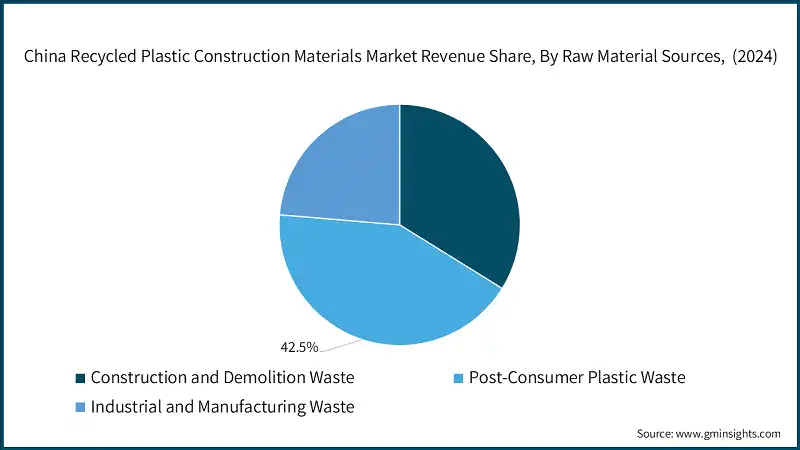
Based on technology, the market is segmented into construction and demolition waste, post-consumer plastic waste, and industrial and manufacturing waste. Post-consumer plastic waste was valued at USD 365.4 million in 2024.
- The construction and demolition (C&D) waste form most of the raw material segment in the recycled plastic construction materials market in China, backed by the vast renewal projects in the city and the massive modernization of infrastructures there. The supply of plastic-based waste has risen enormously as older stock of houses has been retired and replaced and weaker constructions are brought down and has hence presented a consistent source of recycling either in the form of aggregates, composites and block materials. The targeted promotion of circular economy activities and the “Zero Waste Cities” program of the government are additional incentives to route C&D waste into the building sector, which further solidifies the status of C&D waste as the biggest source of raw materials.
- The second-largest source is post-consumer plastic waste and increases the number of households consuming plastic and plastic packaging waste. Improved collection systems and recycling infrastructure in major cities such as Shanghai, Beijing and Shenzhen have seen post-consumer plastics diverted to the production of insulation materials, cladding and piping. Although the share is not as high as C&D waste one, it is anticipated that the segment will continue growing as the more rigid recycling of plastic requirements get passed on throughout the nation.
- In the meantime, manufacturing and industrial waste contribute a less relevant part in providing quality plastic foodstuff used in specific construction matters. It is relatively homogenous and thus fits in precision applications like thermal insulation and infrastructure-grade material. Nevertheless, it has a lower level of growth when compared with the sheer presence of C&D waste that even today, dominates by nature due to policy and weight of availability.
Looking for region specific data?
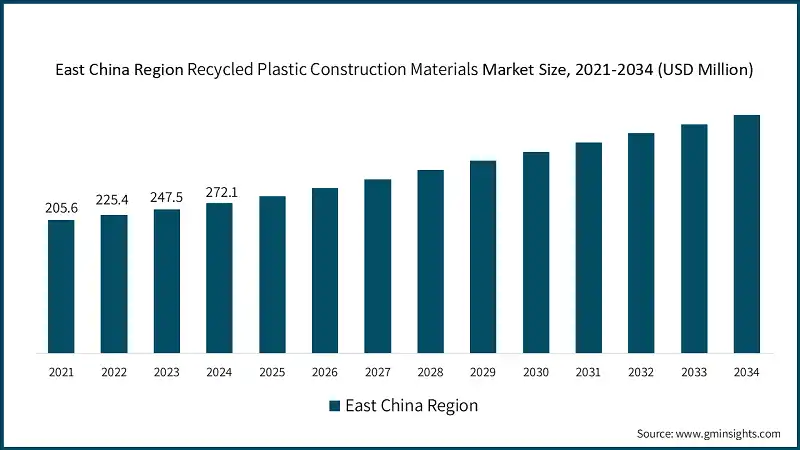
East China recycled plastic construction materials market held 25.2% revenue share with USD 272.1 million in 2024.
- The market of North China Region is growing with CAGR of about 8% due to the rigorous green building policies of Beijing and renewal of infrastructures of Tianjin to Hebei. Eco-friendly local public projects and prefab construction are trends that bode well in the region in terms of increased demand of recycled plastic composites being used as insulation, piping and roofing materials.
- A positive value of nearly 9.8% CAGR is leading the East China Region with Shanghai forcing people to move toward waste-sorting techniques, and Jiangsu had a record level of constructional output. Rapid growth in the market is exemplified by demonstration projects and high volumes of use in housing and metro infrastructure, that is, plastic-modified asphalt. Tough provincial policies and a well-developed industry additionally boosts the growth.
- South China Region CAGR is estimated to be around 9.7% with the aid of the booming real estate market in Guangdong and demand of prefabricated houses. The fact that the region is a large manufacturing center gives it sufficient sources of PCR feedstock to make its use cost-effective in floors, drainage pipes, and composite panels. The adoption is reinforced by Shenzhen and Guangzhou requirements of circular economy.
- The region of Southwest China is growing at a CAGR of almost 9.9% which is the highest rate of all regions and is driven by the urbanization drive of Chengdu and Chongqing. Large-scale infrastructural and sustainable urban planning investments are the forces that lead to recycled plastics being used to build bridges, roads, and housing. The low-carbon construction materials are something that should be supported by provincial policies encouraging people to use construction materials that are good in the province.
- The market is experiencing a CAGR of around 8% in Northwest China Region driven by the infrastructure projects which are part of the Belt and Road Initiative in Xinjiang and Shaanxi. Duplication of recycled plastics into pipeline, drainage, and road surfacing is becoming popular, and the economic benefits associated with its use are attracting its usage even in arid and resource-sensitive conditions.
- With a CAGR of nearly 9.6%, Central China Region is rising mainly due to the intense urbanization and inexpensive housing construction that takes place in Henan, Hubei and Hunan. The increasing use of recycled plastics in prefabricated housing, insulation and interior walls is in line with modernization of the region and government supported green programs.
- Northeast China Region has the lowest national growth rate of almost 6% CAGR as the prospects of growth in the construction projects in the three provinces of Liaoning, Jilin, and Heilongjiang are relatively stagnant. However, green urban renewal projects and the process of revitalization of the industrial base are encouraged by the government, which helps take up the recycled plastics slowly in terms of public housing and infrastructural enhancement.
China Recycled Plastic Construction Materials Market Share
- The top 7 companies in the China recycled plastic construction materials industry are China National Building Material Group Corporation, China Resources Group, China State Construction Engineering Corporation, Sinopec, Shanghai Construction Group, Guangdong Provincial Construction Group, and Shandong Hi-Speed Group, contributing around 62% of the market in 2024.
- CNBM is taking a progressive role by entering strategic partnerships with drivers in recycling and research centers to ensure that recycled plastics become a backup in cement composites, panels, and prefabricated modules. The firm is willing to spend a lot of money on low-carbon research and development efforts to produce hybrid cement plastic materials that can lead to dual-carbon targets in China. CNBM reaches its cost competitiveness through its huge manufacturing presence and supply chain, besides increasing exports to Southeast Asia. Its commitment towards carbon-cutting construction materials makes it a world standard in the sphere of sustainability.
- CSCEC focuses on mass application of recycled plastics in the environmentally friendly construction and housing activities. The business model is a hybrid of aggressive bidding systems and value-added sustainability consulting in order to attract both the public and the private developers. The firm is also researching on digital building platforms where the lifecycle savings of carbon are monitored to enable clients to achieve green building certification. CSCEC strengthens its leadership position in green construction by meeting the unaddressed demand based on integrated, cost-effective eco-materials.
- China Resources lays emphasis in the urban development works by recycling plastic on wood composition (WPC) applying it on the floors, landscapes, and homes. The firm seeks geographical alliances with city administration to extend supply of recycled feedstock and waste deficiency. It has competitive advantage in streamlining solutions to achieve sustainability goals at the community level as well as the branding strategies like eco-labels certification. This makes China Resources a leader in terms of adopting the circular economy on a city level.
- Sinopec is characterized by upstream integration whereby it has implemented chemical recycling technologies to produce construction grade- PCR resins. Its competitive strategy is to make large-scale investments on pyrolysis and depolymerization plants to ensure stable feedstock supply to pipes, insulation foams, and roofing sheets. Sinopec is also involved in venturing joint ventures with construction companies to come up with advanced building materials that are manufactured using recycled plastics sustainably. It has an unprecedented advantage in the market because of its duality as a provider of material and sustainability innovators.
- SCG utilizes its involvement in the development of megaprojects in urban areas to implement recycled plastic aggregate, panels and composites. The company is focusing on a presentation of projects in metro, residential, and bridge building that depicts the environment and endurance advantages. Crafting or recycling G seeks to bolster the likelihood of adherence to the changing laws by investing in digital monitoring systems to monitor performance of recycled contents. Its approach of engineering superiority and mixing and matching circular materials increases its competitive strength in urban work.
- Guangdong Provincial Construction Group initiative focuses on prefabricated homes and sewerage facilities through reuse of plastics, which decreases the cost of construction and the complexity of time. The company makes investments in the regional recycling partnerships to achieve supply security and cost stability. Guangdong Construction Group can satisfy unmet needs of southern China housing to fill gaps in the market because it can develop its solutions to suit the ever-increasing housing demand, and as a result, the government in China fully supports this company and its clients trust it.
- Shandong Hi-Speed designs roads by using recycled plastics with a special emphasis on infrastructure development and adding recycled plastics into road surfacing, guardrails and structural composites. Its competitive market focuses include being the first company to undertake plastic-modified asphalt work in the expressways with success in cost savings and long-term stability. The company also seeks to establish partnerships with the technology providers to maximize the recycled road materials and to scale up. That makes Shandong Hi-Speed a national innovative leader in terms of sustainable infrastructure.
China Recycled Plastic Construction Materials Market Companies
Major players operating in the China recycled plastic construction materials industry are
- China National Building Material Group Corporation
- China Resources Group
- China State Construction Engineering Corporation
- CRDC Global
- Guangdong Provincial Construction Group
- Shandong Hi-Speed Group
- Shanghai Construction Group
- Sinopec
- Zhejiang Provincial Energy Group
China Recycled Plastic Construction Materials Market Report Attributes
| Key Takeaway | Details |
|---|---|
| Market Size & Growth | |
| Base Year | 2024 |
| Market Size in 2024 | USD 1.08 Billion |
| Forecast Period 2025 - 2034 CAGR | 9.1% |
| Market Size in 2034 | USD 2.55 Billion |
| Key Market Trends | |
| Drivers | Impact |
| National Circular Economy Strategy | Accelerates adoption of recycled plastic construction materials by mandating sustainable resource use and boosting investments in recycling infrastructure. |
| Construction Waste Management Mandates | Ensures a steady supply of raw materials by enforcing segregation, collection, and reuse of construction and demolition waste. |
| Urbanization and Infrastructure Development | Expands demand for recycled plastic materials as large-scale housing, smart cities, and infrastructure projects integrate eco-friendly construction |
| Pitfalls & Challenges | Impact |
| Infrastructure Development Requirements | High capital and technological investment needs slow down the large-scale adoption of recycled plastic materials in construction projects. |
| Regional Development Disparities | Uneven recycling infrastructure and policy enforcement across provinces hinder uniform market penetration and scalability. |
| Opportunities: | Impact |
| Belt and Road Initiative Integration | Expands demand for recycled plastic construction materials through cross-border infrastructure projects aligned with Chinas sustainability goals. |
| Green Building Certification Growth | Accelerates market adoption as developers increasingly use recycled plastic materials to meet LEED, BREEAM, and Chinas Three-Star standards. |
| Market Leaders (2024) | |
| Market Leaders |
18.7% market share |
| Top Players |
Collective market share in 2024 is 62.4% |
| Competitive Edge |
|
| Regional Insights | |
| Largest Market | East China Region |
| Fastest Growing Market | Central China Region |
| Emerging Country | Beijing Municipality, Shanghai Municipality, Zhejiang Province, and Anhui Province |
| Future Outlook |
|
What are the growth opportunities in this market?
China Recycled Plastic Construction Materials Market News
- In August 2025, the State Administration for Market Regulation in China introduced nine new national standards on recycled plastics beginning February 2026. The standards will help in enhancing quality and uniformity within the PCR grades in various types of construction either in profiles, decking or piping. Stakeholders in the industry noted that such a shift will fast track the use of recycled plastics in major building and infrastructure developments.
- In April 2025, Changzhou opened up the first road part of the world in which a plastics-asphalt mix is used due to the reconstruction of the roads by Jiangsu Provincial Transport Department being made of recycled plastics. The pilot project, created in collaboration with local research institutes recycles post-consumer plastics to increase durability of the road. According to the authorities, the plan fits into the Chinese circular economy plans and once expanded, it would create a new market in recycled plastics feedstock to finance infrastructure developments.
- In November 2024, Aramco China launched three refurbished pop-up basketball courts across Beijing that used flooring made of recycled plastics. The company underlined that the innovation is not only resilient but also sustainable, and thus the firm enters the recycled construction products in sports infrastructure. The project falls within ESG commitments that are made by Aramco in the Chinese market.
The China recycled plastic construction materials market research report includes in-depth coverage of the industry with estimates & forecasts in terms of revenue (USD Million) & volume (Kilotons) from 2021 to 2034, for the following segments:
Market, By Product Type
- Recycled plastic aggregates and additives
- Concrete additives
- Plastic sand and aggregate substitutes
- Composite material components
- Wood-plastic composites (WPC)
- Decorative and finishing materials
- Recycled plastic building blocks and bricks
- Plastic sand bricks
- Eco-bricks and composite blocks
- Structural building components
- Insulation and thermal materials
- Foam insulation products
- Fiber-based insulation materials
- Thermal barrier systems
- Piping and infrastructure components
- Drainage and water management systems
- Utility infrastructure components
- Underground pipeline systems
- Roofing and cladding materials
- Recycled plastic roofing systems
- Exterior cladding solutions
- Waterproofing and membrane systems
Market, By Application
- Residential construction
- Urban housing development
- Rural construction and renovation
- Affordable housing programs
- Commercial and office construction
- Office buildings and business centers
- Retail and shopping centers
- Hospitality and tourism infrastructure
- Industrial construction
- Manufacturing facilities
- Warehouses and logistics centers
- Industrial parks and special economic zones
- Infrastructure and public works
- Transportation infrastructure
- Water and wastewater treatment facilities
- Public buildings and facilities
- Smart city and green building projects
- Smart city pilot programs
- Green building certification projects
- Sustainable urban development
Market, By Raw Material Source
- Construction and demolition waste
- Concrete and masonry waste
- Plastic construction materials waste
- Mixed construction debris
- Post-consumer plastic waste
- PET (Polyethylene Terephthalate)
- HDPE (High-Density Polyethylene)
- PP (Polypropylene)
- PVC (Polyvinyl Chloride)
- Other plastic types
- Industrial and manufacturing waste
- Manufacturing process waste
- Packaging and container waste
- Electronic and electrical waste plastics
The above information is provided for the following regions and countries:
- North China Region
- Beijing Municipality
- Tianjin Municipality
- Hebei Province
- Shanxi Province
- Inner Mongolia Autonomous Region
- East China Region
- Shanghai Municipality
- Jiangsu Province
- Zhejiang Province
- Anhui Province
- Fujian Province
- Jiangxi Province
- Shandong Province
- South China Region
- Guangdong Province
- Guangxi Zhuang Autonomous Region
- Hainan Province
- Southwest China Region
- Chongqing Municipality
- Sichuan Province
- Guizhou Province
- Yunnan Province
- Tibet Autonomous Region
- Northwest China Region
- Shaanxi Province
- Gansu Province
- Qinghai Province
- Ningxia Hui Autonomous Region
- Xinjiang Uygur Autonomous Region
- Central China Region
- Henan Province
- Hubei Province
- Hunan Province
- Northeast China Region
- Liaoning Province
- Jilin Province
- Heilongjiang Province
Frequently Asked Question(FAQ) :
What is the market size of China recycled plastic construction materials in 2024?
The market size was USD 1.08 billion in 2024, with a CAGR of 9.1% expected through 2034 driven by China's circular economy strategy, construction waste management mandates, and rapid urbanization.
What is the projected value of the China recycled plastic construction materials market by 2034?
The market is expected to reach USD 2.55 billion by 2034, propelled by green building certifications, smart city developments, and government policies promoting sustainable construction materials.
How much revenue did the Wood-Plastic Composites (WPC) segment generate in 2024?
WPC segment generated USD 289.7 million in 2024, leading the market with 26.8% share due to its broad applications in decking, façades, and landscaping projects.
What was the valuation of residential construction application segment in 2024?
Residential construction held 27.5% market share and generated USD 297.3 million in 2024, supported by urban housing demand and affordable housing programs.
What is the growth outlook for the Central China Region from 2025 to 2034?
Central China Region is projected to grow at a 9.6% CAGR through 2034, fueled by intense urbanization and affordable housing construction in Henan, Hubei, and Hunan provinces.
Which region leads the China recycled plastic construction materials market?
East China Region held 25.2% share with USD 272.1 million in 2024. Shanghai's waste-sorting initiatives and Jiangsu's high construction output drive the region's dominance.
What are the upcoming trends in the China recycled plastic construction materials market?
Key trends include digitization through AI and IoT for material tracking, increasing green building certifications (LEED, BREEAM, Three-Star), and Public-Private Partnerships for recycling infrastructure development.
Who are the key players in the China recycled plastic construction materials market?
Key players include China National Building Material Group Corporation, China State Construction Engineering Corporation, China Resources Group, Sinopec, Shanghai Construction Group, Guangdong Provincial Construction Group, and Shandong Hi-Speed Group.
China Recycled Plastic Construction Materials Market Scope
Related Reports