Summary
Table of Content

China Molecular Diagnostics Market
Get a free sample of this report
Form submitted successfully!
Error submitting form. Please try again.
Thank you!
Your inquiry has been received. Our team will reach out to you with the required details via email. To ensure that you don't miss their response, kindly remember to check your spam folder as well!
Request Sectional Data
Thank you!
Your inquiry has been received. Our team will reach out to you with the required details via email. To ensure that you don't miss their response, kindly remember to check your spam folder as well!
Form submitted successfully!
Error submitting form. Please try again.
China Molecular Diagnostics Market Size
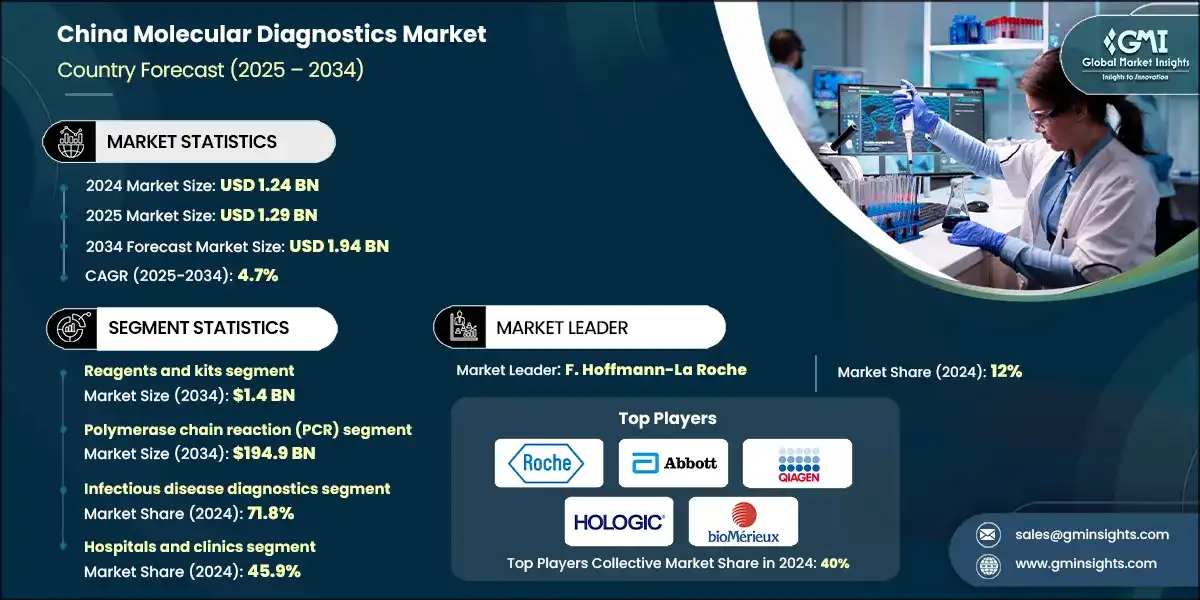
The China molecular diagnostics market was valued at USD 1.24 billion in 2024 and is projected to grow from USD 1.29 billion in 2025 to USD 1.94 billion by 2034, expanding at a CAGR of 4.7%, according to the latest report published by Global Market Insights Inc. This steady growth is stimulated by various factors such as the rising prevalence of infectious and chronic diseases across China, growing adoption of precision and personalized medicine, increasing government initiatives and healthcare spending, growing geriatric population base, among other. Major companies in the industry include F. Hoffmann-La Roche, Abbott Laboratories, Qiagen, Hologic, Biomerieux.
China Molecular Diagnostics Market Key Takeaways
Market Size & Growth
- 2024 Market Size: USD 1.24 Billion
- 2025 Market Size: USD 1.29 Billion
- 2034 Forecast Market Size: USD 1.94 Billion
- CAGR (2025–2034): 4.7%
Key Market Drivers
- Rising prevalence of infectious and chronic diseases across China.
- Growing adoption of precision and personalized medicine.
- Increased government initiatives and healthcare spending.
- Increasing geriatric population base.
Challenges
- High cost and limited accessibility.
- Complex regulatory landscape.
Opportunity
- Expansion of genomic research and biobanking.
Key Players
- Market Leader: F. Hoffmann-La Roche led with over 12% market share in 2024.
- Leading Players: Top 5 players in this market include F. Hoffmann-La Roche, Abbott Laboratories, Qiagen, Hologic, Biomerieux, which collectively held a market share of 40% in 2024.
Get Market Insights & Growth Opportunities
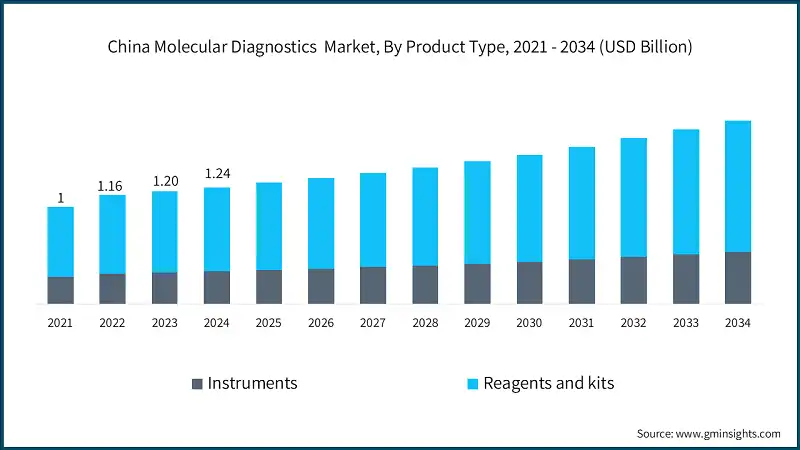
The market increased from USD 1 billion in 2021 to USD 1.2 billion in 2023, increasing burden of infectious and chronic disease is major catalyst for growth of molecular diagnostics in China as the population ages and lifestyle related conditions became more common. The demand for accurate, early stage detection diagnostic tools is increasing. For instance according to National Institutes of Health (NIH), by the end of 2020 China had approximately 1.1 million people living with HIV and 351,000 cumulative reported deaths highlighting scale of public health challenge. These surge in disease prevalence drives increased investment in healthcare infrastructure, diagnostic tool and innovation. The rising prevalence of diseases like HIV along with emerging threats is increasing adoption of molecular diagnostics, further accelerating the molecular diagnostics market growth.
Increasing aging population is major factor driving the growth for molecular diagnostic market. In 2023, according to the National Bureau of statistics of China, it was currently the only country in world with more than 200 million elderly people by end of 2022 and the population aged 60 and above reached 280 million accounting for 19.8% of national total. This growing elderly demographic creates need for advanced diagnostics, stimulating the market growth.
Molecular diagnostics refers to a diagnostic method that examines biological markers in the genome and proteome, including RNA, DNA, and proteins, to identify and monitor various diseases. This technique is widely utilized for diagnosing genetic disorders, infectious diseases, and cancer due to its high effectiveness and precision.
To get key market trends
China Molecular Diagnostics Market Trends
- Government initiatives are accelerating development and adoption of China's molecular diagnostic market. Programs like healthy China 2030 and expansion of public health insurance are helping to prioritise early disease detection and personalised medicine.
- These policies encourage the adoption of advanced diagnostic technology including genomics, PCR based testing especially in cancer, infectious disease, and chronic conditions.
- Additionally, healthcare spending is important factor supporting infrastructure and innovation. Increased funding allows hospital and labs to invest in high throughput diagnostic platform and train specialised personnel. It also helps boost R&D for domestic biotech firms and helping them compete rising demand for accurate rapid and affordable molecular tests.
- For instance, according to joint report by World Bank and Chinese government China's health spending is projected to reach USD 2.5 trillion by 2035 up from USD 543.5 billion in 2014. These surge in expenditure reflects the countries commitment to healthcare modernization.
- Moreover, precision medicine relies on molecular diagnostic to identify genetic proteomic and metabolic markers, that help targeted therapies as China invest in personalised healthcare demand for advanced diagnostic tools such as next generation sequencing and PCR based assays continues to increase, stimulating the market growth.
China Molecular Diagnostics Market Analysis
Learn more about the key segments shaping this market
Based on the product type, the China market is segmented into instruments, and reagents and kits. The reagents and kits segment led this market in 2024, accounting for the highest market share because of its frequent repeat purchases accelerated by its high-throughput workflow and routine diagnostic testing. This segment was valued at USD 892.6 million in 2024 and is projected to reach USD 1.4 billion by 2034, growing at a CAGR of 4.6%. This growth is largely attributed to the rising prevalence of chronic disease conditions and rising aging population across the globe. In comparison, the instruments segment was valued at USD 347.4 million in 2024 and is projected to reach USD 556.1 million by 2034, growing at a CAGR of 4.9% during forecast period.
- Molecular diagnostic instruments include range of advanced tools used to detect and analyse biological markers at molecular level. Common instruments include PCR machine, next generation sequencing platforms, microarrays, automated nucleic acid extractors. These devices are essential for identifying genetic mutation pathogens and disease specific biomarkers with high sensitivity and specificity.
- These instruments are used primarily for early detection personalised treatment planning and monitoring responses. In China, they are increasingly applied in oncology, infectious disease control, and genetic screening.
- Additionally, their ability to deliver rapid and accurate result makes them important in clinical decision especially as the country shifts towards precision medicine.
- For instance, Agilent offers high-resolution CGH + SNP microarrays for cytogenetic workflows, enabling whole-genome analysis of copy number (CN) and loss of heterozygosity (LOH) in a single test. Featuring SurePrint technology and over 28 million validated probes, these arrays support applications in cancer, prenatal, and postnatal diagnostics.
- Additionally, the increasing prevalence of diseases, technological improvement and greater adoption of instruments, is further accelerating the market growth.
Based on technology, the China molecular diagnostics market is segmented into polymerase chain reaction (PCR), hybridization, sequencing, isothermal nucleic acid amplification technology (INAAT), microarrays, and other technologies. The polymerase chain reaction (PCR) segment accounted for the highest market share of 70.4% in 2024. In comparison, the hybridization segment was valued at USD 126.7 million in 2024 and is expected to grow to USD 194.9 billion by 2034, with a CAGR of 4.5%.
- Polymeric chain reaction PCR is widely used technique in molecular diagnostic that amplifies small segment of DNA or RNA. It enables the detection of genetic material from pathogens, mutations, or specific biomarkers with high sensitivity and specificity.
- Variants include conventional PCR, real-time PCR, and digital PCR each offering different level of precision.
- PCR is used for early and accurate diagnosis of infectious disease, genetic disorders, and cancers. It plays important role in personalised medicine by identifying mutations that guide targeted therapies.
- Additionally, as disease prevalence increases especially in aging population the adoption of PCR rises to meet diagnostic demands.
- For instance, according to World Health Organization, China accounts for a significant share of the global hepatitis burden, with approximately eighty-seven million people chronically infected with the hepatitis B virus, representing about one-third of all chronic HBV carriers worldwide. Additionally, an estimated 7.6 million people in China are living with chronic hepatitis C, highlighting the urgent need for widespread diagnostic and treatment solutions.
- Therefore, the high prevalence of chronic diseases such as hepatitis B and C in China significantly increases the demand for accurate and early diagnostic tools like PCR.
Based on application, the China molecular diagnostics market is segmented into infectious disease, genetic disease testing, oncology testing, and other applications. The infectious disease diagnostics market is further bifurcated into, COVID-19, flu, respiratory syncytial virus (RSV), tuberculosis, CT/NG, HIV, Hepatitis C, Hepatitis B, and other infectious disease diagnostics. The infectious disease diagnostics segment accounted for the highest market share of 71.8% in 2024.
- Infectious disease diagnostics involved detecting pathogens such as viruses bacteria using molecular tools like PCR, Next generation sequencing (NGS) and microarrays. These tests identify genetic material from organism responsible for diseases like HIV, hepatitis tuberculosis, and COVID-19.
- Infectious disease segment dominates the market due to high burden of infectious disease in densely populated countries like China.
- For instance, according to the State Council of the People's Republic of China, by the end of 2022, approximately 1.22 million individuals were living with HIV/AIDS in the country. Since the first reported case in 1985, China has recorded a cumulative death toll of 418,000 due to HIV/AIDS.
- Molecular diagnostics, especially with PCR based technologies, offer high levels of accurate and timely testing solutions, making them essential for outbreak management as well as daily healthcare management.
- Molecular diagnostics offer sensitivity and speed, making them an important choice in clinical setting.
- Therefore, as disease prevalence rises the adoption of molecular diagnostics for infectious disease increases, stimulating the market growth.
Learn more about the key segments shaping this market
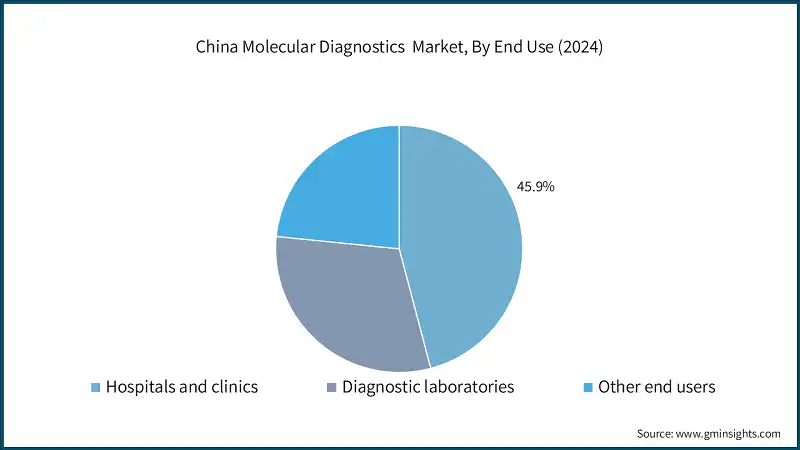
Based on end use, the China molecular diagnostics market is segmented into hospitals and clinics, diagnostic laboratories, and other end users. The hospitals and clinics segment accounted for the highest market share of 45.9% in 2024.
- Hospitals play an important role in molecular diagnostic market due to their robust infrastructure, skilled personnel, and access to advanced equipment. They are well equipped to handle high throughput and complex diagnostic procedure making them and best place for implementing molecular technologies like PCR and NGS.
- The rising prevalence of chronic infections and cancer in China has led to increased hospital admissions further stimulating demand for diagnostic services.
- For instance, according to global cancer observatory In 2022, China reported 4,824,703 new cases, 2,574,176 deaths, and 10,968,974 prevalent cases over a 5-year period. These figures highlight the substantial disease burden and underscore the critical need for robust diagnostic and healthcare infrastructure.
- Additionally, the growing geriatric population also contribute to hospital-based diagnostic as older adults are more susceptible to infection and chronic illness, and they also require frequent testing.
- Moreover, hospital benefit from integrated IT structure that supports data management and real time reporting improving diagnostic efficiency. Public and private investments in hospital-based lab especially in markets like China strengthen their dominance.
China Molecular Diagnostics Market Share
- The molecular diagnostics market in China is strongly influenced by the presence of leading companies such as Abbott Laboratories, F. Hoffmann-La Roche, Danaher Corporation, Siemens Healthineers, and Thermo Fisher Scientific. These firms maintain a dominant market position through their diverse product portfolios, well-established distribution networks, and ongoing investments in R&D. Their ability to deliver high-performance, reliable diagnostic solutions across a wide range of disease areas gives them a competitive edge in China’s rapidly evolving healthcare landscape.
- Additionally, these companies benefit from strategic partnerships with local healthcare providers and regulatory support for advanced diagnostic technologies, which further strengthens their market presence. Their focus on precision medicine and automation aligns with China’s healthcare modernization goals, making them key drivers of innovation and growth in the molecular diagnostics sector.
- New entrants in China’s molecular diagnostics market are actively leveraging innovation, regulatory alignment, and strategic positioning to gain traction. They are focusing on developing advanced technologies such as digital PCR and next-generation sequencing platforms, targeting high-demand areas like cancer screening, infectious disease detection, and prenatal testing. Many are securing local regulatory approvals, forming partnerships with domestic healthcare providers, and investing in R&D to differentiate their offerings.
- Startups like Rainsure Bio and PilotGene have entered the market by developing digital PCR (dPCR) platforms.
China Molecular Diagnostics Market Companies
Few of the prominent players operating in the China molecular diagnostics industry include:
- Abbott Laboratories
- Agilent Technologies
- Becton, Dickinson, and Company
- Biocartis
- Biomerieux
- Bio-Rad Laboratories
- Danaher Corporation
- F. Hoffmann-La Roche
- Hologic
- Illumina
- Qiagen
- QuidelOrtho Corporation
- Siemens Healthineers
- Sysmex Corporation
- Thermo Fisher Scientific
- Rainsure Bio
- Pilot Gene
- Hologic
Hologic delivers molecular diagnostics for infectious diseases, STIs, and transplant monitoring, emphasizing high-throughput automation and lab efficiency. Its scalable platforms are designed to meet current needs while supporting future growth.
bioMérieux offers molecular diagnostics for a broad range of infectious diseases, enabling rapid results and supporting pathogen detection and resistance profiling. Its syndromic testing solutions improve clinical decisions through automation, reliability, and user-friendly design.
Bio-Rad advances molecular diagnostics with technologies like digital PCR for precise DNA/RNA analysis. Its solutions aid early detection of cancer, infections, and genetic disorders, with specialized tools for reproductive health. The company emphasizes innovation, reliability, and lab performance through robust standards and controls.
China Molecular Diagnostics Market Report Attributes
| Key Takeaway | Details |
|---|---|
| Market Size & Growth | |
| Base Year | 2024 |
| Market Size in 2024 | USD 1.24 Billion |
| Market Size in 2025 | USD 1.29 Billion |
| Forecast Period 2025 - 2034 CAGR | 4.7% |
| Market Size in 2034 | USD 1.94 Billion |
| Key Market Trends | |
| Drivers | Impact |
| Rising prevalence of infectious and chronic diseases across China | Drives demand for early and accurate molecular diagnostics, expanding market size. |
| Growing adoption of precision and personalized medicine | Boosts the need for advanced molecular tools like PCR and NGS, accelerating innovation. |
| Increased government initiatives and healthcare spending | Enhances infrastructure and access, supporting widespread adoption of molecular diagnostics |
| Increasing geriatric population base | Raises diagnostic needs due to age-related diseases, strengthening hospital-based molecular testing demand. |
| Pitfalls & Challenges | Impact |
| High cost and limited accessibility | Restricts widespread adoption, especially in rural and underfunded healthcare settings. |
| Complex regulatory landscape | Slows product approvals and market entry for both domestic and international players. |
| Opportunities: | Impact |
| Expansion of genomic research and biobanking | Opens new avenues for personalized diagnostics and long-term disease tracking, driving innovation and market growth. |
| Market Leaders (2024) | |
| Market Leaders |
12% market share |
| Top Players |
Collective Market Share is 40% |
| Competitive Edge |
|
| Future outlook |
|
What are the growth opportunities in this market?
China Molecular Diagnostics Market News
- In May 2022, Abbott received FDA clearance for its Alinity m STI Assay, a PCR-based test that detects four common STIs using a single swab or urine sample. Designed for the Alinity m system, this product launch improved diagnostic efficiency, expanded Abbott’s portfolio, and supported revenue growth in molecular diagnostics.
The China molecular diagnostics market research report includes in-depth coverage of the industry with estimates and forecasts in terms of revenue in USD Million and from 2021 - 2034 for the following segments:
Market, By Product Type
- Instruments
- Reagents and kits
Market, By Technology
- Polymerase chain reaction (PCR)
- Hybridization
- Sequencing
- Isothermal nucleic acid amplification technology (INAAT)
- Microarrays
- Other technologies
Market, By Application
- Infectious disease diagnostics
- COVID-19
- Flu
- Respiratory syncytial virus (RSV)
- Tuberculosis
- CT/NG
- HIV
- Hepatitis C
- Hepatitis B
- Other infectious disease diagnostics
- Genetic disease testing
- Oncology testing
- Other applications
Market, By End Use
- Hospitals and clinics
- Diagnostic Laboratories
- Other end use
Frequently Asked Question(FAQ) :
What is the market size of the China molecular diagnostics in 2024?
The market size was USD 1.24 billion in 2024, with a CAGR of 4.7% expected through 2034 driven by rising disease prevalence, expanding precision medicine adoption, and increased government healthcare initiatives.
What is the projected value of the China molecular diagnostics market by 2034?
The China molecular diagnostics market is expected to reach USD 1.94 billion by 2034, propelled by government initiatives like Healthy China 2030, growing geriatric population, and advancement in PCR and NGS technologies.
What is the current China molecular diagnostics market size in 2025?
The market size is projected to reach USD 1.29 billion in 2025.
How much revenue did the reagents and kits segment generate in 2024?
Reagents and kits segment generated USD 892.6 million in 2024 and is projected to reach USD 1.4 billion by 2034, due to frequent repeat purchases and high-throughput workflows.
What was the valuation of the polymerase chain reaction (PCR) segment in 2024?
The PCR segment accounted for the highest market share of 70.4% in 2024, driven by its widespread use in detecting infectious diseases, genetic disorders, and cancers with high sensitivity.
What is the growth outlook for the hybridization segment from 2025 to 2034?
Hybridization segment was valued at USD 126.7 million in 2024 and is expected to grow to USD 194.9 million by 2034, with a CAGR of 4.5%.
Which end-use segment leads the China molecular diagnostics market?
Hospitals and clinics segment held the highest market share of 45.9% in 2024, led by robust infrastructure, skilled personnel, and access to advanced equipment for high-throughput diagnostic procedures.
What are the upcoming trends in the China molecular diagnostics market?
Key trends include government initiatives like Healthy China 2030, increased healthcare spending projected to reach USD 2.5 trillion by 2035, expansion of precision medicine, and adoption of multi-omics approaches combining genomics, proteomics, and metabolomics.
Who are the key players in the China molecular diagnostics market?
Key players include F. Hoffmann-La Roche, Abbott Laboratories, Qiagen, Hologic, Biomerieux, Agilent Technologies, Becton Dickinson and Company, Biocartis, Bio-Rad Laboratories, Danaher Corporation, Illumina, QuidelOrtho Corporation, Siemens Healthineers, Sysmex Corporation, Thermo Fisher Scientific, Rainsure Bio, and PilotGene.
China Molecular Diagnostics Market Scope
Related Reports