Summary
Table of Content

China Medical Adhesive Tapes Market
Get a free sample of this report
Form submitted successfully!
Error submitting form. Please try again.
Thank you!
Your inquiry has been received. Our team will reach out to you with the required details via email. To ensure that you don't miss their response, kindly remember to check your spam folder as well!
Request Sectional Data
Thank you!
Your inquiry has been received. Our team will reach out to you with the required details via email. To ensure that you don't miss their response, kindly remember to check your spam folder as well!
Form submitted successfully!
Error submitting form. Please try again.
China Medical Adhesive Tapes Market Size
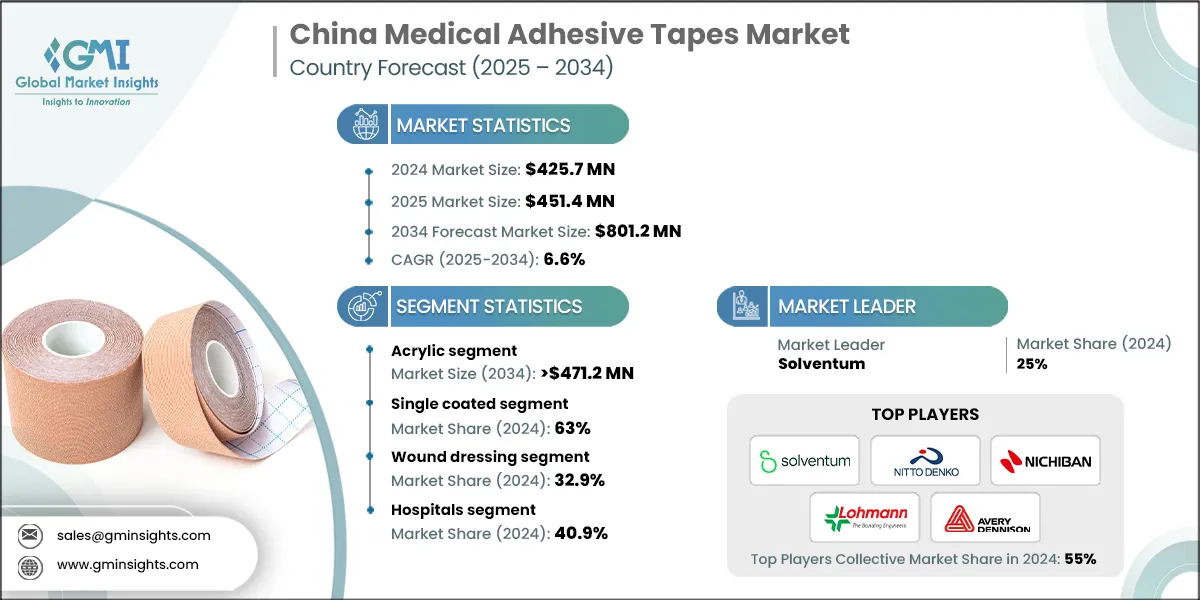
The China medical adhesive tapes market was valued at USD 425.7 million in 2024 and is projected to grow from USD 451.4 million in 2025 to USD 801.2 million by 2034, expanding at a CAGR of 6.6%, according to the latest report published by Global Market Insights Inc. The market has been steadily growing, driven by the growth in minimally invasive procedures, rising ostomy procedures, increasing demand for gentle, skin-safe adhesive tapes driven by the growing pediatric and geriatric populations, technological advancements in adhesive materials.
China Medical Adhesive Tapes Market Key Takeaways
Market Size & Growth
- 2024 Market Size: USD 425.7 Million
- 2025 Market Size: USD 451.4 Million
- 2034 Forecast Market Size: USD 801.2 Million
- CAGR (2025–2034): 6.6%
Key Market Drivers
- Growth in minimally invasive procedures.
- Rising ostomy procedures.
- Increasing demand for gentle, skin-safe adhesive tapes amid growing pediatric and geriatric populations.
- Technological advancements in adhesive materials.
Challenges
- Environmental concerns and disposal issues.
- Fragmented distribution channels.
Opportunity
- Expansion of remote diagnostics and virtual care..
Key Players
- Market Leader: Solventum led with over 25% market share in 2024.
- Leading Players: Top 5 players in this market include Solventum, Nitto Denko Corporation, Nichiban, Lohmann GmbH, Avery Dennison Corporation, which collectively held a market share of 55% in 2024.
Get Market Insights & Growth Opportunities
Medical adhesive tapes are specific tapes used clinically to secure dressings, bandages, and medical devices onto the skin. Major players in the medical adhesive tapes industry include, Nitto Denko Corporation, Solventum, Avery Dennison Corporation, Nichiban, Lohmann GmbH. The market continues to feature predominantly skin-friendly, durable, and hypoallergenic adhesive products that allow good fixation whilst minimizing topical irritations of the skin, particularly important for all skin conditions or sensitive skin.
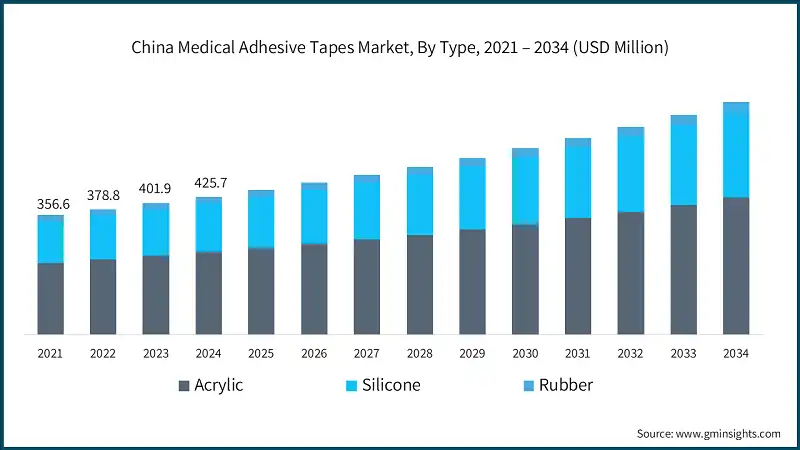
The market increased from USD 356.6 million in 2021 to USD 401.9 million in 2023. This growth is largely due to the growth in minimally invasive procedures and increasing demand for gentle, skin-safe adhesive tapes driven by the growing pediatric and geriatric populations. The growing pediatric and geriatric populations in China, both of which have highly sensitive skin, are driving increased demand for gentle, skin-safe medical adhesive tapes this trend is fueling market growth by pushing manufacturers to innovate hypoallergenic, breathable, and low-trauma adhesive solutions that cater to long-term care, chronic conditions, and home healthcare needs.
The rising number of ostomy procedures are playing a major role in driving market growth. For example, in 2022, China recorded approximately 127,672 ostomy surgeries, including colostomy, ileostomy, and urostomy procedures. This number is projected to rise steadily through 2030, driven by the increasing prevalence of colorectal cancer, inflammatory bowel diseases, and bladder-related conditions across the country.
Medical adhesive tapes play a crucial role in ostomy procedures by securely attaching ostomy bags to the skin around the stoma, ensuring a leak-proof seal while minimizing skin irritation. These tapes are designed to be flexible, breathable, and hypoallergenic, accommodating body movement and long-term wear. Thus, increasing prevalence of colorectal cancer and rising ostomy procedures is significantly stimulating market growth.
Additionally, the increase in minimally invasive procedures such as laparoscopy, endoscopy, robotic-assisted surgery, catheter-based procedures, is positively affecting the medical adhesive tapes market as these procedures require secure, skin-friendly tape for small dressings, sensors and medical devices to be in place during and after the surgical procedure. In 2022, as per National Institute of Health, China offered digestive endoscopy services at over 7470 hospitals, an increase from 6128 in 2012. This expansion is driving demand for advanced adhesive tapes that offer flexibility, breathability, and long-term wear especially in post-operative care and device fixation, thereby fueling market growth.
Medical adhesive tapes are an essential part of modern health systems, especially used in wound care, surgical procedures, and fixation of medical devices. These tapes are designed to be breathable, flexible, and hypoallergenic to provide maximum comfort when used for long periods.
To get key market trends
China Medical Adhesive Tapes Market Trends
- The ongoing technological advancement in adhesive materials is driving demand for advanced medical adhesive tapes in the China market.
- One of the most popular advancements, is the growing use of biocompatible and hypoallergenic materials that provide stickiness without skin irritation. Biocompatible adhesive materials are the best option for long-term wear, with elderly or pediatric patients.
- In addition to this, foam and fabric tapes are evolving with improved breathability and flexibility to maximize patient comfort during prolonged use. The predominant use of biodegradable and eco-friendly materials is rising to meet China's sustainability objectives, while the regulatory push for greener products for the healthcare sector is paving the way for medical adhesive providers.
- Technological innovation is pushing the boundaries of traditional adhesive tapes by incorporating smart capabilities, such as sensors embedded within the tape to monitor wound healing, temperature, or moisture levels. These smart tapes provide real-time data to healthcare providers, enabling proactive treatment and reducing the risk of infection. This is particularly valuable in managing chronic wounds and post-surgical care.
- Lohmann’s DuploMED 85300 skin adhesive is a cutting-edge solution designed for long-term medical wear. It is water-resistant, breathable, and highly flexible, making it ideal for applications like continuous glucose monitoring, post-surgery care, and cardiac monitoring. With a wear time of up to 28 days, it enhances patient comfort and supports sustainability. The adhesive is biocompatible (ISO 10993 certified) and can be removed painlessly and without residue, ensuring a gentle experience for most users.
- Medical tape manufacturers are responding by developing specialized products that support device stability, enhance patient comfort, and ensure accurate data collection making remote patient monitoring a key growth driver in the medical adhesive tapes market.
China Medical Adhesive Tapes Market Analysis
Learn more about the key segments shaping this market
Based on the type, the China medical adhesive tapes market is segmented into acrylic, silicone, and rubber. The acrylic segment accounted for 59.6% of the market in 2024, due to its skin-friendliness, breathability, and resistance to moisture and temperature. The segment is expected to exceed USD 471.2 million by 2034, growing at a CAGR of 6.4% during the forecast period. On the other hand, the silicone segment is expected to grow with a CAGR of 6.9% from 2025 to 2034. The growth of this segment can be attributed to its superior skin adhesion with minimal trauma upon removal, making it ideal for pediatric and geriatric care.
- Acrylic adhesives are generally pressure-sensitive and utilized in a variety of medical applications, e.g., dressings, surgical tape and transdermal patches. Acrylic adhesives have excellent adhesion to skin and medical materials and are breathable, while also resistant to moisture and temperature changes.
- Acrylic adhesives are a significant driver to the growth of the medical adhesive tapes market in China, due to their adaptability, cost, and reliability of performance. They have a wide range of use in wound care, surgical procedures, and wearable medical devices, as demand grows for advanced healthcare solutions. This segment is also benefitting with the increasing prevalence of chronic diseases, the growing aging population, and the expansion of home healthcare services.
- Products such as Solventum's Micropore Surgical Tape, with an acrylate-based adhesive, demonstrate this innovation by allowing airflow which is both safe to the skin and maintain a secure fixation which is important for patients with sensitive or fragile skin.
Based on the adhesive, the China medical adhesive tapes market is segmented into single coated and double coated. The single coated segment accounted for the highest market share of 63% in 2024.
- In clinical applications, single coated tapes i.e., an adhesive coated side and a non-adhesive side are being used for wound dressings, surgical applications and device fixation for use in ostomy care as a secure but breathable means of adhering to skin or applying medical devices, while being flexible and easy to remove, critical for patient/resident comfort and ability for the clinician to work efficiently.
- For instance, ST-245 from Nitto Denko Corporation in Japan is a breathable medical adhesive tape that was developed to conform to the skin safely and maximize patient comfort. It uses a micro-gap adhesive coating that provides an airflow while adhering securely to skin. It has levels of water resistance and moisture permeability, providing comfort for the patient on long term wear. The thickness of ST-245 was selected considering flexibility and safety while still maintaining the necessary durability.
- The single coated segment plays a vital role in the evolution of China’s medical adhesive tapes market. Its adaptability, patient-centric design, and alignment with modern healthcare trends make it a key contributor to market expansion.
Based on the application, the China medical adhesive tapes market is segmented into surgery, wound dressing, device fixation, and other applications. The wound dressing segment accounted for market share of 32.9% in 2024.
- Wound dressing plays a critical role in managing fragile skin conditions in both pediatric and geriatric populations. In children, especially those under two years of age, the skin is thinner and more sensitive, making it highly susceptible to medical adhesive-related skin injuries (MARSI).
- Similarly, elderly patients face increased risks due to age-related skin thinning and comorbidities. In both groups, the use of advanced wound dressings such as soft silicone-based tapes helps minimize trauma during dressing changes, promoting safer and more effective care.
- Kendall Paper Tape is specifically designed for repeated applications on sensitive and fragile skin, making it ideal for both pediatric and elderly patients. These populations are more prone to medical adhesive-related skin injuries (MARSI) due to thinner skin layers, reduced elasticity, and increased vulnerability to trauma. As geriatric and pediatric population continues to rise, the importance of high-performance adhesive tapes in ensuring safe and efficient recovery becomes increasingly pronounced.
Learn more about the key segments shaping this market
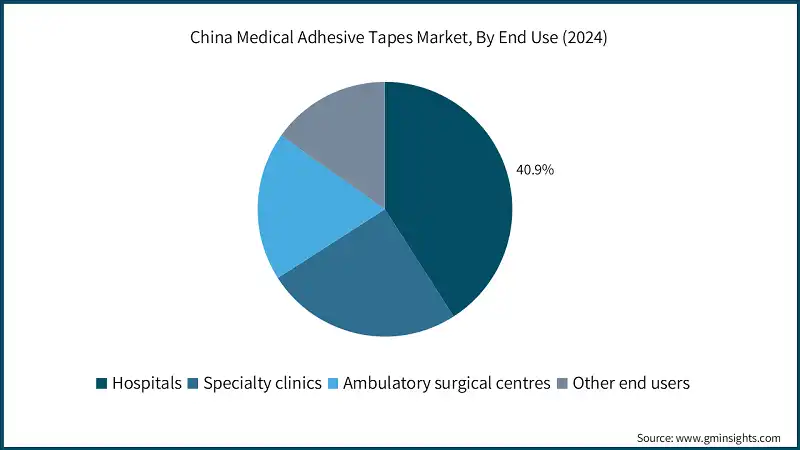
Based on end use, the China medical adhesive tapes market is segmented into hospitals, specialty clinics, ambulatory surgical centers, and other end users. The hospitals segment accounted for market share of 40.9% in 2024.
- Hospitals in China are playing a pivotal role in expanding the medical adhesive tapes market. With the increasing emphasis on chronic disease management, hospitals require reliable and sterile adhesive solutions for wound care, IV-line securement, and post-operative dressing.
- As of 2021, 267 million people in China were aged 60 and above, accounting for 18.9% of the population, with chronic diseases being a major healthcare burden. As chronic diseases such as diabetes, cardiovascular conditions, and cancer become more prevalent, hospitals are increasingly involved in long-term patient care, which demands frequent use of medical adhesive tapes for chronic wounds dressings, securing medical devices, and supporting rehabilitation procedures.
- In addition to advancement, hospitals have more advanced adhesive technology that provides faster healing, minimize skin trauma, and improve patient comfort for the elderly with fragile skin backgrounds. This trend is further supported by government initiatives aimed at strengthening hospital infrastructure and chronic disease programs, which indirectly boost procurement and usage of medical consumables like adhesive tapes.
China Medical Adhesive Tapes Market Share
- The top 5 players, such as Nitto Denko Corporation, Solventum, Avery Dennison Corporation, Nichiban, and Lohmann GmbH collectively held 55% of the total market share. These firms maintain their leadership through a combination of material innovations, AI-assisted manufacturing, regulatory compliance, and strategic partnerships with hospitals and surgical centers.
- The medical adhesive tapes market is undergoing significant transformation, fueled by rising demand for skin-friendly, high-performance products used in wound care, surgical procedures, and device stabilization. A key innovation in this space is the emergence of silicone-based adhesives, which provide gentle yet secure adhesion and allow for painless removal making them particularly suitable for patients with delicate or sensitive skin. These tapes are increasingly favored in pediatric, elderly, and post-surgical care environments.
- Additionally, hydrogel and hydrocolloid adhesives are gaining traction for their moisture-balancing properties, which help maintain optimal healing environments and reduce the risk of skin maceration during extended wear. Argyle Neonatal Hydrogel Adhesive Tape by Cardinal Health is designed with a clear hydrogel formula that gently yet securely adheres to the delicate skin of infants. It effectively holds catheters, I.V. lines, and lead wires in place without causing irritation or damage.
- Manufacturers in China's medical adhesive strips market are investing in increased production capacity, expanding their product portfolio, and complying with international quality standards because of increased demand for products from hospitals and chronic care environments. Additionally, many manufacturers are implementing sustainability measures and forming strategic alliances to increase distribution, localization, and responsiveness to changing health needs, allowing them to remain competitive in a rapidly expanding and evolving market
China Medical Adhesive Tapes Market Companies
Few of the prominent players operating in the China medical adhesive tapes industry include:
- Avery Dennison Corporation
- Berry Global Group
- Cardinal Health
- Flexcon Company
- Johnson & Johnson
- Lintec Corporation
- Lohmann GmbH
- McKesson Corporation
- Medline Industries
- Medtronic
- Nichiban
- Nitto Denko Corporation
- Paul Hartmann
- Smith & Nephew
- Solventum
- Lohmann GmbH
Lohmann GmbH is a specialized provider in the U.S. medical adhesive tape market, offering advanced bonding solutions for wearables, diagnostics, wound care, and ostomy. Their portfolio features skin-friendly adhesives with extended wear times, precision die-cut formats, and biocompatible materials engineered for comfort and reliability. Products include longwear skin adhesives for 28+ day use, diagnostic tapes with tight process tolerances, and customizable smart patch solutions.
Solventum distinguishes itself in China’s medical adhesive tapes market through its advanced silicone-based technologies that prioritize skin safety and long wear. Its 2480 and 2484 Hi-Tack Silicone Adhesive Tapes are designed for fragile skin, offering breathability, conformability, and up to seven-day wear time, ideal for elderly and chronic care patients. These innovations reflect Solventum’s commitment to gentle yet secure adhesion, making it a preferred choice for OEMs and healthcare providers focused on patient comfort and device reliability.
Avery Dennison Corporation plays a strategic role in China’s medical adhesive tapes market by offering high-performance materials tailored for wound care, surgical applications, and device securement. Avery Dennison delivers specialty adhesives such as hydrocolloid tapes, film dressings, and foam-based securement strips that support chronic and acute wound management. These products are engineered for breathability, skin comfort, and moisture vapor transmission critical features for long-term wear and sensitive skin applications.
China Medical Adhesive Tapes Market Report Attributes
| Key Takeaway | Details |
|---|---|
| Market Size & Growth | |
| Base Year | 2024 |
| Market Size in 2024 | USD 425.7 Million |
| Market Size in 2025 | USD 451.4 Million |
| Forecast Period 2025 - 2034 CAGR | 6.6% |
| Market Size in 2034 | USD 801.2 Million |
| Key Market Trends | |
| Drivers | Impact |
| Growth in minimally invasive procedures | Drives the need for flexible, skin-safe tapes for wound closure and post-operative care. |
| Rising ostomy procedures | Drives the demand for moisture-resistant, hypoallergenic tapes for secure and comfortable ostomy appliance fixation. |
| Increasing demand for gentle, skin-safe adhesive tapes amid growing pediatric and geriatric populations | Drives innovation in soft, breathable, long-wear tapes suitable for sensitive skin. |
| Technological advancements in adhesive materials | Drives development of smart, sensor-compatible tapes and eco-friendly adhesive solutions. |
| Pitfalls & Challenges | Impact |
| Environmental concerns and disposal issues | Drives exploration of biodegradable and sustainable adhesive tape materials. |
| Fragmented distribution channels | Limits market access in rural areas, driving need for digital platforms and streamlined supply chains. |
| Opportunities: | Impact |
| Expansion of remote diagnostics and virtual care. | Drives need for long-wear, hypoallergenic tapes for chronic wound care and securement of monitoring devices. |
| Market Leaders (2024) | |
| Market Leaders |
25% Market Share |
| Top Players |
Collective market share in 2024 is 55% |
| Competitive Edge |
|
| Regional Insights | |
| Future outlook |
|
What are the growth opportunities in this market?
China Medical Adhesive Tapes Industry News:
- In April 2021, 3M introduced the 2484 Single Coated Medical Film Tape with Hi-Tack Silicone Adhesive, designed to offer secure, breathable, and gentle adhesion for up to seven days. Tailored for fragile skin, this launch marked the second addition to 3M’s Hi-Tack Silicone Adhesive line, following the 2480 tape released earlier.
The China medical adhesive tapes market research report includes an in-depth coverage of the industry with estimates and forecast in terms of revenue in USD Million and volume in Units and from 2021 - 2034 for the following segments:
Market, By Type
- Acrylic
- Silicon
- Rubber
Market, By Adhesive
- Single coated
- Double coated
Market, By Application
- Surgery
- Wound dressing
- Device fixation
- Other applications
Market, By End Use
- Hospitals
- Specialty clinics
- Ambulatory surgical centers
- Other end use
Frequently Asked Question(FAQ) :
What was the market size of the China medical adhesive tapes in 2024?
The market size was valued at USD 425.7 million in 2024, driven by the growth in minimally invasive procedures, rising ostomy procedures, and increasing demand for skin-safe adhesive tapes.
What is the projected value of the China medical adhesive tapes market by 2034?
The market is expected to reach USD 801.2 million by 2034, expanding at a CAGR of 6.6%, supported by technological advancements and the adoption of eco-friendly materials.
What is the projected size of the China medical adhesive tapes market in 2025?
The market is projected to grow to USD 451.4 million in 2025.
What was the market share of the acrylic segment in 2024?
The acrylic segment accounted for 59.6% of the market in 2024, generating significant revenue due to its skin-friendliness, breathability, and resistance to moisture and temperature.
What is the expected growth rate of the silicone segment?
The silicone segment is anticipated to grow at a CAGR of 6.9% from 2025 to 2034, driven by its superior skin adhesion and minimal trauma upon removal, making it ideal for pediatric and geriatric care.
Which adhesive type held the highest market share in 2024?
The single coated segment led the market with a 63% share in 2024.
Which application segment dominated the China medical adhesive tapes market in 2024?
The wound dressing segment held the largest market share of 32.9% in 2024.
Which end-use segment accounted for the highest market share in 2024?
The hospitals segment dominated the market with a 40.9% share in 2024.
What are the key trends in the China medical adhesive tapes industry?
Key trends include the adoption of biocompatible and hypoallergenic materials, advancements in foam and fabric tapes for better breathability and flexibility, the use of biodegradable materials to meet sustainability goals, and the development of smart adhesive tapes with embedded sensors for real-time monitoring.
Who are the key players in the China medical adhesive tapes market?
Prominent players include Avery Dennison Corporation, Berry Global Group, Cardinal Health, Flexcon Company, Johnson & Johnson, Lintec Corporation, Lohmann GmbH, McKesson Corporation, Medline Industries, Medtronic, and Nichiban.
China Medical Adhesive Tapes Market Scope
Related Reports