Summary
Table of Content

China Low-Carbon Concrete and Cement Alternatives Market
Get a free sample of this report
Form submitted successfully!
Error submitting form. Please try again.
Thank you!
Your inquiry has been received. Our team will reach out to you with the required details via email. To ensure that you don't miss their response, kindly remember to check your spam folder as well!
Request Sectional Data
Thank you!
Your inquiry has been received. Our team will reach out to you with the required details via email. To ensure that you don't miss their response, kindly remember to check your spam folder as well!
Form submitted successfully!
Error submitting form. Please try again.
China Low-Carbon Concrete and Cement Alternatives Market Size
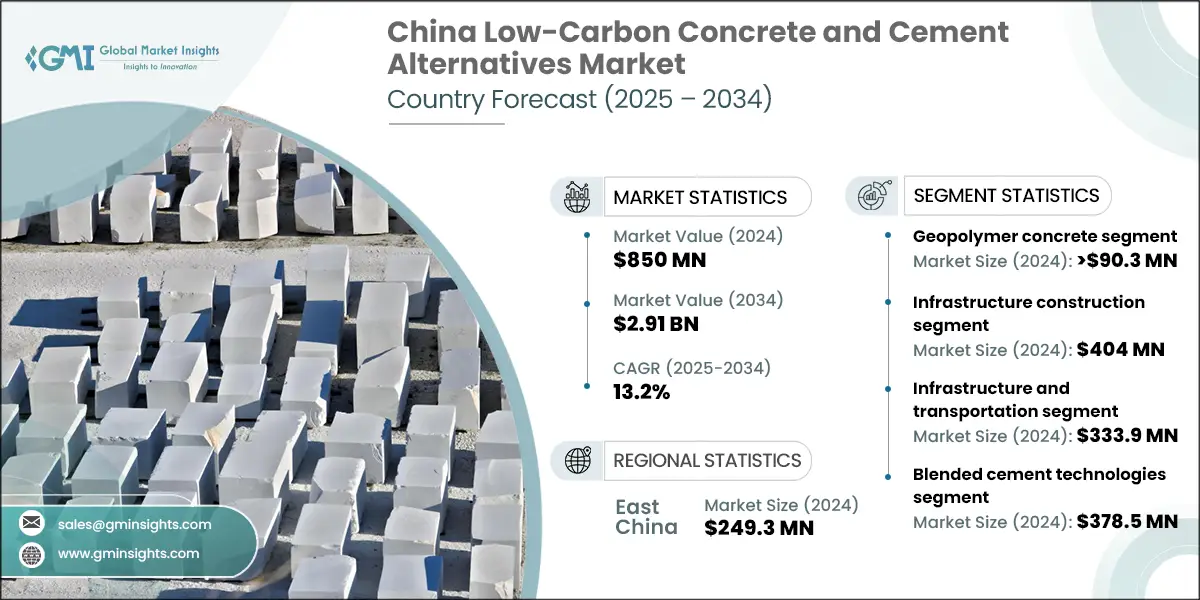
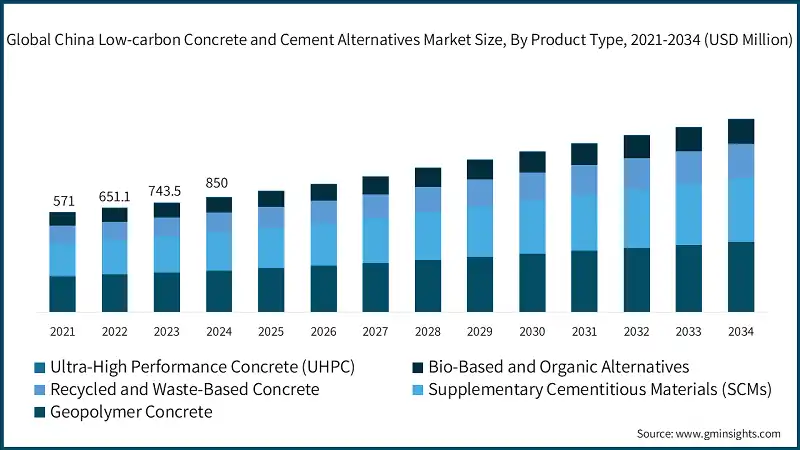
According to a recent study by Global Market Insights Inc., the China low-carbon concrete and cement alternatives market size was estimated at USD 850 million in 2024. The market is expected to grow from USD 956.5 million in 2025 to USD 2.91 billion in 2034, at a CAGR of 13.2%.
China Low-Carbon Concrete and Cement Alternatives Market Key Takeaways
Market Size & Growth
- 2024 Market Size: USD 850 Million
- 2034 Forecast Market Size: USD 2.91 Billion
- CAGR (2025–2034): 13.2%
Regional Dominance
- Largest Market: East China Region
- Fastest Growing Country: Central China Region
Key Market Drivers
- Chinas Carbon Neutrality Goals and Policy Framework.
- Infrastructure Development and Urbanization Trends.
- Environmental Regulations and Emission Reduction Targets.
Challenges
- Technology Adoption Barriers and Quality Standardization.
- Supply Chain Constraints and Raw Material Availability.
Opportunity
- Emerging Technology Applications and Innovations.
- Government Investment and Funding Initiatives.
Key Players
- Market Leader: China National Building Material Group Corporation led with over 21% market share in 2024.
- Leading Players: Top 5 players in this market include China National Building Material Group Corporation, Anhui Conch Cement Company Limited, China Resources Cement Holdings Limited, China Shanshui Cement Group Limited, Huaxin Cement Co., Ltd, which collectively held a market share of 59% in 2024.
Get Market Insights & Growth Opportunities
- The green initiative by China to become carbon-neutral by 2060 is one of the most important drivers of the low-carbon concrete and cement products market in the country. Regulations like the National Carbon Emission Trading System (ETS), to which the cement industry has been currently added are pushing the manufacturers towards using supplementary cementitious materials (SCMs) and alternative binders to ease down emissions. Such regulatory pressure is fast tracking a shift toward sustainable construction material in the country.
- The surging demand in the need of concrete that carries labels of low carbon is triggered by rapid growth in urbanization and expansion of infrastructural growth. As the population of China urbanized to 67 percent by 2024, many mega-projects in transportation, housing and other elements of the public infrastructure are demanding greener resources in both transport and construction. This market is further helping it to increase with government focus on green urbanization and increasing the investment in infrastructure sectors.
- Tough environmental protection regulations are influencing the dynamics of the market by imposing emission reduction goals. The cement industry under carbon trading and emerging emission management laws are encouraging the cement producers to develop and expand low-carbon technology. The policy framework does not only facilitate sustainability but also makes the low-carbon concrete industry of the Chinese economy more competitive in the international market.
- The phase is regionally varied with the East and South China particularly leading because of urbanization and quite robust green policies that favor the low-carbon concrete industry in China. They are concentrated in North China, where their concentration on scale as far as industrial transition goes, whereas the Central and Southwest regions are expanding by means of infrastructure project. Northeast and Northwest are promising regions that are based on industrial transformations and environmental projects.
To get key market trends
China Low-Carbon Concrete and Cement Alternatives Market Trends
- Implementation of digital modes like process optimization through artificial intelligence, in-real-time emission tracking, and blockchain in the supply chain verify sustainability and their efficiency in production. This trend allows the manufacturers to minimize waste, optimize the use of raw materials, and report to the regulators more adequately.
- Another circularity action is the growing use of industrial by-products (fly ash, slag), and construction/demolition wastes in the cement formulations. This minimizes use of virgin materials and cuts down carbon footprints. City works such as the redevelopment of Guangzhou are already leading the way with the use of recycled aggregates and highlight the potential of major scalable circular solutions on landfill burden and green certification.
- The demand also is moving towards more specialized concrete mixes to meet specific uses- the newest high durability geopolymer concretes are being used where harsh environments are present, like infrastructure. The trend can be connected to the increased complexity of the projects and sustainability standards, which promote R&D investments made by producers. A few Chinese manufacturers have created ultra h-performance concrete (UHPC) versions configured to perform in coastal and seismic area.
- The potential to enhance the rate of technology absorption and product innovations is made possible by increasing the associations among cement producers, research and this may be supported by the other parties that are on construction. Such ecosystems enable rapid prototyping and piloting of low-carbon binders and next generation admixtures. As an example, Sichuan-based clusters have created pilot projects where alkali-activated systems are used in conjunction with carbon capture, straining commercial viability.
China Low-Carbon Concrete and Cement Alternatives Market Analysis
Learn more about the key segments shaping this market
Based on products, the market is segmented into Geopolymer Concrete, Supplementary Cementitious Materials (SCMs), Recycled and Waste-Based Concrete, Bio-Based and Organic Alternatives, and Ultra-High-Performance Concrete (UHPC). The geopolymer concrete segment exceeded USD 90.3 million in 2024.
- The Supplementary Cementitious Materials (SCMs) occupy the leading market share in the China Concrete and Cement alternatives low-carbon industry because it offers a cost-effective alternative to traditional materials, possesses mature production technology, and has high compatibility with national carbon neutrality benchmarks.
- The availability of large-scale industrial by-products in China, along with the presence of steel and power industries continuously promotes fly ash, ground granulated blast furnace slag (GGBFS) and silica fume in infrastructure, commercial and residential construction. Adoption has also gained currency in government-mandated demands, like on government-sponsored programs, such as the Green Building Evaluation Standard, and SCM-based products displayed in eco-labeling programs.
- The national focus on decreasing clinker factor in cement manufacturing has a direct effect on the applicability of SCM since it makes it possible to reduce emissions of CO 2 by a considerable margin without sacrificing structural performance. Though such lesser-known markets like geopolymer concrete and ultra-high-performance concrete (UHPC) are gaining ground in niche applications, like high-speed rail and marine infrastructure, they have a lower share as they are both more costly and in need of a more ready supply chain.
Based on applications, the China low-carbon concrete and cement alternatives market is segmented into Infrastructure Construction, Building Construction, Specialized Applications, and Green Building and Sustainable Construction. The infrastructure construction was valued at USD 404 million in 2024.
- Infrastructure Construction has the most proportionate share in the market since there is massive investment in government in transportation networks, public utilities, and large-scale civil engineering infrastructure projects. High-performance construction materials are continually in demand because of rapid urbanization in the developing economies and the efforts made by the major power countries like the China Belt-Road Initiative (BRI) or the India Smart Cities Mission.
- The infrastructure projects need such long-lasting, durable and weather resistant solutions, hence presenting a market driver in the expansion of the market. Project pipelines are also gaining momentum due to an increase in the forms of partnership with state entities (PPPs) and this area is also going strong by endorsing the control of this sector.
- The Building Construction, the Specialized Applications and the Green Building and Sustainable Construction segments have a lesser but continuously escalating share of the market. The Commercial real estate development and Residential housing projects have met the Building Construction demand, whereas the Specialized Applications comprise the niche industry areas in industrial facilities, marine infrastructure and defense structures. Green Building segment is also experiencing an upsurge in implementation demand because of the demand of enhanced sustainability, LEED certifications, and energy-conserving construction standards.
Based on end use industry, the China low-carbon concrete and cement alternatives market is segmented into Construction and Real Estate, Infrastructure and Transportation, Energy and Utilities, and Industrial and Manufacturing. The infrastructure and transportation segment was valued at USD 333.9 million in 2024.
- China Infrastructure and Transportation is the leader in the low-carbon concrete and cement alternatives market due to the widespread governmental investment in sustainable city infrastructure, high-velocity train, highways, and ports.
- Projects on a large scale under the projects of Belt and Road and national urbanization programs give priority to materials with a lower carbon footprint and mostly with the use of supplementary cementitious materials (SCMs) to reduce clinker content along with green building requirements. This segment enjoys economies of scale, economies of bulk purchases and carbon capture integration, which makes it the main engine of growth.
- There is an increasing use of low-carbon mixes in both residential and commercial building construction to meet sustainability targets, whereas industrial sectors use concrete that is long lasting and high performance. But none are as large and fast-moving as in infrastructure and transportation, where projects focusing on greener cement and concrete products are increasingly gaining their order.
Learn more about the key segments shaping this market
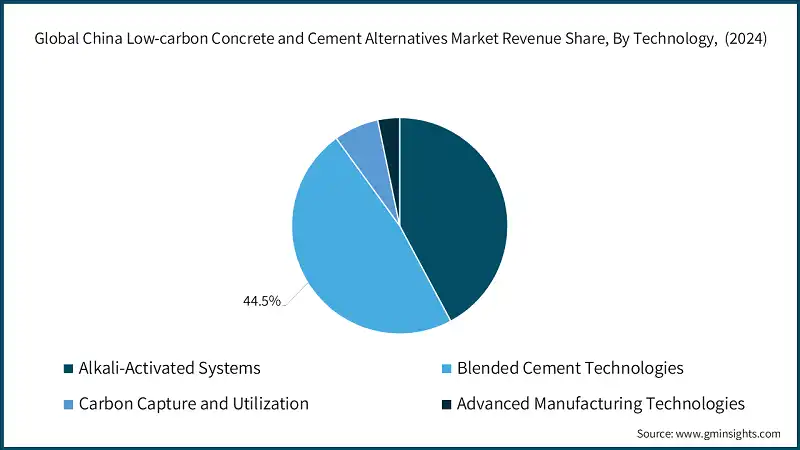
Based on technology, the China low-carbon concrete and cement alternatives market is segmented into Alkali-Activated Systems, Blended Cement Technologies, Carbon Capture and Utilization, and Advanced Manufacturing Technologies. The blended cement technologies was valued at USD 378.5 million in 2024.
- Blended Cement Technologies are the most preferred, which is due to the prevalence of supplementary cementitious materials (SCMs) like fly ash, slag or calcined clays. Such technologies allow a drastic decrease in clinker levels in accordance with the carbon neutrality objectives of China yet keeping the performance and affordability factors. Large supply of industrial by producer and developed processing systems underpin blended cements as the popular avenue in decarbonizing cement.
- New technologies such as Alkali-Activated Systems and Carbon Capture and Utilization (CCU) are entering the sphere through pilot programs and industrial scale demonstrations, especially in heavy manufacturing industries or countries. Like alkali-activated binders, there are also low-carbon alternatives that present interesting opportunities but have scaling issues, (e.g.) problems with raw material consistency.
Looking for region specific data?
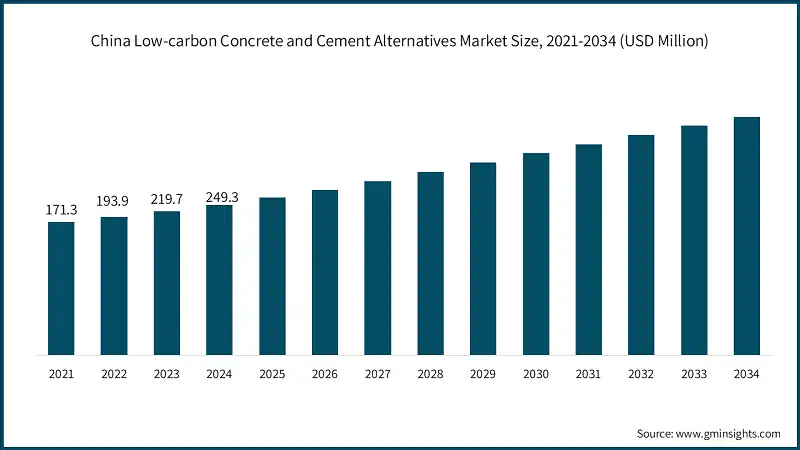
With over 29.3% revenue share, East China Low-carbon concrete and cement alternatives market was valued at USD 249.3 million in 2024.
- East China is both the largest and most developed low-carbon concrete & cement alternatives market in China since it is where the nation focuses its strongest building intensity, manufacturing hubs capable of developing advanced building techniques and first adoption of green-building practices. The sheer scale of the region, not to mention the ongoing investment in commercial, industrial and infrastructure developments, can be seen in the Yangtze River Delta which, by 2024, will be contributing RMB 33,169.1 billion of GDP alone.
- Regions and big cities with the highest percentage include Shanghai, Jiangsu and Zhejiang. The construction industry in Shanghai is growing rapidly (the value of construction projects in the municipality exceeded almost USD 1.0 trillion in 2024, due largely to the size and scale of mixed-use and commercial developments of either require or refer to low-carbon materials and green building certification standards. However, Jiangsu has large volumes of industrial and logistics construction and Zhejiang has a strong presence of the private sector in real estate and export-oriented manufacturing which generate consistent demand in the sustainable precast and high-performance concrete products.
- In East China, the proportion of Chinese green building stock and of international-certified buildings (LEED and the domestic Three-Star system) is disproportionately high, therefore, this realm is a target market of geopolymers and SCMs manufacturers, as well as low-carbon mix manufacturers.
- China now has the largest number of LEED certifications worldwide (with high concentrations in Shanghai, Suzhou, and other cities in the Yangtze delta region) and hundreds of millions of square meters of projects have been certified by Three-Star system already- both put specification pull demand on low-carbon solutions.
The Low-carbon concrete and cement alternatives market in the North China region is expected to experience significant and promising growth from 2025 to 2034.
- North China is a leading chemical and industrial production center largely due to the efforts of such provinces like Shandong, Hebei, and Tianjin. This area is well endowed with port infrastructure such as Tianjin Port, Qingdao Port that allows the stability of supplies both inside and outside the country.
- A rich concentration of specialty chemical, polymer and coatings producers allows its industrial ecosystem to thrive, resulting in synergy in terms of raw material supply and access to skilled labor. Distance of the major end-user industries, such as automotive, electronics, and construction adds to the resilience of the demand.
- Market forces over the past years have been influenced by industrial upgrading by the government and increased stringent environmental policies. A good number of manufacturers in North China have turned to cleaner production technology, automation, and research and development to facilitate the twin carbon objectives in China. Such improvements have led to efficiency in operations, less emission to environment, and high quality of its products thus local firms have been able to compete with international firms. The local chemical parks have also enhanced compliance and safety requirements, which promotes both domestic confidence and the international qualifications.
- The area, however, is experiencing exerted pressure of rising raw material and energy prices, as well as competition of South and East China production that has connection to the coastal supply-chain and foreign collaboration. In order to keep its competitiveness, manufacturers of North China are spending more time and efforts on the development of niche products, as well as export-oriented strategy and research institute cooperation. The region is under pressure to keep current with the trends and adopt the concept of green chemistry and establish stable trade routes on the global market in the long term.
The Low-carbon concrete and cement alternatives market in the South China region is expected to experience significant and promising growth from 2025 to 2034.
- South China (largely in Guangdong Province, plus Guangxi and Hainan) is an emerging high growth-low carbon concrete and cement alternatives, due to massive urbanization, high density industry, and great interest in the private sector in investing in green real-estate. Large coastal urban centers- Guangzhou and Shenzhen, are demanding green commercial and logistics buildings where developers are specifying with high rates of low-clinker blends, high-SCM mixes, and recycled-content precast to achieve green-building standards and corporate ESG goals.
- In South China, the pace of adoption is driven by developer push-pull: luxury developments, tech-savvy developers and contractors are using geopolymer precast, recycled aggregate technologies and engineer SCM mixes to reduce the time to build and to provide a better life-cycle emissions balance.
- Construction-and-industrial waste streams and developed logistics to collect and process fly ash, slag, and recycled concrete aggregates in a centralized process makes the area fertile to pilot implementation of alternative binders and circular models.
- Partnerships with large developers to offer offtake deals on a long-term basis, investment in centralized processing (to ensure recycled feedstock quality), and proactive targeting of a product portfolio to port/warehouse applications and resilient tropical-climate usage scenarios in which durability and low maintenance would be beneficial in terms of total cost of ownership.
The Low-carbon concrete and cement alternatives market in the Central China region is expected to experience significant and promising growth from 2025 to 2034.
- Central China, including Hubei, Hunan, and Henan Province is developing as a strategic centre of the growth of low-carbon concrete and cement substitutes due to high infrastructure modernization and industrial updating. The logistics and transport hub status given to the region enables effective treatment of materials, furthering the infiltration of green construction materials.
- Urban renewal schemes, or sponge city projects and energy-saving industrial parks led by China government are using supplementary cementitious materials (SCMs) (fly ash, slag, and calcined clays) in their massive projects to minimize CO2 emissions.
- The local construction industry can take advantage of access to large sources of raw materials: in particular, fly ash industrial base in Henan and pozzolanic additives minerals in Hunan, which will make it possible to cost-effectively manufacture low-carbon cement alternatives.
- Cement producers are experimenting with carbon capture, use, and storage (CCUS) technology in cement plants that supports the aspirational 2060 target of carbon neutrality in the country. Also, valorization of industrial by-products is on the rise, focusing on cooperation between cement manufacturers and steel/power plants on optimizing material flows of green cement production.
The Low-carbon concrete and cement alternatives market in the Northeast China is expected to experience significant and promising growth from 2025 to 2034.
- The Northeast of China (including Liaoning, Jilin, and Heilongjiang), is seeing a slow but steady move towards low-carbon concrete and cement substitutes, mainly due to industrial restructuring on the one hand and government requires to reduce emissions in the more conventional heavy industries. Old, crumbling infrastructure and population reductions have lowered the new building construction demand in the region, although the on-going urban renewals, re-development of industrial sectors are generating niche programs to meet green building material needs.
- Policies attached to the Chinese national “Dual Carbon” goals are driving cement manufacturers in the local area towards the use of supplementary cementitious materials (SCMs) like fly ash, slag, and silica fume, of which there are abundant industry-generated by-products in this manufacturing-intensive region.
- Moreover, Northeast China has the advantage of being close to the sources of main raw materials, as well as the historical tradition of heavy industry, which advises to introduce the alternative binders to the production procedures.
- Due to the colder climate around the area, there is a need to adjust performance in low-carbon concrete mixes, to make them durable and frost resistant, which has led to innovation in the admixtures developed. This has resulted in partnerships between local institutions of higher-learning, research centers and manufacturers in the effort to come up with products that not only meet sustainability objectives but also address the local situations of the area related to environmental situations.
The Low-carbon concrete and cement alternatives market in the Southwest China is expected to experience significant and promising growth from 2025 to 2034.
- In Southwest China, including Sichuan, Yunnan, Guizhou, Chongqing and Tibet provinces, the same trend is increasing steadily especially after the reconstruction efforts following earthquakes, fast growth of transportation infrastructure, and hydropower projects among others. Rugged terrain and high seismicity have necessitated more use of materials that exhibit least embodied carbon and they are geopolymer concrete as well as Magnesium-based binders.
- There is policy support in regional governments particularly those in Sichuan and Yunnan where there is an aim to ensure that in cementitious mixes there is a tendency to make use of fly ash, slag and other industrial by-products.
- Local cement manufacturers are collaborating with schools such as Sichuan University to come up with blended cement technology that is suitable to work at high altitude. Market expansion in this case is projected to be strengthened by incorporation in the Chinese Belt and Road initiatives that provide sustainability standards on infrastructure in cross-border implications of its development.
The Low-carbon concrete and cement alternatives market in the Northwest China region is expected to experience significant and promising growth from 2025 to 2034.
- Northwest China including Xinjiang, Gansu, Qinghai, Ningxia, and Shaanxi is also becoming a strategic region to implement low-carbon cement and concrete, since there is extensive infrastructure development, industrial base transformation, and urbanization in arid and semi-arid regions. The proximity to the large natural resource reserves allows the region to cheaply source alternative binders such as the alkali-activated materials using the nearby fly ash and silica-rich tailings.
- There is considerable pressure by the government on green construction as part of projects aimed at ecological restoration, in the context of desertification mitigation projects and long-span bridges along major transport corridors such as along the Lanzhou Xinjiang high-speed railway.
- The decarbonization retrofits of the energy-intensive cement manufacturing plants in Shaanxi and Ningxia are underway to make the process carbon-emission free including waste heat recovery and carbon capture pilot at the decarbonization retrofitting facilities.
- Industrial complexes in the Northwest are investing in carbon-negative technologies, including mineral carbonation of ultramafic rocks of the region. Since this area is the nexus of the possible westward expansion of the Chinese economy, the potential of low-carbon cement substitutes will probably spread in the national mega-projects and in export-based supply chains of construction materials.
China Low-Carbon Concrete and Cement Alternatives Market Share
- The top 5 companies in the crystalline waterproofing market are China National Building Material Group Corporation (CNBM), Anhui Conch Cement Company Limited, China Resources Cement Holdings Limited, China Shanshui Cement Group limited, and Huaxin Cement Co., Ltd, contributing around 59% of the market in 2024.
- China National Building Material Group Corporation (CNBM) is the global lead player in cement production industry and it is also one of the firsts in low-carbon building materials industry in China. CNBM uses its subsidiaries to combine the entire value chain of the raw material to end products of innovative low-carbon concrete solutions. Its innovation portfolio entails carbon capture, utilization, and storage (CCUS) pilot plants, mass application of industrial solid waste as alternatives to clinkers, and digital manufacturing systems to optimise energy.
- Anhui Conch Cement Company Limited is one of the Asian cement manufacturers that are most profitable and technically very advanced. It has devoted many resources in cements blending that contain a low clinker content and alternative fuels including biomass and waste energy. To reduce energy intensity, Conch also has very automated kilns with waste heat recovery systems and AI-enabled process controls.
- China Resources Cement Holdings Limited (CRC) is the leader in the Southern China with its network of strategically positioned cement and ready-mix plants. The low-carbon plan adopted by CRC is the extensive use of supplementary cementitious materials (SCMs), recycled aggregates, and low-emission logistic transport fleets. It also relies on smart factory programs to manage production levels in the factory as well as monitor emissions in the real-time.
- China Shanshui Cement Group limited is a large player in Northern China, specializing in low carbon production of cement at low costs. The company utilizes dry-process kiln, power generation through waste-heat and greater utilization of fly-ash and slag to reduce the carbon footprint. Shanshui is also increasing its ready-mix concrete capacity in the efforts to compete in sustainable urban development projects, which are facilitated by local government collaboration in low emission infrastructure initiatives.
- Huaxin Cement Co., Ltd. has branded itself as a leader in sustainable cement solutions by taking the initiative in adopting alternative fuels, biomass energy and sustainable mining strategies. Its low carbon concrete portfolio offers make-up mixes with high performance concrete mix for infrastructure development and industrial use including green buildings. Huaxin actively takes part in international CCUS-related cooperation and its pilot carbon-neutral construction sites.
China Low-Carbon Concrete and Cement Alternatives Market Companies
Major players operating in the China Low-carbon concrete and cement alternatives industry are
- Anhui Conch Cement Company Limited
- Betolar
- China National Building Material Group Corporation
- China Resources Cement Holdings Limited
- China Shanshui Cement Group Limited
- Hangzhou Hanrui Building Materials Co., Ltd
- Hebei Jinniu Energy Group Co., Ltd.
- Huaxin Cement Co., Ltd.
- Jiangxi Wannianqing Cement Co., Ltd
- Tangshan Jidong Cement Co., Ltd.
- URETEK China
- West China Cement Limited
- China corporate building material group (CNBM) has stayed at the helm of Chinese cement and low-carbon cement throughout the years because of its unsurpassable production capacity, expansive research and development infrastructure and vertically integrated supply chain. The company is massively investing in the area of green cement, such as the solutions of carbon capture, utilization, and storage (CCUS) and using industrial waste as alternatives to clinker. The strategic partnerships of CNBM with both national and foreign research organizations would work on high efficiencies, low emission construction materials.
- Anhui Conch Cement Company Limited has cemented its stance competitive by intensively driving capacity and heavy export presence, coupled with an emphasis on sustainability and substitute raw materials. The firm has also invented formulations of blended cement that contains less clinker factor with high mechanical strength and this makes the firm applicable in domestic infrastructure as well as the global market. Anhui Conch actively incorporates the best solutions and photocells and advances in automation using process technology and waste heat recovery in a bid to maximize energy savings associated with all plants.
- China Resources Cement Holdings Limited (CRC) has reinforced its position as the top clinker and cement manufacturer in the region of Southern China through the integration of technological ingenuity and customer focus. The company is actively developing environmentally friendly product line containing eco-friendly cement and concrete including supplementary cementitious materials as well as recycled aggregates. CRC spends a lot on smart manufacturing facilities that boost its operational and minimize carbon intensity.
China Low-Carbon Concrete and Cement Alternatives Market Report Attributes
| Key Takeaway | Details |
|---|---|
| Market Size & Growth | |
| Base Year | 2024 |
| Market Size in 2024 | USD 850 Million |
| Forecast Period 2025 - 2034 CAGR | 13.2% |
| Market Size in 2034 | USD 2.91 Billion |
| Key Market Trends | |
| Drivers | Impact |
| Chinas Carbon Neutrality Goals and Policy Framework | Accelerates adoption of low-carbon materials by enforcing emissions reduction targets and incentivizing green technologies in cement production. |
| Infrastructure Development and Urbanization Trends | Drives large-scale demand for sustainable concrete solutions to support expanding urban infrastructure and eco-friendly construction projects. |
| Environmental Regulations and Emission Reduction Targets | Compels manufacturers to innovate and switch to alternative binders and supplementary cementitious materials to comply with stricter emission standards. |
| Pitfalls & Challenges | Impact |
| Technology Adoption Barriers and Quality Standardization | Limit widespread implementation of innovative low-carbon solutions due to inconsistent product performance and lack of unified industry standards. |
| Supply Chain Constraints and Raw Material Availability | Restrict production scalability and increase costs, particularly in regions with limited access to key supplementary cementitious materials and alternative binders. |
| Opportunities: | Impact |
| Emerging Technology Applications and Innovations | Enable development of advanced low-carbon materials and processes, enhancing efficiency and expanding market adoption across diverse construction segments. |
| Government Investment and Funding Initiatives | Provide critical financial support and incentives that accelerate R&D, pilot projects, and large-scale deployment of sustainable cement alternatives. |
| Market Leaders (2024) | |
| Market Leaders |
21% market share |
| Top Players |
Collective market share in 2024 is 59% |
| Competitive Edge |
|
| Regional Insights | |
| Largest Market | East China Region |
| Fastest growing market | Central China Region |
| Emerging countries | Beijing Municipality, Shanghai Municipality, Zhejiang Province, and Anhui Province |
| Future outlook |
|
What are the growth opportunities in this market?
China Low-Carbon Concrete and Cement Alternatives Market News
- In February 2025, China National Building Material Group (CNBM) declared the opening of its new line of low-carbon cement with innovative carbon capture, utilization and storage (CCUS) technology at its Henan plant. The move will allow a decrease of 30 percent in CO 2 in production and follow the trade ambitions of China to attain so-called dual carbon challenges. The new product family is to be sold not only in the local infrastructure but abroad in Southeast Asia.
- In January 2024, China United Cement (subsidiary of China National Building Material Group) took into operation the largest oxy-fuel combustion project consisting of CCUS in cement industry spaces around the globe. The plant in Qingzhou, Shandong, captures 200,000 tonnes of CO 2 per annum. It uses oxy-fuel combustion technology combined with pressure swing adsorption and low-temperature distillation to deliver a purity of above 99.9% of CO2.
- In December 2024, China Resources Cement Holdings entered into a strategic alliance with Sinoma International Engineering to collaborate on developing green cement technology such as using industrial solid waste as an alternative to a clinker.
The China Low-carbon concrete and cement alternatives market research report includes in-depth coverage of the industry with estimates & forecasts in terms of revenue (USD Million) & volume (KiloTons) from 2021 to 2034, for the following segments:
Market, By Product Type
- Geopolymer Concrete
- Fly Ash-Based Geopolymer Concrete
- Slag-Based Geopolymer Concrete
- Metakaolin-Based Geopolymer Concrete
- Multi-Component Geopolymer Systems
- Supplementary Cementitious Materials (SCMs)
- Fly Ash Concrete
- Ground Granulated Blast Furnace Slag (GGBFS) Concrete
- Silica Fume Concrete
- Natural Pozzolan Concrete
- Recycled and Waste-Based Concrete
- Recycled Aggregate Concrete
- Municipal Solid Waste Incineration Ash Concrete
- Industrial Waste-Based Concrete
- Construction and Demolition Waste Concrete
- Bio-Based and Organic Alternatives
- Bio-Cement and Microbial Concrete
- Plant-Based Fiber Reinforced Concrete
- Organic Polymer-Modified Concrete
- Ultra-High Performance Concrete (UHPC)
- Low-Carbon UHPC Formulations
- Fiber-Reinforced UHPC
- Self-Healing UHPC Systems
Market, By Application
- Infrastructure Construction
- Transportation Infrastructure (Roads, Bridges, Tunnels)
- Water and Wastewater Treatment Facilities
- Energy Infrastructure (Power Plants, Renewable Energy)
- Port and Marine Infrastructure
- Building Construction
- Residential Construction
- Commercial and Office Buildings
- Industrial Buildings and Warehouses
- Institutional Buildings (Schools, Hospitals)
- Specialized Applications
- Precast Concrete Products
- Ready-Mix Concrete
- Concrete Blocks and Masonry Units
- Decorative and Architectural Concrete
- Green Building and Sustainable Construction
- LEED and Green Building Certified Projects
- Nearly Zero Energy Buildings (NZEB)
- Sponge City Construction Projects
- Carbon Neutral Building Initiatives
Market, By End Use Industry
- Construction and Real Estate
- Residential Development
- Commercial Real Estate
- Industrial Real Estate
- Mixed-Use Development Projects
- Infrastructure and Transportation
- Railway and High-Speed Rail Projects
- Highway and Road Construction
- Airport and Aviation Infrastructure
- Urban Transit Systems
- Energy and Utilities
- Power Generation Facilities
- Renewable Energy Projects
- Oil and Gas Infrastructure
- Water Treatment and Distribution
- Industrial and Manufacturing
- Manufacturing Facilities
- Petrochemical and Chemical Plants
- Mining and Extractive Industries
- Data Centers and Technology Infrastructure
Market, By Technology
- Alkali-Activated Systems
- Sodium Silicate Activated Systems
- Sodium Hydroxide Activated Systems
- Potassium-Based Activation Systems
- Hybrid Activation Technologies
- Blended Cement Technologies
- Portland Pozzolan Cement (PPC)
- Portland Slag Cement (PSC)
- Composite Cement Systems
- Ternary Blended Cements
- Carbon Capture and Utilization
- CO2 Mineralization in Concrete
- Carbon Curing Technologies
- Integrated CCUS Systems
- Advanced Manufacturing Technologies
- 3D Printing and Additive Manufacturing
- Automated Mixing and Batching Systems
- Quality Control and Testing Technologies
The above information is provided for the following regions and countries:
- North China Region
- Beijing Municipality
- Tianjin Municipality
- Hebei Province
- Shanxi Province
- Inner Mongolia Autonomous Region
- East China Region
- Shanghai Municipality
- Jiangsu Province
- Zhejiang Province
- Anhui Province
- Fujian Province
- Jiangxi Province
- Shandong Province
- South China Region
- Guangdong Province
- Guangxi Zhuang Autonomous Region
- Hainan Province
- Southwest China Region
- Chongqing Municipality
- Sichuan Province
- Guizhou Province
- Yunnan Province
- Tibet Autonomous Region
- Northwest China Region
- Shaanxi Province
- Gansu Province
- Qinghai Province
- Ningxia Hui Autonomous Region
- Xinjiang Uygur Autonomous Region
- Central China Region
- Henan Province
- Hubei Province
- Hunan Province
- Northeast China Region
- Liaoning Province
- Jilin Province
- Heilongjiang Province
Frequently Asked Question(FAQ) :
What is the market size of the China low-carbon concrete and cement alternatives in 2024?
The market size was estimated at USD 850 million in 2024, with a CAGR of 13.2% projected from 2025 to 2034, driven by China's carbon neutrality goals and regulatory measures.
What is the projected value of the China low-carbon concrete and cement alternatives market by 2034?
The market is expected to reach USD 2.91 billion by 2034, fueled by advancements in sustainable construction materials and increasing adoption of alternative binders.
What was the valuation of the geopolymer concrete segment in 2024?
The geopolymer concrete segment was valued at USD 90.3 million in 2024, holding a significant share in the product segmentation.
What was the valuation of the infrastructure construction application segment in 2024?
The Infrastructure Construction segment was valued at USD 404 million in 2024, supported by government investments in transportation networks and large-scale civil engineering projects.
What was the valuation of the blended cement technologies segment in 2024?
The blended cement technologies segment was valued at USD 378.5 million in 2024, as use of supplementary cementitious materials (SCMs) and reduced clinker levels.
What are the upcoming trends in the China low-carbon concrete and cement alternatives market?
Key trends include the increasing adoption of supplementary cementitious materials (SCMs), advancements in blended cement technologies, and the integration of carbon capture and utilization systems to meet carbon neutrality goals.
Who are the key players in the China low-carbon concrete and cement alternatives market?
Key players include Anhui Conch Cement Company Limited, Betolar, China National Building Material Group Corporation, China Resources Cement Holdings Limited, China Shanshui Cement Group Limited, Hangzhou Hanrui Building Materials Co., Ltd, Hebei Jinniu Energy Group Co., Ltd., Huaxin Cement Co., Ltd.
China Low-Carbon Concrete and Cement Alternatives Market Scope
Related Reports