Summary
Table of Content

China Diabetes Care Devices Market
Get a free sample of this report
Form submitted successfully!
Error submitting form. Please try again.
Thank you!
Your inquiry has been received. Our team will reach out to you with the required details via email. To ensure that you don't miss their response, kindly remember to check your spam folder as well!
Request Sectional Data
Thank you!
Your inquiry has been received. Our team will reach out to you with the required details via email. To ensure that you don't miss their response, kindly remember to check your spam folder as well!
Form submitted successfully!
Error submitting form. Please try again.
China Diabetes Care Devices Market Size
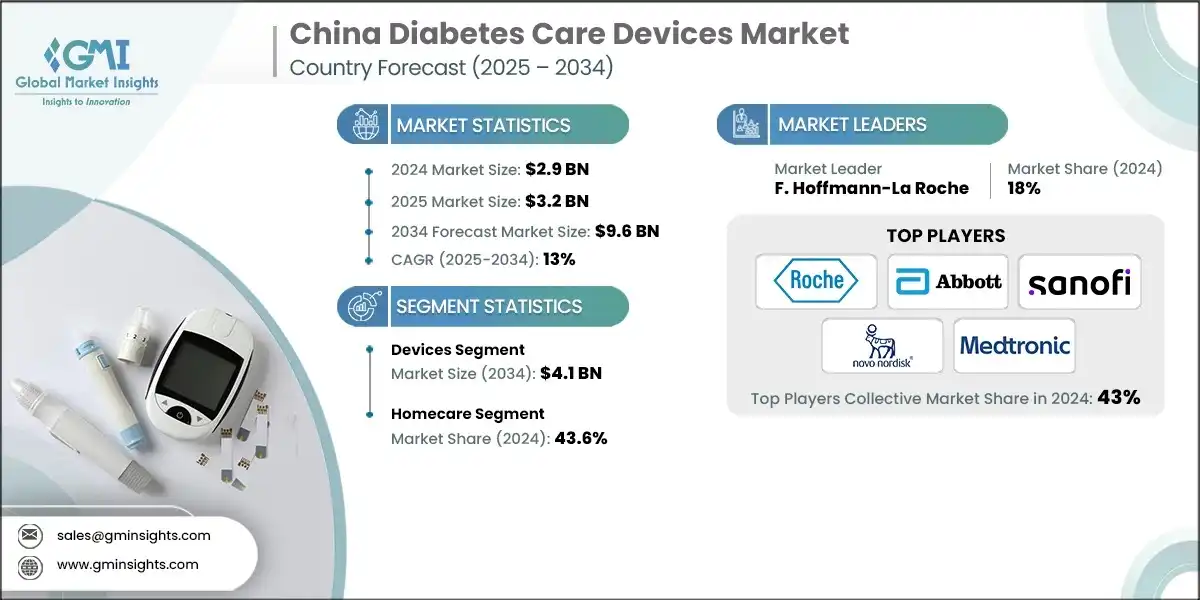
The China diabetes care devices market size was valued at USD 2.9 billion in 2024. The market is projected to grow from USD 3.2 billion in 2025 to USD 9.6 billion by 2034, expanding at a CAGR of 13%, according to the latest report published by Global Market Insights Inc.
China Diabetes Care Devices Market Key Takeaways
Market Size & Growth
- 2024 Market Size: USD 2.9 Billion
- 2025 Market Size: USD 3.2 Billion
- 2034 Forecast Market Size: USD 9.6 Billion
- CAGR (2025–2034): 13%
Key Market Drivers
- Escalating diabetes prevalence in China.
- Advancements in technology in diabetes care devices.
- Growing public and private sector initiatives.
Challenges
- High cost of diabetes care devices.
- Stringent regulatory landscape.
Opportunity
- Expanding reach in underserved regions of China.
Key Players
- Market Leader: F. Hoffmann-La Roche led with over 18% market share in 2024.
- Leading Players: Top 5 players in this market include F. Hoffmann-La Roche, Abbott Laboratories, Sanofi, Novo Nordisk, Medtronic, which collectively held a market share of 43% in 2024.
Get Market Insights & Growth Opportunities
This consistent growth is driven by several factors such as the rising prevalence of diabetes in China, rapid technological advancements in diabetes care devices, and increasing public and private investments in diabetes management.
Diabetes care devices are a range of medical tools designed to help patients in China manage diabetes more effectively. These devices play a crucial role in monitoring blood glucose levels, administering insulin, and supporting overall diabetes management, especially as the country faces growing healthcare demands and adopts more digital health solutions. Major companies in the industry include F. Hoffmann-La Roche, Abbott Laboratories, Sanofi, Novo Nordisk, and Medtronic.
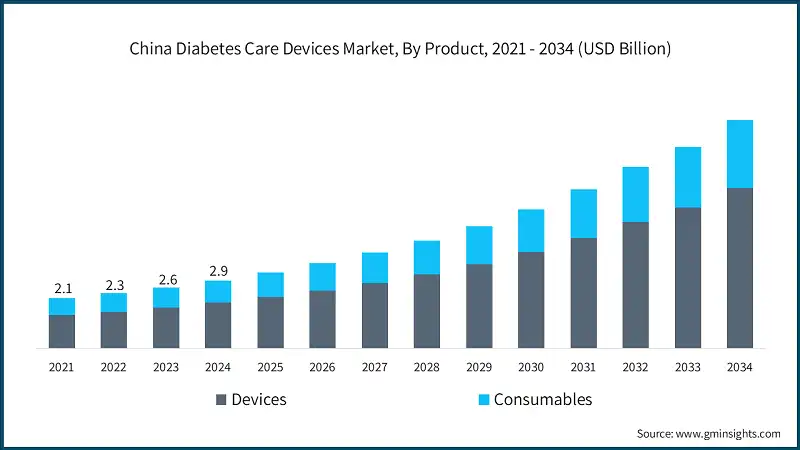
The market increased from USD 2.1 billion in 2021 to USD 2.6 billion in 2023. This growth was mainly driven by the rising use of digital health tools, changing consumer preferences towards smarter and more sustainable solutions, and increasing demand in both major cities and developing regions. After the pandemic, companies took advantage of the increased focus on health by expanding their product offerings and improving supply chains to better meet customer needs. Together, these factors helped push the market forward during this period.
The growth of China’s diabetes care devices market is strongly driven by the rising prevalence of diabetes and the country’s rapidly ageing population. As of 2024, 11.9% of adults in China are living with diabetes, totaling approximately 147.9 million cases according to the International Diabetes Federation. This significant disease burden highlights the urgent need for effective monitoring and treatment solutions.
China also has one of the fastest growing ageing populations in the world. By 2040, the proportion of people aged over 60 is projected to reach 28%, driven by longer life expectancy and declining fertility rates, as reported by the World Health Organization. This demographic shift is contributing to a higher prevalence of chronic conditions such as diabetes, especially among older adults that require regular monitoring and care. As the ageing population expands, so does the demand for reliable, easy-to-use diabetes care devices, positioning this segment as a key driver of market growth in China.
Moreover, the escalating prevalence of diabetes in China, along with its associated complications, is expected to worsen both mortality and morbidity rates among the population. To address this growing health burden, the Chinese government launched the Healthy China 2030 initiative and its corresponding Action Plan, which includes a nationwide diabetes prevention and control campaign. As reported in The Lancet Journals in 2024, the core focus of this strategy is a shift from a disease-centred approach to a health-centred one, emphasizing prevention over treatment in diabetes management.
Diabetes care devices refer to a range of medical devices designed to help individuals with diabetes manage their condition effectively. These devices play a crucial role in monitoring blood glucose levels, administering insulin, and overall diabetes management.
To get key market trends
China Diabetes Care Devices Market Trends
- Technological advancement is a pivotal force shaping the trajectory of China’s diabetes care devices sector. Domestic and international firms are intensifying efforts to engineer affordable, intuitive, and less invasive solutions that deliver precise, real-time data to support diabetes management. This innovation push aligns with China’s growing emphasis on personalized healthcare and digital transformation.
- Local innovators are gaining traction Sibionics, for example, secured CE Mark certification for its GS1 continuous glucose monitoring (CGM) system, which prioritizes cost-efficiency and user accessibility. Likewise, Ypsomed has enhanced its insulin delivery offering in China by integrating smartphone-based bolus administration via the mylife YpsoPump, streamlining user experience.
- Global leaders such as Medtronic and Abbott are reinforcing their presence in China through tailored product development, strategic alliances, and engagement with regulatory bodies. These initiatives are designed to improve market penetration and align device functionality with the specific needs of Chinese healthcare providers and patients.
- Meanwhile, self-monitoring blood glucose (SMBG) tools are undergoing notable refinement, with compact, ergonomic formats that improve usability and mobility. The incorporation of artificial intelligence and predictive analytics into diabetes care platforms is also gaining momentum, enabling more dynamic and individualized treatment pathways.
- As these technologies become more integrated into China’s expanding digital health ecosystem supported by government policy and infrastructure investment their uptake is accelerating across both metropolitan and underserved regions, further catalyzing market expansion.
China Diabetes Care Devices Market Analysis
Learn more about the key segments shaping this market
The China market was valued at USD 2.1 billion in 2021. The market size reached USD 2.6 billion in 2023, from USD 2.3 billion in 2022.
Based on the product, the market is segmented into devices and consumables. The devices segment is further segregated into blood glucose monitoring devices and insulin delivery devices.
In 2024, the blood glucose monitoring devices segment dominated the market, holding the largest share due to the widespread adoption across homecare setting, diagnostic centers, and hospitals. This segment was valued at USD 1 billion in 2024 and is projected to reach USD 4.1 billion by 2034, growing at a CAGR of 15.5%. In comparison, the insulin delivery devices segment, valued at USD 914.8 million in 2024, is expected to grow to USD 2.6 billion by 2034.
- China’s blood glucose monitoring devices segment is experiencing robust growth, underpinned by the country’s substantial diabetes burden, evolving healthcare infrastructure, and rising demand for precision-driven disease management tools. Devices such as continuous glucose monitors (CGMs) and self-monitoring blood glucose (SMBG) meters, which was valued at USD 19.8 billion in 2024, are becoming indispensable in both clinical and homecare settings, enabling patients to make data-informed decisions regarding diet, physical activity, and insulin administration.
- The ability to track glucose levels in real time is critical in preventing acute glycemic episodes and improving therapeutic outcomes. These technologies are increasingly aligned with China’s broader digital health agenda, which emphasizes remote monitoring, patient engagement, and AI-enabled care pathways.
- According to the International Diabetes Federation (IDF), China had approximately 147.9 million adults living with diabetes in 2024 accounting for nearly 12% of its population and over one-fifth of global cases. This epidemiological scale highlights the urgent need for scalable, tech-enabled monitoring solutions that can support proactive disease management.
- Contributing factors such as urban lifestyle shifts, dietary transitions, and sedentary behavior have accelerated the incidence of type 2 diabetes. Moreover, the high prevalence of comorbid conditions such as hypertension and dyslipidemia adds complexity to treatment protocols, reinforcing the need for integrated and intelligent monitoring systems.
- As government-led healthcare modernization continues through investments in hospital networks, diagnostic capabilities, and digital platforms the adoption of advanced glucose monitoring technologies is expected to expand rapidly across both urban and rural regions, driving sustained market momentum.
Learn more about the key segments shaping this market
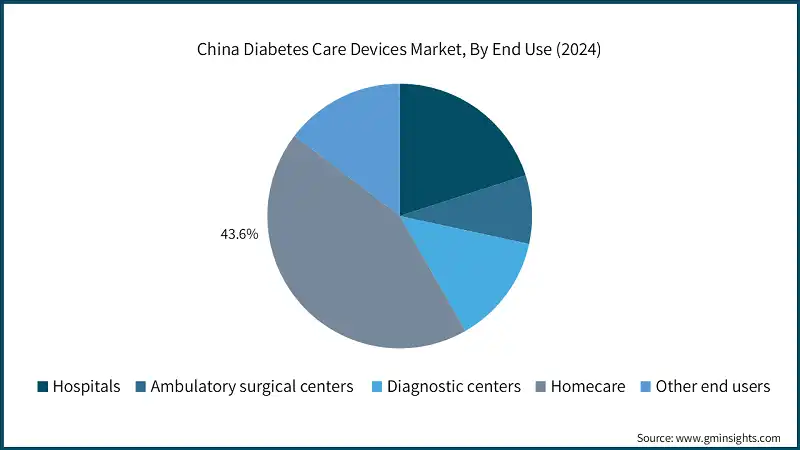
Based on end use, the China diabetes care devices market is segmented into hospitals, ambulatory surgery centers, diagnostic centers, home care, and other end users. The home care segment accounted for the market share of 43.6% in 2024.
- The rising preference for home-based diabetes management in China is significantly accelerating the uptake of personal-use diabetes care devices. These solutions empower individuals to monitor glucose levels, administer insulin, and manage their condition independently by reducing dependency on hospital visits and alleviating pressure on the healthcare system.
- Continuous glucose monitoring (CGM) systems are at the forefront of this shift, offering real-time visibility into glucose trends and enabling users to make proactive decisions regarding nutrition, physical activity, and insulin dosing. This supports improved glycemic control and enhances overall quality of life.
- Urban centers in China are witnessing rapid adoption of CGMs and other smart monitoring tools, driven by increasing digital health literacy and the expansion of remote care platforms. Home-based care also facilitates personalized treatment strategies, allowing patients to collaborate with healthcare professionals to fine-tune insulin regimens based on lifestyle variables.
- China’s demographic landscape is a major catalyst for this segment. With one of the fastest growing aging populations globally, the proportion of individuals aged 60 and above is projected to reach 28% by 2040, according to the World Health Organization (WHO). Older adults who are more vulnerable to diabetes and its complications are increasingly opting for home-based solutions to maintain autonomy and reduce hospital dependency.
- This demographic shift, combined with rising chronic disease prevalence and government-led healthcare modernization, is expected to drive sustained growth in China’s market.
China Diabetes Care Devices Market Share
- The top 5 players in the China diabetes care devices industry F. Hoffmann-La Roche, Abbott Laboratories, Sanofi, Novo Nordisk, and Medtronic collectively hold a 43% market share. These companies maintain their leadership through robust product portfolios, strategic partnerships, regulatory alignment, and continuous innovation tailored to the specific needs of the Chinese healthcare system.
- Roche continues to be a key player in China, particularly in diagnostics and SMBG devices. Its Accu-Chek portfolio remains a trusted brand, and the company is integrating digital health tools to enhance patient engagement and disease management. Roche’s focus on precision diagnostics and mobile health aligns with China’s growing digital healthcare infrastructure.
- Medtronic is a major contributor to the insulin pump and CGM segment in China. The company is working closely with Chinese regulators and healthcare institutions to adapt its advanced diabetes technologies to local clinical practices, particularly for type 1 diabetes management.
- Overall, the China diabetes care devices market is becoming increasingly competitive and innovation-driven, with both multinational and domestic players enhancing their offerings to meet the evolving demands of patients and healthcare providers.
China Diabetes Care Devices Market Companies
Few of the prominent players operating in the China diabetes care devices industry include:
- Abbott Laboratories
- ARKRAY
- Ascensia Diabetes Care
- B. Braun Melsungen
- Becton, Dickinson and Company
- Bionime
- Dr. Reddy’s Laboratories
- Eli Lilly and Company
- F. Hoffmann-La Roche
- Insulet
- Medtronic
- Novo Nordisk
- Sanofi
- Sinocare
- Ypsomed Holding
- Abbott Laboratories
Abbott maintains a leading position in China’s diabetes care devices market, driven by the success of its FreeStyle Libre continuous glucose monitoring (CGM) system. The company has strategically expanded its manufacturing and distribution capabilities within China to meet rising demand. Its acquisition of Bigfoot Biomedical further strengthens its digital health portfolio, enabling integrated insulin management solutions tailored to the Chinese market’s evolving needs.
- Ascensia Diabetes Care
Ascensia has established a strong foothold in China through its CONTOUR series of blood glucose monitoring systems, recognized for their precision and user-centric design. The company is actively diversifying into CGM and connected health platforms, aligning with China’s push toward personalized and tech-enabled chronic disease management. Its focus on interoperability and mobile integration supports broader adoption among digitally engaged patient populations.
- B. Braun Melsungen
B. Braun leverages its extensive healthcare infrastructure in China to support its diabetes care offerings, particularly in institutional settings. The company has built a robust supply chain and clinical presence in China. Its infusion therapy solutions complement diabetes care delivery, positioning B. Braun as a key player in hospital-based and professional care environments.
China Diabetes Care Devices Market Report Attributes
| Key Takeaway | Details |
|---|---|
| Market Size & Growth | |
| Base Year | 2024 |
| Market Size in 2024 | USD 2.9 Billion |
| Market Size in 2025 | USD 3.2 Billion |
| Forecast Period 2025 - 2034 CAGR | 13% |
| Market Size in 2034 | USD 9.6 Billion |
| Key Market Trends | |
| Drivers | Impact |
| Escalating diabetes prevalence in China | This growing burden is prompting national health authorities to scale up prevention and management programs, expanding the market for monitoring and treatment technologies. |
| Advancements in technology in diabetes care devices | Continuous innovation in China’s diabetes care sector, including smart glucometers, connected insulin delivery systems, and mobile-integrated platforms, is improving usability and patient engagement. |
| Growing public and private sector initiatives | Strategic investments from both government bodies and private enterprises are accelerating the development and adoption of advanced diabetes care technologies. |
| Pitfalls & Challenges | Impact |
| High cost of diabetes care devices | The premium pricing of technologically sophisticated devices continues to limit accessibility for lower-income populations in China. Despite the growing need, affordability remains a barrier to widespread adoption. |
| Stringent regulatory landscape | Navigating China’s regulatory environment can be challenging, particularly for startups and smaller firms. Lengthy approval processes and evolving compliance standards may delay market entry and increase operational costs. |
| Opportunities: | Impact |
| Expanding reach in underserved regions of China | Rapid urbanization, rising health awareness, and improvements in healthcare infrastructure across China’s Tier 2 and Tier 3 cities present strong growth potential. Tailored, cost-effective solutions supported by national health campaigns can unlock substantial market value in these areas. |
| Market Leaders (2024) | |
| Market Leaders |
18% |
| Top Players |
Collective market share in 2024 is 43% |
| Competitive Edge |
|
| Regional Insights | |
| Future outlook |
|
What are the growth opportunities in this market?
China Diabetes Care Devices Industry News:
- In January 2024, Medtronic received CE Mark approval for its MiniMed 780G system featuring the Simplera Sync CGM, a compact, user-friendly sensor designed to eliminate the need for fingersticks or overtape. With a streamlined insertion process and reduced size, the device enhances user comfort while maintaining high standards of accuracy and reliability in glucose monitoring. This marks a significant step forward in Medtronic’s diabetes care innovation strategy.
The China diabetes care devices market research report includes in-depth coverage of the industry with estimates and forecast in terms of revenue in USD Million and from 2021 - 2034 for the following segments:
Market, By Product
- Device
- Blood glucose monitoring devices
- Self-monitoring blood glucose meters
- Continuous glucose monitors
- Insulin delivery devices
- Insulin pumps
- Tubed pumps
- Tubeless pumps
- Pens
- Reusable
- Disposable
- Other insulin delivery devices
- Insulin pumps
- Blood glucose monitoring devices
- Consumables
- Testing strips
- Lancets
- Pen needles
- Standard
- Safety
- Syringes
- Insulin pumps consumables
Market, By End Use
- Hospital
- Ambulatory surgical centers
- Diagnostic centers
- Homecare
- Other end use
Frequently Asked Question(FAQ) :
What is the market size of the China diabetes care devices in 2024?
The market size was valued at USD 2.9 billion in 2024, with a CAGR of 13% expected through 2034. The market growth is driven by the rising prevalence of diabetes, technological advancements.
What is the projected value of the China diabetes care devices market by 2034?
The market is poised to reach USD 9.6 billion by 2034, fueled by innovation in diabetes care devices, personalized healthcare initiatives, and digital transformation in the healthcare sector.
What is the expected size of the China diabetes care devices market in 2025?
The market size is projected to reach USD 3.2 billion in 2025.
How much revenue did the blood glucose monitoring devices segment generate in 2024?
The blood glucose monitoring devices segment generated USD 1 billion in 2024 and is set to expand at a CAGR of 15.5% till 2034.
What was the valuation of the insulin delivery devices segment in 2024?
The insulin delivery devices segment was valued at USD 914.8 million in 2024. The segment's growth is led by smartphone-based bolus administration and user-friendly insulin delivery systems.
What was the revenue generated by the home care segment in 2024?
The home care segment led the market with a 43.6% share in 2024, propelled by the rising preference for home-based diabetes management.
What are the upcoming trends in the China diabetes care devices market?
Key trends include affordable minimally invasive devices, AI-driven diabetes management, smartphone-based insulin delivery, and expanding digital health ecosystems.
Who are the key players in the China diabetes care devices industry?
Prominent players include Abbott Laboratories, ARKRAY, Ascensia Diabetes Care, B. Braun Melsungen, Becton, Dickinson and Company, Bionime, Dr. Reddy’s Laboratories, Eli Lilly and Company, and Sinocare.
China Diabetes Care Devices Market Scope
Related Reports