Summary
Table of Content

China Computational Biology Market
Get a free sample of this report
Form submitted successfully!
Error submitting form. Please try again.
Thank you!
Your inquiry has been received. Our team will reach out to you with the required details via email. To ensure that you don't miss their response, kindly remember to check your spam folder as well!
Request Sectional Data
Thank you!
Your inquiry has been received. Our team will reach out to you with the required details via email. To ensure that you don't miss their response, kindly remember to check your spam folder as well!
Form submitted successfully!
Error submitting form. Please try again.
China Computational Biology Market Size
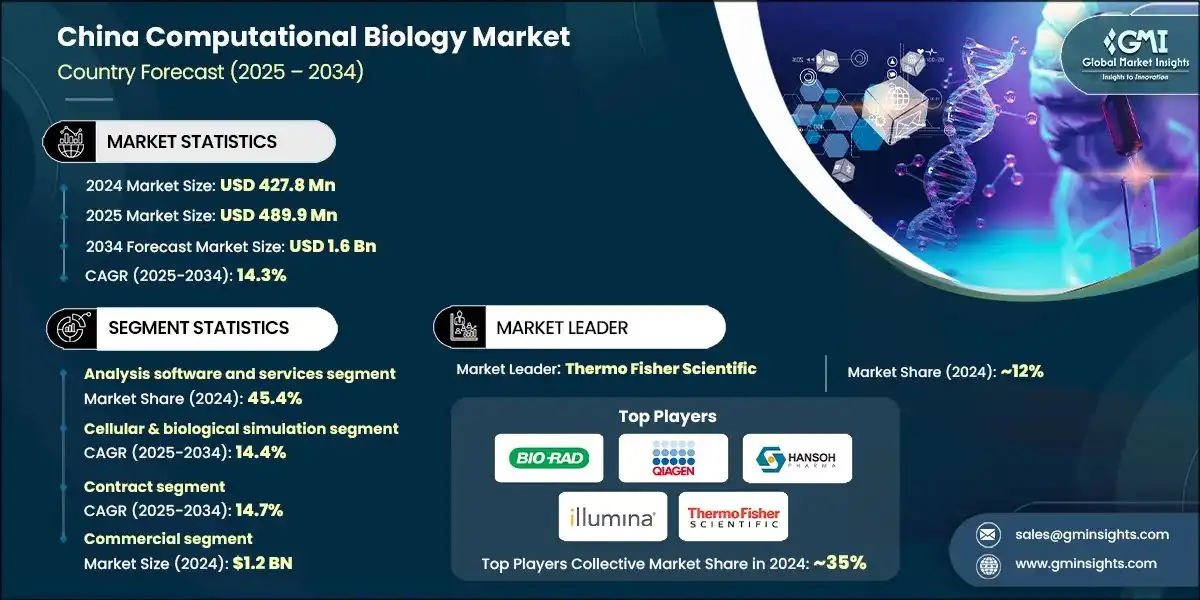
The China computational biology market was valued at USD 427.8 million in 2024. The market is expected to grow from USD 489.9 million in 2025 to USD 1.6 billion in 2034, at a CAGR of 14.3% during the forecast period, according to the latest report published by Global Market Insights Inc. The high market growth is due to the increased clinical trial activities with computational designs, increasing drug development costs & timeline pressures, favorable government policies, and rising volume of omics data & bioinformatics research, among others.
China Computational Biology Market Key Takeaways
Market Size & Growth
- 2024 Market Size: USD 427.8 Million
- 2025 Market Size: USD 489.9 Million
- 2034 Forecast Market Size: USD 1.6 Billion
- CAGR (2025–2034): 14.3%
Key Market Drivers
- Ongoing advancements in bioinformatics and data science.
- Increasing clinical trial activities using computational designs.
- Rising drug development costs & timeline pressures.
- Favorable government policies.
- Rising volume of omics data & bioinformatics research.
Challenges
- Disintegration and mismanagement of data.
- Data privacy & security compliance.
- Lack of skilled professionals.
Opportunity
- Regulatory-ready AI validation solutions.
- Real-time wearable data integration platforms.
Key Players
- Market Leader: Thermo Fisher Scientific led with over 12% market share in 2024.
- Leading Players: Top 5 players in this market include BIO-RAD, QIAGEN, HANSOH PHARMA, Illumina, Thermo Fisher Scientific, which collectively held a market share of 35% in 2024.
Get Market Insights & Growth Opportunities
Computational biology provides powerful analytical tools for streamlining drug discovery, processing biological data, and creating personalized medicine. Key players in the industry include Thermo Fisher SCIENTIFIC, HANSOH PHARMA, QIAGEN, Genedata AG, and Illumina, among others.
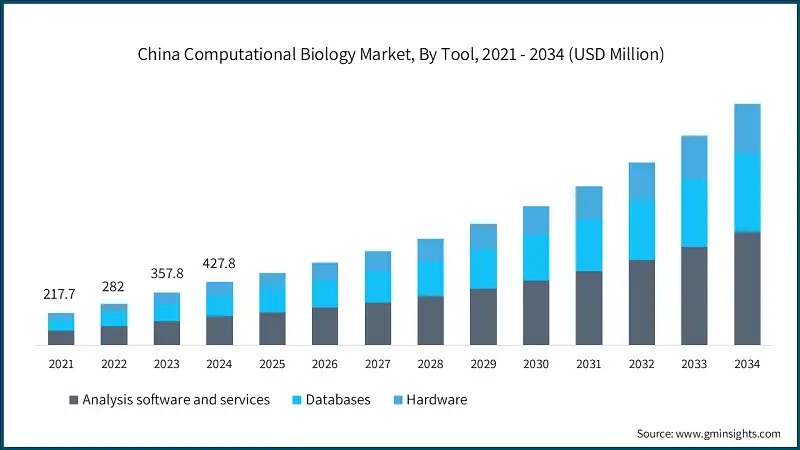
The market has increased from USD 217.7 million in 2021 and reached USD 357.8 million in 2023, with a historic growth rate of 28.2%. This growth has been primarily driven by the integration of multi-omics data, advancements in genomic sequencing, government funding for precision medicine, and the adoption of AI and machine learning in bioinformatics.
The Chinese government has launched large-scale initiatives and allocated substantial budgets to support precision medicine programs. For instance, according to the World Economic Forum, China has incorporated precision medicine into its five-year development strategy, allocating over USD 9 billion towards research initiatives in this field. These investments often include funding for genomic research, data infrastructure, and computational tools that enable the analysis of complex biological datasets. As a result, computational biology has become a critical enabler of precision medicine, helping researchers identify disease mechanisms, predict treatment responses, and develop targeted therapies. This sustained public support not only boosts academic and clinical research but also encourages private sector innovation and collaboration.
Computational biology is an interdisciplinary field combining algorithms, data analytics, and/or high-performance computing, with applications in modeling biological systems, analysis of complex biological data (genomics, proteomics), and speeding up drug discovery, disease modeling, and personalized medicine. The field is an integral part of modern life sciences and pharmaceutical research and development.
To get key market trends
China Computational Biology Market Trends
Ongoing advancements in bioinformatics and data science are a major growth driver for the computational biology market, fundamentally transforming how biological research and drug development are conducted.
- Bioinformatics tools now enable researchers to process and interpret massive datasets generated from genomics, proteomics, and metabolomics studies. These advancements allow for the integration of multi-omics data, providing a holistic view of biological systems and accelerating discoveries in disease mechanisms and therapeutic targets.
- Moreover, sophisticated algorithms and machine learning models are increasingly being used to predict protein structures, simulate molecular interactions, and optimize drug candidates, reducing reliance on costly and time-consuming wet-lab experiments.
- Additionally, the evolution of data science has further amplified these capabilities by introducing scalable cloud-based platforms and high-performance computing solutions. These technologies facilitate real-time data analysis, collaborative research, and secure storage of sensitive biological information.
China Computational Biology Market Analysis
Learn more about the key segments shaping this market
Based on tool, the China computational biology market is segmented into analysis software and services, databases, and hardware. The analysis software and services segment accounted for 45.4% of the market in 2024 due to its critical role in enabling researchers to process, interpret, and visualize massive biological datasets efficiently. The segment is expected to exceed USD 768.2 million by 2034, growing at a CAGR of 14.3% during the forecast period.
On the other hand, the databases segment is expected to grow with a CAGR of 14.1%. The growth of this segment can be attributed to the surging need for centralized repositories to manage multi-omics datasets and the increasing adoption of cloud-based platforms for secure, scalable data storage and real-time accessibility.
- Analysis software and services solutions integrate advanced algorithms, machine learning models, and cloud-based platforms to support multi-omics analysis, drug discovery simulations, and personalized medicine initiatives. The growing complexity of biological data and the need for real-time insights in clinical trials have made software and services indispensable for accelerating research timelines and reducing costs. Additionally, the trend toward AI-driven predictive analytics and interoperability with laboratory systems further strengthens demand for this segment.
- The hardware segment is expected to grow with a 13.8% CAGR during the analysis period. This growth is primarily driven by the rising adoption of high-performance computing systems, advanced sequencing instruments, and cloud-integrated servers to handle massive biological datasets efficiently.
Based on application, the China computational biology market is segmented into cellular & biological simulation, drug discovery & disease modelling, preclinical drug development, clinical trials, and human body simulation software. The cellular & biological simulation segment dominated the market in 2024 and is growing with a CAGR of 14.4% during the forecast period.
- This dominance is driven by its critical role in modeling complex biological systems, enabling researchers to predict cellular behavior, drug interactions, and disease progression without relying solely on costly and time-intensive wet-lab experiments. These simulations leverage advanced algorithms, AI, and high-performance computing to replicate real-world biological processes with remarkable accuracy, accelerating drug discovery and personalized medicine initiatives.
- The drug discovery & disease modelling segment is expected to grow with a 14.7% CAGR during the analysis period. This growth is fueled by the increasing reliance on computational platforms to simulate molecular interactions and predict therapeutic outcomes, significantly reducing R&D timelines and costs. Additionally, the integration of AI-driven predictive analytics and multi-omics data is enabling more accurate disease modeling, accelerating the development of personalized and targeted therapies.
- The preclinical drug development segment is expected to expand rapidly, driven primarily by the growing adoption of computational modeling to predict drug efficacy and toxicity before clinical trials and the integration of AI-powered simulations that reduce costs and accelerate timelines for pharmaceutical R&D.
- The clinical trials segment accounted for a 13% share in 2024. The growth is driven by increasing investments in drug development, rising demand for personalized medicine, and supportive regulatory frameworks that encourage innovation and faster approvals.
- The human body simulation software segment accounted for a 2.9% share in 2024. The growth is driven by the increasing adoption of virtual modeling tools for surgical planning and drug testing, which reduce reliance on costly physical trials, and the integration of AI-powered simulation platforms that enable real-time visualization of physiological responses, supporting precision medicine and personalized treatment strategies.
Based on services, the China computational biology market is segmented into contract and in-house. The contract segment dominated the market in 2024 and is growing with a CAGR of 14.7% during the forecast period.
- This dominance is attributed to pharmaceutical and biotech companies outsourcing computational biology services to specialized providers for cost efficiency, faster turnaround, and access to advanced technologies. Contract research organizations (CROs) offer expertise in bioinformatics, simulation, and multi-omics integration, enabling companies to reduce infrastructure investments and accelerate drug development timelines.
- The in-house segment is expected to grow with a 13.7% CAGR during the analysis period. This growth is driven by large pharmaceutical firms and research institutions investing in internal computational biology capabilities to maintain data security, ensure regulatory compliance, and gain greater control over proprietary research. In-house setups also allow for customized workflows and seamless integration with existing R&D pipelines, supporting long-term innovation strategies.
Learn more about the key segments shaping this market
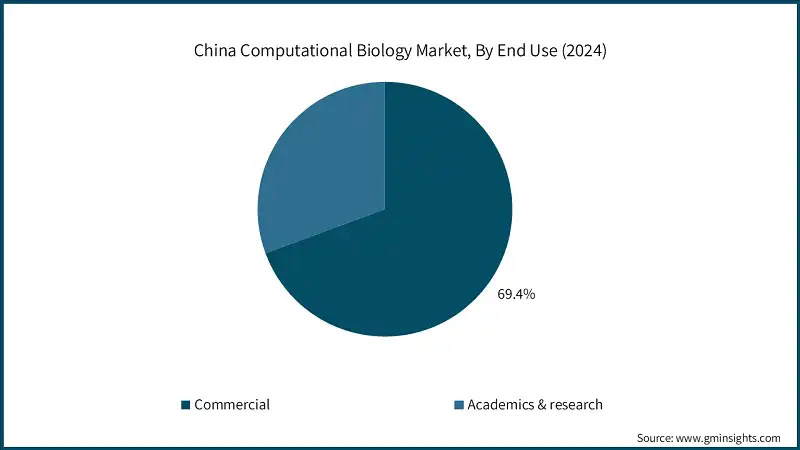
Based on end use, the China computational biology market is segmented into commercial and academics & research. The commercial segment dominated the market with a revenue share of 69.4% in 2024 and is expected to reach USD 1.2 billion within the forecast period.
- This dominance is driven by the widespread adoption of computational biology solutions by pharmaceutical and biotechnology companies to accelerate drug discovery, optimize clinical trials, and reduce R&D costs. The segment benefits from strong investments in AI-driven platforms and cloud-based analytics, enabling faster decision-making and regulatory compliance.
- The academics & research segment held a revenue of USD 130.9 million in 2024. Growth in this segment is fueled by increasing government funding for precision medicine initiatives, rising collaborations between universities and industry, and the growing need for advanced computational tools to support multi-omics research and complex biological simulations.
China Computational Biology Market Share
Leading companies operating in the market, such as BIO-RAD, QIAGEN, HANSOH PHARMA, Illumina, and Thermo Fisher Scientific, among others, have a significant presence in the industry. These players maintain their key position by combining a strong product portfolio, regulatory clearances, consistent innovation, and partnerships with key stakeholders in the industry.
Major companies in the market leverage integrated platforms, acquisitions, and regional presence to help their expansion. These companies invest substantially in AI, cloud processing, and multiomics to enhance drug discovery methods and support precision medicine.
Emerging companies in this market, including players such as Schrödinger, DNAnexus, and instem, focus on providing better advanced modeling and biosimulation methods for specific aspects of pharmaceutical R&D. There is emerging competition in the area of machine learning, with smaller startups utilizing platforms to compete and stay ahead of their peers for faster and more accurate biological information.
China Computational Biology Market Companies
A few of the prominent players operating in the China computational biology industry include:
- BIO-RAD
- cadence
- CERTARA
- Danaher
- DASSAULT SYSTEMES
- DNAnexus
- HANSOH PHARMA
- Illumina
- instem
- QIAGEN
- Schrödinger
- Thermo Fisher SCIENTIFIC
- Thermo Fisher Scientific
The company leverages strategic partnerships with Chinese research institutions and pharma firms to deliver scalable solutions for drug discovery and precision medicine. Its strong focus on AI-driven analytics and cloud-based platforms ensures rapid data processing and interoperability, while localized manufacturing and service hubs enhance accessibility and cost efficiency.
Hansoh Pharma’s USP is its innovation-driven drug development pipeline, integrating computational biology for accelerated R&D in oncology, CNS, and autoimmune disorders. The company combines AI-powered modeling with large-scale omics datasets to optimize clinical trial design and reduce development timelines. Its strong domestic presence and strategic partnerships with tech firms for bioinformatics integration give it a unique advantage in China’s fast-evolving precision medicine landscape.
QIAGEN emphasizes companion diagnostics and automation platforms to support personalized medicine initiatives. Its competitive edge is strengthened by collaborations with regional genomics projects and hospitals, enabling faster adoption of molecular diagnostics. The company’s investment in cloud-enabled bioinformatics tools and regulatory-ready solutions positions it as a trusted partner for precision healthcare and computational biology applications.
China Computational Biology Market Report Attributes
| Key Takeaway | Details |
|---|---|
| Market Size & Growth | |
| Base Year | 2024 |
| Market Size in 2024 | USD 427.8 Million |
| Market Size in 2025 | USD 489.9 Million |
| Forecast Period 2025 - 2034 CAGR | 14.3% |
| Market Size in 2034 | USD 1.6 Billion |
| Key Market Trends | |
| Drivers | Impact |
| Ongoing advancements in bioinformatics and data science | Accelerates precision modeling and predictive analytics for drug discovery. |
| Increasing clinical trial activities using computational designs | Reduces trial timelines and improves success rates through virtual simulations. |
| Rising drug development costs & timeline pressures | Drives adoption of computational tools to optimize workflows and cut expenses. |
| Favorable government policies | Boosts funding and regulatory support for AI-driven biomedical research. |
| Rising volume of omics data & bioinformatics research | Expands demand for scalable computational platforms to manage complex datasets. |
| Pitfalls & Challenges | Impact |
| Disintegration and mismanagement of data | Hampers interoperability and slows research progress. |
| Data privacy & security compliance | Increases operational costs and complexity for regulatory adherence. |
| Lack of skilled professionals | Limits the adoption and implementation of advanced computational solutions. |
| Opportunities: | Impact |
| Regulatory-ready AI validation solutions | Creates a niche for compliance-focused platforms in clinical and pharma sectors. |
| Real-time wearable data integration platforms | Opens new avenues for personalized medicine and continuous health monitoring. |
| Market Leaders (2024) | |
| Market Leaders |
~12% |
| Top Players |
Collective market share in 2024 is ~35% |
| Competitive Edge |
|
| Regional Insights | |
| Future outlook |
|
What are the growth opportunities in this market?
China Computational Biology Industry News:
- In December 2024, QIAGEN announced the launch of Ingenuity Pathway Analysis (IPA) Interpret, a new feature designed to simplify and accelerate the interpretation of complex biological data. This development enabled the company to enhance its service offering and improve the user experience through continuous advancement and updates.
- In March 2024, Hansoh Pharmaceutical Group and Biotheus Inc. announced that the two parties will further expand their strategic collaboration, following their current partnership since 2022. Biotheus will grant Hansoh Pharma a license to use the proprietary anti-EGFR/cMet bispecific antibody HS-20117/PM1080, independently developed by Biotheus, for the development of antibody-drug conjugate products. It will aid the company in improving its industry presence.
The China computational biology market research report includes an in-depth coverage of the industry with estimates and forecasts in terms of revenue in USD Million from 2021 - 2034 for the following segments:
Market, By Tool
- Analysis software and services
- Databases
- Hardware
Market, By Application
- Cellular & biological simulation
- Computational genomics
- Computational proteomics
- Pharmacogenomics
- Other simulations
- Drug discovery & disease modelling
- Target identification
- Target validation
- Lead discovery
- Lead optimization
- Preclinical drug development
- Pharmacokinetics
- Pharmacodynamics
- Clinical trials
- Phase I
- Phase II
- Phase III
- Phase IV
- Human body simulation software
Market, By Services
- Contract
- In-house
Market, By End Use
- Commercial
- Academics & research
Frequently Asked Question(FAQ) :
What was the market size of the China computational biology market in 2024?
The market size was valued at USD 427.8 million in 2024, driven by increased clinical trial activities, rising drug development costs, favorable government policies, and growing bioinformatics research.
What is the projected value of the China computational biology market by 2034?
The market is expected to reach USD 1.6 billion by 2034, growing at a CAGR of 14.3% during the forecast period.
What is the projected size of the China computational biology market in 2025?
The market is expected to reach USD 489.9 million in 2025.
What was the market share of the analysis software and services segment in 2024?
The analysis software and services segment accounted for 45.4% of the market in 2024, generating significant revenue due to its role in processing and visualizing biological datasets.
What is the forecasted value of the analysis software and services segment by 2034?
The segment is projected to exceed USD 768.2 million by 2034, growing at a CAGR of 14.3% during the forecast period.
Which service segment dominated the China computational biology market in 2024?
The contract services segment dominated the market in 2024 and is expected to grow at a CAGR of 14.7% during the forecast period.
What are the key trends in the China computational biology industry?
Key trends include advancements in bioinformatics tools, integration of multi-omics data, adoption of machine learning models for protein structure prediction, and reduced reliance on wet-lab experiments through computational methods.
Who are the key players in the China computational biology market?
Prominent players include BIO-RAD, Cadence, Certara, Danaher, Dassault Systèmes, DNAnexus, Hansoh Pharma, Illumina, Instem, QIAGEN, and Schrödinger.
China Computational Biology Market Scope
Related Reports