Summary
Table of Content

Centrifugal Chiller Refrigerant Market
Get a free sample of this report
Form submitted successfully!
Error submitting form. Please try again.
Thank you!
Your inquiry has been received. Our team will reach out to you with the required details via email. To ensure that you don't miss their response, kindly remember to check your spam folder as well!
Request Sectional Data
Thank you!
Your inquiry has been received. Our team will reach out to you with the required details via email. To ensure that you don't miss their response, kindly remember to check your spam folder as well!
Form submitted successfully!
Error submitting form. Please try again.
Centrifugal Chiller Refrigerant Market Size
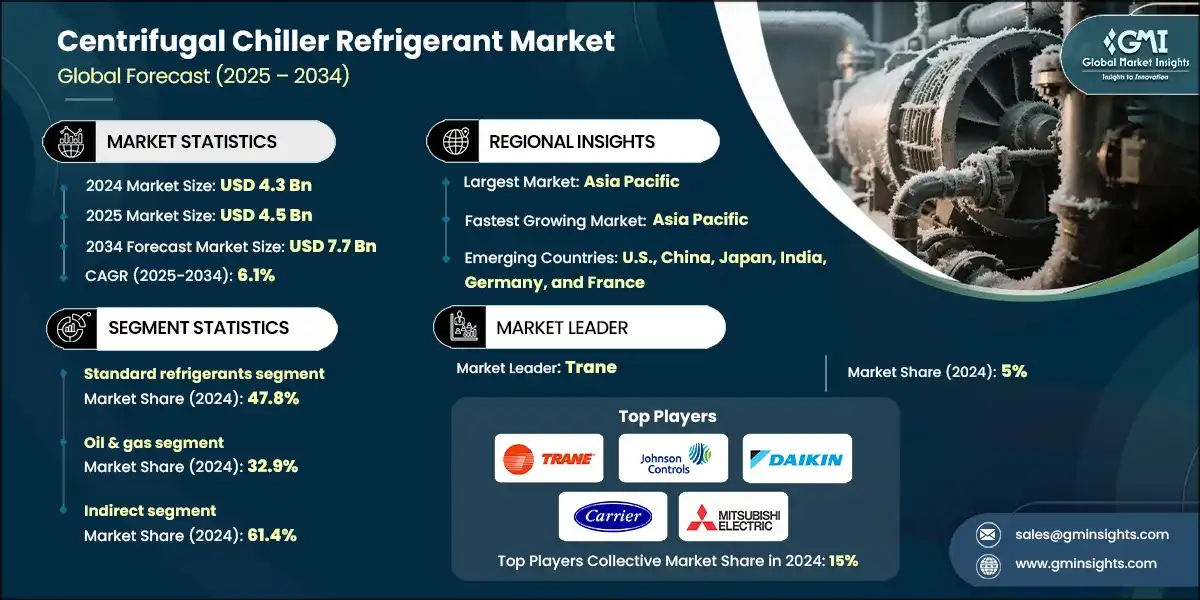
The global centrifugal chiller refrigerant market was estimated at USD 4.3 billion in 2024. The market is expected to grow from USD 4.5 billion in 2025 to USD 7.7 billion in 2034, at a CAGR of 6.1%, according to the latest report published by Global Market Insights Inc.
Centrifugal Chiller Refrigerant Market Key Takeaways
Market Size & Growth
- 2024 Market Size: USD 4.3 Billion
- 2025 Market Size: USD 4.5 Billion
- 2034 Forecast Market Size: USD 7.7 Billion
- CAGR (2025–2034): 6.1%
Regional Dominance
- Largest Market: Asia Pacific
- Fastest Growing Region: Asia Pacific
Key Market Drivers
- Energy efficiency regulations.
- Growing construction industry.
- Rising global temperatures and urbanization.
Challenges
- Strict environmental regulations.
- High initial investment costs.
Opportunity
- Integration with IoT and smart building systems.
- Adoption of low-GWP and natural refrigerants.
- Expansion in emerging markets (Asia Pacific, Latin America).
Key Players
- Market Leader: Trane led with over 5% market share in 2024.
- Leading Players: Top 5 players in this market include Trane, Johnson Controls, Daikin Industries, Carrier Corporation, Mitsubishi Electric Corporation, which collectively held a market share of 15% in 2024.
Get Market Insights & Growth Opportunities
- The market for centrifugal chiller refrigerants is growing rapidly because of the increasing demand for more effective and environmentally friendly cooling systems in the commercial, industrial, and institutional markets. Increased emphasis globally on the reduction of carbon footprints and related pressure from increasing environmental regulations are prompting the move away from traditional refrigerants with a high global warming potential (GWP) toward next-generation refrigerants with reduced either GWP or zero ozone-depleting potential (ODP).
- New refrigerants deliver improved energy efficiency and thermal performance that end-users benefit from by reducing their operating costs and environmental profile. Advances in centrifugal chiller technology, such as advancements in compressor technologies and improvements in heat exchangers also improve performance of contemporary refrigerants by maximizing ability to cool while reducing energy consumption. Possible adoption of smart technologies such IoT-enabled monitoring and AI-based predictive maintenance provide end-users with the ability to monitor real-time performance, operational efficiency, and minimize downtime associated with performance inefficiencies. Development of this market category represents a broader global shift to support sustainability, energy efficiency, and regulatory compliance that fosters innovation and growth for centrifugal chiller refrigerant consumer products.
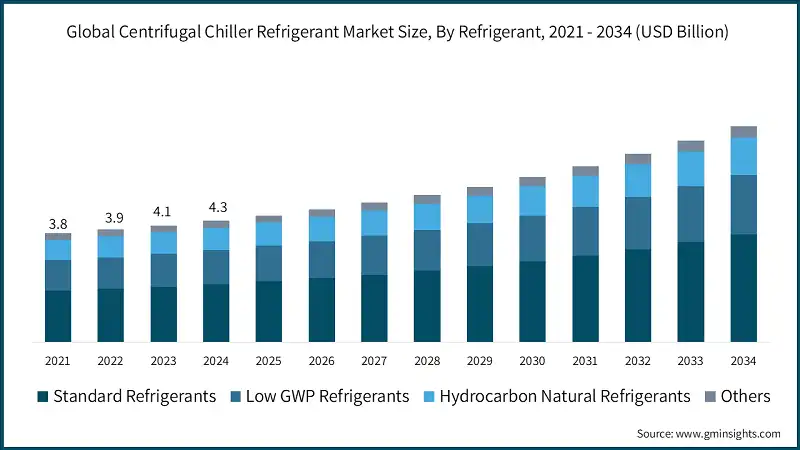
- The centrifugal chiller refrigerant market has grown from USD 3.9 billion in 2021 due to several reasons such as rising demand for efficient cooling systems across commercial, industrial and residential buildings. Increasing urbanization and industrialization, mainly in developing economies, explains the demand for cooling on a larger scale. The regulations for impeding greenhouse gases have prompted the business to adopt low-global warming potential (GWP) refrigerants, while the technological advancements presented by service providers have opened the market for opportunities in low-global warming potential (GWP) refrigerants based on green solutions. All coupled with the new developments in chiller systems, such as advanced energy efficiency and smart controls, all impacted by the changes in technology as well as what is viewed as acceptable in the rotary chiller market.
- In the centrifugal chiller refrigerant market, the standard refrigerants segment dominated the market mainly due to their established efficiency, reliability, and availability in global markets. These products have been tested and utilized for years, and as a result, the industry has a specific choice for certain types of chiller systems. Compatible with older chiller systems has provided ease of transition associated with true retrofit costs. Standard refrigerants are an effective measure for performance versus cost and are utilized in many commercial and industrial applications at any scale and predetermined use.
- The Asia Pacific region is the leading and fastest growing region in global centrifugal chiller refrigerant market due to rapid industrialization, urbanization, and increasing infrastructure development across countries like China, India, and Southeast Asia. The rising demand for energy-efficient cooling solutions in commercial buildings, manufacturing plants, and data centers is driving the adoption of advanced chiller systems. Additionally, the growing construction industry and expanding HVAC market in the region contribute significantly to refrigerant consumption. Supportive government policies promoting energy efficiency and environmental sustainability further boost market growth.
To get key market trends
Centrifugal Chiller Refrigerant Market Trends
The centrifugal chiller refrigerant sector is shifting toward low GWP refrigerants in response to environmental regulations to reduce greenhouse gas emissions and organizations should develop and convert to sustainable refrigerants that comply with international protocols such as the Kigali Amendment as well as the Montreal Protocol.
- As markets shift toward low-GWP refrigerants this transition will not only be compliant but will enhance their brand value and market competitiveness. This trend will result in a smaller environmental footprint and involvement in green ratings. The main influence of this trend is the regulatory pressure, which started around 2020, to drive this change and should lead to a shift by 2030 when low-GWP refrigerants will hover around 50% of the market.
- Demand for energy-efficient HVAC systems is influencing the centrifugal chiller refrigerant market. Companies should use refrigerants that allow centrifugal chillers to operate at higher efficiency, which reduces energy consumption and operational expenses for end-users. The ongoing use of new refrigerants in conjunction with new chiller designs will ensure compliance with the many regulating standards, globally or locally. This trend will result in a reduction in energy and expenses, as well as an environmental impact. This shift has been driven by increased cost of energy and stricter efficiency policies, with a significant increase in the market growing around 2024-2030 as building owners seek out sustainable solutions.
- Chiller system management will be automated to the highest degree through smart building technologies that deliver real-time monitoring and predictive maintenance to employ IoT connections. Organizations should focus on investing in alternative IoT-enabled refrigerants and chiller systems that allow for the analysis of data to optimize cooling operation. Outcomes associated with this trend appear to include increased system reliability, reduced downtime, and lower lifecycle costs associated with HVAC systems and machinery, all of which ultimately will make these systems more attractive in modern construction applications. Smart building applications, technologies, and infrastructure are expected to proliferate because of the smart cities initiative, along with improved coordinated and connected infrastructure, with the promise of wide-scale projects anticipated between the years 2025 to 2035, when the growth in the market will be tremendously accelerated and capture significant sectors as part of the increase in the market.
- Rapid urbanization and new infrastructure development in the emerging economies are expected to drive demand for centrifugal chillers and coolants associated with them. Businesses need to pay attention to developing solutions using refrigerants that are scalable and can be applicable to the needs of cooling significantly large commercial and industrial facilities. Urbanization developmental and industrialization are primary contributors of this trend, while significant amounts of increased space in the market are anticipated to expand by 2022-2035 as urbanization and population sources increase their cooling infrastructure.
Centrifugal Chiller Refrigerant Market Analysis
Learn more about the key segments shaping this market
Based on refrigerant, the market is segmented into standard refrigerants, low GWP refrigerants, hydrocarbon natural refrigerants and others. In 2024, the standard refrigerants segment dominates the market with 47.8% revenue share and is expected to grow at a CAGR of over 6.5% from 2025 to 2034.
- Standard refrigerants still hold a strong position in the refrigerant market for centrifugal chillers, primarily due to their availability, proven history of performance, and inherent compatibility with existing chillers. They offer good cooling efficiency and can be readily serviced by a well-trained manufacturer service network. With a lower initial cost and a solid safety record, standard refrigerants remain the most appropriate choice for many large commercial and industrial applications, especially in parts of the world where considerable investment into new or retrofitted chiller systems with low-GWP alternatives has yet to take place.
- Low-GWP refrigerants have made great advancements in part due to environmental regulations; however, issues related to cost, retrofitting options, and installation still limit their adoption. Though hydrocarbon natural refrigerants - which are considered very sustainable - are being utilized even though regulations control installation due to flammability issues. All low-GWP alternatives offer a promise of sustainability in the future, but the reality overall is that standard refrigerants still maintain a better balance of cost, performance, and existing infrastructure.
Learn more about the key segments shaping this market
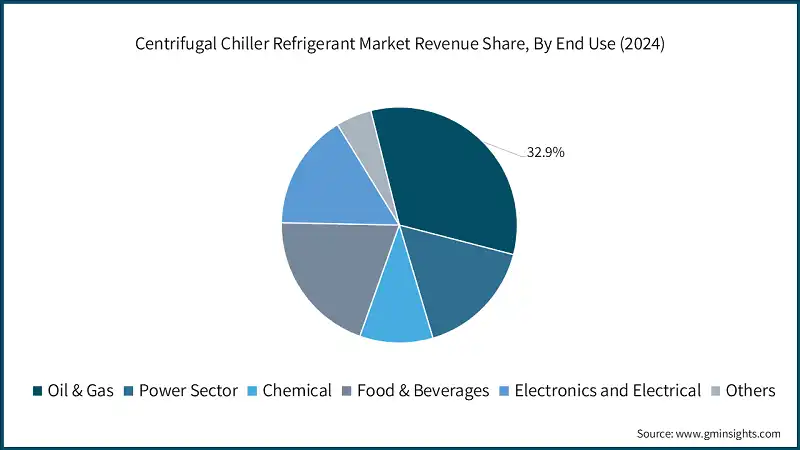
Based on end use, the centrifugal chiller refrigerant market is segmented into oil & gas, power sector, chemical, food & beverages, electronics & electrical, and others. In 2024, the oil & gas segment dominates the market with 32.9% share and is expected to grow at a CAGR of over 6.5% from 2025 to 2034.
- The market is dominated by oil and gas segments due to the high demand for offshore locations, petrochemical facilities, and precision-cooled refineries. Reliable and effective chillers that can maintain a steady operating environment under challenging circumstances are needed in this market. To maintain the thermal management required at capacity, the oil and gas segment needs dependable refrigerants due to its extensive infrastructure and continuously operating installations. The preference for well-established refrigerant technology is made worse by the industry's safety standards and compliance requirements for oil and gas.
- The power generation industry also has efficiencies and cooling demands but is not as urgent as oil & gas facilities given the more stable conditions. Chemical and electrical industries demand special cooling alternatives but are opting for alternatives with lower GWP to meet the stricter environmental regulations. The food & beverages industry values hygiene and temperature operation with refrigeration but generally operate smaller refrigeration systems.
Based on the distribution channel, the centrifugal chiller refrigerant market is segmented as direct & indirect. In 2024, the indirect segment dominates the market with 61.4% revenue share and is expected to grow at a CAGR of over 6.2% from 2025 to 2034.
- Indirect distribution is a rapidly growing segment in the market, thanks to its reach, cost-efficiency, and accessibility. Distributors, resellers, third-party vendors etc., allow manufacturers to access multiple regional markets, especially in developing economies. Because indirect distributors can achieve inventory flexibility and localized customer service, they are suited to even small to mid-sized projects. The indirect channel can often provide a range of offerings to customers without manufacturer engagement, thus amplifying their influence on the commercial and industrial channels.
- Indirect distribution channels are valued for their scalability and ability to expand into a new market; however, with respect to technical expertise and customization, they do not compare to the direct distribution channel. The direct channel is still preferred for large-scale, mission-critical system installations where customization and after-sales service are required. Further, manufacturers use the direct distribution channel to maintain tighter control of quality and compliance with regulations.
Looking for region specific data?
Asia Pacific Centrifugal Chiller Refrigerant Market
Asia Pacific dominated the global market with the highest revenue share of 35.9% in 2024.
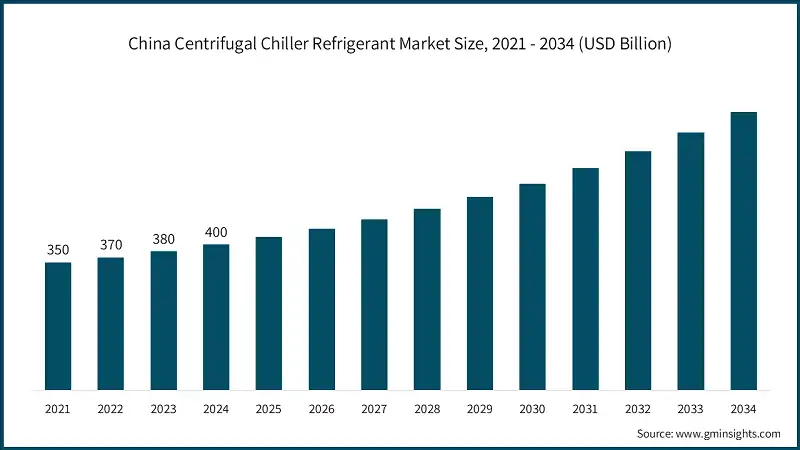
- China dominated the centrifugal chiller refrigerant industry with around 26% share and reached revenue of USD 400 million in 2024. China dominates the Asia-Pacific centrifugal chiller refrigerant market, because of its rapid industrialization of the country and broadening manufacturing base. The country benefits from its established industrial base, low-cost labor, and distribution advantages that allow it to sell centrifugal chillers competitively in the market and to a wide audience.
- Furthermore, China's commitment to building infrastructure creates additional demand for advanced technologies in HVAC, including centrifugal chillers. Finally, manufacturers are an increasingly adopting low-GWP refrigerants such as HFOs as well as natural refrigerants such as ammonia and CO? to meet expanding government environmental regulations. The advent of IoT and smart technologies into chiller systems is also radically changing the market by offering opportunities for remote monitoring, predictive maintenance and improved performance.
North America Centrifugal Chiller Refrigerant Market
In North America, U.S. market for centrifugal chiller refrigerant is expected to experience significant and promising growth from 2025 to 2034.
- The U.S. has a dominant market share in North America's centrifugal chiller refrigerant due to its strong industrial base, highly developed manufacturing facilities, and strict environmental standards. The U.S. is the production and usage leader in high-efficiency centrifugal chillers for the region. U.S. manufacturers enjoy integrated technologies and economies of scale, allowing them to manufacture high-quality refrigerant systems that are cost competitive.
Europe Centrifugal Chiller Refrigerant Market
In Europe, the UK market for centrifugal chiller refrigerant is expected to experience significant and promising growth from 2025 to 2034.
- The UK is a key contributor to the centrifugal chiller refrigerant in Europe, owing to the strength of its industrial base, technological innovation, and sustainability. The UK market is growing rapidly, particularly in the pharmaceutical, chemicals, and data center industry, due to the need for precise, energy-efficient cooling solutions. The admission of smart cities into the UK government agenda, along with a persistent government emphasis on sustainability and green building certifications, such as BREEAM and LEED, hastened the adoption of eco-friendly chillers incorporating low global warming potential (GWP) refrigerants. The strong export activity associated with the UK chemicals and life sciences sectors continues to impact on the demand for advanced cooling solutions required to meet stringent temperature control standards.
MEA Centrifugal Chiller Refrigerant Market
In MEA, the UAE market for centrifugal chiller refrigerant is expected to experience significant and promising growth from 2025 to 2034.
- The UAE is a strong player in the centrifugal chiller refrigerant owing to an established HVAC infrastructure, numerous district cooling systems, and a strong regulatory push toward sustainability. Cities like Dubai and Abu Dhabi have emerged as centers for smart buildings and luxury developments, which require sophisticated cooling solutions, supporting the business growth. The UAE Energy Strategy 2050 is another aspect that emphasized the reduction of carbon emissions in exchange for adopting eco-friendly refrigerants and empowering chiller technologies.
Centrifugal Chiller Refrigerant Market Share
- Trane leads with 5% market share due to their high-quality pigments and wide range of unique, artist-preferred colors. The top 5 companies are Trane, Johnson Controls, Daikin Industries, Carrier Corporation and Mitsubishi Electric Corporation, collectively hold 15% of the market, indicating fragmented market concentration.
- Trane chillers are recognized for their reliability, low refrigerant leakage rates, and quiet operation in large commercial buildings and critical infrastructure. As a manufacturer, Trane has a solid foundation for success in the centrifugal chiller refrigerant market based on innovative technology, compliance with national and global refrigerant standards, and the public relations commitment to reducing environmental impact.
- Johnson Controls provides a very broad portfolio of centrifugal chillers under the YORK brand. Johnson Controls is likely to gain some recognition for high performance systems that can deliver excellent energy-efficiency while producing a lesser environmental impact. Johnson Controls is actively developing their next generation of centrifugal chillers with low-GWP refrigerants and advanced control systems to keep up with increased global demand for sustainable HVAC solutions.
- Daikin has invested in an oil-free, magnetic bearing centrifugal chiller solution that employs ultra-low GWP refrigerants. Daikin continues to develop refrigerant and innovation while investing in flexibility and efficiency to comply with ever-changing energy and environmental regulations. In providing high-performance solutions while still being a viable partner in sustainable solutions for cooling applications globally, Daikin strengthens its position in the industry.
- Carrier has established its position in the HVAC industry for a long time and is a strong manufacturing and service provider for centrifugal chiller technologies. The company is transitioning to next-generation refrigerants and energy-efficient designs are in response to regulatory and market expectations. Carrier centrifugal chillers are used in commercial, industrial, and institutional facilities.
- Mitsubishi Electric is continuing to strengthen its position in this centrifugal chiller refrigerant market through precision engineering and advanced technology. Due to its variable refrigerant flow (VRF) systems, the company is better known for this market and has also invested in high-efficiency chillers for larger buildings and data centers. Mitsubishi's primary strengths throughout the market segment are innovation in inverter-driven compressors and respecting sustainability standards, which address the global market demand for efficient low-emission cooling solutions.
Centrifugal Chiller Refrigerant Market Companies
Major players operating in the centrifugal chiller refrigerant industry are:
- Arkema
- Broad Air Conditioning
- Carrier Corporation
- Daikin Industries
- Drake Refrigeration
- Honeywell International
- Hudson Technologies
- Johnson Controls
- Mitsubishi Electric Corporation
- Orbia
- Sinochem Group
- The Chemours Company
- The Linde Group
- Toshiba Corporation
Carrier has made notable progress on the high-power requirement front but also downward for more flexibility. Features include ceramic bearings, falling-film evaporators tuned for low-pressure refrigerants, variable-speed drives, direct-drive high-speed compressors, and controls to improve efficiency, reduce losses due to mechanical and refrigerant charge, and improved restart times.
Trane is aligning with regulatory shift towards low GWP refrigerants. Trane started commodities chillers for comfort cooling and heating must ship with Low Global Warming Potential (GWP) Refrigerants, within the U.S. starting in January 2025 and is adjusting its product lists.
Daikin has recently expanded its water-cooled centrifugal chiller list with low-GWP options and is complying with emerging European and global regulatory pressures. The company intends to provide refrigerant flexibility to its clients, while maintaining efficiency in part-load and full-load conditions when potentially low GWP refrigerants.
Centrifugal Chiller Refrigerant Market Report Attributes
| Key Takeaway | Details |
|---|---|
| Market Size & Growth | |
| Base Year | 2024 |
| Market Size in 2024 | USD 4.3 Billion |
| Market Size in 2025 | USD 4.5 Billion |
| Forecast Period 2025 - 2034 CAGR | 6.1% |
| Market Size in 2034 | USD 7.7 Billion |
| Key Market Trends | |
| Drivers | Impact |
| Energy efficiency regulations | Accelerates demand for energy-saving refrigerants and chillers. |
| Growing construction industry | Increases need for reliable, large-scale cooling solutions. |
| Rising global temperatures and urbanization | Drives adoption of advanced cooling technologies. |
| Pitfalls & Challenges | Impact |
| Strict environmental regulations | Accelerates demand for energy-saving refrigerants and chillers. |
| High initial investment costs | Increases need for reliable, large-scale cooling solutions. |
| Opportunities: | Impact |
| Integration with IoT and smart building systems | Enables real-time monitoring and optimized energy management, improving operational efficiency and reducing maintenance costs. |
| Adoption of low-GWP and natural refrigerants | Supports regulatory compliance and sustainability goals, attracting environmentally conscious customers and reducing carbon footprint. |
| Expansion in emerging markets (Asia Pacific, Latin America) | Drives revenue growth through increased industrialization and urbanization requiring efficient cooling solutions. |
| Market Leaders (2024) | |
| Market Leaders |
5% market share |
| Top Players |
Collective market share in 2024 is 15% |
| Competitive Edge |
|
| Regional Insights | |
| Largest Market | Asia Pacific |
| Fastest growing market | Asia Pacific |
| Emerging countries | U.S., China, Japan, India, Germany, and France |
| Future outlook |
|
What are the growth opportunities in this market?
Centrifugal Chiller Refrigerant Industry News
- In June 2025, Daikin Industries announced that they would invest in Tokyo-based startup Asuene Inc. With the objective of accelerating decarbonization in the HVAC industry globally, Daikin's investment aims to utilize Asuene's carbon accounting and ESG management platform in combination with Daikin's new energy-efficient HVAC systems and offer a pathway towards full-cycle decarbonization solutions in North America and Japan.
- In 2024, Johnson Controls launched the large?capacity centrifugal chiller optimized for R?1234ze(E), which was claimed as they are up to 30% energy efficient over conventional chillers. More recently in 2025, Johnson Controls expanded its YVAM air?cooled magnetic bearing centrifugal chiller into Europe to meet growing demand in the data center sector, where cooling, energy efficiency, noise, and environmental regulations are becoming more stringent.
- In November 2023, Honeywell and Trane Technologies announced a major sustainability achievement in the UAE. Trane chillers using Honeywell’s ultra-low-GWP Solstice zd (R-1233zd) refrigerant are helping avoid 42,000 tons of CO?e emissions annually across 26 sites, including Pure Harvest Smart Farms.
- In December 2022, Trane launched its new products water-cooled XStream excellent GVWF chiller and air-cooled Sintesis excellent GVAF chiller. The new chillers were designed with magnetic-bearing compressors as well as using the low GWP refrigerant R1234ze. The chillers feature high-speed centrifugal compressor technology to achieve larger capacities, a wider operating map to handle the European weather challenges and improve seasonal efficiencies while being compact.
The centrifugal chiller refrigerant market research report includes in-depth coverage of the industry with estimates & forecasts in terms of revenue (USD Billion) and volume (Thousand Units) from 2021 to 2034, for the following segments:
Market, By Refrigerant
- Standard refrigerants
- Low GWP refrigerants
- Hydrocarbon natural refrigerants
- Others
Market, By Compressor
- Single stage compressor
- Multistage compressor
Market, By End Use
- Oil & gas
- Power sector
- Chemical
- Food & beverages
- Electronics & electrical
- Others (semiconductor, automotive, etc.)
Market, by Distribution Channel
- Direct
- Indirect
The above information is provided for the following regions and countries:
- North America
- U.S.
- Canada
- Europe
- Germany
- UK
- France
- Italy
- Spain
- Asia Pacific
- China
- India
- Japan
- South Korea
- Australia
- Latin America
- Brazil
- Mexico
- Argentina
- MEA
- South Africa
- Saudi Arabia
- UAE
Frequently Asked Question(FAQ) :
What is the market size of the centrifugal chiller refrigerant in 2024?
The market size exceeded USD 4.3 billion in 2024, with a CAGR of 6.1% expected from 2025 to 2034, driven by the demand for efficient and eco-friendly cooling solutions across various sectors.
What is the projected value of the centrifugal chiller refrigerant market by 2034?
The centrifugal chiller refrigerant market is expected to reach approximately USD 7.7 billion by 2034, propelled by the adoption of next-generation refrigerants with low GWP and zero ODP.
What is the current centrifugal chiller refrigerant market size in 2025?
The market size is projected to reach USD 4.5 billion in 2025.
What is the current market share of standard refrigerants in 2024?
Standard refrigerants held a 47.8% revenue share in 2024.
How much revenue did the oil & gas segment generate in 2024?
The oil & gas segment dominated the market with a 32.9% share in 2024, supported by high demand for reliable cooling solutions in offshore locations and petrochemical facilities.
What is the growth outlook for the indirect distribution channel from 2025 to 2034?
The indirect distribution channel is expected to grow at a CAGR of over 6.2% from 2025 to 2034, supported by its cost-efficiency, regional accessibility, and inventory flexibility.
Which region leads the centrifugal chiller refrigerant market in 2024?
Asia Pacific led the market with a 35.9% revenue share in 2024, driven by rapid industrialization and a growing manufacturing base in countries like China.
What are the key trends driving the centrifugal chiller refrigerant market?
Key trends include the shift towards low GWP and zero ODP refrigerants, increasing environmental regulations, and the demand for energy-efficient cooling systems.
Who are the major players in the centrifugal chiller refrigerant market?
Major players include Arkema, Broad Air Conditioning, Carrier Corporation, Daikin Industries, Drake Refrigeration, Honeywell International, Hudson Technologies, Johnson Controls, Mitsubishi Electric Corporation, Orbia, Sinochem Group, The Chemours Company, The Linde Group, and Toshiba Corporation.
Centrifugal Chiller Refrigerant Market Scope
Related Reports