Summary
Table of Content

Cenospheres Market
Get a free sample of this report
Form submitted successfully!
Error submitting form. Please try again.
Thank you!
Your inquiry has been received. Our team will reach out to you with the required details via email. To ensure that you don't miss their response, kindly remember to check your spam folder as well!
Request Sectional Data
Thank you!
Your inquiry has been received. Our team will reach out to you with the required details via email. To ensure that you don't miss their response, kindly remember to check your spam folder as well!
Form submitted successfully!
Error submitting form. Please try again.
Cenospheres Market Size
- Cenospheres which function as lightweight hollow spherical particles originate from the ash that results when coal burns in thermal power facilities. The microspheres contain silica and alumina as their primary components which create distinct features including low weight and high strength and thermal protection. Industries use cenospheres as functional fillers in their products because they exhibit two properties, which are their inert chemical behavior and their consistent particle shape.
- The chemical structure of cenospheres has two main properties, their ability to float and their capacity to resist heat and chemical reactions. Cenospheres is an essential resource as it is a lightweight material with upgraded operational capacity. Their capacity to enhance mechanical properties while minimizing the required material volume has made them highly important in current society.
- Recent technological advancements have transformed how cenospheres are extracted, processed, and utilized. The combination of upgraded wet‑gravity methods with magnetic separation technology has led to better recovery results and superior purity outcomes. The new developments of these technologies enable manufacturers to create products which have better strength and environmental sustainability and lower production costs.
- Cenospheres serve as a cost-effective solution which delivers performance advantages to multiple industries which include construction, automotive, aerospace, paints, plastics and oil and gas. The ability of these materials to decrease product weight while maintaining strength, makes them crucial for industries which aim to improve their energy efficiency and achieve their sustainability goals. The rising popularity of circular economy principles enables businesses to use waste materials by converting them into usable products, which helps protect the environment by diminishing waste and optimizing resource consumption.
- High-strength low-density fillers drives composite manufacturing because these materials create unique characteristics in their products thus rises demand for advanced materials. The ongoing development of global infrastructure and the shift of industries toward better material solutions will ensure continued demand for cenospheres in the future. The multiple end-use sectors all see their importance because the product durability improvements and the raw material usage reductions and functional performance enhancements make their products better.
The global cenospheres market was valued at USD 597 million in 2025. The market is expected to grow from USD 662.7 million in 2026 to USD 1.8 billion in 2035, at a CAGR of 11.4% according to the latest report published by Global Market Insights Inc.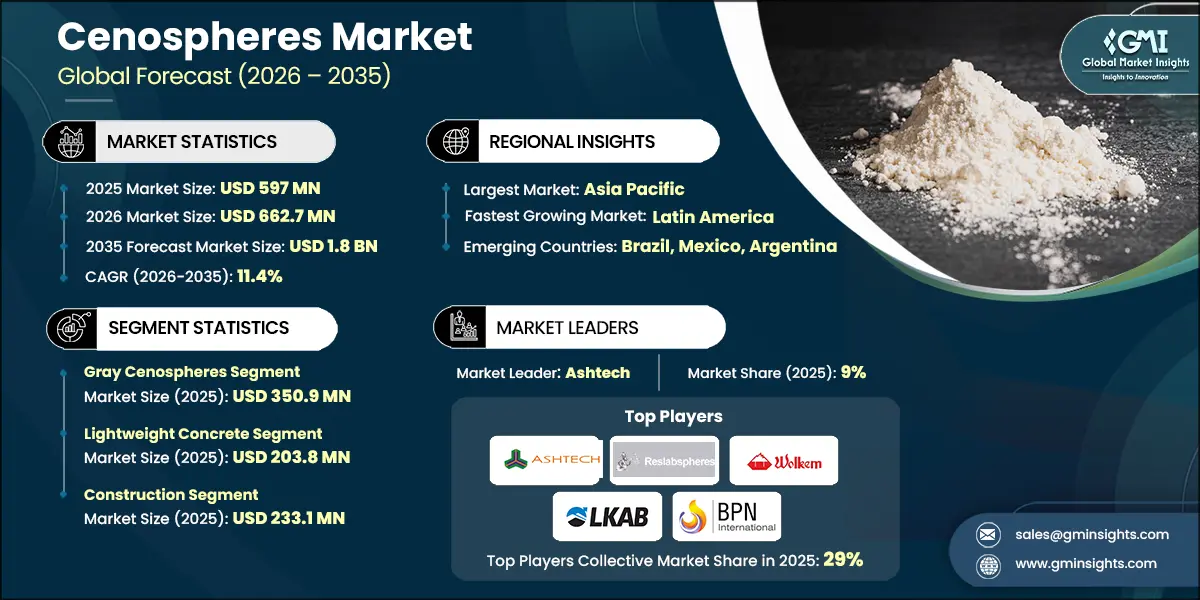
Cenospheres Market Key Takeaways
Market Size & Growth
- 2025 Market Size: USD 597 Million
- 2026 Market Size: USD 662.7 Million
- 2035 Forecast Market Size: USD 1.8 Billion
- CAGR (2026–2035): 11.4%
Regional Dominance
- Largest Market: Asia Pacific
- Fastest Growing Region: Latin America
Key Market Drivers
- Rising demand for lightweight materials.
- Expanding use in composites and polymers.
- Increasing focus on sustainability and circular utilization.
Challenges
- Limited and inconsistent raw material supply.
- High processing and extraction challenges.
Opportunity
- Growth in advanced manufacturing and additive technologies.
- Emerging applications in construction and infrastructure.
- Increasing adoption in oil & gas and energy sectors.
Key Players
- Market Leader: Ashtech led with over 9% market share in 2025.
- Leading Players: Top 5 players in this market include Ashtech, Reslab Microfiller, Wolkem, LKAB Minerals, BPN International, which collectively held a market share of 29% in 2025.
Get Market Insights & Growth Opportunities
To get key market trends
Cenospheres Market Trends
- The use of cenospheres is becoming more popular because industries need lightweight materials which maintain their performance capabilities. The building materials sector and the polymer manufacturing industry and the engineered composite production sector use these hollow microspheres to achieve lower material weight while their products maintain thermal performance and mechanical strength which helps them meet efficiency requirements while controlling product expenses throughout its entire lifecycle.
- The research scientists are implementing tighter particle size distribution together with enhanced surface compatibility to establish uniform dispersion patterns within cementitious compounds and polymer materials and coating technologies. The shift brings predictable rheology results together with stronger interfacial bonds which decrease the amount of resin and binder required to help users achieve their performance requirements while controlling material usage.
- The development of processing techniques enables better recovery rates and pure materials to be obtained from fly ash streams which creates new opportunities for materials to be used in more valuable applications. The improved quality control of cenospheres has enabled their use in high-temperature equipment and syntactic foam materials which provide buoyancy and insulation functions and specialized ceramics which need specific thermal and dielectric characteristics.
- The demand for products needs to consider environmental sustainability targets which exist in society. The use of cenospheres as by-product materials creates circular economy systems which enhance resource efficiency.
- Cenospheres results in rising demand because of their unique combination of low density and high compressive strength and thermal stability makes them suitable for applications requiring these specific characteristics. The adoption of supply chains will progress toward greater acceptance in applications which provide benefits from standardized performance and long-lasting thermal stress resistance and decreased total material usage.
Cenospheres Market Analysis
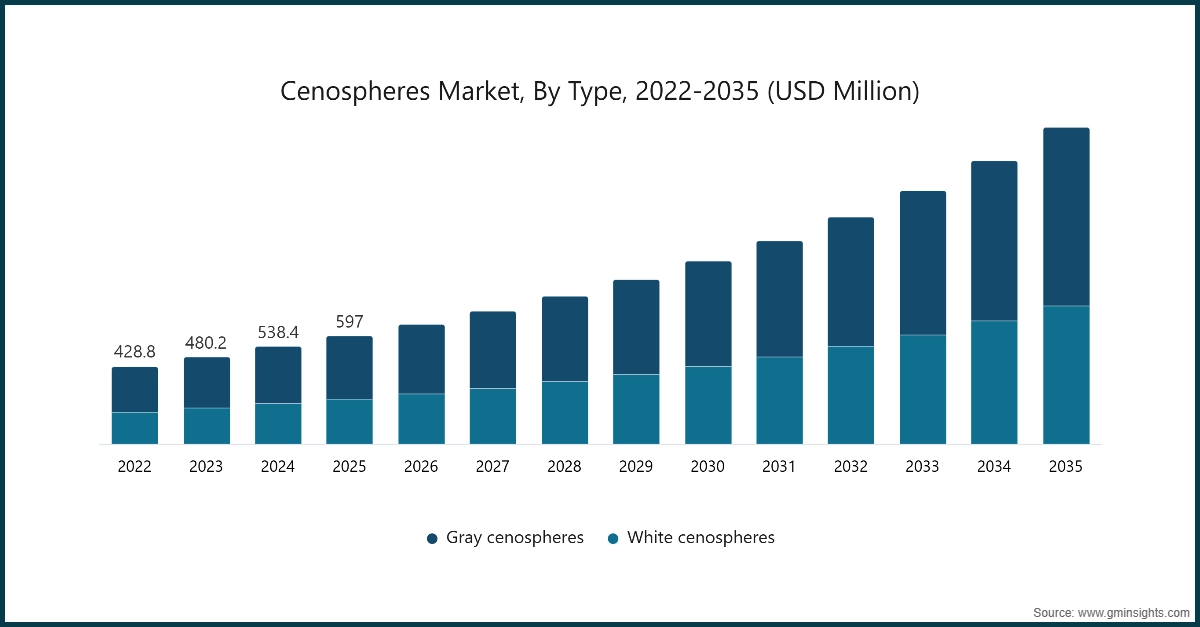
Learn more about the key segments shaping this market
- The usage of gray cenospheres is increasing in structural and heavy-duty applications because these applications require both cost containment and mechanical strength. The particle-size distribution and surface treatment optimization work aims to create improved dispersion for cementitious systems and mortars and refractories and drilling fluids. The construction projects and energy operations require materials that weigh less but maintain their durability, which has resulted in an increased demand for gray grades to use in lightweight concrete elements and grout and shotcrete and density-managed fluids for oilfield services.
- White cenospheres are seeing increased market demand in applications that require high-performance standards and aesthetic appearance and thermal resistance. The producers and compounders need to establish stricter control standards for purity and brightness requirements to produce their products for premium coatings and engineered polymers and specialty ceramics and aerospace composite applications, which need color stability and dielectric performance and smooth surface finish.
- The current trend leads to the development of functionalized surfaces that establish stronger bonds with resins and binders, which allows for decreased filler usage while matching the same performance standards. The solution delivers better thermal insulation with reduced weight and maintains consistent rheological behavior for both thin-film coatings and precision-molded components.
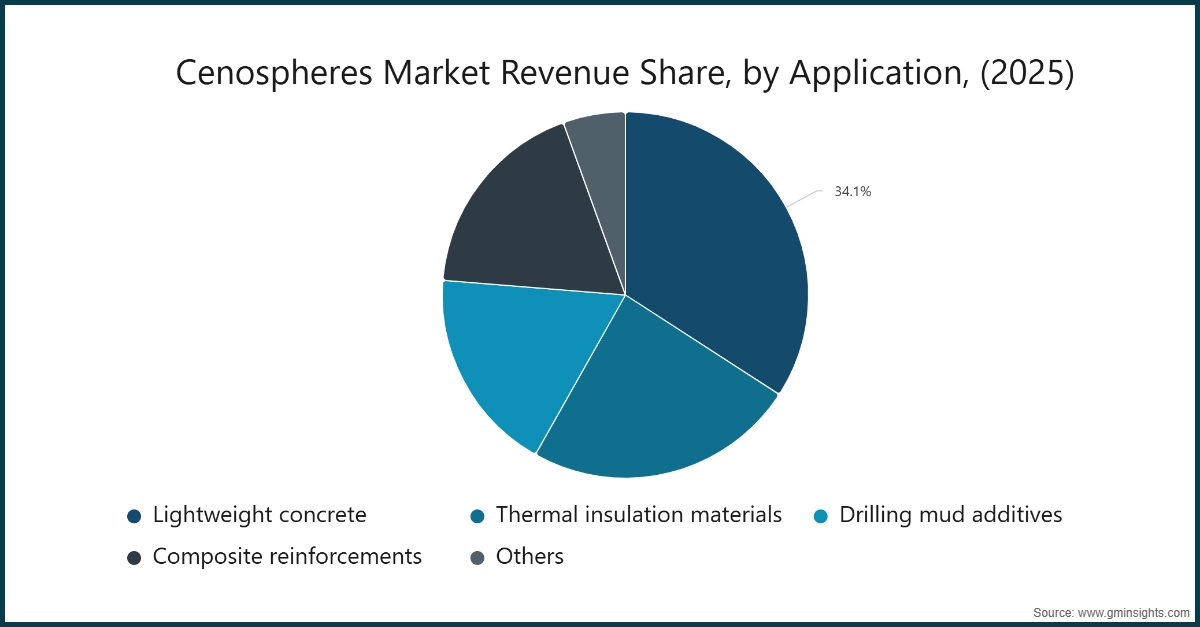
Learn more about the key segments shaping this market
- Industries are steadily increasing the use of cenospheres in lightweight concrete, thermal insulation materials, and composite reinforcements as part of a broader shift toward high‑performance, low‑density formulations. Their hollow structure helps reduce material weight while improving durability, workability, and thermal efficiency, making them valuable in construction products, insulation systems, molded components, and advanced composites. Demand is also rising from manufacturers seeking stable, uniform fillers that enhance strength without significantly increasing material consumption, supporting the growing focus on efficiency and sustainability.
- At the same time, cenospheres are gaining traction in drilling mud additives and other industrial applications due to their ability to control density, stabilize fluid systems, and withstand harsh operational conditions. Their thermal resistance and chemical inertness allow them to perform consistently across varied environments, enabling improved flow behavior and reduced operational loads. Beyond these core uses, cenospheres continue to expand into niche areas such as specialty coatings, refractory blends, syntactic foams, and engineered polymers, reflecting their versatility and the ongoing shift toward lightweight, durable, and resource‑efficient material solutions.
The cenospheres market by end use industry is segmented into construction, oil & gas, automotive, aerospace, paints & coatings and others. Construction hold the largest market value of USD 233.1 million in 2025.
- Cenospheres are seeing steadily rising demand across construction, automotive, and paints & coatings industries as manufacturers look for lightweight fillers that improve material efficiency without compromising durability. Construction uses these materials to create concrete and mortars and building materials which have lower density and better thermal performance according to the current trend of constructing energy-efficient high-performance buildings. The automotive and aerospace industries are both expanding their use of cenospheres which help them achieve weight reduction goals that improve fuel efficiency and mechanical performance by reinforcing composites with reduced material requirements. Coating formulators enhances film strength, surface smoothness and insulation properties through their use of these materials.
- The oil and gas industry increasingly relies on cenospheres for drilling and well-completion activities because their controlled density and thermal stability and chemical inertness qualities enable superior fluid performance and system reliability. The ongoing need for lighter and more versatile materials drives the use of these products across different fields which include specialty ceramics and adhesives and syntactic foams and refractories and engineered polymers. Cross-industry adoption demonstrates a common pattern which organizations follow to achieve weight reduction and performance improvement and sustainable development goals while cenospheres establish themselves as essential materials.
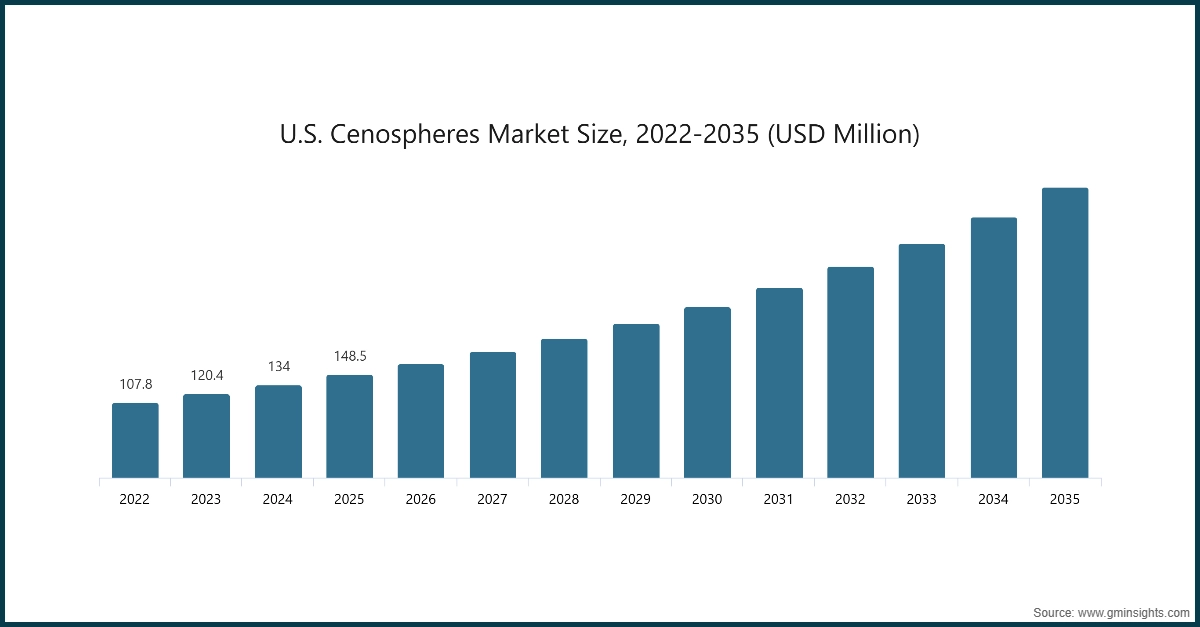
Looking for region specific data?
The market in the North America is expected to experience significant and promising growth from USD 174.8 million in 2025 to USD 494.8 million in 2035. The U.S. cenospheres market accounted for USD 148.5 million in 2025.
- The performance of lightweight materials in North America is advanced which results in the growing usage of cenospheres in construction and energy and industrial manufacturing. The region maintains its engineering application development because of its demand for durable and energy-efficient and budget-friendly solutions. The United States experiences continuous demand growth because of its increasing focus on sustainable building materials and improved drilling efficiency. The industry sectors develop their insulation systems and engineered composites and concrete mixes because they need to reduce weight while their projects demand long-term performance improvements in infrastructure and industrial applications.
The market in the Europe is expected to experience significant and promising growth from USD 148 million in 2025 to USD 421.6 million in 2035.
- European markets show strong interest in advanced eco-friendly material technologies which allow construction projects to develop lightweight materials and their use in specialty composites and high-performance coatings and other materials. The region’s regulatory focus on sustainability continues to encourage the use of low-density fillers that support energy-efficient applications. The industrial and engineering sectors of Germany use cenospheres to improve precision composites and specialty building materials. The automotive sector and high-end manufacturing processes need stable lightweight additives which help maintain performance reliability and improve operational productivity through their continuous development.
The cenospheres market in Asia Pacific is expected to experience increasing growth from USD 210.8 million in 2025 to USD 654.6 million in 2035.
- The Asia-Pacific region maintains its status as the fastest expanding area because large construction projects and manufacturing expansion and lightweight filler demand for cost-efficient production drive its development. The region uses cenospheres to create stronger materials which have lower weight and better thermal properties. The expansion of China’s industrial base and infrastructure development leads to increased cenosphere usage. The construction and manufacturing industries experience rapid growth which leads manufacturers to use cenospheres in cement products and coatings and engineered composites because they enhance product durability and cut down on material needs and boost operational efficiency.
Middle East & Africa market is expected to experience significant and promising growth from USD 30.4 million in 2025 to USD 79.8 million in 2035.
- The Middle East and Africa region produces large quantities of cocoa beans while developing more processing facilities to meet the growing demand for cocoa products from consumers. South African cocoa butter and powder usage increases because of rising demand in both the confectionery and personal care product markets. The supply chain sustainability efforts certification programs and system improvements will create market stabilization and help build export growth opportunities.
Latin America is expected to experience significant and increasing growth from USD 33.2 million in 2025 to USD 104.2 million in 2035.
- Cenosphere adoption in Latin America grows slowly because construction and energy and manufacturing industries search for lightweight additives which enhance their material performance. The industrial development in the region encourages factories to use cost-effective fillers which provide durability while decreasing their production expenses. The demand for cenospheres in Brazil grows because the country develops its infrastructure and oil industry operations which uses cenospheres for material optimization and drilling formulae. The increasing adoption of concrete and coatings and polymer systems drives the industry to improve its product efficiency while establishing operational reliability.
Cenospheres Market Share
- Cenospheres industries are moderately consolidated with players like Ashtech, Reslab Microfiller, Wolkem, LKAB Minerals and BPN International holding 29% market share and Barry Callebaut being the market leader holding the market share of 9% in 2025.|
- The market players who sell cenospheres enhance their market position through their commitment to maintaining product excellence which includes the achievement of particle size consistency and material purity and product performance stability. The companies work to improve their extraction and separation procedures which helps them deliver steady supply chains and reliable material properties for clients who need materials for construction work and composite production and energy applications.
- Companies distinguish from their competitors because of the ability to create specialized grades which match particular industrial requirements serves as a critical element.
- Cost efficiency also plays a central role in competitive strategy. Leading companies maintain their product prices by enhancing their sourcing procedures and production processes and recovery system activities which they use to handle their raw material price fluctuations. The company establishes its bidding advantage for major industrial contracts through its ability to deliver dependable pricing and effective logistics and steady supply of products.
- Processing technology innovations enable companies to maintain their position as market leaders. The companies that invest in surface modification techniques, improved drying systems, and value-added functionalization create products which perform better in demanding composite and high-temperature applications. The company uses its technical advantages to approach premium market customers who value performance over cost concerns.
- The company establishes a strong competitive position through its customer support services and its technical assistance programs and its worldwide distribution system. Customers develop stronger loyalty to the business which provides formulation optimization and material problem resolution and product development support for new product lines that use cenospheres. The companies which operate in emerging markets acquire additional benefits through their strong product presence because they can meet regional market needs without delay.
Cenospheres Market Companies
Major players operating in the cenospheres industry are:
- Ashtech
- BPN International
- China Beihai Fiberglass
- Frilite
- Kulin Corporation
- LKAB Minerals
- Microspheres South Africa
- N.K.Coatchem
- Reslab Microfiller
- Wolkem
- Xingtai Kehui Trading
Ashtech operates advanced processing facilities, secures long‑term sourcing arrangements with power stations, and maintains strong quality‑control systems to ensure consistent particle characteristics. The product range of Ashtech provides solutions for multiple industries which include drilling, paints, refractories, polymers, and construction materials. The company operates advanced processing facilities, secures long‑term sourcing arrangements with power stations, and maintains strong quality‑control systems to ensure consistent particle characteristics.
Reslab Microfiller is an Australian company which specializes in lightweight fillers that include natural cenospheres and man‑made microspheres. The company started its cenosphere refining operations during the 1990s while expanding its global reach to meet the rising demand for light insulating fillers. The Cenolite microspheres which Reslab supplies to various industries demonstrate its dedication to creating low-weight fillers which provide energy-efficient sustainable products for construction projects and coatings and engineered products.
Wolkem functions as a diversified minerals group which started its operations in 1972 by establishing mining operations and using the mine-to-market system which controls all production stages from extraction to final delivery. The company Wolkem offers a complete range of industrial minerals which includes cenospheres together with its well-known products for wollastonite and calcite. The company Wolkem operates in multiple countries to serve customers from more than 20 industries by using its geological expertise and advanced processing facilities and extensive mineral reserves to deliver industrial minerals of superior quality throughout the world.
LKAB mining company operates as its industrial minerals division. The company operates more than 30 mineral products which it delivers to global customers who operate in construction and agriculture and polymers and coatings as well as engineered systems. The company provides sustainable products which include functional fillers and thermal and refractory products and specialty minerals that have been developed to offer durability and high performance. LKAB Minerals operates in multiple countries which enables the company to achieve effective upstream integration through its extensive mineral processing experience and operational presence in various locations.
BPN International imports aluminosilicate cenospheres which are produced through the combustion of coal at extremely high temperatures. The company provides cenospheres for composite materials and insulation products and lightweight concrete and other industrial applications which require low density combined with strength and thermal stability. The company establishes its capacity to supply construction and composite manufacturing and materials engineering markets through its quality control system which monitors chemical composition and particle size.
Cenospheres Market Report Attributes
| Key Takeaway | Details |
|---|---|
| Market Size & Growth | |
| Base Year | 2025 |
| Market Size in 2025 | USD 597 Million |
| Market Size in 2026 | USD 662.7 Million |
| Forecast Period 2026-2035 CAGR | 11.4% |
| Market Size in 2035 | USD 1.8 Billion |
| Key Market Trends | |
| Drivers | Impact |
| Rising demand for lightweight materials | Industries such as automotive, aerospace, and construction increasingly prioritize materials that offer strength without adding weight. Cenospheres, being ultra light and structurally stable, help manufacturers reduce overall product weight while improving durability and fuel/energy efficiency. |
| Expanding use in composites and polymers | The integration of cenospheres into composites, plastics, and rubber formulations is growing due to their ability to enhance thermal resistance, reduce resin usage, and improve mechanical properties. This makes them an attractive additive for paints, coatings, insulation materials, and engineered plastics. |
| Increasing focus on sustainability and circular utilization | Cenospheres are industrial by products recovered from fly ash, aligning with global waste reduction and resource optimization initiatives. As industries adopt circular economy practices, the push toward repurposing waste materials directly supports demand for cenospheres |
| Pitfalls & Challenges | Impact |
| Limited and inconsistent raw material supply | Cenospheres are naturally formed during coal combustion, making their availability dependent on thermal power plant operations. Variations in coal quality and reduced global coal dependence can lead to supply instability and inconsistent particle quality. |
| High processing and extraction challenges | Efficient extraction of cenospheres requires advanced separation techniques. High operational costs, technical complexity, and the need for specialized equipment can restrict production scalability and limit access for smaller manufacturers. |
| Opportunities: | Impact |
| Growth in advanced manufacturing and additive technologies | As sectors like 3D printing, high-performance composites, and engineered ceramics expand, cenospheres offer opportunities due to their unique thermal stability, strength, and compatibility with polymer and metal matrices. |
| Emerging applications in construction and infrastructure | From lightweight concrete and geopolymers to fire-resistant coatings and insulation panels, expanding global infrastructure development opens new avenues for cenosphere-based materials, especially where energy efficiency and durability are priorities. |
| Increasing adoption in oil & gas and energy sectors | Cenospheres offer performance benefits in drilling fluids, cementing operations, and insulation systems. As energy industries focus on safer, more efficient drilling and well-completion practices, the demand for high-performance additives like cenospheres is expected to grow. |
| Market Leaders (2025) | |
| Market Leader |
Market share 9% |
| Top Players |
Collective market share of 29% in 2025 |
| Competitive Edge |
|
| Regional Insights | |
| Largest Market | Asia Pacific |
| Fastest growing market | Latin America |
| Emerging countries | Brazil, Mexico, Argentina |
| Future outlook |
|
What are the growth opportunities in this market?
Cenospheres Industry News
- In October 2025, LKAB and ABB entered a Memorandum of Understanding (MoU) to form a long‑term strategic technology partnership aimed at transforming the future of mining.
- In June 2023, Omya announced that it had acquired Bublon GmbH, a leading producer of lightweight fillers and microspheres made from closed‑cell expanded perlite, using proprietary electrically powered thermal‑expansion technology.
The cenospheres market research report includes an in-depth coverage of the industry with estimates and forecast in terms of revenue in USD Million and volume in terms of kilo tons from 2022–2035 for the following segments:
Market, By Type
- Gray cenospheres
- White cenospheres
Market, By Application
- Lightweight concrete
- Thermal insulation materials
- Drilling mud additives
- Composite reinforcements
- Others
Market, By Distribution Channel
- Construction
- Oil & gas
- Automotive
- Aerospace
- Paints & coatings
- Others
The above information is provided for the following regions and countries:
- North America
- U.S.
- Canada
- Europe
- Germany
- UK
- France
- Spain
- Italy
- Rest of Europe
- Asia Pacific
- China
- India
- Japan
- Australia
- South Korea
- Rest of Asia Pacific
- Latin America
- Brazil
- Mexico
- Argentina
- Rest of Latin America
- Middle East and Africa
- Saudi Arabia
- South Africa
- UAE
- Rest of Middle East & Africa
Frequently Asked Question(FAQ) :
What was the market size of the cenospheres in 2025?
The market size was USD 597 million in 2025, with a CAGR of 11.4% expected through 2035. Increasing demand for lightweight materials with high strength and thermal protection is driving market growth.
What is the projected value of the cenospheres market by 2035?
The market is poised to reach USD 1.8 billion by 2035, driven by advancements in processing techniques, sustainability initiatives, and rising adoption in construction and industrial applications.
What is the expected size of the cenospheres industry in 2026?
The market size is projected to reach USD 662.7 million in 2026.
What was the valuation of the gray cenospheres segment in 2025?
The gray cenospheres segment generated approximately USD 350.9 million in 2025, due to its extensive use in structural and heavy-duty applications requiring cost efficiency and mechanical strength.
What was the valuation of the lightweight concrete segment in 2025?
The lightweight concrete segment accounted for USD 203.8 million in 2025, led by its growing adoption in construction, insulation systems, and advanced composites for high-performance, low-density formulations.
What is the growth outlook for the construction sector in the market?
The construction sector, valued at USD 233.1 million in 2025, as cenospheres are increasingly used in energy-efficient building materials, lightweight concrete, and mortars to meet sustainability and performance goals.
Which region leads the cenospheres sector?
North America leads the market, with its value projected to grow from USD 174.8 million in 2025 to USD 494.8 million by 2035.
What are the upcoming trends in the cenospheres market?
Trends include better particle engineering, improved recovery methods, high-performance applications, and sustainable circular practices.
Who are the key players in the cenospheres industry?
Key players include Ashtech, BPN International, China Beihai Fiberglass, Frilite, Kulin Corporation, LKAB Minerals, Microspheres South Africa, N.K.Coatchem, Reslab Microfiller, Wolkem, and Xingtai Kehui Trading.
Cenospheres Market Scope
Related Reports