Summary
Table of Content

Cattle Rearing Equipment Market
Get a free sample of this report
Form submitted successfully!
Error submitting form. Please try again.
Thank you!
Your inquiry has been received. Our team will reach out to you with the required details via email. To ensure that you don't miss their response, kindly remember to check your spam folder as well!
Request Sectional Data
Thank you!
Your inquiry has been received. Our team will reach out to you with the required details via email. To ensure that you don't miss their response, kindly remember to check your spam folder as well!
Form submitted successfully!
Error submitting form. Please try again.
Cattle Rearing Equipment Market Size
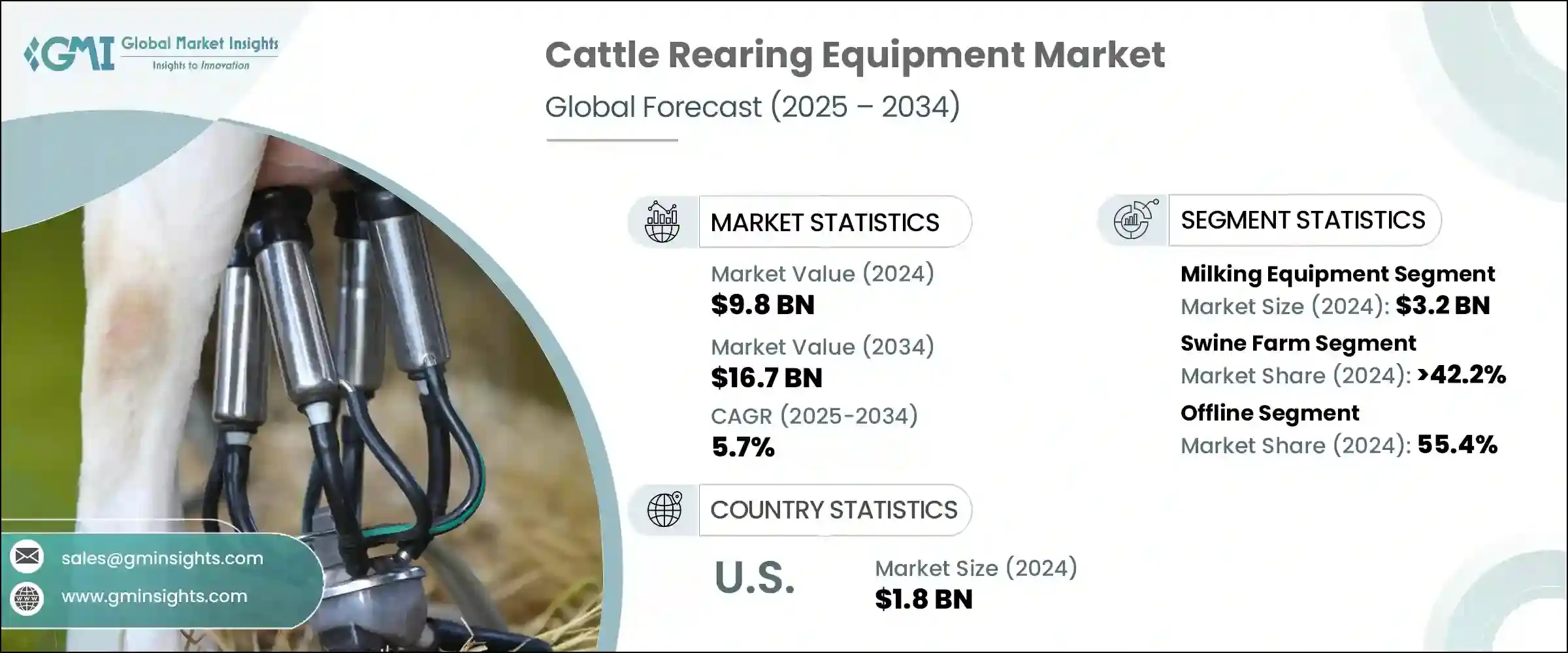
The global cattle rearing equipment market was estimated at USD 9.8 billion in 2024 and the market is expected to grow from USD 10.2 billion to USD 16.7 billion in 2034, at a CAGR of 5.7%.
Cattle Rearing Equipment Market Key Takeaways
Market Size & Growth
- 2024 Market Size: USD 9.8 Billion
- 2034 Forecast Market Size: USD 16.7 Billion
- CAGR (2025–2034): 5.7%
Key Market Drivers
- Rising global demand for dairy and meat products.
- Mechanization and automation in livestock farming.
- Focus on animal health and welfare.
Challenges
- High initial investment costs.
- Low awareness and training gaps.
Opportunity
- Rising global demand for beef and dairy.
- Smart farming adoption.
Get Market Insights & Growth Opportunities
The growing demand for dairy and meat worldwide is driving the growth of the cattle rearing equipment industry. Farms, both large and small, are working to improve efficiency, maintain animal health, and ensure consistent quality. Rising incomes and populations, especially in Asia, Latin America, and Africa, are increasing the need for milk, cheese, yogurt, beef, and other animal products. For instance, the livestock sector is a key part of Indian agriculture and plays an important role in the economy. India is one of the top two farm producers in the world. Agriculture provides about 53% of jobs in India and contributes around 17% to the GDP. The livestock sector adds 4.11% to the GDP and makes up 25.6% of the agricultural GDP. Around 20.5 million people rely on livestock for their livelihood. Livestock contributes 16% of the income for small farm households, compared to 14% for all rural households on average. It supports two-thirds of the rural population and provides jobs to about 8.8% of India’s people. Agriculture uses nearly 43% of India’s land area. Hence, the demand is pushing the livestock industry to produce more, leading to a higher need for advanced rearing equipment.
To meet this demand, farms are using automated milking systems, advanced feeding equipment, climate-controlled barns, and manure management tools. These technologies help farms grow without sacrificing cleanliness or animal care. For example, robotic milking systems and herd management tools improve milk production and cow health in dairy farming. In meat production, better feeding and housing systems help animals grow faster and healthier. Additionally, international trade in meat and dairy products is encouraging producers to follow standard practices and invest in equipment that improves quality. This ensures they meet export rules and food safety standards. As consumers prefer high-quality and nutritious animal products, equipment that provides traceability, hygiene, and efficiency is becoming more important. This trend is increasing equipment sales and driving innovation, with companies offering smarter, energy-saving, and scalable solutions. The rising demand for animal protein is a key factor supporting long-term growth in the market.
To get key market trends
Cattle Rearing Equipment Market Trends
- Automated and intelligent technologies such as robotic milking machines, sensor-based feeders, and intelligent monitoring devices for cattle breeding equipment are being taken up by farmers due to labor deficiency and increased expenses. In 2023, automatic milking systems accounted for roughly 18% of worldwide installations, which is anticipated to increase to more than 30% by 2030 at a CAGR of 8–10%. This is a tendency shared by regions such as North America and Western Europe, where labor costs are high and welfare laws for animals are stringent. Efficiency and animal comfort, together with biosecurity, are enhanced through automation. It also relates to trends such as IoT and sustainable agriculture, with quicker development anticipated from 2025 to 2030, particularly on medium and large-scale farms.
- IoT and precision agriculture are transforming cattle herd management for farmers. Farmers now have access to real-time information on animal health, fertility, feeding, and the environment. This enables them to make more informed decisions, enhance efficiency, increase productivity, decrease diseases, and conserve feed. The smart livestock farming market would reach more than USD 20 billion by 2032, with more than 12% CAGR. North America, Europe, and certain regions in Asia are leading the way, converting conventional cattle farming into precision livestock operations. The systems enhance herd health and fit into automation and sustainability trends. Deployment has already begun, with broader adoption predicted by 2027. The developments are also forging partnerships between technology and agriculture equipment firms, transforming the competitive market.
- Escalating demands for precision feeding units and sophisticated manure management are on the rise because of higher yields and more stringent environmental regulations. Some of the newer technologies include TMR mixers, robotic feeders, and slurry separators. Sales of TMR mixers are anticipated to grow at 6.5% CAGR, while manure separation systems are anticipated to grow at more than 7% CAGR by 2032. The systems maximize feed efficiency, minimize nutrient loss, and assist farms in fulfilling emissions and waste regulations. This development is all about sustainability and green policy by the government. From 2025, particularly in Europe and the Asia-Pacific region, the technologies will be inevitable with tightening environmental regulations. Firms are also incorporating intelligent sensors and green components into feeding and waste management technology.
- The Latin America and Asia-Pacific region is becoming increasingly important for the cattle rearing equipment industry, with the increasing dairy and beef farming. India, China, Brazil, and Argentina are investing in intensive cattle breeding to cover domestic as well as export markets. These areas are projected to contribute more than 45% of the world's equipment demand growth between 2025 and 2032. With increasing herd sizes, one needs equipment that can support a high volume of animals efficiently. This is aligned with the global trends towards automation and IoT-based technology. It also opens up space for equipment that is intended for local climates. The producers will have to design solutions for various landscapes, norms, and sizes of farms, with more farmers requiring mid-range and high-capacity systems.
Cattle Rearing Equipment Market Analysis
Learn more about the key segments shaping this market
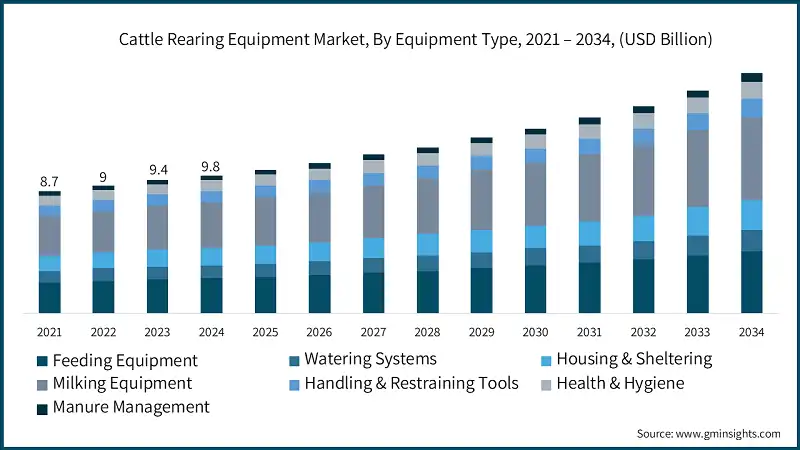
Based on equipment type, the cattle rearing equipment industry is segmented into feeding equipment, watering systems, housing & sheltering, milking equipment, handling & restraining tools, health & hygiene, and manure management. In 2024, the milking equipment segment generated a revenue of USD 3.2 billion and is expected to grow at a CAGR of around 6.2% during the forecast period.
- Dairy farming equipment is driving the cattle rearing equipment growth due to increased demand for milk products across the world and demand for greater efficiency, hygiene, and automation in the production of milk. As individuals require higher quality milk, cheese, yogurt, etc., the developed nations and emerging economies are spending large amounts on advanced dairy farm systems.
- Manual milking is exhausting, time-consuming, and typically has hygiene problems. Automated milking, along with semi-automated milking systems, on the other hand, provide faster milking, even milk production, along with better under health. This is especially suitable for large-scale dairy farms that handle hundreds or thousands of cows and need accurate equipment to provide productivity and quality.
- There is also modern technology, such as robotic milking arms, milk flow sensors to monitor, herd management computer software, and artificial intelligence computer software, that has developed milking machines into more sophisticated and cost-efficient devices. These solutions allow farmers to monitor the performance of individual cows, detect diseases before they occur, and automate herd management.
- Government subsidies in Europe and North America and dairy modernization programs are also persuading farmers to employ advanced milking machinery. Since milk is one of the key sources of revenue and nutrition, especially in the third world, milking systems represent the largest and most invested category in cattle rearing machines and drive their market dominance.
Learn more about the key segments shaping this market
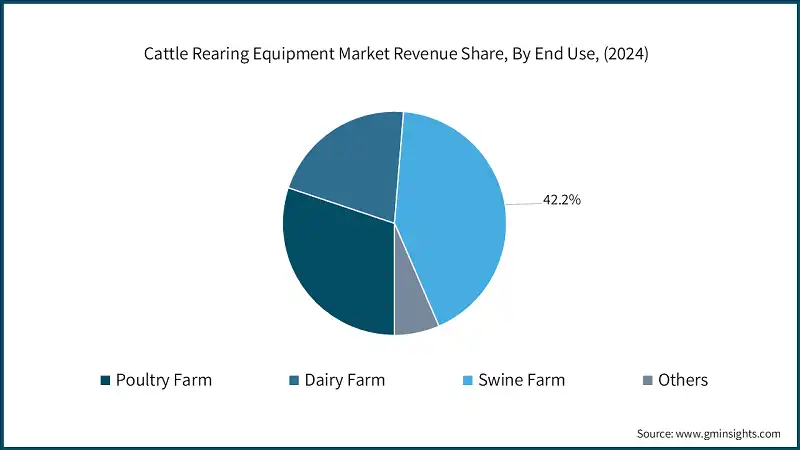
Based on the end use, the cattle rearing equipment market is for poultry farms, dairy farms, swine farms, and others. In 2024, the swine farm segment accounted for over 42.2% and is expected to grow at a rate of 6.2% till 2034.
- Swine farms are leading the expansion of the end use segment in the cattle rearing equipment industry with their increasing focus on biosecurity, productivity, and health of animals, necessitating sophisticated and specialty equipment. Though dominated so far by beef and dairy cattle farms, the pig industry has burst into prominence rapidly with automated feed, climatic housing, and waste handling technologies being utilized to support colossus-scale intensive pig farm operations.
- More widespread use of pork globally, particularly in European and Asia-Pacific countries, has prompted pig farms to produce at the cheapest possible level. Therefore, investment in precision rearing technology such as health monitoring equipment, temperature-controlled pens, and automatic feeders has been on the rise. Pig farms are also being subjected to greater regulatory pressure to enhance hygiene and reduce the environmental impacts of manure, thereby driving demand for high-end hygiene and manure equipment.
- Secondly, the aggressive expansion of commercial pig farms, such as high-density animal operations, aggressive advancement in feed efficiency, or disease control, can be highly impactful in terms of profitability. This makes it a cakewalk for farmers to invest in smart tech and high-performance buildings, thus making swine farms highly significant contributors to market growth in the overall livestock equipment market. Their aggressive drive towards upscaling and modernization makes them highly significant drivers of end use segment growth.
Based on the distribution channel, the cattle rearing equipment market is segmented into online and offline. The offline segment is expected to hold a major share of 55.4% in 2024.
- Offline channels remain the most preferred channels in the market. Offline channels are the most preferred as the products are specialty goods, require physical observation, and have settled dealer and distributor networks in agricultural and rural societies. Farmers and livestock producers usually buy equipment like milking equipment, feed systems, and handling equipment from farm cooperatives, farm supply stores, or dealers. These stores provide demos, after-sales support, and in-home fitting. Since most of these items are bulky and intricate, offline channels enable on-site support, easier customization choices, and easier leasing or financing. In developing nations, poor internet connections and low digital literacy among rural farmers make offline channels the most convenient and easiest to shop at. For mass buyers, offline buying also has advantages such as bulk pricing, warranty assurance, and package services, making it the first of these.
Looking for region specific data?
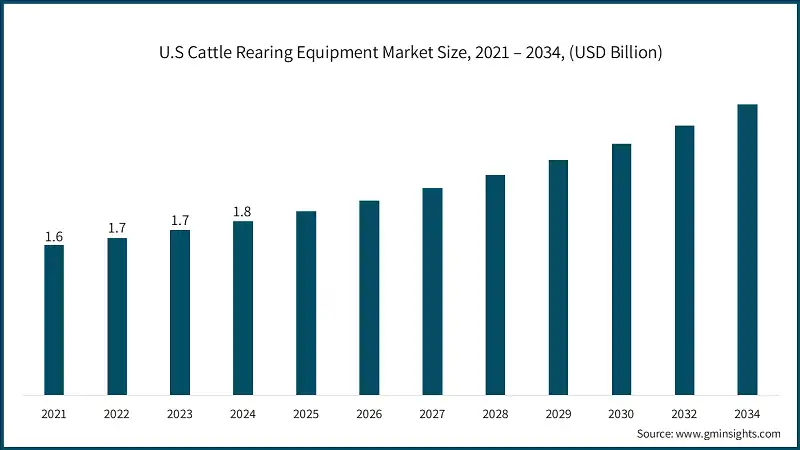
In 2024, the U.S dominated the cattle rearing equipment market, accounting for around 56.5% of the North America market share and generating around USD 1.8 billion in revenue in the same year.
- The United States dominates the cattle rearing machinery market in North America because it has a technologically sophisticated livestock industry, primarily dairy farming and beef rearing. Some of the states with commercial farms with massive capacity are Wisconsin, Texas, and California, which require advanced milking equipment, feed automation, handling equipment, and waste disposal. The nation boasts good farm infrastructure, simple access to financing, and subsidies and grants from the government to support dairy modernization. The U.S. also rapidly embraces new technology, such as robot milking and Internet of Things-based monitoring and therefore is a crucial market for advanced technologies in the region.
The European market in Germany is expected to experience significant and promising growth from 2025 to 2034.
- Germany is the front runner in Europe's cattle rearing equipment industry because of its robust dairy and livestock industry, stringent animal welfare regulations, and technical development. German farms feature automated milking machines, slurry management equipment, and advanced livestock housing. The nation also hosts large equipment manufacturers such as GEA Group, which focuses on exports and innovation. Germany's emphasis on eco-friendly protection, sustainable agriculture, and enhancing productivity ensures continuous investment in advanced equipment for large and medium-scale farms.
The APAC market in China is expected to experience significant and promising growth with a 6.5% CAGR from 2025 to 2034.
- China leads the Asia Pacific cattle farming equipment market with its expanding dairy sector, government policies towards high-technology farming, and increasing demand for quality milk and beef. The government encourages large-scale, high-technology farms to boost productivity as well as food safety. This has raised the application of automated milking systems, feed handling systems, and hygiene systems. Local production enables equipment to be produced at cheaper costs, making it within the reach of farms. China's emphasis on rural agriculture, food security, and sustainability is stimulating investment in advanced livestock equipment.
The MEA cattle rearing equipment market in the UAE is expected to experience significant and promising growth from 2025 to 2034.
- The UAE leads the MEA cattle rearing machinery market by investing in food security, agriculture technology, and desert agriculture. The government and private sector have invested in dairy farms that are climate-controlled, feeding systems that are computerized, as well as cattle houses that are water-efficient despite the unsuitability of the natural environment for cattle farming. Examples of such projects are Al Ain Farms, where equipment is used to enhance production in suboptimal conditions. The UAE, with its emphasis on cutback of imports, organic farming, and hi-tech farming, has emerged as an example of a contemporary cattle-rearing model in deserts.
Cattle Rearing Equipment Market Share
DeLaval International AB, GEA Group AG, Afimilk Ltd, BouMatic LLC, and AGCO Corporation holding 25-30% market share, indicating the moderate concentration as they have a strategic focus on innovation, integrated solutions, and global reach. These market champions capture the market space thanks to cutting-edge automation technology in the form of robotic milking systems, sensor-based herd monitoring systems, and precision feeding equipment that led to farm efficiency, animal health, and milk production.
Afimilk and DeLaval stand apart from each other specifically through their data-driven smart farming systems, while BouMatic and GEA specialize in full life-cycle dairy management systems. They derive their competitive advantage through end-to-end equipment supply—from the house and feeding through to milking and manure removal—and allow farmers to maximize operations through a one-source avenue. Worldwide distribution networks, quality after-sales services, and recognized brand names also contribute to their market presence. Continued investment in R&D keeps these companies at the forefront of sustainability and animal welfare technology, delivering solutions for biosecurity, hygiene, and efficiency in the use of resources. Strategic acquisitions and partnerships also strengthen their geography and technical capabilities, so that they are well-positioned to serve advanced as well as emerging markets.
The companies involved in cattle-rearing machinery deal with an extremely broad selection of products across a number of functional categories. Afimilk Ltd exports milking machines with state-of-the-art technology, animal health monitoring systems, and automatic feeding solutions for total dairy management. AGCO provides combined livestock solutions, including feeding machinery, manure management systems, and housing structures, typically through its brands like GSI. Bob-White Systems offers portable milking machines, portable health equipment delivered to the door, and hygiene-focused accessories to small and medium-sized dairies. BouMatic LLC supplies high-production milking parlors, cooling, and post-milking hygiene equipment for large dairy farms.
Case IH, a global leader in ag machinery, supplies cattle operations with feeding equipment, bale processors, tractors, and attachment-powered manure management equipment. DeLaval International AB offers the entire spectrum of dairy solutions from robot milking systems, feeders, and manure equipment to animal hygiene solutions. FarmTek supplies housing and sheltering units, climatic control units, feeding and watering stations, and health care products with applications for small and large farms. GEA Group AG also supplies milking automation integrated solutions, precision feeding, and slurry handling systems with a focus on high energy efficiency and digitization.
Jaylor Fabricating Inc. markets Total Mixed Ration (TMR) mixers, which are required for feeding optimization, and markets composters to utilize manure. Lely Holding S.A.R.L. dominates robot milking with automated milking systems (e.g., Lely Astronaut), feeding robots (Lely Vector), and manure scraping systems, all of which facilitate full-farm automation. Murray Farm Care Ltd. sells a range of veterinary and health & hygiene products, such as hoof care treatments and disinfectants, as well as cattle handling gear. Pearson International LLC restrains and handles gear-squeezing squeezing chutes and headgates for veterinary examination and cattle control.
Priefert Manufacturing Co., Inc. is an established American firm that produces cattle handling equipment, including chutes, panels, feeders, and portable shelters, primarily for ranchers and feedlots. Real Tuff Livestock Equipment also offers tough, durable handling systems, feeding equipment, and open range fencing panels for stock operations. Lastly, Royal Livestock Farms mainly supply basic cattle sheltering, feeding installation, and overall sanitation equipment, typically fitting local or farm-scale requirements and less industrial automation.
Cattle Rearing Equipment Market Companies
Major players operating in the cattle rearing equipment industry are:
- Afimilk Ltd
- AGCO
- Bob-White Systems
- BouMatic LLC
- Case IH
- DeLaval International AB
- FarmTek
- GEA Group AG
- Jaylor Fabricating Inc.
- Lely Holding S.A.R.L.
- Murray Farm Care Ltd.
- Pearson International LLC
- Priefert Manufacturing Co., Inc.
- Real Tuff Livestock Equipment
- Royal Livestock Farms
Cattle Rearing Equipment Market Report Attributes
| Key Takeaway | Details |
|---|---|
| Market Size & Growth | |
| Base Year | 2024 |
| Market Size in 2024 | USD 9.8 Billion |
| Forecast Period 2025 - 2034 CAGR | 5.7% |
| Market Size in 2034 | USD 16.7 Billion |
| Key Market Trends | |
| Drivers | Impact |
| Rising global demand for dairy and meat products | It drives investment in efficient and scalable cattle breeding solutions to accommodate consumption levels. |
| Mechanization and automation in livestock farming | It drives the use of best-of-breed equipment to increase productivity, minimize labor, and provide consistency. |
| Focus on animal health and welfare | Provokes the adoption of professional equipment that allows ease of hygiene, comfort, and monitoring of cattle well-being. |
| Pitfalls & Challenges | Impact |
| High initial investment costs | Discourages adoption of advanced equipment, particularly for small- and medium-scale cattle producers. |
| Low awareness and training gaps | Hinders optimal equipment utilization, lowering potential productivity and animal welfare gains. |
| Opportunities: | Impact |
| Rising global demand for beef and dairy | Increased global demand for milk and beef is driving investment in advanced feeding, milking, and health-monitoring gear. |
| Smart farming adoption | Cattle performance is maximized with wearables, intelligent feeders, and IoT-based health sensors. |
| Market Leaders (2024) | |
| Market Leader |
|
| Top Players |
Collective market share in 2024 is 24.5% |
| Competitive Edge |
|
| Regional Insights | |
| Largest Market | North America |
| Fastest growing market | Asia Pacific |
| Emerging countries | China, India, South Korea |
| Future outlook |
|
What are the growth opportunities in this market?
Cattle Rearing Equipment Industry News
- In January 2025, Supreme International, a leader in livestock feeding equipment, is launching two new products to expand its Generation 3 line of total mixed ration (TMR) processors. The Gen3 Medium Truck Mount and Gen3 Stationary Mixer are equipped with groundbreaking new features to meet the needs of all livestock operations.
- In November 2024, AgriEID launched an all-in-one Bluetooth-based livestock management solution. The technology that merges digital cattle weighing with electronic identification (EID) NLIS readers into a single uninterrupted, mobile-activated solution changes the way farm herds are managed. The system is the first to be completely operated by a smartphone application on both Apple and Android platforms, rendering hardware that is time-consuming to handle and antiquated controllers a thing of the past.
- In April 2024, Agri IoT Ltd, a holding company dedicated to agri-tech innovations, acquired Moonsyst through a buyout, which invested further funding and augmented the company's management, enabling it to grow further and globally.
- In 2023, Faromatics (Spain) utilizes robotics, artificial intelligence and big data to improve farm productivity and animal welfare at the same time in intensive animal farming. Its signature product, the ChickenBoy, is the globe's first ceiling-suspended robot employed to detect ambient conditions, equipment operation and health and welfare in broiler chickens.
The cattle rearing equipment market research report includes in-depth coverage of the industry with estimates & forecasts in terms of revenue ($ Mn/Bn) and shipment (Units) from 2021 to 2034, for the following segments:
Market, By Equipment Type
- Feeding equipment
- Automatic feeders
- Silage cutters and mixers
- Troughs and hay racks
- Watering systems
- Automatic waterers
- Water troughs
- Pipelines and pumps
- Housing & sheltering
- Cow sheds
- Ventilation systems
- Cooling/heating systems
- Milking equipment
- Milking machines (manual or automated)
- Milk storage tanks
- Teat cleaning devices
- Handling & restraining tools
- Cattle crushes/chutes
- Head gates
- Loading ramps
- Scales for weighing
- Health & hygiene
- Disinfection units
- Hoof trimming stands
- Vaccination and tagging tools
- Manure management
- Scrapers
- Slurry pumps
- Composters or manure spreaders
Market, By Farm Size
- Small-scale farms
- Medium-scale farms
- Large-scale farms
Market, By Application
- Dairy cattle farming
- Beef cattle farming
- Breeding operations
Market, By End Use
- Poultry farm
- Dairy farm
- Swine farm
- Others
Market, By Distribution Channel
- Online
- Offline
The above information is provided for the following regions:
- North America
- U.S.
- Canada
- Europe
- UK
- Germany
- France
- Italy
- Spain
- Russia
- Asia Pacific
- China
- India
- Japan
- Australia
- South Korea
- Latin America
- Brazil
- Mexico
- MEA
- UAE
- South Africa
- Saudi Arabia
Frequently Asked Question(FAQ) :
What is the market size of the cattle rearing equipment in 2024?
The market size was USD 9.8 billion in 2024, with a CAGR of 5.7% expected through 2034 driven by rising global demand for dairy and meat products and the need for modern, efficient livestock solutions.
What is the projected value of the cattle rearing equipment market by 2034?
The cattle rearing equipment industry is expected to reach USD 16.7 billion by 2034, driven by automation in dairy farming, focus on animal welfare, and adoption of smart farming practices.
How much revenue did the milking equipment segment generate in 2024?
Milking equipment generated USD 3.2 billion in 2024.
What was the valuation of the swine farm end-use segment in 2024?
Swine farms held 42.2% market share in 2024, supported by increased investments in health monitoring, hygiene, and automated feeding systems.
Which region leads the cattle rearing equipment market?
North America led the market in 2024 with USD 1.8 billion in revenue. Growth is driven by advanced automation, robotic milking systems, and smart herd management technologies.
What are the upcoming trends in the cattle rearing equipment industry?
Key trends include IoT-based herd monitoring, robotic milking, precision feeding systems, and manure management technologies aligned with sustainability and regulatory compliance.
Who are the key players in the cattle rearing equipment market?
Key players include DeLaval International AB, GEA Group AG, Afimilk Ltd, BouMatic LLC, AGCO Corporation, Lely Holding S.A.R.L., FarmTek, Case IH, Jaylor Fabricating Inc., and Priefert Manufacturing Co., Inc.
Cattle Rearing Equipment Market Scope
Related Reports