Summary
Table of Content

Cast Resin Transformer Market
Get a free sample of this report
Form submitted successfully!
Error submitting form. Please try again.
Thank you!
Your inquiry has been received. Our team will reach out to you with the required details via email. To ensure that you don't miss their response, kindly remember to check your spam folder as well!
Request Sectional Data
Thank you!
Your inquiry has been received. Our team will reach out to you with the required details via email. To ensure that you don't miss their response, kindly remember to check your spam folder as well!
Form submitted successfully!
Error submitting form. Please try again.
Cast Resin Transformer Market Size
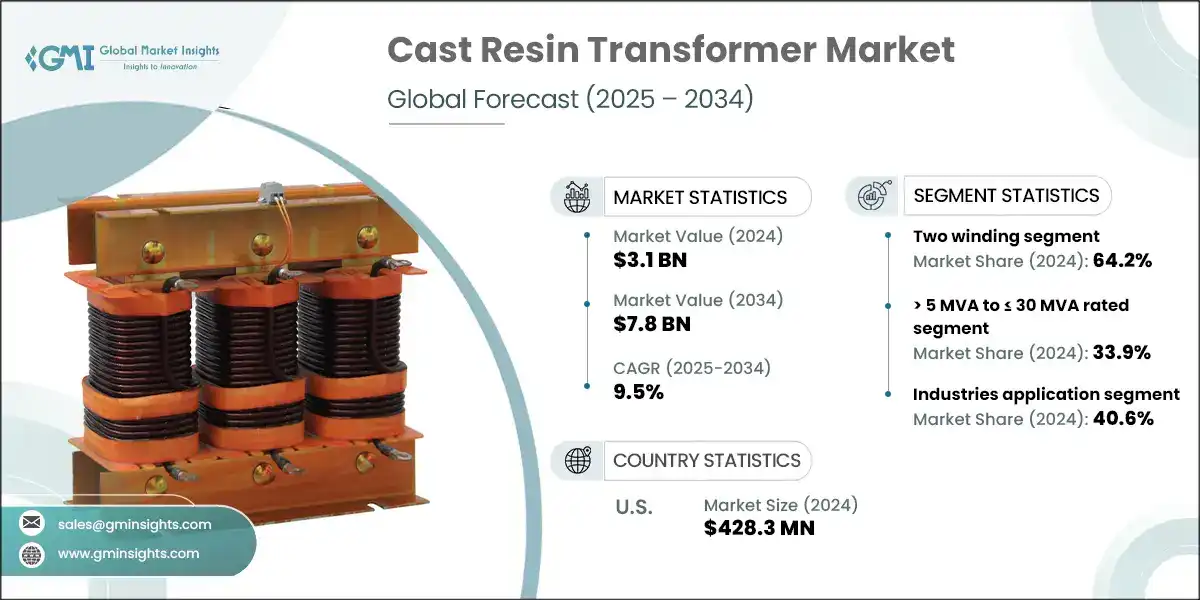
The global cast resin transformer market was estimated at USD 3.1 billion in 2024. The market is expected to grow from USD 3.4 billion in 2025 to USD 7.8 billion in 2034, at a CAGR of 9.5%.
To get key market trends
- Rising adoption of renewable energy sources, driven by global sustainability goals and decarbonization efforts. Government incentives for green energy projects further accelerate market expansion by encouraging infrastructure upgrades and the deployment of cast resin transformers in solar and wind installations.
- Urbanization and smart city development are increasing the need for compact, safe transformers. Infrastructure upgrades in aging power grids support the adoption of cast resin transformers due to their reliability, low maintenance, and suitability for modern urban environments.
- Electrification of rural and remote areas, supported by national development programs, is boosting demand for durable transformers. Eco-friendly transformer designs are preferred for minimizing environmental impact and complying with global emission reduction standards.
- For reference, in 2025, the U.S. Department of Energy unveiled a USD 1.5 billion investment aimed at upgrading the national power grid. Focused on key transmission initiatives, the program seeks to improve grid reliability, integrate renewable energy sources, and lower consumer costs. This move marks a strategic commitment to building a more resilient, efficient, and future-ready energy infrastructure across the United States.
- The cast resin transformer market was valued at USD 2.1 billion in 2021 and grew at a CAGR of 9.5% through 2024. The business outlook will be shaped by grid modernization efforts, rising electricity demand, and the growing integration of renewable energy sources.
- Expansion of electric vehicle (EV) charging infrastructure, driven by the shift to clean mobility, requires reliable power distribution systems. Pad-mounted transformer designs offer easy installation and are ideal for roadside and urban applications, supporting rapid deployment.
- For instance, in 2025, the National Renewable Energy Laboratory (NREL) and the National Infrastructure Advisory Council (NIAC) highlighted a critical shortage of electric transformers in the U.S., driven by aging infrastructure, rising electricity demand, and extreme weather events. With lead times for new transformers stretching up to three years, this bottleneck threatens grid reliability and delays modernization efforts.
- Industrial automation and digitization are increasing the need for stable and uninterrupted power supply. Advanced insulation materials in cast resin transformers ensure safety and performance in harsh industrial environments, making them ideal for automated facilities.
Cast Resin Transformer Market Report Attributes
| Key Takeaway | Details |
|---|---|
| Market Size & Growth | |
| Base Year | 2024 |
| Market Size in 2024 | USD 3.1 Billion |
| Forecast Period 2025 – 2034 CAGR | 9.5% |
| Market Size in 2034 | USD 7.8 Billion |
| Key Market Trends | |
| Drivers | Impact |
| Refurbishment demand for existing grid infrastructure | Aging electrical networks are driving the need for modern, efficient transformer replacements to enhance reliability and extend asset life |
| Growing deployment of renewable energy | The integration of solar and wind power requires flexible, low-loss transformers to manage variable loads and decentralized generation |
| Increasing demand for electricity | Rising urbanization and industrial activity are fueling the need for robust power distribution systems, boosting demand for cast resin transformers |
| Pitfalls & Challenges | Impact |
| High initial cost | Cast resin transformers typically involve greater upfront investment due to specialized materials, manufacturing processes, and advanced insulation technologies, though they offer long-term savings through reduced maintenance and enhanced safety |
| Opportunities: | Impact |
| Refurbishment demand for existing grid infrastructure | Upgrading aging grid assets presents a major opportunity for deploying modern, low-maintenance cast resin transformers |
| Growing deployment of renewable energy | The rise of solar and wind installations creates demand for dry-type transformers that can operate safely in environmentally sensitive areas |
| Increasing demand for electricity | Expanding urbanization and industrialization are driving the need for reliable and scalable transformer solutions in power distribution networks |
| Market Leaders (2024) | |
| Market Leaders |
14.6% market share |
| Top Players |
Collective market share in 2024 is 44% |
| Competitive Edge |
|
| Regional Insights | |
| Largest Market | U.S. |
| Fastest Growing Market | Canada |
| Emerging Country | Canada |
| Future outlook |
|
What are the growth opportunities in this market?
Cast Resin Transformer Market Trends
- The aging electrical infrastructure is increasingly being pushed beyond its original design limits, leading to reliability concerns. To address this, utilities are focusing on modernizing grid networks by integrating advanced technologies, smart equipment, and automated controls. These upgrades aim to create more intelligent and resilient systems capable of handling growing energy demands and adapting to dynamic grid conditions.
- These transformers improve communication between components and improve system responsiveness, these modern units significantly enhance electricity delivery. They help reduce the frequency and duration of outages, accelerate service restoration, and minimize the impact of extreme weather events. This transformation not only strengthens grid performance but also improves customer satisfaction and operational efficiency across the power distribution landscape.
- Growth in offshore wind energy projects, driven by global renewable targets, demands corrosion-resistant and compact transformers. Vacuum casting innovations enhance product durability and reduce failure rates in marine and coastal installations. These transformers ensure consistent performance in high-humidity and salt-laden environments. Their reliability and low maintenance requirements make them ideal for long-term deployment in offshore energy infrastructure.
- For illustration, in 2024, the Biden Administration unveiled a USD 3.5 billion initiative aimed at upgrading and modernizing the aging U.S. electric grid. Backed by the Bipartisan Infrastructure Law, the program funds 58 strategic projects across 44 states, including the deployment of 400 microgrids and enhancements to interregional transmission system.
- Cast resin transformers are increasingly vital in high-speed rail and metro infrastructure due to their compact size and fire-resistant properties. These transformers are ideal for underground and enclosed environments, where safety and space efficiency are critical.
- These cast resin units offer reliable performance with minimal maintenance, supporting uninterrupted power supply for urban transport systems. Their robust design ensures resilience under fluctuating loads and demanding operational conditions.
- In commercial and institutional buildings, cast resin transformers are preferred for their fire-resistant properties and silent operation. Their compact design allows easy integration into confined indoor spaces like basements or utility rooms. These transformers ensure safe and efficient power distribution in environments such as hospitals, schools, and shopping malls, where safety, reliability, and low noise levels are critical.
- For instance, in 2025, Eaton announced a USD 340 million investment to build its transformer manufacturing facility in Jonesville, South Carolina. The plant will focus on producing three-phase transformers to help alleviate the ongoing supply shortage and meet growing demand from utilities, data centers, and industrial sectors.
- These transformers are ideal for renewable energy installations such as solar farms and wind parks. Their ability to withstand fluctuating environmental conditions, including temperature and humidity, makes them a reliable choice for outdoor and remote applications. With minimal maintenance and high efficiency, they support uninterrupted energy flow, aligning with global sustainability goals and ensuring long-term performance in clean energy infrastructure.
- Smart grid initiatives, focused on upgrading traditional power distribution systems, are revolutionizing energy infrastructure. The integration of IoT in cast resin transformers enables real-time monitoring, predictive maintenance, and data-driven decision-making, significantly improving grid reliability and operational efficiency. These intelligent systems also support dynamic load management and faster fault detection, ensuring consistent power delivery even under fluctuating demand conditions.
- Furthermore, refurbishment of existing grid systems, driven by aging infrastructure, creates opportunities for dry-type transformer deployment. Precision coil winding technologies improve energy efficiency and reduce losses, supporting long-term grid sustainability.
- For instance, in 2024, Iberdrola announced a USD 20 billion investment plan for the U.S., set to run through 2030, aimed at upgrading and expanding the country’s grid infrastructure. The initiative focuses on modernizing transmission and distribution systems to meet growing electricity demand and accelerate the shift toward cleaner, more sustainable energy sources.
Cast Resin Transformer Market Analysis
Learn more about the key segments shaping this market
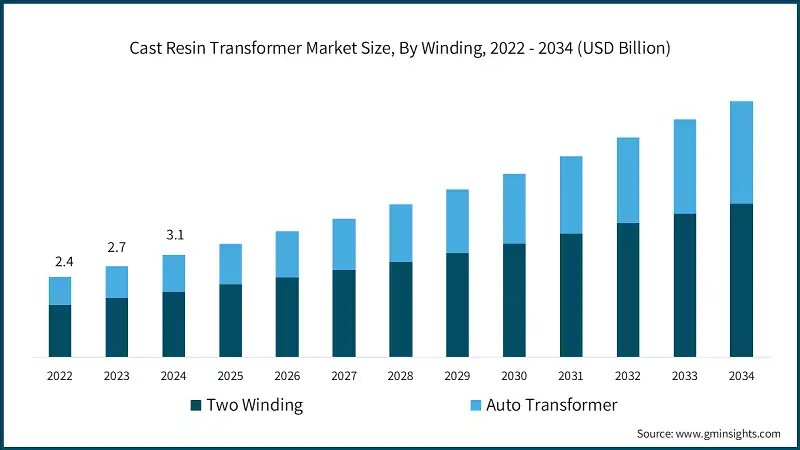
- Based on winding, the industry is segmented into two winding and auto transformer. The two winding cast resin transformer segment dominated the market accounting for 64.2% share in 2024 and is expected to grow at a CAGR of 8.7% through 2034.
- The two winding cast resin transformer market is experiencing robust growth, driven by the increasing demand for energy-efficient electrical solutions across industrial, commercial, and infrastructure sectors. These transformers offer superior insulation, reduced maintenance, and enhanced safety compared to oil-filled alternatives.
- The auto transformer market will grow at a CAGR of 10.7% till 2034. These transformers are poised for significant growth, largely due to their superior operational flexibility and efficient voltage transformation capabilities, which set them apart from conventional transformer types. Their cost-effectiveness, compact footprint, and higher energy efficiency make it an attractive solution across various applications.
- For instance, in 2023, the Government of Canada committed nearly USD 4 million to support the growth of Rex Power Magnetics, a transformer manufacturer based in Southern Ontario. The investment, aimed at expanding production capacity and strengthening the local supply chain, includes the development of new facilities and the creation of skilled jobs. This initiative aligns with Canada’s broader goals of promoting energy-efficient manufacturing and enhancing the resilience of its clean energy infrastructure.
- Based on rating, the industry is segmented into ≤ 5 MVA, > 5 MVA to ≤ 30 MVA and > 30 MVA. The ≤ 5 MVA had a market share of 54.3% in 2024 and is expected to grow at a CAGR of 8.7% from 2025 to 2034.
- The ≤ 5 MVA cast resin transformer segment is gaining traction owing to its suitability for low-voltage distribution in commercial, institutional, and residential applications. These transformers are widely used in schools, hospitals, small businesses, and urban substations where compact design, fire safety, and low maintenance are critical.
- The > 5 MVA to ≤ 30 MVA rated cast resin transformer had a market share of 33.9% in 2024 growing with 9.8% CAGR through 2034. They cater to medium to high power applications across industrial facilities, renewable energy installations, and utility substations. They offer balance between capacity, safety, and operational efficiency, making it suitable for both indoor and outdoor environments.
- For instance, in 2025, the U.S. power grid faced a critical juncture as proposed reductions in federal energy tax credits raised concerns about its ability to modernize and expand. These incentives play a vital role in supporting domestic production of essential components like transformers and inverters, which are key to meeting rising electricity demand and enhancing grid resilience against climate-related challenges.
Learn more about the key segments shaping this market
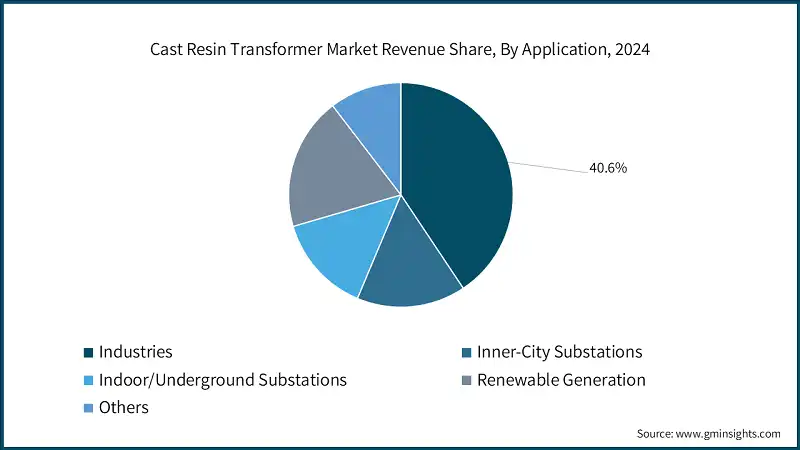
- Based on application, the industry is segmented into industries, inner-city substations, indoor/underground substations, renewable generation and others. The industries application had a market share of 40.6% in 2024 and is expected to grow at a CAGR of 8.7% from 2025 to 2034.
- These transformers are widely used in manufacturing plants, chemical facilities, mining operations, and process industries due to their high reliability, low maintenance, and fire-resistant design. Their dry-type construction eliminates the need for oil, making them safer and more environmentally friendly for indoor and hazardous environments.
- The inner-city substations application had a market share of 15.7% in 2024 with 9.4% CAGR till 2034. These transformers are ideal for densely populated urban areas where space is limited, and safety is paramount. Their dry-type construction eliminates the need for oil, reducing fire hazards and environmental risks, making them compliant with strict urban safety regulations.
- In 2024, Canada secured a vital USD 30 million investment to bolster its infrastructure and prepare for future challenges. This funding enhances advanced testing and simulation capabilities, enabling more effective clean energy integration and improved resilience against emerging threats.
Looking for region specific data?
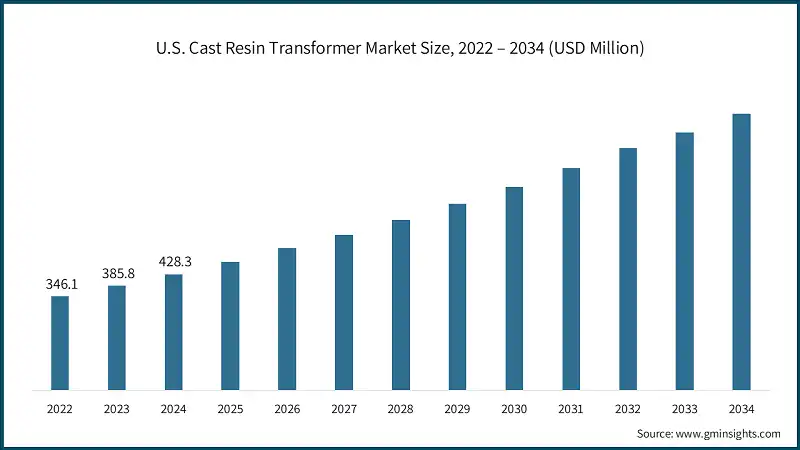
- The U.S. dominated the cast resin transformer market with a 65.1% share of North America in 2024 and generated USD 428.3 million revenue. The rising demand for cast resin transformers in the U.S. is being driven by the need to modernize aging electrical infrastructure and improve urban power reliability. The integration of dry-type transformer technologies, along with advancements in smart grid systems, will accelerate the transition toward safer, more efficient, and environmentally friendly power distribution networks, especially in densely populated and high-risk environments.
- For instance, The U.S. Department of Energy started a $3.5 billion project to improve and protect the country’s electric grid. It covers many states and focuses on replacing old equipment, making the system stronger against extreme weather, and helping more renewable energy sources connect to the grid.
- The North America cast resin transformer market was valued at USD 657.6 in 2024. Increasing investments in grid modernization and sustainable infrastructure along with supportive regulatory frameworks promoting fire-safe, eco-friendly technologies are will shape the business outlook. Incentives including tax credits, modernization grants, and clean energy mandates are fostering a favorable environment for deployment. These measures are accelerating the adoption of cast resin transformers across industrial, commercial, and utility sectors.
- The growing emphasis on sustainable energy infrastructure across Europe, driven by decarbonization goals and strict environmental regulations will shape the trajectory of the cast resin transformer market. The adoption of dry-type transformers, supported by EU-wide initiatives promoting fire safety and eco-friendly technologies, is accelerating the shift from conventional oil-filled units. These efforts are fostering investment in resilient, low-maintenance power systems that align with the continent’s long-term energy transition strategy.
- In 2025, Italy approved an updated industrial plan worth nearly USD 19.3 billion for 2024–2028 to modernize its national electricity grid and support the energy transition. The plan includes major investments in infrastructure, such as new interconnectors and digital technologies, and aims to boost grid resilience, expand renewable energy access, and strengthen Italy’s role as a Mediterranean energy hub. This move reflects the country’s commitment to a more sustainable, secure, and interconnected energy future.
- The Asia Pacific cast resin transformer market is set to reach USD 2.3 billion by 2034. Government-led initiatives promoting renewable energy and grid reliability are encouraging the adoption of these transformers. Supportive policies, infrastructure investments, and regional manufacturing capabilities are creating a favorable environment for deployment, accelerating the shift toward safer and more efficient power distribution systems.
- The Middle East cast resin transformer market was valued at USD 250.9 million in 2024. The region is gaining momentum as countries invest in modernizing their energy infrastructure and diversifying power sources. National strategies focused on smart cities, metro systems, and renewable energy are driving demand for compact, fire-safe transformers.
- Latin America cast resin transformer market had a market share of 6.9% in 2024, owing to the expansion by electrification efforts and infrastructure upgrades across urban and rural regions. Governments are prioritizing energy efficiency and safety, making dry-type transformers a preferred choice for new installations.
Cast Resin Transformer Market Share
- The top 5 companies in the market are Siemens Electric, GE Vernova, Hitachi Energy, Fuji Electric and Schneider Electric contributing around 54% of the market in 2024.
- The global cast resin transformer market demonstrates moderate market concentration, comprising a mix of internationally recognized manufacturers and specialized regional suppliers. The competitive landscape is shaped by technological advancements in insulation materials, thermal management systems, and digital monitoring capabilities tailored to diverse application needs.
- Over the past three years, the global cast resin transformer market has experienced steady growth, fueled by the increasing demand for safe, efficient, and environmentally friendly power distribution solutions. This growth has been driven by urban infrastructure expansion, renewable energy integration, and the modernization of aging grid systems.
- GE Vernova stands out as a key player in the cast resin transformer market, offering a diverse portfolio of high-efficiency solutions designed to meet the evolving demands of modern power grids. Backed by decades of engineering expertise, the company delivers durable and environmentally responsible transformer designs that support voltage stability and minimize transmission losses.
- Siemens Energy holds a strategic position in the cast resin transformer market, offering a broad portfolio of dry-type solutions engineered for energy efficiency and grid reliability. Renowned for its precision manufacturing and advanced insulation technologies, the company delivers transformers that support voltage regulation and reactive power management across complex distribution and transmission networks.
Cast Resin Transformer Market Companies
- In 2024, Siemens Energy generated USD 40.5 billion in revenue, underscoring its strong position in the global energy sector. The company reported a gross profit of USD 5.3 billion, reflecting solid performance across its diverse business portfolio. With an R&D investment of USD 1.4 billion, Siemens Energy reinforced its commitment to innovation, advancing the energy transition, and developing cutting-edge sustainable power technologies.
- In 2024, GE Vernova reported a robust performance, securing USD 44 billion in new orders and generating USD 35 billion in revenue across all business segments. The company delivered over USD 1 billion in free cash flow and further strengthened its substantial USD 119 billion backlog, driven by enhanced operational efficiency and improved margin quality.
- Fuji Electric reported net sales of USD 7.25 billion for FY 2024, reflecting a 1.8% year-over-year increase. Operating profit rose by 10.9% to USD 759 million, while ordinary profit climbed 10.1% to USD 766 million. Profit attributable to owners of the parent surged 22.4% to USD 595 million, driven by improved margins and enhanced operational efficiency across its business segments.
Major players operating in the cast resin transformer market are:
- Abaft Middle East Transformers
- AM Transformers
- Bharat Heavy Electricals Limited
- Bowers Electrical Ltd
- CG Power & Industrial Solutions
- Eaton
- Emirates Transformer and Switchgear Ltd.
- Fuji Electric Co. Ltd.
- GE Vernova
- Hitachi Energy
- Kirloskar Electric Company
- LS ELECTRIC Co., Ltd.
- Raychem RPG Private Limited
- Schneider Electric
- SGB SMIT
- Siemens Energy
- TMC Transformers
- Toshiba Energy Systems and Solutions Corporation
- URJA Techniques
- WEG
Cast Resin Transformer Industry News
- In February 2024, Siemens Energy revealed plans to invest USD 150 million in a new manufacturing facility in Charlotte, North Carolina. This initiative aims to tackle the nationwide shortage of large power transformers and related equipment. Once fully operational, the plant will produce up to 57 units annually, supporting efforts to modernize the power grid and integrate renewable energy sources.
- In April 2023, Eaton announced that they have successfully acquired stake in Jiangsu Ryan Electrical Co. Ltd., they make power distribution system and sub-transmission transformers. This strategic move enhances Eaton's global presence and strengthens its position in the energy, utility, and industrial markets .
- In January 2022, GE Vernova unveiled a new range of transformers designed to support global renewable energy efforts. Among the lineup is the GE-Mistral-14 series, featuring units rated between 275 kV and 400 kV, including two large 340 MVA power transformers. These models, such as the MBH Power variant, have been successfully deployed in multiple wind farm projects worldwide, reinforcing GE’s commitment to sustainable energy infrastructure.
- In April 2022, Siemens Energy launched CAREPOLE, its latest cast resin pole-mounted transformer, into the U.S. grid market. Engineered specifically for pole applications, CAREPOLE features single-phase units ranging from 10 kVA to 100 kVA, with operating voltages up to 36 kV. This product combines compact design with enhanced safety and efficiency, making it well-suited for modern distribution networks and rural electrification efforts.
The cast resin transformer market research report includes in-depth coverage of the industry with estimates & forecast in terms of volume (‘000 Units) and revenue (USD Million) from 2021 to 2034, for the following segments:
Market, By Winding
- Two winding
- Auto transformer
Market, By Rating
- ≤ 5 MVA
- > 5 MVA to ≤ 30 MVA
- > 30 MVA
Market, By Application
- Industries
- Inner-city substations
- Indoor/underground substations
- Renewable generation
- Others
The above information has been provided for the following regions and countries:
- North America
- U.S.
- Canada
- Mexico
- Europe
- Germany
- France
- Russia
- UK
- Italy
- Spain
- Netherlands
- Asia Pacific
- China
- Japan
- South Korea
- India
- Australia
- Middle East & Africa
- Saudi Arabia
- UAE
- South Africa
- Latin America
- Brazil
- Argentina
Frequently Asked Question(FAQ) :
Which region leads the cast resin transformer market?
U.S. held 65.1% share with 428.3 million in 2024. Aging infrastructure modernization and urban power reliability improvements drive this dominance.
What are the upcoming trends in the cast resin transformer market?
Key trends include IoT integration for real-time monitoring, smart grid initiatives, vacuum casting innovations for offshore wind projects, and advanced digital diagnostics for predictive maintenance.
Who are the key players in the cast resin transformer market?
Key players include Abaft Middle East Transformers, AM Transformers, Bharat Heavy Electricals Limited, Bowers Electrical Ltd, CG Power & Industrial Solutions, Eaton, Emirates Transformer and Switchgear Ltd., Fuji Electric Co. Ltd., GE Vernova, Hitachi Energy, Kirloskar Electric Company, LS ELECTRIC Co., Ltd., Raychem RPG Private Limited.
What is the growth outlook for auto transformer segment from 2025 to 2034?
Auto transformers are projected to grow at a 10.7% CAGR till 2034, due to superior operational flexibility, cost-effectiveness, and higher energy efficiency compared to conventional transformers.
What was the market share of the ≤ 5 MVA rating segment in 2024?
The ≤ 5 MVA segment held 54.3% market share in 2024 and is expected to grow at a CAGR of 8.7% from 2025-2034, serving commercial, institutional, and residential applications.
How much market share did the two winding cast resin transformer segment hold in 2024?
Two winding cast resin transformers dominated the market with 64.2% share in 2024 and are expected to grow at a CAGR of 8.7% through 2034.
What is the market size of the cast resin transformer in 2024?
The market size was USD 3.1 billion in 2024, with a CAGR of 9.5% expected through 2034 driven by renewable energy adoption, grid modernization efforts, and increasing electricity demand.
What is the projected value of the cast resin transformer market by 2034?
The cast resin transformer market is expected to reach USD 7.8 billion by 2034, propelled by urbanization, smart city development, and the expansion of electric vehicle charging infrastructure.
Cast Resin Transformer Market Scope
Related Reports