Summary
Table of Content

Car Sharing Market
Get a free sample of this report
Form submitted successfully!
Error submitting form. Please try again.
Thank you!
Your inquiry has been received. Our team will reach out to you with the required details via email. To ensure that you don't miss their response, kindly remember to check your spam folder as well!
Request Sectional Data
Thank you!
Your inquiry has been received. Our team will reach out to you with the required details via email. To ensure that you don't miss their response, kindly remember to check your spam folder as well!
Form submitted successfully!
Error submitting form. Please try again.
Car Sharing Market Size
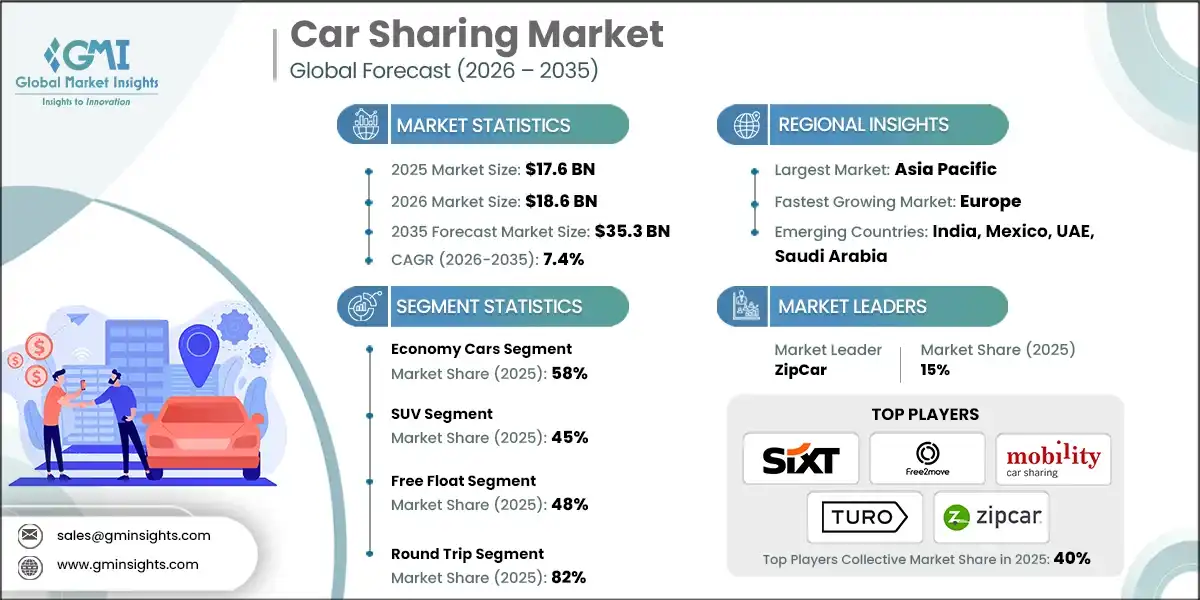
The global car sharing market was estimated at USD 17.6 billion in 2025. The market is expected to grow from USD 18.6 billion in 2026 to USD 35.3 billion in 2035, at a CAGR of 7.4% according to latest report published by Global Market Insights Inc.
To get key market trends
The fast urbanization is exacerbating traffic jams, parking and commuting ineffectiveness in most urban centers across the world. Car sharing provides an alternative approach to owning your cars in such a way that it will be maximized and the time wasted will be minimized. City assistance in alleviating congestion also expedites implementation particularly in the congested metropolitan areas that have poor road and parking networks.
Companies operating in the market are engaged in various inorganic growth strategies such as new product launches, mergers & acquisitions, and partnerships, to stay competitive in the market. For example, in May 2025, Zoomcar collaborated with Weg, in a move to provide seamless access to self-drive cars to visitors in India. This will enable customers of Wego to, book from 25,000+ self-drive cars across 99+ cities in India directly from the Wego platform (website & app), with hyper-local availability.
Deterioration of personal car ownership is being discouraged by increasing expenses in buying, maintaining, processing, fueling the vehicle, and parking. Car sharing offers economic mobility with fixed ownership costs being converted to used based costs. This financial benefit is very attractive to younger customers, urban professionals, and household-based cost-effective consumers who want to have a chance to use vehicles occasionally without any financial obligations of long-term use.
Mobile applications, GPS tracking systems, telematics, and digital payment systems have also greatly enhanced the convenience and reliability of the car sharing services. Seamless booking, live tracking of vehicles, and touchless access improves end user experience and operation. Technology-based systems allow scalable management of fleets, sale and request pricing, and demand forecasts based on data and help expand the market.
The increasing environmental concern and tightening of emission standards are pushing the need to new mobility solutions. Car sharing helps to cut in per-capita vehicle use and incorporate electric and low-emission vehicles. The rise of car sharing is a trend among governments and cities as a sustainable urban mobility approach, car sharing becoming a shared approach compared to climate objectives and emission reduction targets.
The fast development of Europe is caused by the high regulatory provisions of mutual mobility, forced minimization of emissions, and restricted parking spaces in the urban areas. High-level congestion charges and low-emission areas in many cities in Europe restrict the use of personal vehicles, effectively promoting the use of car sharing. The great popularity of shared transport models among the population also enhances the growth of the market within the largest cities.
Car sharing in the Asia Pacific region is dominated, owing to higher population density, faster urbanization, and the low ownership of personal cars in the urban areas. Urban populations tend to depend on the flexibility that mobility services provide in order to move around in cities. Further, the pervasiveness of smart phone usage in the market drives the usage of app-based car sharing.
Car Sharing Market Report Attributes
| Key Takeaway | Details |
|---|---|
| Market Size & Growth | |
| Base Year | 2025 |
| Market Size in 2025 | USD 17.6 Billion |
| Market Size in 2026 | USD 18.6 Billion |
| Forecast Period 2026 - 2035 CAGR | 7.4% |
| Market Size in 2035 | USD 35.3 Billion |
| Key Market Trends | |
| Drivers | Impact |
| Rising urban congestion and parking constraints | Increasing traffic density and limited parking availability in major cities are pushing consumers toward shared mobility solutions as an alternative to private vehicle ownership. |
| Growth of app-based mobility platforms | Seamless mobile booking, digital payments, and real-time vehicle tracking improve user convenience and fleet utilization, accelerating adoption. |
| Increasing cost of vehicle ownership | Rising vehicle prices, insurance, fuel, and maintenance costs are driving consumers to shift from ownership to pay-per-use car sharing models. |
| Expansion of electric vehicle fleets | Integration of electric vehicles in car-sharing fleets supports sustainability goals and reduces operating costs, attracting environmentally conscious users. |
| Pitfalls & Challenges | Impact |
| High fleet acquisition and maintenance costs | Significant upfront investment in vehicles, insurance, and technology platforms impacts profitability, especially for new entrants. |
| Regulatory complexity across regions | Varying city-level regulations, parking rules, and licensing requirements create operational challenges for operators. |
| Opportunities: | Impact |
| Integration with public transportation systems | Multimodal mobility solutions combining car sharing with metro, bus, and rail networks enhance urban mobility ecosystems. |
| Corporate and enterprise car sharing | Businesses adopting shared fleets for employee mobility create steady contract-based demand. |
| Growth of electric and autonomous vehicles | Advancements in EV and future autonomous technologies present long-term opportunities for cost reduction and service expansion. |
| Expansion into emerging urban markets | Rapid urbanization in Asia Pacific, Latin America, and Middle East cities offer significant growth potential. |
| Market Leaders (2025) | |
| Market Leaders |
15% Market Share |
| Top Players |
|
| Competitive Edge |
|
| Regional Insights | |
| Largest Market | Asia Pacific |
| Fastest growing market | Europe |
| Emerging countries | India, Mexico, UAE, Saudi Arabia |
| Future outlook |
|
What are the growth opportunities in this market?
Car Sharing Market Trends
The high pace of urbanization has compelled increased traffic congestion, a lack of parking spaces, and transport inefficiency in large cities across the world. Car sharing can solve these issues through decreased ownership of personal vehicles and better usage of vehicles. Car sharing is quite a solution to dense urban areas with limited roads and parking lots where the authorities are more and more encouraging people to share mobility as a way of reducing congestion.
A shift in consumer behavior, especially among the younger and urban generations, towards the substitution of owning personal cars to flexible and usage-based solutions of transportation is being fueled by changing preferences and consumer needs. Car sharing enables the users to access vehicles as and when necessary, without the need to incur long term ownership costs. Such a change in behavior contributes to the long-term expansion of demand in the urban areas and the market of price-sensitive consumers.
Rising expenses on buying a car, insurance, fuel, upkeep and parking are putting off ownership of personal cars. Car sharing transforms the high fixed costs into variable charges, which are pay-per-use fees, which present considerable financial benefits. This is cost-effective to individuals and companies who want the flexibility of accessing mobility without buying personal vehicles or leasing fleet vehicles.
The innovations in mobile apps, telematics, GPS tracking, and digital payment systems have enhanced the accessibility and reliability of the services. Keyless entry, real-time vehicle availability and fleet optimization through data improve the user experience and efficiency in the operation. Platforms that are facilitated by technology have helped to facilitate scalable operations, enhance the use of fleets, and support dynamic pricing, which accelerates the overall development of the market.
The increasing use of electric cars in car-sharing will contribute to the emission reduction agenda and will reduce operating expenses in the long run. Governments and cities promote EV-based shared mobility by incentivizing it and developing related infrastructure. Electric car sharing attracts environmentally aware consumers and helps operators to meet the tougher requirements of the emission regulations and sustainability standards.
Car sharing is increasingly being implemented for employees to commute, thus optimizing operations and reducing fleet ownership costs among businesses, government agencies, and institutions. Corporate car sharing helps improve asset utilization and reduces operational costs while helping to achieve sustainability goals. Long-term contracts and predictable demand from institutional users provide stable revenue streams, strengthening market expansion prospects.
Car Sharing Market Analysis
Learn more about the key segments shaping this market
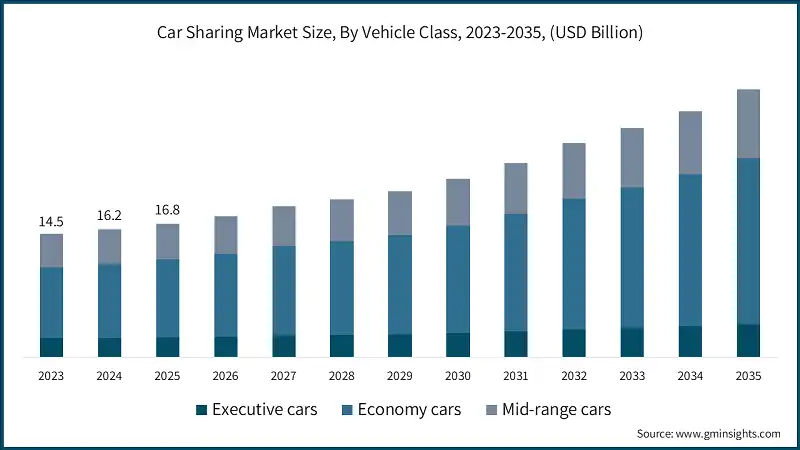
Based on vehicle class, the market is divided into executive cars, economy cars, and mid-range cars. The economy cars segment dominated the car sharing market, accounting for around 58% in 2025 and is expected to grow at a CAGR of over 8% from 2026 to 2035.
- Economy cars are very appealing to budget-conscious city consumers who favor affordability against luxury. The economy cars are best in short distances and day-to-day activities due to low rental prices, low fuel usage and low maintenance expenses. Booking is more common because they are affordable, leading to higher utilization rates and becoming the backbone of a majority of car-sharing fleets in the world.
- Economy cars are preferred by car sharing operators because they cost less to purchase initially and in terms of insurance, repairs and maintenance. These cars allow scaling of fleet faster and enhance investment. Reduced overall cost of ownership enables operators to offer competitive prices and remain profitable to support large-scale deployment to high-need urban sites.
- Economy cars are small and easy to handle and are therefore very suited in busy cities. They do not take up as much parking space and work well in stop-and-go traffic. This is combined with dense city infrastructure, which improves availability and convenience, which strengthens the prevalence of the economy cars in intracity car sharing arrangements.
- Economy cars have increased frequency of booking because they are accessible, and cost less. Vehicle is utilized by means of short duration trips, high frequency of use and short turnaround times. The high usage increases the productivity of fleets and the amount of revenue that a vehicle can make, and as such economy cars have been an ideal segment among those who want to spend a little to maximize their operational efficiency.
- Economy cars are also being offered in electric formation, and thus they are optimal in electrification of car sharing fleets at a low cost. Reduced electricity size, low charging value, and government subsidies make them more attractive. The electric economy vehicles assist the operators to achieve sustainability goals and still afford to have the cars priced relatively low to the mass-market consumers.
- Economy cars appeal to first-time and occasional car sharing users because of their simplicity, recognition, and less financial burden. Before progressing to a high-end product, users who are trying shared mobility services would seek economical products. This is an entry point that increases the number of users and improves the ultimate adoption of car sharing platforms.
Learn more about the key segments shaping this market
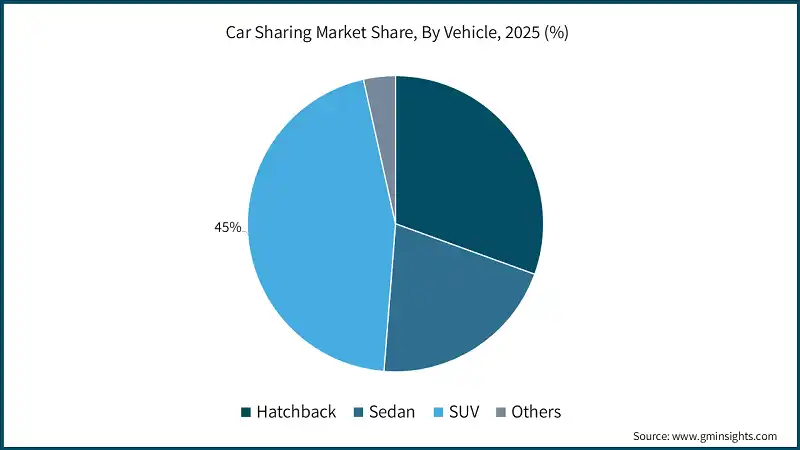
Based on vehicle, the car sharing market is segmented into hatchback, sedan, SUV and others. The SUV segment dominate the market with 45% share in 2025, and the segment is expected to grow at a CAGR of over 7% from 2026 to 2035.
- The increasing demand of large interior, an elevated seating position, and comfort is influencing the adoption of SUV in car sharing dealerships. SUVs are mostly used by users during group travel, family outings and also during trips that require luggage. This utility also contributes to the fact that SUVs are appropriate in an expanded variety of application scenarios compared to smaller cars, which boosts booking rates and total adoption of the fleet.
- SUVs have been mostly preferred to leisure and weekend holidays and other recreational excursions that need bigger driving ranges and comfort. Car sharing services use SUVs to meet the needs of tourist demand in specific areas especially around airlines and major cities. This trend favors increased rental periods and revenue per trip than the compact vehicle markets.
- The cost of operation has been lowered with the improvement in engine technology and introduction of hybrid and fuel-efficient SUVs. The new SUVs have better mileage and reduce the emissions compared to older models hence are more suitable as a shared group. These advances will allow operators to find a compromise between the desire of the user to drive an SUV and the need to be cost-effective and sustainable.
- It is also believed that SUVs are safer, have good visibility in the road and stability especially in the mixed urban and suburban fairways. This impression appeals to the customers who want to have confidence and comfort, particularly during longer road journeys or road journeys that are unknown to them. The increased safety appeal has the effect of driving up demand and recurrent usage in the car sharing platforms.
- The growing supply of electric SUVs promotes the growth of high-end but eco-friendly car sharing services. Electric SUVs offer the experience of zero-emission performance, combined with a large-car design, without sacrificing comfort, which can attract those who also attend to environmental issues. Electric SUVs are also being introduced into shared mobility fleets at a faster rate due to government incentives and the growing presence of charging infrastructure.
- Corporate customers and premium subscribers are opting more to use SUV in the course of business travelling and in face-to-face applications. By using SUVs, Car sharing operators are able to appeal to customers with higher values and to diversify the revenue stream. The segment has increased pricing sensitivity and a longer rental period, which enhances overall profitability in shared vehicle portfolios.
Based on model, the car sharing market is segmented into free float, stationary, and peer to peer. The free float segment dominated the market, accounting for share of 48% in 2025.
- Free-floating car sharing allows the user to pick up and drop the cars anywhere in an identified service area, without the necessity of having fixed stations. This flexibility underlies impulsive travel and mobility on the last mile in large cities. The frequency of the trip is majorly enhanced by convenience-driven usage making the free-floating models very appealing to day-to-day travel within the intracity.
- Free-floating car sharing is becoming a part of the smart city programs in many cities in order to ease the congestion and optimize urban mobility. Specific parking areas, online permits, and sharing of data with municipalities facilitate the unproblematic functioning. Urban mobility objectives facilitated through alignment of policy will increase the implementation of free-floating services in the major urban areas.
- Free-floating models are ideal in short journeys like errands, meetings and point-to-point within urban areas. Pricing by the minute and access to vehicles instantly motivates frequent use. The fleet utilization is boosted by high trip turnover, and in that way, the free-floating car sharing is commercially viable to companies that aim to satisfy high urban demand patterns.
- High-tech telematics, GPS location, and AI-powered demand prediction enable the operators to dynamically reposition vehicles depending on their usage patterns. Real-time data will increase availability, minimize idle time, and augment user satisfaction. Such technological features are mandatory in the management of floating fleets effectively, and these will assist in scalable expansion in competitive metropolitan markets.
- Electric cars are becoming very popular in free-floating car sharing because they are suitable in urban driving and have regulatory advantages. EVs minimize emissions, noise, and operating expenses, as well as meet the city sustainability aims. Free-floating flexibility paired with electric mobility enhance the level of user acceptance and contributes to the expansion of the market in the long term.
- Free-floating car sharing is a sensible substitute for the ownership of a personal car, especially in cities where the cost of ownership and the lack of parking are significant. Such a solution of getting a car on-demand without ownership liabilities is attractive to urban populations, fast tracking the transition to shared mobility and spurring long-term expansion of free-floating models.
Based on business model, the car sharing market is divided into round trip and one way. Round trip dominates with 82% market share in 2025.
- Round-trip car sharing is appropriate to the case of planned traveling during which its users give back vehicles to the same spot. It can be used at an affordable rate depending on time since the pricing strategy is predictable, giving it an hourly or daily rate. This model attracts customers who require the reliability of accessing the car during errands, meetings or travelling all day without incurring the expenses of renting the traditional cars.
- Car sharing round-trip has been widely used in residential complexes, universities, and business campuses as there is designated parking and structured usage. Such environments have consistent demand and usage. The model assists in supporting shared mobility in confined zones and minimizing the number of cars people own but guaranteeing reliable accessibility to the residents, students, and employees.
- The sale of vehicles to fixed location makes it easy to balance fleet, clean up as well as maintain the fleet. Operators gain the advantage of certain distribution of their vehicles and fewer repositioning costs than free-floating models. Simplified operations raise the level of service reliability, aid in cost management and increase scalability, which makes round-trip car sharing appealing to new and existing operators.
- Round trip car sharing works in suburban and semi urban regions where impulsive and short journeys are not prevalent. Prearranged pickup and drop-off spots are consistent with premeditated travel patterns in the areas. It allows the operators to reach beyond large areas of urban centers, reaching new segments of users and broadening geographic market coverage.
- The shared fleet management is less costly than a full implementation because corporations and institutions are sure that the models will be used on a regular basis with accountability. Employees have their own cars minimizing the cost of fleet ownership and aiding in sustainability. Contract terms and frequent usage ensure guaranteed revenue, which leads to an increase of business-oriented round trip car sharing deployments.
- The car sharing round trip provides more guarantees on the availability and status of the vehicle since the users make bookings beforehand. This reliability brings trust especially to the family and to the business users. Ensuring access and predictable returns enhance user satisfaction and will lead to reuse to support long-term demand growth.
Looking for region specific data?
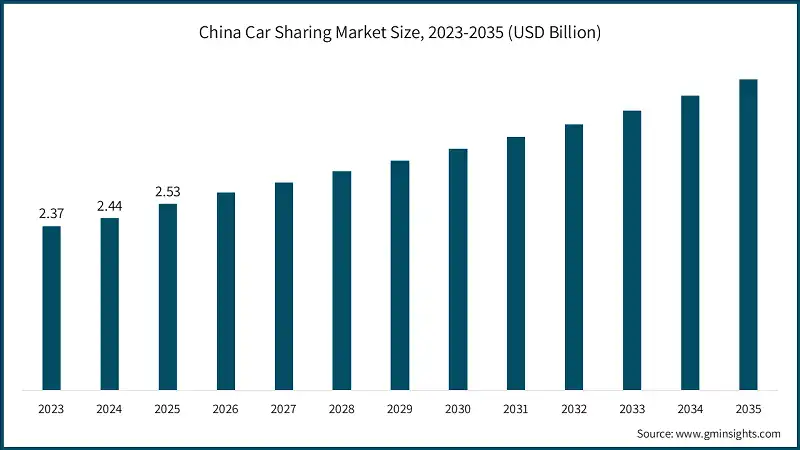
China dominated the car sharing market in Asia Pacific with around 38% share and generated USD 2.53 billion in revenue in 2025.
- The central and municipal governments are actively encouraging people to use shared mobility and electric vehicles in China by providing subsidies, regulatory assurances, and smart cities. The policies promoting a 10% decrease in the number of personal cars, the decrease in emissions, and electrification have a direct positive impact on car sharing platforms. There is preferential licensing, parking support, and EV subsidies that boost the growth of the fleet and the adoption of the EVs in the key cities of China.
- The rapid urbanization in China means that there is excessive traffic jams and a lack of parking spaces in the megacities. The idea of car sharing is a feasible remedy as it eliminates the necessity of owning a personal vehicle and enhances the efficiency of mobility. The high density of urban areas encourages the high levels of vehicle use, which forms the basis of the economical and very scaled car-sharing in the urban areas of China.
- China is the largest producer and adopter of electric vehicles in the world, which allows car sharing operators to have a chance to get access to affordable EV supply. The dense electrification of shared fleets can be facilitated by extensive charging networks and high density of domestic OEM. Sharing electric cars is environmentally friendly and is attractive to urban consumers that are environmentally conscious.
- Intensive smartphone penetration and full-fledged digital ecosystems allow the car sharing services to be easily integrated with mobile payments, navigation, and super-app platforms. Interconnection with applications like WeChat and Alipay will increase accessibility, convenience in booking, and user confidence, which will facilitate frequent use and quick market penetration of different consumer groups.
- The growing middle-income population in China is better demanding more convenient and affordable mobility options to travel on a daily, leisure, and short-distance basis. Car sharing makes vehicles available to customers with no ownership expenses, which attracts consumers who want convenience versus cost-effectiveness. This change of demands contributes to stable growth, especially in young professionals and urban households.
- The massive smart city projects in China focus on smart traffic control and transport systems. Car sharing services provide data on mobility that is helpful in the planning and alleviation of congestion in the city. This cooperation between operators and municipalities allows to optimize the use of the fleet, regulatory support, and access to infrastructure, which enhances the perspectives of growth in long-term in Chinese cities.
The Germany car sharing market is projected to exceed USD 1.7 billion in 2025.
- Germany’s stringent climate policies and commitment to carbon neutrality are accelerating the adoption of shared mobility solutions. Low-emission zones, urban vehicle restrictions, and CO2 reduction targets encourage consumers to reduce private car ownership. Car sharing aligns with national sustainability goals, making it an attractive alternative in Germany’s environmentally conscious urban markets.
- Germany has an established culture of joint mobility, such as car sharing, mass transportation, and micromobility. Consumers feel free with the idea of transport models based on accessibility and it has been seen to have high adoption rates. The presence of long-standing recognition of the benefits of car sharing, as well as the trust in the structured mobility services, makes the regular use in large cities of Germany.
- The car sharing is well integrated with the transport systems in Germany due to the presence of highly advanced urban infrastructure in the country. Car sharing is highly applied as a first- and last-mile technological hybrid to buses, trams, and railways. This multimodal combination makes life easier, boosts the utilization percentage, and makes car sharing play a greater role in the everyday movement around cities.
- Germany is a leader in electric mobility and good automotive ecosystem, which favors the development of EV-based car sharing platforms. Electrification is promoted by government incentives, an increasing number of charging facilities, and the involvement of OEMs domestically. Electric car sharing assists the operators to meet the requirements of the emission laws and attract sustainability-oriented users in the city and suburbs.
- There is a problem of parking and increasing vehicle ownership prices in major cities in Germany. Car sharing will decrease the amount of parking space required and will decrease the congestion in urban areas. The limited availability of parking and high cost make people use the car-sharing services on a few occasions, which leads to a gradual increase in demand in such populated urban centers.
- Germany, a country that has moved towards car sharing, is slowly embracing the concept with businesses and municipalities opting to cut the cost of owning fleets, as well as achieve sustainability. Corporate car sharing schemes can help employees move around with minimum environmental effects. The long-term institutional contracts will also enjoy a stable demand which will help the car sharing services grow steadily throughout the business districts and in the government sector.
The car sharing market in US is projected to grow at a 4.3% CAGR from 2026 to 2035.
- In major US cities, rising vehicle prices, insurance premiums, fuel costs, and parking fees are discouraging private car ownership. Car sharing offers a cost-effective alternative by converting fixed ownership expenses into variable, usage-based costs. This financial advantage is particularly attractive to urban residents, students, and young professionals seeking flexible mobility solutions.
- The fast development of the P2P car sharing systems in US allows vehicle owners to earn money on their idle resources and renters to be able to choose a big range of cars. The asset-light business models embrace fast geographic growth and competitive rates. The high adoption is being supported by the strong consumer trust mechanisms and digital platforms across the urban and suburban markets.
- The move toward shared mobility can be supported by the growing population density in cities and the lack of parking facilities in US metropolitan regions. The cost of parking is also expensive, and space is not always available so that owning a private car is not as viable. Car sharing offers non-committal on-demand access without any long-term parking contracts, which adds to its popularity in the overcrowded urban areas.
- Car sharing is becoming increasingly embraced by US corporations, universities, and large institutions to maximize the use of their fleets as well as save on transportation. Car sharing programs are based on campus and corporate programs that help predict demand and ensure high usage. Such organized environments help the operators in acquiring contracts that are long term, which offer consistent revenue streams and market expansion.
The car sharing market in Brazil is expected to expand steadily through 2035. Brazil’s major cities, including São Paulo and Rio de Janeiro, face severe traffic congestion and limited parking availability due to rapid urbanization.
- Vehicle prices, high interest rates, insurance and the high costs of fuel make the ownership of a private car less accessible to the majority of Brazilian consumers. Car sharing makes cars accessible without any financial commitment. This feature of low prices creates an impetus to use them among young professionals and urban population who prefer flexibility in their mobility and low costs.
- The rising population of the middle-income in Brazil is contributing to the growth of the demand of convenient and flexible modes of transport. Car sharing satisfies the occasional mobility requirements such as work, leisure and family travel without the ownership liabilities. This move towards accessibility-based mobility favors consistent expansion, especially with digitally connected consumers who take accessibility as a value and convenience as a priority in urban areas.
- The popularity of smartphones and the growing use of digital payment solutions allow the car sharing service to be accessed without any difficulties. On-demand booking is available through apps, cashless services, and live vehicle availability increases the user experience. Quality digital infrastructure is helpful in scaled operations of the platform and boosts faster consumer uptake throughout urban centres in Brazil.
The car sharing market in South Africa is projected to grow at a CAGR of 5.7% from 2026 to 2035.
- South Africa’s major metropolitan areas, including Johannesburg, Cape Town, and Pretoria, are experiencing rising urbanization and commuter density. Increasing daily travel demand and congestion are making private vehicle ownership less efficient. Car sharing provides flexible access to mobility without long-term ownership, supporting adoption among urban professionals and frequent city commuters.
- The cost of owning cars is becoming more expensive due to high prices of vehicles, rising interest rates, fuel prices and insurance premiums. Car sharing allows the users to turn fixed costs of ownership into the costs of mobility that can be paid as pay-per-use charges. This low pricing strength is propelling its uptake among the price sensitive consumers, small enterprises and young working couples in the urban and peri-urban setting.
- Increased use of smartphones and digital payment systems has increased the acceptance of mobility solutions through apps. Customers are getting more at ease with mobile booking, live tracking and cashless payment. This digital preparedness promotes scalable car sharing platforms, enhances user experience, and reduces barriers to operation on the part of the service providers.
- South Africa boasts a good tourism industry and therefore has need of short and non-permanent access to vehicles. Car sharing is the most convenient and economical mode of transport among the tourists and in business travelers mainly in large cities and close to airports. This segment facilitates a better utilization rate and achievement of location-based car sharing deployments growth.
Car Sharing Market Share
- The top 7 companies in the car sharing industry are Free2move, Sixt, Turo, Zipcar, Mobility Carsharing, Getaround, and Communauto, collectively contributing around 45% of the market in 2025.
- Sixt uses its strong global network, airport networks, and extensive experience in the car rental industry to promote car sharing services. Its business strategy seamlessly combines traditional car rentals and car sharing services and provides various options for their car models. Digital platform development, conversion to electric and hybrid cars, and collaborations are some strategies that enhance Hertz’s competitive advantage.
- Turo enjoys competitive advantages as a car-sharing platform through its peer-to-peer platform, allowing car owners to make money from underutilized cars while providing potential buyers with affordable options. The trust-building mechanism on the Turo platform enables users to easily rent or buy cars at affordable prices. Additionally, Turo has utilized technology to expand its capacity to cater to more customers.
- Zipcar stays at the top of the market by focusing its efforts and resources on dense urban and university markets, bolstered by the solid operational foundation provided by Avis Budget Group. Its trustworthy app with integrated insurance, varied fleet, and membership-friendly pricing all combine to focus on ease and affordability. Places of strong city partnerships, retainerships due to dedicated parking spots, and corporate programs have put Zipcar in a leading position regarding metropolitan area mobility solutions.
- Mobility Carsharing stays competitive through its highly sustainable model and strong local presence in European markets. The pursuit of electric and low-emission vehicles, community collaboration, and station-based deployment applies to both regulatory targets and environmental objectives. Basically, increased customer service, regional adaptation, and integration into regional public transport systems boost its attractiveness for environmentally sensitive customers and municipalities that are interested in lower congestion and carbon footprints.
- Getaround is distinguished by its frictionless, keyless technology platform featuring remote vehicle access and real-time bookings. The company’s dynamic pricing, robust telematics, and seamless mobile experience further enhance utilization and user convenience. These strategic partnerships with OEMs and insurers extend the fleet options and trust mechanisms, making Getaround a flexible, tech-enabled option to traditional car sharing.
- Communauto competes by integrating free-floating and station-based solutions, as well as having a high level of community integration in Canadian and some European cities. It also focuses on sustainability, competitive pricing, and customer accessibility due to proper parking and accessible online solutions. It also draws in urban customers due to Communauto's focus on regulations, transit connectivity, and proper fleet composition.
Car Sharing Market Companies
Major players operating in the car sharing industry are:
- Cambio Mobilitäts Service
- Communauto
- EKAR FZ
- Free2Move
- Getaround
- GoGet
- Mobility Carsharing
- Sixt
- Turo
- Zipcar
- The car-sharing market is highly saturated and consists of global competitors like Zipcar, Share Now, Getaround, and Turo, and others like Delimobil in Russia and Communauto in Canada. The entry of peer-to-peer (P2P) platforms makes the competition even tougher for companies and allows car owners to make commercial use out of their vehicles. Another factor that adds a good edge to the companies is the formation of collaborations with automobile and mobility app firms.
- There is also competitiveness fueled by service innovations and digital experiences, such as the focus on mobile apps, easy booking options, and tracking services. Free-floating as well as round-trip systems exist side by side to cater to different needs. Environmental laws as well as the mobility agenda are beneficial to companies with electric or hybrid vehicle fleets. There is also consolidation at various levels to optimize costs to be competitive.
Car Sharing Industry News
- In July 2025, Zoomcar partners driver platforms to scale vehicle delivery across major indian cities. Home delivery has consistently shown higher engagement and booking conversion rates on Zoomcar, and this service, with the recent upgrades, is becoming far more accessible, reliable, and widespread across multiple cities.
- In July 2025, Zoomcar declared a partnership with CARS24 to facilitate the quality and safety of vehicles in the self-drive car rental industry through tech-enabled inspections and tracking. As part of this deal, CARS24 will conduct Pre-Delivery Inspections on new host inventory and integrate their GPS tracking device to ensure all the necessary transparency for safety and a superior guest experience, said a company statement.
- In May 2025, Zoomcar announced that it has partnered with Wego. This deal puts Zoomcar's self-drive rental options directly into Wego's platform, ensuring that international tourists can book vehicles throughout India. This partnership allows the Wego users to access over 25,000 cars across 99 cities in India through both Wego's website and mobile application.
- In April 2025, a collaboration between Volkswagen and Uber Technologies has been made public, which aims at launching a large number of all-electric, self-driving ID. Buzz AD electric vehicles in various U.S. cities for a decade, marking a significant step towards the development of self-driving mobility, as well as depicting Volkswagen’s determination to influence the future of mobility.
The car sharing market research report includes in-depth coverage of the industry with estimates & forecasts in terms of revenue ($ Mn/Bn) and shipment (Fleet Size) from 2022 to 2035, for the following segments:
Market, By Vehicle Class
- Economy cars
- Mid-Range cars
- Executive cars
Market, By Vehicle
- Hatchback
- Sedan
- SUV
- Others
Market, By Business Model
- Round trip
- One way
Market, By Model
- Free float
- Stationary
- Peer to Peer
Market, By End Use
- Individual
- Business
- Government Agencies
- Non-Profit Organizations
Market, By Area
- Intercity
- Intracity
Market, By Propulsion
- Gasoline
- Diesel
- BEV
- PHEV
- HEV
- Others
The above information is provided for the following regions and countries:
- North America
- US
- Canada
- Europe
- UK
- Germany
- France
- Italy
- Spain
- Russia
- Denmark
- Asia Pacific
- China
- India
- Japan
- South Korea
- ANZ
- Singapore
- Latin America
- Brazil
- Argentina
- Mexico
- MEA
- UAE
- Saudi Arabia
- South Africa
Frequently Asked Question(FAQ) :
What is the growth outlook for the car sharing industry in the United States?
The U.S. market is projected to grow at a CAGR of 4.3% from 2026 to 2035. Rising costs of vehicle ownership, expansion of peer-to-peer platforms, and increasing adoption by corporations and universities are driving market growth.
Who are the key players in the car sharing market?
Major players include Zipcar, Sixt, Free2Move, Turo, Mobility Carsharing, Getaround, and Communauto. These companies focus on digital platforms, fleet electrification, partnerships, and flexible business models to strengthen their market position.
Which car sharing model led the market in 2025?
The free-floating model led the market with about 48% share in 2025. Its flexibility, convenience for short urban trips, and integration with smart city initiatives are accelerating user adoption.
Which vehicle class dominated the car sharing market in 2025?
Economy cars dominated the car sharing industry in 2025, accounting for around 58% share. Their affordability, low maintenance costs, and suitability for short urban trips drive high utilization rates across global fleets.
What was the market share of the SUV segment in 2025?
The SUV segment accounted for approximately 45% of the market share in 2025. Rising demand for spacious, comfortable vehicles for group travel, leisure trips, and longer journeys is supporting strong adoption.
What is the car sharing market size in 2025?
The global market size for car sharing was valued at USD 17.6 billion in 2025. Market growth is supported by rising urban congestion, high vehicle ownership costs, and increasing adoption of shared mobility solutions in metropolitan areas.
What is the projected value of the car sharing market by 2035?
The market size for car sharing is projected to reach USD 35.3 billion by 2035, growing at a CAGR of 7.4% from 2026 to 2035. Growth is fueled by urbanization, integration of electric vehicles, and multimodal transportation initiatives.
What is the market size of the car sharing industry in 2026?
The market size for car sharing is expected to reach USD 18.6 billion in 2026, reflecting steady growth driven by expansion of app-based mobility platforms and increasing consumer preference for pay-per-use transportation models.
Which business model dominated the car sharing market in 2025?
The round-trip business model dominated the market with nearly 82% share in 2025. Predictable pricing, structured usage, and strong adoption across residential complexes, universities, and corporate campuses support its leadership.
Car Sharing Market Scope
Related Reports