Summary
Table of Content

Capryloyl Glycine Market
Get a free sample of this report
Form submitted successfully!
Error submitting form. Please try again.
Thank you!
Your inquiry has been received. Our team will reach out to you with the required details via email. To ensure that you don't miss their response, kindly remember to check your spam folder as well!
Request Sectional Data
Thank you!
Your inquiry has been received. Our team will reach out to you with the required details via email. To ensure that you don't miss their response, kindly remember to check your spam folder as well!
Form submitted successfully!
Error submitting form. Please try again.
Capryloyl Glycine Market Size
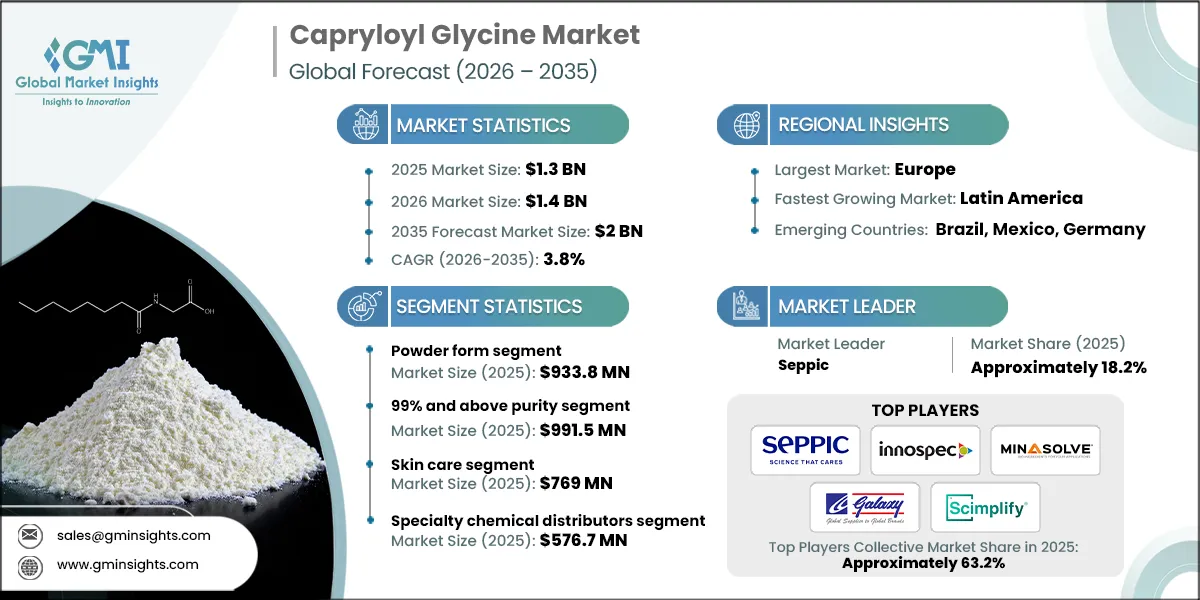
The global capryloyl glycine market was estimated at USD 1.3 billion in 2025. It is expected to grow from USD 1.4 billion in 2026 to USD 2 billion by 2035, at a CAGR of 3.8%, according to latest report published by Global Market Insights Inc.
Capryloyl Glycine Market Key Takeaways
Market Size & Growth
- 2025 Market Size: USD 1.3 Billion
- 2026 Market Size: USD 1.4 Billion
- 2035 Forecast Market Size: USD 2 Billion
- CAGR (2026–2035): 3.8%
Regional Dominance
- Largest Market: Europe
- Fastest Growing Region: Latin America
Key Market Drivers
- Rising demand for clean beauty & natural preservative alternatives.
- Growing prevalence of acne, seborrheic dermatitis & scalp disorders.
- Regulatory push against synthetic preservatives.
Challenges
- Potential skin irritation & allergic reactions in sensitive populations.
- Higher cost compared to conventional synthetic preservatives.
Opportunity
- Untapped potential in oral care & dental hygiene products.
- Expansion into pharmaceutical-grade wound care & medical topicals.
Key Players
- Market Leader: Seppic led with over 18.2% market share in 2025.
- Leading Players: Top 5 players in this market include Seppic, Innospec Inc., Minasolve, Galaxy Surfactants, Scimplify, which collectively held a market share of 63.2% in 2025.
Get Market Insights & Growth Opportunities
- The capryloyl glycine market has been growing at a steady pace and this has been enabled by increased use of clean beauty and a natural alternative of preservatives in global personal care formulations. Companies are industrially repackaging products to minimize the use of conventional synthetic preservatives due to a growing consumer favoring mild, skin and biodegradable type of ingredients. Capryloyl glycine is a perfect addition to this switch since it is a multifunctional amino-acid derivative with antimicrobial activity and skin-conditioning properties, thus gaining more penetration in the skincare, haircare, and hygiene categories.
- Market expansion is also driven by the rising incidence of skin and scalp diseases such as acne, seborrheic dermatitis, and scalp sebum. These requirements are fueling long-term demand of formulations that curb microbiome protection and oil-controlling and barrier-supporting qualities. Capryloyl glycine is being added to specific destinations like anti-acnes products, scalp serums and sensitive-skin products which are helping to sustain increased volumes of consumption in both mass and premium personal care segments.
- The importance of ingredients that are conducive to the skin and scalp microbiome is on the agenda of cosmetic and personal care formulators. The ability of capryloyl glycine to be used in microbiome-friendly systems is leading to its use in prebiotic and microbiome-balancing skincare and scalp products, and is part of an industry trend that sees more products that do not disrupt the natural ecosystem of the skin.
To get key market trends
Capryloyl Glycine Market Trends
- The trend is towards customized beauty and customized treatment products to address a particular skin type and concern. The suppliers of ingredients and formulators are capitalizing on capryloyl glycine using modular and customizable systems that enable the brands to develop specific serums, conditioners, and treatment lines to improve differentiation within competitive portfolios.
- Manufacturers are shifting to the increasingly popular synergistic formulations in which capryloyl glycine is combined with complementary actives like peptides, ceramides or niacinamide. This is the trend in the industry, which is focused on multi-benefit products giving universal performance in one formula, enhancing the shelf life and perception of value.
- The drive to have transparency and traceability in the sourcing of ingredients has been a strategic preference among the retailers and the consumers, influenced by the ethical and verifiable supply chains desired by the consumers and retailers. Capryloyl glycine manufacturers are applying digital traceability solutions, which allows a brand to record and transmit the data concerning the origin, processing, and quality and contribute to increasing trust and helping to establish a premium position.
Capryloyl Glycine Market Analysis
Learn more about the key segments shaping this market
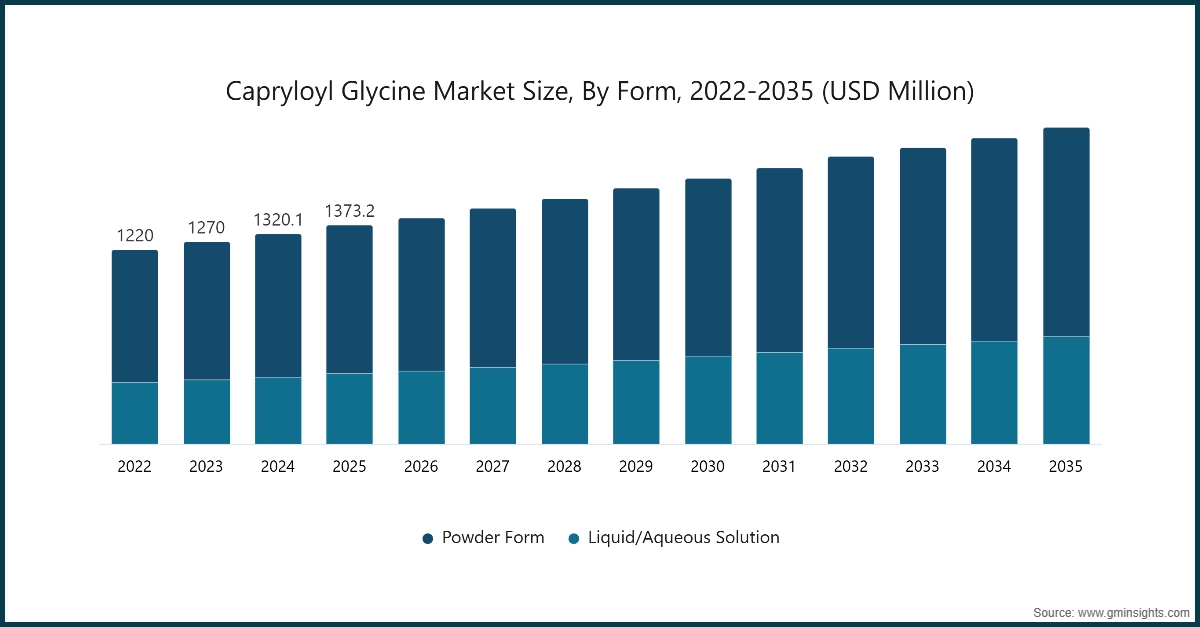
- Form-based market segmentation of capryloyl glycine market is based on the changing preference of manufacturers of cosmetic and personal care products in terms of formulations. Powder form has continued to experience consistent adoption as it has a longer shelf life, is easy to store and can be dosed in large amounts, which makes it appropriate in dry blends and tailor made formulations. Simultaneously, liquid or aqueous solutions are becoming increasingly popular because they allow quicker infiltration of the formula and simplify the processing procedures of manufacturers oriented on efficiency and scalability. This is the balance that helps to enhance wider adoption in a wide range of products.
- The need to promote efficiency of the processes, stability of formulations and compliance with regulations are defining the demand in both forms. Liquid and aqueous versions have gained popularity among formulators who want ready-to-use that can reduce development time and powder versions are also still relevant to brands that want to focus on stability and cost-efficiency in transportation and long shelf life. Continued research on solubility improvement and compatibility of formulations is also enabling the two forms to coexist and this way the suppliers can satisfy the diverse needs of customers without the demand requiring structural changes.
Based on purity, the market is segmented into between 95%-98% purity, between 98%-99% purity, and 99% and above purity. 99% and above purity hold a significant share at a valuation of USD 991.5 million in 2025.
- The purity-based market segmentation of the capryloyl glycine market represents the growing focus on the consistency of performance and alignment with regulatory requirements. The 95-98 purity products are also used extensively in standard formulations of personal care products where the cost-efficiency and functionality are balanced. Meanwhile, the higher purity grades of 98% -99% are finding favor among formulators in search of greater efficacy, a superior stability, and with regard to use in sensitive skin applications, at least in mid-to-premium product lines.
- The 99% and above purity high-end cosmetics, cosmeceuticals, and medical topical usage segment is experiencing a high-end cosmetics, cosmeceuticals, and medical topical usage segment are witnessing an accelerated demand of its products, where traceability of ingredients and precision of formulations are paramount. This segment enjoys the advantage of increasing pressure on the quality of ingredients, international standards in compliance and the increasing interest among consumers in dermatologically tested products. To meet this demand, manufacturers are putting their money into intensive purification technology that allows them to differentiate based on high quality and application-specific positioning.
Based on application, the capryloyl glycine market is segmented into skin care, hair care & scalp treatment, antiperspirant & deodorant, wound care & medical topicals, and oral care. Skin care holds a significant share at a valuation of USD 769 million in 2025.
- Skin care continues to be an important consumption category across application with the increasing demand to use ingredients that have antimicrobial action, sebum regulation and support of skin barrier properties. The use of capryloyl glycine is on the rise in an effort to treat acne-prone, sensitive, and combination skin with products. The use of hair care and scalp treatment is also increasing, owing to its capability of ensuring a balanced microbiome of the scalp and supporting the oil-controlling formulae.
- In addition to traditional personal care, antiperspirants and deodorants are moving towards using capryloyl glycine due to its odor-control and skin-friendly profile that is in line with consumer trend of using actives that are gentle but effective. Further, wound care, medical topicals, and oral care applications are also slowly becoming formulators as they consider multifunctional ingredients with antimicrobial and conditioning properties. The expansion of the field of application increases the general market stability and promotes the diversification of the expansion possibilities.
Learn more about the key segments shaping this market
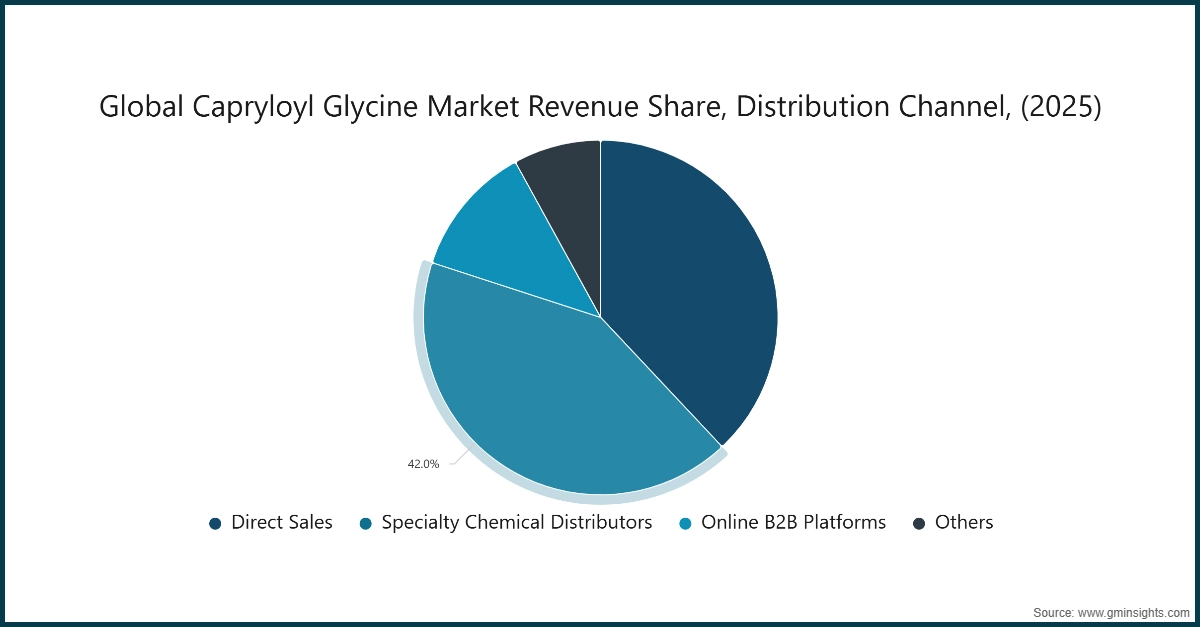
Based on distribution channel, the capryloyl glycine market is segmented into direct sales, specialty chemical distributors, online b2b platforms, and others. Specialty chemical distributors is estimated to grasp a value of USD 576.7 million in 2025 and is expected to grow at 3.5% of CAGR during the forecast period.
- Capryloyl glycine retail distribution environment is influenced by the different customer sizes and procurement choices. Large cosmetic manufacturers and contract formulators still choose direct sales, which has such benefits as technical cooperation, tailored grades, and stability in supply. This channel helps in long term version and is especially applicable to high-purity and application specific products.
- Meanwhile, specialty chemical distributors are instrumental in increasing the market coverage particularly in the small- and mid-sized formulators with their flexibility in order quantities and local assistances. Online B2B is also becoming more popular due to the accelerated tender procurement technology enhanced accessibility, price transparency, and lead times. The ecosystem has been complemented by other channels such as regional traders and formulation partners which have been serving niche and emerging market needs.
Looking for region specific data?
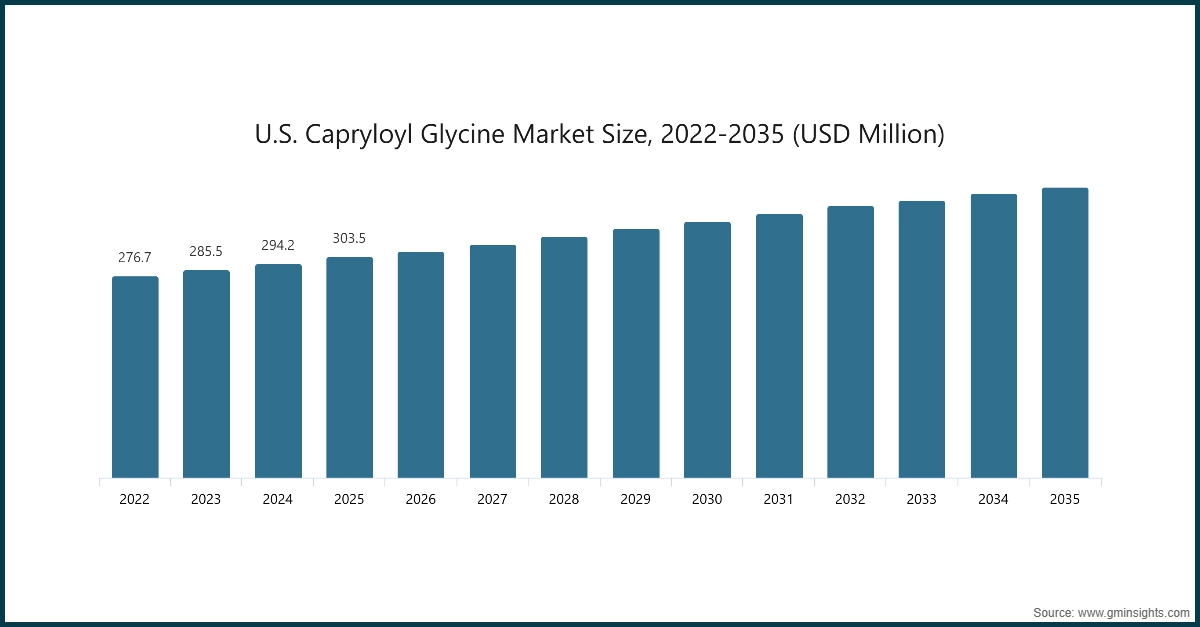
North America capryloyl glycine market accounted for USD 352.9 million in 2025 and is anticipated to show lucrative growth over the forecast period.
- North America is a major growth opportunity to capryloyl glycine with the cosmetics and personal care segment of the industry displaying high expectations of naturally based and multi-functional ingredients. The largest player in the region is the United States with well-developed personal care market, high level of per-capita spending on skincare, and a clean-beauty movement, which heavily focuses on ingredient transparency and sustainability.
- In Canada, the regulations which promote safety and the use of natural ingredients also dominates the demand. They also contribute to growth due to the rise in the number of skincare issues like acne, sensitive skin, and aging, in which capryloyl glycine antimicrobial and skin-conditioning attribute can be appealing to formulators. With the online and retail channels broadening their portfolios of high-end and environmentally friendly products, the regional suppliers are adapting to such consumer trends with tailored products that resonate with such consumer trends.
Europe capryloyl glycine market accounted for USD 535.5 million in 2025 and is anticipated to show lucrative growth over the forecast period.
- Capryloyl glycine is gaining popularity in skincare and cosmetic products in Europe with the increase in consumer awareness of sustainable and safe ingredients and a culture of wellness and personal care. Germany, United Kingdom and France are among the major markets and the regulatory systems have guided the progress of these markets through system such as the EU Cosmetics Regulation that places emphasis on ingredient safety and eco-compatibility.
- European customers are more inclined towards bio-based and ethically-grown ingredients, which is consistent with clean beauty and green chemistry trends. Another trend that European formulators are capitalizing on is the use of capryloyl glycine in high-end products that will address the need to have gentle and dermatologically tested actives. Also, the extraction and formulation technologies have been enhanced, which gives suppliers an opportunity to respond to the varied needs of the market, which is creating a continuous expansion in the region.
Asia Pacific capryloyl glycine market accounted for USD 412 million in 2025 and is anticipated to show lucrative growth over the forecast period.
- The market in Asia Pacific is witnessing a surge in demand of capryloyl glycine owing to the increasing disposable incomes, urbanization and increased beauty awareness among the people. China and Japan can be noted among those who contributed the most, as they have large cosmetics sectors and a great interest in new trends in skin care. The credit of Chinese demand is amplified through the use of capryloyl glycine in anti-acne, oil control, and microbiome-friendly products, as it is showing changing inclination toward younger consumers.
- The K-beauty industry of South Korea is another area that enhances uptake by incorporating the use of multifunctional amino-acid derivatives into fashionable skincare practices. E-commerce penetration is also a factor that facilitates the growth of the region since it allows reaching a wider range of premium and niche cosmetic products. Emerging markets India and Southeast Asia are becoming dynamic sub-markets due to the growing personal care expenditure and the growing interest in the benefits of ingredients.
Latin America market accounted for 3.5% market share in 2025 and is anticipated to show steady growth over the forecast period.
- Latin America is gradually transforming into a regional capryloyl glycine market with Brazil and Mexico being the center markets owing to the growing personal care and beauty markets. The increased consumer demand to natural and functional ingredients is also leading to increased adoption of specialized actives such as capryloyl glycine especially in skincare and anti-aging products. The increase in the economy and the expansion of accessing retailing, both in the digital form and the modern trade, allows the introduction of the greater variety of the offered product in accordance to the local tastes.
- The expansion of the market is also assisted by the growing interest in the efficacy of ingredients and the movement toward the up-end, where consumers favor the performance-oriented formulations rather than conventional commodity products. Although the growth rates are not so high in comparison with North America or Asia Pacific, the young population and increasing beauty spending creates the long-term opportunity to formulators and ingredient suppliers.
Middle East and Africa capryloyl glycine market accounted for over 1.8% share in 2025 and is anticipated to show steady growth over the forecast period.
- The Middle East & Africa region is evolving slowly into a market of capryloyl glycine with rising demand on personal care products to solve skin related issues caused by climate conditions and lifestyle issues. The markets of United Arab Emirates and Saudi Arabia can be characterized by high consumer interest in high-quality skincare which drives the use of ingredients. In such markets, any formulations with antimicrobial properties and barrier effects appeal to consumers who are facing humidity, UV and pollution.
- The increasing urbanization and an expanding middle-income group with more disposable income towards beauty and wellness are favouring growth. The region also mirrors the more general developments of coming up with more eco-friendly formulations, though different countries have different regulatory environments which demand innovative approaches on the part of suppliers. South Africa is also developing into a regional power with its newly emerging cosmeceutical industry, where the anti-aging and hyperpigmentation products containing functional actives are on demand.
Capryloyl Glycine Market Share
The capryloyl glycine industry in 2025 has a moderately consolidated entry mode with a combination of global specialty ingredient producers and niche formulation experts. The presence of Seppic, Minasolve, Innospec Inc., Galaxy Surfactants, and Scimplify in the global market is really high as key players that dominate the market share 63.2%. Their market presence is pegged by long-term customer relationships, the diversification of their product line-ups, and the steady demand related to the usage of their products in skincare, haircare, and hygiene.
To stay competitive, businesses are placing emphasis on product differentiation, sustainability-based innovation, and formulation support services. Major participants are developing bio-based raw materials, green chemistry, and multifunctional development of ingredients to resonate with the clean beauty and regulatory trends. Simultaneously, other business companies are establishing their presence by adding capacities, expanding regionally, forming partnerships with cosmetic brands to co-create tailored solutions, and improving supply chain stability and technical services to keep long-term customers.
Capryloyl Glycine Market Companies
Major players operating in the market are:
- Seppic
- Scimplify
- ATAMAn KIMYA
- Pinpools GMBH
- Euro-Kemical SRL
- Sinerga S.p.A.
- AE Chemie
- DRAVYOM Chemical Company
- DropBio
- Uniproma
- Special Chem
- Zley Group
- Innospec Inc.
- Minasolve
- Euro-Kemical
- Galaxy Surfactants
Seppic is the French manufacturer of speciality chemicals, and a subsidiary of Air Liquide Group, and is extensively involved in personal care, pharmaceutical, and cosmetic ingredients. It is the manufacturer of bio-based and high-performance actives, such as capryloyl glycine as part of its LIPACIDE™ and other glycine-based ingredient portfolios that provide sebum control, antimicrobial and skin-conditioning effects. The R&D of Sepptic focuses on the application of green chemistry, amino-acid based technologies, and sustainable ingredient solutions to the contemporary beauty formulations. It possesses an international presence in which it operates personal care brands in various locations.
Innospec Inc. is a specialty chemicals company based in the United States of America which has diversified business units in Performance Chemicals, Fuel Specialties and Oilfield Services. Its Performance Chemicals unit provides an extensive variety of cosmetic and personal care ingredients such as surfactants, emollients and glycine-based chemistries applied in moderate and sustainability-oriented formulations. The company is backing global markets through R&D, formulation and production resources throughout North America, Europe and Asian markets. In the personal care segment, Innospec focuses on innovation, sustainability and technicality services to the formulators.
Minasolve is a supplier of specialty ingredients which specializes in high quality and multifunctional green chemistry ingredients to the cosmetics market such as CapEasy capryloyl glycine blends that offer the benefit of anti acne, anti sebum and formula protection. The business concentrates on renewable material selection, biodegradable chemistries and sustainable production processes that are based on the development of bio-based ingredients. Minasolve supports personal care formulators in their search of multi-purpose, convenient to use actives and offers eco-friendliness on their product range.
Galaxy Surfactants is an Indian multinational specialty chemicals manufacturer and one of the bigger surfactants suppliers in the world, manufacture more than 200 products used in personal and home care brands in higher than 100 nations. Although it mainly deals with surfactants and amino-acid based cleansers, it also supplies the capryloyl glycine market with similar functionality and innovation in green, high performance ingredients in the skincare formulations. Adoption Galaxy has a strong R&D presence and network of global exports, which are applicable in cosmetics products, hair care and cleansing products.
Scimplify (Cocreate Global Technologies Pvt Ltd) is a pioneered Indian specialty chemicals platform and contract manufacturing player, which was established in 2023, and which provides R&D, pilot-scale development and commercial supply services in industries such as beauty and personal care. The company has a distributed network of manufacturing partners and provides 3,000+ chemical products in the world and formulation and supply-chain services in the cosmetics ingredients.
Capryloyl Glycine Market Report Attributes
| Key Takeaway | Details |
|---|---|
| Market Size & Growth | |
| Base Year | 2025 |
| Market Size in 2025 | USD 1.3 Billion |
| Market Size in 2026 | USD 1.4 Billion |
| Forecast Period 2026-2035 CAGR | 3.8% |
| Market Size in 2035 | USD 2 Billion |
| Key Market Trends | |
| Drivers | Impact |
| Rising demand for clean beauty & natural preservative alternatives | Accelerates adoption of Capryloyl Glycine as a preferred multifunctional active aligned with “free from” and natura-claim product lines. |
| Growing prevalence of acne, seborrheic dermatitis & scalp disorders | Expands demand for Capryloyl Glycine due to its proven sebum-regulating and antimicrobial efficacy in treatment-oriented formulations. |
| Regulatory push against synthetic preservatives | Strengthens Capryloyl Glycine’s market positioning as a compliant, safer replacement for banned or restricted synthetic preservatives. |
| Pitfalls & Challenges | Impact |
| Potential skin irritation & allergic reactions in sensitive populations | Creates adoption barriers in sensitive-skin-focused brands, slowing penetration in dermatologist-endorsed lines. |
| Higher cost compared to conventional synthetic preservatives | Constrains uptake among mass-market brands and cost-sensitive formulators, limiting volume scalability. |
| Opportunities: | Impact |
| Untapped potential in oral care & dental hygiene products | Opens new high‑margin segments where antimicrobial and biofilm‑control benefits offer strong formulation value. |
| Expansion into pharmaceutical-grade wound care & medical topicals | Positions Capryloyl Glycine for premium, clinical‑grade applications with significantly higher pricing power and regulatory defensibility. |
| Market Leaders (2025) | |
| Market Leader |
Market Share Approximately 18.2% |
| Top Players |
Collective Market Share Approximately 63.2% |
| Competitive Edge | Minasolve strengthens its leadership through high‑purity Capryloyl Glycine production (≈21% global share) backed by advanced cosmetic‑grade ingredient engineering, enabling superior antimicrobial efficacy and stability for premium skincare formulations. |
| Regional Insights | |
| Largest Market | Europe |
| Fastest growing market | Latin America |
| Emerging countries | Brazil, Mexico, Germany |
| Future outlook |
|
| Companies covered: | 16 |
| Tables, Charts & Figures: | 150 |
| Countries covered: | 18 |
| No of Pages: | 210 |
What are the growth opportunities in this market?
Capryloyl Glycine Market News
- In April 2024, TRI-K industries inc. announced the release of TRICare CG, a novel multifunctional capryloyl glycine ingredient based on amino acids. The combination of production with a patented green chemistry process that provides a high purity of the product, solvent-free synthesis, and biodegradable catalysts is in line with sustainability and clean-label trends in skincare and cosmetic formulations.
- In March 2023, Draslovka a.s., a top specialty chemicals company and Barrick Gold Corporation had signed an agreement in which Draslovka would pilot its innovative patented GlyCatTM (also known as GlyCat) glycine gold leaching solution in multiple mines worldwide. The technology of Draslovka will potentially be of great value in terms of cost-saving, value addition to the activities at Barrick and environmental impact on the company will be minimized.
This capryloyl glycine market research report includes in-depth coverage of the industry with estimates & forecast in terms of revenue (USD Million) & volume (Kilo Tons) from 2022 to 2035, for the following segments:
Market, By Form
- Powder Form (>90% Concentration)
- Liquid/Aqueous Solution
Market, By Purity
- Between 95%-98% Purity
- Between 98%-99% Purity
- 99% and Above Purity
Market, By Application
- Skin care
- Anti-acne products
- Anti-wrinkle & anti-aging products
- Sebum control & oily skin treatment
- Ph balancing & skin barrier restoration
- Dermo-protective products
- Hair care & scalp treatment
- Anti-dandruff products
- Anti-seborrheic products
- Scalp soothing & irritation relief
- Hair conditioning products
- Antiperspirant & deodorant
- Deodorant formulations
- Antiperspirant products
- Wound care & medical topicals
- Wound dressings & healing products
- Dermatological treatments
- Oral care
- Toothpaste formulations
- Mouthwash & oral rinse products
Market, By Distribution Channel
- Direct sales
- Specialty chemical distributors
- Online b2b platforms
- Others
The above information is provided for the following regions and countries:
- North America
- U.S.
- Canada
- Europe
- UK
- Germany
- France
- Italy
- Spain
- Rest of Europe
- Asia Pacific
- China
- India
- Japan
- South Korea
- Australia
- Rest of Asia Pacific
- Latin America
- Brazil
- Mexico
- Argentina
- Rest of Latin America
- MEA
- UAE
- Saudi Arabia
- South Africa
- Rest of Middle East and Africa
Frequently Asked Question(FAQ) :
What is the market size of the capryloyl glycine in 2025?
The market size was USD 1.3 billion in 2025, with a CAGR of 3.8% expected through 2035 driven by increased use of clean beauty and natural preservative alternatives, rising incidence of skin and scalp diseases, and growing importance of microbiome-friendly ingredients.
What is the projected value of the capryloyl glycine market by 2035?
The capryloyl glycine market is expected to reach USD 2 billion by 2035, propelled by the shift toward customized beauty products, synergistic formulations combining capryloyl glycine with complementary actives, and increasing demand for transparency and traceability in ingredient sourcing.
What is the current capryloyl glycine market size in 2026?
The market size is projected to reach USD 1.4 billion in 2026.
What was the market value of the powder form segment in 2025?
The powder form segment was valued at USD 933.8 million in 2025, holding a significant share due to its longer shelf life, ease of storage, and suitability for dry blends and customized formulations.
What was the market value of the 99% and above purity segment in 2025?
The 99% and above purity segment was valued at USD 991.5 million in 2025, driven by demand in high-end cosmetics, cosmeceuticals, and medical topical applications where ingredient traceability and formulation precision are paramount.
What was the market value of the skin care application segment in 2025?
The skin care application segment was valued at USD 769 million in 2025, representing a significant share due to increasing demand for ingredients with antimicrobial action, sebum regulation, and skin barrier support properties.
Which region leads the capryloyl glycine market?
North America capryloyl glycine market accounted for USD 352.9 million in 2025 and is anticipated to show lucrative growth over the forecast period.
What are the upcoming trends in the capryloyl glycine market?
Key trends include shift toward customized beauty and personalized treatment products, increasing adoption of synergistic formulations combining capryloyl glycine with peptides, ceramides, or niacinamide, implementation of digital traceability solutions for supply chain transparency.
Who are the key players in the capryloyl glycine market?
Key players include Seppic, Scimplify, ATAMAn KIMYA, Pinpools GMBH, Euro-Kemical SRL, Sinerga S.p.A., AE Chemie, DRAVYOM Chemical Company, DropBio, Uniproma, Special Chem, Zley Group, Innospec Inc., Minasolve, and Galaxy Surfactants.
Capryloyl Glycine Market Scope
Related Reports