Summary
Table of Content

Canned Tuna Market
Get a free sample of this report
Form submitted successfully!
Error submitting form. Please try again.
Thank you!
Your inquiry has been received. Our team will reach out to you with the required details via email. To ensure that you don't miss their response, kindly remember to check your spam folder as well!
Request Sectional Data
Thank you!
Your inquiry has been received. Our team will reach out to you with the required details via email. To ensure that you don't miss their response, kindly remember to check your spam folder as well!
Form submitted successfully!
Error submitting form. Please try again.
Canned Tuna Market Size
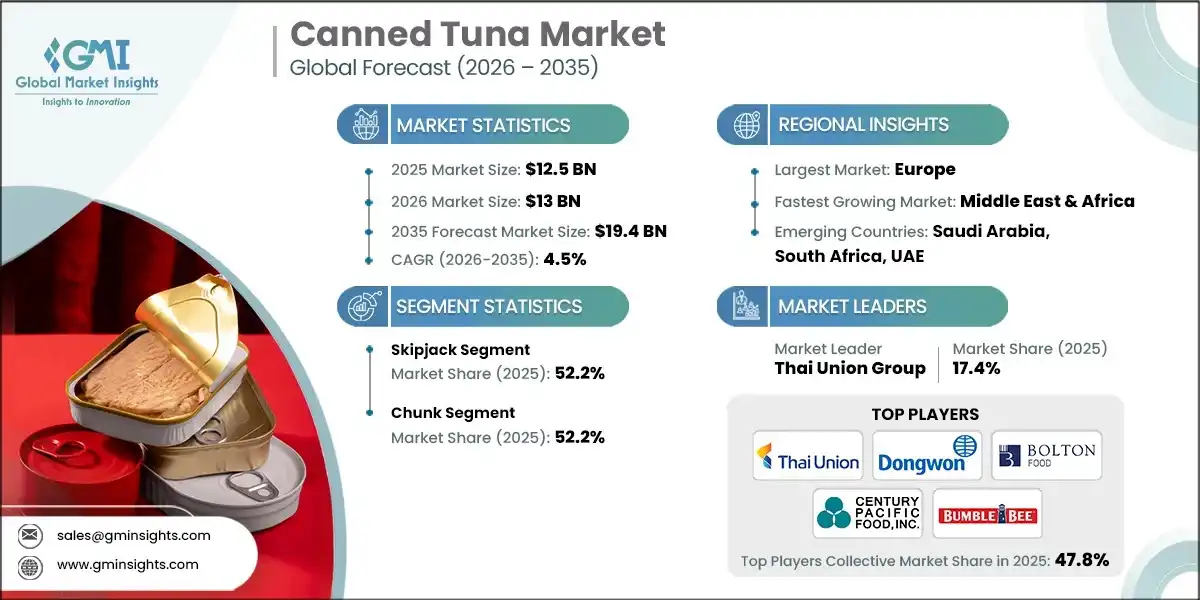
The global canned tuna market size was valued at USD 12.5 billion in 2025. The market is expected to grow from USD 13 billion in 2026 to USD 19.4 billion in 2035, at a CAGR of 4.5% according to latest report published by Global Market Insights Inc.
Canned Tuna Market Key Takeaways
Market Size & Growth
- 2025 Market Size: USD 12.5 Billion
- 2026 Market Size: USD 13 Billion
- 2035 Forecast Market Size: USD 19.4 Billion
- CAGR (2026–2035): 4.5%
Regional Dominance
- Largest Market: Europe
- Fastest Growing Region: Middle East & Africa
Key Market Drivers
- Increasing protein diet.
- Expansion of the food industry.
- Convenience trend driving flavored & pouch formats.
Challenges
- Price volatility of tuna.
- Competition from alternative proteins.
Opportunity
- Growing demand for ready-to-eat protein options.
- Rising interest in eco-friendly packaging.
Key Players
- Market Leader: Thai Union Group led with over 17.4% market share in 2025.
- Leading Players: Top 5 players in this market include Thai Union Group, Dongwon Industries, Bolton Food, Century Pacific Food, Bumble Bee Foods, which collectively held a market share of 47.8% in 2025.
Get Market Insights & Growth Opportunities
- Canned tuna can be defined as a processed seafood product in which tuna fish is preserved in cans with oil, water, or brine to make it relatively easy to enjoy the health benefits of eating this type of fish while maintaining the longevity of the protein sources. As one of the main basic foods in nearly every household around the globe, canned tuna is characterized as a food source possessed of an affordable, nutritional benefit, and easy preparation.
- According to the Food and Agriculture Organization (FAO), the annual volume of tuna catch globally is increasing by a constant rate over the years, reaching 7.9 million tons in 2018. This increase in the amount of tuna makes it a source on which the canned tuna market relies because it assures a constant raw material supply flowing to manufacturers.
- Consequently, with people's present tendency around the world to consume more healthful foods in order to attain fitness goals, demand for high-protein diets is growing rapidly, and there seems to be nothing better than canned tuna in this case as a source of lean protein. Almost all governments and health organizations are encouraging the intake of proteins among populations around the globe, especially among the aging section of the population and the health-conscious young shoppers, just for the reason that a good amount of protein promotes overall health.
- For instance, the World Health Organization (WHO) encourages balanced diets, with a rich percentage of protein emphasized, and thus creates demand for protein-rich canned food, like tuna. This has led consumers to adopt canned tuna as part of their everyday diets, thus enhancing market sales.
- On the other hand, the growth of the canned tuna market can also be attributed to the changes in the food industry caused by urbanization and newer lifestyles affecting all population groups. Along with the growth of these retailing and food service sectors, consumers continuously look for fast yet healthy meal options. Canned tuna perfectly fits with this because it has long shelf life and portability, as well as versatility. The trend towards convenience also encouraged innovations in the formats of the products, such as flavored and pouch variants of canned tuna, allowing busy consumers to enjoy ready-to-eat yet flavorfully appealing options.
To get key market trends
Canned Tuna Market Trends
- The innovations in process techniques and the advanced packaging technology have been increasingly affecting the canned tuna industry. The utilization of high-pressure processing (HPP) is making it easier to preserve canned tuna without using any additive while prolonging the shelf life and thereby retaining nutritional quality. Pouches and biodegradable cans are now the new eco-friendly lightweight packages that are gaining momentum simply due to the consumer's demands for sustainable products. The advances in technology not only serve in improving the category of products but also minimizing contamination.
- Growing consumer preference is demanding improved varieties of canned tunas that have more value addition through flavoring or branding them as premium. Innovations in flavors include added herbs, spices, or sauces for flavor varieties that fit different culinary trends. Ready-to-eat and gourmet-style canned tuna is becoming popular particularly among the younger cohort consumers and food service providers.
- In modern-day innovations are improving supply chain transparency and traceability. Digital tools such as blockchain and IoT have become quite synonymous. They are intended for real-time tracking-from-catch-to-consumer assurance of compliance with food safety standards and those of sustainable practices, transparency on what is happening to tuna before they reach consumers and gaining their confidence while meeting compliance with evolving regulations and prevention of fraud and inefficiencies.
- Health and wellness trend has made significant transformation, as a strong focus of the product development process where it seeks to develop products with better nutritional profiles, such as having omega-3 fatty acids, or reducing sodium. The innovations that are currently happening within products will largely focus on clean-label materials and minimal processing in line with the consumer expectations about eating in a healthier way. This particular micro-trend tends to push manufacturers to reformulate their products and innovate because there will definitely be an increase in demand for nutritious functional foods in the future.
Canned Tuna Market Analysis
Learn more about the key segments shaping this market
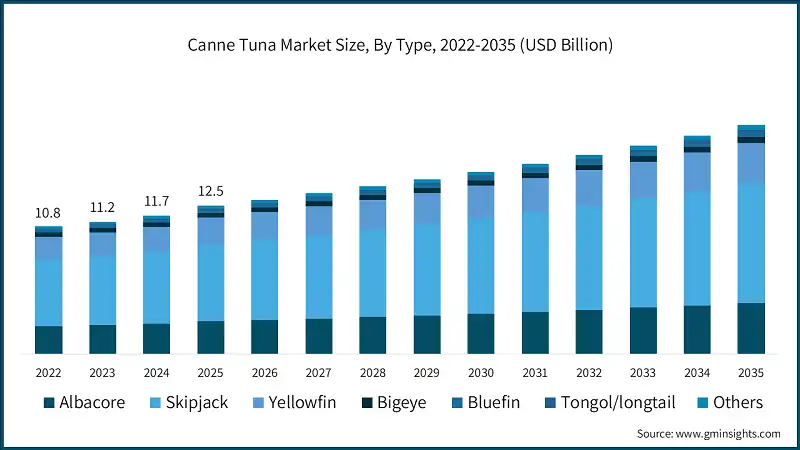
Based on type, the canned tuna market is segmented into albacore, skipjack, yellowfin, bigeye, bluefin, tongol/longtail and others. Skipjack dominated the market with an approximate market share of 52.2% in 2025 and is expected to grow with a CAGR of 4.6% till 2035.
- Skipjack tuna holds the dominant share in the canned tuna market due mainly to its ubiquitous availability, low price, and favorable palatability. The tropical waters have an abundant population of skipjack tuna, and it is easier and less expensive for manufacturers to source it, resulting in lower production costs and competitive prices offered to their consumers. Its readily accessible supply chain and an armor-plated consumer preference for milder flavors seemed to magnify its share in the market.
- A considerable part of the canned market is also occupied by albacore tuna, mainly due to its image as a premium product because of its relatively milder flavor and firmer texture. The health-oriented consumer and the gourmet segments are increasingly drawn to this fish species. The fish typically contains higher omega-3 content and is widely perceived to be of better quality, allowing it to be priced up, making it appealing to the niche market segments focusing on health benefits. .
- Yellowfin is regarded as a little stronger in flavor and quite firm in texture, thus used even in traditional and modern recipes that would have been used for canned products. Demand for yellowfin not only increases with prices but also increases in areas with consumers wanting a compromise between the cheaper option of skipjack and the premium option of albacore.
- Bigeye and bluefin tuna are normally viewed as premium and high-value species that are reserved for specialty and sushi-grade markets only. Tongol/Longtail and other rare species have only "niched" markets that are frequently sold in specific regional recipes or specialty producers. Their contribution in the overall market remains pretty limited such that skipjack continually prevails because of sheer abundance and cost-effectiveness.
Learn more about the key segments shaping this market
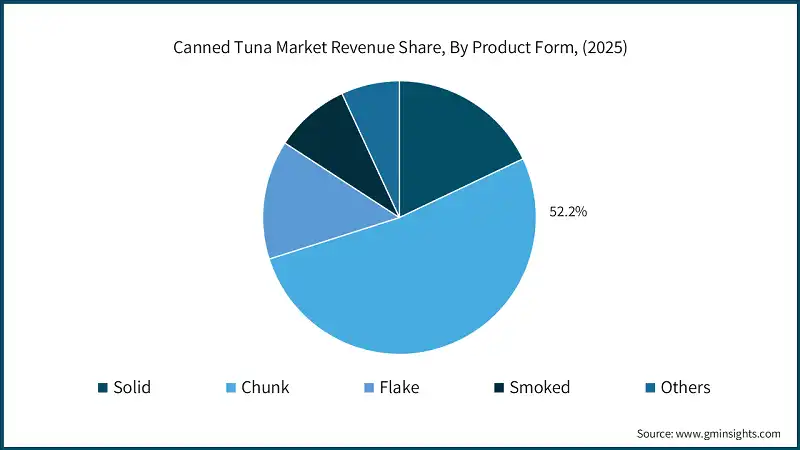
Based on product form, the canned tuna market is segmented into solid, chunk, flake, smoked and others. Chunk held the largest market share of 52.2% in 2025.
- Chunk segment dominate the market, as texture is most appealing among the consumers and food manufacturers for many recipes and applications. The chunk is in high demand and can be effortlessly tossed into salads, sandwiches, and ready-to-eat meals sold through retail and food service.
- Canned solid is also preferred due to its long shelf life and convenience for the consumer who wants a quick protein source. Traditional tunas are still acceptable to households supporting the demand in this category, although slightly less than chunk, as they require an easy-to-eat format.
- Flaked tuna is quite soft and tender and is hence used in recipes requiring easy amalgamation, such as salads and pasta. Niche markets focused on culinary versatility serve the flaked variety, which enjoys steady growth but relatively moderate compared to other forms. The smoked variety, although it carries a premium price tag, finds its way into the gourmet and specialty markets.
Based on container type, the canned tuna market is segmented into metal cans, flexible pouches (retort pouches), glass jars and others.
- Metal cans have long been the predominant type of container for canned tuna, primarily due to their sensible durability, cost effectiveness, and developed infrastructure for manufacturing. Metal cans have thus become the preferred choice among bulk storage containers with a long shelf life, which helps retain their strong market presence.
- Flexible pouches- especially retort pouches are gaining ground on account of their lightweight, convenience, and portability for busy consumers looking for easy-to-open single servings thus stimulating innovations and growth for this segment.
- While glass jars might not find many applications, these appeal more towards the premium segments and gourmet lines because of aesthetics and quality perception thereby ensuring niche markets that are more concentrated on artisanal and organic products; higher cost remains the deterrent for mass applications.
Based on end use, the canned tuna market is segmented into retail/household consumption, foodservice (restaurants, hotels, catering), institutional (schools, hospitals, military, corporate), food processing & manufacturing, pet food and others.
- As it's affordable & widely eaten as a quick, nutritious meal or snack to be consumed by people, this product is preferred in retail and household consumption. Foodservice establishments, especially restaurants, hotels, and catering services, have become a very major contributor to the demand for ready-to-eat seafood products because of lifestyle changes among consumers.
- Generous in institutionalizing facilities such as schools, hospitals, military, and corporate cafeterias, a steady demand for providing protein-rich and easy to serve in mass preparations continues.
- Food-processing and manufacturing companies use the canned tuna ingredient in ready-to-eat meals, salads, and snacks, mostly because of the need for consumer packaged protein sources.
- The pet food segment is booming as it inspires pet owners to develop nutritious and high-protein alternatives in pet diets, driving some innovations into new formulations of pet foods containing canned tuna.
- These include specialized diets and the fast-growing export market, as consumer patterns and regional preferences increasingly become diverse from one another and further broaden the total market.
Based on distribution channel, the canned tuna market is segmented into mass retailers (supermarkets, hypermarkets, warehouse clubs), convenience stores, online retail & E-commerce, specialty & health food stores, foodservice distributors, export/international distributors and others.
- Supermarkets, hypermarkets, and warehouse clubs operate as the widely distributed sales channels with a large reach, bulk purchasing powers, and higher consumer footfall, which renders it as the main channels for canned tuna sales.
- Convenience stores are steadily increasing in importance as consumers seek quick on-the-go meal solutions, underpinning steady growth due to urbanization and busy lifestyles.
- This medium is now witnessing a paradigm shift in which technology is becoming an enabler for online retail and e-commerce, witnessing growing demand for an extended assortment of canned tuna products, which can easily be accessed by the consumers.
- Health and specialty stores have opened up attractive streaming channels for health-conscious consumers by presenting premium, organic, and sustainably sourced canned tuna options; thereby fostering product innovations and premiumization.
- Foodservice distributors are crucial sources of canned tuna for restaurants, canteens, and catering services. Export and international distributors would extend the market by undertaking cross-border trade, especially in emerging regions with demand for processed seafood, thus supporting global growth.
Looking for region specific data?
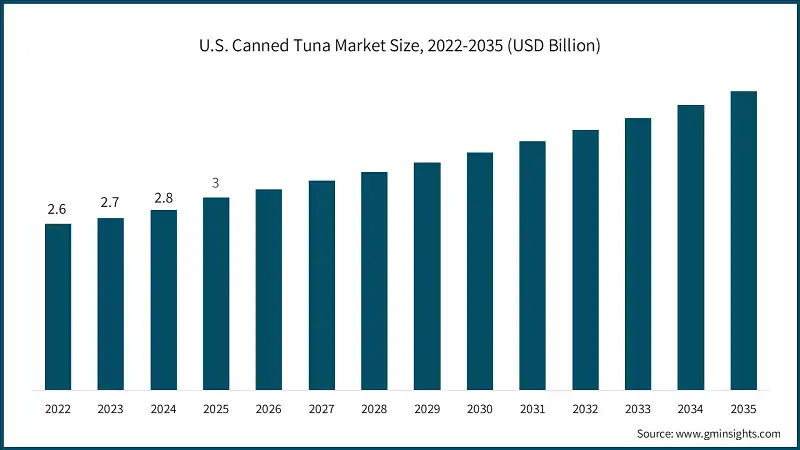
The canned tuna market in North America will grow at a CAGR from approximately 4.6% between 2026 and 2035 with US occupying market of USD 3 billion in 2025.
- Consumer awareness of health and wellness increases the demand for sustainably sourced and organic canned tuna options and motivates a shift towards more eco-friendly fishing and processing practices by manufacturers.
- Adoption of advanced fishing technologies including selective fishing gear and vessel tracking systems ensures sustainable harvesting in line with regulatory and consumer expectations on sustainability.
- Innovations in packaging, such as eco-friendly and lightweight materials, achieve the sustainability standard for brands and attract eco-conscious consumers. Therefore, the introduction of plant-based and alternative protein will redirect product development by companies toward the creation of premium and flavored canned tuna varieties.
The canned tuna markets in Europe, especially in a few countries like Germany, are expected to grow with a rapid pace in the coming years.
- Heavy governmental regulations on the environment combined with a strong Though the consumers in today's world are demanding, they have become quite conscious about the environment, thus causing them to prefer responsible sourcing and sustainable fishing practices with a clear preference towards eco-label certifications such as MSC.
- Continued R&D in processing techniques, e.g. improved canning methods and preservation techniques, will improve product quality for consumer demand for freshness and nutrition and lengthen shelf life.
- The market in Europe is adopting clean label and allergen-free formulations, increasing interest in environmentally friendly packaging and sustainable sourcing innovations.
- Premium ready-to-eat seafood products are in great consumer demand, and are being explored for new innovative flavors, formats, and health-centric formulations, the potential of which combines to expand the market.
The canned tuna market in China and India is expected to have lucrative growth between 2026 and 2035, with CAGR 4.3% in the Asia Pacific region.
- The cause of this high demand, especially among health-conscious young consumers, is the transforming urbanization and growth in real disposable income that has led to greater consumption of high-quality sustainably sourced canned tuna.
- Policies by governments to support responsible sourcing and environmentally friendly production practices are already driving sustainability in fishery and manufacturing practices.
- Nowadays, the increasing adoption of organic and natural food products with significant growth of health and wellness sectors drives brands to create innovations which encompass eco-friendly packaging and sustainable ingredients.
- Advanced technologies in fishing and processing are being invested to improve efficiency, reduce waste, and promote sustainable supply chains across the value chain.
Between 2026 and 2035, the canned tuna market for canned tuna in the Middle East is projected to grow significantly during this period, with approximate CAGR of 4.8%.
- Rising tourism, hospitality, and wellness sectors create demand for sustainable seafood products of the highest quality and best practices for resource management as well as environmentally conscious sourcing and processing.
- Government initiatives are geared towards the development of environmentally sustainable practices and healthy living would spur the adoption of environmentally friendly technologies for tuna processing.
- The introduction of biological and thermal processing innovations will reduce costs and improve the overall sustainability profile of canned tuna products across the continent.
Between 2025 and 2034, a promising expansion of the canned tuna sector is foreseen in Latin America.
- Policies designed with the aim of promoting sustainability in fisheries and green extraction techniques have created a favorable environment for eco-conscious innovation in the production of canned tuna.
- Rising disposable income levels and an increasing amount of scientific research into natural and sustainable ingredients will also create additional support for product development in alignment with eco-friendly and health-focused trends.
- The new advanced fishing, processing, and packaging technologies concentrated on minimizing environmental impacts indeed have catalyzed growth and innovation within the regional market.
Canned Tuna Market Share
Canned tuna industry is moderately consolidated with players like Thai Union Group, Dongwon Industries, Bolton Food, Century Pacific Food and Bumble Bee Foods accounts for 47.8% market share in 2025.
The canned tuna market consists of such leading companies operating mostly in their regional areas. Their long years of experience with canned tuna allow these companies to maintain a strong market position worldwide. Their product offerings are diverse and majorly supported by production capacities and distribution networks, which can serve the increasing demand for canned tuna in various regions.
Canned Tuna Market Companies
Major players operating in the canned tuna industry includes:
- American Tuna
- Bumble Bee Foods
- Century Pacific Food
- Crown Prince
- Dongwon Group
- Nauterra
- Princes Food
- Safe Catch
- StarKist Co.
- Thai Union Group
- Wild Planet Foods
Thai Union Group has extensive processing capacity in Thailand and global distribution networks. Thai Union also markets other major brands such as Chicken of the Sea, John West, and Mareblu, serving different geographic markets and consumer segments. The market position of the company is vertically integrated, whereas, from tuna procurement, processing, and distribution, the company gains efficiency and control over its supply chain.
Dongwon Industries is a conglomerate of South Korea which is involved significantly in tuna processing and has wider dimensions of global distribution. The company is involved in fishing, processing, and distributing tuna to its markets in Asia and around the world. The market position of Dongwon reflects the vertical integration along with a strong presence in Asian markets.
Bolton Food operates major European brands including Rio Mare, Saupiquet, and Palmera. Bolton Food invested in sustainability certification and traceability systems as a response to the European consumers' preference for environmentally conscious seafood.
Century Pacific Food is a major Philippine processor with strong domestic market presence and export operations. Its processing infrastructure and competitive labor cost advantages relate to the proximity to Western Pacific tuna fishing grounds. Century Pacific does both national business within the Philippines and external trade with marketplaces such as the USA.
Bumble Bee Foods is a major U.S. brand that has an established market presence and depth of retail distribution. Bumble Bee has delineated a sustainability path that included dolphin-safe sourcing and MSC certification, thus maintaining consumer trust and competitive positioning.
Canned Tuna Market Report Attributes
| Key Takeaway | Details |
|---|---|
| Market Size & Growth | |
| Base Year | 2025 |
| Market Size in 2025 | USD 12.5 Billion |
| Market Size in 2026 | USD 13 Billion |
| Forecast Period 2026-2035 CAGR | 4.5% |
| Market Size in 2035 | USD 19.4 Billion |
| Key Market Trends | |
| Drivers | Impact |
| Increasing protein diet | Boosts consumer demand for canned tuna as a convenient, high-protein food source |
| Expansion of the food industry | Expands distribution channels and product availability of canned tuna globally |
| Convenience trend driving flavored & pouch formats | Encourages innovation and diversification in canned tuna products to meet on-the-go consumer preferences |
| Pitfalls & Challenges | Impact |
| Price volatility of tuna | Leads to fluctuating production costs and potential supply shortages, impacting market stability |
| Competition from alternative proteins | Challenges canned tuna’s market share as consumers shift towards plant-based and other protein sources |
| Opportunities: | Impact |
| Growing demand for ready-to-eat protein options | Drives increased sales of canned tuna as a quick, nutritious meal solution |
| Rising interest in eco-friendly packaging | Opens avenues for canned tuna brands to adopt sustainable packaging and attract environmentally conscious consumers |
| Market Leaders (2025) | |
| Market Leaders |
17.4% |
| Top Players |
Collective Market Share of 47.8% in 2025 |
| Competitive Edge |
|
| Regional Insights | |
| Largest Market | Europe |
| Fastest growing market | Middle East & Africa |
| Emerging countries | Saudi Arabia, South Africa, UAE |
| Future outlook |
|
What are the growth opportunities in this market?
Canned Tuna Industry News
- In October 2025, Envasur began its exports of canned tuna to Dubai, representing around 6,600 boxes of Tunnis brand tuna; in fact, this increase in commercial traffic opens the first trade barriers that are expected to develop for the future in the region about tuna trade.
- In June 2025, Bolton, WFF, and Oxfam joined together at Milan's Together for Positive Impact event to forge new partnerships around sustainable fishing, ocean protection, and human rights at sea, all as part of their commitment to structural change in the tuna industry.
- In March 2023, Thai Union, one of the very largest canned tuna producers worldwide, would purchase tuna exclusively from fishing vessels operational measures of which will reduce incidental catch risks against vulnerable species. This would form part of the entire mechanism of global plans to reduce bycatch and promote responsible fishing practices.
This canned tuna market research report includes in-depth coverage of the industry, with estimates & forecasts in terms of revenue (USD Billion) and volume (Kilo Tons) from 2022 to 2035, for the following segments:
Market, By Type
- Albacore
- Skipjack
- Yellowfin
- Bigeye
- Bluefin
- Tongol/longtail
- Others
Market, By Product Form
- Solid
- Chunk
- Flake
- Smoked
- Others
Market, By Container Type
- Metal cans
- Flexible pouches (retort pouches)
- Glass jars
- Others
Market, By End Use
- Retail/household consumption
- Foodservice (restaurants, hotels, catering)
- Institutional (schools, hospitals, military, corporate)
- Food processing & manufacturing
- Pet food
- Others
Market, By Distribution Channel
- Mass retailers (supermarkets, hypermarkets, warehouse clubs)
- Convenience stores
- Online retail & e-commerce
- Specialty & health food stores
- Foodservice distributors
- Export/international distributors
- Others
The above information is provided for the following regions and countries:
- North America
- U.S.
- Canada
- Europe
- Germany
- UK
- France
- Spain
- Italy
- Rest of Europe
- Asia Pacific
- China
- India
- Japan
- Australia
- South Korea
- Rest of Asia Pacific
- Latin America
- Brazil
- Mexico
- Argentina
- Rest of Latin America
- Middle East and Africa
- Saudi Arabia
- South Africa
- UAE
- Rest of Middle East and Africa
Frequently Asked Question(FAQ) :
What was the market size of the canned tuna in 2025?
The market size was valued at USD 12.5 billion in 2025, with a CAGR of 4.5% expected through 2035. The market growth is driven by innovations in processing techniques, packaging technologies, and increasing consumer demand for sustainable and premium products.
What is the projected value of the canned tuna market by 2035?
The market is poised to reach USD 19.4 billion by 2035, fueled by advancements in supply chain transparency, health-focused product development, and growing demand for ready-to-eat and gourmet-style tuna.
What is the expected size of the canned tuna industry in 2026?
The market size is projected to reach USD 13 billion in 2026.
What was the market share of the skipjack segment in 2025?
The skipjack segment held an approximate market share of 52.2% in 2025 and is expected to grow at a CAGR of 4.6% through 2035.
What was the valuation of the chunk segment in 2025?
The chunk segment dominated the market with a 52.2% share in 2025, led by its appealing texture and versatility in salads, sandwiches, and ready-to-eat meals.
What is the growth outlook for the canned tuna sector in North America?
The market in North America is projected to grow at a CAGR of approximately 4.6% between 2026 and 2035, with the U.S. market valued at USD 3 billion in 2025. Rising health awareness and demand for sustainably sourced products are key growth drivers.
What are the upcoming trends in the canned tuna market?
Trends include HPP for clean preservation, eco-friendly packaging, blockchain and IoT transparency, clean-label focus, and gourmet flavor innovation.
Who are the key players in the canned tuna industry?
Key players include American Tuna, Bumble Bee Foods, Century Pacific Food, Crown Prince, Dongwon Group, Nauterra, Princes Food, Safe Catch, StarKist Co., Thai Union Group, and Wild Planet Foods.
Canned Tuna Market Scope
Related Reports