Summary
Table of Content

Cannabis Edibles Market
Get a free sample of this report
Form submitted successfully!
Error submitting form. Please try again.
Thank you!
Your inquiry has been received. Our team will reach out to you with the required details via email. To ensure that you don't miss their response, kindly remember to check your spam folder as well!
Request Sectional Data
Thank you!
Your inquiry has been received. Our team will reach out to you with the required details via email. To ensure that you don't miss their response, kindly remember to check your spam folder as well!
Form submitted successfully!
Error submitting form. Please try again.
Cannabis Edibles Market Size
- The cannabis edibles industry is experiencing continuous growth because consumers now prefer sustainable and environmentally friendly products. The industry requires businesses to implement environmentally friendly methods through sustainable material sourcing and the use of compostable product packaging and the creation of transparent product labels. The increasing importance of sustainability in purchasing decisions enables brands that meet these customer needs to achieve greater market success. The changing consumer perspective drives market growth because it attracts eco-friendly customers who are willing to pay more for premium goods.
- The food and beverage industry is using cannabis in multiple ways to create new market opportunities. Manufacturers use advanced infusion methods to add cannabinoids into candy products and baked goods and snack items and ready-to-drink beverages. The company expansion into major food sectors enables customers to access products from different markets. The growing range of edible innovations leads to higher cannabis-infused product consumption which boosts the cannabis market value.
- The personal care and cosmetics markets are experiencing increasing consumer interest for cannabis products. The growing relationship between cannabis and wellness has created demand for cannabis products which now supports the cannabis edibles market. Customers now recognize cannabinoid-based skincare products because they understand the benefits of these products which leads to better market acceptance of cannabis-derived items. The wider adoption of cannabis-based products has enabled brands to expand into new market segments while making consumers more confident about using cannabis products.
The global cannabis edibles market was estimated at USD 14.8 billion in 2025. It is expected to grow from USD 17.1 billion in 2026 to USD 60.2 billion by 2035, at a CAGR of 15%, according to latest report published by Global Market Insights Inc.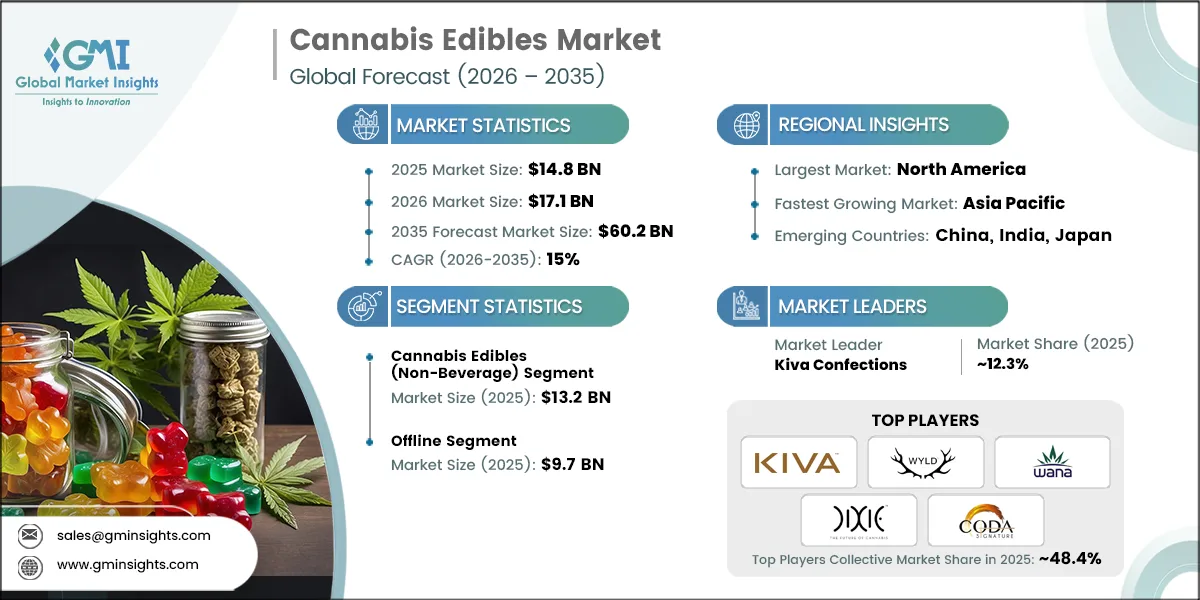
Cannabis Edibles Market Key Takeaways
Market Size & Growth
- 2025 Market Size: USD 14.8 Billion
- 2026 Market Size: USD 17.1 Billion
- 2035 Forecast Market Size: USD 60.2 Billion
- CAGR (2026–2035): 15%
Regional Dominance
- Largest Market: North America
- Fastest Growing Region: Asia Pacific
Key Market Drivers
- Growing consumer preference for eco-friendly products.
- Expanding applications in food and beverage sector.
- Rising demand in personal care and cosmetics industries.
Challenges
- High production costs.
- Limited availability of raw materials.
Opportunity
- Expansion of Biosurfactant Production through Biotechnology.
- Rising Demand for Sustainable Ingredients in Personal Care and Home Care Products.
Key Players
- Market Leader: Kiva Confections led with over 12.3% market share in 2025.
- Leading Players: Top 5 players in this market include Kiva Confections, Wyld, Wana Brands, Dixie Elixirs, Coda Signature, which collectively held a market share of 48.4% in 2025.
Get Market Insights & Growth Opportunities
To get key market trends
Cannabis Edibles Market Trends
- The demand for low-dose cannabis edibles has grown as consumers want products which deliver consistent and predictable effects. Manufacturers create products which deliver results through their special formulations which target relaxation and sleep support and focus and stress relief. The current market trend supports the creation of micro-dosed gummies and chocolates and drinks which customers who want to experience balanced consumption can use.
- The edible product range of companies keeps growing through the introduction of new product formats which include infused beverages and baked goods and fast-acting gummies and dissolvable products. Consumers who want to buy high-quality cannabis edible products now prefer products which contain premium ingredients and natural flavors and gourmet formulations. The market competition requires brands to use this innovation for product differentiation while developing better relationships with their customers.
- Health-conscious consumers prefer cannabis edibles which contain organic and vegan and clean-label ingredients. The manufacturing industry has started to use natural fruit extracts together with plant-based sweeteners and minimally processed ingredients for their product development. The current market trend leads companies to emphasize product ingredient quality while they develop new products.
- The development of fast-acting cannabis edibles arises from technological advancements which have improved cannabinoid infusion and nanoemulsion technologies. The new formulations show better bioavailability because they improve product absorption speed while reducing the time needed for users to feel effects. Companies need to invest in advanced formulation technologies which help them develop products with better performance and create predictable customer experiences.
Cannabis Edibles Market Analysis
Learn more about the key segments shaping this market
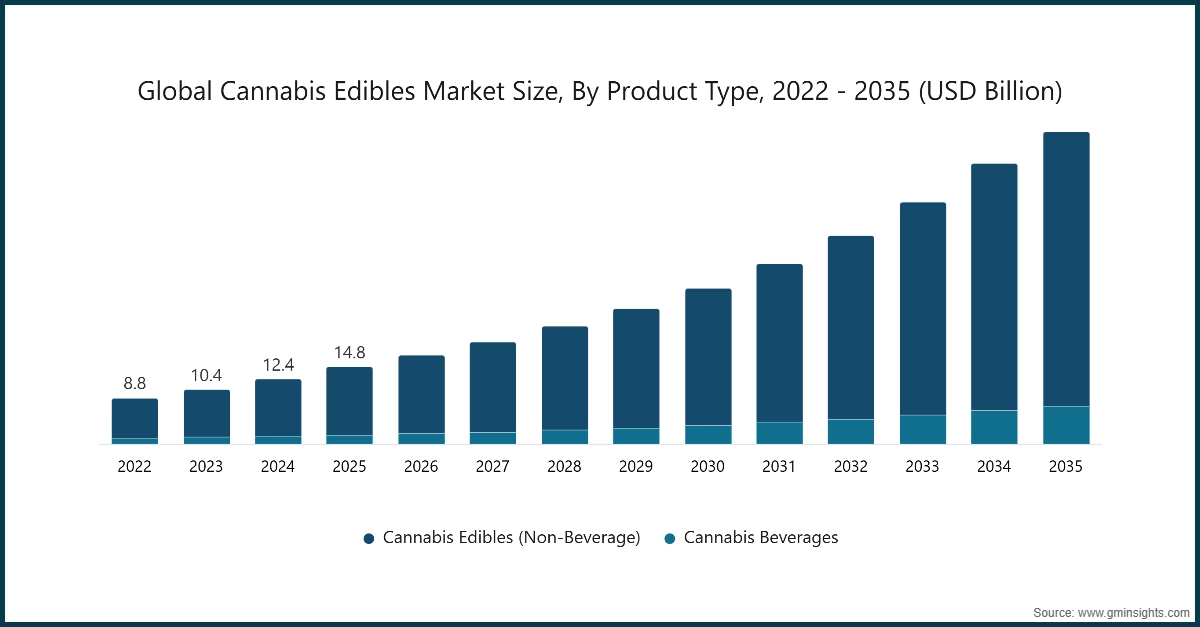
Based on product type, the market is segmented into cannabis edibles (non-beverage), and cannabis beverages. Cannabis edibles (non-beverage) holds a significant share at a valuation of USD 13.2 billion in 2025.
- The cannabis edibles market presents a wide range of products which manufacturers develop to meet changing needs of their customers who consume cannabis products. The market for non-liquid edible products which includes gummies chocolates and baked goods and confectionery items maintains strong consumer demand because these products offer easy use and extended shelf life and exact dosage features. The products allow users to consume their products secretly while controlling their cannabinoid intake which makes them appropriate for both recreational users and people who use products for health benefits.
- The cannabis-infused beverage market is currently experiencing growth because companies are testing new drinking formats which match current social drinking patterns and lifestyle choices. The development of cannabinoid infusion technologies leads to better product performance because it enhances product stability and improves taste and reduces time to achieve desired effects which results in wider consumer acceptance.
Based on packaging, the cannabis edibles market is segmented into plastic, glass, cartons, metal cans, and others. Plastic holds a significant share at a valuation of USD 7.2 billion in 2025.
- The cannabis edibles industry uses various packaging methods which help maintain product safety and freshness while meeting all required regulations. The industry standards require plastic packaging to be used because its lightweight construction and economical pricing and design adaptability enable its use in making gummies and chocolates and confectionery products. The cannabis industry is adopting glass packaging for premium edible items because this material delivers better product protection and preserves taste and creates a brand image which appeals to high-end customers in the premium cannabis market.
- The packaging of edible products which includes infused snacks and beverages now uses cartons and metal cans because these materials provide both product safety and easy storage. Manufacturers choose carton-based packaging for their secondary packaging needs because it provides sustainable benefits while enabling effective brand promotion. Manufacturers use metal cans to package cannabis-infused beverages because these containers deliver both long-lasting protection and extended product freshness.
Learn more about the key segments shaping this market
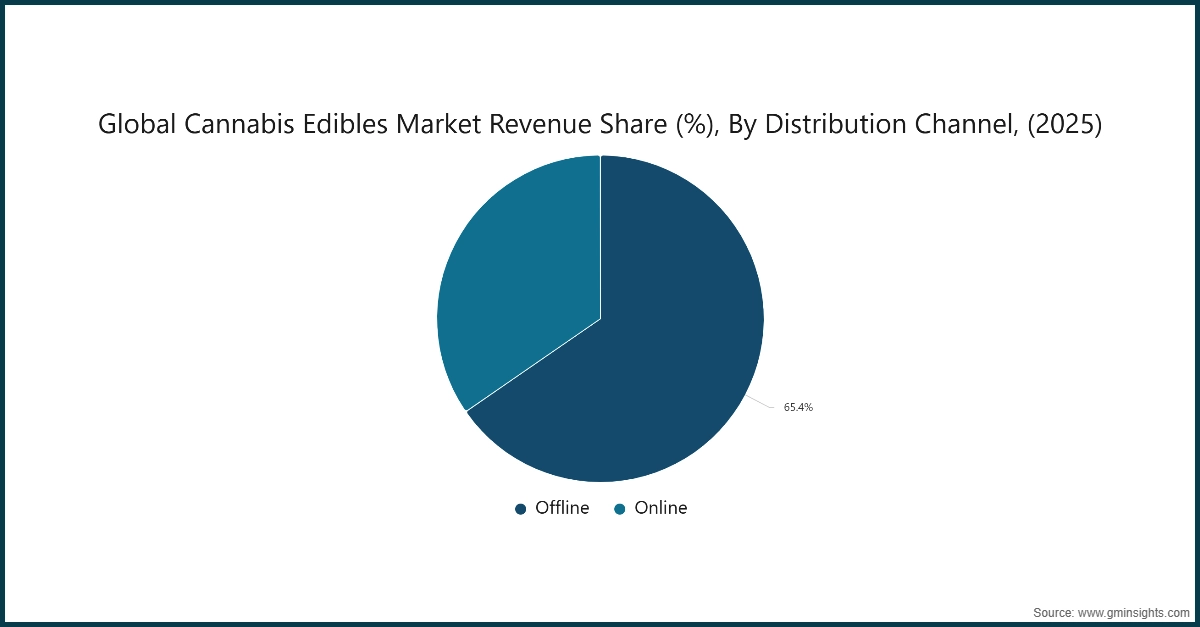
- The cannabis edibles industry depends on physical retail infrastructure which involves licensed dispensaries and specialty cannabis stores and regulated retail outlets to distribute products. The distribution channels enable consumers to legally purchase edible products while their age verification needs and regulatory requirements are met. Through retail spaces customers can receive product information which helps them understand dosage instructions and product options and cannabinoid content which leads to better purchasing decisions and increased trust in the brand.
- Digital platforms are becoming an essential distribution channel for cannabis edible products in regulated markets which use traditional retail channels as their main distribution method. Through online sales channels customers can access products more easily and brands can connect with them directly. Businesses are putting more money into digital storefronts and delivery services and online ordering systems to expand their customer base.
Looking for region specific data?
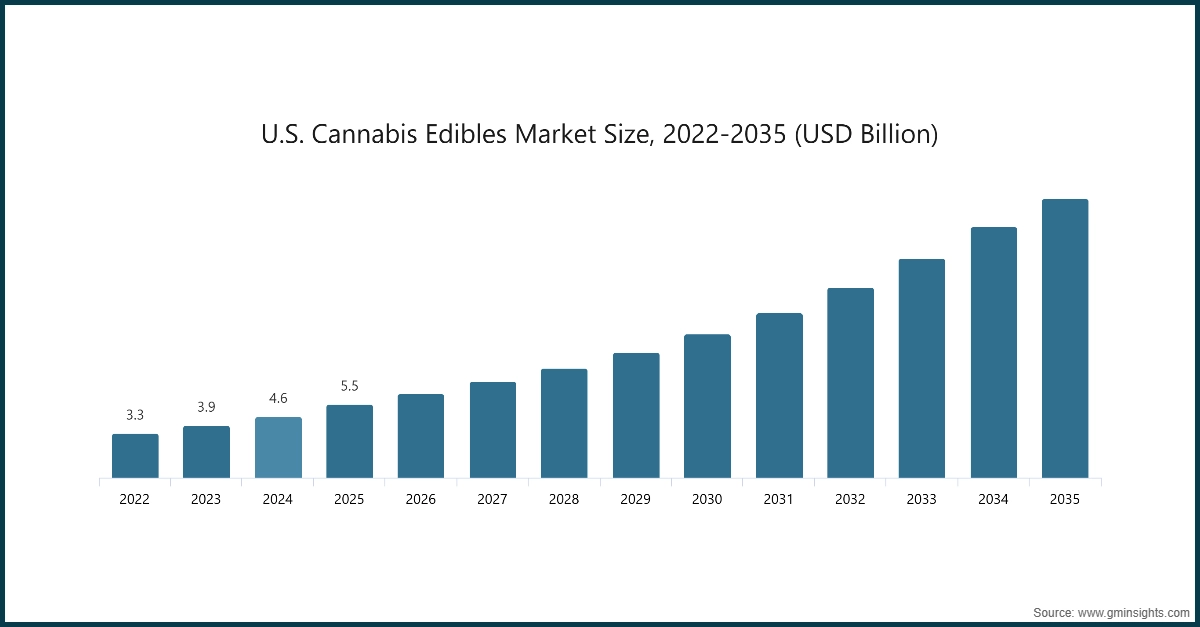
- The United States cannabis edibles market in North America reaches considerable proportions because multiple states have legalized cannabis consumption while consumers show high demand for alternative cannabis products. Product innovation receives its momentum from the rising market demand for gummies and chocolates and infused beverages. Canadian cannabis producers develop their edible products and their retail distribution systems because the country has implemented nationwide cannabis legalization and established regulatory systems.
- The cannabis edibles indutsry throughout North America experiences profitable growth because more people accept cannabis products and regulatory bodies keep developing new laws. The market requirements are driving manufacturers to create edible products which contain low doses and functional ingredients and premium characteristics. The regional market development receives additional support from expanding dispensary networks and strong brand competition and the rising product availability in retail channels.
Europe accounted for USD 3 billion in 2025 and is anticipated to show lucrative growth over the forecast period.
- The European cannabis edibles market depends on Germany because of its growing medical cannabis program and its current policy discussions about cannabis regulations. The country’s pharmaceutical system and research programs are creating favorable conditions for cannabis-based edible product development. The Netherlands and Switzerland are both helping to expand their cannabis markets by testing pilot projects and allowing restricted cannabis business operations.
- The European market is growing at a consistent pace because of new regulations and increasing consumer knowledge about cannabinoid wellness products. The market growth is driven by research funding and pharmaceutical industry partnerships and new product development. The regional market is experiencing growth because of rising consumer demand for cannabis-infused confectionery and nutraceutical edible products which offer controlled dosage options.
Asia Pacific market accounted for USD 2.5 billion in 2025 and is anticipated to show lucrative growth over the forecast period.
- Australia serves as a key element for the Asia Pacific cannabis edibles industry because of its medical cannabis legalization and improved access to cannabinoid treatments for patients. Thailand is experiencing significant market growth because of new laws that permit cannabis commercialization and product innovation. The current situation creates opportunities for developing cannabis-infused food products and wellness formulations that meet changing consumer demands.
- Regulatory changes have created more access to cannabis products which has resulted in increased market growth and higher consumer spending and improved knowledge about cannabis medical products in the Asia Pacific cannabis edibles market. The market for edible cannabis formulations is expanding because more consumers want plant-based wellness solutions and nutraceutical products. Research activities and new policy developments are helping to create a business environment which enables product development and market growth throughout the entire area.
Latin America market accounted for 9.2% market share in 2025 and is anticipated to show steady growth over the forecast period.
- Brazil maintains a significant position in the Latin American cannabis edibles industry because it became the first country to legalize recreational cannabis and create controlled systems for cannabis farming and distribution. Mexico is experiencing higher market activity because their medical cannabis rules change and people increasingly accept cannabis use. The current situation brings new investment opportunities for cannabis product development which includes the creation of edible products.
- The cannabis edibles market in Latin America is developing because regulations are becoming more permissive while people show greater interest in cannabinoid treatments. The region depends on its advantageous agricultural climate and its growing cannabis farming operations to supply essential raw materials. The region experiences rapid growth in cannabis edible products because people now understand cannabis-derived wellness solutions and pharmaceutical research leads to more cannabis-derived beverages.
Middle East and Africa market accounted for 8.6% market share in 2025 and is anticipated to show steady growth over the forecast period.
- Israel functions as the main force behind the Middle East & Africa cannabis edibles market because the country has established a robust medical cannabis system and built extensive research facilities. The country has developed advanced clinical research capabilities that enable scientists to develop products based on cannabinoid medications. South Africa is also contributing to regional growth through evolving cannabis regulations and increasing cultivation activities which support cannabis-based product manufacturing.
- The Middle East & Africa cannabis edibles market is growing slowly as authorities discuss changing medical cannabis rules. Research activities about cannabis-derived health benefits are increasing which drives product research efforts. Herbal wellness products and pharmaceutical cannabis applications have become popular among people which creates new business opportunities for cannabis edible manufacturers throughout the region.
Cannabis Edibles Market Share
The cannabis edibles industry has moderate competition because both large cannabis operators and specialized edible product brands compete in this market. The top five companies Kiva Confections, Wyld, Wana Brands, Dixie Elixirs and Coda Signature control 48.4% of the global cannabis edibles industry share in 2025 which shows that the industry has developed into a semi-consolidated structure where strong brand competition exists. The companies have built strong market positions through their broad product range which includes gummies chocolates beverages and confectionery products while they use brand recognition and distribution contracts to access regulated cannabis markets.
Companies currently use product innovation and expansion of cannabinoid-based formulations and distributor retailer partnerships to maintain their competitive edge. Market participants are increasing their product offerings by introducing new flavors and fast-acting formulations and functional products which provide specific effects for relaxation and sleep and wellness needs. Companies are improving their market position through multi-state expansion and brand licensing agreements and advanced extraction and infusion technology investments which help them create products with better consistency and precise dosage delivery and enhanced consumer experience.
Cannabis Edibles Market Companies
Major players operating in cannabis edibles industry are:
- Canna River
- Wana Brands
- Copperstate Farms
- Kiva Confections
- Wyld
- Plant Jam (Cloud Creamery)
- Dixie Elixirs
- Naturecan
- Coda Signature
- Bhang Corporation
- Uncrate
- Village Farms International Inc
Kiva Confections established its business in 2010. The company which operates from Oakland California now produces top-quality cannabis edibles which include infused chocolates and gummies as well as mints and chews. The company develops customer experiences through its precise dosing methods and premium ingredients and its creation of high-end products. The company operates multiple brands including Camino and Terra and Petra and Lost Farm. Kiva products are available at licensed dispensaries throughout the United States and Canada which makes the brand one of the most popular edible products in the market.
Wyld is a U.S.-based cannabis edibles company which the company established in 2015 in Oregon to produce cannabis gummies that contain fruit flavors. The brand creates predictable effects which include relaxation and energy and sleep through its use of natural ingredients and real fruit flavors and its consistent dosing of cannabinoids. Wyld has established itself as one of the leading cannabis edible brands in the United States which it sells across multiple states where cannabis use is legal. The company offers both CBD gummies and cannabis-infused beverages as part of its product line.
Wana Brands founded its business in 2010 from Colorado to establish itself as one of North America’s biggest cannabis edibles producers which now sells its THC and CBD gummies. The company creates products through its research-based development process which delivers specific results that treat sleep problems and relaxation needs and pain management requirements. The company distributes its products through licensing agreements across the United States and Canada and Puerto Rico. The company holds the top market position as the leading cannabis edibles brand in North America across several markets which track consumer spending.
Dixie Elixirs established its business in 2009 from Denver Colorado to become a trailblazer for cannabis-infused consumer products. The brand started its business by selling THC beverages but now provides a complete line of edible products which include tinctures and topicals and concentrates. Dixie develops products through scientific methods which guarantee customers will experience the same strength and taste in all products. The company uses licensing agreements and distribution partnerships to sell its products in all legal cannabis markets.
Coda Signature established its business in 2015 from Colorado to become a premium cannabis edibles company which specializes in chocolate bars and truffles and fruit-based edibles. The brand creates a high-end market image through its development of new flavor combinations which use top-quality ingredients. Coda Signature products are available at hundreds of dispensaries throughout major cannabis markets in the United States which include Colorado and California. The company has won many industry awards which recognize its outstanding product development and product quality of infused edibles.
Cannabis Edibles Market Report Attributes
| Key Takeaway | Details |
|---|---|
| Market Size & Growth | |
| Base Year | 2025 |
| Market Size in 2025 | USD 14.8 Billion |
| Market Size in 2026 | USD 17.1 Billion |
| Forecast Period 2026-2035 CAGR | 15% |
| Market Size in 2035 | USD 60.2 Billion |
| Key Market Trends | |
| Drivers | Impact |
| Growing consumer preference for eco-friendly products | Accelerates market expansion by driving demand for sustainable and clean-label formulations. |
| Expanding applications in food and beverage sector | Enhances market size through increased integration into diversified product categories. |
| Rising demand in personal care and cosmetics industries | Strengthens cross-industry adoption, supporting overall market growth. |
| Pitfalls & Challenges | Impact |
| High production costs | Constrains profit margins and limits large-scale commercialization. |
| Limited availability of raw materials | Creates supply chain disruptions, impacting consistent product availability. |
| Opportunities: | Impact |
| Expansion of Biosurfactant Production through Biotechnology | Enables cost optimization and scalable production, improving market competitiveness. |
| Rising Demand for Sustainable Ingredients in Personal Care and Home Care Products | Creates new revenue streams through increased adoption of eco-friendly formulations. |
| Market Leaders (2025) | |
| Market Leader |
Market Share Approximately 12.3% |
| Top Players |
Collective Market Share Approximately 48.4% |
| Competitive Edge |
|
| Regional Insights | |
| Largest Market | North America |
| Fastest growing market | Asia Pacific |
| Emerging countries | China, India, Japan |
| Future outlook |
|
What are the growth opportunities in this market?
Cannabis Edibles Industry News
In 2025, a self-care cannabis edible brand, CaliLily, will begin operations and is planning to make its debut with a wealth of business experience and an increase in cannabis usage. Founded by a duo, its goal is to transform self-care using cannabis infused food with bold flavors and new tastes.
In June 2024, Curaleaf started selling to adults in New York and simultaneously pursued global sales. With the hope of growing their medical marijuana business, they acquired Can4Med, in Poland, along with a Canadian Licensed Cannabis producer which set them back $16 million.
- In June 2024, Ben Kovler reportedly discussed with the founding chairman of Boston Beer Co, Jim Koch about a possible merger.
- Improving Company, a manufacturer of cannabis delicacies containing fruits, herbs, teas and spices, has secured USD 6.7 million in funding, bringing its total funding to USD 11 million as of December 2023.
The cannabis edibles market research report includes in-depth coverage of the industry with estimates & forecast in terms of revenue (USD Billion) & volume (Kilo Tons) from 2022 to 2035, for the following segments:
Market, By Product Type
- Cannabis edibles (non-beverage)
- Gummies and confectionery
- Baked goods
- Other edibles
- Cannabis beverages
- THC-Infused Beverages
- CBD-Infused Beverages
- Mixed cannabinoid beverages
Market, By Packaging
- Plastic
- Glass
- Cartons
- Metal Cans
- Others
Market, By Distribution Channel
Offline
- Online
The above information is provided for the following regions and countries:
- North America
- U.S.
- Canada
- Europe
- UK
- Germany
- France
- Italy
- Spain
- Rest of Europe
- Asia Pacific
- China
- India
- Japan
- South Korea
- Australia
- Rest of Asia Pacific
- Latin America
- Brazil
- Mexico
- Argentina
- Rest of Latin America
- MEA
- UAE
- Saudi Arabia
- South Africa
- Rest of Middle East and Africa
Frequently Asked Question(FAQ) :
What is the market size of the cannabis edibles in 2025?
The market was valued at USD 14.8 billion in 2025 and is expected to grow at a CAGR of 15% through 2035, driven by rising demand for sustainable, premium, and low-dose products.
What is the projected value of the cannabis edibles market by 2035?
The market is poised to reach USD 60.2 billion by 2035, supported by increasing product innovation, legalization trends, and consumer preference for convenient cannabis consumption formats.
What is the expected size of the cannabis edibles industry in 2026?
The market is projected to reach USD 17.1 billion in 2026.
How much revenue did the cannabis edibles (non-beverage) segment generate in 2025?
The cannabis edibles (non-beverage) segment generated approximately USD 13.2 billion in 2025, driven by high demand for gummies, chocolates, and baked goods.
What was the valuation of the plastic packaging segment in 2025?
Plastic packaging held a significant share in 2025, owing to its cost-effectiveness, lightweight properties, and flexibility, making it ideal for packaging gummies and confectionery products.
Which distribution channel dominates the cannabis edibles market?
The offline distribution channel dominated the market with a valuation of USD 9.7 billion in 2025, supported by licensed dispensaries and regulated retail environments ensuring compliance and consumer trust.
Which region leads the cannabis edibles sector?
North America leads the market with USD 6.6 billion in 2025, driven by widespread legalization in the United States and nationwide legalization in Canada.
What are the key trends in the cannabis edibles market?
Key trends include the rise of sustainable packaging, micro-dosed products, premium ingredients, natural flavors, infused beverages, fast-acting gummies, and dissolvable formats, along with increasing consumer preference for eco-friendly and high-quality products.
Who are the key players in the cannabis edibles industry?
Major players include Canna River, Wana Brands, Copperstate Farms, Kiva Confections, Wyld, Plant Jam (Cloud Creamery), Dixie Elixirs, Naturecan, Coda Signature, Bhang Corporation, Uncrate, and Village Farms International Inc.
Cannabis Edibles Market Scope
Related Reports