Summary
Table of Content

Bromine Flame Retardant Market
Get a free sample of this report
Form submitted successfully!
Error submitting form. Please try again.
Thank you!
Your inquiry has been received. Our team will reach out to you with the required details via email. To ensure that you don't miss their response, kindly remember to check your spam folder as well!
Request Sectional Data
Thank you!
Your inquiry has been received. Our team will reach out to you with the required details via email. To ensure that you don't miss their response, kindly remember to check your spam folder as well!
Form submitted successfully!
Error submitting form. Please try again.
Bromine Flame Retardant Market Size
- Growing concerns regarding fire safety and the increasing frequency of fire accidents propel the demand for BFRs globally. Additionally, the expanding construction and automotive sectors in emerging economies contribute significantly to the rising demand for BFRs. Furthermore, technological advancements in BFR formulations, such as halogen-free alternatives, also drive market growth by addressing environmental and health concerns. Thus, the market is expected to attain a market value of over USD 4.23 billion by 2035.
- Environmental and health concerns pose a significant challenge for the bromine flame retardant market. There's increasing scrutiny of the potential toxicity and persistence of BFRs in the environment, leading to regulatory restrictions and consumer skepticism. Moreover, studies linking BFR exposure to health risks, such as hormonal disruptions and developmental issues, have heightened awareness and concerns among the public and policymakers. Addressing these concerns requires innovation in developing safer alternatives and transparent communication to build trust in BFR products. Failure to effectively mitigate these environmental and health challenges could lead to market limitations and reputational damage for BFR manufacturers.
The global bromine flame retardant market was valued at USD 2.47 billion in 2025. It is projected to grow from USD 2.63 billion in 2026 to USD 4.23 billion by 2035, representing 5.4% CAGR from 2026 to 2035, according to latest report published by Global Market Insights Inc.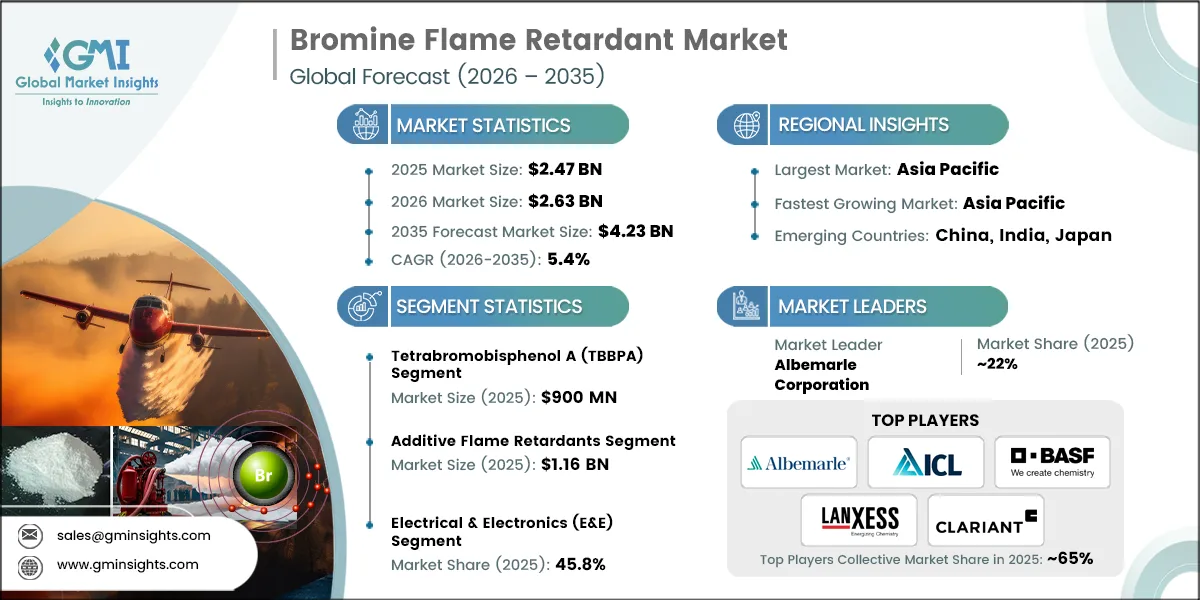
Bromine Flame Retardant Market Key Takeaways
Market Size & Growth
- 2025 Market Size: USD 2.47 Billion
- 2026 Market Size: USD 2.63 Billion
- 2035 Forecast Market Size: USD 4.23 Billion
- CAGR (2026–2035): 5.4%
Regional Dominance
- Largest Market: Asia Pacific
- Fastest Growing Region: Asia Pacific
Key Market Drivers
- Rising fire safety regulations across industrial applications.
- Expanding use in electronics and electrical housings.
- Increasing construction activities requiring fire-resistant materials.
- Growth in transportation sectors using polymer-based components.
Challenges
- Regulatory scrutiny on halogenated flame retardants.
- Rising preference for alternative non-halogen systems.
- Supply fluctuations and pricing of bromine raw materials.
Opportunity
- Development of more efficient, lower-toxicity brominated formulations.
- Growing demand from emerging electronics manufacturing hubs.
- Integration of bromine retardants in advanced polymer blends.
- Adoption in renewable energy components requiring fire resistance.
Key Players
- Market Leader: Albemarle Corporation led with over 22% market share in 2025.
- Leading Players: Top 5 players in this market include Albemarle Corporation, ICL (Israel Chemicals Ltd), BASF SE, Lanxess AG, Clariant AG, which collectively held a market share of 65% in 2025.
Get Market Insights & Growth Opportunities
To get key market trends
Bromine Flame Retardant Market Trends
- The market is moving toward bromine-based systems which provide fire protection while creating less environmental impact. Manufacturers are developing new products with decreased environmental persistence and reduced toxicity and enhanced performance in upcoming polymer materials. The ongoing implementation of stricter regulations in multiple regions enables bromine retardants to maintain their effectiveness as fire safety materials.
- The electronics and electrical manufacturing industry drives market trends because manufacturers produce smaller devices which have higher integration levels and face greater thermal challenges. Brominated retardants continue to be incorporated into housings, connectors, and circuit substrates due to their efficient performance and easy manufacturing process. The increased market demand for consumer electronics and data infrastructure components and electrical mobility products maintains this growth trajectory.
- The construction industry creates new consumption patterns through its demand for fire-resistant insulation materials and cable systems and structural polymers. The combination of urban expansion and more rigorous construction regulations generates a rising demand for flame retardants which must effectively protect modern building materials that include polyurethane foams and polystyrene and engineering plastics.
- The transportation industry embraces lightweight polymer solutions which enable brominated flame retardants to be used in engineering resins for automotive rail and aerospace applications. The need for thermal stability and fire protection in interior components and wire systems and electronic control units leads to more extensive product usage. The renewable energy market is experiencing growth through solar energy components and energy storage systems which create new opportunities for different applications.
Bromine Flame Retardant Market Analysis
Learn more about the key segments shaping this market
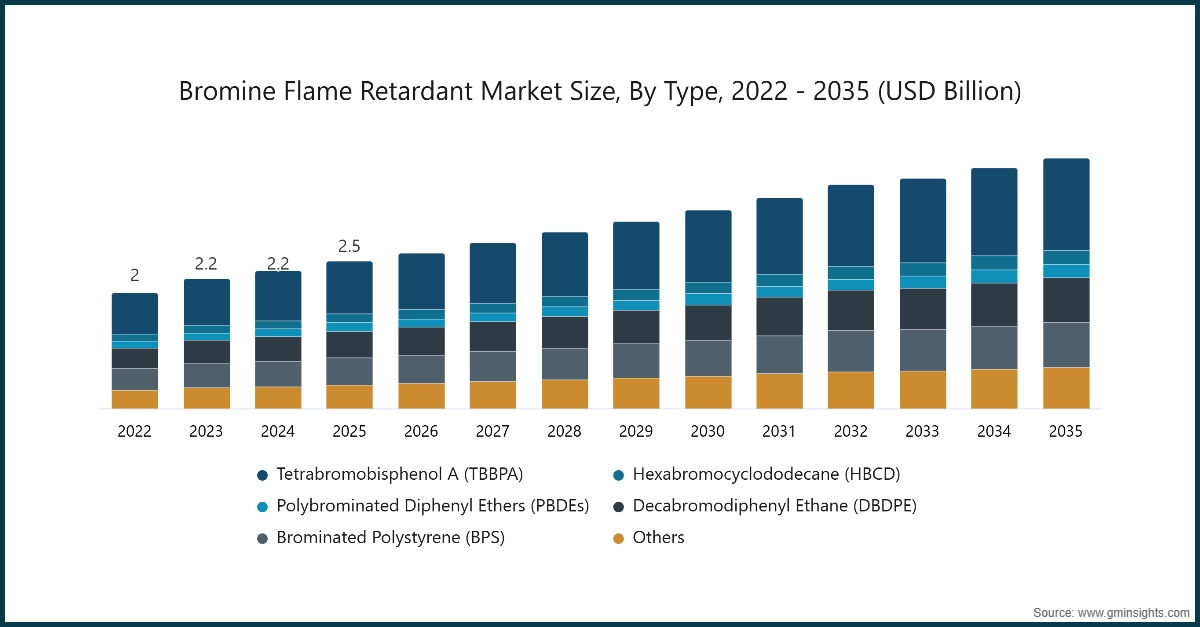
Based on type, the market is segmented into tetrabromobisphenol A (TBBPA), hexabromocyclododecane (HBCD), polybrominated diphenyl ethers (PBDEs), decabromodiphenyl ethane (DBDPE), brominated polystyrene (BPS), and others. The tetrabromobisphenol A (TBBPA) segment was valued at USD 900 million in 2025, and it is anticipated to expand to 5.6% of CAGR during 2026-2035.
- The segment centered on tetrabromobisphenol A shows a strong relationship with various polymer systems which includes the electronic components of electrical systems and engineered materials. The material exhibits processing stability and high-temperature operational performance which manufacturers use to create fire-resistant safety solutions for their complex product requirements.
- The segment growth rate depends on two factors which include All regulatory framework changes and All new material development requirements. TBBPA-based products are being improved by manufacturers to meet current safety standards while maintaining their ability to work with modern resins. The segment maintains its market position because it successfully delivers three essential business requirements which include performance needs and compliance obligations and formulation flexibility.
Bromine flame retardant market based on technology is segmented into reactive flame retardants , additive flame retardants, and polymeric flame retardants. The additive flame retardants segment was valued at USD 1.16 billion in 2025, and it is anticipated to expand to 5.5% of CAGR during 2026-2035.
- The additive flame retardants segment is shaped by its broad compatibility with a wide range of polymers, which supports its use across electronics, construction materials, and transportation components. Its ability to be incorporated during processing without chemically bonding to the polymer gives manufacturers flexibility in tailoring fire‑resistant performance for diverse applications.
- This segment’s progress is also influenced by ongoing innovation focused on improving dispersion, thermal stability, and environmental profiles. Producers are refining additive formulations to meet shifting regulatory expectations and performance requirements, ensuring they integrate effectively into modern material systems. These improvements support steady utilization across industries adopting advanced polymer technologies.
Bromine flame retardant market based on form is segmented into powder/granules, liquid , masterbatch/dispersion, solid crystals. The powder/granules segment was valued at USD 1.58 billion with a market share of 63.7% in 2025, and it is anticipated to expand to 5.3% of CAGR during 2026-2035.
- The powder and granules segment continues to hold strong relevance due to its processing convenience, storage stability, and compatibility with bulk polymer manufacturing. Its ease of incorporation during compounding supports wide usage across electronics, construction materials, automotive components, and engineered plastics that require consistent fire‑resistant performance.
- Advancements in dispersion quality, thermal behavior, and handling characteristics further strengthen the segment’s position. Producers are refining powder‑based formulations to support efficient processing and improved integration with evolving polymer technologies. This encourages stable demand across industries seeking reliable and adaptable flame‑retardant solutions.
Learn more about the key segments shaping this market
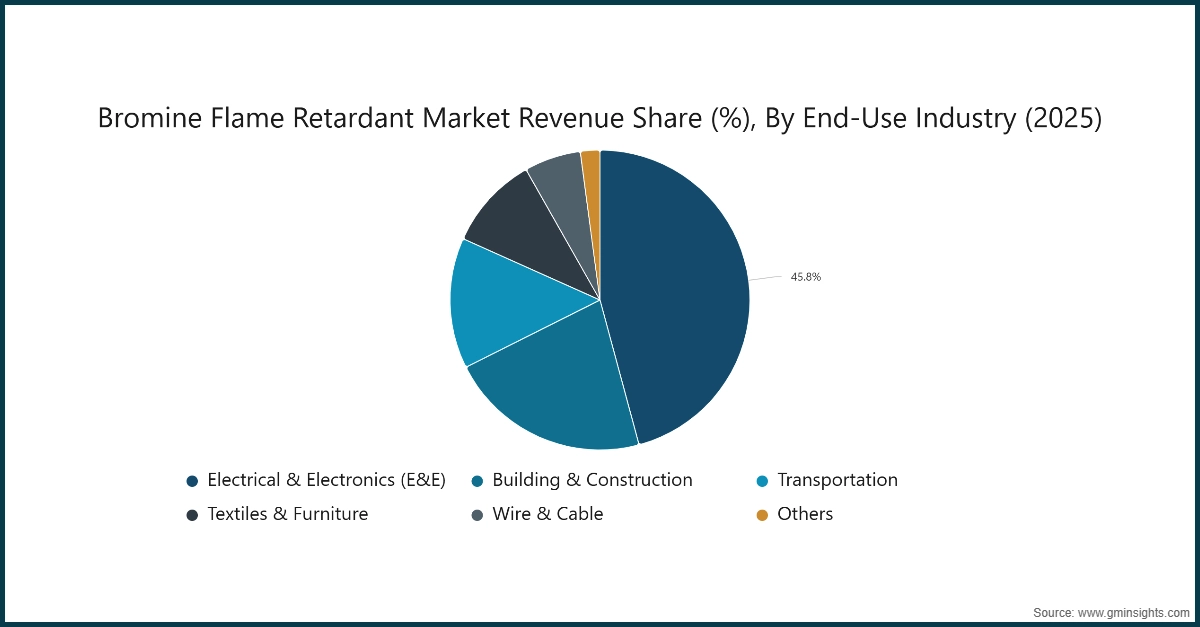
Bromine flame retardant market based on end-use industry is segmented into electrical & electronics (E&E), building & construction, transportation, textiles & furniture, wire & cable, and others. The electrical & electronics (E&E) segment was valued at USD 1.13 billion with a market share of 45.8% in 2025, and it is anticipated to expand to 5.3% of CAGR during 2026-2035.
- The electrical and electronics segment maintains strong relevance due to its extensive use of polymer components that require consistent fire‑resistant performance. Brominated solutions continue to support circuit boards, housings, connectors, and insulation materials, driven by rising device complexity and expanding production of consumer and industrial electronics.
- Growth within this segment is further shaped by increasing deployment of data infrastructure, electric mobility systems, and smart devices. Producers are refining formulations to align with evolving safety expectations and thermal performance needs, supporting stable integration of bromine-based retardants across diverse electronic applications.
Looking for region specific data?
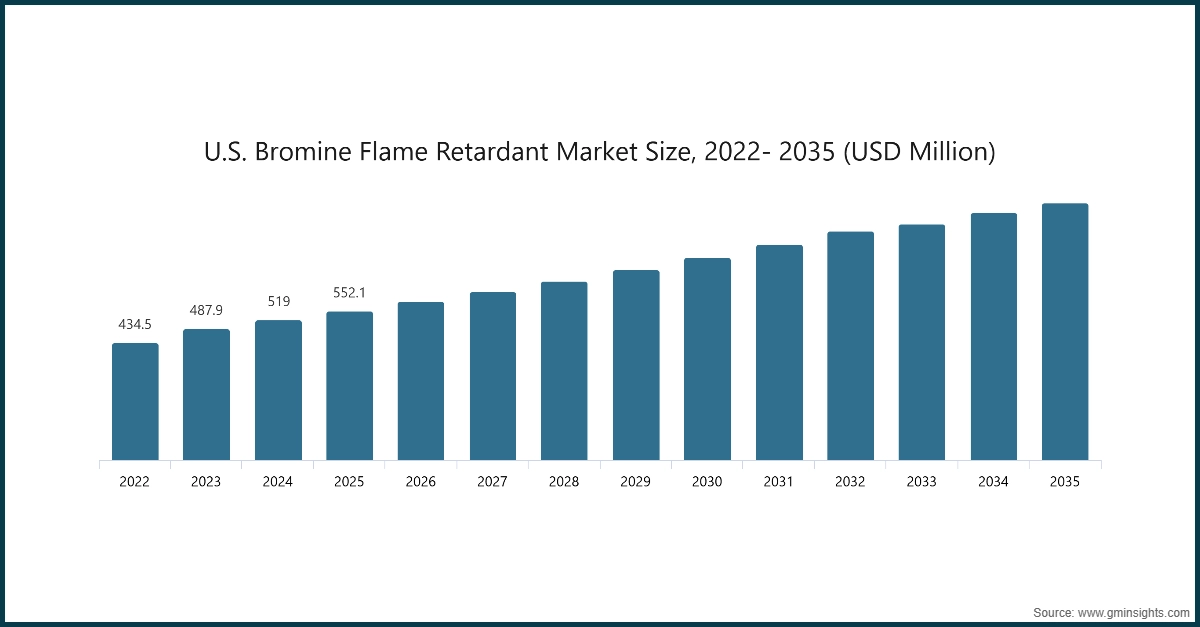
The North America bromine flame retardant market accounted for USD 624 million in 2025 and is anticipated to show lucrative growth over the forecast period.
The market for bromine-based flame retardants shows steady growth because their applications extend to multiple sectors including electronics, construction materials, transportation components, and industrial equipment. The region's regulatory framework necessitates producers to develop product formulas which achieve optimal fire protection while minimizing environmental impact. Electrical infrastructure upgrades together with advanced polymer system integration and automation technology expansion are driving ongoing market demand. The region establishes strong research capabilities which enable scientists to create custom solutions for advanced performance applications. Industries currently require brominated systems because these materials deliver efficient results while maintaining easy processing features and known performance outcomes in intricate design work.
The Europe bromine flame retardant market accounted for USD 659 million in 2025 and is anticipated to show lucrative growth over the forecast period.
Europe shows steady movement toward balanced, compliance‑aligned brominated flame retardant solutions supported by stringent material standards across multiple end‑use sectors. Electronics manufacturing, building materials, and transportation industries apply increasing focus on safer, more compatible flame‑resistant chemistries, shaping the direction of product development. Brominated systems continue to exist in products which require advanced thermal protection and thermal protection capabilities because regulatory requirements drive ongoing enhancement activities. The region promotes sustainable design practices and circular material systems together with advanced polymer development which drives suppliers to enhance their product performance through better dispersion properties and processing capabilities. Industries progress toward better product requirements through transitional processes which work toward increased product specifications.
Asia Pacific bromine flame retardant market accounted for 40.5% market share in 2025 and is anticipated to show lucrative growth over the forecast period.
Asia Pacific remains the strongest growth platform, supported by wide‑scale electronics production, increasing urban infrastructure, and expanding polymer processing industries across developing and established economies. Demand for products increases because consumer electronics manufacturing, automotive components production, and electrical devices creation lead to higher production levels throughout engineered material development. The region requires flame retardants which guarantee operational efficiency and stable quality and match the standards of high-volume production processes according to its fast-growing manufacturing sector. The demand for brominated solutions increases because they provide essential performance characteristics which match the requirements of insulation systems, circuit substrate materials, and engineering plastic materials in the construction industry and smart device market and renewable energy sector. The segment strengthens its position through investments in new material innovations together with development of industrial cluster networks.
Latin America bromine flame retardant market is anticipated to grow at a CAGR of 5% during the analysis timeframe.
Latin America experiences moderate but steady progress driven by expanding construction activity, wider adoption of consumer electronics, and growth in transportation manufacturing across emerging industrial zones. Brominated flame retardants gain traction due to their ability to deliver consistent protection in polymer materials used in appliances, cables, insulation, and vehicle components. The process of building integration advancements together with electrical system upgrades results in a gradual integration process at the present time. The region expands its logistics and automotive assembly and infrastructure growth which leads to increased use of fire-resistant plastics. Manufacturers develop product formulas which deliver optimal performance across all operational circumstances and processing conditions found in regional businesses.
Middle East & Africa bromine flame retardant market is expected to grow at a CAGR of 5.1% during the analysis timeframe.
The Middle East and Africa market demonstrates rising utilization supported by rapid urban expansion, infrastructure upgrades, and growing reliance on electrical systems across residential and commercial projects. Brominated solutions are incorporated into insulation materials, wires, cables, electronics, and engineered plastics due to their stable performance in high‑temperature and demanding climatic conditions. Industrial diversification across sectors such as construction, transportation, and energy contributes to increasing application scope. The region progresses toward fire-safe solutions which help handle building materials and electrical installations by delivering both protection and smooth processing characteristics. The current phase of development depends on elevated industrial production capabilities and the implementation of modernization ventures.
Bromine Flame Retardant Market Share
- Albemarle Corporation, ICL (Israel Chemicals Ltd), BASF SE, Lanxess AG, and Clariant AG are a significant part of the global bromine flame retardant industry and with further standing of being consolidated with the top five players steadily holding 65% market share in the year 2025.
- The industry shows intense competition as companies develop brominated chemical products which meet the growing performance and safety requirements of electronic devices and construction materials and engineered polymer products.
- Producers establish their market position through their connections to polymer processing systems, which enable them to provide material solutions that create strong blending results for various compounding processes.
- Regulatory adaptability shapes business competitiveness because companies invest in compliant formulation development and efficient safety assessment methods which enable them to retain their status in regulated markets.
- The electronics industry serves as the main battlefield where manufacturers compete with each other to find flame retardants which provide fire protection through their ability to stabilize both low and high temperature environments for small thermally stressed devices.
- The industry gains its competitive edge through advanced dispersion and compatibility enhancements because organizations now focus on maximizing their polymer processing throughput.
- Transportation's lightweight material trends create a competitive environment between companies which develop engineering resin solutions for vehicle interiors and wire systems and under‑the‑hood components.
- Suppliers establish environmental refinement as their core business strategy by improving their recyclability procedures and decreasing their permanent material features to create circular material solutions.
- The capacity of a business to sustain its operations depends on supply network stability and its ability to manufacture products in different regional locations while stable bromine supplies and local manufacturing capabilities enable continuous production operations.
- Technical support along with application-specific guidance enables companies to develop lasting industry partnerships by providing value through testing support and formulation improvement and end-use performance validation services.
Bromine Flame Retardant Market Companies
The major players operating in bromine flame retardant industry include:
- Albemarle Corporation
- ICL (Israel Chemicals Ltd)
- BASF SE
- Lanxess AG
- Clariant AG
- Eastman Chemical Company
- Tosoh Corporation
- Akzo Nobel N.V.
- Jordan Bromine Company (JBC)
- Shandong Brother Sci. & Tech. Co., Ltd.
- Oceanchem Group Limited
- Shandong Tianyi Chemical Co., Ltd.
- Others
- Albemarle Corporation continues its work on bromine flame retardant solutions because it controls both bromine resources and chemical processing capabilities. The company offers materials that meet the fire safety requirements of electronics and construction polymers and industrial fields which need fire protection that remains constant.
- ICL (Israel Chemicals Ltd.) operates through its complete bromine value chain which includes production and development of customized flame retardant products. Its products enable various polymer systems used by electronics and insulation materials and transportation components which need to maintain safe fire protection performance.
- BASF SE sells its polymer additives which work together with specialized resins and construction products. The company develops formula enhancements which enable easier processing while maintaining thermal performance across different industrial settings.
- Lanxess AG develops specialty additives to improve fire safety for engineering plastics and foams and electronic components. The company develops applications which enable performance measurements that require precise testing in high tech industries.
- Clariant AG develops additive technologies which deliver constant fire resistance performance for polymer materials used in electronics and construction and mobility applications. The company develops specialized industrial applications through its product development process which enhances its market position.
Bromine Flame Retardant Market Report Attributes
| Key Takeaway | Details |
|---|---|
| Market Size & Growth | |
| Base Year | 2025 |
| Market Size in 2025 | USD 2.47 Billion |
| Market Size in 2026 | USD 2.63 Billion |
| Forecast Period 2026-2035 CAGR | 5.4% |
| Market Size in 2035 | USD 4.23 Billion |
| Key Market Trends | |
| Drivers | Impact |
| Rising fire safety regulations across industrial applications | Guides higher adoption of bromine-based flame retardants |
| Expanding use in electronics and electrical housings | Supports steady demand in high-volume manufacturing |
| Increasing construction activities requiring fire-resistant materials | Strengthens consumption in insulation and building products |
| Growth in transportation sectors using polymer-based components | Boosts usage in automotive and aerospace plastics |
| Pitfalls & Challenges | Impact |
| Regulatory scrutiny on halogenated flame retardants | Creates pressure on long-term product positioning |
| Rising preference for alternative non-halogen systems | Limits growth potential in sensitive end-use sectors |
| Supply fluctuations and pricing of bromine raw materials | Introduces uncertainty in production planning |
| Opportunities: | Impact |
| Development of more efficient, lower-toxicity brominated formulations | Enhances acceptance in evolving regulatory environments |
| Growing demand from emerging electronics manufacturing hubs | Expands addressable market for volume-driven applications |
| Integration of bromine retardants in advanced polymer blends | Unlocks usage in lightweight engineering materials |
| Adoption in renewable energy components requiring fire resistance | Opens new pathways in solar and energy storage systems |
| Market Leaders (2025) | |
| Market Leader |
Market Share Approximately 22% |
| Top Players |
Collective Market Share Approximately 65% |
| Competitive Edge |
|
| Regional Insights | |
| Largest Market | Asia Pacific |
| Fastest growing market | Asia Pacific |
| Emerging countries | China, India, Japan |
| Future outlook |
|
What are the growth opportunities in this market?
Bromine Flame Retardant Industry News
- In November 2025, Clariant announced its strategic joint venture with FUHUA, focused on developing innovative non-halogenated flame retardants. The new initiative aims to create next-generation flame retardants to serve several industries like building and construction, automotive, electric and electronic, directly addressing the tightening technical and regulatory environment in these sectors.
The bromine flame retardant market research report includes in-depth coverage of the industry with estimates & forecast in terms of revenue (USD Billion) & volume (Kilo Tons) from 2022 to 2035, for the following segments:
Market, By Type
- Tetrabromobisphenol A (TBBPA)
- Hexabromocyclododecane (HBCD)
- Polybrominated Diphenyl Ethers (PBDEs)
- Decabromodiphenyl Ethane (DBDPE)
- Brominated Polystyrene (BPS)
- Others
Market, By Technology
- Reactive Flame Retardants
- Additive Flame Retardants
- Polymeric Flame Retardants
Market, By Form
- Powder/Granules
- Liquid
- Masterbatch/Dispersion
- Solid Crystals
Market, By End-Use Industry
- Electrical & Electronics (E&E)
- Building & Construction
- Transportation
- Textiles & Furniture
- Wire & Cable
- Others
The above information is provided for the following regions and countries:
- North America
- U.S.
- Canada
- Europe
- UK
- Germany
- France
- Italy
- Spain
- Rest of Europe
- Asia Pacific
- China
- India
- Japan
- South Korea
- Australia
- Rest of Asia Pacific
- Latin America
- Brazil
- Mexico
- Argentina
- Rest of Latin America
- MEA
- UAE
- Saudi Arabia
- South Africa
- Rest of Middle East and Africa
Frequently Asked Question(FAQ) :
What is the market size of the bromine flame retardant in 2025?
The market size was USD 2.47 billion in 2025, with a CAGR of 5.4% expected through 2035 driven by rising fire safety regulations, expanding electronics manufacturing.
What is the projected value of the bromine flame retardant industry by 2035?
The bromine flame retardant market is expected to reach USD 4.23 billion by 2035, propelled by advancements in safer brominated chemistries, steady demand from electronics and construction.
What is the current bromine flame retardant industry size in 2026?
The market size is projected to reach USD 2.63 billion in 2026.
How much revenue did the Tetrabromobisphenol A (TBBPA) segment generate in 2025?
The TBBPA segment generated USD 900 million in 2025, leading among type segments with strong compatibility with electronic components and engineered polymer systems.
What was the valuation of the powder/granules form segment in 2025?
The powder/granules segment held a dominant 63.7% market share and was valued at USD 1.58 billion in 2025, owing to its processing convenience, storage stability.
What is the growth outlook for additive flame retardants from 2026 to 2035?
Additive flame retardants are projected to grow at a 5.5% CAGR till 2035, due to broad polymer compatibility, flexibility in processing and environmental performance.
Which region leads the bromine flame retardant market?
North America bromine flame retardant market accounted for USD 624 million in 2025. Large-scale electronics production and expanding polymer processing industries across the region fuel its dominance.
What are the upcoming trends in the bromine flame retardant market?
Key trends include development of lower-toxicity brominated formulations, growing adoption in renewable energy components such as solar panels and innovation driven by tightening regulatory frameworks across regions.
Who are the key players in the bromine flame retardant market?
Key players include Albemarle Corporation, ICL (Israel Chemicals Ltd), BASF SE, Lanxess AG, and Clariant AG.
Bromine Flame Retardant Market Scope
Related Reports