Summary
Table of Content

Brewing Additives Market
Get a free sample of this report
Form submitted successfully!
Error submitting form. Please try again.
Thank you!
Your inquiry has been received. Our team will reach out to you with the required details via email. To ensure that you don't miss their response, kindly remember to check your spam folder as well!
Request Sectional Data
Thank you!
Your inquiry has been received. Our team will reach out to you with the required details via email. To ensure that you don't miss their response, kindly remember to check your spam folder as well!
Form submitted successfully!
Error submitting form. Please try again.
Brewing Additives Market Size
- The market is experiencing strong growth because more people want better beer and wine which shows better visual clarity and longer shelf life and superior taste. The growing demand for craft beverages and premium alcoholic drinks leads producers to adopt new additives which boost their manufacturing process and maintain product quality. The key trends show that consumers prefer natural and sustainable additives which match their desire for clean-label and eco-friendly products.
- Brewing additives, which include fining agents and stabilizers and antifoaming agents and color enhancers, play a critical role in food production by enhancing product visibility while extending product storage time and improving all aspects of the brewing procedure. These additives satisfy the requirements of both professional breweries and home brewers who want to produce high-quality products. The beer market leads in sales because it dominates the industry followed by wine and specialty drinks.
- The market experiences growth through two factors which are improvements in brewing technology and the increasing demand for non-alcoholic and low-alcohol products. Manufacturers are developing new product solutions which help them keep up with changing consumer preferences, which creates a competitive environment throughout the market.
The global brewing additives market was valued at USD 4.4 billion in 2025. The market is expected to grow from USD 4.6 billion in 2026 to USD 7.8 billion in 2035, at a CAGR of 5.9% according to latest report published by Global Market Insights Inc.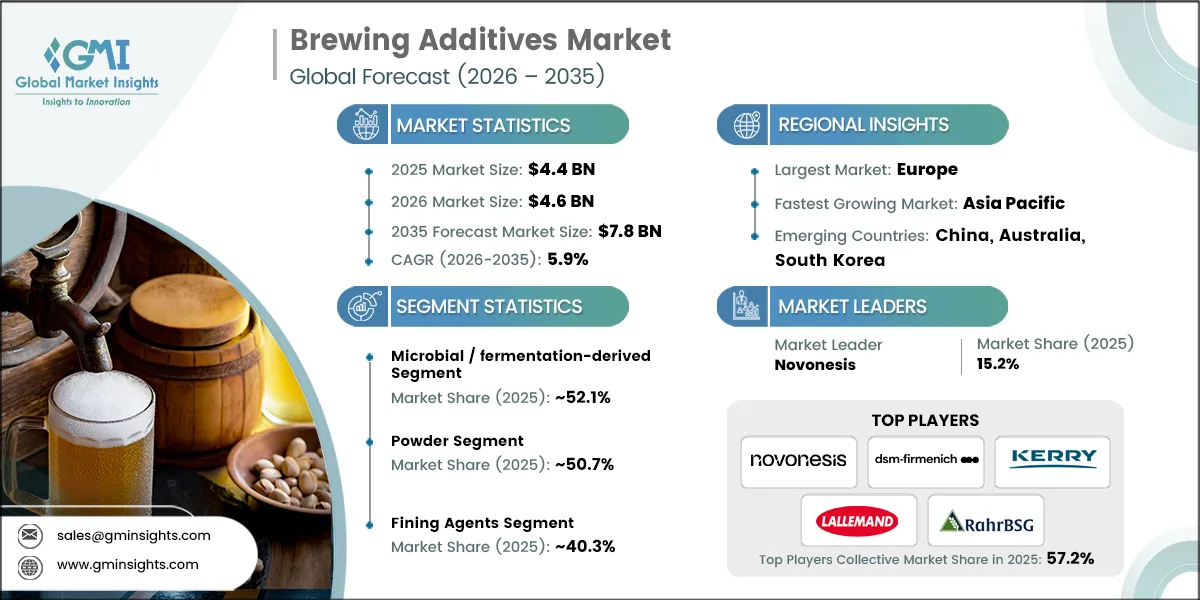
Brewing Additives Market Key Takeaways
Market Size & Growth
- 2025 Market Size: USD 4.4 Billion
- 2026 Market Size: USD 4.6 Billion
- 2035 Forecast Market Size: USD 7.8 Billion
- CAGR (2026–2035): 5.9%
Regional Dominance
- Largest Market: Europe
- Fastest Growing Region: Asia Pacific
Key Market Drivers
- Increasing demand for premium and craft beverages.
- Technological advancements in brewing processes.
- Growth in home brewing and microbreweries.
Challenges
- Fluctuations in raw material availability.
Opportunity
- Increasing consumer preference for natural and organic ingredients.
- Expansion of functional and health-enhancing brewing additives.
Key Players
- Market Leader: Novonesis led with over 15.2% market share in 2025.
- Leading Players: Top 5 players in this market include Novonesis, DSM-Firmenich, Kerry Group, Lallemand Brewing, RahrBSG, which collectively held a market share of 57.2% in 2025.
Get Market Insights & Growth Opportunities
To get key market trends
Brewing Additives Market Trends
- The brewing additives industry is experiencing strong expansion because of the rising need for better tasting drinks and more effective manufacturing methods. Brewers use fining agents and stabilizers to improve product clarity and stability and shelf life which creates an improved consumer experience and extended product quality. Antifoaming agents have become vital for production because they help maintain cost-efficient operations by controlling foam during the brewing process.
- Beer and wine consumers are now choosing premium products which forces manufacturers to use new additives such as color enhancers and flavor boosters to create unique and appealing products. Brewers are increasingly using natural and sustainable ingredients because of the rising consumer demand for environmentally friendly options that match their health-conscious values.
- The growth of craft beer and home brewing has driven up demand for specialty additives which allow breweries to create unique products that stand out in a competitive landscape.
Brewing Additives Market Analysis
Learn more about the key segments shaping this market
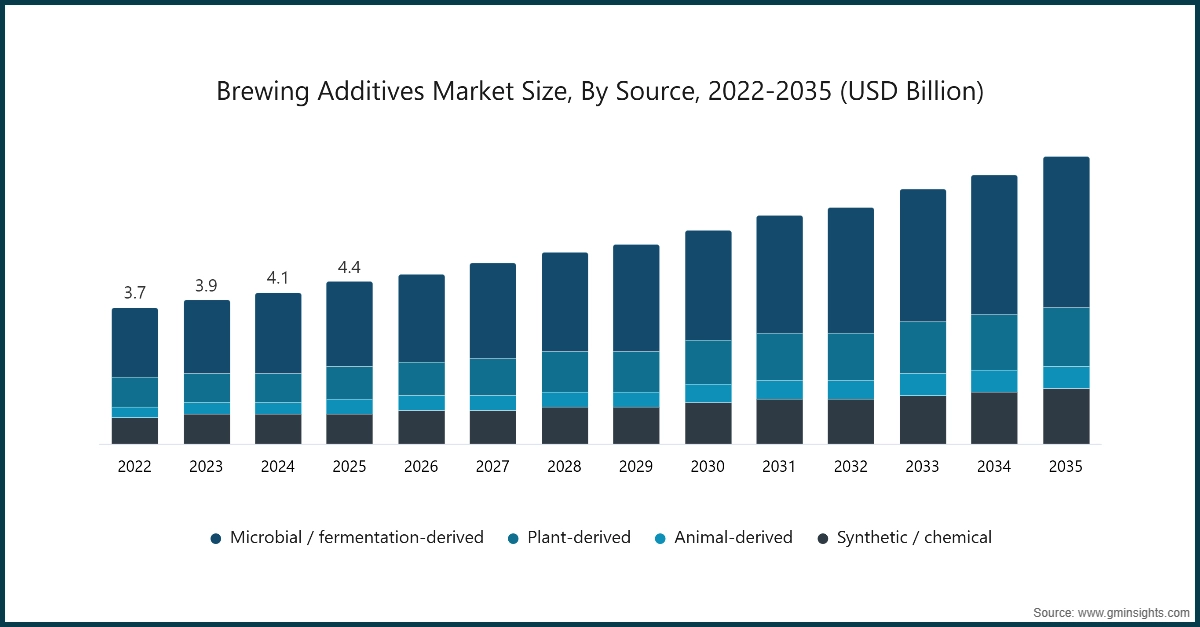
Based on source, the market is segmented into microbial / fermentation-derived, plant-derived, animal-derived and synthetic / chemical. Microbial / fermentation-derived dominated the market with an approximate market share of 52.1% in 2025.
- The brewing additives market primarily depends on microbial and fermentation-based ingredients because these ingredients provide customers with natural sustainable and versatile products which match their rising need for clean-label items. The brewing industry uses these products for their benefits to fermentation and their capacity to create better tasting beverages which results in ongoing product development.
- The growing consumer demand for natural and organic ingredients has led to increased use of plant-derived additives. The market experiences growth through clean-label product demand and plant-based product demand because these products are used extensively to provide color and flavor and health advantages.
- The niche usage of animal-derived ingredients persists because their historical importance is now challenged by growing vegan and vegetarian practices and ethical sourcing concerns.
Learn more about the key segments shaping this market
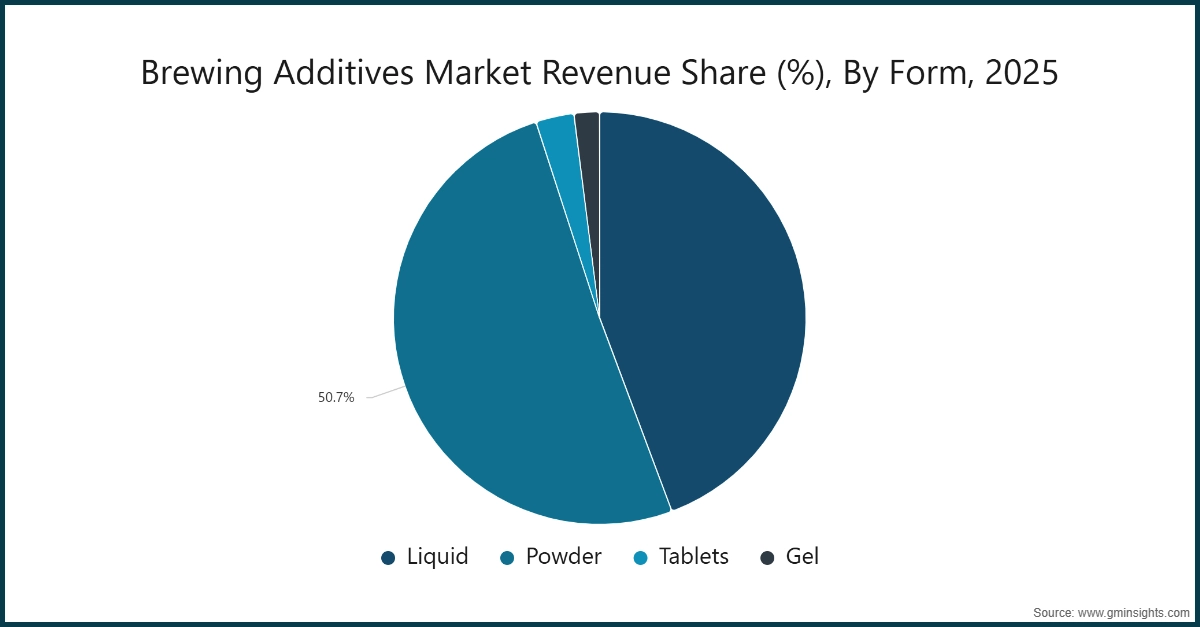
Based on form, the brewing additives market is segmented into liquid, powder, tablets and gel. Powder dominated the market with an approximate market share of 50.7% in 2025.
- The powder form maintains market dominance because its people use it for industrial brewing operations because it provides better stability and storage capabilities and longer storage duration. The cost-effective and easily transportable nature of powders secures their market presence across various regions.
- Liquid additives receive high value because their rapid solubility together with their precise dosage control helps brewers produce consistent and efficient results. The brewing process will benefit from their fast integration capability because it allows large breweries to automate their production setup, which increases their operational efficiency.
- The market for tablets has expanded because users find the product more convenient while it delivers precise dosing and default wastage control. The craft brewing and home brewing industry customers select this product because it delivers both precise measurement and simple operation.
Based on type, the brewing additives market is segmented into fining agents, antifoaming agents, stabilizers, color enhancers and others. Fining agents dominated the market with an approximate market share of 40.3% in 2025 and is expected to grow with a CAGR of 6.1% by 2035.
- Fining agents dominate the brewing additives market because they provide essential functions for maintaining beverage clarity and stability. These agents remove unwanted particles and proteins and polyphenols from beer and wine production to create visually and sensorially appealing final products.
- The craft beer and premium wine segments have seen increased fining agent usage because consumers now prefer clear and high-quality beverages. The popularity of natural fining agents, which include bentonite and silica gel and isinglass has increased because these agents match clean-label product requirements. The essential role of these products in all brewing processes helps producers from small to large scale operations maintain their market leadership.
Based on application, the market is segmented into wine, beer and others.
- Beer leads the brewing additives market because its global consumption enables various beer production processes which require different types of additives. The use of fining agents and stabilizers and antifoaming agents serves as essential components which help improve beer production efficiency and maintain its flavor stability and clarity.
- The demand for specialized additives has increased because craft beer and premium beer products have become more popular among consumers who want different beer options. The emergence of non-alcoholic and low-alcohol beer products has increased the need for brewing additives which require exact formulations to preserve both taste and product quality.
- The beer segment maintains its market dominance because new brewing technologies develop and more consumers start drinking traditional and modern beer products.
Looking for region specific data?
The brewing additives market in North America will grow at a CAGR from approximately 5.6% between 2026 and 2035.
- The demand for innovative brewing additives that improve flavor, product stability, and extended shelf life is increasing because consumers now prefer craft and premium beer options. The industry is experiencing product development through innovation because brewers now concentrate on creating distinct taste experiences and better brewing methods.
The brewing additives markets in Europe, especially in a few countries like Germany, are expected to grow with a rapid pace in the coming years.
- The food safety regulations and environmental sustainability requirements compel breweries to select eco-friendly bio-based products which comply with these standards. The circular economy principles support breweries in using biodegradable and natural ingredients from their brewing operations.
The brewing additives market in China and India is expected to have lucrative growth between 2026 and 2035, with CAGR 6% in the Asia Pacific region.
- The urbanization process together with rising income levels has increased sales of premium and craft beers which use unique additives to create distinctive flavors. The health-conscious consumer market prefers natural and organic ingredients over other product options.
- The natural additives together with the biodegradable ingredients which breweries want to use will emerge as a result of government initiatives that promote sustainable manufacturing together with eco-friendly operations.
Between 2026 and 2035, the market for brewing additives in the Middle East is projected to grow significantly during this period.
- The demand for high-quality organic beer products, which support regional wellness trends drives this market growth. The hospitality and tourism industries drive the need for novel brewing components.
- Breweries now use natural additives together with bio-based products because government policies promote sustainability in their operations.
Between 2025 and 2035, a promising expansion of the brewing additives sector is foreseen in the Latin America.
- Breweries and consumers choose eco-friendly ingredients in their production because they want to follow sustainable practices and use organic materials which are important in craft brewing. The use of natural additives together with bio-based ingredients in brewing processes is being encouraged through legislation which supports sustainable farming and organic extraction methods.
Brewing Additives Market Share
Brewing additives industry is moderately consolidated with players like Novonesis, DSM-Firmenich, Kerry Group, Lallemand Brewing and RahrBSGt which accounts for 57.2% market share in 2025.
The brewing additives industry consists of such leading companies operating mostly in their regional areas. Their long years of experience with brewing additives have allowed these companies to maintain a strong market position worldwide. Their product offerings are diverse and majorly supported by production capacities and distribution networks, which can serve the increasing demand for brewing additives in various regions.
Brewing Additives Market Companies
Major players operating in the brewing additives industry includes:
- AEB Brewing
- Agrovin
- ATPGroup
- DSM-Firmenich
- Enartis S.r.l.
- General Filtration
- Kerry Group
- Lallemand Brewing
- Novonesis
- RahrBSG
- White Labs
DSM-Firmenich’s brewery ingredients provide innovative solutions which help breweries create sustainable beers through their development of unique products which enhance flavor stability and aroma and overall drink quality.
Novonesis delivers brewing solutions through its biosolutions and natural ingredients which include bio-based additives that boost fermentation efficiency and create better beer flavors.
Kerry Group provides a wide selection of brewing ingredients which contain enzymes and stabilizers and flavor enhancers to help brewing operations run more effectively while maintaining product quality.
Lallemand Brewing supplies fermentation nutrients and yeast derivatives and brewing additives which enable brewers to achieve better brewing results while maintaining yeast health and producing superior beer quality with long-lasting flavor.
RahrBSG supplies brewing nutrients and adjuncts and specialty ingredients which help craft and commercial breweries achieve consistent fermentation results.
Brewing Additives Market Report Attributes
| Key Takeaway | Details |
|---|---|
| Market Size & Growth | |
| Base Year | 2025 |
| Market Size in 2025 | USD 4.4 Billion |
| Market Size in 2026 | USD 4.6 Billion |
| Forecast Period 2026-2035 CAGR | 5.9% |
| Market Size in 2035 | USD 7.8 Billion |
| Key Market Trends | |
| Drivers | Impact |
| Increasing demand for premium and craft beverages | Drives market growth by encouraging innovative and high-quality additive formulations |
| Technological advancements in brewing processes | Enhance efficiency and product consistency, supporting market expansion and innovation |
| Growth in home brewing and microbreweries | Boosts demand for specialized and affordable brewing additives, opening new market segments |
| Pitfalls & Challenges | Impact |
| Fluctuations in raw material availability | May lead to supply chain disruptions and increased production costs in the global brewing additive market |
| Opportunities: | Impact |
| Increasing consumer preference for natural and organic ingredients | Stimulates market development for healthier and eco-friendly additives |
| Expansion of functional and health-enhancing brewing additives | Presents opportunities for diversification and premium product offerings in the market |
| Market Leaders (2025) | |
| Market Leader |
Market share 15.2% |
| Top Players |
Collective market share in 2025 is 57.2% |
| Competitive Edge |
|
| Regional Insights | |
| Largest Market | Europe |
| Fastest growing market | Asia Pacific |
| Emerging countries | China, Australia, South Korea |
| Future outlook |
|
What are the growth opportunities in this market?
Brewing Additives Industry News
In January 2024, Anheuser-Busch InBev beer company, based in Belgium, has proposed an investment of USD 4,000 million to enhance its brewery operations in Karnataka. Anheuser-Busch InBev's substantial investment in enhancing brewery operations in Karnataka is likely to increase demand for beer stabilizers, as improved production processes require advanced stabilization solutions to maintain quality and shelf life.
In September 2024, DeVANS has expanded its Six Fields beer lineup portfolio by entering the premium lager market. DeVANS' entry into the premium lager market is expected to drive demand for beer stabilizers, as higher-quality products require enhanced stability and clarity.
This brewing additives market research report includes in-depth coverage of the industry, with estimates & forecasts in terms of revenue (USD Billion) and volume (Kilo Tons) from 2022 to 2035, for the following segments:
Market, by Source
- Microbial / fermentation-derived
- Plant-derived
- Animal-derived
- Synthetic / chemical
Market, by Form
- Liquid
- Powder
- Tablets
- Gel
Market, by Type
- Fining agents
- Antifoaming agents
- Stabilizers
- Color enhancers
- Others
Market, by Application
- Wine
- Beer
- Others
The above information is provided for the following regions and countries:
- North America
- U.S.
- Canada
- Europe
- Germany
- UK
- France
- Spain
- Italy
- Rest of Europe
- Asia Pacific
- China
- India
- Japan
- Australia
- South Korea
- Rest of Asia Pacific
- Latin America
- Brazil
- Mexico
- Argentina
- Rest of Latin America
- Middle East and Africa
- Saudi Arabia
- South Africa
- UAE
- Rest of Middle East and Africa
Frequently Asked Question(FAQ) :
What was the market size of the brewing additives in 2025?
The market was valued at USD 4.4 billion in 2025, growing at a CAGR of 5.9% till 2035. The market is driven by increasing demand for premium beverages and additives that enhance taste, clarity, and shelf life.
What is the projected value of the brewing additives market by 2035?
The brewing additives market is expected to reach USD 7.8 billion by 2035, fueled by the rising popularity of craft beverages and sustainable additives.
What is the expected size of the brewing additives industry in 2026?
The market size is projected to reach USD 4.6 billion in 2026.
What was the market share of microbial/fermentation-derived additives in 2025?
Microbial/fermentation-derived additives dominated the market with an approximate share of 52.1% in 2025.
What was the valuation of powdered brewing additives in 2025?
Powdered brewing additives held a market share of approximately 50.7% in 2025, led by their stability, cost-effectiveness, and extended storage capabilities.
What is the growth outlook for fining agents from 2026 to 2035?
Fining agents are expected to grow at a CAGR of 6.1% up to 2035, maintaining their importance in enhancing product clarity and stability.
Which region leads the brewing additives sector?
North America leads the market is set to expand at a CAGR of 5.6% between 2026 and 2035, propelled by the demand for innovative additives that improve flavor, stability, and shelf life.
What are the upcoming trends in the brewing additives market?
Key trends include rising demand for natural additives, growth in craft and home brewing, and increased use of specialty ingredients for premium products.
Who are the key players in the brewing additives industry?
Key players include AEB Brewing, Agrovin, ATPGroup, DSM-Firmenich, Enartis S.r.l., General Filtration, Kerry Group, Lallemand Brewing, Novonesis, RahrBSG, and White Labs.
Brewing Additives Market Scope
Related Reports