Summary
Table of Content

Boiler Market
Get a free sample of this report
Form submitted successfully!
Error submitting form. Please try again.
Thank you!
Your inquiry has been received. Our team will reach out to you with the required details via email. To ensure that you don't miss their response, kindly remember to check your spam folder as well!
Request Sectional Data
Thank you!
Your inquiry has been received. Our team will reach out to you with the required details via email. To ensure that you don't miss their response, kindly remember to check your spam folder as well!
Form submitted successfully!
Error submitting form. Please try again.
Boiler Market Size
The industry forms a core component of the global thermal equipment landscape. The industry is primarily influenced by energy demand patterns, regulatory frameworks, and capital investment cycles. Long-term growth is supported by ongoing infrastructure development and the continued need for reliable heat generation systems worldwide.
Boiler Market Key Takeaways
Market Size & Growth
- 2025 Market Size: USD 112.2 Billion
- 2026 Market Size: USD 122.4 Billion
- 2035 Forecast Market Size: USD 220.9 Billion
- CAGR (2026–2035): 6.8%
Key Market Drivers
- Stringent government regulations to limit carbon emissions.
- Paradigm shift toward decarbonization.
- Rising demand for efficient space and water heating system.
- Ongoing replacement of the existing heating units with energy-efficient boilers.
Challenges
- High initial investments.
- Surging popularity of available alternatives.
Opportunity
- Growth of electric & hybrid boilers.
- Industrial process electrification.
- Retrofit & replacement demand.
- Smart & connected boiler technologies.
Key Players
- Market Leader: Bosch Limited led with over 9% market share in 2025.
- Leading Players: Top 5 players in this market include VIESSMANN, Bosch Limited, Vaillant Group, BDR Thermea Group, A. O. Smith, which collectively held a market share of 36% in 2025.
Get Market Insights & Growth OpportunitiesA boiler is a closed, pressurized vessel designed to heat water or other fluids by transferring thermal energy from a fuel source, electricity, or another heat medium. The system operates by raising the fluid’s temperature, often converting it into steam under controlled pressure conditions. Core components typically include a heat source, combustion or heating chamber, heat transfer surfaces, pressure regulation mechanisms, and safety controls that maintain stable operation and structural integrity.
For illustration, in September 2025, Babcock Wanson Group strengthened its presence in Spain by acquiring ACT Andaluces, enhancing its industrial boiler service and maintenance capabilities across the Iberian Peninsula. The acquisition enables the company to offer advanced high-efficiency boilers, heat recovery systems, hybrid technologies, and electric solutions, reinforcing its commitment to delivering comprehensive, energy-efficient thermal solutions to industrial clients throughout the region with innovation focus.
The industry is shaped by capacity ranges, pressure ratings, fuel options, and system configurations. Demand spans low, medium, and high-capacity units, reflecting diverse operating requirements. This segmentation allows suppliers to address varied performance expectations while maintaining flexibility across regional and regulatory environments.
Energy transition trends are gradually reshaping the boiler market. Conventional technologies continue to dominate installed base volumes, while low-emission and alternative-energy systems gain momentum. This shift is driven by policy mandates, environmental targets, and growing awareness of lifecycle efficiency and carbon intensity considerations.
The market was valued at USD 84.2 billion in 2022 and grew at a CAGR of approximately 4.5% through 2025. Increasing adoption of low-emission, hybrid, and renewable-compatible boilers is shaping market trends and competitive dynamics worldwide.
Regulatory influence remains a critical determinant of market direction. Emission limits, efficiency standards, and safety regulations increasingly govern system design and replacement cycles. Compliance requirements differ by region, creating uneven adoption rates and influencing product specifications, certification processes, and investment priorities across markets.
Technological advancement plays a central role in market competitiveness. Improvements in heat transfer efficiency, control accuracy, and system reliability have enhanced overall performance benchmarks. These developments support reduced energy losses and improved operational consistency, aligning boilers with modern efficiency and sustainability expectations.
For instance, in May 2024, Miura strengthened its global position by acquiring U.S.-based Cleaver-Brooks, a leading manufacturer of industrial and commercial boilers. This strategic acquisition enhances its product portfolio, broadens its industrial boiler expertise, and significantly expands its service presence across North America by leveraging Cleaver-Brooks’ well-established distribution channels, technical support infrastructure & extensive maintenance network across regional markets for sustained industry leadership and growth.
The global boiler market size was estimated at USD 112.2 billion in 2025. The market is expected to grow from USD 122.4 billion in 2026 to USD 220.9 billion by 2035, at a CAGR of 6.8%, according to a recent study by Global Market Insights Inc.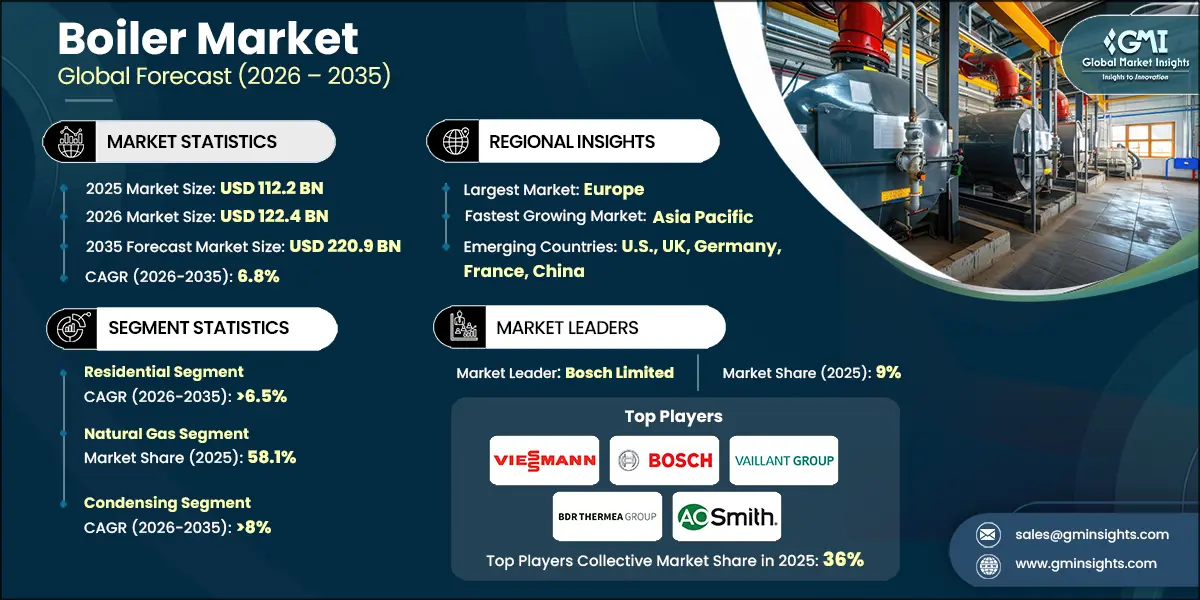
To get key market trends
Boiler Market Trends
Replacement demand contributes significantly to overall market stability. Aging installed systems, rising maintenance costs, and tightening regulations encourage upgrades to newer technologies. This replacement-driven demand provides resilience against economic volatility and supports steady market activity even during periods of limited new infrastructure investment.
Regional market dynamics vary based on economic maturity, energy policy, and climate conditions. Developing regions typically drive volume growth, while mature markets emphasize efficiency improvements and emissions compliance. These regional contrasts shape demand patterns, pricing strategies, and technology adoption rates globally.
For instance, in May 2025, Midea Group agreed to acquire BDR Thermea’s China operations, including well-known residential boiler brands such as Baxi and De Dietrich. The transaction enhances Midea’s domestic heating portfolio, strengthens its position in China’s residential boiler segment, and establishes a strategic supply partnership with BDR Thermea to support broader collaboration and expansion across international markets globally in the long term ahead.
Cost considerations remain central to purchasing decisions within the boiler market. Capital expenditure, operating efficiency, fuel costs, and maintenance requirements are evaluated collectively. As energy prices fluctuate, total cost of ownership analysis increasingly influences system selection and long-term investment planning.
Digital integration is emerging as a supporting market trend. Monitoring systems, automation, and data-driven optimization enhance operational visibility and reliability. While adoption levels vary, digital capabilities are increasingly viewed as value-added features that support efficiency goals and asset management strategies.
The outlook of the market is closely tied to global decarbonization efforts and energy system transformation. Market evolution will depend on regulatory alignment, technological innovation, and economic feasibility. Adaptability to changing energy landscapes will remain essential for sustained business growth.
For citation, in September 2025, Babcock Wanson Group expanded its regional footprint by acquiring ACT Andaluces, a Spain-based specialist in industrial boiler maintenance. This strategic move strengthens its capacity to provide integrated, turnkey industrial heating solutions across Southern Spain, including high-efficiency boilers, hybrid systems, and advanced heat recovery technologies, enhancing service responsiveness, technical expertise, and overall customer support capabilities in the regional industrial market.
Boiler Market Analysis
Learn more about the key segments shaping this market
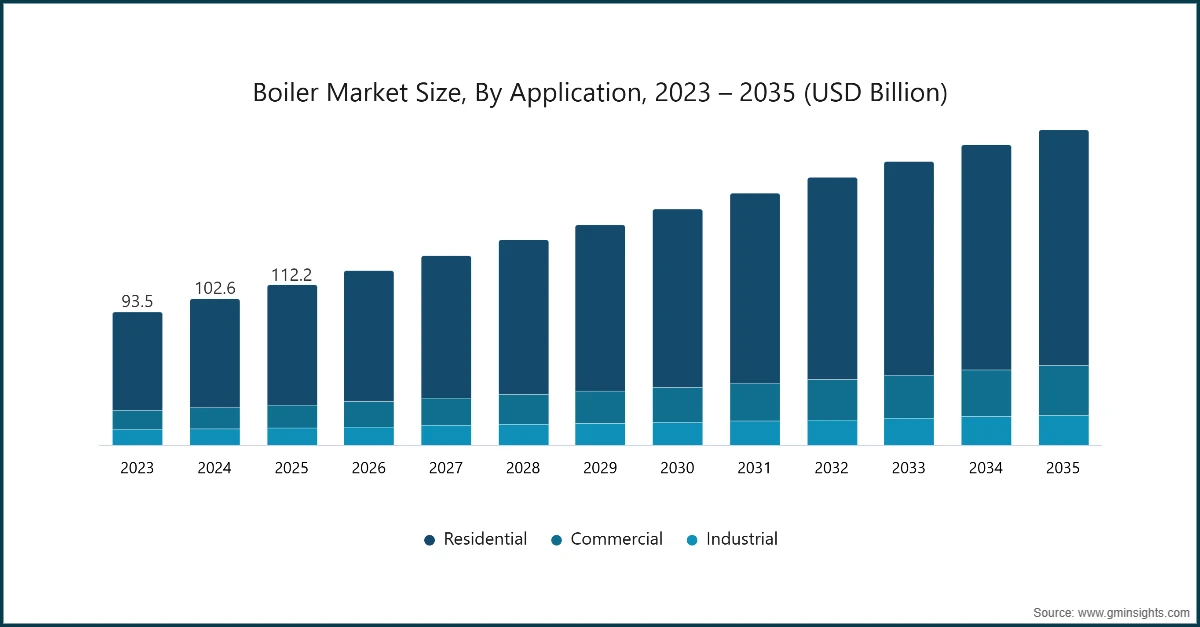
Based on application, the industry is segmented into residential, commercial and industrial. The residential application holds a share of about 65% in 2025 and is projected to grow at a growth rate of over 6.5% through 2035.
The industry is shaped by housing development trends, climate conditions, and household energy requirements. Demand is supported by system replacement cycles and rising preference for energy-efficient solutions. Regulatory standards, fuel availability, and operating cost considerations play a key role in influencing adoption patterns worldwide.
For instance, in November 2025, Thermax Babcock & Wilcox Energy Solutions secured an order worth approximately USD 64 million from Dangote Industries to supply four 400 TPH high-pressure utility boilers for its refinery and petrochemical complex in Nigeria. This contract strengthens Thermax’s presence in Africa and reinforces its leadership in delivering large-scale, high-capacity industrial boiler solutions for major energy and industrial projects.
The commercial boiler market segment is set to exceed USD 30 billion by 2035. The industry is driven by demand for dependable and efficient heating systems within non-residential buildings. Market growth is supported by infrastructure expansion, replacement of aging systems, and stricter efficiency regulations. Technological improvements, energy cost considerations, and sustainability goals continue to shape purchasing decisions.
The industrial segment was valued at USD 12.1 billion in 2025. The market is influenced by industrial output levels, energy consumption patterns, and regulatory compliance requirements. Demand is shaped by the need for reliable, high-capacity heat generation systems with improved efficiency. Ongoing modernization, emission reduction mandates, and energy cost optimization continue to define market evolution globally.
For instance, in January 2025, Hurst Boiler & Engineered Energy Equipment presented a comprehensive boiler room modernization project at the Waldorf Astoria/Signia by Hilton Orlando. The initiative upgraded the hotel’s commercial heating plant, enhancing system reliability, operational efficiency, and overall energy performance, while demonstrating advanced boiler technologies and integrated solutions designed to optimize performance, reduce operating costs, and support long-term sustainability goals for hospitality facilities.
Learn more about the key segments shaping this market
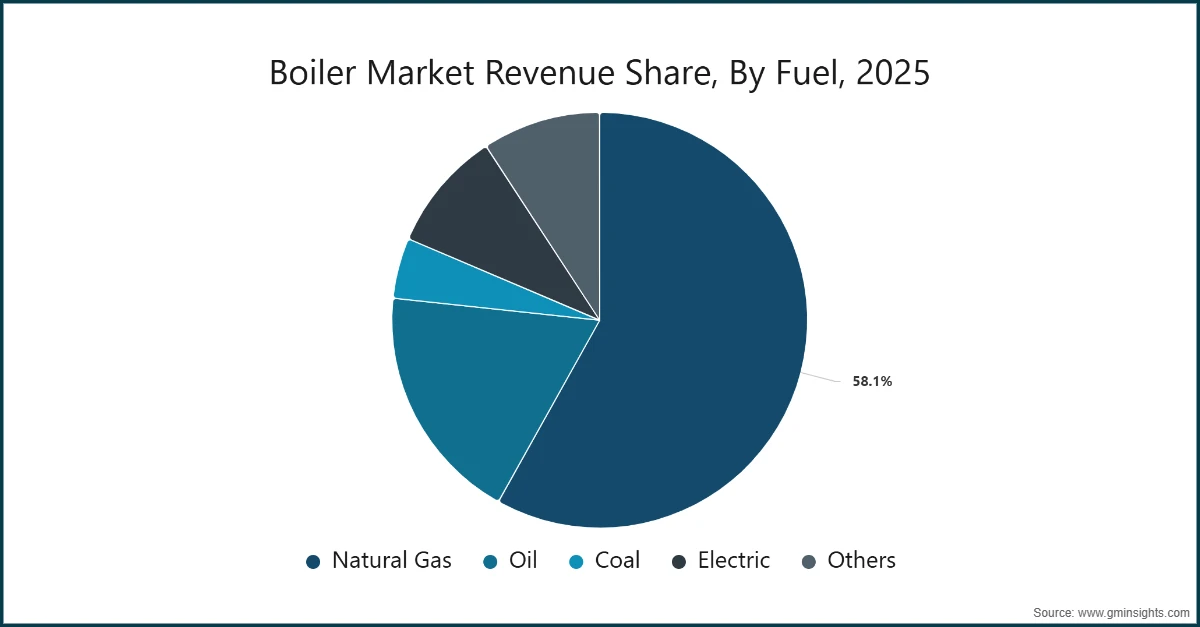
Based on fuel, the industry is divided into natural gas, oil, coal, electric and others. The natural gas boiler market holds a share of 58.1% in 2025 and is set to reach over USD 120 billion by 2035.
The market is shaped by widespread fuel availability, competitive pricing, and relatively lower emission profiles. Demand is supported by efficiency advantages and regulatory preference over higher-carbon fuels. Ongoing infrastructure development, replacement activity, and energy transition policies continue to influence market stability and long-term growth globally across regions.
Oil fired boiler industry was estimated at USD 20.9 billion in 2025. The industry is influenced by fuel price volatility, regional fuel availability, and emission regulations. Demand is largely driven by replacement needs in areas with limited gas infrastructure. Efficiency improvements and emission control requirements continue to shape market trends, while gradual fuel transition policies impact long-term growth prospects.
For instance, in January 2024, Bosch introduced its Greenstar 30 kW wall-mounted condensing boiler across European markets, designed to achieve efficiency levels of up to 94%. The launch targets homeowners seeking energy-efficient heating solutions, reinforcing the company’s focus on advanced residential technologies, reduced emissions performance, and compliance with evolving regional energy standards and sustainability-driven heating system requirements, strengthening its competitive position across industry.
The electric market is set to grow at a rate of 11.5% from 2026 to 2035. The market is driven by electrification trends, grid decarbonization, and tightening emission regulations. Demand benefits from zero on-site emissions, compact system design, and precise controllability. Growth is supported by renewable electricity integration, policy incentives, and rising interest in low-maintenance, energy-efficient heating solutions globally across diverse markets worldwide.
The coal boiler market is shaped by legacy installations, fuel availability, and regional energy policies. Demand is increasingly constrained by stringent emission regulations and decarbonization initiatives. While coal remains cost competitive in certain regions, efficiency upgrades, pollution controls, and gradual fuel substitution continue to influence market contraction trends globally today.
For instance, in August 2025, Bosch launched an advanced connected digital platform for boiler systems that incorporates IoT connectivity and predictive maintenance capabilities to enhance performance monitoring and reliability. The solution is designed to help industrial and commercial operators optimize efficiency, reduce downtime, and improve lifecycle management through data-driven insights, strengthening operational control and supporting smarter, technology-enabled energy infrastructure across facilities.
Based on technology, the industry is bifurcated into condensing and non-condensing. The condensing boiler industry will witness a CAGR of over 8% by 2035. These systems recover latent heat from exhaust gases, improving overall performance. Adoption is supported by regulatory incentives, replacement cycles, and sustainability goals, positioning condensing technology as a preferred solution in efficiency-focused markets worldwide.
The non-condensing market is characterized by simpler system design and lower upfront costs. Demand persists in regions with less stringent efficiency regulations and existing infrastructure compatibility. However, market growth remains limited as replacement trends and policy frameworks increasingly favor higher-efficiency heating technologies over conventional systems.
Looking for region specific data?
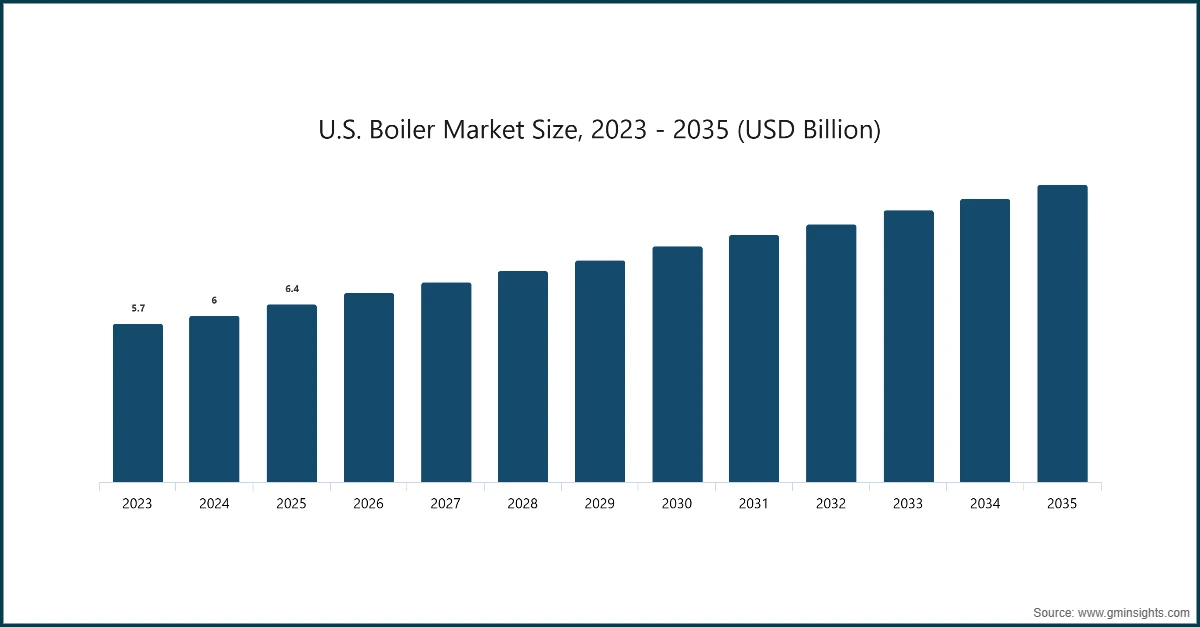
The U.S. dominated the boiler market in North America with around 78% share in 2025 and generated USD 6.4 billion in revenue. Market activity is supported by infrastructure upgrades and modernization initiatives. Emphasis on emission reduction, fuel flexibility, and operating cost optimization continues to shape purchasing decisions and long-term market development nationwide.
For illustration, in March 2024, Viessmann revealed a strategic partnership with Schneider Electric to integrate its boiler solutions with the EcoStruxure building automation platform. This collaboration aims to deliver smarter, interconnected heating systems that improve energy efficiency, operational visibility, and control for residential and commercial buildings, while supporting digitalized building management and advancing sustainable heating infrastructure across modern property environments.
The North America market is projected to surge USD 14 billion by 2035. The industry reflects a mature yet evolving landscape shaped by energy transition strategies and policy alignment. Market activity is increasingly centered on system optimization, electrification readiness, and emissions accountability. Investment decisions emphasize lifecycle performance and adaptability to future regulatory changes rather than capacity expansion alone.
The Europe boiler market is shaped by aggressive decarbonization targets and harmonized efficiency directives. Market momentum is largely replacement driven, focusing on low-emission and high-performance systems. Cross-border regulatory alignment, energy price volatility, and strong sustainability commitments influence technology selection and investment timing across both mature and transitioning economies regionally.
For illustration, in June 2025, Babcock Wanson strengthened its European market position by acquiring Danish industrial boiler service specialist Chr. Møller while simultaneously introducing its LV-Pack low-voltage electric industrial boiler range. This dual move expands its product portfolio, enhances regional service support, and reinforces its ability to deliver diversified, energy-efficient boiler solutions tailored to evolving industrial customer requirements across the region.
The Asia Pacific accounts for about 30% of the boiler market in 2025. The growth is supported by industrial development and infrastructure investment, while efficiency and emission standards are gradually strengthening. Diverse fuel availability and uneven regulatory maturity create varied adoption patterns across developing and developed economies.
The Middle East & Africa industry is set to grow at a rate of over 6% by 2035. The demand is uneven, reflecting varying levels of industrialization and regulatory enforcement. Investment priorities focus on reliability and efficiency, while gradual policy shifts toward sustainability shape long-term market potential.
For instance, in May 2024, Thermax Limited secured a USD 62 million international contract to supply two 550 TPH circulating fluidized bed combustion industrial boilers for a national power generation project in Botswana. The order strengthens the company’s global presence, expands its large-scale project portfolio, and reinforces its capabilities in delivering high-capacity, advanced boiler solutions for utility-grade power infrastructure developments.
The Latin America market reflects fragmented growth driven by selective infrastructure upgrades and energy diversification efforts. Demand is closely tied to macroeconomic stability and capital availability. Policy inconsistency, import dependence, and financing constraints moderate expansion, while efficiency improvements and modernization initiatives create pockets of opportunity across key regional economies.
Boiler Market Report Attributes
| Key Takeaway | Details |
|---|---|
| Market Size & Growth | |
| Base Year | 2025 |
| Market Size in 2025 | USD 112.2 Billion |
| Market Size in 2026 | USD 122.4 Billion |
| Forecast Period 2026-2035 CAGR | 6.8% |
| Market Size in 2035 | USD 220.9 Billion |
| Key Market Trends | |
| Drivers | Impact |
| Stringent government regulations to limit carbon emissions | Stricter emission norms and efficiency standards are pushing industries and households to replace conventional boilers with low-emission, high-efficiency, and electric boiler systems. |
| Paradigm shift toward decarbonization | Global decarbonization goals are accelerating the transition toward electric, hybrid, and renewable-integrated boilers, reducing dependence on fossil fuels across residential, commercial, and industrial sectors. |
| Rising demand for efficient space and water heating system | Growing urbanization and energy cost concerns are driving demand for boilers offering higher thermal efficiency, faster heating, compact design, and lower operating expenses. |
| Ongoing replacement of the existing heating units with energy-efficient boilers | Aging boiler infrastructure is being replaced with modern, energy-efficient models to meet regulatory requirements, improve reliability, reduce fuel consumption, and lower lifecycle operating costs. |
| Pitfalls & Challenges | Impact |
| High initial investments | High upfront costs for advanced boiler systems, including electric and high-efficiency models, often limit adoption, particularly among small industries and cost-sensitive residential users. |
| Surging popularity of available alternatives | Increasing adoption of heat pumps, district heating, and solar thermal systems is reducing boiler demand by offering competitive efficiency, lower emissions, and long-term operational savings. |
| Opportunities: | Impact |
| Growth of electric & hybrid boilers | Rising renewable power integration and decarbonization policies are creating strong opportunities for electric and hybrid boilers across residential, commercial, and industrial heating applications. |
| Industrial process electrification | Industries transitioning toward electrified process heating are driving demand for high-capacity electric boilers to support steam generation, sterilization, and controlled thermal processes. |
| Retrofit & replacement demand | Aging boiler installations across industries and buildings present opportunities for retrofit solutions and replacement with energy-efficient, low-emission, and digitally controlled boiler systems. |
| Smart & connected boiler technologies | Increasing adoption of IoT-enabled boilers for predictive maintenance, energy monitoring, and operational optimization is opening new revenue streams for manufacturers and solution providers. |
| Market Leaders (2025) | |
| Market Leader |
Market Share of 9% |
| Top Players |
Collective Market Share of 36% |
| Competitive Edge |
|
| Regional Insights | |
| Emerging countries | U.S., UK, Germany, France, China |
| Future outlook |
|
What are the growth opportunities in this market?
Boiler Market Share
The top 5 players in market are VIESSMANN, Bosch Limited, Vaillant Group, BDR Thermea Group and A. O. Smith contribute around 36% of the market share in 2025.
The industry is characterized by stable, demand-driven growth supported by industrial operations, power generation, and building heating needs. It is a technology-intensive and moderately consolidated industry where established players compete on efficiency, emissions performance, fuel flexibility, and service networks. Market trends are strongly influenced by environmental regulations, energy costs, infrastructure expansion, and modernization of aging boiler systems.
Viessmann’s boiler portfolio spans residential, commercial, and industrial segments, featuring wall-hung and floor-standing condensing gas boilers, oil-fired units, electric boilers, and high-pressure steam systems. Its offerings integrate digital controls, modular cascade designs, and compatibility with renewable energy systems, positioning the company as a full-range global boiler solutions provider worldwide today.
Bosch Limited, through its divisions, provides a diverse boiler range including residential condensing gas boilers, commercial hot-water and steam boilers, and industrial process systems. Its portfolio emphasizes energy efficiency, low emissions, and smart connectivity, supported by modular configurations and hybrid integration with heat pumps and renewable heating technologies globally.
Vaillant Group offers an extensive selection of boilers focused on residential and light commercial use, including wall-hung condensing combi, system, and conventional models. Its portfolio integrates intelligent controls, cascade capability, and compatibility with heat pumps and solar thermal systems, highlighting efficiency, compact design, and low-emission performance across applications worldwide markets.
BDR Thermea Group’s portfolio spans multiple brands delivering condensing, combi, system, and heat-only boilers for residential and commercial markets. The company emphasizes sustainable innovation with hydrogen-ready models, hybrid heating solutions, and advanced control platforms, enabling flexible installation, energy optimization, and compliance with evolving global efficiency and emissions standards worldwide.
A.O. Smith’s boiler lineup focuses primarily on high-efficiency commercial condensing boilers and hydronic heating systems, complemented by select residential models. Its products feature stainless-steel heat exchangers, modular design, and advanced controls, targeting reliability, thermal efficiency, and space savings for institutional, industrial, and large-scale building applications across markets globally.
Boiler Market Companies
ALFA LAVAL reported net sales of USD 3.5 billion in the first half of 2025, reflecting strong demand across its energy, heat transfer, and fluid handling solutions. The company maintained robust operational performance, delivering significant outputs in heat and electricity production. These results underscore its ability to drive growth, operational efficiency, and profitability in a competitive global market.
In 2024, Bosch Limited’s reported sales revenue of USD 104.9 billion, with an EBIT margin of 3.5%. The results reflect strong performance across its automotive, industrial technology, and energy sectors, highlighting the company’s ability to balance growth and profitability while investing in innovation, sustainability initiatives, and advanced technologies to maintain a competitive global presence.
In the first six months of 2025, Miura America reported strong financial performance, generating USD 810 million in revenue. The growth was driven by robust demand for its high-efficiency boilers and industrial heating solutions across commercial and industrial sectors. These results underscore Miura America’s operational strength, market competitiveness, and ability to deliver reliable, energy-efficient technologies.
Major players operating in the boiler industry are:
A.O. Smith
Ariston Holding
Babcock & Wilcox
Babcock Wanson
Baxi
BDR Thermea Group
Bosch Limited
Bradford White Corporation
BURNHAM COMMERCIAL BOILERS
Carrier
Clayton Industries
Cleaver-Brooks
DAIKIN INDUSTRIES
FERROLI
Fulton
Hurst Boiler & Welding
IHI Corporation
John Cockerill
Lennox International
MITSUBISHI HEAVY INDUSTRIES
Miura America
Navien
P.M. Lattner Manufacturing
PARKER BOILER
Thermax
U.S. Boiler Company
Vaillant Group
Vattenfall
VIESSMANN
WM Technologies
Boiler Industry News
In January 2026, A.O. Smith completed the acquisition of LVC Holdco LLC (Leonard Valve Company) for USD 470 million, marking a strategic expansion of its water temperature and flow‑control portfolio. This acquisition strengthens A.O. Smith’s commercial water heating and boiler offerings, enhancing integration between advanced temperature‑mixing technologies and high‑efficiency boiler systems. The move positions the company to provide more comprehensive thermal solutions to institutional and industrial boiler‑using customers, aligning with rising regulatory and operational demands for precise, energy‑efficient water system control.
In September 2025, Babcock & Wilcox was recognized as a leading player in the industrial boiler industry through its inclusion in the Industrial Boilers – Company Evaluation Report, 2025. The assessment highlights the company’s advancement in renewable‑focused, smart‑infrastructure boiler systems designed for modern industrial energy needs. This acknowledgment reflects Babcock & Wilcox’s strategic investments in low‑emission technologies, improved combustion systems, and cleaner fuel transitions. These innovations are aimed at enhancing thermal efficiency while supporting industries in meeting tightening global environmental regulations, signaling the company’s strengthened position in supplying sustainable and reliable boiler solutions.
In May 2025, BDR Thermea Group entered into strategic cooperation agreements with Midea that significantly reshape its presence in the Asian boiler market. Under the agreement, Midea will acquire BDR Thermea’s China‑based operations, including manufacturing facilities, sales channels, and core boiler technologies. The arrangement allows Midea to continue operating established brands such as Baxi, De Dietrich, Brötje, and Chappée in the Chinese market while supplying boiler products and services to BDR Thermea internationally. This strategic move supports both companies’ ambitions toward energy‑efficient heating solutions, enhancing the availability of sustainable and technologically advanced boiler systems in global markets.
In February 2025, Carrier marked a significant transformation in its heating and boiler‑related portfolio by completing the integration of Viessmann Climate Solutions, following the previously announced acquisition. This strategic move brought Viessmann’s advanced product suite including hydrogen‑ready boilers, high‑efficiency heat pumps, solar thermal systems, and its One Base digital energy platform under Carrier’s global umbrella. The acquisition enhances Carrier’s technological leadership in the heating sector, expanding its capabilities in renewable and hybrid heating solutions. This combination not only strengthens Carrier’s position across Europe and global HVAC markets but also accelerates innovation in next‑generation boiler systems designed for lower emissions and improved operational efficiency.
The boiler market research report includes in-depth coverage of the industry with estimates & forecast in terms of revenue (USD Million) & volume (Units) from 2022 to 2035, for the following segments:
Market, By Fuel
Natural gas
Oil
Coal
Electric
Others
Market, By Capacity
≤ 10 MMBTU/hr
> 10 - 50 MMBTU/hr
> 50 - 100 MMBTU/hr
> 100 - 250 MMBTU/hr
> 250 MMBTU/hr
Market, By Application
Residential
Single family
Multi family
Commercial
Offices
Healthcare facilities
Educational institutions
Lodgings
Retail stores
Others
Industrial
Food processing
Pulp & paper
Chemical
Refinery
Primary metal
Others
Market, By TechnologyCondensing
Non-condensing
Condensing
Non-condensing
Market, By Sales Channel
Online
Dealer
Retail
The above information has been provided for the following regions and countries:
North America
U.S.
Canada
Mexico
Europe
France
UK
Poland
Italy
Spain
Austria
Germany
Sweden
Russia
Asia Pacific
China
India
Philippines
Japan
South Korea
Australia
Indonesia
Middle East & Africa
Saudi Arabia
Iran
UAE
Nigeria
South Africa
Latin America
Argentina
Chile
Brazil
Frequently Asked Question(FAQ) :
What was the market size of the boiler market in 2025?
The global boiler market size was valued at USD 112.2 billion in 2025, driven by replacement demand, aging systems, and regulatory compliance.
What is the projected value of the boiler market by 2035?
The market is expected to reach USD 220.9 billion by 2035, growing at a CAGR of 6.8%, supported by advancements in technology and increasing demand for energy-efficient systems.
What is the projected size of the boiler market in 2026?
The market is projected to reach USD 122.4 billion in 2026.
What was the market share of the natural gas boiler segment in 2025?
The natural gas boiler segment held a 58.1% market share in 2025 and is expected to surpass USD 120 billion by 2035.
What was the market share of the residential application segment in 2025?
The residential application segment accounted for 65% of the market in 2025 and is projected to grow at a rate exceeding 6.5% through 2035.
Which region dominated the boiler market in North America in 2025?
The U.S. led the North American boiler market with a 78% share, generating USD 6.4 billion in revenue in 2025. Infrastructure upgrades and emission reduction initiatives supported this dominance.
What are the key trends in the boiler industry?
Key trends include replacement-driven demand, regional variations in energy policies and climate conditions, and a focus on efficiency improvements and emissions compliance.
Who are the major players in the boiler market?
Major players include A.O. Smith, Ariston Holding, Babcock & Wilcox, Babcock Wanson, Baxi, BDR Thermea Group, Bosch Limited, Bradford White Corporation, and Burnham Commercial Boilers.
Boiler Market Scope
Related Reports