Summary
Table of Content

Blue Cheese Market
Get a free sample of this report
Form submitted successfully!
Error submitting form. Please try again.
Thank you!
Your inquiry has been received. Our team will reach out to you with the required details via email. To ensure that you don't miss their response, kindly remember to check your spam folder as well!
Request Sectional Data
Thank you!
Your inquiry has been received. Our team will reach out to you with the required details via email. To ensure that you don't miss their response, kindly remember to check your spam folder as well!
Form submitted successfully!
Error submitting form. Please try again.
Blue Cheese Market Size
- The blue cheese market exists because traditional dairy methods and its special taste and high-end market status combine to create its unique presence in global cheese sales. Demand for cheese products emerges from consumer interest in artisanal and specialty and aged cheese varieties which particularly gain traction through foodservice and gourmet retail channels. Blue cheese maintains culinary value through its use in dressings and sauces and salads and bakery fillings while remaining popular as a standalone food item. The market offers product variety through its milk source and aging technique and texture and flavor intensity differentiation which helps attract both traditional customers and new food explorers.
- The overall market experiences growth because people show more interest in premium dairy products and it has been discovered that international cuisine and specialty cheese products have become more common in modern retail environments. People in urban areas with higher disposable income spend more money to try new flavor experiences that include blue-veined cheeses. Foodservice operators and quick-service restaurants use blue cheese as a menu item to create better food value and more complex flavor profiles which leads to greater online sales. The growth of mold-ripened cheeses depends on better cold-chain logistics which enable manufacturers to send their products to customers in more distant locations.
- The blue cheese market will expand steadily as consumers learn about strong-flavored cheeses and companies develop new cheese products. Buyers who value product quality are now choosing clean-label products and organic options and products that guarantee controlled-origin sourcing. People in areas with strong cheese traditions still consume most cheese but people in emerging markets learn about cheese because western diets and global food distribution become more common.
The global blue cheese market was valued at USD 2.8 billion in 2025. It is projected to grow from USD 3 billion in 2026 to USD 4.9 billion by 2035, representing 5.6% CAGR from 2026 to 2035, according to latest report published by Global Market Insights Inc.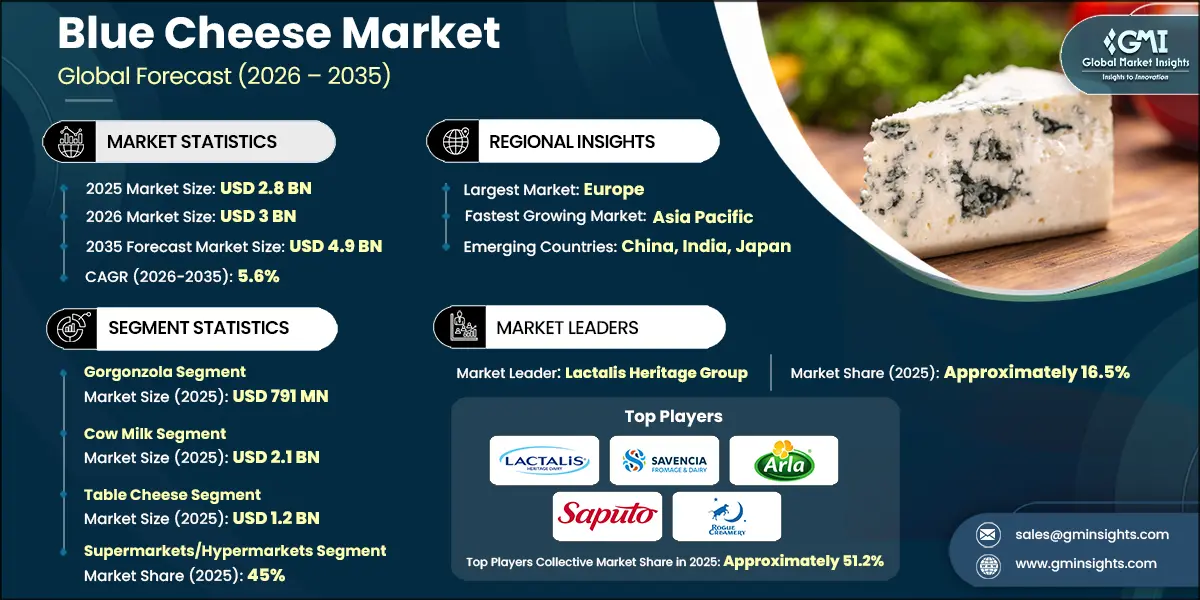
Blue Cheese Market Key Takeaways
Market Size & Growth
- 2025 Market Size: USD 2.8 Billion
- 2026 Market Size: USD 3 Billion
- 2035 Forecast Market Size: USD 4.9 Billion
- CAGR (2026–2035): 5.6%
Regional Dominance
- Largest Market: Europe
- Fastest Growing Region: Asia Pacific
Key Market Drivers
- Rising preference for specialty and artisanal cheeses.
- Expanding use in foodservice and culinary applications.
- Exposure to international and westernized cuisines.
- Premium positioning within the dairy category.
Challenges
- Strong flavor limiting mass consumer acceptance.
- Shorter shelf life and storage sensitivity.
- Dependence on controlled aging and production conditions.
Opportunity
- Product innovation with milder and blended variants.
- Growth of organic and clean-label dairy products.
- Expansion in emerging urban food markets.
- Premium retail and specialty store expansion.
Key Players
- Market Leader: Lactalis Heritage Group led with over 16.5% market share in 2025.
- Leading Players: Top 5 players in this market include Lactalis Heritage Group, Savencia SA, Arla Foods amba, Saputo Inc., Rogue Creamery, which collectively held a market share of 51.2% in 2025.
Get Market Insights & Growth Opportunities
To get key market trends
Blue Cheese Market Trends
- The blue cheese industry is experiencing a shift toward premiumization because consumers increasingly value artisanal production methods which create unique flavor profiles for their cheese products. Consumers are showing stronger interest in cheeses which have traditional aging methods and authentic regional flavors and fermentation processes that create controlled production. Consumers are showing increased demand for specialty blue cheeses when they select products that exist beyond standard dairy offerings.
- Consumers are becoming more open to new products because producers make changes to their product offerings. Producers use milder flavors and creamier textures and product combinations to create better experiences for first-time customers. Blue cheese can attract more customers through this method while its primary brand identity remains unchanged across various retail and dining spaces.
- Market trends develop through foodservice innovations which now use blue cheese as an ingredient rather than a standalone product. The product develops new menu styles through its implementation into dressings and dips and burgers and flatbreads and gourmet fast food. Application-based product demand creates steady volume flow through both institutional settings and commercial kitchen operations.
- The blue cheese industry needs sustainability and clean-label product options which have become essential components of its business model. Consumers expect food transparency which requires brands to use natural ingredients and organic milk and minimal additives in their products. The blue cheese industry continues to develop into a strong and stable market because cold-chain networks have improved and stores that sell specialty products have increased.
Blue Cheese Market Analysis
Learn more about the key segments shaping this market
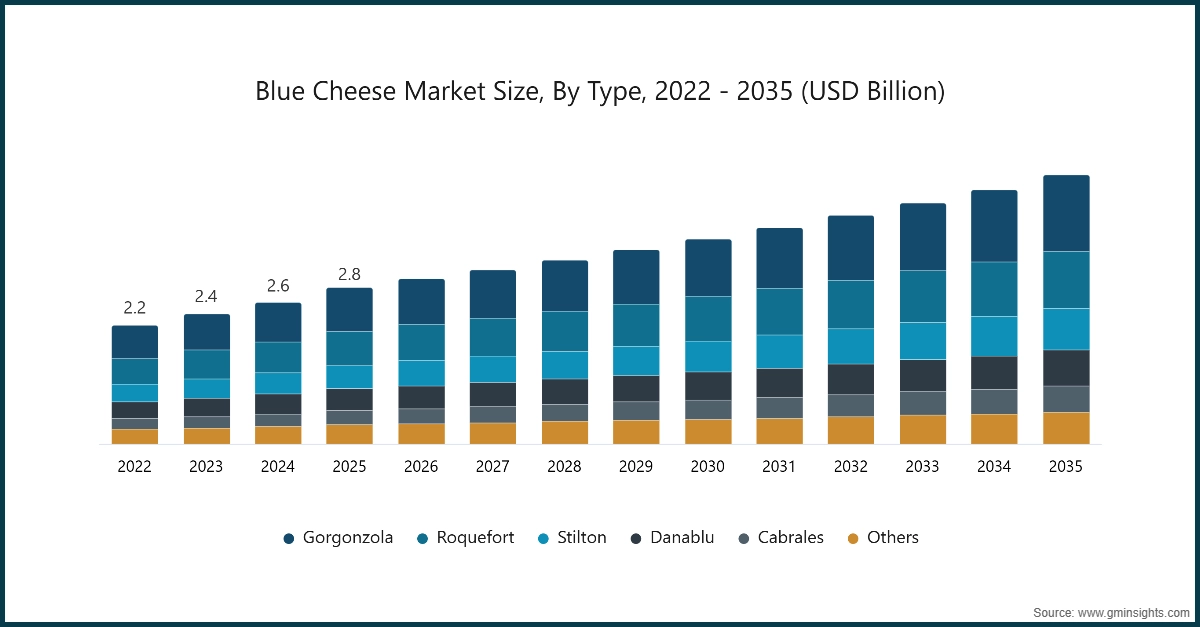
Based on type the, market is segmented into gorgonzola, roquefort, stilton, danablu, cabrales, and others. The gorgonzola segment was valued at USD 791 million in 2025, and it is anticipated to expand to 5.7% of CAGR during 2026-2035.
- The blue cheese market by type reflects a balance between heritage-driven varieties and region-specific flavor identities. Established types such as gorgonzola, roquefort, and stilton continue to shape overall consumption patterns due to their strong recognition, traditional production methods, and consistent use in both retail and foodservice applications. These cheeses benefit from long-standing culinary relevance and stable demand among consumers familiar with bold, aged dairy products. Their positioning as premium or specialty offerings supports steady market contribution across mature cheese-consuming regions.
- At the same time, varieties such as danablu, cabrales, and other regional or blended blue cheeses contribute to diversification within the market. These segments support experimentation, localized consumption, and menu-driven demand, particularly where milder textures or distinct regional characteristics are preferred. The combined segmentation highlights a market that values authenticity while gradually adapting to broader taste preferences, allowing traditional blue cheeses and emerging variants to coexist and support overall market expansion.
Based on source, the market is segmented into cow milk, goat milk, and sheep milk. The cow milk segment was valued at USD 2.1 billion in 2025, and it is anticipated to expand to 5.3% of CAGR during 2026-2035.
- The blue cheese market by source highlights distinct consumer preferences shaped by taste intensity, texture, and traditional consumption patterns. Cow milk–based blue cheese forms the backbone of this segmentation due to its wide availability, balanced flavor profile, and suitability for large-scale production. Its versatility supports usage across retail, foodservice, and processed food applications, making it a common choice for both classic blue cheese varieties and modern adaptations. Familiarity with cow milk cheeses also encourages repeat consumption and easier acceptance among a broad consumer base.
- Goat milk and sheep milk blue cheeses add depth and differentiation to the market by catering to niche and premium segments. These sources are often associated with sharper flavor notes, denser textures, and traditional regional practices, appealing to experienced cheese consumers seeking authenticity and sensory complexity. While their consumption remains more specialized, they contribute to product diversity and premium positioning within the market. Together, the source-based segmentation reflects a balance between mainstream demand driven by cow milk and specialized growth supported by goat and sheep milk blue cheeses.
Based on application is segmented into table cheese, cooking ingredient, salad topping, and spread/dip. The table cheese segment was valued at USD 1.2 billion with a market share of with a market share of 44.9% in 2025, and it is anticipated to expand to 5.2% of CAGR during 2026-2035.
- The blue cheese market by application reflects varied consumption patterns influenced by eating habits, culinary usage, and convenience preferences. Table cheese remains a core application, driven by traditional consumption and premium positioning in retail and specialty food channels. Its role as a standalone product supports consistent demand among consumers who value authentic flavor and texture, especially within established cheese-consuming regions.
- Other applications such as cooking ingredients, salad toppings, and spreads or dips contribute to market expansion by increasing usage frequency and versatility. Blue cheese is increasingly incorporated into prepared foods, dressings, sauces, and casual dining formats, strengthening its presence beyond direct consumption. This application-based segmentation highlights a gradual shift toward multifunctional use, supporting broader adoption across households and foodservice environments while maintaining relevance as both an ingredient and a finished product.
Learn more about the key segments shaping this market
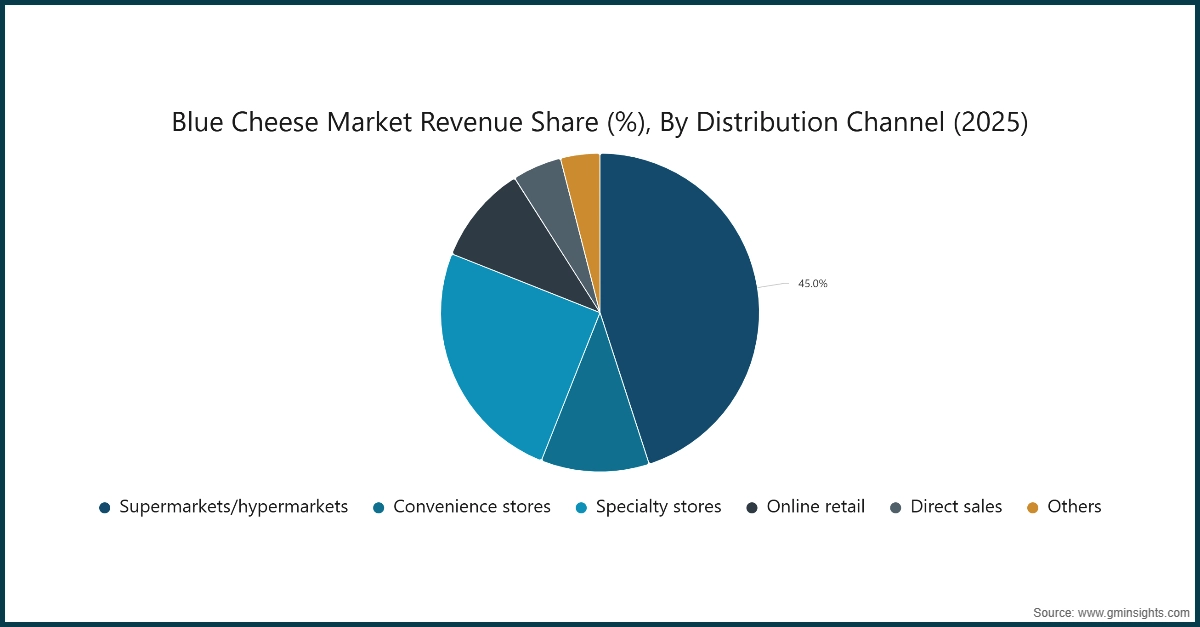
Based on distribution channel, the market is segmented into supermarkets/hypermarkets, convenience stores, specialty stores, online retail, direct sales, and others. The supermarkets/hypermarkets segment was valued at USD 1.2 billion with a market share of 45% in 2025, and it is anticipated to expand to 5.4% of CAGR during 2026-2035.
- The blue cheese market by distribution channel reflects changing purchasing behaviors and the balance between accessibility and product specialization. Supermarkets and hypermarkets remain central to market reach due to their broad product assortments, consistent cold-chain infrastructure, and ability to introduce blue cheese to mainstream consumers. Their role supports regular household purchases and visibility of both established and flavored variants, reinforcing blue cheese as part of everyday premium dairy offerings.
- Other channels such as convenience stores, specialty stores, online retail, and direct sales contribute to channel diversification and targeted consumption. Specialty stores and direct sales emphasize authenticity, regional varieties, and premium positioning, while online retail supports wider geographic access and niche product discovery. Convenience stores and alternative channels address impulse and smaller-format purchases. Together, this distribution mix strengthens market resilience by combining mass-market availability with specialized and experience-driven sales formats.
Looking for region specific data?
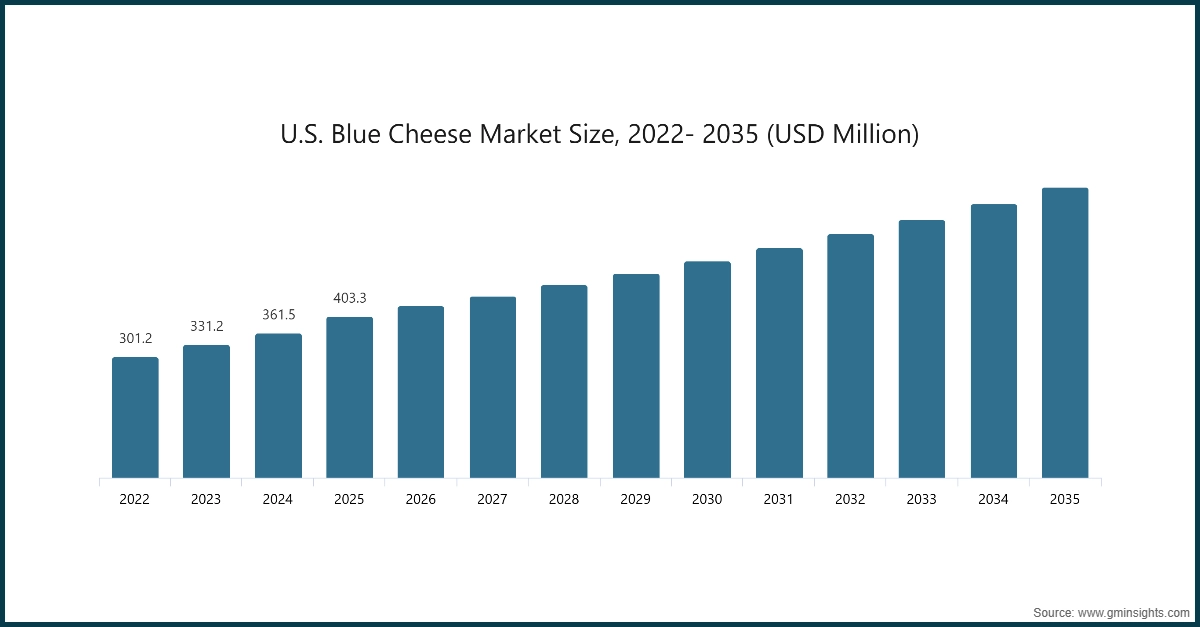
The North America blue cheese industry accounted for USD 469 million in 2025 and is anticipated to show lucrative growth over the forecast period.
The blue cheese market in North America is shaped by strong foodservice demand and the wide use of blue cheese in dressings and burgers and casual dining formats. The United States functions as a primary consumption market because dairy infrastructure exists throughout the country while restaurants and packaged food products maintain regular use of cheese throughout their menus. Canadian cheese production occurs through continuous cheese retail sales which drive cheese production in urban markets through their increasing demand for artisanal cheese and specialty cheese products.
The Europe market accounted for USD 2 billion in 2025 and is anticipated to show lucrative growth over the forecast period.
European blue cheese production maintains its traditional methods through its dedication to preserving authentic regional cheese-making techniques. France and Italy serve as key countries because their residents maintain long-established cheese consumption traditions which lead to domestic markets that value mold-ripened cheese products. The region benefits from high per‑capita cheese consumption because premium cheese products maintain their demand across multiple food distribution channels, which include retail, hospitality, and specialty food markets.
Asia Pacific blue cheese market accounted for 7.1% market share in 2025 and is anticipated to show lucrative growth over the forecast period.
The Asia Pacific market experiences changes because people now prefer different diets while they become more familiar with western food. Japan maintains market demand through its premium food consumption and culinary experimentation which drives Japanese culinary development, while Australia supports the market through its developed dairy production and growing specialty cheese awareness. Modern retailing systems and urban population growth and increasing disposable income levels create extended market opportunities for businesses in the region.
Latin America blue cheese market is anticipated to grow at a CAGR of 5% during the analysis timeframe.
Latin America shows restricted blue cheese consumption which however grows through premium foodservice and retail outlets. Brazil serves as an important market because its dairy industry is extensive and Brazilian consumers now want to buy specialty cheese products. Argentine cheese culture drives regional cheese demand because it includes traditional cheese recipes and modern cheese applications of blue cheese.
Middle East & Africa market is expected to grow at a CAGR of 7.1% during the analysis timeframe.
The Middle East and Africa blue cheese market expands through the rising demand for specialty dairy products and the increasing number of hospitality businesses. The United Arab Emirates supports consumption through international foodservice outlets and premium retail environments, while South Africa contributes through established dairy processing and niche specialty cheese demand. Urban consumers drive market expansion because they want to experience unique and high-quality dining options.
Blue Cheese Market Share
- Lactalis Heritage Group, Savencia SA, Arla Foods amba, Saputo Inc., and Rogue Creamery are a significant part of the global blue cheese industry and with further standing of being slightly consolidated with the top five players steadily holding 51.2% market share in the year 2025.
- The competitive environment depends on two essential elements, which are traditional production methods and controlled aging processes. Taste and texture and product quality work together to determine which products customers will choose at both retail stores and food service establishments.
- Product differentiation, which includes different milk sources and aging periods and blue vein intensity, creates distinct product variations. The suppliers can provide products to both experienced customers and those who prefer gentler taste options.
- The specialty retail and gourmet food markets use premium product placement to create their competition advantages. Packaging elements, storytelling through product origins, and brand authenticity perception all help customers remember brands and make repeat purchases.
- Market stability depends on two critical factors, which are scale capabilities and reliable product delivery systems. The efficient distribution system enables businesses to reach more markets while decreasing the chances of product waste.
- The market presence of application-focused formats improves through their development as crumbles and spreads and sauces. The formats enable customers to use products frequently while they combine them with ready-to-eat meals and restaurant menus.
- The entire industry shifts toward clean-label products and high-quality items. Customers who prioritize quality will trust products that use natural elements and limited additives and reveal their ingredient sources.
- Regional specialization shapes market competition because producers select specific markets that match local consumer preferences. This method enables businesses to create products that meet cultural needs and build market demand.
- Foodservice partnerships provide two main benefits, which include increasing brand recognition and maintaining stable product quantities. Food service businesses receive regular supplies of products, which helps the company build its long-term market presence.
- Companies maintain their market position through their ability to meet current consumer demands, which include mild taste alternatives and mixed product options. The system provides participants with the means to handle changing taste preferences while maintaining their brand product characteristics.
Blue Cheese Market Companies
The major players operating in blue cheese industry include:
- Maytag Dairy Farms
- Rogue Creamery
- Arla Foods amba
- Lactalis Heritage Group
- Savencia SA
- Saputo Inc.
- Clawson Dairy Limited
- Prairie Farms Cheese Division
- Cashel Farmhouse Cheesemakers
- casArrigoni srl
- Others
- Lactalis Heritage Group sustains its operations by implementing traditional cheese-making methods which require specialized skills in cheese production and cheese aging techniques. The company's wide-ranging dairy operations enable it to produce blue cheese which maintains its authentic taste across different areas. The company uses its combined sourcing and distribution system to create dependable supply networks. The company maintains its focus on marketing products which represent both high-quality and traditional heritage styles.
- Savencia SA operates in the blue cheese market by producing cheese products which have both added value and traditional cultural significance. The company's diverse product range enables it to deliver both table cheese products and culinary cheese solutions. The company establishes distinct product qualities through its combination of different texture variations and different levels of flavor strength. The company achieves a balance between operating on a large scale while maintaining specialized operational activities.
- Arla Foods amba operates through two main activities which involve producing high-quality dairy products and obtaining milk through its cooperative milk collection system. The company's blue cheese production process depends on traceability standards and controlled manufacturing methods to deliver reliable products. The company builds consumer trust through its clean label products. The company maintains strong market presence in developed dairy markets which creates continuous product demand.
- Saputo Inc. maintains its market position through three core factors which include its large operational scale and efficient processing capabilities and various product delivery methods. The company provides retail and foodservice operations with dependable product supply throughout the entire year. The company uses its effective cold-chain management system to expand its product delivery network. The company maintains its core focus on achieving stable operations while securing consistent product volume.
- Rogue Creamery uses its traditional production method which uses small-scale production to create products that require extended aging time and deep flavor development. The company sells its products to both specialty retail stores and high-end food service markets. The company's commitment to craftsmanship techniques helps establish its products as premium offerings. The company creates unique product differentiation which establishes its identity within the wide blue cheese market.
Blue Cheese Market Report Attributes
| Key Takeaway | Details |
|---|---|
| Market Size & Growth | |
| Base Year | 2025 |
| Market Size in 2025 | USD 2.8 Billion |
| Market Size in 2026 | USD 3 Billion |
| Forecast Period 2026-2035 CAGR | 5.6% |
| Market Size in 2035 | USD 4.9 Billion |
| Key Market Trends | |
| Drivers | Impact |
| Rising preference for specialty and artisanal cheeses | Supports consistent demand for premium and mold-ripened cheese varieties |
| Expanding use in foodservice and culinary applications | Increases volume consumption across sauces, salads, and prepared foods |
| Exposure to international and westernized cuisines | Improves consumer familiarity with strong-flavored cheese profiles |
| Premium positioning within the dairy category | Enhances value perception and pricing stability |
| Pitfalls & Challenges | Impact |
| Strong flavor limiting mass consumer acceptance | Restricts penetration among first-time and conservative cheese consumers |
| Shorter shelf life and storage sensitivity | Raises logistical complexity and handling costs |
| Dependence on controlled aging and production conditions | Constrains scalability and consistent output |
| Opportunities: | Impact |
| Product innovation with milder and blended variants | Broadens appeal across wider consumer segments |
| Growth of organic and clean-label dairy products | Aligns blue cheese offerings with health-conscious purchasing behavior |
| Expansion in emerging urban food markets | Creates new consumption bases beyond traditional cheese regions |
| Premium retail and specialty store expansion | Improves visibility and accessibility of niche cheese products |
| Market Leaders (2025) | |
| Market Leader |
Market Share Approximately 16.5% |
| Top Players |
Collective Market Share Approximately 51.2% |
| Competitive Edge |
|
| Regional Insights | |
| Largest Market | Europe |
| Fastest growing market | Asia Pacific |
| Emerging countries | China, India, Japan |
| Future outlook |
|
What are the growth opportunities in this market?
Blue Cheese Industry News
- In April 2023, Lactalis Heritage Group, a prominent player in the global dairy arena, made headlines with a series of strategic acquisitions, bolstering its foothold in the cheese market. Notably, Lactalis took over Ambrosi, an esteemed Italian company celebrated for its hard cheeses, including Grana Padano and Parmigiano Reggiano. This strategic acquisition is poised to fortify Lactalis's standing in the coveted Protected Designation of Origin (PDO) cheese segment.
The blue cheese market research report includes in-depth coverage of the industry with estimates & forecast in terms of revenue (USD Billion) & (Kilo Tons) from 2022 to 2035, for the following segments:
Market, By Type
- Gorgonzola
- Gorgonzola Dolce
- Gorgonzola Piccante
- Roquefort
- Stilton
- Danablu
- Cabrales
- Others
Market, By Source
- Cow Milk
- Goat Milk
- Sheep Milk
Market, By Applications
- Table Cheese
- Cooking Ingredient
- Pasta & Italian Dishes
- Sauces & Dressings
- Baked Goods
- Salad Topping
- Spread/Dip
Market, By Distribution channel
- Supermarkets/hypermarkets
- Convenience stores
- Specialty stores
- Online retail
- Direct sales
- Others
The above information is provided for the following regions and countries:
- North America
- U.S.
- Canada
- Europe
- UK
- Germany
- France
- Italy
- Spain
- Rest of Europe
- Asia Pacific
- China
- India
- Japan
- South Korea
- Australia
- Rest of Asia Pacific
- Latin America
- Brazil
- Mexico
- Argentina
- Rest of Latin America
- MEA
- UAE
- Saudi Arabia
- South Africa
- Rest of Middle East and Africa
Frequently Asked Question(FAQ) :
What is the market size of the blue cheese in 2025?
The global blue cheese market was valued at USD 2.8 billion in 2025, driven by rising consumer interest in artisanal and specialty cheeses.
What is the projected value of the blue cheese industry by 2035?
The blue cheese market is projected to reach USD 4.9 billion by 2035, growing at a CAGR of 5.6% from 2026 to 2035, supported by expanding foodservice applications, clean-label demand, and rising consumer experimentation with bold-flavored dairy products.
What is the blue cheese industry size in 2026?
The blue cheese market size is projected to reach USD 3 billion in 2026, fueled by increasing premiumization, improved cold-chain logistics, and greater availability of specialty cheeses in modern retail environments.
How much revenue did the gorgonzola segment generate in 2025?
The gorgonzola segment was valued at USD 791 million in 2025 and is anticipated to expand at a CAGR of 5.7% from 2026 to 2035, supported by its strong culinary recognition, traditional production methods, and consistent demand in retail and foodservice applications.
What was the market share of the table cheese application segment in 2025?
The table cheese segment accounted for USD 1.2 billion with a 44.9% market share in 2025, driven by traditional consumption patterns, premium positioning in specialty food channels.
What was the valuation of the cow milk segment in 2025?
The cow milk segment was valued at USD 2.1 billion in 2025 and is anticipated to grow at a CAGR of 5.3% through 2035, due to wide availability, balanced flavor profile, versatility across retail and foodservice applications, and suitability for large-scale production.
Which region leads the blue cheese market?
Europe leads the global blue cheese market, accounting for USD 2 billion in 2025, driven by high per-capita cheese consumption, and strong demand across retail, hospitality, and specialty food channels.
What are the upcoming trends in the blue cheese market?
Key trends include expanding foodservice use in dressings, dips, and gourmet fast food, growing demand for clean-label and organic variants, and improved cold-chain logistics enabling wider geographic distribution.
Who are the key players in the blue cheese market?
Key players include Lactalis Heritage Group, Savencia SA, Arla Foods amba, Saputo Inc., Rogue Creamery, Maytag Dairy Farms, Clawson Dairy Limited, Prairie Farms Cheese Division, Cashel Farmhouse Cheesemakers, and casArrigoni srl.
Blue Cheese Market Scope
Related Reports