Summary
Table of Content

Blast Chillers Market
Get a free sample of this report
Form submitted successfully!
Error submitting form. Please try again.
Thank you!
Your inquiry has been received. Our team will reach out to you with the required details via email. To ensure that you don't miss their response, kindly remember to check your spam folder as well!
Request Sectional Data
Thank you!
Your inquiry has been received. Our team will reach out to you with the required details via email. To ensure that you don't miss their response, kindly remember to check your spam folder as well!
Form submitted successfully!
Error submitting form. Please try again.
Blast Chillers Market Size
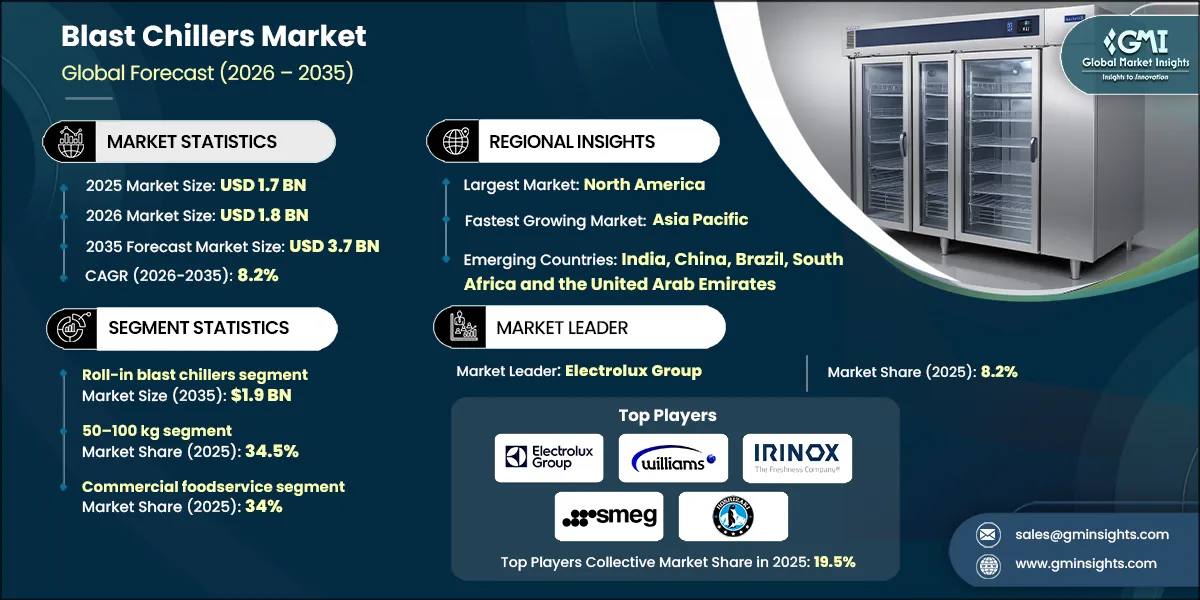
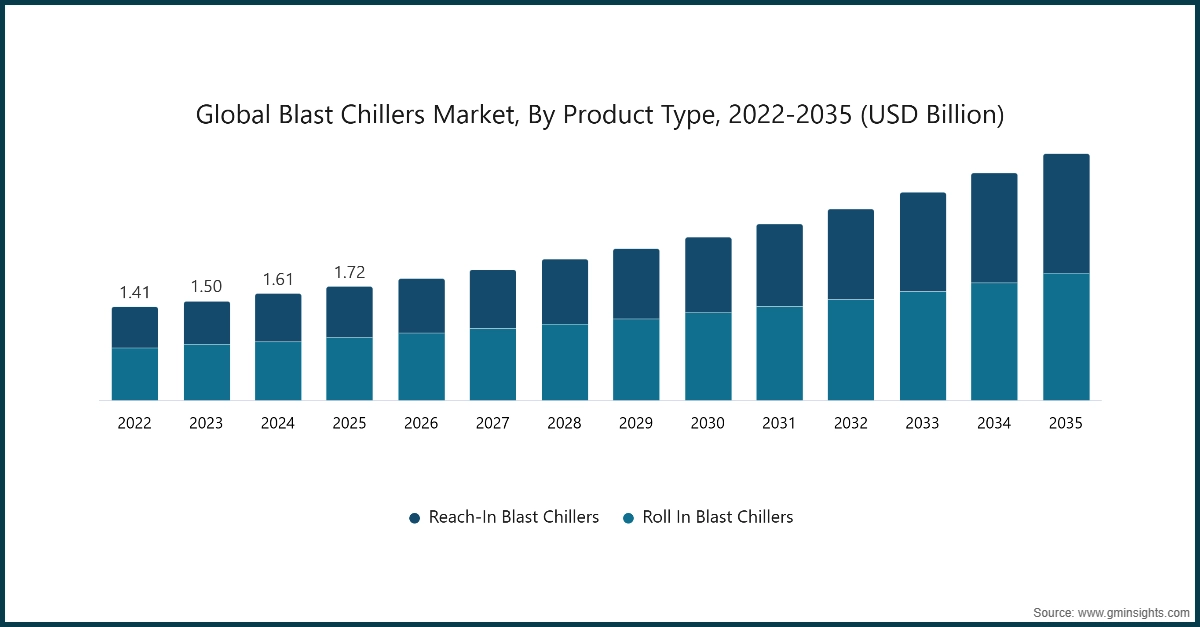
The global blast chillers market was valued at USD 1.7 billion in 2025 with a volume of 61,870.4 units. The market is expected to grow from USD 1.8 billion in 2026 to USD 3.7 billion in 2035 with a volume of 1,24,447.8 units, at a CAGR of 8.2% and a value CAGR of 7.4% during the forecast period according to the latest report published by Global Market Insights Inc.
Blast Chillers Market Key Takeaways
Market Size & Growth
- 2025 Market Size: USD 1.7 Billion
- 2035 Forecast Market Size: USD 3.7 Billion
- CAGR (2026–2035): 8.2%
Regional Dominance
- Largest Market: North America
- Fastest Growing Region: Asia Pacific
Key Market Drivers
- Rising demand for rapid cooling solutions in food processing facilities.
- Stringent food safety regulations and compliance requirements.
- Expansion of the global cold chain infrastructure.
- Growth of commercial kitchens, hotels, and quick-service restaurants (QSRs).
Challenges
- High initial investment and maintenance costs.
- Energy consumption and operational efficiency concerns.
Opportunity
- Adoption of energy‑efficient and eco‑friendly refrigeration technologies.
- Increasing demand from ready‑to‑eat and packaged food industries.
Key Players
- Market Leader: Electrolux Group led with over 8.2% market share in 2025.
- Leading Players: Top 5 players in this market include Electrolux Group, Williams Refrigeration, IRINOX S.p.A., SMEG S.p.A., Hoshizaki Corporation, which collectively held a market share of 19.5% in 2025.
Get Market Insights & Growth Opportunities
The blast chiller market is growing due to strict food safety regulations worldwide, a rising focus on quick cooling technology in foodservice and food processing sectors, a focus on food waste reduction and maintaining a cold chain, and food safety regulations laid down by the government regarding the controlling of temperatures, thereby endorsing modern cooling technology.
Government-established food safety protocols such as the United States's FDA Food Code specify rigorous requirements for ensuring minimized pathogen growth during cooling operations and push foodservice operations to adopt rapid cooling equipment in their processes as a result of these requirements. For example, the FDA Food Code (2022 edition) is the model for state and territorial food-safety regulations and has been incorporated into many different jurisdictions, therefore further enforcing strict cooling practices for retail and foodservice sectors.
To control, eliminate, and detect contamination in food and meet federally controlled food safety performance standards, food processing plants are increasingly depending on blast chillers to rapidly remove heat from cooked products. The producers of poultry, meat and ready-to-eat food must ensure immediate chilling to prevent the growth of pathogens which is in line with the USDA Food Safety and Inspection Service (FSIS) recommendations. The USDA FSIS reports that inspection staff completed 8.1 million food safety and food defense inspections in 7,100+ regulated facilities, emphasizing the extent to which the regulated chilling and temperature-control operations are implemented.
To get key market trends
Blast Chillers Market Trends
- The market is witnessing a strong shift toward energy‑efficient blast chillers as commercial kitchens and food processors aim to reduce operational costs and meet sustainability goals. Modern systems deliver faster cooling with lower power consumption while maintaining high food safety standards.
- Growing demand in cloud kitchens and quick-service restaurants catalyzes market growth. Cloud kitchens and restaurants require blast chiller units in their kitchens to enhance food production processes, advance meal preparation, and sustain food quality during peak hours of operation.
- Companies are now incorporating digital controls, automation, and remote monitoring capabilities in their blast chiller designs. Such smart capabilities improve accuracy, ease of operation, and minimize operator errors to help foodservice professionals keep their units running even in high‑pressure kitchen environments.
- Bakeries and confectionaries also tend to rely more on blast chillers in order to stabilize textures and maintain structural strength and longevity of freshness. Fast cooling allows for higher quantities and consistent results in pastries, doughs, chocolates, as well as other quality-sensitive goods.
Blast Chillers Market Analysis
Learn more about the key segments shaping this market
On the basis of product type, the market is segmented into roll‑in blast chillers and reach‑in blast chillers.
- The roll‑in blast chillers segment is anticipated to reach USD 1.9 billion by 2035. Roll-in blast chillers are gaining traction in applications that require high-volume cooling, such as in central kitchens, institutional food service, or large food processing operations. Their ability to manage full mobile racks are in line with the industry transition to batch food preparation and the simplification and management of the workflow, which guarantees consistency even at the peak production periods.
- With increasing requirements for food safety and stricter temperature control regulations, the roll-in unit is finding application due to its ability to cool uniformly and consistently.
- The reach‑in blast chillers segment was valued at USD 774.3 million in 2025 and is anticipated to grow at a CAGR of 9% over the forecast years. Reach‑in blast chillers continue to evolve with enhancements in energy efficiency, compact engineering, and digital precision, traits that fit the needs of restaurants, cafés, bakeries, and rapidly growing cloud‑kitchen formats. Their space-saving design supports operators working within tighter kitchen layouts while still ensuring rapid, consistent cooling.
- With the industry leaning toward smarter equipment, reach‑in models are already being incorporated with automated cycles, touch‑screen interfaces, and even remote monitoring.
Learn more about the key segments shaping this market
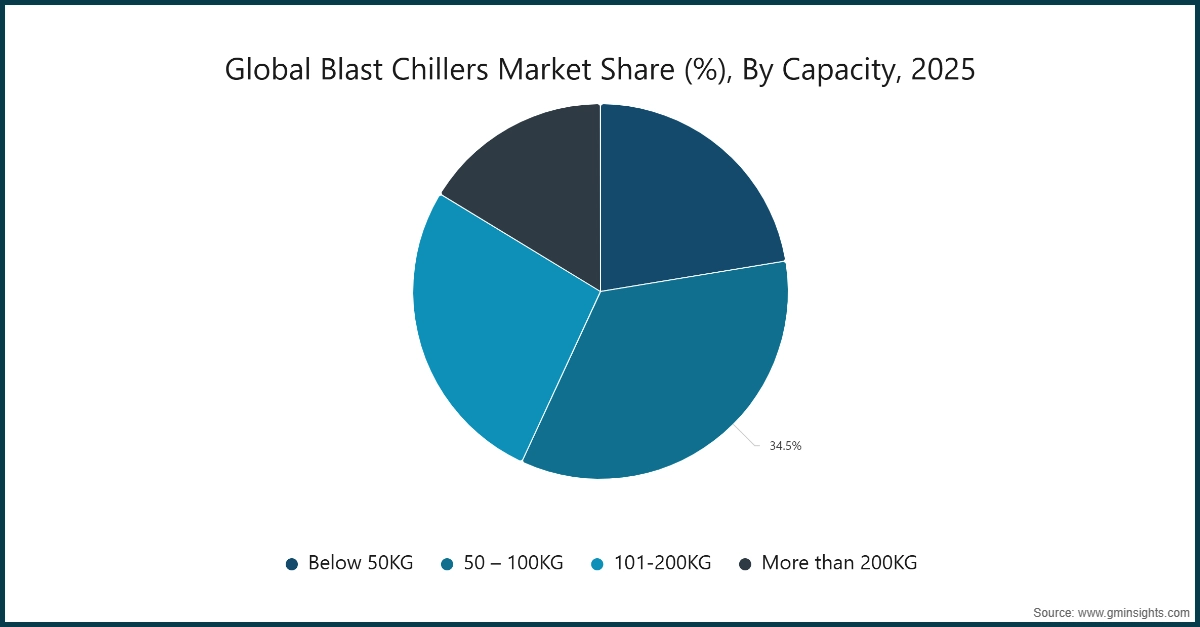
On the basis of capacity, the blast chillers market is divided into 50 kg, 50–100 kg, 101–200 kg, and more than 200 kg.
- The 50–100 kg segment held a market share of 34.5% in 2025. The 50-100kg segment is gaining popularity with mid-sized restaurants, bakeries, and cloud kitchens seeking more powerful cooling abilities while avoiding the investment in large industrial appliances. The balance of space, speed, and efficiency is critical for operators, especially as their menu volume and prep cycle continue to increase.
- The demand is also increasing due to the increasing normalization of food safety practices by organizations. This range of capacities will provide a steady production flow for daily operations by allowing kitchens to cool their production quickly while retaining consistency, freshness, and temperature control requirements.
- The 101–200 kg segment is anticipated to grow at a CAGR of 9.1% during the forecast period 2026 - 2035. The 101–200 kg segment is gaining traction within larger commercial kitchens, institutional foodservices, and high‑volume catering operations. These units support more intensive production schedules, allowing teams to handle bigger loads during peak hours without compromising cooling uniformity or workflow efficiency.
- This category also has opportunities arising from trends associated with automation and central food processing. With organizations expanding their size, they require solutions for refrigerating greater volumes of food per cycle, hence making this segment fit for their environments.
On the basis of application, the blast chillers market is divided into commercial foodservice, institutional kitchens, food processing & manufacturing, logistics & cold chain, and others.
- The commercial foodservice segment held a market share of 34% in 2025. The foodservice commercial market is also adopting blast chiller solutions as a means to improve prep process efficiency and, more importantly, ensure effective food safety compliance. The requirement for quick cooling is also essential for commercial establishments such as restaurants and cloud kitchens to retain quality and ensure consistency in their offerings.
- Smaller operators are adopting them too, driven by rising demand for speed and reliability in daily operations.
- The food processing & manufacturing segment is anticipated to grow at a CAGR of 9.1% during the forecast period 2026 - 2035. Blast chiller technology is increasing its relevance in the food processing and production industries, as businesses continue to expand production and the requirements of quality control become more stringent. Blast chiller technology is necessary due to the need for rapid cooling of the products. Their ability to support large‑batch workflows is driving steady adoption across the sector.
Looking for region specific data?
North America Blast Chillers Market
The North America market dominated the market with a market share of 37.7% in 2025.
- North America continues to advance in cold‑chain modernization driven by rising regulatory expectations and the growing scale of foodservice operations.
- The high emphasis placed by the region on temperature-controlled logistics and increased food-safety compliance has made blast chillers common in commercial kitchens, caterers, and processors to help maintain quality and reduce spoilage in high-volume environments.
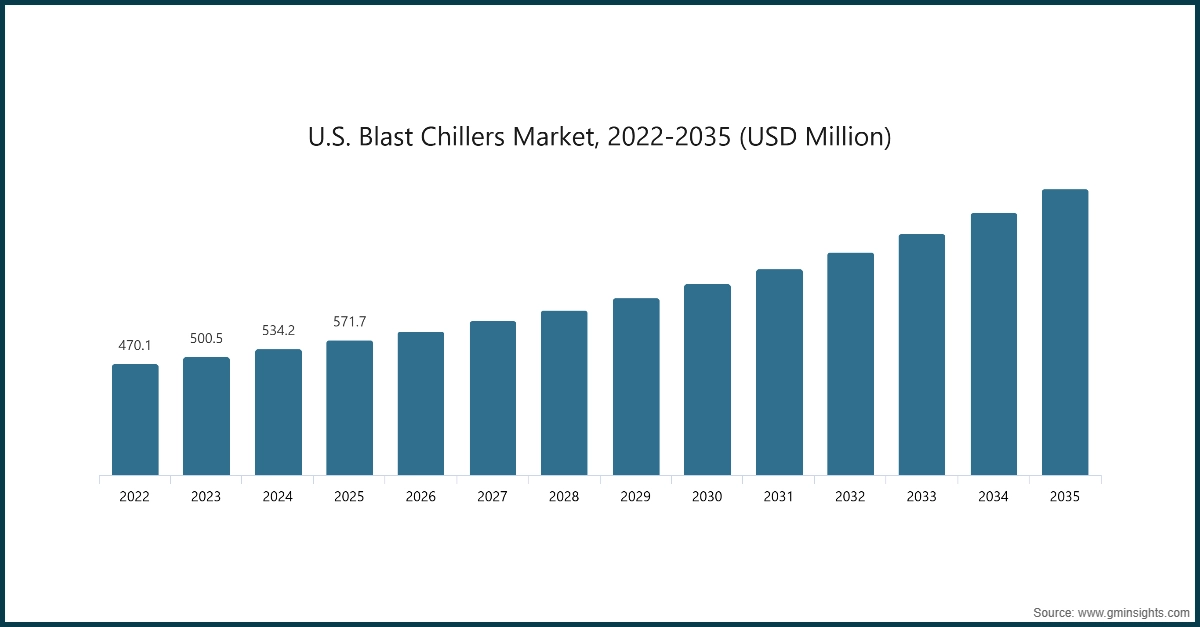
The U.S. blast chillers market was valued at USD 470.1 million and USD 500.5 million in 2022 and 2023, respectively. The market size reached USD 571.7 billion in 2025, growing from USD 534.2 million in 2024.
- In the U.S., demand for blast chillers is supported by the continued expansion of the foodservice and retail sectors, where rapid‑cooling equipment helps operators maintain safety and efficiency. According to the USDA, the level of total food sales at both foodservice and food retailing establishments exceeds USD 2 trillion every year since 2021, with a sales level of USD 2.58 trillion in 2024, representative of the extent to which prepared food enterprises depend on a rapid cooling system.
Europe Blast Chillers Market
Europe market accounted for USD 459.4 million in 2025 and is anticipated to show lucrative growth over the forecast period.
- Europe’s blast chiller market benefits from stringent food‑handling regulations, strong enforcement mechanisms, and mature cold‑chain infrastructure.
- Continuous regulatory harmonization within the European Union member states continues to push foodservice operators and processing units toward high-precision cooling systems that ensure safety, traceability, and quality retention.
Germany dominates the Europe blast chillers market, showcasing strong growth potential.
- Germany remains one of the most heavily regulated food‑safety markets in Europe, strengthened by its national hygiene framework.
- Accordingly, the German Food Hygiene Regulation LMHV was revised in 2022 to include very strict temperature control mandates regarding the storage and transport of perishable goods, adding more emphasis on reliable rapid-cooling technologies in commercial kitchens and food manufacturing facilities.
Asia Pacific Blast Chillers Market
- The Asia Pacific market is anticipated to grow at the highest CAGR of 9.5% during the analysis timeframe.
- Asia Pacific is experiencing rapid growth in cold‑chain development as urbanization, rising incomes, and expanding retail networks drive higher expectations for food quality and safety.
- The region is still spending heavily on logistics infrastructure, automated temperature-controlled systems, and traceability technologies, which are contributing to increased use of blast chillers.
- China blast chillers market is estimated to grow with a significant CAGR, in the Asia Pacific market.
- China is accelerating cold‑chain capacity at an unprecedented pace. According to the China Federation of Logistics & Purchasing (CFLP), the country’s total cold storage capacity reached 237 million cubic meters in 2024, a 7.73% year‑on‑year increase, reflecting strong national commitment to food safety and distribution efficiency, factors that directly increase demand for blast chillers in food processing and foodservice industries.
Latin American Blast Chillers Market
- Brazil leads the Latin American market, exhibiting remarkable growth during the analysis period.
- The Brazilian market for blast chillers is evolving in response to the increasing needs of foodservice establishments, as well as food retailers and processors, looking to improve the quality of their food product or achieve greater operating efficiency. Large-scale food production and rich culinary heritage create the demand for high-quality rapid cooling solutions in order to preserve food items.
Middle East and Africa Blast Chillers Market
- South Africa market to experience substantial growth in the Middle East and Africa market in 2025.
- In South Africa, interest in blast chillers is strengthening as the country addresses food handling practices and seeks to improve food chain management.
- The use of rapid-cooling technology is being increasingly adopted in commercial kitchens, retail, and food processing as such technology ensures high quality and is in response to increasing demands for fresh and frozen food in the local and international markets.
Blast Chillers Market Share
The competitive landscape of the market is shaped by continuous technological advancement and strategic collaboration among global refrigeration and commercial‑kitchen equipment manufacturers. Leading players such as Electrolux Group, Williams Refrigeration, IRINOX S.p.A., SMEG S.p.A., and Hoshizaki Corporation have secured an estimated 19.5% share in the global market for blast chillers. These players are making significant investments in R&D to enhance the efficiency of cooling, accelerate cycle times, improve sustainability performance, and integrate smarter control systems into their product lines. Joint ventures remain very dynamic, while product line extension and regional capacity upgrade activities are also frequent as companies attempt to improve distribution infrastructure in response to rising demand in both foodservice and food processing sectors.
In addition, new market players and niche refrigeration technology innovators are also contributing to market dynamism through the introduction of latest chilling technologies, components with high energy efficiency, and flexible solutions suited to specific markets. This dynamic market environment is thus ensuring continuous improvement in product performance, reliability, and user-centric designs, ultimately aiding the market’s growth.
Blast Chillers Market Companies
Prominent players operating in the blast chillers industry are as mentioned below:
- Alto Shaam, Inc
- Cool Head Europe
- Electrolux Group
- Foster Refrigerator
- Friginox
- Fulgor Milano
- Hoshizaki Europe B.V. (Hoshizaki Corporation)
- Infrico
- IRINOX S.p.A.
- Lainox
- SMEG S.p.A.
- TEFCOLD (UK)
- Traulsen & Co., Inc.
- Victory Refrigeration LLC
- Williams Refrigeration
Electrolux Group holds a strong presence in the market through its focus on performance, reliability, and user‑centric design. The company is also still developing rapid-cooling technology in order to assist commercial kitchens to enhance workflow efficiency in addition to minimizing food waste as well as being consistent in medium-volume settings. Through advanced control solutions, energy-saving designs, and compatibility with kitchen solutions, Electrolux remains an ideal partner for the hotel industry and restaurants that seek reliable fast cooling solutions.
Williams Refrigeration is recognized for its robust, high‑performance blast chiller portfolio designed to support demanding commercial and food‑processing operations. The company focuses on durability, temperature precision, and hygienic construction to enable operators to meet strict standards of safety while optimizing cooling cycles.
IRINOX S.p.A. is known for its specialized expertise in rapid‑cooling and multifunctional chilling systems, offering solutions that blend advanced technology with premium build quality. The brand is especially favored by bakeries, pastry shops, and high‑end culinary environments due to its precision cooling, versatile program options, and attention to product integrity. IRINOX continues to focus on enhancing user experience and operational flexibility, helping professionals manage diverse production needs while upholding the highest standards of food safety and consistency.
Blast Chillers Market Report Attributes
| Key Takeaway | Details |
|---|---|
| Market Size & Growth | |
| Base Year | 2025 |
| Market Size in 2025 | USD 1.7 Billion |
| Forecast Period 2026-2035 CAGR | 8.2% |
| Market Size in 2035 | USD 3.7 Billion |
| Key Market Trends | |
| Drivers | Impact |
| Rising demand for rapid cooling solutions in food processing facilities | Drives higher adoption of blast chillers and rapid cooling equipment to maintain food quality and safety in processing facilities. |
| Stringent food safety regulations and compliance requirements | Accelerates market growth as manufacturers and operators invest in compliant chilling technologies to meet regulatory standards. |
| Expansion of the global cold chain infrastructure | Expands market opportunities by increasing demand for advanced cooling solutions across logistics, storage, and distribution networks. |
| Growth of commercial kitchens, hotels, and quick-service restaurants (QSRs) | Boosts sales of blast chillers and related equipment due to rising requirements from hotels, QSRs, and large-scale commercial kitchens. |
| Pitfalls & Challenges | Impact |
| High initial investment and maintenance costs | Limits market growth due to the high upfront costs and ongoing maintenance requirements of blast chillers. |
| Energy consumption and operational efficiency concerns | Raises operational challenges, prompting the need for solutions that optimize energy consumption and efficiency. |
| Opportunities: | Impact |
| Adoption of energy‑efficient and eco‑friendly refrigeration technologies | Encourages market expansion as manufacturers and end-users adopt energy-efficient and environmentally friendly chilling technologies. |
| Increasing demand from ready‑to‑eat and packaged food industries | Drives increased adoption of blast chillers to meet the preservation and quality requirements of ready-to-eat and packaged food products. |
| Market Leaders (2025) | |
| Market Leader |
8.2% market share |
| Top Players |
Collective market share in 2024 is 19.5% |
| Competitive Edge |
|
| Regional Insights | |
| Largest Market | North America |
| Fastest growing market | Asia Pacific |
| Emerging countries | India, China, Brazil, South Africa, and the United Arab Emirates |
| Future outlook |
|
What are the growth opportunities in this market?
Blast Chillers Industry News
- In September 2023, Williams announced the launch of its new range of reach-in blast chiller/freezer models, designed to offer greater flexibility and capacity for professional kitchens. The new line spans from a compact 10kg undercounter unit to larger 50kg cabinet models, providing solutions for a wide variety of operation sizes and production demands.
- In July 2022, Traulsen launched new reach-in and undercounter blast chillers under its Centerline by Traulsen brand. These models target cost-conscious operators with a "back-to-basics" approach that simplifies training and operation.
The blast chillers market research report includes in-depth coverage of the industry with estimates and forecast in terms of revenue (in USD Million) and volume (in units) from 2022 – 2035 for the following segments:
Market, By Product Type
- Roll In Blast Chillers
- Reach-In Blast Chillers
Market, By Capacity
- Below 50KG
- 50 – 100KG
- 101-200KG
- More than 200KG
Market, By Application
- Commercial foodservice
- Restaurants & QSR
- Hotels & Resorts
- Catering Companies
- Bakeries & Confectioneries
- Institutional kitchens
- Hospitals & Healthcare Facilities
- Schools & Universities
- Correctional Facilities
- Food processing & manufacturing
- Meat, Seafood, Poultry Processors
- Ready-to-eat (RTE) and Frozen Food Manufacturers
- Dairy Processing
- Logistics & cold chain
- Others
The above information is provided for the following regions and countries:
- North America
- U.S.
- Canada
- Europe
- UK
- Germany
- France
- Italy
- Spain
- Netherlands
- Asia Pacific
- China
- Japan
- India
- South Korea
- Australia
- Latin America
- Brazil
- Mexico
- Argentina
- Middle East and Africa
- UAE
- Saudi Arabia
- South Africa
Frequently Asked Question(FAQ) :
What was the market size of the blast chillers market in 2025?
The global market was valued at USD 1.7 billion in 2025, with a volume of 61,870.4 units.
What is the projected value of the blast chillers market by 2035?
The market is expected to reach USD 3.7 billion by 2035, with a volume of 124,447.8 units, growing at a CAGR of 8.2% in volume and 7.4% in value during the forecast period.
What is the projected size of the blast chillers market in 2026?
The market is expected to reach USD 1.8 billion in 2026.
What was the market share of the 50–100 kg segment in 2025?
The 50–100 kg segment held a market share of 34.5% in 2025, driven by demand from mid-sized restaurants, bakeries, and cloud kitchens seeking efficient cooling solutions.
What was the market share of the commercial foodservice segment in 2025?
The commercial foodservice segment accounted for 34% of the market in 2025, as establishments adopted blast chillers to enhance food prep efficiency and ensure food safety compliance.
Which region dominated the blast chillers market in 2025?
North America led the market with a 37.7% share in 2025, driven by strong demand from commercial foodservice establishments and advancements in food safety standards.
What are the upcoming trends in the blast chillers industry?
Key trends include the adoption of energy-efficient systems, integration of digital controls and automation, and increasing demand from cloud kitchens and quick-service restaurants.
Who are the key players in the blast chillers market?
Prominent players include Alto Shaam, Inc., Cool Head Europe, Electrolux Group, Foster Refrigerator, Friginox, Fulgor Milano, Hoshizaki Europe B.V. (Hoshizaki Corporation), Infrico, and IRINOX S.p.A.
Blast Chillers Market Scope
Related Reports