Summary
Table of Content

Biodiesel Market
Get a free sample of this report
Form submitted successfully!
Error submitting form. Please try again.
Thank you!
Your inquiry has been received. Our team will reach out to you with the required details via email. To ensure that you don't miss their response, kindly remember to check your spam folder as well!
Request Sectional Data
Thank you!
Your inquiry has been received. Our team will reach out to you with the required details via email. To ensure that you don't miss their response, kindly remember to check your spam folder as well!
Form submitted successfully!
Error submitting form. Please try again.
Biodiesel Market Size
- Rising national blending mandates in heavy‑duty transport coupled with strong compliance frameworks towards sustainable fuel adoption is augmenting the business landscape. Across major diesel‑reliant economies, policymakers are ratcheting up biodiesel blend requirements, an immediate lever to decarbonize trucks, buses, agriculture, construction, rail gensets and public fleets.
- As OEMs expand warranties for higher blends (B20 and beyond), the transition cost to end users drops, supporting adoption at scale without new vehicle capital expenditure. In short, binding blend rules transform biodiesel from a discretionary, price‑spread play into an obligation‑driven commodity with multi‑year visibility.
- For instance, in June 2025, Brazil’s energy council (CNPE) approved B15 nationwide, formalized by the Ministry of Mines and Energy and the Presidency. Brazil’s regulator ANP issued operational guidance to retailers, confirming implementation and compliance procedures.
- The volumes tied to these mandates also catalyze logistics upgrades terminals, blending skids, lab capacity and spur concurrent R&D on higher‑blend operability in rail, marine, mining, and off‑road equipment. Such clear policy ladders provide lead indicators for capex, including tankage, esterification units, and feedstock collection networks.
- Southeast Asia is using biodiesel policy to localize value from palm and other oils, curb petroleum imports, and lift rural incomes. For instance, since January 2025 Indonesia’s Ministry of Energy (ESDM) confirmed mandatory B40 and detailed 2024 performance under B35. ESDM also communicated planned progression to B50 and quantified import reduction and job impacts.
- Furthermore, in the U.S., the Renewable Fuel Standard (RFS) sets nested, annual volume targets that include biomass‑based diesel (BBD). EPA’s multi‑year set rule for 2023–2025 provides clear floors that fuel planning, bank financing, and hedging strategies rely on. Proposed updates for 2026–2027 continue to evolve program mechanics, reinforcing a long‑term compliance market for biodiesel RINs.
- Europe’s policy architecture keeps tightening sustainability thresholds and chain‑of‑custody controls, stabilizing demand for compliant biodiesel and reward investments in traceability. The revised Renewable Energy Directive (RED III), combined with the Union Database (UDB) rollout and recognition of voluntary schemes, raises the bar on documentation, feedstock eligibility, and GHG accounting.
- The 2024 delegated directive expanding Annex IX feedstocks broadens the pool of eligible wastes and residues. This direction of travel pushes producers toward assured supply chains and verified GHG savings, improving buyer confidence and long‑term contracting for FAME.
According to a recent study by Global Market Insights Inc., the biodiesel market was estimated at USD 70.5 billion in 2025. The market is expected to grow from USD 77.7 billion in 2026 to USD 182 billion in 2035, at a CAGR of 9.9%.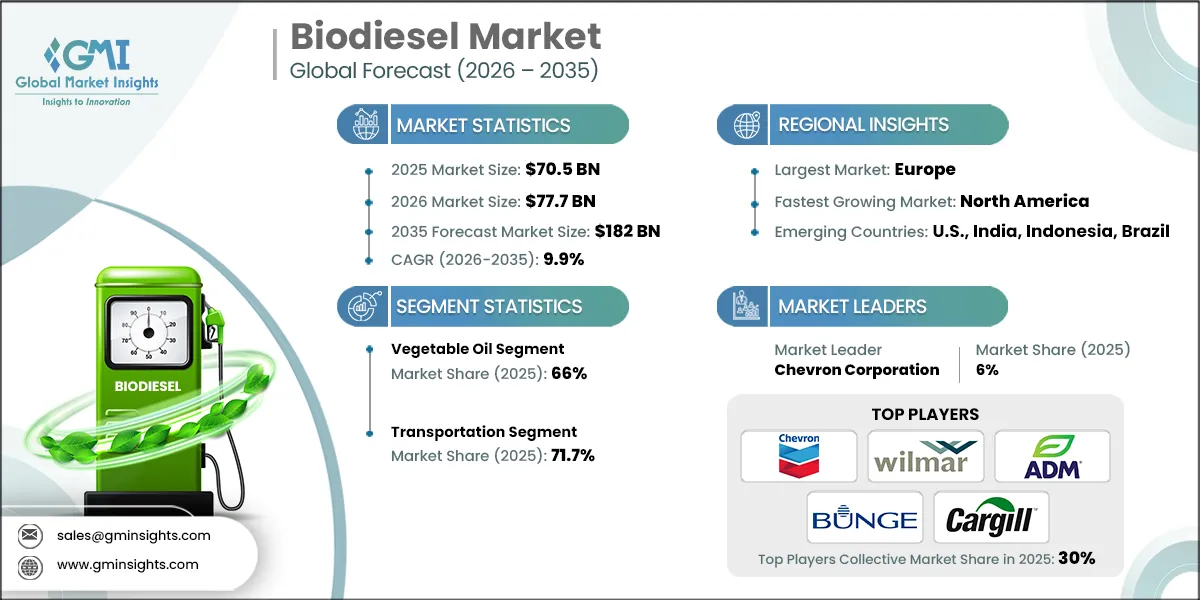
Biodiesel Market Key Takeaways
Market Size & Growth
- 2025 Market Size: USD 70.5 Billion
- 2026 Market Size: USD 77.7 Billion
- 2035 Forecast Market Size: USD 182 Billion
- CAGR (2026–2035): 9.9%
Regional Dominance
- Largest Market: Europe
- Fastest Growing Region: North America
Key Market Drivers
- Rising demand for sustainable energy.
- Fluctuating oil prices.
Challenges
- Feedstock availability and cost.
Opportunity
- Expansion of waste‑derived feedstocks.
- Rising demand for low‑carbon fuels in hard‑to‑abate sectors.
Key Players
- Market Leader: Chevron Corporation led with over 6% market share in 2025.
- Leading Players: Top 5 players in this market include Chevron Corporation, Wilmar International, Archer Daniels Midland, Bunge, Cargill, which collectively held a market share of 30% in 2025.
Get Market Insights & Growth Opportunities
To get key market trends
Biodiesel Market Trends
- Corporate investment and capacity additions by integrated producers along with OEM acceptance of higher biodiesel blends will complement the industry scenario. Leading renewable fuel companies are committing capital to scale and optimize biodiesel/renewables systems, often integrating feedstock pre‑treatment, hydrogen, utilities, storage, and multi‑product slates.
- For instance, Neste’s Green Finance Report 2024 details allocation to Rotterdam and other sites, with renewables capacity targets and project timelines. Its 2024 Annual/Financial statements discuss capacity, performance, and the updated program to restore margins and deliver the Rotterdam growth project by 2027.
- Such programs improve unit costs, product flexibility, and logistics resilience, while green financing frameworks reduce cost of capital. Producers’ public disclosures also witnesses a pivot toward reliability and supply chain optimization, improvements that benefit biodiesel availability and price competitiveness relative to fossil diesel, especially under supportive policy regimes.
- Automakers have progressively validated biodiesel blends up to B20 (and, in controlled applications, beyond), reducing operational risk for fleets. This acceptance paired with clear fuel specs (ASTM D6751 for B100, ASTM D7467 for blends) positions biodiesel as a practical, low‑capex decarbonization step.
- Technical communications from OEMs emphasize benefits including lubricity restoration at low blends, high cetane for smoother combustion, and defined storage/maintenance practices. The result is wider confidence among truck, off‑road, marine, and genset operators who can decarbonize now while electrification and hydrogen infrastructure scale.
- For illustration, Cummins confirms B20 approvals across numerous engine families and publishes guidance on biodiesel performance, lubricity benefits, and application notes, including a 2024 article on fleet performance and a 2025 infographic covering blends up to B100/B40 contexts.
- Maritime sector acceptance and bunkering standards for bio‑blends is further bolstering the product consumption. Ports and regulators are codifying biofuel bunkering requirements, while carriers expand low‑emission offerings using FAME blends (e.g., B24–B30) as an immediate step before methanol and ammonia scale.
- For reference, Singapore’s MPA formalized biofuel bunkering frameworks aligned with ISO 8217:2024, and in March 2025 authorized conventional bunker tankers to carry and deliver biofuel blends up to B30 without separate approval, with pilots up to B100 ongoing.
- Carbon‑intensity‑based crediting models continue to underpin biodiesel economics by monetizing lifecycle GHG reductions relative to fossil diesel. Program updates tightening CI curves, revising calculators, and clarifying crop‑oil guardrails, signal policy longevity and iterative refinement rather than retrenchment.
- For reference, from July 2025, after OAL approval, the California Air Resources Board adopted LCFS and published an updated Informative Digest, including Tier 1 calculators for biodiesel and HEFA fuels part of a broader package aligning with ZEV rules while sustaining low‑carbon liquid fuels.
Biodiesel Market Analysis
Learn more about the key segments shaping this market
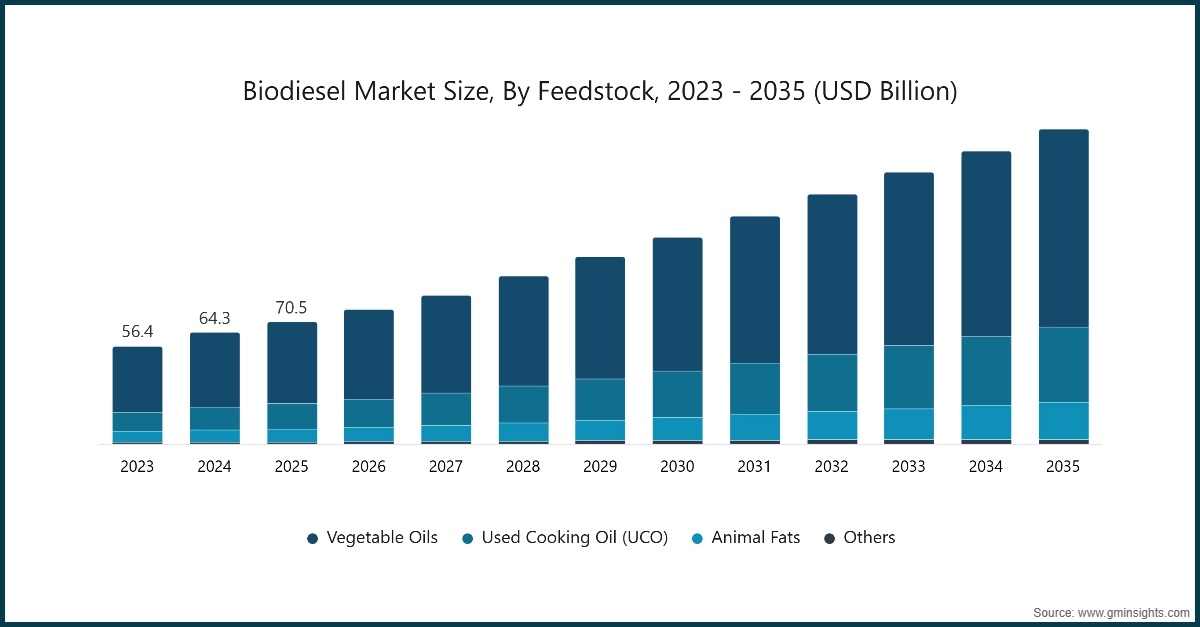
- Based on feedstock, the biodiesel market is segmented into vegetable oils, used cooking oils (UCCO), animal fats, and others. Vegetable oil feedstock industry dominated by 66% of the market share in 2025 and is set to grow at a CAGR of 9.3% by 2035. Vegetable oils including soybean, palm, rapeseed and canola continue to form the backbone of global biodiesel production due to their predictable supply chains, high conversion yields, and mature processing infrastructure.
- The market is undergoing a structural shift owing to the regulatory tightening in the EU and parts of Asia is pushing producers to prioritize waste‑ and residue‑based materials over virgin crop oils to meet sustainability thresholds and indirect land‑use change (ILUC) restrictions.
- For instance, in January 2026, the U.S. department of Agriculture expects 14.8 billion pounds of soybean oil to go to biofuel production for 2025-2026, down from the December outlook of 15.5 billion pounds. As a result, refiners increasingly balance between high‑volume virgin oils (palm, soy) and advanced residues to meet evolving regulatory and commercial expectations.
- Used cooking oil industry for biodiesel will grow at a CAGR of 11.4% by 2035. Used cooking oil is rapidly rising as one of the most strategically important feedstocks in the biodiesel industry, propelled largely by regulatory pressures to lower lifecycle carbon intensity.
- UCO offers strong GHG performance compared to virgin vegetable oils, making it a preferred option in jurisdictions with strict sustainability frameworks such as the EU and UK. The introduction of the Union Database (UDB) by the European Commission, along with strengthened ISCC traceability protocols, has increased transparency and trust in cross‑border UCO supply chains.
- For instance, in April 2025, ISCC confirmed that it has strengthened certification rules for waste‑ and residue‑based biofuels, including UCO, and is collaborating with the European Commission on enhanced verification measures linked to the EU Union Database, reinforcing UCO’s role in compliant biodiesel supply chains.
- Animal fat feedstock market will grow at a CAGR of 10.8% by 2035, driven by advanced biofuel criteria and rising demand for low‑carbon feedstocks. Animal fats including tallow, poultry fat, and other rendered by‑products are gaining traction in biodiesel and renewable diesel refining as markets increasingly prize low‑carbon, non‑food feedstocks.
- As renewable diesel (HVO) facilities expand globally, these fats-based feedstock will increasingly prioritize for their compatibility with hydrotreatment processes and their ability to help refineries meet stricter CI reduction targets. This trend is especially visible in markets where waste‑based materials receive preferential regulatory incentives, positioning animal fats as an indispensable feedstock category for long‑term compliance.
- For reference, in April 2025, ISCC’s waste‑and‑residue certification framework, including updates to ISCC EU 202‑5 and expanded auditing requirements, explicitly strengthens classification and traceability for animal fats as recognized waste‑derived feedstocks, ensuring compliance with EU RED III sustainability rules.
Learn more about the key segments shaping this market
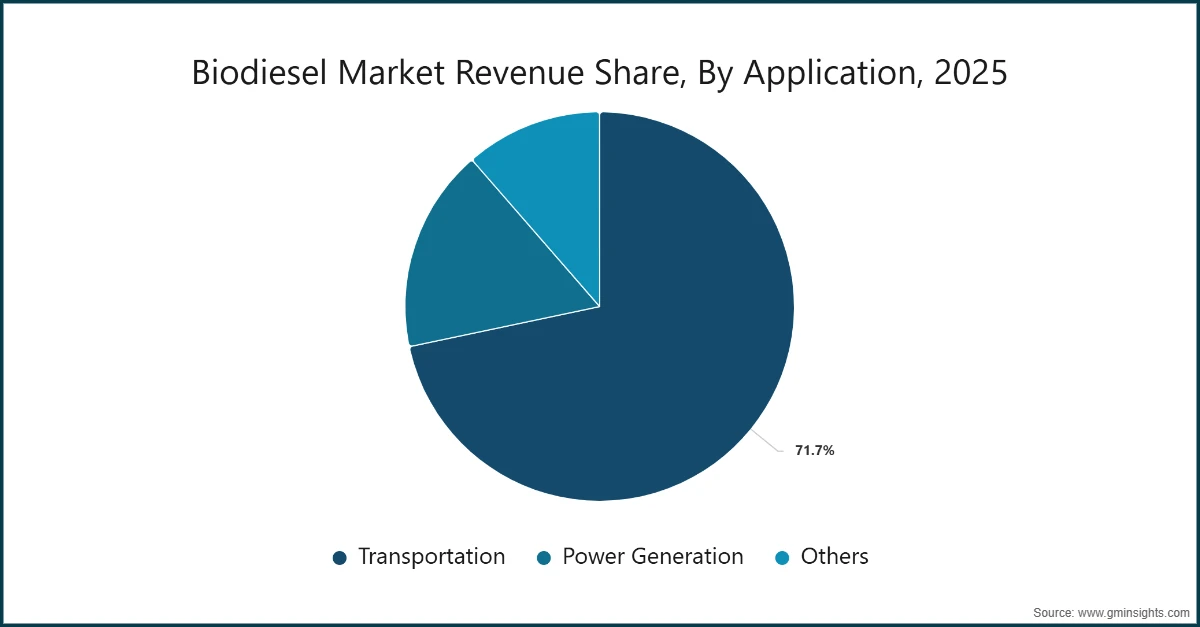
- Based on application, the biodiesel market is segmented into transportation, power generation, and others. Transportation application market held a market share of 71.7% in 2025 and will grow at a CAGR of 9% by 2035. Transportation remains the dominant application for biodiesel, propelled by a tightening matrix of national blend mandates, renewable fuel standards, and carbon‑intensity–based compliance markets.
- Governments increasingly view biodiesel as a fast‑deploying decarbonization lever for hard‑to‑electrify segments such as long‑haul trucking, municipal fleets, agricultural machinery, and logistics hubs. With diesel engines continuing to power global freight and public transport networks, biodiesel’s drop‑in compatibility reduces adoption friction and avoids major infrastructure retrofits.
- For instance, in May 2025, the government of Malaysia expanded its biodiesel usage of B10 and B20 on ground transport vehicles at its main international airport as part of efforts to achieve net-zero carbon emissions by 2050. In addition, lifecycle emission benefits also support fleet operators responding to ESG commitments and clean‑fleets legislation.
- The power generation application market will grow at a CAGR of 11.4% by 2035. Growing use of biodiesel as a cleaner backup and distributed energy fuel is augmenting the industry scenario. Biodiesel’s role in power generation is strengthening as utilities, data centers, microgrids, and critical infrastructure operators seek lower‑emission alternatives to petroleum diesel for backup.
- For instance, in September 2025, the government of Canada announced an investment of over USD 267 million in production incentives for the country’s biofuels producers along with increasing the biofuel regulations across the country. The combination of decarbonization mandates, risk‑mitigation strategies, and corporate sustainability targets will increasingly offtake the segment growth.
- Biodiesel’s chemical properties make it suitable for existing diesel gensets with minimal modifications, providing an immediate route to reduce particulate matter, sulfur emissions, and lifecycle CO₂. This dynamic is especially visible in regions prioritizing grid resilience, where severe weather, aging infrastructure, or energy‑security concerns increase reliance on backup power assets.
- Biodiesel is expanding its footprint as sectors pursue immediate, cost‑effective emission reductions without overhauling existing equipment. Industrial and off‑road applications construction machinery, mining vehicles, agricultural equipment benefit from biodiesel’s lubricity and compatibility with standard diesel engines, supporting decarbonization in high‑load operations.
- Residential and commercial heating markets in colder regions have increasingly turned to biodiesel blends to cut heating oil emissions while leveraging installed boiler systems. The marine sector, facing stringent IMO decarbonization targets, is adopting biodiesel blends (often B20–B30) as transitional fuels ahead of longer‑term solutions like methanol or ammonia.
Looking for region specific data?
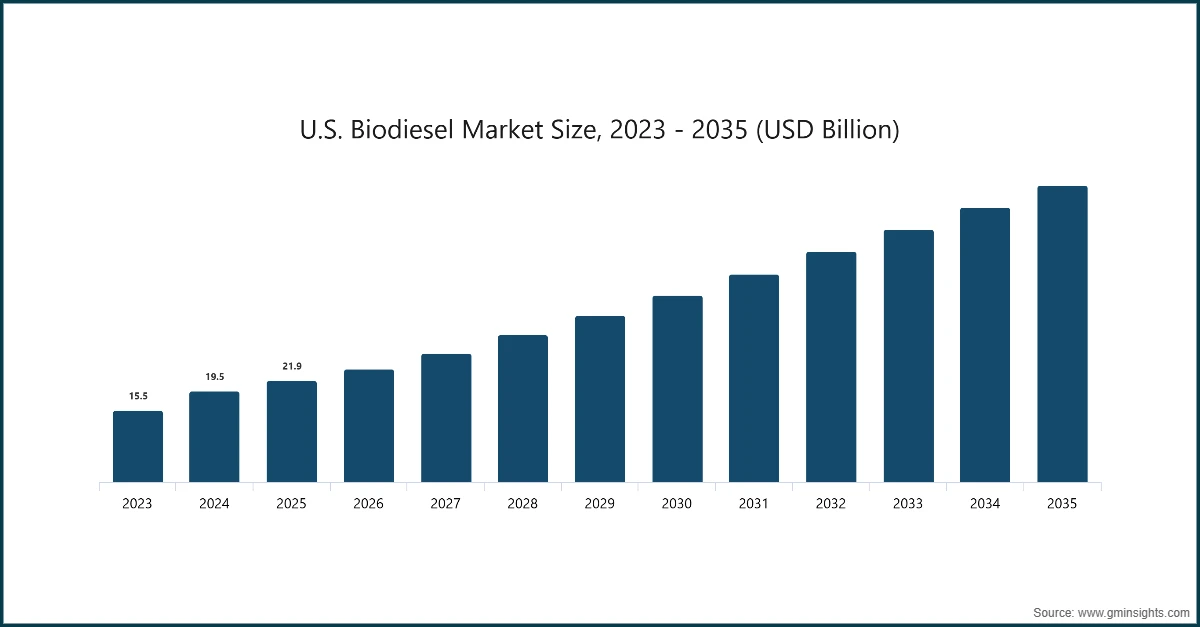
- The U.S. dominated the biodiesel market with around 93% market share in 2025 across North America region and generated USD 21.9 billion in revenue. The regional’s market is defined by strong regulatory anchors, including the U.S. Renewable Fuel Standard (RFS) and sub‑national low‑carbon fuel programs that continue to shape demand.
- The region is also experiencing a strategic diversification from traditional soy‑based biodiesel toward waste‑ and residue‑derived feedstocks in response to tightening carbon‑intensity expectations. Moreover, U.S. biofuel export activity particularly toward Canada, Latin America, Europe, and Asia has reinforced domestic production resilience.
- For instance, in August 2025, the Renewable Fuels Association expressed strong support for EPA’s proposed Renewable Fuel Standard volumes for 2026 and 2027, while also recommending slight modifications to the agency’s plan for prioritizing American-made renewable fuels over import-based fuels.
- The Europe biodiesel market will grow at a CAGR of 8.3% by 2035. The EU biodiesel landscape continues to evolve under tightening sustainability regulations, driven by RED III, updated Annex IX feedstock classifications, and strengthened auditing requirements.
- For instance, in November 2025, the European commission announced the sustainable transport investment plan (STIP) to accelerate the energy transition of waterborne transport and aviation sector. The investment plan responds to unlock investments and scale up production of renewable and low-carbon fuels.
- Europe’s regulatory ecosystem increasingly rewards waste and residue‑based biodiesel, encouraging producers to transition away from crop‑based oils where ILUC risks are prominent. The launch and expansion of the EU Union Database (UDB) are enhancing visibility and traceability across supply chains, helping authorities identify non‑compliance and protect market integrity.
- Asia Pacific biodiesel industry will grow at a CAGR of 10% by 2035. The region remains one of the fastest‑growing biodiesel market, led by robust government intervention and domestic energy‑security agendas. The government‑driven initiatives not only bolster domestic markets but also influence regional trade flows, as surplus volumes shift across APAC.
- For instance, since January 2025, the government of Indonesia started B40 biodiesel program, the palm oil-based content share in biodiesel is raised from 35 percent (B35). The program aims to switch to cleaner fuels as well as part of Indonesian President Prabowo Subianto's energy self-sufficiency ambition, thereby adding to the market growth down the line.
- Middle East & Africa region will grow at a CAGR of 2% by 2035. The regional biodiesel market is comparatively nascent but shows steady signs of traction driven by energy‑transition agendas, industrial demand, and growing import activity. Several African economies are exploring biofuel adoption to reduce dependence on expensive diesel imports and enhance rural development opportunities through oilseed agriculture.
- The Latin America industry will cross USD 14 billion by 2035. The region continues to strengthen its biodiesel segment through a blend of regulatory mandates, abundant agricultural feedstocks, and evolving clean‑energy policies. Demand is primarily driven by national decarbonization strategies and integrated rural‑development objectives that position biodiesel as both an economic and environmental asset.
Biodiesel Market Share
- The top 5 companies in the biodiesel industry including Chevron Corporation, Wilmar International, Archer Daniels Midland, Bunge, and Cargill held over 30% market share in the year 2025. Chevron Corporation, post-acquisition of Renewable Energy Group (REG) in June 2022, has catered a fair share of biodiesel, especially across the U.S.
- ADM corporate pages indicates biodiesel production across multiple regions, which has significantly added to its brand positioning. Bunge biofuels feedstock positioning and partnerships supporting lower‑CI fuels. While Wilmar corporate and annual‑report resources confirms palm biodiesel production within an integrated tropical‑oils network.
Biodiesel Market Companies
Major players operating in the biodiesel industry are:
- Abellon Clean Energy
- Ag Processing
- Altret Greenfuels
- Anellotech
- Archer Daniels Midland
- Bunge
- Cargill
- Chevron
- Clariant
- FutureFuel
- G-Energetic Biofuels
- Greenergy
- Grupo Potencial
- Manuelita
- Renewable Biofuels
- TerraVia
- Total Energies
- Universal Biofuels
- Washwell Biodiesel
- Wilmar International
- ADM is a global agricultural processing and biofuels company with a major presence in biodiesel through integrated oilseed‑crushing, refining, and transesterification operations across the U.S., EU, Brazil, and Canada. The company reported net earnings of USD 295 million in Q1 2025 and USD 108 million in Q3 2025, with year‑to‑date operating cash flow of USD 5.8 billion as of Q3 2025.
- Bunge is a leading global agribusiness and oilseed processor supplying key biodiesel feedstocks including soybean, canola, and waste‑based oils to renewable‑fuel producers worldwide. The company reported USD 53.1 billion in full‑year 2024 revenue, with net income of USD 1.1 billion and diluted EPS of USD 7.9.
- Wilmar International is one of the world’s largest integrated agribusiness groups and a leading producer of palm‑based biodiesel, supported by its extensive presence in tropical‑oil refining, oleochemicals, and downstream fuel manufacturing across Indonesia, Malaysia, China, and India. The company reported USD 67.38 billion in revenue and USD 1.17 billion in net profit for FY2024.
Biodiesel Market Report Attributes
| Key Takeaway | Details |
|---|---|
| Market Size & Growth | |
| Base Year | 2025 |
| Market Size in 2025 | USD 70.5 Billion |
| Market Size in 2026 | USD 77.7 Billion |
| Forecast Period 2026-2035 CAGR | 9.9% |
| Market Size in 2035 | USD 182 Billion |
| Key Market Trends | |
| Drivers | Impact |
| Rising demand for sustainable energy | Growing global commitments to decarbonization and renewable‑energy adoption continue to push biodiesel forward as an accessible, low‑carbon alternative for transport and industrial sectors. |
| Fluctuating oil prices | Volatility in fossil‑fuel prices strengthens biodiesel’s attractiveness by encouraging countries and industries to diversify energy sources and stabilize long‑term fuel costs. |
| Pitfalls & Challenges | Impact |
| Feedstock availability and cost | Limited and price‑sensitive feedstock supplies including vegetable oils, used cooking oil, and animal fats, pose ongoing constraints that can increase production costs and impact biodiesel output stability. |
| Opportunities: | Impact |
| Expansion of waste‑derived feedstocks | Growing availability of used cooking oil and agricultural residues presents a major opportunity to lower production costs while meeting strict sustainability standards. |
| Rising demand for low‑carbon fuels in hard‑to‑abate sectors | Increasing decarbonization requirements in freight, marine, and off‑road equipment is creating strong long‑term demand for biodiesel as an immediate drop‑in solution. |
| Market Leaders (2025) | |
| Market Leader |
Market Share of 6% |
| Top Players |
Collective Market Share of 30% |
| Competitive Edge |
|
| Regional Insights | |
| Largest Market | Europe |
| Fastest growing market | North America |
| Emerging countries | U.S., India, Indonesia, Brazil |
| Future outlook |
|
What are the growth opportunities in this market?
Biodiesel Industry News
- In October 2025, Grupo Potencial decided to invest over USD 7.5 million to acquire 300,000 tonnes of soybeans in the 2025/26 harvest to supply its new plant in Curitiba, Paraná, Brazil. This in turn will assist the company to produce biodiesel using soyabeans.
- In January 2025, FGV Holdings Berhad (FGV) and the Malaysian Palm Oil Board (MPOB) formalized a Memorandum of Collaboration (MoC). This partnership underscores a shared commitment to fostering a sustainable and responsible palm‑oil sector, while simultaneously supporting the country’s efforts to enhance biodiesel production through greener industry practices.
- In January 2025, the Government of Canada announced new investments under the Energy Innovation Program (EIP) to accelerate the development of made‑in‑Canada clean‑fuel technologies. This funding initiative is intended to support the transition toward more affordable, lower‑carbon fuels by advancing innovations in biomass collection, transportation, and processing, particularly within high‑emitting sectors.
This biodiesel market research report includes in-depth coverage of the industry with estimates & forecast in terms of revenue (USD Million) and volume (Mtoe) from 2022 to 2035, for the following segments:
Market, By Feedstock
- Vegetable oils
- Used cooking oil (UCO)
- Animal fats
- Others
Market, By Application
- Transportation
- Power generation
- Others
The above information has been provided for the following region and countries:
- North America
- U.S.
- Canada
- Mexico
- Europe
- Germany
- France
- UK
- Spain
- Italy
- Asia Pacific
- China
- India
- Indonesia
- Australia
- South Korea
- Middle East & Africa
- Saudi Arabia
- South Africa
- Latin America
- Brazil
- Argentina
Frequently Asked Question(FAQ) :
What is the market size of the biodiesel in 2025?
The market was valued at USD 70.5 billion in 2025, with a CAGR of 9.9% projected through 2035. The growth is driven by national blending mandates and compliance frameworks supporting sustainable fuel adoption.
What is the projected value of the biodiesel market by 2035?
The market is expected to reach USD 182 billion by 2035, fueled by increased adoption in heavy-duty transport and advancements in renewable fuel technologies.
What is the expected size of the biodiesel industry in 2026?
The market size is projected to reach USD 77.7 billion in 2026.
What was the market share of the vegetable oil feedstock segment in 2025?
The vegetable oil feedstock segment held a dominant 66% market share in 2025 and is anticipated to grow at a CAGR of 9.3% through 2035.
What was the market share of the transportation application segment in 2025?
The transportation application segment accounted for 71.7% of the market share in 2025 and is set to expand at a CAGR of 9% until 2035.
Which region dominated the biodiesel sector in 2025?
The U.S. led the market in 2025, capturing 93% of the North American market share and generating USD 21.9 billion in revenue. This dominance is attributed to strong regulatory frameworks like the Renewable Fuel Standard (RFS) and sub-national low-carbon fuel programs.
What are the upcoming trends in the biodiesel market?
Key trends include rising investments in biodiesel capacity, wider OEM and maritime adoption, growth in green financing and carbon-credit models, and regulatory and technological advances improving competitiveness with fossil diesel.
Who are the key players in the biodiesel industry?
Major players in the market include Abellon Clean Energy, Ag Processing, Altret Greenfuels, Anellotech, Archer Daniels Midland, Bunge, Cargill, Chevron, Clariant, and FutureFuel.
Biodiesel Market Scope
Related Reports