Summary
Table of Content

Biodegradable Polymers Market
Get a free sample of this report
Form submitted successfully!
Error submitting form. Please try again.
Thank you!
Your inquiry has been received. Our team will reach out to you with the required details via email. To ensure that you don't miss their response, kindly remember to check your spam folder as well!
Request Sectional Data
Thank you!
Your inquiry has been received. Our team will reach out to you with the required details via email. To ensure that you don't miss their response, kindly remember to check your spam folder as well!
Form submitted successfully!
Error submitting form. Please try again.
Biodegradable Polymers Market Size
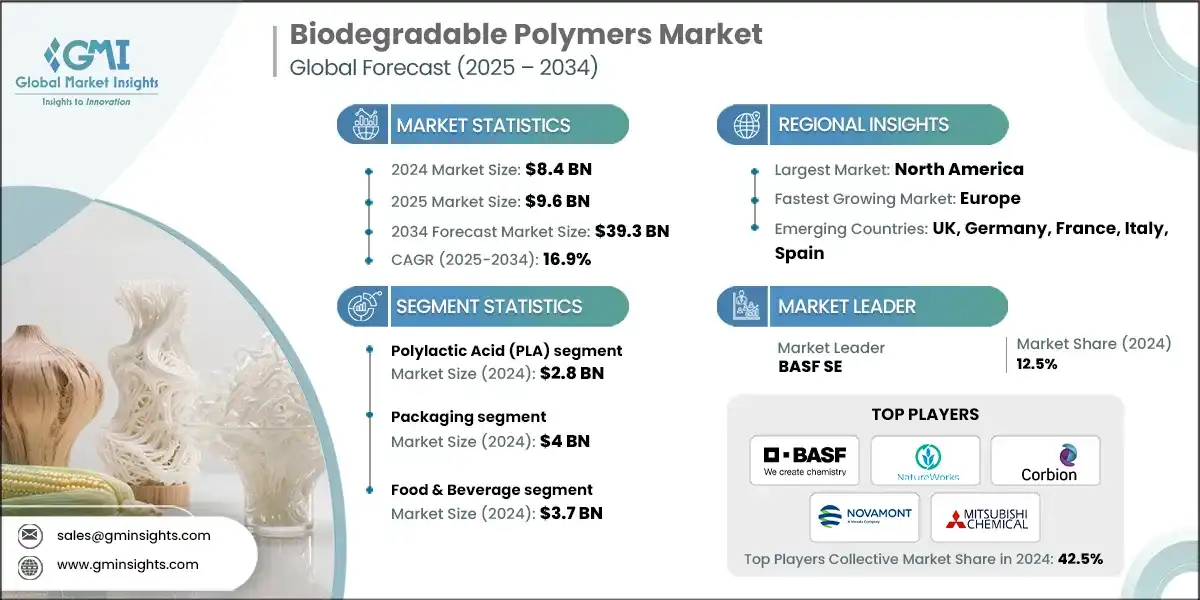
The global biodegradable polymers market size was estimated at USD 8.4 billion in 2024. It is expected to grow from USD 9.6 billion in 2025 to USD 39.3 billion by 2034, at a CAGR of 16.9% according to latest report published by Global Market Insights Inc.
Biodegradable Polymers Market Key Takeaways
Market Size & Growth
- 2024 Market Size: USD 8.4 Billion
- 2025 Market Size: USD 9.6 Billion
- 2034 Forecast Market Size: USD 39.3 Billion
- CAGR (2025–2034): 16.9 %
Regional Dominance
- Largest Market: North America
- Fastest Growing Region: Europe
Key Market Drivers
- Advancements in production technology.
- Rising demand in packaging industry.
- Increasing use in medical and agricultural applications.
- Consumer preference for eco-friendly products.
Challenges
- High production costs.
- Performance limitations.
Opportunity
- Expansion in medical and agriculture sectors.
- Technological innovations.
- Development of circular economy models.
Key Players
- Market Leader: BASF SE led with over 12.5% market share in 2024.
- Leading Players: Top 5 players in this market include BASF SE, NatureWorks LLC, Corbion N.V., Novamont S.p.A., Mitsubishi Chemical Group, which collectively held a market share of 42.5% in 2024.
Get Market Insights & Growth Opportunities
- Biodegradable polymers are those kinds of polymers that break down by natural means like water, carbon dioxide, and biomass after being exposed to aerobic conditions (presence of microorganisms), heat, and moisture. This contrasts with plastics that stay embedded in the environment for hundreds of years, thereby making biodegradable polymers more acceptable in terms of being environmentally friendly since they have ability to decay it naturally over time. This can be derived from renewable resources such as corn starch or sugarcane or produced synthetically.
- Increased environmental awareness and regulations on plastic pollution are the key drivers for growing biodegradable polymer market. Governments are imposing bans and restrictions on single-use plastics all over the world, thus pushing industries towards adoption of sustainable alternatives. Demand for biodegradable packaging results in rising consumer awareness about the environment, agricultural films, and disposable products.
- Advancement in technology has contributed tremendously to the improvement of development, processing, and performance of biodegradable polymers. Most of the research being done currently is on optimization of the chemical structure specifically to improve properties such as strength, flexibility and thermal stability, while still retaining the ability to be degraded naturally.
To get key market trends
Biodegradable Polymers Market Trends
- Changes in production technology for biodegradable polymers are rendering these materials increasingly available and affordable. Enzyme-based synthesis and bio-catalysis not only formulate better-quality polymer, but with lower energy consumption.
- Manufacturers are utilizing continuous processing methods where production is considerably simplified, and waste minimization is maximized. Apart from efficiency gains, these technological steps also lower barriers to mass adoption, hence augmenting the overall growth of the market.
- The major factor for the increasing demand for biodegradable polymers in the packaging sector concerns the rising regulations against single-use plastics. Hence the companies are opting for biodegradable alternatives for food packaging materials, shopping bags, and disposable containers. Retailers like supermarkets and fast-food chains have begun to adopt packaging materials such as polylactic acid (PLA) to address the consumer demand and regulatory compliance.
- The use of biodegradable polymers in medicine and agriculture is currently increasing because of their compatibility and environmental benefits. Medical applications include suturing with biodegradable substances, drug delivery systems, and temporary implants that degrade within the body without requiring any surgery for their removal. In agriculture, crop yield is improved by using biodegradable films and mulch sheet, thus reducing plastic waste. The applications are being optimized and extended on an ongoing basis, thus demonstrating the versatile potential of biodegradable polymers as these new additional applications increase demand.
- Consumers are creating the future of the market because of preferring eco-friendly products. The major increase in the public's awareness of plastic pollution and sustainability is driving today shoppers into preferring brands investing in green packaging and biodegradable materials.
Biodegradable Polymers Market Analysis
Learn more about the key segments shaping this market
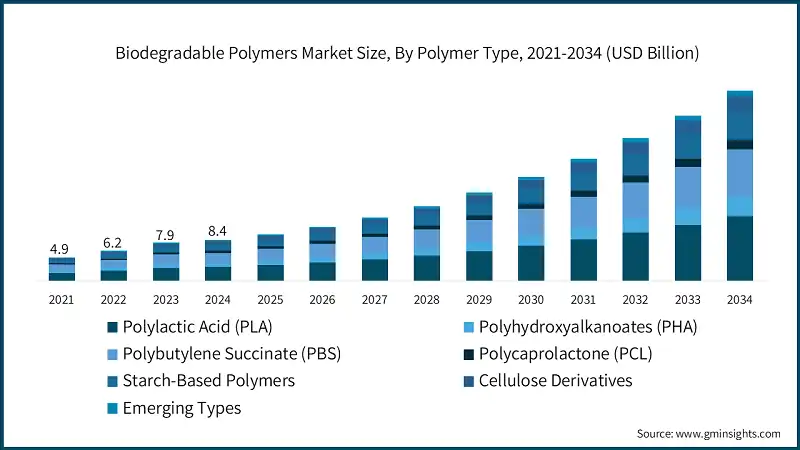
Based on polymer type, the market is segmented into polylactic acid (PLA), polyhydroxyalkanoates (PHA), polybutylene succinate (PBS), polycaprolactone (PCL), starch-based polymers, cellulose derivatives and other emerging types. Polylactic Acid (PLA) hold a market value of USD 2.8 billion in 2024.
- Polylactic Acid (PLA) is growing due to its widespread use in packaging, disposable items, and biomedical applications. The applicability of PLA to composting under industrial conditions and compatibility with existing manufacturing infrastructure makes it attractive for food and beverage companies looking for sustainable solutions to enhance their market position. Polyhydroxyalkanoates (PHAs) are experiencing growth in medical devices and specialty plastic markets due to their excellent biodegradability.
- In agriculture and medical applications, the usage of polybutylene succinate (PBS) and polycaprolactone (PCL) is rapidly increasing. PBS is selected due to its strength and ability to withstand heat, making it suitable for the manufacture of compostable bags and agricultural films, as seen in European waste management programs where PBS films are being adopted. The application of PCL is ever-increasing in the medical field for drug delivery and tissue engineering due to biocompatibility and controlled degradation rates. Furthermore, starch-based polymers and cellulose derivatives are used for packaging and disposable tableware, largely benefiting from low prices and renewability. Even at a smaller level, the new polymers that draw research attention for their unique properties and sustainability benefits suggest a diversified growth in the future of the market.
Learn more about the key segments shaping this market
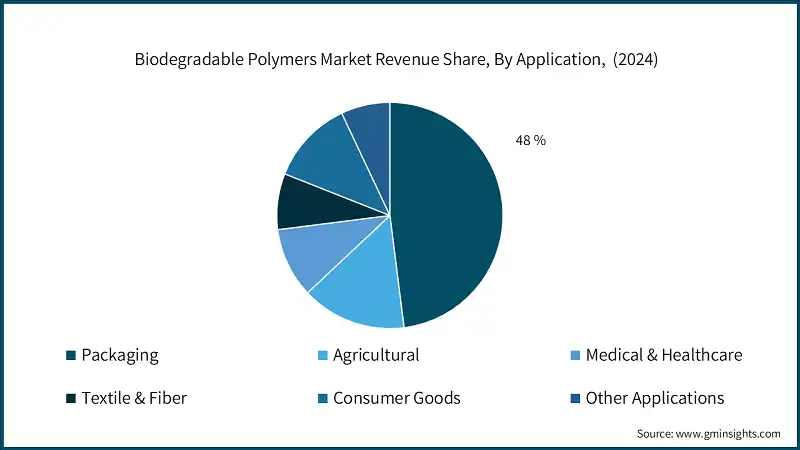
Based on applications, the biodegradable polymers market is segmented into packaging, agriculture, medical & healthcare, textile & fiber, consumer goods and other applications. Packaging segment was valued at USD 4 billion in 2024.
- The largest and fastest-growing application area for biodegradable polymers is packaging segment due to the worldwide efforts for single-use plastic waste. Food, beverage, and retail companies are increasingly substituting conventional plastics with PLA, starch-based films, and cellulose-based products, acknowledging the environmental policy shifts and consumer need that endorses this action. This segment holds high-volume applications, as well as visible sustainability benefits, thus becoming the most commercially mature area. Similarly, steady growth is currently observed in the agriculture segment as an increasing adoption of biodegradable mulch films, plant pots, and slow-release fertilizers offers soil contamination reduction and the elimination of plastic removal after harvest, especially in regions pushing for stricter agricultural sustainability requirements.
- The expansion of the medical and healthcare sectors as the world is demanding bioresorbable materials like PHA and PCL in sutures, scaffolds, and drug delivery systems. Such materials safely degrade in the body after having a good clean, safer use for temporary applications in medicine. In the textile & fiber industry there is a collection of biodegradable polymers into green fabrics and nonwovens, responding to the market trend towards sustainability in the fashion industry.
Based on end-user industry, the biodegradable polymers market is segmented into food & beverage, agriculture & horticulture, healthcare & medical, automotive, electronics & consumer, textiles & apparel. Food & Beverage segment was valued at USD 3.7 billion in 2024.
- The food and beverage industry is the leading consumer of biodegradable polymers because of the immediate need for sustainable packaging with the aim of reducing plastic waste. Compostable containers, films, and cutlery made from PLA and starch-based polymers are being absorbed into the segment as a compliance strategy with regulations and a way of getting into the bandwagon of increasing trends among customers for eco-friendly products. The Agriculture & Horticulture sector, too, is rapidly adopting biodegradable films, mulches, and plant pots which keep the soil healthy and decompose into it, all to help in the reduction of plastic pollution and surveillance towards environment-related policies.
- Electronics & consumer, automotive, and textile & apparel are other industries that have experienced moderate growth in biotechnology. In food and beverages, it provides assurance of safety, shelf life, and nutritional quality to foods. The electronics and Consumer industry is using bio-based materials and processes to promote sustainability and innovation. The automotive industries are looking into biofuels and biodegradable materials to cut the environmental footprint. Textile and apparel industry is demanding biotechnology solutions to produce sustainable fibers and environmentally safe methods for manufacturing in response to consumer demands for sustainable products.
Looking for region specific data?
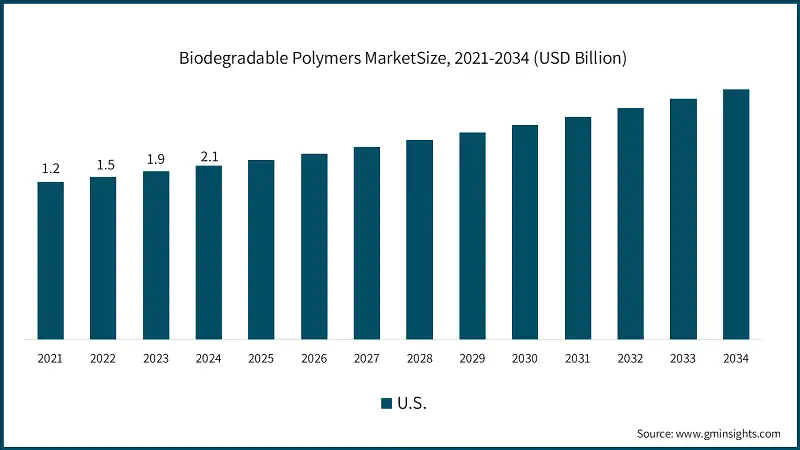
The U.S. biodegradable polymers market accounted for USD 2.1 billion in 2024.
The market for biodegradable polymers is growing in North America as the focus of both businesses and consumers is shifting towards environmental sustainability. Increased awareness about plastic pollution, as well as more stringent regulation on single-use plastics, put pressure on manufacturers to use eco-friendly alternatives. This shift is strong in the United States, whereby federal and state policies have promoted the use of biodegradable materials across packaging, agriculture, and consumer goods. Advances in polymer science also enable the performance and cost-effectiveness of biodegradable polymers such that it becomes attractive to industries that want to reduce their carbon footprints. Therefore, North America will continue to grow as a leading region for innovation adoptions of biodegradable polymer solutions.
The biodegradable polymers market in Europe is constantly growing. Increased awareness among people in the environment along with heavy regulation on reduction of plastic waste and sustained environmental aspect has encouraged the European nations to introduce biodegradable materials in their policy frameworks. They have supported policies that would regulate the use of plastics through restrictions imposed on single-use plastics, as well as promotion of circular economy principles. Innovations in polymer technology have improved the performance of biodegradable polymers to the extent where they can find applications in packaging, homemaking, and agriculture among many other fields. Moreover, end-user preferences are shifting more towards green products, thus manufacturers are inclined to biodegradable products with greener raw material production methods.
The Asia-Pacific biodegradable polymer industry is a rapidly developing industry, with governments and consumers slowly diverting their priorities towards a more sustainable environment. Countries like China, India, Japan, and South Korea are implementing policies targeted at reducing their plastic pollution levels, promoting behavior changes, reducing reliance on single-use plastics, and encouraging the use of environmentally friendly materials instead. Rising awareness regarding green issues drives demand for biodegradable substitutes, especially in the packaging, agriculture, and healthcare segments.
The biodegradable polymer sector in Latin America is growing rapidly with the various driving factors in which environment, agriculture, and supporting policies are considered. The key countries in this change include Brazil, Mexico, and Argentina, which have adopted specific regulations toward plastic waste reduction and a multiplicity of sustainable alternatives. Increased consumer demand for sustainable products also drives the escalation of standards for adopting biodegradable materials in packaging, agriculture, and other food services. Thus, Latin America is likely to capture significant market shares in the global biodegradable polymer market due to favorable policies, resource availability, and consumer loyalty.
Biodegradable polymers market in Middle East and Africa is driven by increased investments made in sustainable technologies and environmental initiatives. Government support and policies are urging the adoption of biodegradable materials in multiple industries and reducing the burden of plastic waste. Leading this movement across the packaging, agriculture and consumer goods segments are countries such as the UAE, Saudi Arabia and South Africa. More so, partnerships established between local research institutions and the global companies expedite the progress made on new biodegradable polymer material development, fostering innovation and ensuring continued growth of the sector as it cuts across the region.
Biodegradable Polymers Market Share
The global market is moderately concentrated, with the top five players having market share of 42.5%, with the market leader being BASF SE, which holds a 12.5% market share.
- The market for biodegradable polymers has shown tremendous growth of their own as it is fueled by the recently concerned regulations and public awareness about the environment. Leading companies in the industry are making strategic moves by investing in long-term research and development to remain competitive in the market.
- Companies are focusing on developing newer kinds of biodegradable polymers. They also extend to energy-efficient production processes. Industry giants are employing manufacturing processes that consume less energy and produce less wastage during production.
- There is also compliance with the changing environmental regulations that bring many companies into the biodegradable polymer market. As the regulations have become stringent, the companies would have taken the step of making their products meet the international standards of biodegradability and composability.
Biodegradable Polymers Market Companies
Major players operating in the biodegradable polymers industry include:
- BASF SE
- NatureWorks LLC
- Novamont S.p.A
- Corbion N.V.
- Mitsubishi Chemical Group
- Kaneka Corporation
- Biome Bioplastics Limited
- FKuR Kunststoff GmbH
- Braskem S.A.
- Kingfa Sci. & Tech. Co., Ltd.
- Bio On S.p.A.
- Plantic Technologies Limited
- Genomatica Inc.
- Mango Materials Inc.
- Full Cycle Bioplastics Inc.
- RWDC Industries Pte Ltd.
- Bioplastics Feedstock Alliance
- CJ CheilJedang Corporation
BASF SE is chemical company, built upon the sustainable foundation of its innovations across material development. With biodegradable polymers, BASF aims to develop environmentally friendly solutions. Leveraging its strong R&D capacities and cross-sector partnerships, the company is working to develop biodegradable technologies that further waste reduction, responsible consumption, and ecological balance.
NatureWorks LLC is known as an advanced materials company in the U.S. which provides all-encompassing biopolymers from annually renewable resources. It is a partnership company of Cargill and PTT Global Chemical for which the efforts are directed toward giving any performance polymer solutions as an alternative to oil-based plastics with increased environmental accountability. The company operates globally, covering areas like packaging, 3D printing, or consumer goods, besides general influence on innovation, sustainable feedstocks, and the circular economy.
Corbion N.V. is a Netherlands company that focuses on sustainable ingredient solutions and has a solid presence in biobased materials and biochemicals. With expertise in fermentation and natural processes, Corbion develops biodegradable, renewable polymers, mainly for packaging, agriculture, and medical applications. Environmental considerations become integral to the company's operations, which are largely based on circular economy principles to develop alternatives to conventional fossil-based materials. Innovation focuses on collaboration across a variety of industries in the development of sustainable production methods.
Novamont S.p.A. is an Italian-based company which is mainly producing biodegradable and compostable materials made from renewable resources. It focuses on sustainability-enhancing chemical innovation by combining agricultural techniques and consequently producing an eco-friendly product that minimizes environmental impact. Novamont develop such materials that are easily recyclable or biodegradable, thereby promoting a circular economy along with local and responsible production systems.
Mitsubishi Chemical Group is a Japanese corporation aiming to develop sustainable materials through innovation and responsibility towards the environment. The group incorporates advanced research in the manufacture of biodegradable polymers that serve eco-friendly applications across varied industries, such as packaging, agriculture, and consumer products. Mitsubishi Chemical Group contributes to the emerging economies of the circular economy by their efforts with renewable resources and environmental impacts throughout the life cycle of goods.
Biodegradable Polymers Market Report Attributes
| Key Takeaway | Details |
|---|---|
| Market Size & Growth | |
| Base Year | 2024 |
| Market Size in 2024 | USD 8.4 Billion |
| Market Size in 2025 | USD 9.6 Billion |
| Forecast Period 2025 - 2034 CAGR | 16.9 % |
| Market Size in 2034 | USD 39.3 Billion |
| Key Market Trends | |
| Drivers | Impact |
| Advancements in production technology | Improvements in manufacturing processes have lowered costs and enhanced the quality of biodegradable polymers, making them more accessible and competitive compared to traditional plastics. |
| Rising demand in packaging industry | The packaging sector is one of the largest users of plastics. With growing consumer preference for sustainable packaging, companies are shifting towards biodegradable polymers to reduce their environmental impact. |
| Increasing use in medical and agricultural applications | Biodegradable polymers are gaining popularity in specialized fields such as medical devices, drug delivery systems, and agricultural films, where their ability to safely decompose offers significant advantages. |
| Consumer preference for eco-friendly products | Growing consumer demand for green and sustainable products across various industries, including food service, textiles, and electronics, is encouraging manufacturers to incorporate biodegradable polymers into their offerings. |
| Pitfalls & Challenges | Impact |
| High production costs | Compared to conventional plastics, biodegradable polymers often have higher manufacturing costs, which can limit their adoption, especially in price-sensitive markets. |
| Performance limitations | Some biodegradable polymers may have inferior mechanical properties, such as lower strength or heat resistance, making them less suitable for certain applications. |
| Opportunities: | Impact |
| Expansion in medical and agriculture sectors | Biodegradable polymers are increasingly used in healthcare and agriculture, offering safe degradation for medical implants and reducing plastic waste in farming. These high-value applications are driving demand for sustainable materials in these industries. |
| Technological innovations | Advances in polymer chemistry and manufacturing are enhancing the strength, heat resistance, and cost-effectiveness of biodegradable polymers. These improvements are expanding their industrial applications and making them more competitive with traditional plastics. |
| Development of circular economy models | Biodegradable polymers support circular economy goals by enabling reuse, recycling, and composting, reducing environmental impact. Growing investments in composting and recycling infrastructure are helping integrate these materials into sustainable waste management systems. |
| Market Leaders (2024) | |
| Market Leaders |
12.5% Market Share |
| Top Players |
Collective Market Share 42.5 % |
| Competitive Edge |
|
| Regional Insights | |
| Largest Market | North America |
| Fastest growing market | Europe |
| Emerging countries | UK, Germany, France, Italy, Spain, |
| Future outlook |
|
What are the growth opportunities in this market?
Biodegradable Polymers Industry News
- In July 2025, Teknor Apex has purchased Danimer Scientific, bioplastics company that offers biodegradable materials such as PHAs and PLA. This purchase enhances Teknor Apex's innovative frontier in sustainability and broadens the company's product portfolio as well as R&D capabilities. Danimer maintains its independence in operations but brands the company independently. Danimer has a portfolio of 480 patents and advanced fermentation-based biopolymer processes. This partnership aims to quicken the development of green alternatives to plastics and diversify economies in different industries.
- In November 2023, BASF launched BVERDE GP 790 L, a ready-biodegradable anti-redeposition polymer that has 79% biobased content and is marketed for laundry detergent applications. This modified polysaccharide offers all functional properties of polyacrylate chains but has advantages in terms of sustainability and compatibility in detergent formulations, resulting in better clarity and homogeneity of products. The launch shows BASF's new innovative and eco-friendly ingredients that would meet the growing demand for sustainable solutions with full performance.
The biodegradable polymers market research report includes in-depth coverage of the industry with estimates & forecast in terms of revenue (USD Billion) and volume (Kilo Tons) from 2021 to 2034, for the following segments:
By Polymer Type
- Polylactic acid (PLA)
- Polyhydroxyalkanoates (PHA)
- Polybutylene succinate (PBS)
- Polycaprolactone (PCL)
- Starch-based polymers
- Cellulose derivatives
- Emerging types
By Applications
- Packaging
- Agricultural
- Medical & healthcare
- Textile & fiber
- Consumer goods
- Other applications
By End Use Industry
- Food & beverage
- Agriculture & horticulture
- Healthcare & medical
- Automotive
- Electronics & consumer
- Textile & apparel
The above information is provided for the following regions and countries:
- North America
- U.S.
- Canada
- Europe
- UK
- Germany
- France
- Italy
- Spain
- Asia Pacific
- China
- India
- Japan
- South Korea
- Australia
- Latin America
- Brazil
- Mexico
- Argentina
- MEA
- UAE
- Saudi Arabia
- South Africa
Frequently Asked Question(FAQ) :
What is the market size of the global biodegradable polymers market in 2024?
The market size was USD 8.4 billion in 2024, driven by rising environmental awareness, growing restrictions on single-use plastics, and increased adoption of sustainable packaging materials across industries.
What is the projected market value of the global biodegradable polymers industry by 2034?
The market is expected to reach USD 39.3 billion by 2034, growing at a CAGR of 16.9%, fueled by technological innovations, growing circular economy initiatives, and the expansion of biodegradable applications in healthcare and agriculture.
What is the estimated market size of the global biodegradable polymers market in 2025?
The market is projected to reach USD 9.6 billion in 2025, supported by advancements in polymer processing technologies, lower production costs.
Which polymer type segment dominated the global market in 2024?
The polylactic acid (PLA) segment led the market with USD 2.8 billion revenue in 2024, due to its widespread application in packaging.
Which application segment generated the highest revenue in 2024?
The packaging segment dominated with USD 4 billion revenue in 2024, as global brands and retailers adopt biodegradable packaging materials such as PLA, starch-based films, and cellulose derivatives to comply with sustainability mandates.
Which end-user industry held the largest market share in 2024?
The food and beverage segment accounted for USD 3.7 billion revenue in 2024, driven by the demand for compostable containers, films, and cutlery to reduce plastic waste and align with eco-friendly consumption trends.
Which region leads the global biodegradable polymers market?
North America led the market with USD 2.1 billion revenue in 2024, supported by strong regulatory frameworks, high public awareness, and increasing adoption of biodegradable materials across packaging, agriculture, and healthcare applications.
Who are the key players in the global biodegradable polymers market?
Key players include BASF SE, NatureWorks LLC, Corbion N.V., Novamont S.p.A., Mitsubishi Chemical Group, Kaneka Corporation, Biome Bioplastics Limited, FKuR Kunststoff GmbH, Braskem S.A., Kingfa Sci. & Tech. Co. Ltd., Bio-On S.p.A., Plantic Technologies Limited, Genomatica Inc., Mango Materials Inc., Full Cycle Bioplastics Inc., RWDC Industries Pte Ltd., Bioplastics Feedstock Alliance, and CJ CheilJedang Corporation.
Biodegradable Polymers Market Scope
Related Reports