Summary
Table of Content

Biodegradable Food Sensors Market
Get a free sample of this report
Form submitted successfully!
Error submitting form. Please try again.
Thank you!
Your inquiry has been received. Our team will reach out to you with the required details via email. To ensure that you don't miss their response, kindly remember to check your spam folder as well!
Request Sectional Data
Thank you!
Your inquiry has been received. Our team will reach out to you with the required details via email. To ensure that you don't miss their response, kindly remember to check your spam folder as well!
Form submitted successfully!
Error submitting form. Please try again.
Biodegradable Food Sensors Market Size
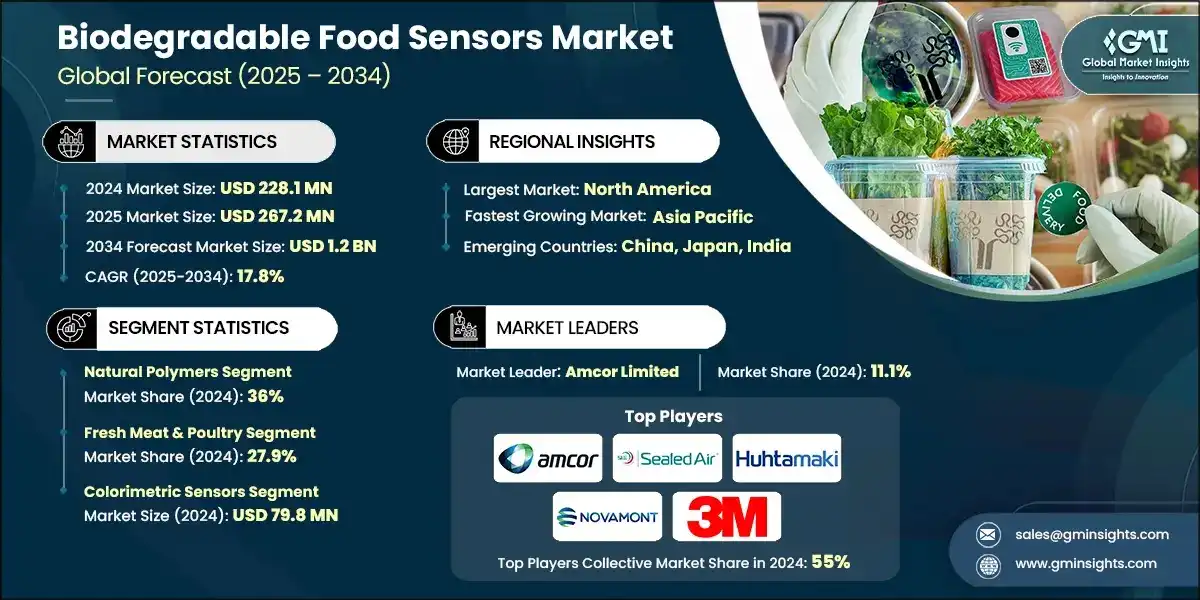
The global biodegradable food sensors market size was estimated at USD 228.1 million in 2024. The market is expected to grow from USD 267.2 million in 2025 to USD 1.2 billion in 2034, at a CAGR of 17.8% according to latest report published by Global Market Insights Inc.
Biodegradable Food Sensors Market Key Takeaways
Market Size & Growth
- 2024 Market Size: USD 228.1 Million
- 2025 Market Size: USD 267.2 Million
- 2034 Forecast Market Size: USD 1.2 Billion
- CAGR (2025–2034): 17.8%
Regional Dominance
- Largest Market: North America
- Fastest Growing Region: Asia Pacific
Key Market Drivers
- Growing Awareness of Food Safety and Quality Monitoring.
- Rising Environmental Concerns and Demand for Sustainable Packaging.
- Regulatory Push Towards Eco-Friendly Packaging and Sensors.
Challenges
- Limited Shelf-Life and Durability Concerns.
Opportunity
- Growing Alternative Protein Market and Sustainability Mandates.
Key Players
- Market Leader: Amcor Limited led with over 11.1% market share in 2024.
- Leading Players: Top 5 players in this market include Amcor Limited, Sealed Air Corporation, Huhtamäki, Novamont, 3M Company, which collectively held a market share of 55% in 2024.
Get Market Insights & Growth Opportunities
- The more the consumers are aware of foodborne diseases and the deterioration in quality, the more advanced monitoring systems are being accepted for indicator purposes to provide real-time information about freshness. Biodegradable sensors can provide continuous monitoring of the volatile compounds associated with spoilage such as ammonia, hydrogen sulfide, and volatile amines. Increased food safety awareness drives the market due to the resultant demand from food categories across the board, especially in meat and seafood applications where spoilage-related risks are the highest.
- Climate change mitigation and plastic waste reduction are generating supporting initiatives for biodegradable alternatives for food packaging. Regulatory pressures imposed on companies to honor their sustainability promises are driving investments into eco-friendly packaging solutions that give an assurance for food safety performance. Environmental concerns contribute to growth of the market, especially in Europe and North America where lots of sustainability regulations are being employed.
- Regulatory initiatives by various governments such as the European Union's active and intelligent materials regulations and the FDA guidance on smart packaging technologies are also creating a favorable environment for the adoption of biodegradable sensors. In Europe, within the framework of the EU-funded BIOSMART program, the first-ever oxygen sensor approved for food packaging applications was developed.
To get key market trends
Biodegradable Food Sensors Market Trends
- Increasing Integration of Biodegradable Sensors in Food Packaging: Smart food packaging has combined with biodegradable sensors to originate developments that will probably have a significant influence on real time freshness monitoring and reducing waste by as much as 20% through sensor-embedded packaging. These sensors generally monitor gas levels to determine the quality of the products at various stages of the supply chain thereby giving the consumers and retailers reliable freshness indicators. The trend toward integration is currently contributing almost 12% toward market growth, and all these developments are owing in no small part due to applications of improved meat, seafood, and produce packaging.
- Rising Consumer Demand for Eco-Friendly Food Safety Solutions: There is large demand for green solutions in food packaging concerning safety monitoring-a trend, because of increasing consciousness regarding the environment, towards the combination of safety monitoring and biodegradability. In this regard, consumers are now choosing materials for packaging that are environment friendly as they decompose in nature while keeping the food quality assurance feature. This trend of sustainability contributes towards the market growth trajectory close to 10%, with this feature more apparent in developed countries under stringent environmental regulations.
- Technological Advancements in Nanomaterials Enhancing Sensor Performance: Cellulose nanocrystals with other nanomaterials have been found to improve mechanical properties of their biodegradable sensors by 43% and maintain complete environmental compatibility. The advanced integration of nanomaterials for sensors will make their sensitivity and stability better which could reduce the detection limit to as low as 1 ppm for monitoring ammonia in meat packaging. Overall, such technological advancement would add up to 8% of the growth of the total market owing to improved performance characteristics.
Biodegradable Food Sensors Market Analysis

Learn more about the key segments shaping this market
Natural polymers dominate the market with 36% of market share in 2024, amounting to approximately USD 82.1 million, and will be projected with the highest growth rates of 19.5% CAGR through 2034. This segment comprises cellulose, chitosan, starch, and alginate-based sensor substrates that have shown good biocompatibility and complete biodegradability. Out of these, cellulose-based sensors lead the pack with their other excellent mechanical properties, processing versatility, and abundant availability from renewable sources. High growth rates in this sector are attributable to an accelerating preference toward naturally derived materials which address environmental concerns and still maintain a high performance.
Integration of nanocellulose plays an important role in performance enhancement, where cellulose nanocrystals improve up to 43% of mechanical properties with full biodegradation. Advanced processing technologies such as 3D printing and electrospinning allow fine-tuning of sensor geometry and performance characteristics to meet customization requirements for specific food applications. Major manufacturers are committing huge investments in natural polymer sensors, with several declaring joint ventures with suppliers of agricultural waste to furnish sustainable sourcing of raw materials.
Bioplastics are the second-largest segment, with a 26.1% market share, corresponding to USD 59.5 million in 2024, while growing on a 15.6% CAGR in the forecasted period. These include polylactic acid (PLA), polyhydroxyalkanoates (PHA), and polyhydroxybutyrate (PHB) that provide controlled biodegradation rates suitable for food packaging applications. PLA is dominating this sector because of its superior processability, mechanical properties, and supply chain infrastructure. The segment is benefitting from matured manufacturing technologies and regulatory acceptance for food contact applications.
Manufacturing scalability merits provide a favorable scenario for bio-based plastics when considering bulk sensor manufacture. Established processing equipment and methods allow economical production at the same time as precise control over sensor performance characteristics. Commercial viability has been successfully demonstrated for bio-based plastic sensors under the auspices of the EU BIOSMART project, with regulatory approval having been achieved for oxygen monitoring applications in food packaging.

Learn more about the key segments shaping this market
Fresh meat & poultry applications lead the biodegradable food sensors market with a 27.9% market share valued at USD 63.6 million in 2024, projected to increase at the highest rate of 20.2% CAGR, owing to paramount food safety conditions and high spoilage risks. Spoilage of the meat is monitored by detecting volatile amines that correspond to the basic total volatile nitrogen (TVB-N) and ammonia formation during protein degradation. Sophisticated sensors monitor meat decay in real time and allow for accurate freshness indicators to be communicated to both consumers and retailers.
Commercially viable 3D-balanced sensors for meat freshness monitoring that can detect the food safety requirements yet economically manufactured for mass implementation have been attained. Stringent food safety requirements require the monitoring systems of meat products, especially in developed markets where safety awareness is high among consumers.
The Seafood & Aquaculture segment accounts for a 23.2% market share valued at USD 52.9 million in 2024 while growing at an 18.7% CAGR through systems that monitor fish freshness by detecting ammonia and hydrogen sulfides in the spoilage process. Cellulose fiber-based ammonia sensors can monitor fish deterioration over 11 hours, providing precise monitoring against international food safety standards. For applications in China, the localization of the fish spoilage threshold provisions in food safety regulation is that TVB-N should not score beyond 20 mg/100 g, which therefore acts as calibration targets for the performance of the sensor.
Fresh Produce is having a 22% market share valued at USD 50.2 million in 2024 and is to grow at a compound annual growth rate (CAGR) of 16.8% through monitoring of ethylene and carbon dioxide levels indicating ripeness and quality deterioration. Smart packaging for fruits and vegetables carry gas sensors that optimize storage conditions to prolong their shelf life while giving consumers freshness information. The segment benefits from the increasing consumer demand for the freshness and quality of produce along with the increased consumer awareness towards the reduction of food waste.
Dairy Products account for an 18% market share worth USD 41.1 million in 2024, with a growth of 15.2% CAGR through pH monitoring systems detecting lactic acid production and bacterial contamination. Such biodegradable sensors give early warning to spoilage while being able to satisfy dairy packaging and regulatory standards.
By sensor technology the biodegradable food sensors market is segmented as colorimetric sensors, electrochemical sensors, optical sensors, gas sensors, biosensors, and others. Colorimetric sensors, which account for 35% market share valued at USD 79.8 million in 2024, are likely to grow at 18% CAGR in the coming years, owing to their simplicity, economy, and visibility. These sensors use pH-responsive indicators, including natural dyes such as anthocyanins or curcumin, which exhibit a clear color change upon the interaction with food spoilage compounds. This dominance in technology is attributed to the consumer choice of the more intuitive visual indicators and the simplicity of manufacturing methods that allow for the cost-effective production of the sensors.
Colorimetric sensor probative abilities have been significantly enhanced such that ammonia detection limits have reached 1 ppm when using PLA-based electrospun fiber substrates. Such sensors serve their purpose of reliably monitoring the evolution of volatile compounds associated with protein degradation, namely ammonia, hydrogen sulfide, and volatile amines. With the electrospinning and casting techniques employed in their manufacture, large-scale production is assured without compromising performance repeatability.
Electrochemical sensors account for 23.8% of the market share worth USD 54.3 million in 2024, and it is being cited as the fastest-growing sector with a CAGR of 19.5% owing to their high sensitivity and rapid response nature. Cellulose acetate-based electrochemical sensors offer rapid on-site detection of pesticide residues and contaminants in a matter of minutes to the field in food safety concerns, with their complete biodegradability. The demand for quantitative analysis capabilities and real-time monitoring applications drives the growth of this segment.
High-end electrochemical sensors incorporate enzyme-based detection modes that provide a highly specific response to target analytes while remaining stable in food storage environments. These biosensor methods use naturally occurring enzymes that catalyze specific reactions upon interacting with spoilage compounds, ensuring both high selectivity and environmental compatibility through complete biodegradability.
Looking for region specific data?
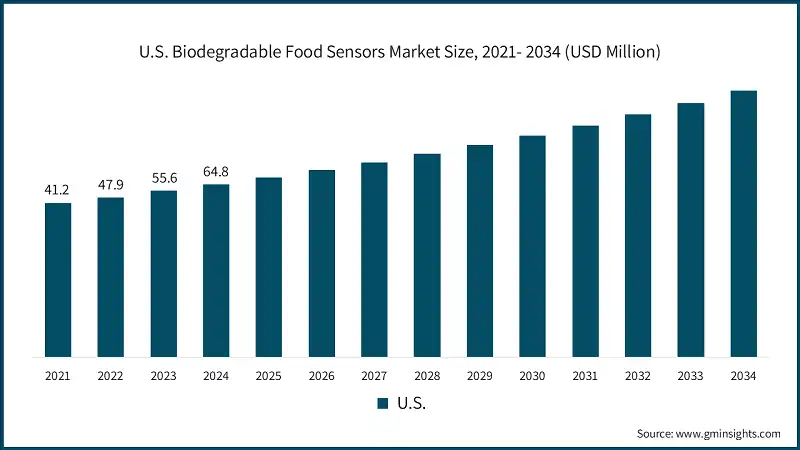
- Biodegradable food sensors market value in the U.S. reached USD 64.8 million in 2024 and would increase up to approximately USD 348.7 million by 2034. North America, which shares the largest market share at 35.9% worth USD 82 million in 2024, would expand at a CAGR of 18.5% due to its advanced research infrastructure and government backing for sustainable technologies. Breakthrough biodegradable sensor technologies combining high performance and ecological compatibility have been developed by Clarkson University and its other premier institutions. The region derives great advantage from established venture capital funding for cleantech innovations and supportive regulatory frameworks for sustainable packaging technologies.
- The U.S. leads in commercialization of biodegradable sensor technologies, with many startups and established companies introducing sensor-integrated packaging products. Government initiatives such as USDA funding for food safety research and EPA support for sustainable packaging development provide favorable conditions for market growth. Complementary opportunities in sensor innovation and commercialization are also created by Canada's strength in sustainable materials research and clean technology development.
- Europe has about 30% of its market share worth USD 68.4 million in 2024, growing at a 17.7% CAGR with the strongest regulatory support toward sustainable packaging technologies. The EU BIOSMART project has successfully developed and commercially released the first oxygen sensor approved for food packaging applications, regulatory feasibility, and market viability. Europe's active and intelligent materials regulations provide clear pathways for sensor approval but will maintain strict safety standards.
- Internationally, Germany sits atop the world's automotive and industrial sensor applications, while Netherlands and Switzerland are regarded as the emerging countries in food technology and green packaging innovations. The region's circular economy initiatives and reducing plastic waste set great driving forces for biodegradable alternatives in the market. Accelerated technology transfer coupled with commercialization reaches a level through an academic-industry collaboration platform such as Horizon Europe.
- Asia Pacific represents 26% in terms of biodegradable food sensors market share which is USD 59.3 million in terms of value in 2024 and displays an ever-strong growth of 17% CAGR by developing and expanding food processing industries along with rising public environmental awareness. China, Japan, and South Korea conquer regional development by advanced manufacturing capabilities and increasing investment in smart packaging technologies. The region's large-scale food production and processing industries provide opportunities for sensor deployment across diverse applications.
- China lays the ground for decreased food and environmental safety as consequently favorable conditions for biodegradable sensor adoption are brought in. Japan's lead in advanced materials and sensor technologies should support preparation of a high-performance biodegradable alternative. South Korea capability in the electronics and package industry complements sensor technologies with food packaging systems for commercial applications.
Biodegradable Food Sensors Market Share
Top 5 players in the market hold around 55% of the total market share in 2024. Therefore, these statistics talk about the novelty of the technology space and the opportunity it has opened for both existing packaging companies and for new entrants with different backgrounds in the innovative technology space. The leadership in the market is to come from this mix of capabilities in packaging, sensor technology, the development of sustainable materials, and connections with the food industry.
Amcor Limited stands out as a leader in the market in the world, accounting for 11.1% of the market share in 2024 on its standing as a premier packaging organization endowed with complete facilities for sustainable packaging. Within its sensor portfolio, intelligent packaging solutions now consist of biodegradable technologies for the monitoring of freshness and safety of foods. Seal this with excellent customer relations within the food industry, global manufacturing ability, and impressive research and development on sustainable packaging development, and that's the special advantage for Amcor. More recently, even though Amcor has established collaborations with sensor technology companies and is working on a fully biodegradable smart packaging system.
Sealed Air Corporation holds a market share close to 10.8% of the market in 2024, as it forms part of a full scope of diversified packaging solutions, increasingly utilizing biodegradable sensor technologies for applications related to monitoring food safety and quality. These strengths are complemented by leading capabilities in food packaging; cold chain management solutions; and established distribution networks catering to major food processors and retailers. The recent investments made by Sealed Air into technologies of sustainable packaging and into sensor integration capabilities could be said to signify the instant future intention that it holds to attain the leadership position in intelligent biodegradable packaging solutions.
Biodegradable Food Sensors Market Companies
Major players operating in the biodegradable food sensors industry are:
- Amcor Limited
- Sealed Air Corporation
- Huhtamäki Oyj
- 3M Company
- NatureWorks LLC
- Novamont S.p.A.
- Total Corbion PLA
- BASF SE
- Transparent Path
- Vericool
- FreshSurety
- BT9
- Amcor Limited
- Amcor Limited is the foremost company in the world that possesses state-of-the-art machinery to produce biodegradable sensors for various packaging formats and food applications. Their intelligent packaging portfolio encompasses biodegradable freshness indicators, temperature monitoring systems, and gas detection sensors integrated into flexible and rigid packaging solutions. Through extensive global manufacturing, strong working relationships with the food industry, and significant investment in research and development for sustainable packaging innovations, Amcor has been able to greatly differentiate itself in the marketplace. Recent activities consist of sensor technology collaboration with companies, development of fully compostable smart-packaging systems, and advancing sensor integration at manufacturing sites across North America, Europe, and Asia Pacific.
- Amcor Limited is the foremost company in the world that possesses state-of-the-art machinery to produce biodegradable sensors for various packaging formats and food applications. Their intelligent packaging portfolio encompasses biodegradable freshness indicators, temperature monitoring systems, and gas detection sensors integrated into flexible and rigid packaging solutions. Through extensive global manufacturing, strong working relationships with the food industry, and significant investment in research and development for sustainable packaging innovations, Amcor has been able to greatly differentiate itself in the marketplace. Recent activities consist of sensor technology collaboration with companies, development of fully compostable smart-packaging systems, and advancing sensor integration at manufacturing sites across North America, Europe, and Asia Pacific.
- Sealed Air Corporation
- Sealed Air Corporation is advancing rigorously into biodegradable sensor applications, utilizing its strength in food packaging and cold chain solutions. The Sealed Air sensor systems comprise freshness indication, temperature monitoring, and package integrity systems using biodegradable materials compatible with existing packaging processes. Key strength areas of Sealed Air remain in its food packaging know-how and specialization, existing relations with major food processors as clients, and moderately fair cold chain management capability. Strategy focus includes development of biodegradable sensor technologies for meat and seafood applications, enhancement of intelligent packaging solutions, and interfacing sensor data with supply chain management systems.
- Sealed Air Corporation is advancing rigorously into biodegradable sensor applications, utilizing its strength in food packaging and cold chain solutions. The Sealed Air sensor systems comprise freshness indication, temperature monitoring, and package integrity systems using biodegradable materials compatible with existing packaging processes. Key strength areas of Sealed Air remain in its food packaging know-how and specialization, existing relations with major food processors as clients, and moderately fair cold chain management capability. Strategy focus includes development of biodegradable sensor technologies for meat and seafood applications, enhancement of intelligent packaging solutions, and interfacing sensor data with supply chain management systems.
- Huhtamaki Oyj
- Huhtamaki Oyj provides fiber-based packaging expertise and development capabilities toward sustainable materials for biodegradable sensor applications in the food service and consumer packaging markets. The company's sensors' portfolio comprises cellulose-based freshness indicators, compostable temperature monitoring systems, and biodegradable gas sensors integrated into paper-based packaging solutions. Huhtamaki's competitive position draws strength from its strong presence across the European market, established sustainability credentials, and advanced fiber-processing capabilities, thus ensuring integration of sensor measurements into a variety of packaging formats.
- Huhtamaki Oyj provides fiber-based packaging expertise and development capabilities toward sustainable materials for biodegradable sensor applications in the food service and consumer packaging markets. The company's sensors' portfolio comprises cellulose-based freshness indicators, compostable temperature monitoring systems, and biodegradable gas sensors integrated into paper-based packaging solutions. Huhtamaki's competitive position draws strength from its strong presence across the European market, established sustainability credentials, and advanced fiber-processing capabilities, thus ensuring integration of sensor measurements into a variety of packaging formats.
- Novamont
- Novamont develops biodegradable and compostable materials with a special focus on Mater-Bi bioplastics, which enables sensor integration while providing complete environmental compatibility. The company's technology platform combines starch-based polymers with biodegradable additives towards sensor substrates that can be used for food packaging applications, having controllable degradation rates. Partnership agreements with packaging manufacturers and sensor developers initiate and accelerate commercialization of intelligent biodegradable packaging solutions.
- Novamont develops biodegradable and compostable materials with a special focus on Mater-Bi bioplastics, which enables sensor integration while providing complete environmental compatibility. The company's technology platform combines starch-based polymers with biodegradable additives towards sensor substrates that can be used for food packaging applications, having controllable degradation rates. Partnership agreements with packaging manufacturers and sensor developers initiate and accelerate commercialization of intelligent biodegradable packaging solutions.
- Natureworks LLC
- Natureworks LLC specializes in bio-based polymers, particularly strong in polylactic acid (PLA) materials for biodegradable sensor applications. The competitive positioning of the company benefits from vertical integration for the manufacture of bio-based polymers, established supply arrangements with packers, as well as technical competence in the development of compostable materials. Recent developments involve a partnership with a sensor manufacturer for the optimization of PLA formulations for specific detection applications and enlarging capacity for the corresponding burgeoning demand for biodegradable sensor substrates.
- Natureworks LLC specializes in bio-based polymers, particularly strong in polylactic acid (PLA) materials for biodegradable sensor applications. The competitive positioning of the company benefits from vertical integration for the manufacture of bio-based polymers, established supply arrangements with packers, as well as technical competence in the development of compostable materials. Recent developments involve a partnership with a sensor manufacturer for the optimization of PLA formulations for specific detection applications and enlarging capacity for the corresponding burgeoning demand for biodegradable sensor substrates.
Biodegradable Food Sensors Market Report Attributes
| Key Takeaway | Details |
|---|---|
| Market Size & Growth | |
| Base Year | 2024 |
| Market Size in 2024 | USD 228.1 Million |
| Market Size in 2025 | USD 267.2 Million |
| Forecast Period 2025 – 2034 CAGR | 17.8% |
| Market Size in 2034 | USD 1.2 Billion |
| Key Market Trends | |
| Drivers | Impact |
| Growing Awareness of Food Safety and Quality Monitoring | Increasing consumer awareness of foodborne illnesses and quality deterioration is driving adoption of advanced monitoring systems that provide real-time freshness indicators |
| Rising Environmental Concerns and Demand for Sustainable Packaging | Climate change mitigation efforts and plastic waste reduction initiatives are accelerating adoption of biodegradable alternatives in food packaging |
| Regulatory Push Towards Eco-Friendly Packaging and Sensors | Government initiatives including the EUs active and intelligent materials regulations and FDA guidance on smart packaging technologies are creating favorable regulatory environments |
| Pitfalls & Challenges | Impact |
| Limited Shelf-Life and Durability Concerns | Biodegradable sensors face inherent stability challenges in various food storage conditions, with performance degradation occurring over extended storage periods |
| Opportunities: | Impact |
| Growing Alternative Protein Market and Sustainability Mandates | Increasing adoption across major food manufacturers driven by investment in food tech innovation and corporate sustainability commitments |
| Market Leaders (2024) | |
| Market Leaders |
11.1% market share |
| Top Players |
Collective market share is 55% in 2024 |
| Competitive Edge |
|
| Regional Insights | |
| Largest Market | North America |
| Fastest growing market | Asia Pacific |
| Emerging country | China, Japan, India |
| Future outlook |
|
What are the growth opportunities in this market?
Biodegradable Food Sensors Industry News
- In January 2025, Amcor Limited announced a USD300 million investment in biodegradable sensor technology development across its global R&D facilities, focusing on cellulose-based freshness indicators and compostable temperature monitoring systems for meat and seafood packaging. The initiative includes partnerships with leading universities to develop next-generation sensor materials that combine high performance with complete biodegradability according to sustainable packaging industry reports.
- In November 2024, Sealed Air Corporation launched its new ProFresh biodegradable sensor line featuring colorimetric freshness indicators for meat and poultry packaging, utilizing natural anthocyanin dyes that provide clear visual spoilage indication while maintaining complete environmental compatibility. The sensors demonstrate detection limits of 1 ppm for ammonia monitoring as per food packaging research.
The biodegradable food sensors market research report includes in-depth coverage of the industry, with estimates & forecast in terms of revenue (USD Million) and volume (Kilo Tons) from 2021 to 2034, for the following segments:
Market, By Material Base
- Natural polymers
- Chitosan-based sensors
- Alginate systems
- Cellulose & derivatives
- Starch-based materials
- Bio-based plastics
- PLA (polylactic acid) systems
- PHA (polyhydroxyalkanoates)
- PCL (polycaprolactone)
- Bio-polyethylene
- Protein-based materials
- Gelatin-based sensors
- Collagen systems
- Soy protein
- Whey protein
- Composite materials
- Natural fiber reinforced
- Nanocellulose enhanced
Market, By Application
- Fresh meat & poultry
- Spoilage detection systems
- Pathogen monitoring
- Temperature abuse indicators
- Seafood & aquaculture
- Freshness indicators
- Bacterial growth monitoring
- Cold chain applications
- Fresh produce
- Ripeness monitoring
- Ethylene detection
- Moisture management
- Dairy products
- pH monitoring systems
- Bacterial contamination detection
- Shelf life extension
- Processed foods
- Package integrity monitoring
- Shelf life indicators
Market, By Sensor Technology Type
- Colorimetric sensors
- Electrochemical sensors
- Optical sensors
- Gas sensors
- Biosensors
- Others
The above information is provided for the following regions and countries:
- North America
- U.S.
- Canada
- Europe
- UK
- Germany
- France
- Italy
- Spain
- Rest of Europe
- Asia Pacific
- China
- India
- Japan
- South Korea
- Australia
- Rest of Asia Pacific
- Latin America
- Brazil
- Mexico
- Argentina
- Rest of Latin America
- Middle East & Africa
- UAE
- Saudi Arabia
- South Africa
- Rest of Middle East & Africa
Frequently Asked Question(FAQ) :
What is the market size of the global biodegradable food sensors market in 2024?
The market size was USD 228.1 million in 2024, driven by rising food safety concerns, growing consumer awareness of foodborne illnesses, and the increasing demand for sustainable and intelligent packaging solutions.
What is the projected market value of the global market by 2034?
The market is expected to reach USD 1.2 billion by 2034, growing at a CAGR of 17.8%, fueled by stringent sustainability regulations, technological innovations in nanomaterials, and regulatory initiatives supporting eco-friendly smart packaging.
What is the estimated market size of the global market in 2025?
The market is projected to reach USD 267.2 million in 2025, supported by rising adoption of biodegradable sensors across meat, seafood, and produce packaging for real-time freshness and spoilage detection.
Which material base segment dominated the global biodegradable food sensors market in 2024?
The natural polymers segment led the market with 36% share (USD 82.1 million) in 2024, driven by widespread adoption of cellulose-, chitosan-, and starch-based materials offering full biodegradability and strong mechanical performance.
Which application segment generated the highest revenue in 2024?
The fresh meat and poultry segment dominated with 27.9% share (USD 63.6 million) in 2024 and is projected to grow at a 20.2% CAGR, owing to high spoilage risks and stringent food safety standards across developed markets.
Which sensor technology type held the largest market share in 2024?
The colorimetric sensors segment accounted for 35% of the global market (USD 79.8 million) in 2024, favored for their cost-effectiveness, simplicity, and ability to visually indicate spoilage through color change.
Which region leads the global biodegradable food sensors market?
North America led the market with 35.9% share (USD 82 million) in 2024, supported by advanced R&D infrastructure, strong regulatory backing for sustainable packaging, and high commercialization rates of smart biodegradable sensors.
Which region is expected to be the fastest growing in the global biodegradable food sensors industry?
The Asia Pacific region is projected to grow at a CAGR of 17% through 2034, driven by the expansion of food processing industries, increasing investment in sustainable technologies, and rising awareness of environmental safety.
Who are the key players in the global biodegradable food sensors market?
Key players include Amcor Limited, Sealed Air Corporation, Huhtamäki Oyj, 3M Company, NatureWorks LLC, Novamont S.p.A., Total Corbion PLA, BASF SE, Transparent Path, Vericool, FreshSurety, and BT9.
Biodegradable Food Sensors Market Scope
Related Reports