Summary
Table of Content

Biocement for Construction Application Market
Get a free sample of this report
Form submitted successfully!
Error submitting form. Please try again.
Thank you!
Your inquiry has been received. Our team will reach out to you with the required details via email. To ensure that you don't miss their response, kindly remember to check your spam folder as well!
Request Sectional Data
Thank you!
Your inquiry has been received. Our team will reach out to you with the required details via email. To ensure that you don't miss their response, kindly remember to check your spam folder as well!
Form submitted successfully!
Error submitting form. Please try again.
Biocement for Construction Application Market Size
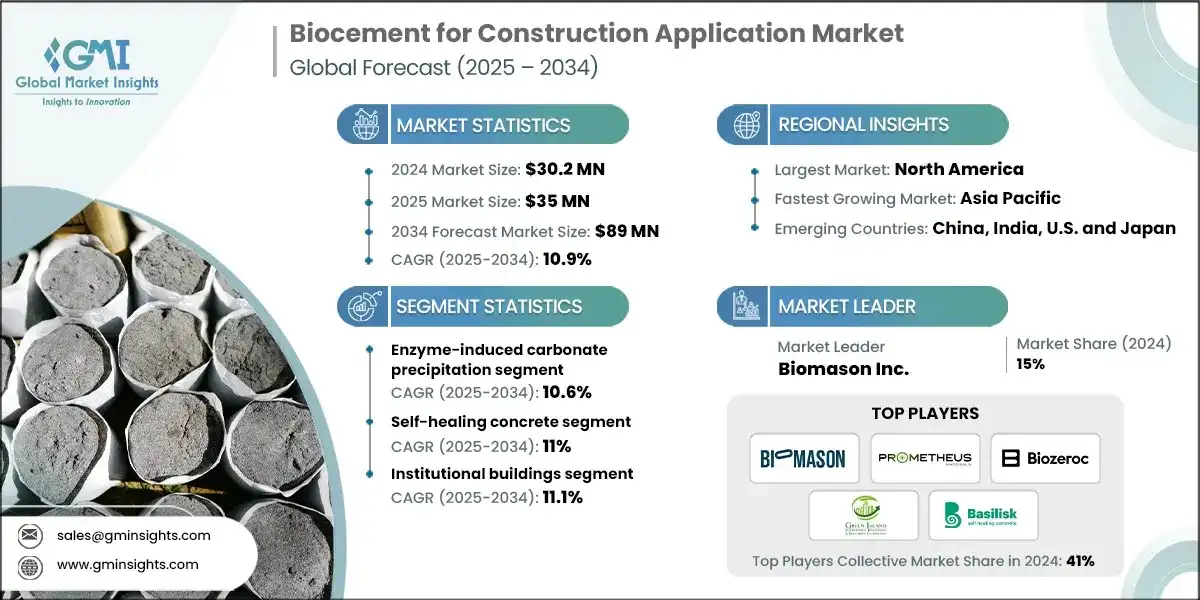
The global biocement for construction application market was estimated at USD 30.2 million in 2024 The market is expected to grow from USD 35 million in 2025 to USD 89 million in 2034, at a CAGR of 10.9% according to latest report published by Global Market Insights Inc.
To get key market trends
- Sustainable and green building materials are fast emerging into great demand and thus driving the great growth of the biocement market for construction application. Compared to ordinary Portland cement, which releases large amounts of CO2, biocement seems to be a good alternative in minimizing the carbon footprint of the construction industry. Biocement is prepared through microbial processes that induce calcite precipitations making it a durable and green binder for use in construction works.
- Trends in the construction market imply that biocement is being increasingly adopted for infrastructure, residential, and commercial buildings due to its advantages, lower energy consumption, reduced greenhouse gas emissions, and better mechanical properties. With advances in microbial technologies and bio-based materials, biocement processing is going to benefit much with higher efficiency and lower costs, enabling it to compete with conventional cement even further. Additionally, with high levels of regulatory pressure and sustainability initiatives globally, more construction companies are being encouraged to include biocement in their projects.
- In R&D, modification of production processes, enhancement of material property, and broaden application fields for soil stabilization, precast elements, and repair works are going to be focused on. The market growth is driven by increasing awareness of environmental issues and consumer preference for green building practices.
- North America is the largest market for biocement for construction application due to advancement in technology and research facilities in U.S. and Canada.
- Asia Pacific is the fastest growing region for biocement for construction application market, due to increasing industrialization and awareness among big players, the region can enhance its performance in this market in the coming years.
Biocement for Construction Application Market Report Attributes
| Key Takeaway | Details |
|---|---|
| Market Size & Growth | |
| Base Year | 2024 |
| Market Size in 2024 | USD 30.2 Million |
| Market Size in 2025 | USD 35 Million |
| Forecast Period 2025 - 2034 CAGR | 10.9% |
| Market Size in 2034 | USD 89 Million |
| Key Market Trends | |
| Drivers | Impact |
| Rising demand for sustainable and eco-friendly construction materials | Increasing awareness of environmental impact drives adoption of biocement as a green alternative. |
| Stringent environmental regulations promoting low-carbon building solutions | Governments policies incentivize the use of eco-friendly materials like biocement to reduce carbon footprints. |
| Advancements in bio-technology enhancing biocement performance and applications | Technological innovations improve biocements strength, durability, and scalability for construction use. |
| Pitfalls & Challenges | Impact |
| High production costs | The manufacturing process of biocement can be expensive, limiting its cost competitiveness compared to traditional cement. |
| Limited awareness and acceptance | Builders and developers may be hesitant to adopt biocement due to lack of familiarity and proven long-term performance data. |
| Opportunities: | Impact |
| Growing demand for sustainable construction materials | Increasing focus on environmentally friendly building practices creates a significant market for biocement. |
| Government incentives and green building certifications | Policies and certifications favoring eco-friendly materials can boost biocement adoption. |
| Technological advancements improving biocement properties | Innovations can enhance performance, reduce costs, and expand applications, opening new market segments. |
| Market Leaders (2024) | |
| Market Leaders |
15% market share |
| Top Players |
Collective market share in 2024 is 41% |
| Competitive Edge |
|
| Regional Insights | |
| Largest Market | North America |
| Fastest Growing Market | Asia Pacific |
| Emerging Country | China, India, U.S. and Japan |
| Future Outlook |
|
What are the growth opportunities in this market?
Biocement for Construction Application Market Trends
- Technological advancements, changing regulations and product innovations are all agents of dynamic growth currently experienced in the bio-cement market for construction applications. Major technological trends in this regard include microbial-induced calcite precipitation (MICP) and bio-enzymatic processes that adopt sustainable and high-performance producing ways to cement materials. The emergence of these takes would be expected to improve the ultimate biocement strength, durability, and initial and final setting time, making bio cement become more comparable with traditional concrete, although these would result in lower carbon emissions.
- Regulatory trends seem to be becoming favorable for green building materials. There are tougher rules implemented by governments and environmental agencies as they enter decarbonization initiatives to ramp up certifications for green buildings such as LEED and BREEAM. These regulations could induce biocement to be used as a more sustainable alternative such that it encourages the inclusion of bio-based materials by builders and developers into their projects.
- Product innovations are driving the major proportion of market growth. Companies have been constantly upgrading the formulations of bio-cement by enhancing their properties such as water resistance, load-bearing strength, and longevity. New formulations are being designed with specific applications in mind such as repair and restoration, or modular construction, with the aim of extending usage for biocement. Further, nanotechnology and bio-additives incorporated into the mixes significantly improve both performance and environmental arguments.
- The markets incline more toward adoption of bio-based cement solutions-enhanced by technological developments, favorable regulations and innovative products meeting emerging sustainable needs in construction. Indeed, these forces are expected to speed up the translation of traditional cement into bio-cement across global construction.
Biocement for Construction Application Market Analysis
Learn more about the key segments shaping this market
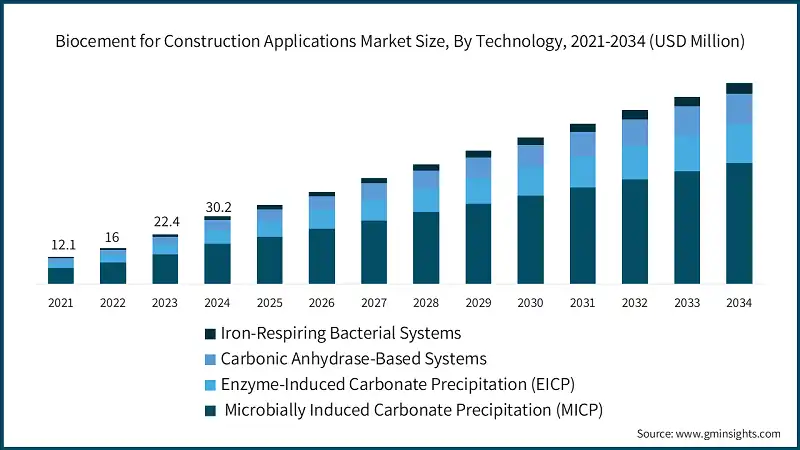
Based on technology, the market is segmented into microbially induced carbonate precipitation (MICP), enzyme-induced carbonate precipitation (EICP), carbonic anhydrase-based systems, iron-respiring bacterial systems.
- The biocement for construction application market exhibits a clear-cut distinction between technology segments, wherein microbially induced carbonate precipitation (MICP) holds the largest share of approximately 60%. The technology mainly employs naturally occurring bacteria such as Sporosarcina pasteurii to precipitate calcium carbonate through metabolic processes, thereby forming strong, binding agents for applications within the construction space.
- The extensive research underpinning MICP technology confirms its commercial viability, which has lent to its dominant position in the market; the expected continuing trend of innovation and avenues for wider application, particularly the differentiated applications for concrete and soil stabilization, is rightly expected to reflect in the 11% CAGR.
- The second largest technology segment is enzyme-induced carbonate precipitation (EICP). It holds 19.8% of the market, with a CAGR of 10.6%. EICP does take advantage of being applied even in controlled environments whereby it may be impossible to ensure the viability of the bacteria because it uses purified enzymes to catalyze the precipitation of carbonate.
- Iron-respiring bacterial systems are the least holding market share at 5% but has the highest growth potential with 11.3% CAGR. These systems uniquely use binding mechanisms in specific environmental conditions and specialized applications where conventional MICP may not be working effectively.
Learn more about the key segments shaping this market
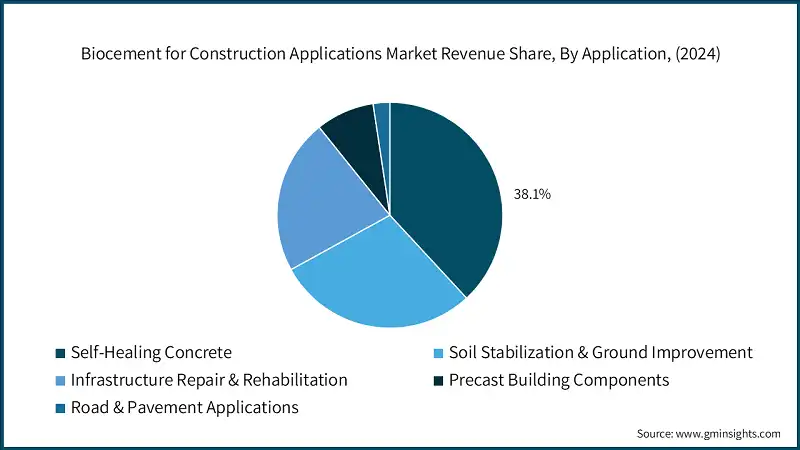
Based on applications, the biocement for construction application market is segmented into self-healing concrete, soil stabilization & ground improvement, infrastructure repair & rehabilitation, precast building components, road & pavement applications.
- The self-healing concrete takes the lead in application segment with market share of 38.1% and CAGR of 11% through 2034, being the commercially viable biocement application. This provides unique solutions to critical infrastructure maintenance problems through autonomous crack repair with significant lifecycle cost reductions and an extended service life for structures.
- According to the 10.8% CAGR, soil stabilization and ground improvement applications represent USD 28.9 million of market share, providing solutions to critical geotechnical engineering challenges. MICP technology provides much more environmentally friendly alternatives to traditional chemical stabilization methods and presents superior performance under a variety of soil conditions while severely limiting environmental impact.
- Infrastructure repair and rehabilitation add 22.2% to the market share and have the highest application CAGR at 11.3%. The niche in aging infrastructure restoration with biocement would benefit from not having to undertake demolition and reconstruction. Such military applications prove bio-inspired concrete restoration valid for civilian construction by DARPA.
- Precast building components hold 8.4% market share with CAGR of 10.4%, where controlled manufacturing environments that optimize biocement performance characteristics are provided. Quality control benefits derived from reduced construction site variables will facilitate wide market penetration because of this application segment.
- Road and pavement applications still hold only 2.4% of the market share currently, although the likelihood for growth is tremendous because of decreasing costs in technology and increasing validation in performance. The 9% CAGR reflects emerging opportunities in the transportation infrastructure modernization.
Based on end use, the biocement for construction application market is segmented into institutional buildings, industrial & manufacturing facilities, commercial structures, residential construction.
- Institutional buildings, including educational facilities, healthcare institutions, government buildings, and religious structures, have become the most important application for biocement technologies at 40.2% of market share and 11.1% CAGR. These types of buildings consider long-term durability and environmental sustainability. Such a huge market share indicates a willingness of institutional buyers to spend on premium sustainable technologies since lifecycle performance is expected to be better from such investments.
- Industrial and manufacturing facilities account for 29.8% market share with 10.6% CAGR, reflecting strong demand from sectors requiring durable, chemical-resistant construction materials. The durability and self-healing effects of biocement enable manufacturing facilities to reduce maintenance downtime and increase service life. Biocement gains special importance in terms of industrial applications due to high resistance against chemicals, in addition to maintaining structural integrity even under harsh operating conditions.
- Commercial accounts for 20.2% of the market share, having the highest end-use CAGR, which is 11.3%. It is increasing as an end-use application, with its scope mainly in office buildings, retail centers, hotels, and mixed-use developments. However, most residential construction, which currently represents 9.8% market share, is emerging with a 10% CAGR because of high-end residential projects and sustainable housing developments. Although this is currently the smallest end-use segment, residential applications are expected to see substantial growth potential as costs of technology fall, and awareness among consumers increases.
Looking for region specific data?
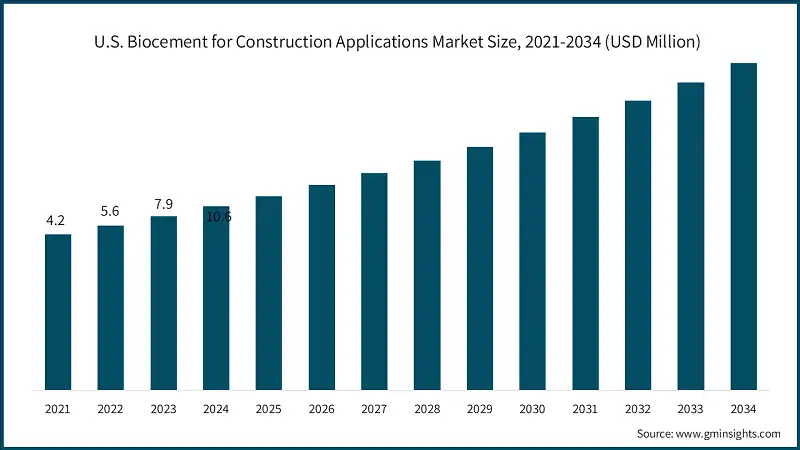
North America accounts for a decent chunk of the biocement for construction application market with 43.5% of the share and 11.1% CAGR.
- The North American biocement market is gradually gaining momentum owing to the rise in environmental consciousness and the stringent prohibitions exercised on classic cement manufacture. Leading the way in all of these is the U.S. through the approval of major investment in sustainable construction practices and green building schemes, like LEED. The market in Canada is also booming on the back of government schemes in favor of sustainable infrastructures and the creation of eco-smart cities. Introduction of advanced biocement formulations and the increase of research and development activities will further stimulate the growth of the market. Emerging markets with their increasing shifts into sustainable materials in the construction industry along with the rising demand for resilience in infrastructure position North America as a promising player for various bio-cement solutions in coming years.
Europe biocement for construction application accounted for USD 9 million in 2024 and is anticipated to show lucrative growth over the forecast period.
- Europe has also strong presence due to its adherence to principles of sustainability and circular economy. The UK and Germany have introduced one of the first bio-based construction materials in the country and are developing stringent environmental regulations and green building standards. The government incentives and the construction industry's tendency toward low-impact materials are driving France and Italy towards increasing use of bio-cement. Spain focuses on the strategic renovation and urban regeneration projects associated intimately with increasing bio-cement usage.
The Asia Pacific biocement for construction application is anticipated to grow at the CAGR of 11.3% during the analysis timeframe.
- The region exhibits a lot of full room for bio-cement and is growing because of hasty urbanization and infrastructure development within the region. By virtue of the most aggressive government policies that promote green construction and sustainable materials, committing to extensive adoption of bio-cement in massive infrastructure projects, China is the most active market within Asia Pacific. India, also considering using bio-cement as a sustainable alternative because of the burgeoning construction of houses. Japan and South Korea are focusing on creating innovative, resilient infrastructures, even using bio-cement for durability and environmental benefits. Australia, with its emphasis on sustainable urban planning and eco-conscious building practices, continues to grow the marketplace.
Latin America biocement for construction application accounted for 5.1% in 2024 and is anticipated to show lucrative growth over the forecast period.
- Emerging markets for biocement in Latin America are primarily infrastructure modernization and sustainable construction initiatives. In Brazil, public policies favor the use of eco-efficient materials in sustainable construction. In Mexico, with a significant growth in the number of stakeholders interested in sustainable building, bio-cement has found acceptance in both residential and commercial construction projects. Biocement application in the region furthermore has strong advocacy to promote the resilience of infrastructures against the impacts of climate change. Although market penetration is relatively low, government incentives and increased awareness of the environment are expected to yield considerable growth within a few years.
Middle East & Africa biocement for construction application accounted for 1.6% in 2024 and is anticipated to show lucrative growth over the forecast period.
- The gradual adoption of bio-cement is within the sustainable development agenda of the Middle East and Africa country region. The UAE leads in this regard for production of some innovative, eco-friendly construction materials integrated in various luxury and infrastructure projects to reduce the carbon footprint and increase sustainability. Green building practice founded by Vision 2030 is encouraged in Saudi Arabia to develop evidence for increasing bio-cement applications, particularly for large-scale infrastructural and urban development. Focused on reducing the dependency on conventional cement while developing alternative methods of creating friendly approaches to the environment is expected to entice future growth of bio-cement into construction applications across MEA.
Biocement for Construction Application Market Share
The top 5 companies in the biocement for construction application industry include Biomason Inc., Prometheus Materials Inc., Biozeroc Ltd., Green Island International Ltd., Basilisk B.V. These are prominent companies operating in their respective regions covering 44% of the market share. These companies hold strong positions globally due to their experience in biocement for construction application market. Their diverse product portfolios, backed by robust production capabilities and distribution networks, enable them to meet the rising demand across various regions.
- Biomason develops bio-cement technology by using bacteria that create concrete which is sustainable in nature. This process is greener than conventional cement manufacturing since it substantially reduces carbon emissions for the environment. Strong emphasis on R&D and strategic partnerships with other players in the field help Biomason quickly scaling up and deploying its products in construction markets all over the world.
- Prometheus Materials the company’s proprietary microbial approach allows to produce sufficient bio-cement. Such concrete acts as a low carbon, bio-based cement product, thus making Prometheus Materials the specialist dealing in it.
- Biozeroc uses microbial processes to develop bio-concrete and bio-cement products with reduced CO2 emissions. Its technology achieves durability and sustainability targeting both the construction and infrastructure sectors. Biozeroc's current strategic collaborations and pilot projects give evidence of the viability of its technology even if it's still early penetration into the market.
- Green Island Cement is into green buildings, including bio-cement solutions. Their approach is toward the adoption of both conventional and bio-based methods to come up with products for the construction sector that are sustainable. A diversified portfolio and global outreach will only cut more available market avenues. Its bio-cement segment, however, suffers from competition with specialized firms which have more advanced microbial technologies.
- Basilisk specializes in microbially based bio-cement solutions tailored for construction. Such claims hold that these bio-cements provide cost-effective, environmentally sustainable alternatives for conventional cement procured through its proprietary technology. Basilisk's RD and pilot projects suggest its faith in launching the product and scaling up thereafter.
Biocement for Construction Application Market Companies
Major players operating in the biocement for construction application industry include:
- Biomason Inc.
- Prometheus Materials Inc.
- Biozeroc Ltd.
- Green Island International Ltd.
- Basilisk B.V.
- Carbicrete Inc.
Biocement for Construction Application Industry News
- In 2024, Swiss company Medusoil opened a biocement production plant in Molondin, Switzerland, and utilized its mobile biocementation plant for road projects in Romania. The company specializes in sustainable construction materials that employ organic binders and mineralization processes, advancing eco-friendly solutions in the construction industry.
- In June 2022, StoneCycling and Biomason, two of the world's most inventive sustainable building material companies, announced a collaboration product to bring Europe's construction industry closer to a planet-friendly model.
- In June 2021, Biomason, the only company producing bio-cement, is developing eco-friendly bio-cement floor tiles in collaboration with Swedish fashion company Nudie Jeans. This initiative aims to create sustainable flooring solutions, reducing carbon emissions and promoting circular economic principles. The project advances Biomason’s goal of achieving carbon-neutral construction materials and highlights its innovation in sustainable building solutions.
This biocement for construction application market research report includes in-depth coverage of the industry, with estimates & forecasts in terms of revenue (USD Million) and volume (Tons) from 2025 to 2034, for the following segments:
Market, By Technology Type
- Microbially induced carbonate precipitation (MICP)
- Ureolytic bacteria systems
- Sporosarcina pasteurii applications
- Bacillus species implementations
- Enzyme-induced carbonate precipitation (EICP)
- Carbonic anhydrase-based systems
- Co2-capturing enzyme systems
- Ambient temperature carbonation
- Enhanced co2 sequestration
- Iron-respiring bacterial systems
Market By Application
- Self-healing concrete
- Autonomous crack repair systems
- Encapsulated bacterial technologies
- Long-term durability enhancement
- Soil stabilization & ground improvement
- Foundation strengthening
- Liquefaction prevention
- Erosion control systems
- Infrastructure repair & rehabilitation
- Crack sealing applications
- Surface consolidation
- Structural restoration
- Precast building components
- Architectural elements
- Structural components
- Decorative applications
- Road & pavement applications
- Road repair & maintenance
- Dust control systems
- Temporary infrastructure
Market, By End Use
- Residential construction
- Institutional buildings
- Office buildings
- Schools
- Hospitals
- Retail facilities
- Commercial structures
- Roads
- Bridges
- Airports
- Others
- Industrial & manufacturing facilities
- Warehouses
- Factories
- Logistic centers
The above information is provided for the following regions and countries:
- North America
- U.S.
- Canada
- Europe
- Germany
- UK
- France
- Spain
- Italy
- Rest of Europe
- Asia Pacific
- China
- India
- Japan
- Australia
- South Korea
- Rest of Asia Pacific
- Latin America
- Brazil
- Mexico
- Argentina
- Rest of Latin America
- Middle East and Africa
- Saudi Arabia
- South Africa
- UAE
- Rest of Middle East and Africa
Frequently Asked Question(FAQ) :
What is the market size of the biocement for construction application in 2024?
The market size was USD 30.2 million in 2024, with a CAGR of 10.9% expected through 2034 driven by rising demand for sustainable and green building materials.
What is the projected value of the biocement for construction application market by 2034?
The biocement for construction application market is expected to reach USD 89 million by 2034, propelled by advancements in bio-technology, stringent environmental regulations, and growing adoption of eco-friendly construction materials.
What is the current biocement for construction application market size in 2025?
The market size is projected to reach USD 35 million in 2025.
How much market share did the microbially induced carbonate precipitation (MICP) technology segment hold in 2024?
MICP technology held the dominant market share of approximately 60% in 2024, utilizing naturally occurring bacteria to precipitate calcium carbonate for construction applications.
What was the valuation of self-healing concrete application segment in 2024?
Self-healing concrete held the largest application market share of 38.1% in 2024, providing autonomous crack repair solutions.
What is the growth outlook for Asia Pacific region from 2025 to 2034?
Asia Pacific is the fastest growing market and is projected to grow at 11.3% CAGR through 2034, fueled by rapid urbanization, infrastructure development, and government policies promoting green construction.
Which region leads the biocement for construction application market?
North America leads the market with 43.5% share in 2024, supported by environmental consciousness, stringent regulations, and investments in sustainable construction practices and green building schemes like LEED.
What are the upcoming trends in the biocement for construction application market?
Key trends include advancements in microbial-induced calcite precipitation (MICP) and bio-enzymatic processes, stricter green building certifications (LEED and BREEAM), incorporation of nanotechnology and bio-additives, and focus on self-healing concrete technologies.
Who are the key players in the biocement for construction application market?
Key players include Biomason Inc., Prometheus Materials Inc., Biozeroc Ltd., Green Island International Ltd., Basilisk B.V., and Carbicrete Inc.
Biocement for Construction Application Market Scope
Related Reports