Summary
Table of Content

Bio-Based Polyamide Market
Get a free sample of this report
Form submitted successfully!
Error submitting form. Please try again.
Thank you!
Your inquiry has been received. Our team will reach out to you with the required details via email. To ensure that you don't miss their response, kindly remember to check your spam folder as well!
Request Sectional Data
Thank you!
Your inquiry has been received. Our team will reach out to you with the required details via email. To ensure that you don't miss their response, kindly remember to check your spam folder as well!
Form submitted successfully!
Error submitting form. Please try again.
Bio-Based Polyamide Market Size
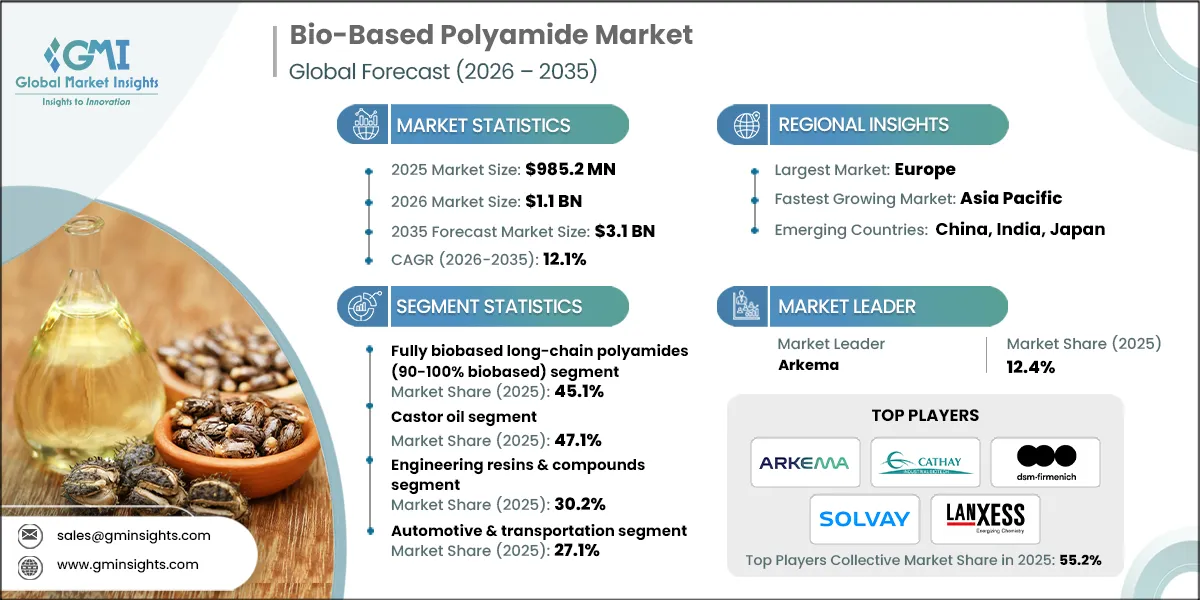
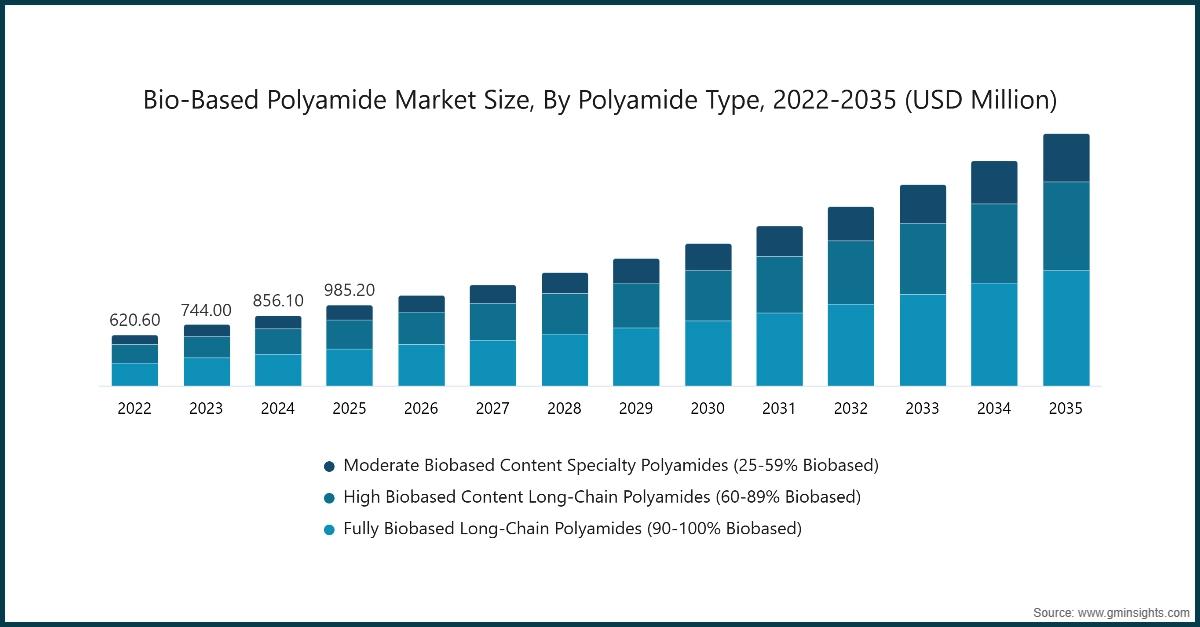
The global bio-based polyamide market was valued at USD 985.2 million in 2025. The market is expected to grow from USD 1.1 billion in 2026 to USD 3.1 billion in 2035, at a CAGR of 12.1% according to latest report published by Global Market Insights Inc.
Bio-Based Polyamide Market Key Takeaways
Market Size & Growth
- 2025 Market Size: USD 985.2 Million
- 2026 Market Size: USD 1.1 Billion
- 2035 Forecast Market Size: USD 3.1 Billion
- CAGR (2026–2035): 12.1%
Regional Dominance
- Largest Market: Europe
- Fastest Growing Region: Asia Pacific
Key Market Drivers
- Sustainable consumer demand.
- Growth in end-use industries.
- Technological advancements.
Challenges
- High production costs.
- Limited raw material availability.
Opportunity
- Expanding application scope.
- Innovation in feedstocks.
Key Players
- Market Leader: Arkema led with over 12.4% market share in 2025.
- Leading Players: Top 5 players in this market include Arkema, Cathay Biotech, DSM‑Firmenich, Solvay, LANXESS, which collectively held a market share of 55.2% in 2025.
Get Market Insights & Growth Opportunities
- The bio-based polyamide market is primarily driven by growing consumer demand for sustainable and environmentally friendly materials. This biopolymer mineralizing in the replacement of petroleum-based raw materials which, in return, reduces dependence on these and lessens the carbon footprint towards supporting sustainability initiatives on a global stage.
- Bio-based polyamides are made with the main intent of being high-performance materials for application in different fields that possess the same or better properties compared to conventional polyamides developed from petrochemical sources. With these properties, they exhibit great mechanical strength, a high resistance to chemical activities and stability under thermal conditions, making them capable of operating in very demanding applications.
- Benefits of bio-based polyamides include lower emissions of greenhouse gases, decreased environmental footprint, and compliance with high environmental legislation. All these features are attractive to eco-conscious consumers and manufacturers looking for sustainable alternatives. Further, these materials serve businesses in achieving corporate sustainability objectives and complying with requirements on eco-labels and carbon credits.
- Bio-based polyamides are used in multiple industries. For instance, in the automotive sector, they offer lightweight structures and durability in construction components that improve vehicle fuel efficiency. Bio-based polyamides are also used in the production of eco-fiber for textiles and technical textiles. They can equally be applied in electronics, as well as in packaging and consumer goods, wherein the clear environmental benefits of bio-based materials become highly appreciated. As technology advances, the bio-based polyamide market stands a potential promise for fantastic growth, driven by the demand for sustainable global development and innovations in eco-efficient product use.
To get key market trends
Bio-Based Polyamide Market Trends
- The bio-based polyamide market lies in a promising trajectory for growth as there are advances in technologies, new regulations, and continuous innovation in products. As companies tend toward sustainable orientation, many are motivated to develop bio-based polyamides produced from renewable, bio-fed stocks like castor oil, fatty acids, and other bio-renewable monomers.
- Advances in technology have been very instrumental towards the growth of the market. Innovations in bio-polymer synthesis, and processing techniques have developed the performance characteristics of bio-based polyamides so that they are comparable to traditional petrochemical variants. Enhanced production methods have reduced costs and thus commercialized these sustainable materials.
- The regulatory frameworks continue to support the adoption of bio-based polymers in all countries globally. Regulations that aim to limit carbon emissions and reduce plastic waste are promoting the trend of switching to environmentally friendly products thereby enhancing growth in the market. Adoption of international standards for sustainability and recyclability is increasing the acceptance of bio-polyamides in the industry.
- It is also product innovation that drives the market in the present scenario. Companies have been developing specific new formulations and composites to provide greater durability, flexibility, and heat resistance so as to increase the application base of bio-based polyamides. Innovations in blending bio-based polyamides with other bioplastics or reinforcing agents are creating high-performance materials suitable for demanding applications in the automotive, textiles, electronics and packaging sectors.
Bio-Based Polyamide Market Analysis
Learn more about the key segments shaping this market
Based on polyamide type, the market is segmented into fully biobased long-chain polyamides (90-100% biobased), high biobased content long-chain polyamides (60-89% biobased), moderate biobased content specialty polyamides (25-59% biobased). Fully biobased long-chain polyamides (90-100% biobased) dominated the market with an approximate market share of 45.1% in 2025 and is expected to grow with a CAGR of 12.2% by 2035.
- The bio-based polyamide type is witnessing varied growth trends. Fully bio-based long-chain polyamides (90-100% bio-based) are emerging on the market because of environmental benefits and excellent functionality being pushed by advances in bio-sourcing technologies and an increase in consumer demand for sustainability. High biobased content long-chain polyamides (60-89%), are also growing in support of industries switching to greener alternatives but keeping an eye on cost and performance compromise. Specialty polyamides with moderate biobased content (25-59%) are growing steadily on the back of applications where partial bio-content affords environmental advantages without sacrificing the required functionality. Innovators are finding ways to increase bio-content levels, reduce costs, and broaden their application spectrum so that bio-based polyamides become a substantial sustainable-choice solution across sectors.
Learn more about the key segments shaping this market
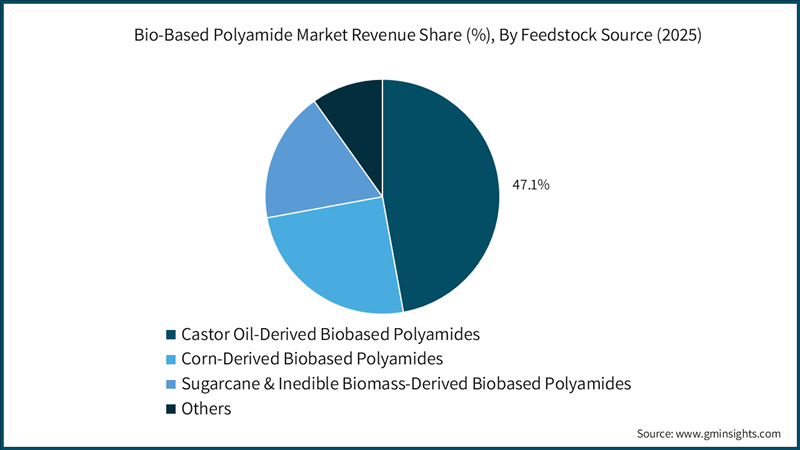
Based on feedstock source, the bio-based polyamide market is segmented into castor oil-derived biobased polyamides, corn-derived biobased polyamides, sugarcane & inedible biomass-derived biobased polyamides. Castor oil held the largest market share of 47.1% in 2025 and is expected to grow at a CAGR of 12.2% during 2026-2035.
- Market growth for castor oil-derived biobased polyamides is booming as castor is abundant, renewable, and eco-friendly. Polyamides made from castor oil are durable and have superior performance, biodegradability, and resistance to chemicals, making them suitable for automotive, textiles, and packing applications. Research-related advances in extraction and polymerization technologies are further enhancing the features and cost-effectiveness of castor oil-based polyamides, empowering castor oil-based polymers in many sectors seeking sustainable replacements for the conventional polymers.
- Similarly, corn-origin biobased polyamides are increasingly receiving attention due to their easy availability and developed supply chain. These polyamides are renewable and biodegradable since they are made from corn-based feedstocks, making them suitable for use in environmental applications. Sugarcane- and inedible-biomass-derived biobased polyamides are emerging candidates, using agricultural wastes and non-food crops to produce high-performance, sustainable polymers.
Based on application, the market is segmented into engineering resins & compounds, textile fibers & filaments, films & flexible packaging, extruded profiles & tubes, additive manufacturing powders & filaments, others. Engineering resins & compounds segments dominated the market with an approximate market share of 30.2% in 2025 and is expected to grow with a CAGR of 12.4% by 2035.
- The market for bio-based polyamides through applications such as engineering resins and compounds is booming because of an increased demand for high-performance sustainable materials in automotive, electronics, and industrial end-use applications. Such bio-based resins have good mechanical properties well as chemical resistance and environmental benefits to make them good replacement alternatives to traditional petroleum-based plastics. Indeed, the trend towards lighter, more durable, and greener materials has facilitated innovation and acceptance in the manufacturing sectors, which companies have sought to achieve by meeting each of those regulations and consumer likes through emphasized sustainability.
- Applications for bio-based polyamides include textiles, films, flexible packaging, and additive manufacturing. Bio-based polyamides tend to be biodegradable, renewable, and versatile. This has resulted in an increasing use of textile fibers and filaments made from bio-polyamides due to their strength and eco-friendliness which further promotes the trend of sustainable fashion. Consumers are driving the growth in films and flexible packaging with an eye toward greener packaging solutions. In addition, bio-based polyamides will be increasingly present in the new additive manufacturing powders and filaments that will be available in the future as the industry will now shift towards more sustainable production methods that can be tailored to consumers' demands. This presents a rapidly changing application landscape that puts sustainability right at the core of its innovations and growth.
Based on end use, the bio-based polyamide market is segmented into automotive & transportation, textiles & apparel, electronics & electrical, packaging & consumer goods, construction & building materials, industrial machinery & water management, medical & pharmaceutical, and others. Automotive & transportation segments dominated the market with an approximate market share of 27.1% in 2025 and is expected to grow with a CAGR of 12.3% by 2035.
- The automobile and transportation industry is a big arena for the bio-polyamides market because the manufacturers are always looking for eco-friendly materials to save the weight of their vehicles and improve fuel economy. Bio-based polyamides are endowed with excellent mechanical strength, chemical resistance, and heat stability such that they can be used in various applications under the hood, in an interior part, and structural componentization. Due to the stricter emission regulations imposed by governments, as well as the demand for greener vehicles from consumers, bio-based polymers find a much more prominent place in the strategies of car manufacturing companies to achieve their sustainability targets, thereby fueling growth in this segment.
- In packaging and consumer products, bio-polyamide films and parts are environment-friendly alternatives to traditional plastics, keeping pace with global trends in reducing the plastic waste and carbon footprint. Moreover, current consumer awareness and pressure from regulations encourage brands to shift to bio-materials, further widening the market front of bio-based materials.
- Additionally, there are developments in bio-based polyamides being adopted by other economic sectors such as construction, industrial machinery, water management, and medicine. Thus, bio-polyamide polymers can be seen as contributing to sustainable and durable solutions for piping systems, insulation, and fittings in construction and building materials. Likewise, bio-polyamides afford chemical resistance and durability-the essential features that will keep these constituents performing for the critical infrastructure-in industrial machinery and water management. Medical and pharmaceutical applications for biocompatible and sterilization-resistant bio-based polyamides will include devices, surgical instruments, and drug delivery systems. Overall, across end-use sectors, market segments are poised for tremendous growth based on regulatory trends and technological advances coupled with a global shift toward sustainability.
Looking for region specific data?
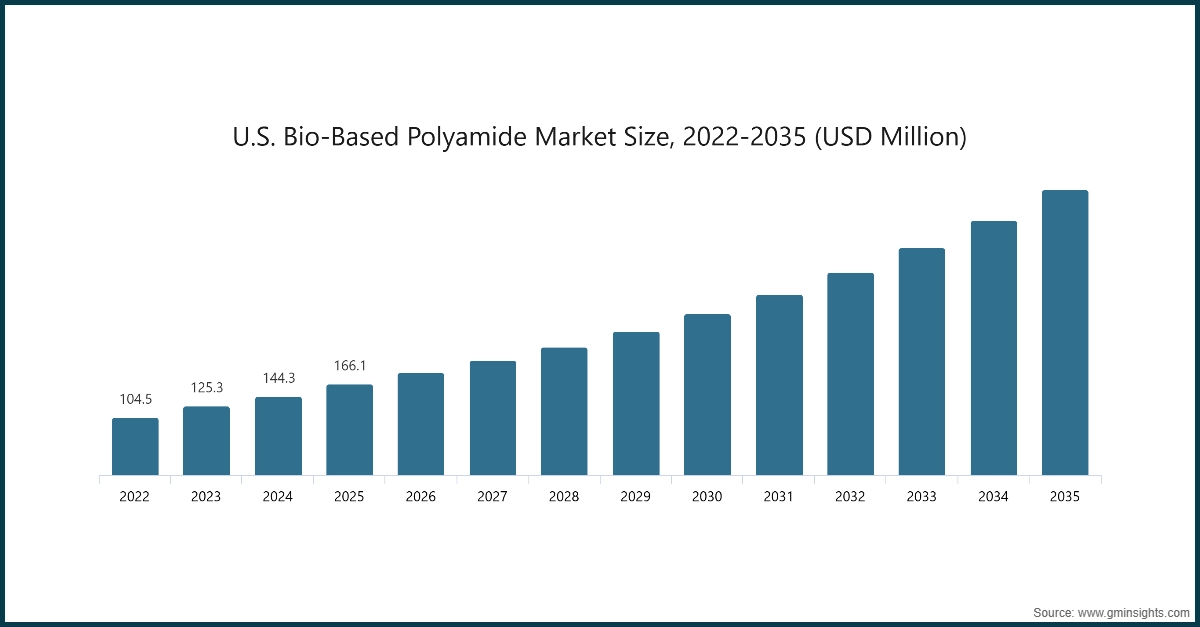
The North America bio-based polyamide industry is growing rapidly on the global level with a market share of 21.1% in 2025.
- The bio-based polyamide market has an accelerated phase of growth in North America due to biopolymers and their regulations from the environment, increasing consumer awareness, and sustainable practices in manufacture. Bio-polyamides in the automotive and packaging sectors of this region are majorly accepted to conform to environmental standards for eco-friendliness and minimize carbon footprints. Major research institutions and innovative companies in the North American region are promoting the development of new bio-based polyamide formulations, which enhances regional growth and technological advancement.
Europe bio-based polyamide market leads the industry with revenue of USD 394.3 million in 2025 and is anticipated to show lucrative growth over the forecast period.
- The market in Europe is regarded as heavily mature and regulated with an extensive focus on sustainability and circular-economy initiative. Stringent environmental regulations of the European Union, such as bans on single-use plastics and incentives to biodegradable materials, create an environment inducing industries such as textiles, packaging, and automotive to embrace bio-polyamides. Europe further strengthens a well-established ecosystem of bio-based polymer producers and research collaborations, thus fuelling innovations, strengthen competitiveness, and keeps the region as a front-runner in implementing sustainable bio-derived polymers.
The Asia Pacific bio-based polyamide market is anticipated to grow at a CAGR of 12.4% during the analysis timeframe.
- Asia-Pacific is the most rapid region in the progress of the market, propelled by the increasing industrial bases, quick urbanization, and rising environmental concerns. Such countries as China, India, and Japan appear to be investing massively in sustainable materials to support their burgeoning automotive, electronics and textile industries.
Latin America bio-based polyamide accounted for 6% market share in 2025 and is anticipated to show steady growth over the forecast period.
- The Latin American bio-based polyamide market is in an emerging stage, which sounds promising because of the growing consciousness of environmental concerns & government incentives that promote sustainable development. The emphasis is practically on automotive, packaging, and consumer goods sectors, wherein bio-polyamides are tended toward more and more as environmentally friendly alternatives. Brazil and Mexico are investing in bio-based sectors and sustainability, which should in turn enhance demand regionally, gradually engendering local manufacturing capabilities.
Middle East & Africa bio-based polyamide accounted for USD 26.7 million market size in 2025 and is anticipated to show lucrative growth over the forecast period.
- The Middle East and Africa (MEA) is still newly discovering bio-based polyamides, precipitated by-a driving factor for sustainable solutions in construction, water management, and industrial applications. Growing awareness of environmental impact and attempts toward sustainable infrastructure projects are creating opportunities for bio-polyamide integration.
Bio-Based Polyamide Market Share
The top 5 companies in bio-based polyamide industry include Arkema, Cathay Biotech, dsm-firmenich, Solvay, LANXESS. These are prominent companies operating in their respective regions covering approximately 55.2% of the market share in 2025. These companies hold strong positions due to their extensive experience in bio-based polyamide market. Their diverse product portfolios, backed by robust production capabilities and distribution networks, enable them to meet the rising demand across various regions.
- Arkema is an important company in the bio-based polyamides area relying on its R&D strength and innovative product portfolio for separation. Since sustainability and green solution development are in tune with the present global market prospects, Arkema is poised to be the industry leader. This includes collaborations and investments in bio-based materials and a wide distribution system that gives the company leeway to expand into many editing industries, such as automotive, textiles, packaging, and so on.
- Cathay Biotech Inc. specializes in the development and production of bio-based polyamides, emphasizing cost-effective manufacturing methods. It gives such an edge to the company that it can offer high-quality bio-polyamide materials at relatively lower prices. This is an attractive proposition for the price-sensitive market. The ability of the company to innovate and scale-up production will therefore place it very well to satisfy the sustainable polymer demand that is fast rising, especially around the Asia Pacific, where manufacturing costs are considered an important factor.
- dsm-firmenich knowledge of bio-based polymers with strengths in specialty chemicals. Innovation, quality and sustainability are at the heart of their strategy, all helping them to develop solutions targeted at premium markets differentiating them from competitors. Further down the executive suite, the joint venture strategy also allows for risk-sharing and acceleration in growth for the bio-based polyamide territory.
- Solvay is reputed for technological innovation and has a diversified product portfolio in synthetic fibers and polymers, including bio-based polyamides. It is an extensive R&D infrastructure and presence that offers competitive advantages for the company to develop high-performance bio-polyamide materials.
- LANXESS is a major player focusing on specialty chemicals, and high-performance polymers including bio-based polyamides. Custom development of high-performance bio-polyamide solutions for specific industrial needs serves as a competitive advantage for LANXESS.
Bio-based polyamide Market Companies
Major players operating in the Bio-based polyamide industry include:
- AKRO‑PLASTIC GmbH
- Arkema
- Avient Corporation
- Cathay Biotech
- Domo Chemicals
- DSM‑Firmenich
- Evonik Industries
- LANXESS
- NUREL
- Solvay
- Tekmar Group (TEKMA)
Bio-Based Polyamide Market Report Attributes
| Key Takeaway | Details |
|---|---|
| Market Size & Growth | |
| Base Year | 2025 |
| Market Size in 2025 | USD 985.2 Million |
| Market Size in 2026 | USD 1.1 Billion |
| Forecast Period 2026-2035 CAGR | 12.1% |
| Market Size in 2035 | USD 3.1 Billion |
| Key Market Trends | |
| Drivers | Impact |
| Sustainable consumer demand | Increasing awareness and preference for eco-friendly products among consumers are driving manufacturers to adopt bio-based polyamides. |
| Growth in end-use industries | Expansion in automotive, textiles, packaging, and electronics sectors, which are actively seeking sustainable materials to meet regulatory and consumer demands, is fueling market growth. |
| Technological advancements | Innovations in bio-polymer synthesis and processing are improving the performance and cost-effectiveness of bio-based polyamides, making them more commercially viable. |
| Pitfalls & Challenges | Impact |
| High production costs | Currently, bio-based polyamides often incur higher manufacturing costs compared to conventional polyamides, limiting widespread adoption. |
| Limited raw material availability | Dependence on specific bio-renewable feedstocks can lead to supply chain constraints and price volatility. |
| Opportunities: | Impact |
| Expanding application scope | Growing demand in sectors like automotive, textiles, and electronics offers opportunities for diversification and increased market penetration. |
| Innovation in feedstocks | Developing alternative and more abundant bio-based raw materials can reduce costs and ensure stable supply chains. |
| Market Leaders (2025) | |
| Market Leader |
12.4% Market Share |
| Top Players |
Collective Market Share of 55.2% in 2025 |
| Competitive Edge |
|
| Regional Insights | |
| Largest Market | Europe |
| Fastest growing market | Asia Pacific |
| Emerging countries | China, India, Japan |
| Future outlook |
|
| Companies covered: | 11 |
| Tables, Charts & Figures: | 205 |
| Countries covered: | 18 |
| No of Pages: | 190 |
What are the growth opportunities in this market?
Bio-Based Polyamide Industry News
- In June 2024, Fulgar, a pioneering Italian company, introduced Q-Geo, a new bio-based polyamide yarn designed to revolutionize the textile industry. This yarn is produced from 46% non-edible corn cultivated on land unsuitable for food crops, which greatly minimizes its environmental footprint compared to conventional materials.
- In February 2024, LG Chem and CJ CheilJedang announced a partnership to establish a bio-polyamide production facility in South Korea, with the goal of developing a local supply chain for bio-nylon. This agreement, though non-binding, see CJ CheilJedang utilizing advanced fermentation technology to produce pentamethylenediamine (PMDA), a crucial component for bio-nylon.
This bio-based polyamide market research report includes in-depth coverage of the industry, with estimates & forecasts in terms of revenue (USD Billion) and volume (Kilo Tons) from 2026 to 2035, for the following segments:
Market, By Polyamide Type
- Fully biobased long-chain polyamides (90-100% biobased)
- High biobased content long-chain polyamides (60-89% biobased)
- Moderate biobased content specialty polyamides (25-59% biobased)
Market, By Feedstock Source
- Castor oil-derived biobased polyamides
- Corn-derived biobased polyamides
- Sugarcane & inedible biomass-derived biobased polyamides
- Others
Market, By Application
- Engineering resins & compounds
- Textile fibers & filaments
- Films & flexible packaging
- Extruded profiles & tubes
- Additive manufacturing powders & filaments
- Others
Market, by End Use
- Automotive & transportation
- Textiles & apparel
- Electronics & electrical
- Packaging & consumer goods
- Construction & building materials
- Industrial machinery & water management
- Medical & pharmaceutical
- Others
The above information is provided for the following regions and countries:
- North America
- U.S.
- Canada
- Europe
- Germany
- UK
- France
- Spain
- Italy
- Rest of Europe
- Asia Pacific
- China
- India
- Japan
- Australia
- South Korea
- Rest of Asia Pacific
- Latin America
- Brazil
- Mexico
- Argentina
- Rest of Latin America
- Middle East and Africa
- Saudi Arabia
- South Africa
- UAE
- Rest of Middle East and Africa
Frequently Asked Question(FAQ) :
What was the market size of the bio-based polyamide market in 2025?
The market size was USD 985.2 million in 2025, with a CAGR of 12.1% projected through 2035, driven by advancements in bio-polymer synthesis, regulatory support, and increasing demand for sustainable materials.
What is the projected value of the bio-based polyamide market by 2035?
The market is expected to reach USD 3.1 billion by 2035, fueled by innovations in production methods, adoption of international sustainability standards, and growing applications in various industries.
What is the projected size of the bio-based polyamide market in 2026?
The market is expected to grow to USD 1.1 billion in 2026.
What was the market share of fully biobased long-chain polyamides (90-100% biobased) in 2025?
Fully biobased long-chain polyamides held the largest share, accounting for 45.1% of the market in 2025, and are projected to grow at a CAGR of 12.2% through 2035.
What was the market share of castor oil-derived bio-based polyamides in 2025?
Castor oil-derived bio-based polyamides held a significant market share of 47.1% in 2025 and are expected to grow at a CAGR of 12.2% during 2026-2035.
Which region leads the bio-based polyamide market?
North America was the largest regional market in 2025, with a market share of 21.1%. The region is experiencing rapid growth due to strong industrial infrastructure and increasing adoption of sustainable materials.
What are the upcoming trends in the bio-based polyamide industry?
Key trends include advancements in bio-polymer synthesis and processing techniques, regulatory frameworks promoting sustainability, and the adoption of international standards for recyclability and environmental compliance.
Who are the key players in the bio-based polyamide market?
Major players include AKRO-PLASTIC GmbH, Arkema, Avient Corporation, Cathay Biotech, Domo Chemicals, DSM-Firmenich, Evonik Industries, and LANXESS.
Bio-Based Polyamide Market Scope
Related Reports