Summary
Table of Content

Bifacial Solar Module Market
Get a free sample of this report
Form submitted successfully!
Error submitting form. Please try again.
Thank you!
Your inquiry has been received. Our team will reach out to you with the required details via email. To ensure that you don't miss their response, kindly remember to check your spam folder as well!
Request Sectional Data
Thank you!
Your inquiry has been received. Our team will reach out to you with the required details via email. To ensure that you don't miss their response, kindly remember to check your spam folder as well!
Form submitted successfully!
Error submitting form. Please try again.
Bifacial Solar Module Market Size
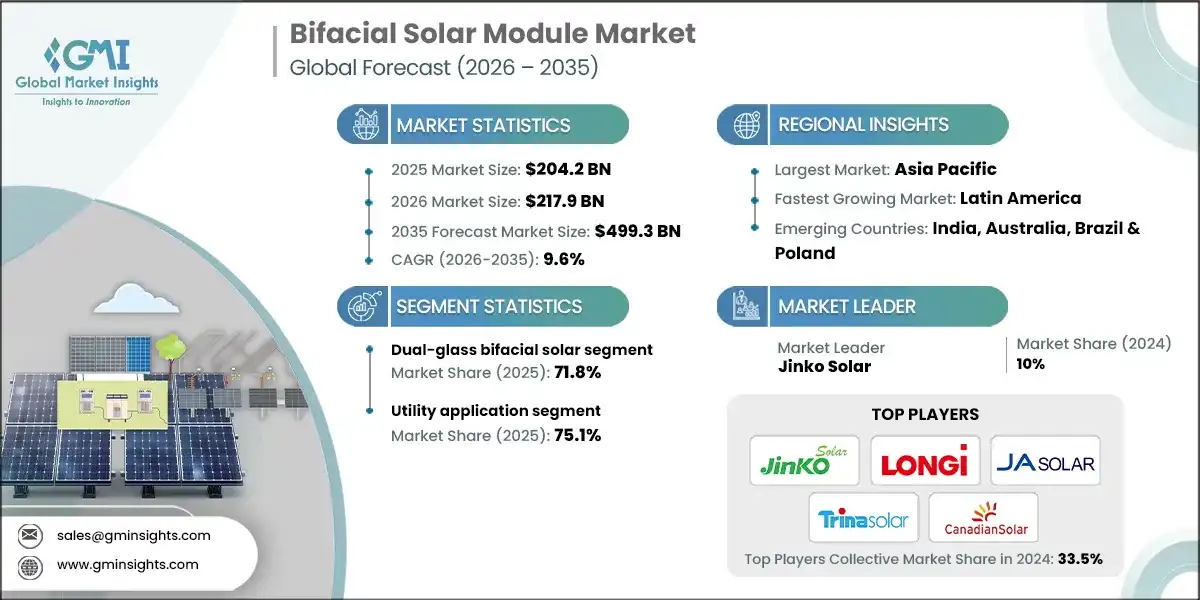
The global bifacial solar module market was estimated at USD 204.2 billion in 2025. The market is expected to grow from USD 217.9 billion in 2026 to USD 499.3 billion in 2035, at a CAGR of 9.6%, according to Global Market Insights Inc.
 To get key market trends
- The growing need for high-power solutions in utility-scale projects, aimed at maximizing energy output per unit area, is driving product adoption. Furthermore, the integration of advanced technologies such as n-type Passivated Emitter Rear Contact (PERC), Tunnel Oxide Passivated Contact (TOPCon), and Heterojunction (HJT), all designed to enhance system efficiency and performance, is expected to accelerate product penetration.
- A bifacial solar module is a photovoltaic panel designed to generate electricity using sunlight captured on both its front and rear surfaces. The front side absorbs direct solar radiation, while the rear side utilizes reflected light from surrounding surfaces such as the ground or nearby structures. This dual-sided design significantly improves energy yield compared to traditional monofacial modules, making bifacial technology an efficient solution for maximizing power generation in solar installations.
- Growing demand for durable and high-efficiency solar modules in harsh climatic conditions, coupled with increasing adoption of advanced bifacial technology to maximize energy yield, is driving manufacturers to develop robust designs tailored for utility-scale renewable projects. For instance, in December 2025, Waaree Solar Americas Inc. received a 288 MWp order for solar modules from Sabanc Renewables. This significant order represents the company’s first deployment of 620Wp bifacial modules equipped with advanced 3.2 mm high-strength front glass, specifically designed to withstand severe weather and hail-prone conditions.
- Increasing efficiency gains from innovations such as n-type TOPCon, PERC, and heterojunction (HJT) cell architectures have fueled bifacial adoption. For instance, in July 2025, Tongwei achieved an unprecedented 91.7% bifaciality, meaning the rear generates over 91% of the front-side power, signaling a breakthrough in bifacial performance. As a result, modules now frequently reach front-side efficiencies above 23–24% and overall bifacial output gains. Improved efficiency not only increases annual energy yield but also directly lowers the levelized cost of energy (LCOE), making bifacial systems economically compelling.
- Asia Pacific is among the dominant regions on account of growing investments in infrastructure and solar capacity across the region. Countries such as India, China, and Australia are offloading capital into utility-scale plants, microgrids, and rural electrification systems, leading to uplift the business scenario. Bifacial modules, which capture reflected light, are ideal in these high-consumption projects due to their higher yield. With infrastructure growth underway and financiers active, bifacial adoption is set to surge, meeting demand while offering lower LCOE and enhanced sustainability.
- Key players are at the forefront of introducing a new product line in the market. For instance, in August 2024, Vikram Solar launched its SURYAVA bifacial module featuring Heterojunction technology (HJT) and 20 Busbar G12 cells. This innovation delivers over 23% efficiency, ensuring superior energy generation, durability, and performance compared to conventional solar modules. Moreover, increasing government support through renewable energy policies, including tax incentives and subsidies for advanced solar technologies, is driving the adoption of bifacial modules by reducing costs and boosting project viability.
- Latin America is the fastest-growing region in the bifacial solar module market. Growing investments in solar infrastructure across the region are accelerating bifacial module adoption. Countries such as Brazil, Chile, and Mexico are expanding utility-scale solar projects to meet rising electricity demand and decarbonization goals. Brazil alone added the majority of solar capacity in 2023, making it one of the fastest-growing solar markets globally. Bifacial modules are preferred for these large-scale projects due to their ability to deliver up to 30% higher energy yield compared to monofacial panels, optimizing land use and reducing LCOE. This trend aligns with regional commitments to achieve carbon neutrality and diversify energy sources.
Bifacial Solar Module Market Report Attributes
| Key Takeaway | Details |
|---|---|
| Market Size & Growth | |
| Base Year | 2025 |
| Market Size in 2025 | USD 204.2 Billion |
| Market Size in 2026 | USD 217.9 Billion |
| Forecast Period 2026 - 2035 CAGR | 9.6% |
| Market Size in 2035 | USD 499.3 Billion |
| Key Market Trends | |
| Drivers | Impact |
| Growing demand for higher energy yield | Growing need for maximizing solar output is driving bifacial module adoption, as they deliver up to 30% more energy compared to monofacial panels. |
| Increasing government incentives and policy support | Increasing tax benefits, subsidies, and renewable energy targets encourage developers to adopt bifacial modules, reducing project costs and improving efficiency for large-scale solar installations. |
| Pitfalls & Challenges | Impact |
| Growing installation complexity and costs | Growing complexity in installation and mounting requirements for bifacial modules increases labor costs and design challenges, making projects less attractive for small-scale developers. |
| Increasing risk of performance variability | Increasing dependence on ground reflectivity and environmental conditions can lead to inconsistent energy gains, reducing predictability and complicating financial modeling for bifacial solar projects. |
| Opportunities: | Impact |
| Growing demand for utility-scale solar projects | Growing large-scale solar installations in emerging markets creates opportunities for bifacial modules, offering higher energy yield and reduced LCOE for developers and investors. |
| Increasing adoption of advanced solar technologies | Increasing preference for high-efficiency solutions drives bifacial module opportunities, supported by innovations like HJT and TOPCon, ensuring superior performance and competitive advantage in global solar markets. |
| Market Leaders (2025) | |
| Market Leaders |
10% market share |
| Top Players |
|
| Competitive Edge |
|
| Regional Insights | |
| Largest Market | Asia Pacific |
| Fastest Growing Market | Latin America |
| Emerging Countries | India, Australia, Brazil & Poland |
| Future outlook |
|
What are the growth opportunities in this market?
Bifacial Solar Module Market Trends
- Rising adoption of next-generation cell technologies is pushing bifacial efficiency frontiers. Innovations in n-type TOPCon, HJT, and perovskite tandem cells, together with ultra-thin glass backsheets, are boosting bifaciality to above 90% and enabling module efficiencies beyond 23–24%. These advancements also lower degradation risks and extend module life, making bifacial options more attractive. Worldwide uptake of these high-efficiency architectures is accelerating the shift from conventional panels, as cost-per-watt metrics increasingly favor bifacial systems.
- Growing demand for versatile solar solutions suitable for rooftops, carports, and ground-mounted systems is boosting bifacial module adoption. Additionally, growing applications in dual-use solar installations, including agrivoltaics and floating solar, are expanding bifacial uptake. Vertical bifacial panels are finding traction in agrivoltaics, as evidenced by Finnish studies showing efficient dual energy and crop yields at just 8 m spacing. In addition, floating bifacial systems benefit from water cooling, boosting efficiency by around 6% in Norway. These niche applications maximize land and resource use, unlocking new deployment opportunities in landscapes traditionally underutilized by solar.
- Companies' rising focus on introducing their product in developing countries will complement the industry growth. For instance, in June, JinkoSolar supplied over 220,000 Tiger NEO bifacial modules for Bulgaria’s 123 MW Verila Solar Plant, the nation’s largest PV project, boosting solar capacity by 7% despite challenging mountainous terrain and steep slopes near Kraynits.
- Growing integration of bifacial modules in hybrid renewable systems combining solar with wind or battery storage is gaining traction globally. These setups optimize land use, improve grid stability, and enhance energy reliability. Bifacial panels, with their higher energy yield, complement hybrid systems by reducing LCOE and maximizing generation during peak hours. Developers in various regions are increasingly adopting hybrid projects to meet renewable targets and mitigate intermittency challenges. As energy storage costs decline and hybrid plant economics improve, bifacial modules will play a critical role in shaping next-generation renewable infrastructure.
- Key players' ongoing efforts in introducing a new product line with advanced features will complement the industry growth. For instance, in April 2025, Gautam Solar launched its Rectangular N-Type TOPCon bifacial panels, delivering 620–640 Wp power and up to 23.69% efficiency. Certified by BIS, these next-gen modules target developers and EPCs seeking high-performance solutions.
Bifacial Solar Module Market Analysis
Learn more about the key segments shaping this market
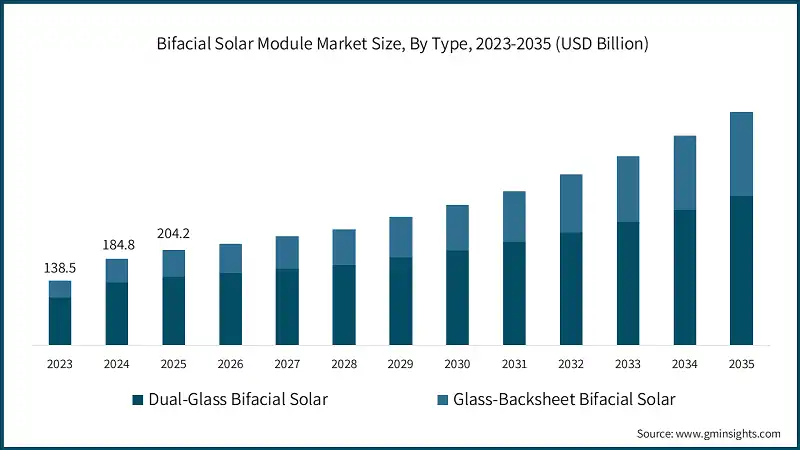
Based on type, the industry is segmented into dual-glass bifacial solar and glass-backsheet bifacial solar. The dual-glass bifacial solar dominated about 71.8% market share in 2025 and is expected to grow at a CAGR of 8.4% through 2035.
- Increasing demand for robust and long-lasting solar panels is accelerating the adoption of dual-glass bifacial modules. These panels feature tempered glass on both sides, offering superior resistance to moisture, corrosion, and mechanical stress compared to traditional polymer backsheets. This durability ensures extended operational life, reducing maintenance costs and improving return on investment for utility-scale and commercial projects.
- Additionally, their enhanced protection against harsh environmental conditions, such as high humidity or sandstorms, makes them ideal for challenging climates. As investors prioritize reliability and performance, dual-glass bifacial technology is becoming a preferred choice for sustainable and cost-effective solar installations worldwide, leading to escalate the product growth.
- Glass-backsheet bifacial solar market will grow at a CAGR of 12.4% by 2035. Growing preference for cost-effective bifacial solutions is driving the adoption of glass-backsheet modules. These modules offer a balance between performance and affordability, making them attractive for large-scale solar projects. Compared to dual-glass designs, glass-backsheet modules reduce weight and simplify installation, lowering overall system costs.
- Additionally, rising demand for lightweight and flexible designs is boosting the use of glass-backsheet bifacial modules. Unlike heavier dual-glass modules, glass-backsheet variants offer easier handling and reduced structural loads, which are critical for rooftop and commercial installations. Their lighter weight minimizes transportation and installation challenges, reducing labor costs and project timelines, leading to uplift the business growth.
Learn more about the key segments shaping this market
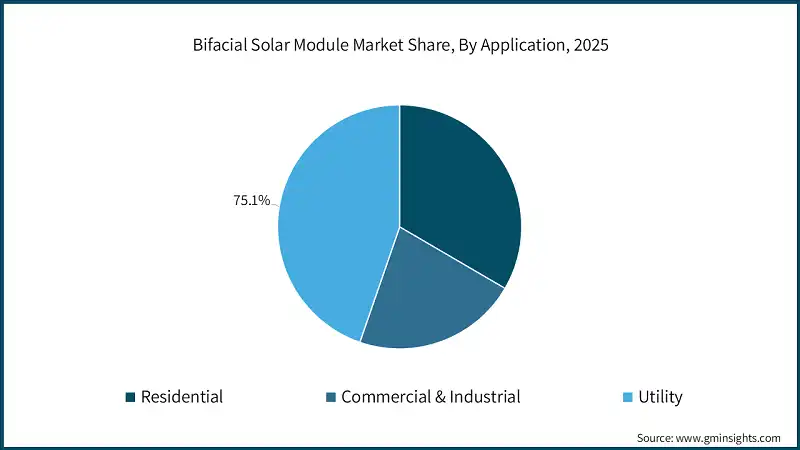
Based on application, the bifacial solar module market is segmented into residential, commercial & industrial and utility. The utility application dominates the market with a 75.1% share in 2025 and is expected to grow at a CAGR of 8.7% from 2026 to 2035.
- Rising utility-scale developers focus on maximizing the energy output within a project's fixed footprint will foster the business growth. Bifacial panels capture sunlight from both the front (direct light) and rear (reflected light, or albedo) sides, generating additional energy compared to traditional monofacial panels, depending on the installation environment. This significant boost in power output per unit area directly improves the overall system efficiency and power density, which is crucial for optimizing land use in large solar farms.
- Commercial & industrial segment is set to grow at a CAGR of 10.8% by 2035. Increasing energy yield is a major driver for adopting bifacial solar modules in commercial and industrial applications. These modules capture sunlight from both sides, utilizing reflected and diffused light to generate 5–20% more electricity than monofacial panels. For businesses with limited rooftop or ground space, this efficiency boost maximizes power generation without expanding the footprint, leading to uplift the business growth
- The residential segment is set to grow at a CAGR of 10% by 2035. Increasing energy output is a key driver for bifacial solar modules in residential applications. Homes often have limited rooftop space, making efficiency critical. Additionally, enhanced performance reduces electricity bills and improves return on investment, making bifacial technology attractive for households seeking sustainable energy solutions.
Looking for region specific data?
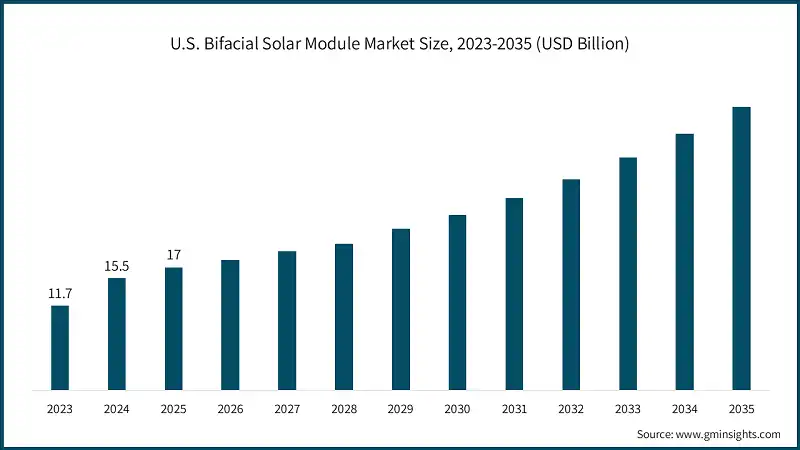
- The U.S. dominated the bifacial solar module market in North America with around 95.8% share in 2025 and is expected to reach USD 39 billion by 2035.
- Increasing demand for high-efficiency solar solutions is driving bifacial module adoption in the U.S. These panels capture sunlight from both sides, delivering 5–20% higher energy yield. Rising deployment of large-scale solar farms and favorable federal incentives, such as the Investment Tax Credit (ITC), are accelerating bifacial adoption. U.S. developers leverage bifacial modules to maximize output on existing land, improving profitability under competitive power purchase agreements (PPAs).
- Moreover, companies' ongoing efforts in introducing products to developed countries will foster the industry growth. For instance, in June 2023, LONGi launched its Hi-MO 7 PV module in Canada, featuring advanced HPDC cell technology, bifacial M10 design, 580W output, and 22.5% efficiency. This innovation strengthens LONGi’s role in Canada’s rapidly growing utility-scale solar market, supported by federal incentives.
- The North America bifacial solar module market accounted for a market value of USD 17.8 billion in 2025. Increasing demand for high-performance solar solutions is driving bifacial module adoption across the region. Additionally, growing corporate and governmental focus on carbon neutrality and renewable energy targets is boosting demand for advanced solar technologies. Bifacial modules help meet these goals efficiently, supporting ESG compliance and strengthening North America’s transition toward clean energy.
- Europe bifacial solar module market is anticipated to reach USD 104.9 billion by 2035. Rising deployment of large-scale solar farms, supported by EU Green Deal targets and national renewable energy incentives, accelerates bifacial adoption. Developers leverage bifacial technology to maximize generation on existing land, improving project economics under competitive feed-in tariffs and power purchase agreements.
- Asia Pacific bifacial solar module market is anticipated to grow at a CAGR of 9.2% by 2035. Increasing subsidies, tax benefits, and renewable energy targets across countries like China, India, and Japan are accelerating bifacial adoption. Policies promoting high-efficiency technologies make bifacial modules attractive for large-scale and rooftop projects. Moreover, the growing share of top players in the region enhances the product credibility, leading to uplift the business growth.
- For instance, in October 2024, Reliance New Energy showcased its Pro-XL bifacial HJT solar module at the REI Expo in Greater Noida. Featuring 144 half-cut G12 wafers, it offers up to 91% bifaciality, -0.24%/°C temperature coefficient, 0.3% annual degradation, and a 30-year power guarantee of 90.3%.
Bifacial Solar Module Market Share
- The top 5 companies, including Jinko Solar, JA Solar Technology, Trina Solar, LONGi Green Energy Technology, and Canadian Solar, account for around 33.5% market share. Manufacturers are investing heavily in high-efficiency cell designs such as heterojunction (HJT) and TOPCon to enhance bifacial performance. These innovations improve energy yield, reduce degradation rates, and optimize bifaciality factors, making modules more reliable and cost-effective.
- Continuous R&D ensures better temperature coefficients and higher conversion efficiencies, attracting large-scale projects and residential users seeking maximum output. By prioritizing technological advancements, producers strengthen product competitiveness and accelerate adoption across diverse applications.
- Producers are implementing large-scale manufacturing and automation to lower the production costs of bifacial modules. Economies of scale combined with optimized supply chains help reduce upfront prices, making bifacial technology more affordable for utility-scale and rooftop projects. Additionally, strategies including vertical integration and localized production minimize logistics costs and improve delivery timelines. These cost-focused initiatives enhance market penetration, enabling developers and homeowners to adopt bifacial solutions without significant financial barriers.
- Manufacturers are promoting bifacial modules alongside advanced solar tracking systems to maximize rear-side energy capture. This integration significantly boosts energy yield, especially in utility-scale projects, improving overall project economics. By offering bundled solutions with trackers and digital monitoring platforms, companies deliver higher performance and lower LCOE. These smart solutions appeal to developers aiming for optimized generation and long-term reliability, accelerating bifacial adoption in regions with high solar irradiance and competitive tariff structures.
Bifacial Solar Module Market Companies
Eminent players operating in the bifacial solar module industry are:
- 3Sun
- AE Solar
- Astronergy
- Axitec
- Bluesun Solar
- Boviet Solar
- Canadian Solar
- First Solar
- Hanwha Q CELLS
- JA Solar Technology
- Jinko Solar
- LONGi Green Energy Technology
- Primroot
- Seraphim Solar
- Sharp Corporation
- Silfab Solar
- Sunergy
- Trina Solar
- Vikram Solar
- Yingli Solar
- Jinko Solar, leveraging mass production of N-type TOPCon bifacial modules, achieves high bifaciality and bankability. Its Tiger Neo series, global expansion, and strong module shipment volume solidify its role in driving bifacial adoption in utility-scale projects. The company recorded USD 12.4 billion in revenue in 2024, growing at a significant CAGR.
- LONGi Green Energy Technology, a pioneer in bifacial solar, deploys advanced BC/HPBC based bifacial modules with high efficiency and reliability. Its global scale and R&D investment support robust bifacial product performance across utility, commercial, and residential markets.
- JA Solar Technology achieved USD 9.9 billion in 2024 revenue. It integrates high-performance bifacial cells into its module lineup, enhancing energy yield and durability. JA Solar’s focus on advanced cell technologies supports reliable bifacial module deployment in utility-scale and distributed solar markets.
- Trina Solar reported revenues of USD 6 billion and profits of USD 74 million in its half-yearly financial results in 2024. Its vertex bifacial series, often paired with smart trackers and digital systems, boosts output and reliability. Backed by strong R&D and mass production capacity, Trina enhances bifacial adoption across utility-scale deployments globally.
- Canadian Solar posted USD 1.5 billion in revenue in the third quarter ended September 30, 2025. Its bifacial modules, offered alongside solar-plus-storage solutions and long-term warranties, are optimized for commercial and utility-scale projects. Vertically integrated production and energy-storage integration improve project viability and sustainability.
Bifacial Solar Module Industry News
- In June 2025, NTPC Green Energy Ltd, announced a tender for the procurement of bifacial photovoltaic (PV) modules for a major solar power project in Bhuj, Gujarat. The project, with a capacity of 600 MW AC (equivalent to 750 MW DC), is part of India’s broader renewable energy expansion strategy aimed at accelerating solar adoption and reducing carbon emissions. This initiative underscores the growing demand for advanced bifacial technology to enhance energy yield and optimize land utilization in large-scale solar installations.
- In March 2025, SWELECT Energy Systems Ltd secured over 150 MW orders for TOPCon bifacial solar modules and raised USD 32 million through Non-Convertible Debentures. The capital will support the expansion of its Independent Power Producer portfolio to 1 GW by 2026-27, reinforcing its renewable energy commitment.
- In October 2022, Trina Solar announced to supply bifacial Vertex DEG21C.20 modules for Cero Generation’s 100 MW Project Delfini, one of Greece’s largest solar PV plants in Prosotsani Drama. The project, backed by a power purchase agreement (PPA), aims to deliver affordable renewable energy and reduce electricity costs amid rising prices across Europe.
This bifacial solar module market research report includes an in-depth coverage of the industry with estimates & forecast in terms of revenue in “USD Billion” from 2022 to 2035, for the following segments:
Market, By Thickness
- < 2 mm
- 2 mm to 3 mm
- > 3 mm
Market, By Type
- Dual-glass bifacial solar
- Glass-backsheet bifacial solar
Market, By Application
- Residential
- Commercial & industrial
- Utility
Market, By Technology
- Passivated emitter rear contact (PERC)
- TOPCon
- Heterojunction (HJT)
Market, By Frame Type
- Framed
- Frameless
The above information has been provided for the following regions and countries:
- North America
- U.S.
- Canada
- Europe
- Germany
- Spain
- Netherlands
- Poland
- Asia Pacific
- China
- Australia
- India
- Japan
- Middle East & Africa
- UAE
- Turkey
- Egypt
- Latin America
- Brazil
- Chile
Frequently Asked Question(FAQ) :
Which region leads the bifacial solar module market?
The U.S. dominated North America’s bifacial solar module market with a 95.8% share in 2025 and is projected to reach USD 39 billion by 2035, driven by rising demand for high-efficiency solar solutions.
What are the upcoming trends in the bifacial solar module market?
Key trends include adoption of next-generation cell technologies like TOPCon and HJT achieving 90%+ bifaciality, integration with hybrid renewable systems, and expansion into agrivoltaics and floating solar applications.
Who are the key players in the bifacial solar module market?
Key players include Jinko Solar, LONGi Green Energy Technology, JA Solar Technology, Trina Solar, Canadian Solar, First Solar, Hanwha Q CELLS, Astronergy, Seraphim Solar, Vikram Solar, Sharp Corporation, Silfab Solar, AE Solar, Axitec, Boviet Solar, Bluesun Solar, Sunergy, Yingli Solar, Primroot, and 3Sun.
What is the growth outlook for glass-backsheet bifacial solar from 2026 to 2035?
Glass-backsheet bifacial solar is projected to grow at a 12.4% CAGR through 2035, due to cost-effectiveness, lightweight design, and simplified installation requirements.
What was the market share of utility applications in 2025?
Utility applications held 75.1% market share in 2025, leading the segment due to focus on maximizing energy output in large-scale solar installations.
What is the market size of the bifacial solar module in 2025?
The market size was USD 204.2 billion in 2025, with a CAGR of 9.6% expected through 2035 driven by growing demand for high-efficiency solar solutions and advanced cell technologies like TOPCon and HJT.
What is the current bifacial solar module market size in 2026?
The market size is projected to reach USD 217.9 billion in 2026.
How much revenue did the dual-glass bifacial solar segment generate in 2025?
Dual-glass bifacial solar dominated with 71.8% market share in 2025, supported by superior durability and resistance to harsh environmental conditions.
What is the projected value of the bifacial solar module market by 2035?
The bifacial solar module market is expected to reach USD 499.3 billion by 2035, propelled by utility-scale project expansion, technological innovations, and government incentives for renewable energy.
Bifacial Solar Module Market Scope
Related Reports