Summary
Table of Content

Bicycle Frames Market
Get a free sample of this report
Form submitted successfully!
Error submitting form. Please try again.
Thank you!
Your inquiry has been received. Our team will reach out to you with the required details via email. To ensure that you don't miss their response, kindly remember to check your spam folder as well!
Request Sectional Data
Thank you!
Your inquiry has been received. Our team will reach out to you with the required details via email. To ensure that you don't miss their response, kindly remember to check your spam folder as well!
Form submitted successfully!
Error submitting form. Please try again.
Bicycle Frames Market Size
Bicycle frames are essential for the performance, durability, and safety of road, mountain, hybrid, and electric bicycles. They influence riding quality, weight, aerodynamics, and load capacity. Manufacturers are focusing on lightweight materials and advanced designs to meet consumer demands across various applications.
Bicycle Frames Market Key Takeaways
Market Size & Growth
- 2025 Market Size: USD 27.9 Billion
- 2026 Market Size: USD 29.6 Billion
- 2035 Forecast Market Size: USD 55.5 Billion
- CAGR (2026–2035): 7.2%
Regional Dominance
- Largest Market: Asia Pacific
- Fastest Growing Region: North America
Key Market Drivers
- Rising health awareness and cycling adoption.
- Urban mobility shift and traffic congestion solutions.
- Government initiatives promoting cycling infrastructure.
- E-bike market boom driving specialized frame demand.
- Lightweight material demand for performance cycling.
Challenges
- High cost of advanced materials (carbon fiber, titanium).
- Supply chain disruptions and raw material shortages.
Opportunity
- Growing e-bike segment requiring reinforced frames.
- Customization demand enabling premium pricing.
- Sustainable and recycled material innovation.
- Expansion in emerging markets (India, Southeast Asia, LATAM).
Key Players
- Market Leader: Trek Bicycle led with over 5% market share in 2025.
- Leading Players: Top 5 players in this market include Accell, Merida Industry, Pon, Specialized, Trek Bicycle, which collectively held a market share of 23% in 2025.
Get Market Insights & Growth Opportunities
The market focuses on frame manufacturing using materials like aluminum, carbon fiber, steel, titanium, and advanced composites. It includes frame design, tube forming, welding, surface treatments, and OEM and aftermarket supplies. Technological advancements have shifted the industry toward hydroformed aluminum and high-modulus carbon fiber frames, enhancing performance and stiffness-to-weight ratios.
The growing focus on health, urban mobility, and cycling infrastructure is driving the adoption of advanced bicycle frames. Government efforts to promote sustainable transportation and the rising popularity of e-bikes are further boosting demand for reinforced, battery-integrated frame designs.
The Asia Pacific dominates the bicycle frames market due to its strong manufacturing base, robust supply chain, and high production volumes in countries like China, India, and Japan. The presence of major OEMs, cost-efficient production, and rising demand for traditional bicycles and e-bikes further solidify its leadership.
North America is experiencing rapid market growth due to increasing participation in cycling, rising e-bike adoption, and significant investments in cycling infrastructure in the U.S. and Canada. The demand for premium lightweight frames and performance bicycles further drives this expansion.
The global bicycle frames market was estimated at USD 27.9 billion in 2025. The market is expected to grow from USD 29.6 billion in 2026 to USD 55.5 billion in 2035, at a CAGR of 7.2% according to latest report published by Global Market Insights Inc. The market volume was estimated at 23.4 million units in 2025. The market is projected to grow from 25.6 million units in 2026 to 49 million units by 2035, registering strong double-digit growth over the forecast period.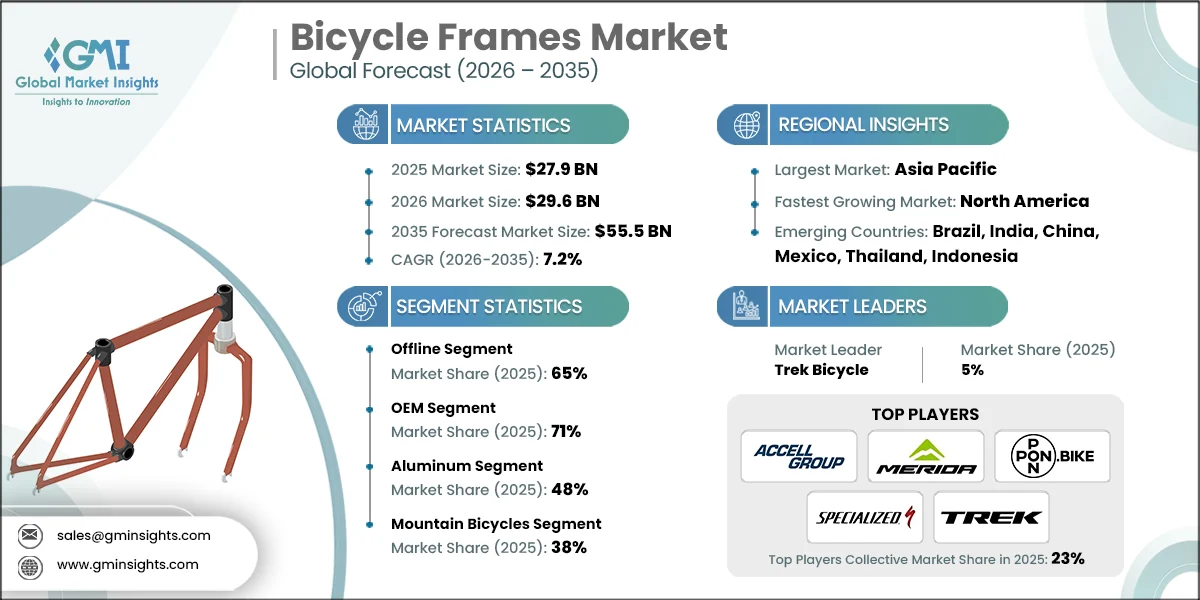
To get key market trends
Bicycle Frames Market Trends
The market is experiencing significant growth due to advancements in material technologies and increasing consumer demand for lightweight, high-performance frames. Regulatory support for sustainable transportation and the rising popularity of electric bicycles further drive the market toward smarter and eco-friendly mobility solutions.
Stringent global cycling safety and quality standards are driving market transformation. Regulatory bodies now enforce protocols for frame integrity testing, fatigue resistance, and material certification. These measures require advanced manufacturing precision and quality assurance from frame producers and OEM bicycle brands.
The growing adoption of electric bicycles and smart mobility technologies is driving demand for purpose-built e-bike frames. Features like reinforced bottom brackets, integrated battery housing, and motor mount compatibility are transforming frame design and materials engineering across mass-market and premium segments.
Rising pedestrian and cyclist fatalities in urban areas are driving demand for safer mobility infrastructure, positioning bicycles as a preferred low-risk transport mode. The WHO's Global Status Report on Road Safety highlights that investments in cycling infrastructure are boosting bicycle market growth, with city governments procuring bicycles and frames for shared mobility fleets at an unprecedented scale.
Advancements in bicycle frame manufacturing, such as hydroforming, internal cable routing, and additive manufacturing, are improving structural performance, aerodynamics, and rider ergonomics. Carbon fiber composite frames, using multi-directional layup techniques, reduce weight by 30-40% compared to aluminum while offering superior fatigue resistance and vibration dampening.
Advanced computational design tools, including finite element analysis, topology optimization, and AI-driven generative design, are transforming bicycle frame engineering. These technologies enable precise material distribution and improve structural efficiency by 25-35% compared to traditional methods, allowing premium manufacturers to enhance performance without compromising weight or durability.
For instance, in March 2025, Trek Bicycle launched its next-generation OCLV Mountain Carbon frame platform, featuring AI-assisted topology optimization and advanced carbon fiber layup scheduling. The frame, validated through over 500,000 simulated load cycles, offers a 15% weight reduction and improved impact resistance, setting new benchmarks in the premium mountain bicycle market.
Bicycle Frames Market Analysis
Learn more about the key segments shaping this market
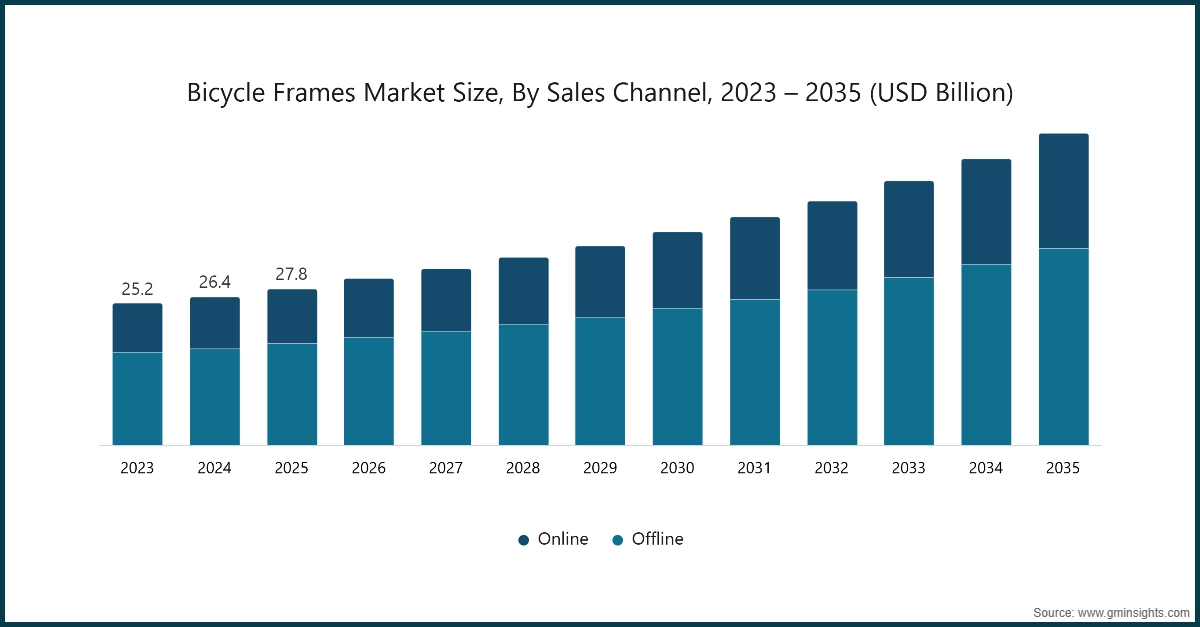
Based on sales channel, bicycle frames market is segmented into online and offline. The offline segment dominates the market with 65% share in 2025, and the segment is expected to grow at a CAGR of 6.9% from 2026 to 2035.
- Offline channels are expected to retain a majority share in 2035, driven by the high-involvement nature of bicycle purchases, the importance of test rides, professional fitting services, and community-building activities at physical locations.
- Specialty bicycle retailers deliver services that are challenging to replicate online, such as expert consultations, professional fittings, pre-delivery assembly, and ongoing mechanical support. These offerings justify retail margins and build lasting customer loyalty.
- In 2024, Citi Bike expanded to nearly 40,000 bikes across 2,200+ stations, recording over 45 million trips. This growth highlights the increasing offline presence of bike share and rental operators, particularly in tourism and urban mobility.
- The growth of online channels is driven by trends such as direct-to-consumer websites for margin capture, expanding e-commerce marketplaces, mobile commerce and social media integration, augmented reality tools enhancing purchase confidence, and subscription models generating recurring revenue.
- For instance, in April 2025, PeopleForBikes reported that 850,000 additional units were sold directly to consumers in 2024, significantly influencing industry projections. Nearly 50% of e-bike sales occurred through direct channels, with strong adoption in the premium electric segment due to higher margins and buyer confidence.
- In 2024, bike sales through Chinese livestreams on Douyin grew by over 200%, underscoring the rapid expansion of social commerce in the Asia Pacific. This trend leverages influencer-led demonstrations, real-time viewer engagement, and limited-time promotions to drive purchases.
- This model proves particularly effective for youth and price-sensitive consumers prioritizing value and social proof over traditional brand relationships.
- Offline channels remain relevant despite digital transformation due to limitations in online bicycle purchases, such as the inability to test ride, complex assembly, sizing uncertainties, shipping challenges for fragile products, and lack of physical retailer support for warranty and service.
Learn more about the key segments shaping this market
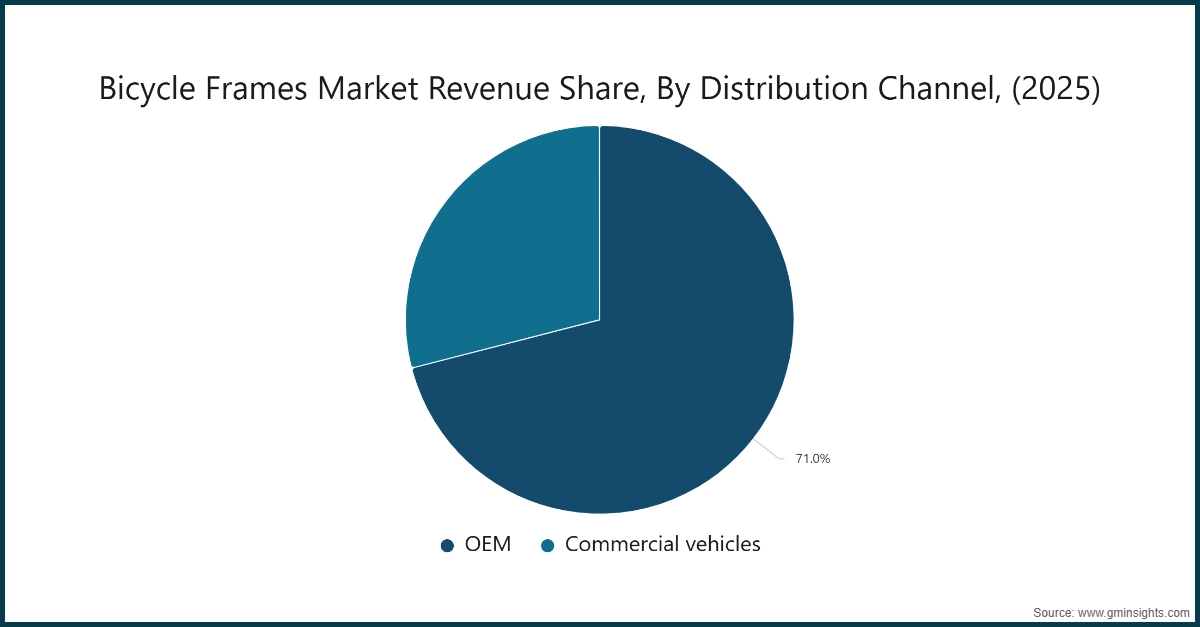
Based on distribution, bicycle frames market is divided into OEM and aftermarket. The distribution channel structure reflects bicycles' nature as integrated systems where frames represent foundational components typically procured by bicycle brands rather than end consumers. The OEM segment dominates with 71% market share in 2025 and is growing at the rate of 7.5% CAGR.
- By 2025, the OEM channel is expected to hold a 71% share, driven by a market structure where frame manufacturers supply frames to bicycle brands, which assemble them with components and accessories for consumer sales.
- OEM relationships prioritize volume commitments, technical co-development, supply chain integration, and intellectual property collaboration.
- Taiwan's and China's manufacturing concentration creates OEM ecosystem efficiency, with Taiwan accounting for 40% of global frame production and China 35% of component manufacturing.
- Frame manufacturers contribute significantly to OEMs through technical co-development, focusing on suspension design, material science research, manufacturing innovations, and testing to support bicycle brands' product advancements.
- E-bike market growth particularly favors OEM channel as battery integration, motor mounting, and electrical system accommodation require deep technical collaboration between frame suppliers and bicycle brands.
- In 2025, the aftermarket channel is expected to account for 29% of the market. While its share declines, absolute growth highlights demand for custom builds, frame upgrades, crash replacements, and niche applications.
- Custom bicycle builders and boutique frame manufacturers target the premium aftermarket segment, offering bespoke frames priced at USD 2,000 to over USD 5,000. These artisanal builders emphasize craftsmanship, heritage, and authenticity through hand-built construction using traditional methods.
- Competitive cyclists represent disproportionate aftermarket share through frequent frame replacements and component upgrades. Carbon fiber crash damage often requires frame replacement rather than repair, creating recurring aftermarket demand.
- Aftermarket growth limitations include OEM complete bicycle value propositions offering integrated designs, warranty coverage, and professional assembly at competitive total costs. For most consumers, complete bicycles provide superior value versus aftermarket frame plus component purchases.
Based on material, the bicycle frames market is segmented into aluminum, steel, carbon fiber, titanium and others. The aluminum segment dominates with 48% market share in 2025 with 7.4% CAGR during 2026 to 2035.
- Aluminum frames dominate the market due to their superior performance, manufacturing scalability, cost-efficiency, and enhanced sustainability through recycled content.
- The material's combination of light weight, excellent strength-to-weight ratio, corrosion resistance, and complete recyclability positions it as the preferred choice across diverse consumer segments from entry-level commuters to competitive cyclists.
- Manufacturing scalability ensures high-volume production with consistent quality, enabling both mass-market pricing and premium positioning through advanced alloys and heat treatments. Aluminum frame production, driven by extrusion, welding, and heat treatment processes, is concentrated in Taiwan (40% of global frame production) and China (35% of component manufacturing).
- Future growth drivers include the expanding e-bike market leveraging aluminum's structural benefits, advancements in recycled aluminum technology enhancing sustainability, and the development of circular economy infrastructures enabling closed-loop recycling.
- In 2025, steel frames are expected to hold 24% of the market, driven by their 30–50-year lifespan, recyclability, superior ride quality, and repairability. These features align with growing consumer preferences for durability and sustainability over minor weight savings.
- Steel offers the lowest production environmental impact among common frame materials, requiring only 1.8-2.5 kg CO2 per kg with energy consumption of 20-35 MJ/kg.
- High-tensile and chromoly steel variants serve distinct market segments. High-tensile steel dominates entry-level and developing market segments through low cost and adequate performance for basic transportation applications.
- Steel's repairability advantage becomes increasingly relevant in circular economy context. Unlike carbon fiber requiring specialized facilities and often uneconomical repairs, steel frames can be welded and restored by local bike shops or frame builders using widely available equipment.
- By 2025, carbon fiber frames are expected to account for 19% of the market, growing at a 7.7% CAGR. This growth is fueled by advancements in performance, increased amateur racing participation, and progress in recycled carbon integration despite environmental challenges.
- Carbon fiber's unmatched strength-to-weight ratio enables frame construction achieving UCI minimum 6.8kg weight limits while maintaining structural integrity for professional racing demands.
- The material's directional strength properties enable engineers to optimize stiffness for power transfer and ensure comfort in critical zones. This capability, unmatched by isotropic materials like aluminum or steel, justifies its premium pricing for competitive cyclists.
Based on frames, the bicycle frames market is divided between mountain bicycle, hybrid bicycle, electric bicycle, road bicycle and others. Mountain bicycles dominate with 38% market share in 2025, and with a CAGR of 7.4% during forecast period.
- Mountain bicycle frames lead the frame type segment, comprising sub-categories like cross-country, trail, enduro, and downhill. Each requires specific geometry, suspension integration, and materials suited to distinct terrains and riding styles.
- Global investments in trail infrastructure are driving segment growth. Bentonville, Arkansas, highlights this trend with nearly 70 miles of mountain bike trails, the 550+ mile OZ Trails network, and a chairlift-served mountain bike park set to begin construction in spring 2025.
- Material selection varies substantially by mountain bike discipline. Cross-country prioritizes weight minimization driving carbon fiber adoption, with professional racers using sub-10kg full-suspension bikes.
- Trail and all-mountain categories increasingly adopt aluminum due to its durability, cost-effectiveness, and reasonable weight, with manufacturers like Giant, Trek, and Merida focusing aluminum e-MTB platforms.
- For instance, in April 2025, the mountain bike frame market is growing with expanding trail infrastructure. Bentonville, Arkansas, features 70 miles of trails, and a chairlift-served bike park set for spring 2025 is expected to boost demand for aluminum and carbon fiber frames.
- By 2025, road bicycle frames are expected to account for 26% of the market, growing at a 7.6% CAGR. This growth is fueled by rising competitive cycling participation, expanding gran fondo events, and advancements in aerodynamics and materials.
- Advancements in engineering have enabled aero road bikes to meet the UCI's 6.8kg minimum weight while maintaining aerodynamic tube profiles. These designs are now suitable for various terrains and conditions, overcoming past weight-related limitations.
- By 2025, electric bicycle frames are expected to account for 16% of the market, driven by an 8.2% CAGR, e-bike market growth, premium frame engineering, and increased adoption of pedal-assist technology.
- E-bike frame engineering differs fundamentally from conventional bicycles due to battery integration, motor accommodation, increased structural loads, and higher operating speeds.
- A 0.6 kWh e-bike battery, with an average CO2 footprint of 60 kg, requires frame designs that balance range and weight for optimal handling. Mounting options include downtube integration for centralized weight, rear rack mounting for cargo and serviceability, and semi-integrated designs for protection and accessibility.
Looking for region specific data?
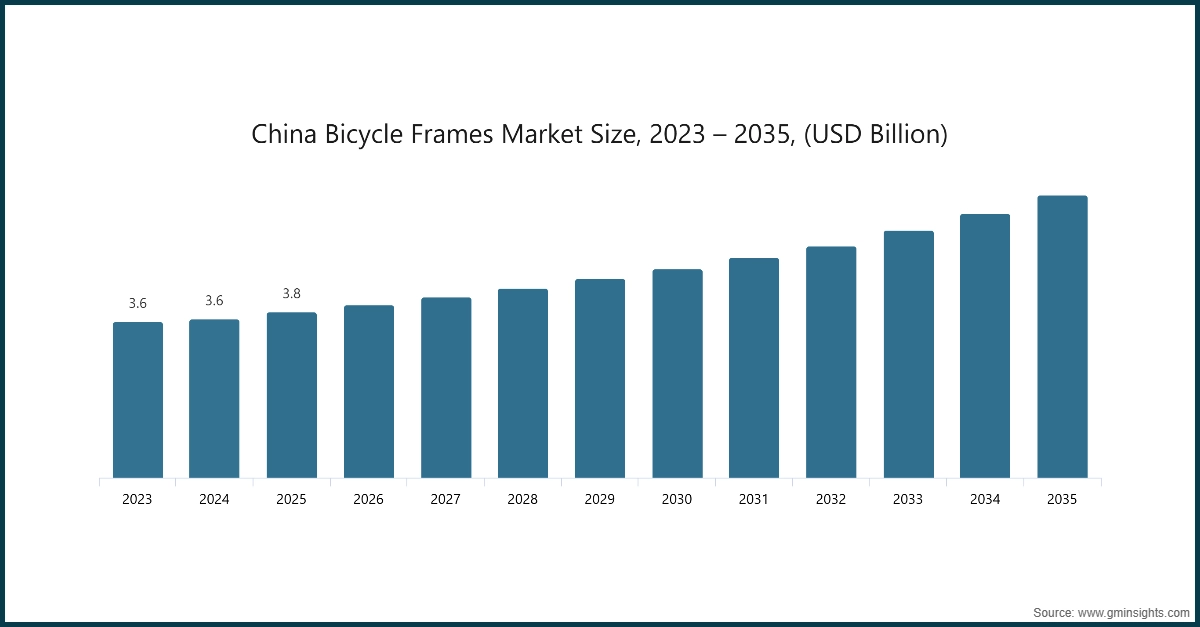
China dominates the Asia Pacific bicycle frames market, showcasing strong growth potential, with a CAGR of 5.6% from 2026 to 2035.
- China's 14th five-year plan emphasizes advanced lightweight frame technologies and electric bicycle-compatible architectures to modernize urban mobility, expand green transportation infrastructure, and enhance domestic manufacturing competitiveness.
- For instance, in April 2025, China's Ministry of Industry and Information Technology (MIIT) introduced updated standards for e-bike frames, requiring improved fatigue resistance and waterproofing by January 2026. This has prompted manufacturers like Phoenix Bicycle and Flying Pigeon to expedite material upgrades and quality certifications.
- By 2025, lightweight aluminum and carbon fiber frame technologies aim to be fully integrated into all new bicycle segments. By 2030, AI-driven design platforms and automated carbon fiber systems are expected to enable Chinese manufacturers to compete with Taiwanese and European benchmarks in global markets.
- In China's competitive bicycle and e-bike market, manufacturers like Yadea, AIMA Technology, Giant Manufacturing (China), and Merida are investing in advanced frame engineering and integrated battery housing to meet growing demand for premium, lightweight, and stylish designs across urban and performance segments.
- China's domestic supply chain policies and manufacturing localization incentives require bicycle frame material suppliers and advanced component manufacturers to prioritize domestic sourcing and comply with export control regulations. These measures enhance the competitiveness of local manufacturers in both domestic and regulated export markets.
Asia Pacific dominated bicycle frames market, which accounted for USD 6.3 billion in 2025 and is anticipated to show growth of 6.2% CAGR over the forecast period.
- The Asia-Pacific market is growing rapidly due to urbanization, investments in cycling infrastructure, rising e-bike adoption, and government-backed green initiatives. These trends are driving manufacturers to expand production and improve engineering standards for mass-market and premium segments.
- China, the largest bicycle frame manufacturing hub in Asia-Pacific, is advancing in e-bike-specific frame engineering, lightweight aluminum hydroforming, and carbon fiber composite production.
- In March 2025, Yadea Group announced the expansion of its Tianjin facility, integrating automated carbon fiber frame production and AI-driven quality inspection systems.
- Japan's bicycle frame industry, led by Shimano, Panasonic Cycles, and Bridgestone Cycle, excels in advanced engineering using high-tensile chromoly steel, aerospace-grade aluminum, and carbon fiber. Decades of materials expertise and strict quality standards position Japanese frames at the premium level globally and domestically.
- For instance, in February 2025, Bridgestone Cycle launched its next-generation e-bike frame platform with integrated battery cavity hydroforming and corrosion-resistant surface treatments. The platform targets Japan's urban commuter e-bike market, aiming to set new standards for durability and design.
- South Korea is rapidly advancing its bicycle frame technology ecosystem, driven by government investments in urban mobility and a growing cycling culture. Collaborations between domestic manufacturers and research institutions are fostering innovations in composite frame engineering and smart manufacturing, positioning the country as a competitive player in Asia-Pacific's premium bicycle frame supply chain.
- India's market is steadily growing, driven by Tata Motors-affiliated cycling ventures, Hero Cycles, and domestic e-bike manufacturers integrating advanced aluminum and steel frame engineering.
- Southeast Asian markets, including Thailand, Indonesia, and Vietnam, are expanding their bicycle frame manufacturing and consumption due to regional production by Japanese and Taiwanese OEMs, rising cycling adoption driven by urban challenges, and increased government investment in cycling infrastructure.
The bicycle frames market in US is expected to experience significant and promising growth with a CAGR of 8.2% from 2026 to 2035.
- The United States leads the North America market, driven by strong demand for premium cycling products, a well-established cycling culture, growing e-bike adoption, and investments in urban cycling infrastructure. This compels brands to enhance frame engineering and material technology for American consumers.
- OEMs and bicycle brands in the US market are focusing on advanced frame engineering to meet the diverse needs of cyclists. This includes multi-material construction, compliance-tuned tube profiles, and integrated mounting solutions for varied cycling environments like trails, urban commuting, and gravel riding.
- For instance, in January 2025, Specialized Bicycle Components launched its next-generation Stumpjumper EVO carbon mountain bike frame. Designed using advanced simulations and rider data, it offers a 12% improvement in torsional stiffness and targets the growing trail and enduro cycling market in key US regions.
- California, Colorado, Oregon, and Washington lead the United States in bicycle frame technology development, premium cycling adoption, and urban cycling infrastructure expansion.
- Texas and Arizona are emerging as key hubs for bicycle frame distribution, e-bike assembly, and cycling infrastructure expansion. This growth is driven by increasing metropolitan populations, expanding urban trail networks, favorable business regulations, and the presence of major bicycle retail chains and distribution centers targeting the US Sun Belt market.
- The growing US e-bike market is driving demand for specialized bicycle frames with reinforced engineering, integrated battery housing, and motor mount compatibility. This trend is fostering premium pricing and significant R&D investments among established brands and emerging direct-to-consumer e-bike manufacturers targeting urban and recreational riders.
North America bicycle frames market is anticipated to grow at a CAGR of 8.4% during the analysis timeframe.
- The North America market is driven by advanced material engineering, a strong cycling culture, growing urban mobility investments, innovative domestic technologies, and government support for sustainable transportation initiatives.
- The United States dominates regional bicycle frame demand due to rising investments in premium cycling products, increasing e-bike adoption, robust cycling infrastructure programs, and the presence of leading brands with domestic R&D and manufacturing facilities.
- Canada is emerging as a key player in North America's bicycle frames market, driven by urban cycling infrastructure expansions, R&D incentives for sustainable transportation, and rising demand for purpose-built frames for e-bikes and cargo bicycles.
- The Canadian government is prioritizing sustainable urban mobility by focusing on cycling safety infrastructure, domestic active transportation manufacturing, and local supply chain resilience. Key areas include advanced frame engineering and e-bike technology development to support decarbonization and reduce urban congestion in major metropolitan centers.
- Ontario, British Columbia, and Quebec are driving demand for bicycle frames that meet Canada’s varied riding conditions, requiring corrosion resistance, durability, and all-terrain adaptability for urban commuting, trails, and all-season use.
- The North American bicycle industry relies on advanced frame engineering and a strong supply chain. U.S. and Canadian suppliers develop premium materials like carbon fiber, titanium, and e-bike-specific aluminum, serving both domestic markets and global OEM brands seeking high-precision manufacturing expertise.
Germany dominates the Europe bicycle frames market, showcasing strong growth potential, with a CAGR of 7.7% from 2026 to 2035.
- Germany dominates the European Market, driven by premium brands like Canyon Bicycles, Cube Bikes, Focus Bikes, and Rose Bikes. These companies invest in advanced frame engineering, aerodynamic designs, and e-bike-specific innovations to cater to Germany's high-performance cycling consumer base.
- For instance, in February 2025, Canyon Bicycles launched its Aeroad CFR road bike frame, featuring AI-driven fluid dynamics and advanced carbon fiber layup. The frame offers improved aerodynamics, a 9% weight reduction, and sets new standards in Europe's premium bicycle frame market.
- German bicycle frame manufacturers are accelerating the development of e-bike-compatible frames, ensuring structural safety certification compliance, and adopting sustainable manufacturing processes, driven by directives like the EU Cycling Strategy 2030 and updated national cycling infrastructure frameworks.
- Increasing urban mobility demand and expanding cycling infrastructure in cities like Berlin, Munich, Hamburg, and Cologne are driving manufacturers to develop versatile bicycle frames that cater to Germany's growing urban cycling population.
- Germany's rising cycling participation and e-bike adoption are driving OEMs to develop multi-material frames using hydroformed aluminum and carbon fiber. These designs enhance rigidity, reduce weight, and meet the aesthetic demands of urban and recreational e-bike consumers.
Europe bicycle frames market is anticipated to grow at a CAGR of 7.3% during the analysis timeframe.
- The European market is driven by stringent safety standards, premium domestic brands, and advanced frame engineering expertise in Germany, Italy, and the Netherlands. Rising investments in urban cycling infrastructure and demand for lightweight, durable, and e-bike-compatible frames further boost the adoption of advanced materials and precision manufacturing.
- European standardization bodies, including CEN, and EU Horizon Europe research consortia are enhancing e-bike standards for frame safety, battery certification, and smart connectivity. Manufacturers must conduct rigorous testing, including fatigue, durability, and electromagnetic compatibility assessments, to secure CE marking for EU market entry.
- The adoption of advanced bicycle frame technologies in the UK, France, Italy, Spain, and Nordic countries is shaped by cycling culture maturity, urban infrastructure investments, consumer purchasing power, and active transportation policies. These factors drive demand for premium materials like carbon fiber, aluminum, and e-bike-specific frames across Europe's cycling markets.
- The UK market excels in advanced cycling engineering, with tier-one frame specialists in the Midlands and Southwest England. Motorsport-derived carbon fiber technology is also being adapted from Formula One and endurance racing for premium road and mountain bike frame production.
- Nordic countries, including Sweden, Norway, and Finland, are adopting advanced bicycle frame technologies like durable aluminum and corrosion-resistant titanium to withstand harsh winters. This shift is driven by government cycling initiatives, high e-bike penetration, and consumer preference for sustainable, long-lasting frames.
Brazil leads the Latin American bicycle frames market, exhibiting remarkable growth of 7.7% during the forecast period of 2026 to 2035.
- Brazil dominates the Latin American market, driven by increasing cycling participation, urban mobility initiatives, and investments in bike lanes, mountain bike parks, and e-bike incentives.
- Government programs promoting cycling safety and sustainable transport are boosting the adoption of high-quality frames, particularly aluminum and carbon fiber, in urban commuter and recreational segments.
- Brazilian bicycle manufacturers, including both local brands and assembly plants of international players, are increasingly focusing on advanced frame engineering for e-bikes, road bikes, and mountain bikes, aligning with growing demand for lightweight, durable, and battery-compatible designs.
- Key bicycle hubs in Brazil include São Paulo, Rio de Janeiro, and Porto Alegre, where OEMs and local suppliers are integrating carbon fiber and aluminum frame production, alongside e-bike battery and motor integration solutions.
- Macroeconomic factors, including currency fluctuations and import duties, have raised costs for premium materials and advanced manufacturing equipment, impacting overall frame production budgets but driving innovation in local sourcing and cost-efficient designs.
UAE to experience substantial growth in the Middle East and Africa bicycle frames market in 2025.
- The UAE dominates the Middle Eastern market, driven by high income levels, advanced cycling infrastructure, government wellness initiatives, and a growing cycling culture, attracting premium international brands to Dubai and Abu Dhabi.
- Rising demand for premium cycling products in GCC markets is prompting international bicycle frame brands and tier-one component suppliers to develop market-specific strategies. These include heat-resistant coatings, sand and dust protection, and customized solutions for high-net-worth consumers investing in top-tier carbon fiber frames.
- For instance, in February 2025, Canyon Bicycles partnered with a Dubai-based premium sports retailer to introduce its Aeroad CFR and Grail CFR carbon frames in the UAE. The initiative targets affluent expatriates and domestic cyclists in Dubai and Abu Dhabi, offering regional warranty and servicing.
- Abu Dhabi's Urban Mobility Master Plan and Dubai's Smart City cycling strategy focus on cycling infrastructure, safety standards, and participation growth. These efforts boost the regional bicycle frame market and attract global premium cycling brands to the UAE.
- International bicycle frame brands and cycling technology providers are leveraging the UAE's advanced sports infrastructure and challenging terrains to test frame durability, heat resistance, and sand ingress protection. This positions the UAE as a key destination for extreme environment testing in global cycling product development.
Bicycle Frames Market Share
The top 7 companies in the market are Trek Bicycle, Merida Industry, Accell, Specialized, Pon, Dorel Industries, and Canyon Bicycles contributed around 51% of the market in 2025.
- Trek Bicycle leads the bicycle frames market through advanced carbon fiber engineering, proprietary OCLV technology, and AI-driven structural simulations. Its competitive edge lies in a strong IP portfolio, global retail partnerships, and cost-efficient manufacturing across the US and Asia.
- Merida Industry specializes in high-volume aluminum and carbon bicycle frame manufacturing, leveraging its vertically integrated Taiwanese production infrastructure. By combining proprietary aluminum hydroforming and advanced carbon fiber layup scheduling, the company delivers cost-efficient, technically advanced frames across road, mountain, gravel, and e-bike categories.
- Accell designs advanced aluminum frames and e-bike-specific structures for brands like Batavus, Raleigh, and Winora. Its adaptive approach ensures motor compatibility, integrated battery housing, and region-specific geometry, delivering reliable performance and competitive pricing across European markets.
- Specialized Bicycle utilizes advanced computational design tools, proprietary FACT carbon fiber technology, and rider biomechanics research to create high-performance bicycle frames. These innovations ensure continuous product refinement and maintain the brand's premium positioning in the global bicycle market.
- Pon, managing brands like Gazelle, Cervelo, Santa Cruz, and Kalkhoff, develops advanced e-bike frames with smart connectivity and battery systems. Leveraging shared technology investments and manufacturing scale, it delivers premium solutions for diverse consumer needs, from road racing to urban commuting and cargo applications.
- Dorel Industries, through its Cycling Sports Group, manages brands like Cannondale, GT, and Schwinn. The company specializes in advanced aluminum and carbon frame engineering, e-bike platform development, and a portfolio ranging from recreational to premium performance bicycles.
- Canyon Bicycles, headquartered in Koblenz, Germany, specializes in premium bicycle frame engineering and innovation. By leveraging advanced computational fluid dynamics and rider biomechanics analytics, the company ensures optimized performance and rapid product development, maintaining its premium brand across direct-to-consumer markets in Europe, North America, and Asia-Pacific.
Bicycle Frames Market Companies
Major players operating in bicycle frames industry are:
- Argon 18
- Bianchi
- Cannondale Bikes
- Canyon
- Cervélo
- Giant Manufacturing.
- Santa Cruz
- SCOTT Sports
- Specialized Bicycle
- Trek
- The bicycle frames market is led by Trek, Specialized Bicycle, Giant Manufacturing, Cannondale Bikes, Bianchi, Canyon, SCOTT Sports, Cervélo, Santa Cruz, and Argon 18. These companies deliver innovative frame designs and materials for road, mountain, hybrid, and electric bikes.
- These companies enhance their offerings by integrating lightweight carbon fiber, durable aluminum, aerodynamic tube shaping, full-suspension systems, and e-bike batteries, improving ride performance and meeting global cycling needs across professional, recreational, and urban segments.
Bicycle Frames Market Report Attributes
| Key Takeaway | Details |
|---|---|
| Market Size & Growth | |
| Base Year | 2025 |
| Market Size in 2025 | USD 27.9 Billion |
| Market Size in 2026 | USD 29.6 Billion |
| Forecast Period 2026-2035 CAGR | 7.2% |
| Market Size in 2035 | USD 55.5 Billion |
| Key Market Trends | |
| Drivers | Impact |
| Rising health awareness and cycling adoption | Boosts demand for performance-oriented, durable, and lightweight frames across recreational and fitness cycling segments. |
| Urban mobility shift and traffic congestion solutions | Increases preference for commuter bicycles, driving higher production of hybrid and city bike frames. |
| Government initiatives promoting cycling infrastructure | Encourages large-scale bicycle adoption, supporting OEM expansion and higher frame manufacturing volumes. |
| E-bike market boom driving specialized frame demand | Accelerates development of reinforced, battery-integrated frames designed to support higher loads and electrical components. |
| Lightweight material demand for performance cycling | Drives innovation in carbon fiber and advanced aluminum frames to enhance speed, efficiency, and ride quality. |
| Pitfalls & Challenges | Impact |
| High cost of advanced materials (carbon fiber, titanium) | Increases overall bicycle pricing, limiting adoption in price-sensitive and mass-market segments. |
| Supply chain disruptions and raw material shortages | Causes production delays and cost volatility, affecting OEM margins and timely product availability. |
| Opportunities: | Impact |
| Growing e-bike segment requiring reinforced frames | Expands demand for structurally stronger, battery-integrated frames, increasing value per unit and technological differentiation. |
| Customization demand enabling premium pricing | Allows manufacturers to offer tailored geometry, materials, and finishes, supporting higher margins in performance and enthusiast segments. |
| Sustainable and recycled material innovation | Strengthens brand positioning and regulatory compliance while attracting environmentally conscious consumers. |
| Expansion in emerging markets (India, Southeast Asia, LATAM) | Creates new volume growth avenues such as rising urbanization, income levels, and mobility needs drive bicycle adoption. |
| Market Leaders (2025) | |
| Market Leader |
5% Market Share |
| Top Players |
Collective Market Share is 23% |
| Competitive Edge |
|
| Regional Insights | |
| Largest Market | Asia Pacific |
| Fastest growing market | North America |
| Emerging countries | Brazil, India, China, Mexico, Thailand, Indonesia |
| Future outlook |
|
What are the growth opportunities in this market?
Bicycle Frames Industry News
- In June 2025, Accell, in partnership with a Netherlands-based energy storage research institute, introduced an integrated e-bike frame platform with structural battery cell embedding technology. This innovation, offering a 40% improvement in frame torsional rigidity, will debut in the 2026 model year for Batavus and Winora e-bikes in the European market.
- In May 2025, Specialized Bicycle Components acquired a California-based additive manufacturing startup specializing in titanium and aluminum bicycle frame components. This acquisition enhances Specialized's custom frame engineering capabilities, enabling mass-customized frame solutions for premium consumers by the 2026 model year.
- In March 2025, Canyon Bicycles launched an AI-assisted generative frame design platform in collaboration with a German computational engineering software provider. The platform reduced frame engineering development cycles by 28% and improved stiffness-to-weight ratios compared to traditional finite element analysis methods.
- In January 2025, Trek Bicycle partnered with a leading carbon fiber technology firm to develop a bio-resin-based carbon fiber composite, reducing production emissions by 35%. The composite will debut in the 2026 model year on Trek's Madone SLR and Émonda SLR road frames.
The bicycle frames market research report includes in-depth coverage of the industry with estimates & forecasts in terms of revenue (USD Bn) and shipments (Units) from 2022 to 2035, for the following segments:
Market, By Material
- Aluminum
- Steel
- Carbon Fiber
- Titanium
- Others
Market, By Frame
- Mountain bicycle
- Hybrid bicycle
- Electric bicycle
- Road bicycle
- Others
Market, By Sales Channel
- Online
- Offline
Market, By Distribution Channel
- OEM
- Aftermarket
Market, By End Use
- Professional/competitive cyclists
- Recreational/enthusiast cyclists
- Commuters/urban cyclists
- Youth cyclists
- Others
The above information is provided for the following regions and countries:
- North America
- US
- Canada
- Europe
- Germany
- UK
- France
- Italy
- Spain
- Russia
- Netherlands
- Sweden
- Denmark
- Poland
- Asia Pacific
- China
- India
- Japan
- Australia
- South Korea
- Singapore
- Thailand
- Indonesia
- Vietnam
- Latin America
- Brazil
- Mexico
- Argentina
- Colombia
- MEA
- South Africa
- Saudi Arabia
- UAE
- Israel
Frequently Asked Question(FAQ) :
What was the market size of the bicycle frames market in 2025?
The market size was USD 27.9 billion in 2025, with a CAGR of 7.2% expected through 2035, driven by advancements in material technologies and increasing demand for lightweight, high-performance frames.
What is the projected value of the bicycle frames market by 2035?
The market is expected to reach USD 55.5 billion by 2035, fueled by the growing adoption of electric bicycles, regulatory support for sustainable transportation, and innovations in frame design.
What was the market volume of bicycle frames in 2025?
The market volume was estimated at 23.4 million units in 2025, with projections indicating growth to 49 million units by 2035.
Which sales channel dominated the bicycle frames industry in 2025?
The offline segment dominated the market with a 65% share in 2025 and is expected to grow at a CAGR of 6.9% from 2026 to 2035.
What was the market share of the OEM segment in 2025?
The OEM segment held a 71% market share in 2025 and is projected to grow at a CAGR of 7.5% through 2035.
Which material segment led the bicycle frames market in 2025?
The aluminum segment led the market with a 48% share in 2025 and is expected to grow at a CAGR of 7.4% from 2026 to 2035.
Which region dominates the Asia Pacific bicycle frames market?
China dominates the Asia Pacific market, showcasing strong growth potential with a CAGR of 5.6% from 2026 to 2035.
Who are the major players in the bicycle frames market?
Key players include Argon 18, Bianchi, Cannondale Bikes, Canyon, Cervélo, and Giant Manufacturing.
Bicycle Frames Market Scope
Related Reports