Summary
Table of Content

Bicycle Bottom Bracket Market
Get a free sample of this report
Form submitted successfully!
Error submitting form. Please try again.
Thank you!
Your inquiry has been received. Our team will reach out to you with the required details via email. To ensure that you don't miss their response, kindly remember to check your spam folder as well!
Request Sectional Data
Thank you!
Your inquiry has been received. Our team will reach out to you with the required details via email. To ensure that you don't miss their response, kindly remember to check your spam folder as well!
Form submitted successfully!
Error submitting form. Please try again.
Bicycle Bottom Bracket Market Size
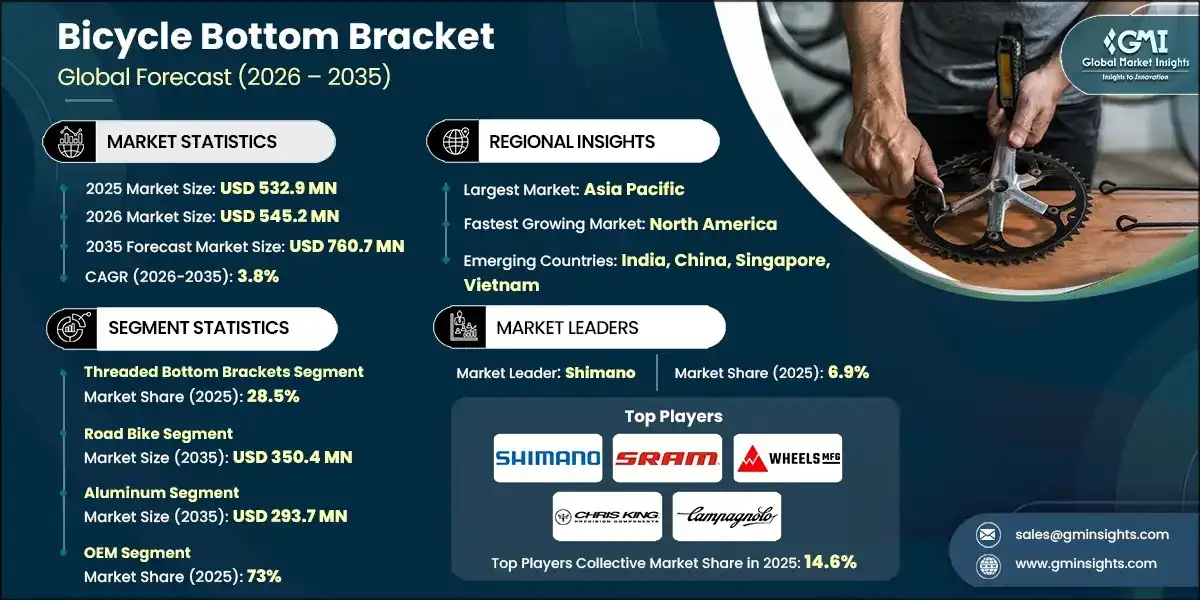
The global bicycle bottom bracket market size was estimated at USD 532.9 million in 2025. The market is expected to grow from USD 545.2 million in 2026 to USD 760.7 million in 2035, at a CAGR of 3.8% according to latest report published by Global Market Insights Inc.
Bicycle Bottom Bracket Market Key Takeaways
Market Size & Growth
- 2025 Market Size: USD 532.9 Million
- 2026 Market Size: USD 545.2 Million
- 2035 Forecast Market Size: USD 760.7 Million
- CAGR (2026–2035): 3.8%
Regional Dominance
- Largest Market: Asia Pacific
- Fastest Growing Region: North America
Key Market Drivers
- Growth in Global Bicycle Sales.
- Expansion of E-Bike Market.
- Advancements in Material Technology.
- Rising Popularity of Performance Cycling.
- Aftermarket Customization Growth.
Challenges
- Compatibility Issues Across BB Standards.
- High Cost of Advanced Materials.
Opportunity
- E-Bike-Specific BB Designs.
- Growth in Gravel/Adventure Cycling.
- Integrated and Smart Component Adoption.
- Lightweight Frame Integration.
Key Players
- Market Leader: Shimano led with over 6.9% market share in 2025.
- Leading Players: Top 5 players in this market include Shimano, SRAM, Wheels Manufacturing, Chris King Precision Components, Campagnolo, which collectively held a market share of 14.6% in 2025.
Get Market Insights & Growth Opportunities
An increase in people cycling for recreational, commuting and fitness reasons is increasing the demand for reliable Power Train Components. As people buy mid-to-high priced bikes, the requirements of OEMs (Original Equipment Manufacturers) and Aftermarket Constitutes (products sold in the aftermarket) will rise for long-lasting and efficient Bottom Brackets. The continued growth of this sector will come from the same trends experienced with all other bike categories and in all regions.
As the demand for e-Bikes increases around the world, the need for stronger and higher torque capable BBs increases as well. This leads to increased demand for BBs made using reinforced designs with improved bearings using advanced materials. As global e-Bike penetration accelerates, there will be increased emphasis from bicycle manufacturers to design and supply BB systems that excel in longevity, torque transfer and vibration dampening. All of these factors will increase both OEM and Aftermarket unit volumes.
Chris King launched his new line of Titanium Bottom Brackets in October 2024, with an assortment of expanded and limited-edition colors available through anodization. These products are intended to showcase advanced surface treatment technology and distinguish themselves as ultra-premium offerings that will appeal to bicycle enthusiasts by offering high quality and longevity, with many options for customization and craftsmanship.
Due to innovations in the field of bearing and friction-reducing technologies and precision machining, manufacturers are continually raising the performance expectations of their products. Manufacturers with superior ratios of stiffness to weight and considerably improved seals and longer service lives create a competitive advantage. This leads to more upgrades and OEM integration. This shift toward Premium Bottom Bracket solutions based on efficiency will be a major driving force in the future.
Professional and enthusiastic cyclists will continue to place a great deal of emphasis on efficient, stiff and lightweight biking components. As such, they will continue to adopt ceramic bearings, carbon reinforced shells and high precision bb interfaces. The performance segment will greatly influence product innovation and pricing strategies for bicycle manufacturers, creating an increase in consumer demand for premium components across wider recreational circles.
The increasing popularity of electric bicycles is largely influencing the expansion of the bicycle bottom bracket market. The e-bikes utilize new parts that can sustain the superior torque from their motors. These include high-range bottom brackets that promote efficiency and reliability even when provided with added strain. The growing trend of using e-bikes for commuting or recreational purposes in metropolitan areas has led to an increase in the demand for high-quality bottom brackets.
To get key market trends
Bicycle Bottom Bracket Market Trends
The push for lighter frames, cleaner aesthetics and increased stiffness has led manufacturers to use press-fit and fully integrated Bottom Bracket systems (BB) more frequently. Despite debate over compatibility, OEMs find these systems attractive because they make assembly easier and create more structural continuity. Their continued growth and acceptance will expand into performance-oriented and carbon bicycle frames.
As the use of carbon fiber, composite polymers, ceramic bearings, and titanium components becomes more common, Mid-Range bicycles are beginning to adopt options that have previously only been available on premium models. This will change what OEMs specify in addition to how the aftermarket chooses to upgrade their bikes.
Cyclists are investing significantly more money in Drivetrain upgrades with the addition of ceramic Bottom Brackets, oversized bearings, and precision machined Cups. Specialized parts are now easily accessible for consumers through e-commerce platforms, giving them the option to upgrade their bicycles for performance and/or comfort. Because of this, there is growing aftermarket demand especially in North America and Europe.
Silent, smooth, and long-lasting Bottom Brackets are becoming the expectation from riders, as a result, manufacturers are introducing better Seals, closer Tolerances, Anti-Creak Designs, and improved interfaces with materials. Improvements in Durability and Maintenance-Free solutions will continue to gain popularity, especially amongst Commuters and riders who put many miles on their bikes thus creating new Standards for products within the various BB categories.
One of the major challenges affecting the bottom bracket customer base is the question concerning compatibility. There are several inclusions of bottom brackets some of which are threaded, press fit, external among others and all of these cut across different bikes and crank sets. This wide range of standards is able to be quite a nuisance for both the customers and bike stores.
Bicycle Bottom Bracket Market Analysis
Learn more about the key segments shaping this market
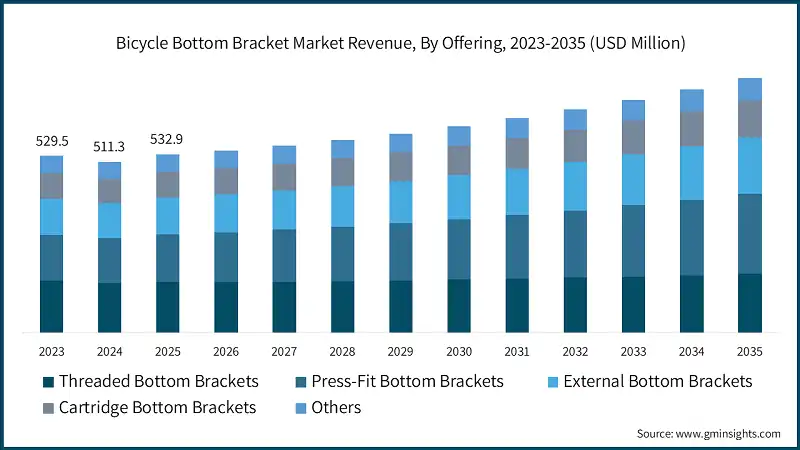
Based on offering, bicycle bottom bracket market is segmented into threaded bottom brackets, press-fit bottom brackets, external bottom brackets, cartridge bottom brackets, others. The threaded bottom brackets segment dominates the market with 28.5% share in 2025, and the segment is expected to reach USD 177.3 million in 2035.
- The standardization of threading for threaded bottom brackets provides strong fit between components, long-lasting durability and ease of installation without requiring special tools. The pop
ularity of threaded bottom brackets for commuter bicycles, touring bicycles, steel-frame bicycles, and restoration bicycles is based on their reliability and ease of use. While the popularity of threaded bottom brackets may be diminishing in new bicycle frames, the strong demand for premium and improvement components will allow these types of bottom brackets to continue to be important. - Press-fit systems utilize an oversized frame shell with bearings that are pressed directly into the frame shell. The advantages of press-fit systems are increased stiffness in the bottom bracket and easier manufacture of carbon frames. Increasingly improved manufacturing tolerances have resulted in strong adoption rates of press-fit bottom brackets in mid to premium bicycles, including e-bikes, primarily due to the introduction of threaded-type solutions to eliminate noise problems with the bottom bracket. As a result of the expanding service capability and increasing consumer acceptance of this product category, it is expected to continue to grow in the coming years.
- In external bottom brackets, the bearings are situated outside the frame shell, providing wider spacing between the bottom bracket and framed shell, which provides improved stiffness, durability, and better load distribution. External bottom brackets are commonly used in mountain, gravel, and adventure bicycles, where ease of repair and reliability are critical. The standardized bearing sizes and ease of service associated with external bottom bracket designs have led to strong aftermarket demand and continued durability.
Learn more about the key segments shaping this market
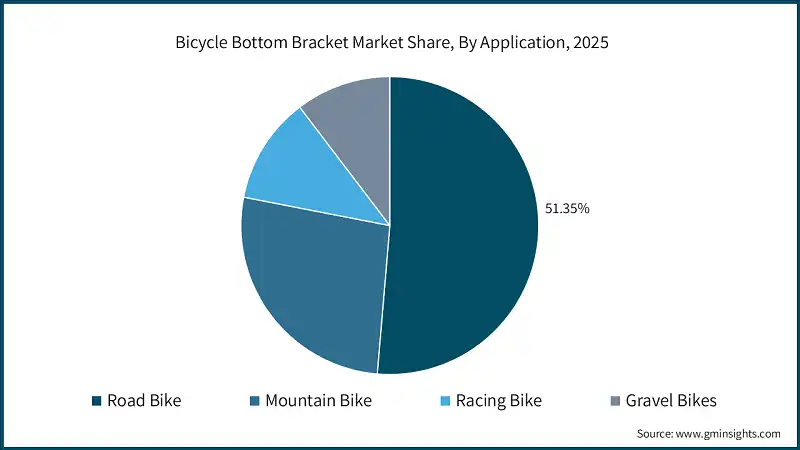
Based on application, the bicycle bottom bracket market is segmented into road bike, mountain bike, racing bike, gravel bikes. The road bike segment dominates with 51.35% market share in 2025 and is estimated to reach USD 350.4 million by 2035.
- The largest segment of the bottom bracket category is comprised of road bike use due to competitive racing, endurance cycling, and performance recreational use. These applications have the highest attention to lightweight, smooth rolling bearings, and aerodynamic integration. In mature countries, a constant amount of demand continues for existing customers, while demand for markets that are emerging continues to provide opportunities for new customers to purchase premium quality bottom brackets and to frequently purchase replacement parts.
- Mountain bike applications include durability of parts, sealed bearings and parts, and the ability to work reliably in wet conditions, mud, and rocky/high-impact riding. External bearing systems have become the most common because of ease of maintenance in the field and ease of servicing when required. The availability of bike parks, the increase in access to trails, and the increase in participation are all contributing to high demand for external bearing systems as well as more robust, high-performance bottom brackets to meet this growing need.
- Gravel bike applications are now considered the fastest growing and represent the blending of road bike efficiency with the versatility of an off-road bike. All gravel bike bottom brackets require excellent sealing, lightweight, and rugged durability over mixed terrain. Many gravel cyclists are high spenders, moving to gravel cycling from road or off-road disciplines, creating a high level of premium component consumption, which in turn leads to continued innovation from both road and mountain applications.
Based on material, the bicycle bottom bracket market is segmented into steel, aluminum, carbon fiber, titanium, composite materials. The aluminum segment dominates with 48.2% market share in 2025 and is anticipated to reach USD 293.7 million by 2035.
- Aluminum is the most common material used in bottom brackets because of its good balance of weight, strength, durability, resistance to corrosion, and price. It has a large distribution, as it currently serves many types of bikes, including entry-level bicycles all the way up to mid-range bicycles. While growth rate is slow for aluminum, it still provides polyfunctional performance capabilities (manufacturing ease and numerous compatibility options with many different frame designs), allowing it to remain at the top.
- Steel, on the other hand, is used for many entry-level, commuter bikes, and many developing bicycle markets. Steel is less expensive than aluminum bottom brackets, however the products are much heavier than aluminum and limit their performance capabilities. Although they are very durable throughout their life cycle and install and replace easily, for many bike enthusiasts, steel still meets their needs for older classic bikes and vehicles.
- Carbon-fiber, like aluminum and steel, provides an excellent strength-to-weight ratio, but it also has exceptional growth potential due to increased manufacturing efficiency and greater design flexibility. As carbon-fiber products become mainstream within competitive cycling and weight-sensitive cyclists, it will provide a very solid platform for all future growth opportunities. It is visible in professional cycling and therefore has an outstanding opportunity for future growth, while at the same time provide an exceptional premium for the consumer due to its strength and performance.
Based on distribution channel, the bicycle bottom bracket market is divided into OEM, aftermarket. OEM segment dominates with 73% market share in 2025 and is projected to grow at a CAGR of 3.3% from 2026 to 2035.
- The largest and most diverse user base for cycling products is recreational cyclists. Their range is diverse from casual riders to fitness-focused cycling enthusiasts. With a rising interest in personal health, outdoor activities and infrastructure development for cycling, recreational cyclists are now increasingly willing to upgrade to higher-quality components for increased performance. This user base will continue to support mid to upper tier priced bottom brackets that provide significant increases in reliability and efficiency.
- Cyclists who compete at the highest level (i.e., Professional) require maximum efficiency, low drag coefficients and lightweight materials. This has resulted in a growing market for ceramic bearings, premium materials and advanced designs. While this sub-segment is a very small/mature segment, this category represents a significant driver of innovation within the cycling industry, along with establishing technical authority and facilitating broader acceptance of new materials and technologies through racing validation and endorsements.
- For commuter cyclists, durability, and the ability to provide reliable, low maintenance and cost-effective performance are key attributes. As such, there is a strong preference among commuter cyclists for sealed bottom brackets that can endure the rigors of heavy, daily use, as well as the effects of varying weather conditions. Global urbanization, sustainable development, and an increase in E-Bikes for commuting purposes are all contributing to increases in demand for heavy-duty, torque-generating (i.e. providing power to the pedals) systems. Additionally, as consumer purchasing patterns move toward seasonal or periodic replacement of cycling products, infrastructure expansion is further supporting the ongoing growth of the commuter segment.
Looking for region specific data?
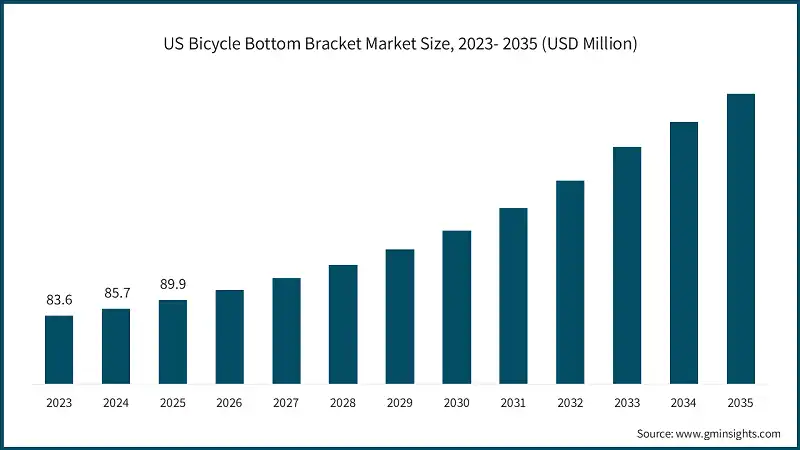
The US bicycle bottom bracket market is valued at USD 89.9 million in 2025 and is expected to experience significant and promising growth from 2026 to 2035.
- As gravel biking continues to grow in popularity in the United States, the demand for bottom brackets (BBs) that feature a combination of superior seals, ability to resist contamination, and long-term durability is increasing. These bottom brackets are viewed as a necessity by many gravel riders craving low-maintenance, high-stability, and adaptability to changing terrains. It would be reasonable to suggest that the increased interest in performance-based BB technology within the aftermarket is largely due to this trend.
- The growth of e-commerce in the United States is quickly changing the way riders purchase components. Many are now turning to e-commerce platforms to conduct online research about BBs and make online purchases. With access to detailed product reviews, installation processes, and compatibility information, the rise of premium BBs continues, along with an increase of direct-to-consumer BB brands focusing on advanced bearing systems.
- A growing group of amateur and fitness-focused cyclists interested in competitive riding is driving a continued interest in lightweight, low-friction BB systems. In addition, the high rate of participation in endurance events and structured training programs is prompting cyclists to regularly upgrade their components. As a result, the demand for carbon, ceramic, and precision machined BB systems will remain strong in the mid-to-premium price range.
North America region in the bicycle bottom bracket market held a market revenue USD 104.1 million in 2025 and is anticipated to grow at a CAGR of 3.7% between 2026 to 2035.
- North America is increasingly favoring the use of premium bottom brackets with ceramic bearings and light weight, high durability construction. Gravel, endurance and adventure cycling are increasing demand for components that provide the right combination of stiffness, low friction and resistance to harsh weather conditions. The strong aftermarket upgrade culture and the high consumer spending power will continue to fuel a consistent trend toward the use of top-tier performance products.
- The continued adoption of e-bikes, especially for uses such as commuting, fitness and recreation, is creating an increased need for bottom brackets engineered to handle higher torque loads. As a result, retailers are now stocking reinforced bottom brackets with improved sealing and bearing durability. This trend will promote mid to premium product turnover and motivate manufacturers to develop specialized systems for motor assisted bicycles within North America.
- The rising number of custom frame builders in North America will drive the use of high end, precision machined bottom brackets. Cyclists who purchase custom bikes place a high priority on material quality, machining accuracy and long service life. This trend will help support niche brands, advanced materials such as titanium, and high value products tailored to an individual’s performance and aesthetic requirements.
Europe bicycle bottom bracket market accounted for USD 128.6 million in 2025 and is anticipated to show growth of 2.9% over the forecast period.
- The widespread use of e-bikes in Europe drives manufacturers to create bottom brackets that can handle more torque, repeated riding, and extreme weather. As a result, manufacturers are designing bottom brackets with better seals, stronger bearings, and improved press-fit designs. These products are now being produced and used in the OEM market for all types of commuters, trekking, and cargo bikes as per European Union legislation about safety.
- European cycle consumers believe the most reliable brands have the highest level of machining accuracy, use only the best quality raw materials, and offer long-lasting gears. The deep-rooted culture of cycling in many European countries is pushing today's bicycle manufacturers to design bottom brackets that maximize performance by reducing friction losses as much as possible. This demand has strengthened the demand for high-end components in the premium and mid-premium markets, as well as supporting local companies that produce high-end bicycle components.
- The focus on sustainable manufacturing practices has changed the way that consumers in Europe make decisions about what products they want. Many consumers are now seeking serviceable and repairable bottom brackets that have a long lifespan. To meet this need, cyclists are focusing on products with robust housing, replaceable bearings, and reduced waste profiles. A result of this focus is an increase in the demand for high-quality external and thread-together bottom brackets that meet the needs of cyclists for both long-term performance and ease of maintenance.
Germany dominates the Europe bicycle bottom bracket market, showcasing strong growth potential, with a CAGR of 3.6% from 2026 to 2035.
- Bottom brackets that include exceptional tolerances, long service life, and advanced engineering are the standard in Germany because of their cycling culture, which is largely engineering-focused; therefore, the manufacturers producing these components consistently introduce high-quality materials and advanced bearing systems to meet these standards and develop a market for precision machined, long-life BB systems.
- With the increase in the number of electric bikes being manufactured in Germany, there is greater demand for bottom brackets that are built to withstand torque, have superior sealing capability and bearing durability. As electric bikes have increased significantly in the commuter and trekking markets, original equipment manufacturers (OEMs) are pushing them to develop improved, strengthened, higher specification BB systems for their suppliers that will endure extended heavy-load cycling.
- A greater number of German cyclists have greater expectations for long-term peace of mind and ease of use and maintenance; therefore, an increasing number of BB systems are being produced with replaceable bearings and designed to thread together. Both consumers and bicycle mechanics prefer designs that minimize creaking, provide better alignments and have longer service intervals. These factors increase the market desire for premium and mid-premium BB solutions.
Asia Pacific region leads the bicycle bottom bracket market, exhibiting remarkable growth of 4.5% during the forecast period of 2026 to 2035.
- The growth of the middle classes in Asia and the presence of a significant amount of volume OEMs, creating an increased volume requirement globally across all types of products, is an underlying driver for growing OEM requirements for bottom brackets throughout All Price Segments. High volume production in Asia has supported the ongoing prevalence of Aluminum and Steel componentry, and the strong growth rate associated with premium Bottom Bracket adoption across Japan, Australia and South Korea.
- Urbanization and government initiatives affecting transportation are driving explosive growth in the E-Bike market throughout China, Southeast Asia and developed APAC countries. As the e-Bike segment continues to grow, the Market is continually pushing for Reinforced, Torque-rated Bottom Brackets with superior salability. Manufacturers are prioritizing Bottom Bracket systems with optimized benefits for electric motor load capacity and extended miles.
- The trend to higher performance components by APAC consumers has resulted in the growing number of Road and Gravel Bikes, as well as Fitness Bikes. Additionally, the attractiveness of premium components has led to increased consumer interest in quality upgrades, which are driving demand for Ceramic, Carbon, and Precision Turned Bottom Brackets. The consumer awareness of brands in this category has been driven by influencer marketing efforts, competitive events and the rapidly growing Club Cycling Culture.
China to experience substantial growth in the Asia Pacific bicycle bottom bracket market in 2025. The market in China is expected to reach USD 185.1 million by 2035.
- The mass production of bicycles in China has encouraged large quantities of affinity for inexpensive aluminum and steel types of bottom brackets (BB). Manufacturers in China (OEMs) focus on the efficiency of production around a system that can be used in the construction of many different types of bicycle frames, leading them to strongly desire the use of a standardized BB type in their products in order to enable volume production etc.
- The dramatic increase in the popularity of electric bicycle usage is driving the need for strong, durable BBs that are designed for high-torque, everyday usage. Corporations are looking to introduce BBs specifically for electric bicycles, delivery companies (Fleets) and urban users by developing additional offerings of upgraded BBs with improved levels of strength and sealing.
- China's growing population of middle-class individuals is creating an increasing demand for higher-end bicycles, as well as alternate components and UF performance enhancements. The types of bikes that will most influence the growth of the category include the gravel, road and triathlon-biased segments, all of which are demanding lightweight and low-friction BBs. Online market (E-commerce) has also accelerated the acceptance of BB upgrade market segments via education and culture around customization of upgraded products.
Latin America is valued at USD 19.5 million in 2025 and is expected to experience substantial growth during the forecast period from 2026 to 2035.
- Latin American cities' growing bicycle commuting markets are a result of increased attention paid to the cycling commuter as well as increased pressure put on the cycling infrastructure. This has led to an increase in demand for high quality low maintenance bottom brackets designed to withstand heavy daily abuse as well as various weather conditions, while maintaining a low price point.
- Countries like Brazil, Chile and Colombia are quickly expanding the number of enthusiastic cyclists and competitive cyclists and this has resulted in increasing demand for high end component parts amongst those cyclists. The way that cyclists invest in improving the quality and performance of their bicycles through the use of high quality, durable bottom brackets has facilitated the development of the aftermarket and the use of new advanced bearing technology.
- The demand for low-cost bottom brackets (BBs) made from steel & aluminum continues to be driven by economic constraints. While there is an increase in the number of performance related categories, the mainline bike production and replacement category is still dominated by lower cost materials. As a result, bike manufacturers must develop a competitive pricing strategy balanced with adding value through the inclusion of durability improving features.
MEA is valued at USD 29.2 million in 2025 and is expected to experience substantial growth during the forecast period from 2026 to 2035.
- Cycling is becoming progressively popular among people living in urban areas of the Middle East as a way to relax and improve health; thus, this has spurred the growing need for stronger, durable bottom brackets with efficient seals for use in a hot and dusty environment. The main emphasis of consumers in the Gulf region is on performance and longevity, so premium products are being more widely used.
- Government-supported mobility initiatives, along with more cycling-friendly infrastructure, are promoting greater acceptance of e-bikes. Consequently, this is changing consumer demand for bottom brackets that have been engineered to handle greater torque loads, as well as provide long-lasting reliability over long distances. Therefore, both fleet operators and daily commuters are increasingly searching for reinforced, low-maintenance components.
- On the African continent and in other lower-income areas, affordability drives widespread use of steel and basic aluminum bottom brackets. While utility cycling is driving continued use and replacement of these components, harsh climates will continue to cause components to be replaced. Therefore, companies manufacturing low-cost yet durable components have established strong competitive positions within these highly price-sensitive markets.
Bicycle Bottom Bracket Market Share
- The top 7 companies in the bicycle bottom bracket industry are Shimano, SRAM, Wheels Manufacturing, Chris King Precision Components, Campagnolo, Full Speed Ahead, and Cane Creek Cycling Components contributed around 15.9% of the market in 2025.
- Shimano OEM bicycle company's strategy is to bundle their drivetrains, bottom brackets and braking systems together into kits (bundles of kits) to create an integrated system that helps bicycle manufacturers reduce complexity in their specifications. By using this system approach, Shimano has increased the cost of switching from one manufacturer to another, established long-term supply agreements, and created many customers who use Shimano bottom brackets on entry-level, mid-range and high-end bicycles throughout the world.
- SRAM continues to develop their DUB bottom bracket/crank interface standards in mountain bike, gravel bike, and road cycling segments. This product relationship further increases the dependency of the marketplace on SRAM for addition of products that enhance the aftermarket, as well as foster brand loyalty in the long-term by reducing the barriers of compatibility developing while still protecting their proprietary technologies and developments from competitors of open standards.
- Wheels Manufacturing is taking a proactive approach in establishing their influence with the introduction of a bottom bracket system that features an engineered solution to the problem of creaking and alignment of bottom brackets that are pressed in to frames. Their engineering-based solution appeals to mechanics and cycling enthusiasts who demand long-lasting products along with improved serviceability.
- Campagnolo leverages its long history and name recognition in the high-end cycling market to continue to foster brand loyalty amongst professional and dedicated high-end road cyclists. The bottom brackets associate closely with other drivetrain products, due to their ability to create an integrated system, by utilizing the benefits and value of premium European engineered products. Continuous refinements to Campagnolo's products with precision and performance through the development of Ultra-Torque and Super Record technologies bolster Campagnolo's reputation as the leader within the precision-engineered cycling industry. The central value-added improvements to product updates are the use of ceramic bearings and lightweight materials.
Bicycle Bottom Bracket Market Companies
Major players operating in the bicycle bottom bracket industry are:
- Campagnolo
- Cane Creek Cycling Components
- Chris King Precision Components
- Enduro Bearings
- Full Speed Ahead
- Shimano
- SRAM
- Token Products
- Wheels Manufacturing
- Shimano dominates the global market due to its vertically-integrated manufacturing capabilities, as well as its extensive portfolio of patents. Shimano offers a full range of bottom brackets, from entry-level cartridge models to those using its new Hollowtech II external-bearing system, with options made from carbon fiber, titanium, and ceramic materials. A strong OEM presence in the marketplace and a comprehensive distribution network enable Shimano to provide reliable products that are highly compatible with many different types of bicycles, and therefore leading the way in the recreational, commuter and professional cycling segments.
- SRAM's market leadership in terms of performance on mountain bikes and road bikes is based on the company's proprietary DUB system, along with a number of recent acquisitions (including Truvativ and RockShox) and innovative product developments. A strong ecosystem of lock-in products, sponsorship of professional teams, and an emphasis on high-performance product design allows SRAM to reinforce its premium product position and serve the needs of high-performance athletes and aftermarket consumers. SRAM's focus on providing lightweight, durable and precise bottom brackets appeals to performance-oriented riders, as well as aftermarket buyers looking for cutting-edge technology and high/a> stiffness-to-weight ratios.
- Wheels Manufacturing specializes in aftermarket and compatibility solutions, serving virtually every bottom bracket standard. The company has a unique ability to provide thread-together and adapter systems that are well-suited to accommodate the fragmented nature of the bottom bracket industry. All machining processes are done in the U.S. to provide precision parts and to support rapid innovation and responsive customer service. Consequently, Wheels Manufacturing has developed a strong reputation among bicycle mechanics, boutique builders and cycling enthusiasts who are searching for high-quality replacement or upgrade bottom brackets that are long-lasting and adaptable in use.
Bicycle Bottom Bracket Market Report Attributes
| Key Takeaway | Details |
|---|---|
| Market Size & Growth | |
| Base Year | 2025 |
| Market Size in 2025 | USD 532.9 Million |
| Market Size in 2026 | USD 545.2 Million |
| Forecast Period 2026-2035 CAGR | 3.8% |
| Market Size in 2035 | USD 760.7 Million |
| Key Market Trends | |
| Drivers | Impact |
| Growth in Global Bicycle Sales | Expanding global bicycle ownership increases OEM production volumes and aftermarket replacements, boosting demand for durable and efficient bottom brackets. This drives higher component standardization, encourages new product launches, strengthens supplier bargaining power, and elevates long-term revenue visibility for manufacturers across all categories. |
| Expansion of E-Bike Market | E-bikes’ high-torque loads push manufacturers to develop stronger, precision-engineered bottom brackets, increasing unit value and technological differentiation. This stimulates R&D investments, shifts OEM specifications toward reinforced systems, and expands premium pricing opportunities, elevating margins for suppliers positioned in high-performance drivetrain components. |
| Advancements in Material Technology | Innovations in composites, ceramics, and lightweight alloys raise bottom-bracket performance standards and push market adoption of premium products. This enhances brand differentiation, supports higher price points, and encourages OEMs to integrate advanced materials, ultimately expanding value capture for component suppliers. |
| Rising Popularity of Performance Cycling | Performance cyclists’ pursuit of efficiency and durability drives demand for low-friction, high-precision bottom brackets. This pushes manufacturers toward premium engineering, expands aftermarket upgrades, and increases product turnover cycles, shifting overall market value toward high-end and specialized component categories. |
| Aftermarket Customization Growth | Greater consumer interest in bike personalization accelerates replacement purchases, boosting sales of ceramic, oversized, and specialty bottom brackets. This strengthens aftermarket revenue streams, supports niche manufacturers, and reduces dependency on OEM cycles, diversifying overall market stability and long-term growth potential. |
| Pitfalls & Challenges | Impact |
| Compatibility Issues Across BB Standards | Multiple shell and spindle standards create complexity for consumers and manufacturers, raising engineering, inventory, and warranty costs. This limits scalability, slows adoption of new technologies, increases return rates, and suppresses market efficiency by reducing uniformity across bike models and regions. |
| High Cost of Advanced Materials | Premium materials significantly elevate production expenses, restricting affordability for mass-market bikes and slowing widespread adoption. This concentrates sales in higher-income regions, reduces OEM uptake, limits economies of scale, and restrains revenue growth for brands dependent on advanced or ceramic-based bottom-bracket systems. |
| Opportunities: | Impact |
| E-Bike-Specific BB Designs | Developing torque-optimized bottom brackets for e-bikes opens premium product lines with higher margins. This enables strategic OEM partnerships, drives early-mover advantage, and positions suppliers to capitalize on the fastest-growing segment of the global bicycle industry. |
| Growth in Gravel/Adventure Cycling | Demand for durable, sealed, and vibration-resistant bottom brackets in gravel bikes promotes innovation in materials and interface design. This expands high-value product categories, strengthens aftermarket upgrades, and drives OEM diversification toward adventure-focused models. |
| Integrated and Smart Component Adoption | Sensor-ready or integrated drivetrain components open new value pools through data-enabled cycling performance insights. Manufacturers can upsold premium models, form technology partnerships, and differentiate offerings, expanding bottom-bracket relevance within the connected-bike ecosystem. |
| Lightweight Frame Integration | OEM movement toward lighter, more integrated frames increase demand for custom-fit or press-fit bottom brackets. This creates specialized supply opportunities, drives higher OEM contract values, and encourages manufacturers to invest in precision machining and advanced materials for structural compatibility. |
| Market Leaders (2025) | |
| Market Leaders |
6.9% Market Share in 2025 |
| Top Players |
|
| Competitive Edge |
|
| Regional Insights | |
| Largest Market | Asia Pacific |
| Fastest growing market | North America |
| Emerging countries | India, China, Singapore, Vietnam |
| Future outlook |
|
What are the growth opportunities in this market?
Bicycle Bottom Bracket Industry News
- In January 2025, Shimano released a new bottom bracket called the Hollowtech III which includes bearing shields. As a result of this innovation, the company has increased contamination resistance and has also been able to extend the longevity of the bearings by 40%. This unit incorporates advanced seal material along with unique labyrinthine designs which helps reduce friction, protects against water and dirt, improves longevity by addressing the main carrier failure mechanisms, and provides the high durability needed for both professional and recreational cycling applications.
- In December 2024, SRAM introduced its latest DUB series of bottom brackets. The new DUB bottom brackets feature a newly designed thread-together style. This design combines the reliability of traditional threaded bottom brackets with the advantages of having larger spaced bearings and comes with a variety of different installations that are consistent across all models. The new design addresses the concerns that consumers have voiced regarding the installation reliability of press-fit style bottom brackets while maintaining the performance benefits. The newly designed bottom brackets also reinforce SRAM's presence in the mountain bike, gravel bike, and road bike performance cycling segments.
- In November 2024, Wheels Manufacturing continues to enhance its line of adapter products in order to allow modern external bearing bottom brackets to be fitted into vintage frames with unique thread types. By offering these options, Wheels Manufacturing is able to continue to support the growing restoration market, enabling owners of vintage bicycles to take advantage of the newest technology available for bearing systems without compromising their original specifications, and also balancing the desire for historical accuracy with the need for modern performance and reliability.
- Enduro Bearings introduced the MAX line of bottom brackets in September 2024 for use on electric bicycles, which will replace the older technology for motorized bicycles and provide a more reliable product for the expanding Electric Bicycle market. The new MAX Bottom Brackets will feature stronger races, more balls, and improved seals, giving them the ability to withstand greater amounts of torque than the older technology.
The bicycle bottom bracket market research report includes in-depth coverage of the industry with estimates & forecasts in terms of revenue (USD Mn) and Volume (Units) from 2022 to 2035, for the following segments:
Market, By Offering
- Threaded bottom bracket
- Press-fit bottom bracket
- External bottom bracket
- Cartridge bottom bracket
- Others
Market, By Application
- Road bike
- Mountain bike
- Racing bike
- Gravel bikes
Market, By Material
- Steel
- Aluminum
- Carbon Fiber
- Titanium
- Composite Materials
Market, By Distribution Channel
- OEM
- Aftermarket
Market, By End Use
- Professional / Performance Cyclists
- Recreational Cyclists
- Commuter Users
- Bike Manufacturers
The above information is provided for the following regions and countries:
- North America
- US
- Canada
- Europe
- Germany
- UK
- France
- Italy
- Spain
- Russia
- Nordics
- Portugal
- Croatia
- Asia Pacific
- China
- India
- Japan
- Australia
- South Korea
- Singapore
- Thailand
- Indonesia
- Vietnam
- Latin America
- Brazil
- Mexico
- Argentina
- MEA
- South Africa
- Saudi Arabia
- UAE
- Turkey
Frequently Asked Question(FAQ) :
What was the market size of the bicycle bottom bracket in 2025?
The market size was estimated at USD 532.9 million in 2025, with a CAGR of 3.8% expected through 2035. The growth is driven by increasing cycling activities for recreation, commuting, and fitness.
What is the projected value of the bicycle bottom bracket market by 2035?
The market is poised to reach USD 760.7 million by 2035, fueled by advancements in materials, growing aftermarket demand, and increased adoption of performance-oriented bottom bracket systems.
What is the expected size of the bicycle bottom bracket industry in 2026?
The market size is projected to reach USD 545.2 million in 2026.
What was the market share of the threaded bottom brackets segment in 2025?
The threaded bottom brackets segment held a 28.5% market share in 2025, generating approximately USD 151.8 million, and is expected to reach USD 177.3 million by 2035.
What was the valuation of the road bike segment in 2025?
The road bike segment dominated with a 51.35% market share in 2025, valued at approximately USD 273.5 million, and is projected to surpass USD 350.4 million by 2035.
What was the market share of the aluminum segment in 2025?
The aluminum segment led the market with a 48.2% share in 2025, valued at approximately USD 256.8 million, and is anticipated to cross USD 293.7 million by 2035.
What was the valuation of the US bicycle bottom bracket sector?
The US market was valued at USD 89.9 million in 2025. The growing popularity of gravel biking in the region has driven demand for bottom brackets with superior seals, contamination resistance, and long-term durability.
What are the upcoming trends in the bicycle bottom bracket market?
Key trends include wider adoption of press-fit and integrated bottom brackets, advanced materials such as carbon fiber and ceramic bearings, rising aftermarket upgrades, and the push for silent, durable, low-maintenance designs.
Who are the key players in the bicycle bottom bracket industry?
Key players include Campagnolo, Cane Creek Cycling Components, Chris King Precision Components, Enduro Bearings, Full Speed Ahead, Shimano, SRAM, Token Products, and Wheels Manufacturing.
Bicycle Bottom Bracket Market Scope
Related Reports